
AI is moving fast. Laws, buyer rules, and platform policies are trying to catch up. If you wait until your first big customer asks, “Can you prove this is safe and legal?” you will already be behind.
Good compliance is not a pile of paperwork. It is a set of simple guardrails that keep your team from shipping risky features by accident. If you set those guardrails early, you move faster later—because you do not have to stop everything to “fix” the product right before a deal closes.
And if you are building real tech in AI or robotics, compliance and IP should grow together. The same choices that reduce risk can also make your inventions more defensible.
If you are a technical founder and you want help building an IP-backed foundation while you build, you can apply anytime at https://www.tran.vc/apply-now-form/
AI compliance is not a “later” problem
Most early teams treat compliance like taxes: annoying, confusing, and best avoided until the last possible moment. That is normal. You are trying to ship. You are trying to hire. You are trying to stay alive.
But AI changes the math. AI products can fail in quiet ways, and then suddenly fail in loud ways. A normal bug might break a button. An AI bug might leak private data, invent a harmful answer, or make a decision that looks unfair. Those problems do not only hurt users. They can also break trust with customers, block your sales pipeline, and trigger legal trouble.
Here is the part founders miss: compliance is not mainly about regulators. Early on, compliance is about your customers. The first serious buyer—especially in healthcare, finance, insurance, education, HR, defense, and enterprise IT—will ask for proof that your system has basic controls. They might call it “AI governance.” They might call it “security.” They might call it “risk review.” But the message is the same:
“Show me your guardrails, or we cannot buy.”
If you have nothing, the deal slows down. The buyer will drag you into a long review. They will ask for documents you do not have. They will want controls you did not build. Your team will scramble. Roadmap stops. Everyone is stressed. Founders start making desperate promises, and then they pay for those promises later.
If you build the guardrails early, you avoid that trap. You also reduce the chance of a scary incident that forces you into damage control.
Now, “guardrails” can sound big. It does not have to be. In the early days, you are not building a full compliance program like a public company. You are building a clean system that is easy to explain.
A simple way to think about AI compliance is this:
- What can go wrong?
- What will we do to prevent it?
- How will we prove we did it?
That is it. That is the whole game.
And if you do it early, you gain three advantages that most startups never get.
First, you build trust faster. When a customer asks hard questions, you can answer in plain words. That alone puts you ahead of competitors.
Second, you build a better product. Guardrails push you to make clear choices about data, model behavior, and how people can use the system. Products with clear boundaries are easier to use and easier to sell.
Third, you create real assets. The way you design your controls, your training pipeline, your monitoring, your safety layer—these can become patentable inventions. That is a big deal for deep tech teams. It turns “boring compliance work” into a moat.
This is one reason Tran.vc exists. Tran.vc invests up to $50,000 worth of in-kind patent and IP services so founders can protect what they are building while they are still early. If you want to build guardrails and an IP strategy at the same time, you can apply anytime at https://www.tran.vc/apply-now-form/
The three questions every buyer will ask you
Even if your buyer does not use these exact words, their risk team will be thinking about these three areas:
1) Data: “Where did this data come from, and who owns it?”
If you collect user data, you must know what you collect, why you collect it, where you store it, and who can see it. If you use third-party data, you must know the license terms. If you train on customer data, you must be able to explain how you keep one customer’s data from showing up in another customer’s results.
A common early mistake is using “whatever data is easy” to get a model working, and then building product and sales on top of it. Later, when a customer asks about rights, consent, and retention, you realize you cannot answer.
Early guardrail: write down the data sources you use and the rules for each. Keep it simple. If it is not allowed, do not use it. If it is allowed only for testing, keep it out of production. If the license is unclear, avoid it.
This also helps your IP story. Clear data rights and clean training inputs make it easier to defend your work later.
2) Behavior: “What does the model do, and what does it refuse to do?”

AI compliance is not only about privacy. It is also about behavior. In plain terms: can your system do something harmful, and can you stop it?
If you ship a tool that can generate content, advise people, rank people, or make choices for people, you need rules. Not vague rules. Real ones.
Early guardrail: define your “red lines.” These are the outputs you will not allow, even if a user asks. Then implement controls that match the risk. For some products, simple prompt rules and output filters may be enough. For others, you need human review, strong logging, and step-by-step approval.
Also, you need to think about who is responsible for what. If your model is “suggesting” actions, but the user is “deciding,” you need to make that clear in the design. Your UI, your docs, and your contracts should not conflict with each other. Many startups lose trust because their marketing says one thing and their product does another.
3) Proof: “Can you show evidence that you tested and monitored it?”
This is where many teams fail, because they rely on vibes. They “feel” the model is good. They tested it a bit. They do not have structured records. When a buyer asks for proof, the team cannot show much.
Early guardrail: keep a simple testing and monitoring trail. You do not need fancy tools on day one. You need a repeatable habit. Every time you change the model, you log what changed, why it changed, and what tests you ran. Every time there is a serious bad output, you log it and track what you did to prevent it from happening again.
This is not bureaucracy. It is product hygiene.
What “guardrails early” looks like in real life
Let’s make this very practical.
Imagine you are building an AI agent that reads support tickets and drafts replies. This sounds safe, but there are hidden traps.
It could leak private data into a reply.
It could invent a refund policy that is not real.
It could produce a rude message that harms the brand.
It could tell a customer to do something unsafe.
If you do not plan for these, you will eventually see them.
Guardrails early means you do a few simple things before you scale usage:
You decide what data the agent can see. Maybe it can read the ticket and a small set of knowledge base pages, but not the full customer database. That limit alone cuts risk.
You decide what the agent is allowed to say. Maybe it can answer common questions, but it cannot make promises about refunds, legal issues, or medical advice.
You add an approval step. In early stages, the agent drafts and a human sends. Later, you can relax this for low-risk cases.
You log what happens. If the agent suggests something wrong, you capture it, fix the prompt or the retrieval, and track that fix.
Notice what is missing: long policy docs. The guardrails are mostly product choices. That is why doing it early is powerful. You can bake safety into the system while the system is still flexible.
Now, compliance gets harder when your AI is used to score people, decide access, or control physical systems. Robotics adds safety risk. If your system can move a machine, you must think about physical harm, not only bad text.
But the pattern is the same. You limit inputs. You limit actions. You add checks. You keep records.
That is the core.
And again, these choices can become IP. A unique safety layer for a robotics control model, a novel monitoring method, a specialized data isolation pipeline—those can be patentable. Tran.vc helps technical teams find those “hidden inventions” while they are building, and then protect them. If you want to explore that, apply anytime at https://www.tran.vc/apply-now-form/
The biggest mistake: copying big-company compliance too early
Founders sometimes swing to the other extreme. They read a big compliance framework online and try to copy it. They create a heavy process that slows shipping and makes the team hate compliance.
That is not the goal.
Early-stage compliance should be small, sharp, and tied to your product risks. You should be able to explain it in normal words. If your process needs a full-time person before you have product-market fit, it is probably too heavy.
Here is a better approach: build a “minimum viable compliance system.” Not a minimum viable document set. A system.
A system is a few decisions that are consistent:
- you know what data you use,
- you know what the model can do,
- you can show how you test and monitor,
- you can respond fast when something goes wrong.
That is enough to pass many early buyer checks and keep you out of trouble.
As you grow, you can expand it. But you will be expanding something that already works, not starting from scratch under pressure.
Why this matters for fundraising, too
Investors are also getting more careful about AI risk. Some will ask about your data rights. Some will ask about model safety. Some will ask what would happen if regulators change the rules.
If you can answer with a calm, clear story, you look like a serious builder. You also reduce “unknown risk,” which is one of the biggest reasons investors hesitate.
And if you can point to IP strategy—real filings, a thoughtful moat—you stand out even more. In deep tech, the best teams do not only build features. They build defensible assets.
That is the bet Tran.vc makes: help you turn your core tech into protected value early, without forcing you to chase VC money too soon. If that fits your path, you can apply anytime at https://www.tran.vc/apply-now-form/
AI Compliance: Setting Up Guardrails Early
Start with one simple “risk map”
Before you add more features, pause and draw a clear picture of where risk can enter your product. This is not a big document. It is a short view of how data moves, how the model makes outputs, and how users act on those outputs. When you can see the full path, it becomes easier to place guardrails in the right spots.
Most teams try to fix problems after they show up in production. That approach is expensive, because every fix touches sales, support, and trust. A risk map helps you prevent the common failures before customers find them first.
Define your “what could go wrong” moments
Every AI product has a few key moments where things can break in a high-impact way. These moments usually happen when data is collected, when the model is prompted, when a tool is called, and when an output is shown to a human. In robotics, they also happen when an action becomes a movement in the real world.
When you name these moments, you are not being negative. You are being realistic. This is how strong teams protect speed, because fewer surprises means fewer emergency stops later.
Decide the level of control based on harm
Not all features need the same level of control. A grammar helper does not carry the same risk as a model that ranks job candidates. A robot that moves heavy items near people must be treated differently than a robot that sorts boxes in a closed space.
You want to match the strength of your guardrails to the size of the harm. If you over-control low-risk features, your product feels slow. If you under-control high-risk features, you may lose customers and create legal exposure.
If you want help turning these guardrails into a clear plan that also supports patents and IP, you can apply anytime at https://www.tran.vc/apply-now-form/
Put guardrails around data first
Make a clean list of data sources
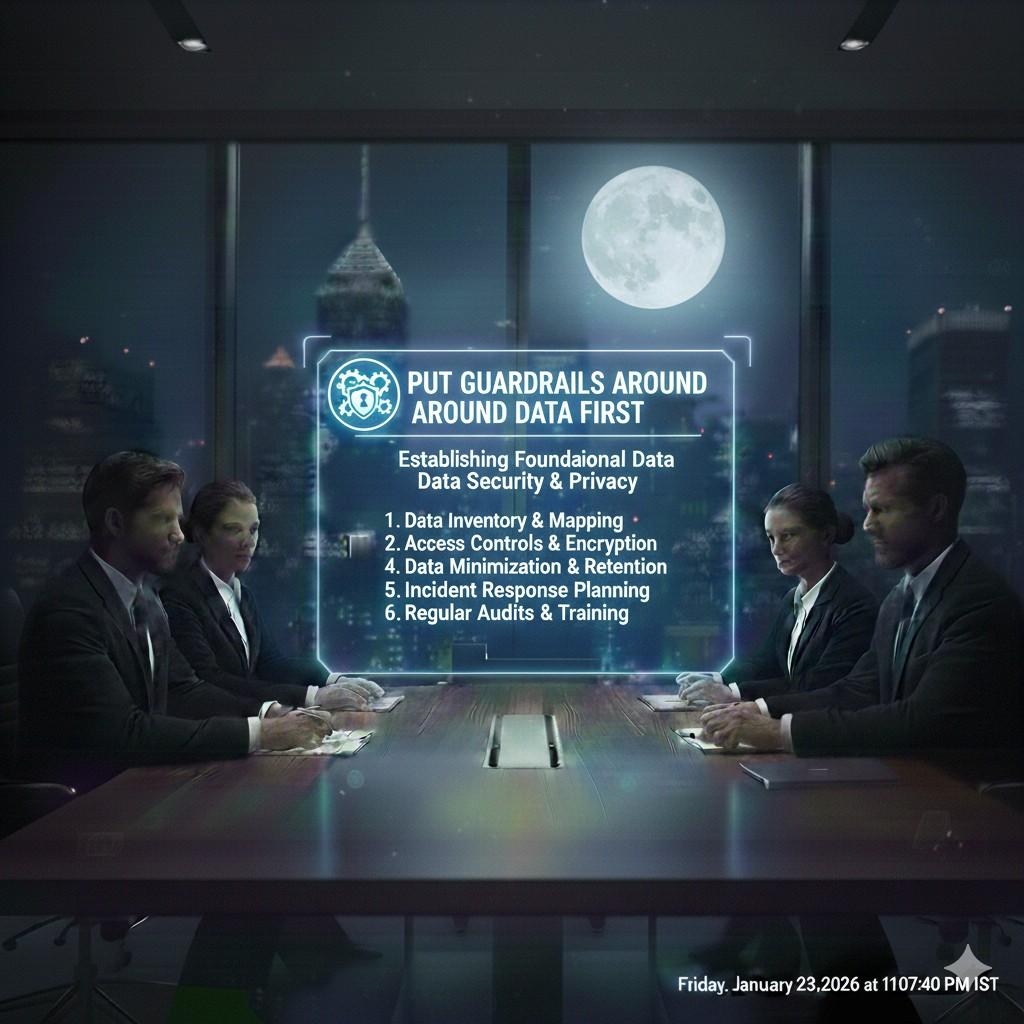
Many compliance problems start with a simple question: “Where did this data come from?” If the team cannot answer fast, trust drops. Early on, you should keep a short list of every data source you use, even if it is just a page in your internal wiki.
Include what the data is, why you use it, and whether you have clear rights to use it. If a source is uncertain, do not build your product on it. You can still test ideas, but do not let unclear data become the foundation of your company.
Control what the model can see
A lot of AI failures happen because the model sees too much. When a system can access wide internal data, it becomes easy for private details to leak into an output. Even if the model “usually behaves,” you cannot treat “usually” as a guarantee.
A strong early move is to limit context on purpose. Only pass the smallest set of facts the model needs to do the task. If the model does not need full customer records, do not provide them. If it only needs a summary, give it a summary.
Decide how you handle customer data
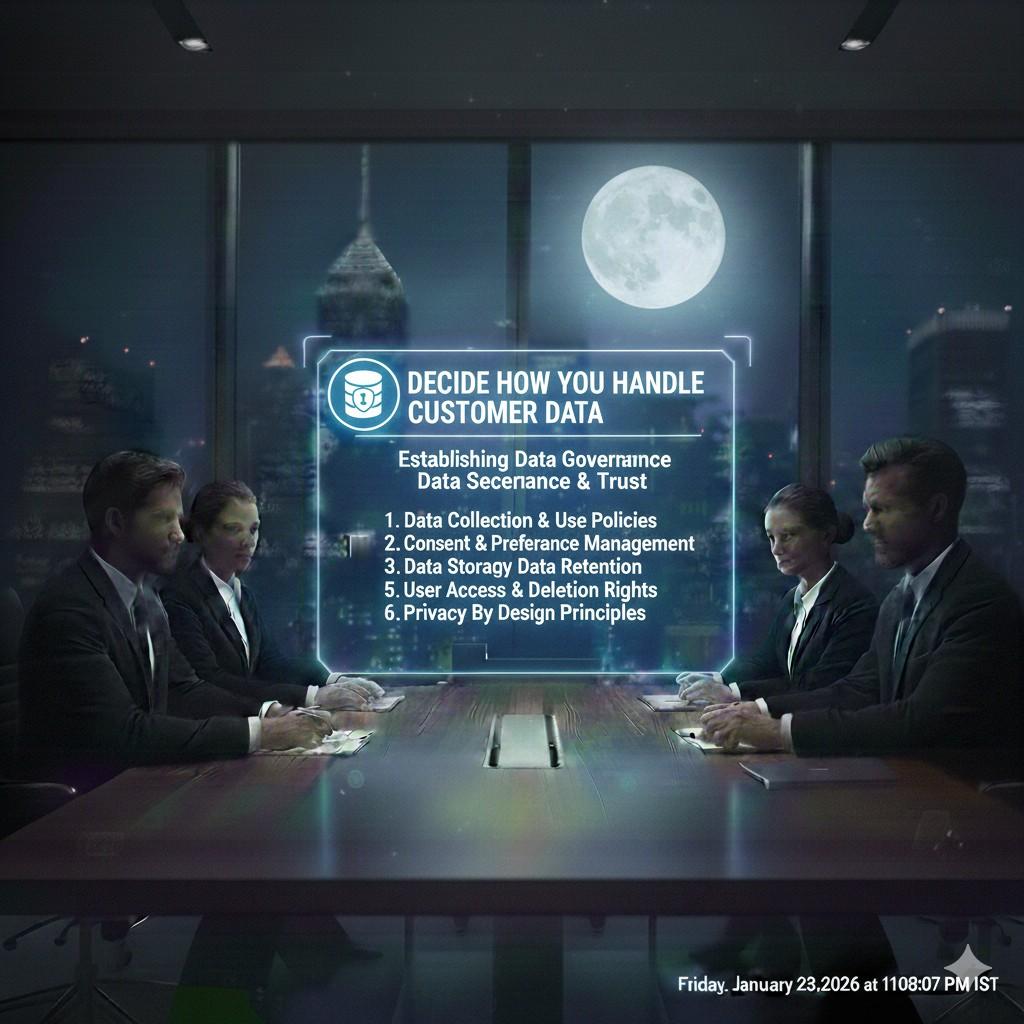
If you sell B2B, customers will ask what you do with their data. They want to know if their data is used to train models, how long you keep it, and whether other customers can ever see it. If you cannot explain this in plain words, the buyer will assume the worst.
Even as a small team, you can set a simple rule such as: “Customer data is not used for training unless the customer opts in.” Or: “We only train on anonymized and approved data.” Pick the rule that fits your product, then make sure your system follows it in practice.
Plan for deletion and retention early
Data retention feels boring until a customer asks for deletion, or a regulator asks how long you keep records. If your system cannot delete data cleanly, you may end up holding risk you do not want. The easiest time to design deletion is before you have a huge pile of data.
Think in terms of data “lifetimes.” Some data should be kept for a short time, like raw user prompts. Some records should be kept longer, like audit logs that show how the system behaved. When you choose lifetimes on purpose, you avoid random storage habits that become hard to unwind.
Tran.vc helps deep tech teams build these foundations in a way that also creates defensible assets. If you want that kind of hands-on support, apply anytime at https://www.tran.vc/apply-now-form/
Set clear rules for model behavior
Write your “allowed” and “not allowed” zones
Most teams only think about what the model should do. Compliance forces you to also define what the model must not do. This is not about fear. It is about clarity, and clarity helps you ship faster because everyone knows the boundaries.
Your “not allowed” zone might include legal advice, medical advice, hate or harassment, or actions that move money without approval. In robotics, it might include movement in unsafe zones, high force actions near people, or actions that could break equipment.
Build refusal and escalation into the product
A refusal is not a failure if it is designed well. A refusal is a safety feature. When the model hits a red line, it should refuse in a calm way and guide the user to a safe next step. Sometimes the next step is to ask a human. Sometimes it is to narrow the request.
Escalation is also a sales feature. Buyers like products that know their limits. If your system can say, “I can draft this, but a human must approve,” that often makes enterprise teams more comfortable adopting it.
Reduce hallucinations with structure, not hope
Hallucinations are not only a model problem. They are often a product design problem. If you ask an AI to answer anything with no limits, it will guess. If you give it a narrow task, clear sources, and a format it must follow, it is less likely to invent facts.
Strong teams use structure. They use retrieval with approved sources, clear citations inside the answer when needed, and templates that force the model to stay inside bounds. This is not about making the system stiff. It is about making it reliable.
Match safety to the way users actually behave
A common compliance miss is designing guardrails for “ideal users.” Real users are rushed. They copy and paste. They try weird prompts. They push the system to see what it can do. Your guardrails must expect that.
If you have a feature that can be misused, assume it will be. Then design the system so misuse is harder and safe use is easier. When safe use feels smooth, you reduce risk without adding friction.
If you want to turn your safety layer into part of your moat, Tran.vc can help you spot what is patent-worthy and protect it early. Apply anytime at https://www.tran.vc/apply-now-form/
Build proof as you build the product
Log the right things from day one
The biggest sales delays happen when a customer asks for evidence and the startup has none. The solution is not a big compliance team. The solution is simple habits and basic records. When you ship changes, you keep track of what changed and why.
You should log model versions, prompt versions, key configuration changes, and major data pipeline updates. You should also log important user actions, especially when the system takes steps that matter, such as sending a message, approving a workflow, or triggering a robot action.
Make testing repeatable, not heroic
Many early teams test in an unstructured way. Someone tries a few prompts, things look fine, and the change ships. That feels fast, but it creates hidden risk. When something goes wrong later, you cannot explain what happened or when it started.
A better approach is repeatable testing that fits your stage. Keep a small set of test cases that cover your product’s real use. Add new cases when you see failures. Over time, your test set becomes a living shield that grows with the product.
Track incidents like a product team, not a legal team
Incidents will happen. The goal is not to pretend you have zero incidents. The goal is to respond well and learn fast. When a bad output appears, capture it, identify the root cause, and record the fix you made.
This creates a strong story for buyers. You can show that you take problems seriously, that you have a process, and that the product improves. Most risk teams do not expect perfection. They expect discipline.
Monitor for drift and silent failures
AI systems can change behavior over time, even if you do not update the model. Data shifts. User behavior shifts. New edge cases appear. In robotics, wear and tear and changing environments can also change outcomes. If you do not monitor, you may not notice the change until a customer complains.
Monitoring does not need to be fancy at first. Start by watching a few key signals: error rates, refusal rates, and the number of escalations to humans. Add quality review samples on a schedule. These small steps catch drift early.
Tran.vc works with founders to build this kind of clean foundation while also turning core systems into protectable IP. You can apply anytime at https://www.tran.vc/apply-now-form/
Make guardrails support sales, not slow it down
Translate compliance into buyer language
Founders often explain safety in engineering terms. Buyers hear risk in business terms. When you talk to customers, connect guardrails to outcomes they care about: fewer errors, safer use, clearer accountability, and easier audits.
If you can explain your controls in simple words, you reduce the fear buyers feel when they hear “AI.” You also shorten review cycles, because reviewers can quickly understand what you built and why it works.
Prepare a lightweight “trust packet”
A trust packet is a small set of items you can share during sales when buyers ask for proof. It does not need to be long. It needs to be clear. Think of it as a short folder that explains your data handling, security basics, testing approach, and incident response.
When you have this ready, you avoid the scramble that kills momentum. You can answer questions the same day. That speed alone can separate you from competitors who are still figuring out what they should say.
Show that humans stay in control when needed
Many buyers do not want fully automated decisions. They want a system that helps humans make better calls. If your product includes human review, approval steps, or clear override controls, say so early. Do not hide it, and do not treat it as a weakness.
In many markets, “human in the loop” is a comfort signal. It tells the buyer that you designed for reality, not for a demo.
Use compliance choices to shape your moat
When you build guardrails in a thoughtful way, you often create unique methods: safer data pipelines, specialized monitoring, better evaluation tools, and reliable workflows. These can become part of your defensible edge if you protect them.
Tran.vc exists to help you do that early, before you raise a big round or give up control. If you want to explore how your guardrails can become IP assets, apply anytime at https://www.tran.vc/apply-now-form/