
Raising before you’re ready wastes time. Raising when you’re ready feels calm. The difference is proof—simple signals that show your product works, your loop is safe, and your team learns fast. You don’t need huge revenue to get there. You need clear milestones that match the job your product does in the real world.
This guide walks you through those milestones in plain words. We’ll show how to define them, how to measure them, and how to present them so investors see control, not noise. You’ll get practical steps you can run this month with a small team and a tight budget.
If you want help turning the engine behind your milestones into protected IP, Tran.vc invests up to $50,000 in in-kind patent and IP services for AI, robotics, and deep tech teams. We work with you to build a moat before the seed. Apply anytime at https://www.tran.vc/apply-now-form/.
Milestone 1: A Sharp Problem and a Narrow ICP

Everything starts with one clear job. Write it in a short line a buyer would say on a busy day. Keep it plain. Name the role that feels the pain first and the place where it shows up each week. When the job is that specific, your team can build, demo, and sell without drift. Investors also relax because narrow is easier to win.
Collect a few field notes that prove the job is real. Use dates, settings, and small numbers. A supervisor who loses forty-five minutes at each changeover. A lab lead who repeats a setup twice a week. When the same scene repeats across sites, you have a wedge. Your pitch, your product choices, and your metrics should all point at this one wedge until it hums.
If you solve that job with a unique method, capture the steps in simple order. List what you sense, how you check, what you decide, and what you do when input is messy. If those steps are new and useful, protect them. A focused filing turns a sharp problem into ground you own, not ground you rent.
Milestone 2: Fast Activation on Fresh Cohorts

Activation is the first real win a new user reaches. Define it in one sentence tied to the job, not your UI. A login is not a win. A tour is not a win. A first safe run at line speed is a win. A first clean report a manager trusts is a win. When the definition is strict, the data is honest and your fixes point in the right place.
Measure two things for each weekly cohort: the share who hit the win and the median time it took. Time matters because speed calms fear. A win in minutes lands differently than a win in days. Track the few steps on the path to the win so you can see where people stall. This gives you easy targets for small product changes that cut delay.
Ship tiny moves that shave minutes without adding risk. A dry run before live action turns fear into action. Saved presets remove setup pain. A sample dataset that matches the floor gets people to the first result fast. Mark each change on your chart with a date and a five-word label. A steady climb with clear causes is a strong signal that your engine learns.
Milestone 3: A Retention Tail That Holds
Retention is quiet proof that value returns without a push. Choose an active event that repeats the job, not a login. Make it the same across cohorts so the curve means something. Plot user or account retention to week eight or month two. The first drop shows onboarding pain. The flat tail shows habit. The job now is to lift that tail a little each month.
Make the second win faster than the first. Land people on last good settings. Show clear confidence cues so they know when it is safe to proceed. Make sharing and exporting one click so results feed other work. These small touches create rituals. Rituals turn into habit. Habit turns into a tail that sits higher.
Explain tail lifts with a cause and a date. “Saved presets reduced re-teach,” or “dry run added before live motion.” When a guardrail or planner keeps the tail high even under glare, drift, or noise, write the method down and protect it. Habit attached to protected logic is a moat you can keep as you scale.
Milestone 4: Time to First Revenue, Even if Small

You may not have big ARR yet, but you can show speed to dollars. Start the clock at the first qualified call. Qualified means the buyer has the pain, has a path to budget, and has a next step on the calendar. Stop the clock when money arrives, even if it is a small pilot fee. Cash is the clean signal that a promise became a plan.
Shorten the cycle with paper and proof that move fast. A one-page pilot order with a narrow, safe scope. A short security note that answers the ten questions legal always asks. A tiny safety page that shows detect, decide, act, and fallbacks in plain words. Each item removes a week of waiting. Mark the date you introduced each one on your chart and show the drop in days. That slope says your process works in the real world.
Keep pricing modest for the first step and tie it to a single outcome the buyer feels, like fewer false rejects at speed or minutes saved per changeover. When the win lands on time, expand calmly. When the win misses, show what you learned and fix the blocker. Either way, you move from talk to money, which is the point of the milestone.
Milestone 5: A Qualified Pipeline You Can Defend

A short list of real deals beats a long list of maybes. Define qualified in one hard line: a buyer who lives the pain, a path to budget, and a dated next step. Apply the rule to every source the same way. When a deal loses any piece, move it out without drama. Discipline here is a signal by itself.
Show where time is spent. List the stages you actually see—discovery, sandbox, shadow, guarded pilot—and the median days in each. Label the step you changed to remove delay and the lift you observed. A one-page security FAQ can cut legal time. A ready preset can cut sandbox time. A clean pilot order can cut procurement time. Time saved is a non-revenue metric that feels like revenue because it brings dollars closer.
Link each deal to a proof asset with a clear name. A glare clip at line speed. A shadow score with pairs of decisions. A benchmark pass with bounds. Assets end debates inside the buyer’s org. They also make your pipeline feel like a plan, not a wish. That feeling is what moves a partner to a second meeting.
Milestone 6: A Living Safety Case with Real Clips
In robotics and AI, safety is not a slide at the end. It is the door to the room. A living safety case makes that door easy to open. Define your boundary in plain words. Say what you sense, what you decide, what you control, and what you never touch. Boundaries reduce fear, and fear is what slows deals.
List the top hazards you face in the wedge you chose. For each one, show detect, decide, and act as a short chain. Then attach a clip or log where your guardrail fired and risk was avoided. Add a reason code like glare, drift, occlusion, or bad spec. These small artifacts do more than long prose because they show behavior, not claims.
Review the case once a week. When you ship an improvement, add a dated line so the case becomes a timeline of risk reduction. Over a quarter, the pattern will speak for you: fewer defers, faster safe resumes, clearer stops. If your arbitration or fusion logic is truly new and practical, capture the steps and protect them. A trusted safety engine that others cannot copy is rare and valuable.
Milestone 7: Unit Economics Hints That Point Up

At this stage you need hints, not a full model. Pick a few simple ratios that tie to your loop. Minutes to first win. Tickets per active account. Cloud cost per run. Show direction over six to eight weeks. Even a small drop, if steady and explained, builds belief that margin will improve as you grow.
Tie each slope to a change you shipped. Auto-detect that removes a setup step. Batch caching that cuts inference cost. A preset that reduces support. Write the date and the effect in one line under each mini chart. Cause and effect turns soft numbers into hard signals and gives you levers you can pull again.
If a specific method is the reason a cost drops or a step disappears, document it and consider filing. Cost advantages age well when they are protected. They let you price fairly, retain well, and still keep room to reinvest. That is the heart of a healthy seed story.
Milestone 8: Product Velocity with Dates and Outcomes

Speed, done right, is a milestone. Keep a public change log your buyers can feel. For each release, write the date, the change, and the metric it moved. Add one image from the real product. Keep the words plain and the claims small. When a change misses, note it and roll back. This tone builds more trust than any promise.
Align every release to a loop: trigger, decision, result. If a change shortened the loop or made it safer, say by how much. Use the same cohort windows and the same definitions you show in your deck. Stability makes reading easy and stops arguments in meetings. Over weeks, the pattern of tiny, dated wins becomes its own proof.
When a release that moved a metric came from a unique method—a planner under mixed light, a confidence score that blends sensors—write a one-page method sketch and protect it. Velocity plus moat stands out in every partner room because it says you move fast and you keep your edge.
Milestone 9: References and Raw Quotes
Warm references are force multipliers. At pre-seed, one clear voice inside the buyer’s world is worth a page of logos. Find the customer who is proud to share a short note or take a quiet call. Do not script them. Invite them to describe one scene, one number, and one change in their own words. Raw speech beats polished praise because it sounds like a real day at work.
Make it easy. Send a one-paragraph recap of the win they already had, with the exact words they used. Add one image they can recall in a second. Ask for a line they’d be comfortable repeating to a peer and a ten-minute slot for a reference call. Respect their time and their rules. When the ask is light, the yes comes fast and repeats often.
Place two short quotes in your deck near the chart they reflect. Keep the spelling and tone. “Dry run made it safe to try on shift.” “False rejects dipped under two percent at 30 FPS.” These lines become anchor points in partner meetings. They also act as a test: if you can’t get a quote like this, you likely need to improve the loop before you raise.
Milestone 10: Pricing That Maps to Pain

Price should feel like the buyer’s world, not yours. Anchor it to one outcome they already track—minutes saved, scrap cut, safe resumes, yield protected. Use the unit they approve without debate: per line, per device, per run, per team. When the unit and the pain match, closing is mostly about timing and trust, not about theory.
Prove fairness with a tiny, guarded first step. State scope, guardrail, clock, and fee in one line. “Two-week run on line two to cut re-teach minutes by half under glare guardrail; $X per line.” Share the same line in a one-page order anyone can forward. Small, clear offers move through legal faster and create a shared map for expansion later.
Tune gently. After three fast approvals, lift modestly on the next two while keeping scope fixed. If pushback appears, ask which lever feels heavy—unit, scope, or amount—and adjust only one at a time. Record the effect. Over a month, you will arrive at a price that moves quickly, signals value, and sets a base for scale without discounts that erode trust.
Milestone 11: Security Answers in Plain Words

Security doubts can stall good deals. Remove doubt with calm, short answers. Describe your boundary in one paragraph: what you sense, what you decide, what you control, and what you never touch. Add a simple diagram that shows where data flows, where it rests, who can see it, and how long you keep it. Plain shapes beat dense text.
Prepare a ten-answer FAQ that covers encryption, access control, logging, regions, retention, deletion, incident response, vendor access, PII defaults, and audit trails. Keep each answer to two lines. Honest brevity says you know your system and respect the reviewer’s time. It also lets your champion paste answers into their internal thread without a meeting.
When a buyer asks for a form, reply the same day with prefilled fields where possible. Track the few items that always trigger back-and-forth and fix them once in your doc set. Speed here is a traction signal. It shows you remove friction where others add it. If you’ve invented a privacy-preserving way to get the same insight with less data, document the steps and consider filing; useful privacy methods can become real assets.
Milestone 12: A Tidy, Living Data Room
A small, neat folder wins trust. Include one architecture page, one safety page with two clips, three short scene videos named clearly, two one-page proofs with before/after numbers, a metrics methodology note (definitions, windows, cohort rules), and your one-page pilot order. Date every file. Add a short README that lists what’s inside and when it was updated.
Keep names boring and findable. “Scene-Glare-03.mp4” is better than “Final_v7.mov.” When someone forwards a link on a phone, clear names get opened and cited in partner meetings. That is how documents travel without you and still tell the right story.
Refresh one item each month. Swap a clip for a fresher one. Update a chart with the same axes and new dots. Add a line to the safety page when a guardrail improves. A living room feels like a living product. During diligence, it shortens cycles because most answers are one click away.
Milestone 13: A Weekly Learning Rhythm
Cadence is a milestone. Run a 20-minute Friday review with the same frame. One new field fact. One change shipped. One metric that moved. One next move. Paste a screenshot. Add a date. Close the doc. The format is simple on purpose; simplicity makes it stick.
Invite engineering, product, and GTM to share one line each. Engineers name edge cases and guardrails. Product names presets and defaults. GTM names owners and next steps. Shared lines become shared language. Shared language speeds choices and cuts waste, which shows up in your charts as smoother activation and a stronger tail.
Keep a log of misses with the same dignity as wins. “Tried auto-threshold on Jan 11; reverted Jan 13; no lift.” This tone radiates maturity in updates and fundraising. It also preserves memory, so when an idea comes back six weeks later, you can attach evidence and move on with grace.
Milestone 14: IP That Mirrors Your Best Metrics

Your best lifts come from methods, not slogans. Write each method in steps: inputs, transforms, checks, actions, fallbacks. Keep code out and language plain. If the steps are novel and useful in the messy field scenes you face, file focused provisionals. Field context—light, speed, device—helps prove utility.
Align filings to what users feel. If a glare-safe planner raised activation and retention, that is the engine to protect. If a confidence score cut false rejects and support tickets, protect that. If a data recipe found hard cases with less labeling, protect that. Map each claim to the chart it moved and keep a one-page sketch in your appendix.
Mention IP lightly where it matters. A small footer—“Method protected (provisional filed 2025-01-18)”—links traction to moat without legal tone. Investors remember short links that tie value to assets. Tran.vc works side by side on this, investing up to $50,000 in in-kind patent and IP services so your best loops become durable ground.
Milestone 15: A Two-Slide Summary Anyone Can Retell
Busy rooms need a story that travels. Build two slides that a partner can carry into their meeting without you. Keep the frame stable. Swap fresher dots monthly. Stability makes growth visible.
Slide A carries proof under real limits. Title with the job in buyer words. Show three small boxes—sandbox, shadow, benchmark—with target, result, and constraint in tiny type, plus one still image each. Add one raw operator quote near the boxes. Place a quiet footer naming the method that enabled the win and the filing status. This page answers “does it work and why should it last?”
Slide B carries motion to dollars. On the left, show two dated release notes with the metric each moved; on the right, a tiny table of qualified pilots with next step dates and amounts. Add a small line for “median days to first paid step” with one label tied to a process change. Close with your tiny paid offer: scope, guardrail, metric, owner, start date. Clear asks get yes. Vague asks get stalls.
Self-Score: Are You Ready to Raise?
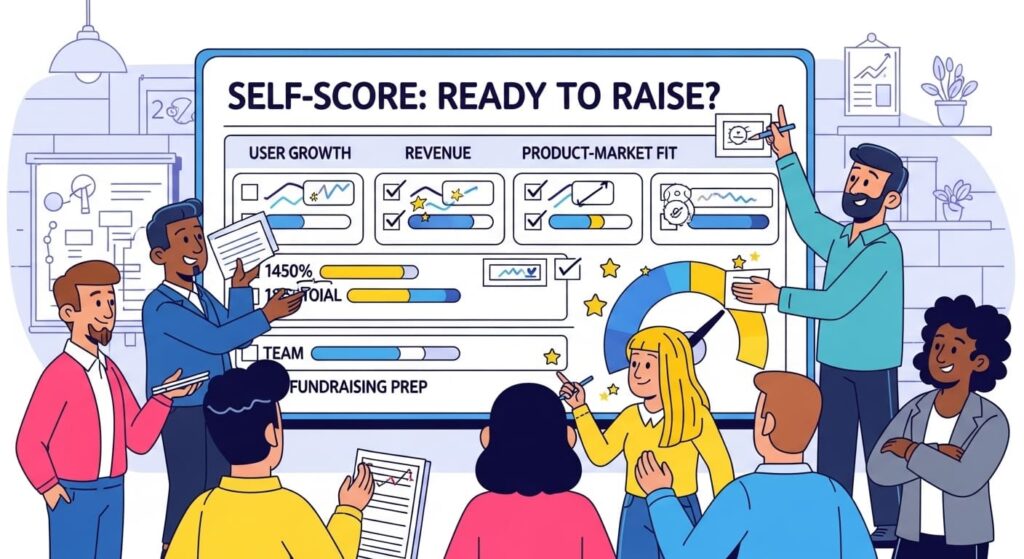
Use this as a calm, honest checkpoint you can run every Friday. Score each line 0 (not yet), 1 (in progress), or 2 (solid). The goal is not perfection. The goal is steady proof you can show and defend. For each item below you’ll see what “2” really looks like, how to gather the evidence, and the fastest move to climb a point next week.
Problem & ICP
A “2” means your problem fits in one short sentence a buyer would say on a busy day, and five dated field notes from real settings back it up. The notes include who felt the pain, where it happened, and a small number (minutes lost, rejects per shift). Keep the words theirs, not yours. If you’re at “0–1,” schedule three twenty-minute calls with doers, not executives, and capture the last time the problem happened. Put the five best notes in a single doc at the top of your deck so the whole team repeats the same line.
Activation
A “2” means activation is defined as the first real win, not a login, measured on weekly cohorts with both rate and median time, and you can point to two dated changes that lifted it. Evidence is a simple chart with small labels like “Jan 8 — added dry run” and “Jan 15 — saved presets.” If you’re at “0–1,” preload a sample or preset that mirrors the most common case and add a dry-run button. Time the first five new users from open to win and write the number on your standup page.
Retention
A “2” means you’ve chosen an “active” event that repeats the job, plotted cohorts to week eight or month two, and the flat tail has risen at least once with a dated cause. Screenshots show users landing on last good settings, and support questions about “is this safe?” have dropped. If you’re low, make the second win faster than the first by saving state and adding a clear confidence cue; then read the next two cohorts without changing definitions.
Time to First Revenue
A “2” means you start the clock at the first qualified call and stop it at cash in, even if the payment is a small pilot fee. The median days are trending down, with a process change labeled on the chart (one-page order, security FAQ, safety note). If you’re at “0–1,” carve a guarded, two-week paid step that a line manager can approve and prepare the single page that makes that approval easy. The win here is speed, not size.
Pipeline Quality
A “2” pipeline is short and true. Every deal on your table has the pain, a path to budget, and a dated next step. Stages show median days, and you’ve removed one source of delay with a visible fix. Each line links to a proof artifact (clip, bundle, shadow score). If you’re light, cut every deal without a date, then add one asset to each remaining line that answers its top doubt in under thirty seconds.
Safety
A “2” safety case is living, not a binder. It defines your boundary (“sense–decide–act” and “never do”), lists the top hazards in your wedge, and attaches short clips where guardrails fired with reason codes like glare or drift. There’s a dated note each week where something improved. If you’re at “0–1,” record two thirty-second clips that show a safe defer and a safe resume under real constraints and pin them to a one-page safety note.
Unit Economics Hints
A “2” shows direction, not fantasy. Minutes to first win, tickets per active account, and cost per run are trending the right way over six to eight weeks, and each slope is tied to a specific change. If you’re low, pick one lever that removes a repeated step (auto-detect, batch caching, saved presets), ship it, and read the next two weeks with the same lens. Small, dated drops are stronger than big, smoothed averages.
Velocity
A “2” velocity story is a public change log with dates, the change shipped, and the metric it moved—plus at least one honest rollback. Each entry includes a real screenshot. If you’re at “0–1,” start today: one image, one sentence, one metric, once a week. Label the next change you expect to move activation or the tail and circle the dot when it moves.
References
A “2” means two raw quotes in buyer language sit beside the charts they reflect, and one customer will take a quiet ten-minute reference call for your narrow pilot. If you’re low, ask your happiest user for a single sentence about one scene and one number in their words, then make the ask easy: a short call with someone in their exact role at a look-alike site.
Pricing
A “2” means you have a one-page, guarded pilot offer tied to a buyer proxy (uptime, scrap, safe resume time), with three recent “yes” decisions at the current price and scope. If you’re light, anchor to one proxy number you already moved in shadow or sandbox, choose the buyer’s unit (per line, per device, per run), and test on two look-alikes with the same paper.
Security
A “2” is a one-page answer sheet and a small diagram that says what you collect, where it lives, who can see it, and how long you keep it, plus a ten-answer FAQ you can send same day. If you’re low, write the paragraph, draw the diagram, and collect the ten most common questions from your last three threads. Plain words beat badges at this stage.
Data Room
A “2” room is tiny, dated, and tidy: architecture page, safety page with two clips, three short scene videos, two before/after one-pagers, metrics methodology, and your pilot order. File names are boring and findable. If you’re light, create a README with dates and swap one asset a month so the room always feels alive.
Cadence
A “2” cadence is a 20-minute Friday loop with the same four lines: field fact, change shipped, metric moved, next move. The doc is dated and short. If you’re low, schedule the meeting and paste last week’s numbers. Momentum comes from the ritual, not from a big speech.
IP ↔ Metrics
A “2” means the methods behind your best lifts are written as steps (inputs, checks, actions, fallbacks), and at least one focused provisional is filed that maps to a chart in your deck. If you’re low, pick the change that moved activation or the tail the most, write it as a simple flow, and file a narrow provisional so the edge that moves numbers becomes an asset you own.
Two-Slide Story
A “2” deck ends with two slides anyone can retell. Slide A shows proof under real limits (three scenes with target/result/constraint), one raw quote, and a quiet method note (“provisional filed”). Slide B shows motion to dollars (two dated release notes with metric shifts, a tiny “days to first paid step” line, a qualified pipeline table with dates), and your small, guarded offer with owners and a start date. If you’re low, build these two slides first and keep them fresh—everything else is appendix.
How to Use the Score This Week
Pick three lines that sit at “1.” For each, write one step you will ship in five days that could lift it. Keep steps small: a preset, a dry run, a one-page order, a safety clip, a clearer definition. Paste the three into your Friday doc with owners and dates. Next week, update only the dots that should have moved. Don’t widen the plan. Depth beats breadth at this stage.
When a step moves a dot twice, treat the underlying method as an engine. Write the flow, capture logs, and—if it’s truly novel and useful—file. Linking metric lifts to owned methods is how you raise with leverage, not hope
Conclusion: Raise When Proof Feels Calm
You do not need loud charts to raise. You need a few steady signals that match the job: a fast first win, a tail that holds, a short path to first dollars, and a small offer that moves without drama. Put dates on every change. Tie each lift to one cause. Keep your words plain. When your deck reads like a lab log, not a brochure, rooms lean in.
Protect the engine that makes the lifts repeat. If a guardrail, planner, data recipe, or state-sync method keeps winning under messy inputs, write the steps and file. Now traction rests on assets you own. That is how you keep price, slow copycats, and raise on your terms.
If you want a partner to lock this in, Tran.vc invests up to $50,000 in in-kind patent and IP services for AI, robotics, and deep tech teams. We help you pick the right wedge, file smart claims, and package proof that reads calm and fundable. If that is your next step, apply now: https://www.tran.vc/apply-now-form/.