
Biotech moves in a strange way.
You can spend two years proving something works… and still lose the whole company because you waited six months too long to protect it. Or you file a patent too early, before you truly know what matters, and you lock yourself into a weak story you can’t fix later.
That is why biotech IP is not just “get a patent.” It is a timing game.
It is also a three-part game:
Patents (what you can stop others from copying),
Data (what proves your claim is real),
and regulatory timing (when your work becomes public, and when your choices become hard to change).
Most early teams do not lose because they lack talent. They lose because they treat IP like paperwork. In biotech, IP is a strategy tool. If you use it well, it can do three very practical things for you:
It can keep copycats out while you are still small.
It can help you raise money with less stress.
It can let you pick partners on your terms, not theirs.
Tran.vc exists for this exact moment. If you are building in biotech, AI biology, lab automation, diagnostics, drug tools, or anything where science meets software, your IP needs to be strong before you get pulled into a rushed seed round. Tran.vc invests up to $50,000 in in-kind patent and IP services, so you can build real protection early—without giving up control just to pay a law firm. If you want to see if you fit, you can apply anytime here: https://www.tran.vc/apply-now-form/
Now, let’s start where founders actually feel the pain: what should we patent first, and when?
In biotech, your “product” is rarely one thing. It is a chain.
You may have a target. A way to hit it. A way to make it. A way to measure it. A way to deliver it. A way to run the process again and again without drift. A way to show safety. A way to show it works. And a way to explain all of that in a clear story.
Your IP strategy must match that chain.
If you only patent the end result, you often miss the real moat. If you only patent the method, you may end up with a narrow claim that is easy to work around. If you only patent the data, you may not have a patent at all, because raw data is usually not something you “own” through a patent.
So you start by asking a simple question:
If a smart competitor had my slide deck, what part would they copy first?
That answer is usually your first IP focus.
Sometimes it is the molecule or sequence.
Sometimes it is the formulation.
Sometimes it is the assay.
Sometimes it is the manufacturing path.
Sometimes it is the training data, the labeling method, or the model’s output in a diagnostic setting.
Sometimes it is the “boring” step that makes the whole thing scale.
Here is the common early mistake: teams patent what sounds impressive, not what is hardest to reproduce.
For example, a team may patent a “novel therapeutic composition,” but the real advantage is that they found a way to keep the protein stable for six months at room temp. That stability unlocks shipping, storage, and real-world use. Without it, the therapy is a lab toy. With it, it is a business.
If you do not protect the stability trick, a competitor can take a different molecule, copy your stability method, and beat you on speed.
That is why good biotech IP is not just “novel.” It is also business-critical.
Now the second early mistake: filing before you have your core proof.
Founders hear “file fast” and think speed is everything. Yes, speed matters. But in biotech, filing fast with thin support can hurt you.
A patent is not a press release. You do not “announce” a dream. You make a set of claims, and you must support those claims with enough detail that your filing does not fall apart later.
If your first filing is vague, you may end up trapped. Later, when you finally have strong data, you may not be able to add it in the way you need. You can file again, but now you may have timing issues, cost issues, and story issues.
So what is the right move?
Most strong early biotech teams do something like this:
They do a tight early filing that captures the core idea and the key variations they already know.
Then they do a second filing once the first serious dataset lands.
Then they keep building a family of filings as the product hardens.
This is not about filing “a lot.” It is about filing with purpose. Each filing should remove a specific risk:
Risk that someone patents around you.
Risk that you cannot claim the full scope later.
Risk that partners will force you into bad terms.
This is where data enters the picture.
Data is not just for investors and regulators. Data is also a weapon in patenting.
In biotech, data does at least four things for patents:
It shows your idea works, at least in a clear way.
It helps you claim a broader range, because you can support it.
It helps you defend against “obviousness” attacks.
It helps you pick what to claim, because it reveals what matters.
But you need to be careful. Data can also create danger.
The moment you share data publicly, you can harm your patent rights in many countries. Even in the US, where there is often a limited grace period, it is still risky. And investors do not like “risky IP.”
So you need a clean rule inside the team:
No public sharing of enabling detail until your filing plan is locked.
That includes:
Slides sent to strangers.
Posters.
Conference talks.
Preprints.
Demo days.
Even some grant applications, depending on what you submit and how it becomes public.
This does not mean you must become secretive. It means you must treat disclosure like a lever. You pull it when it helps you, not when it hurts you.
Now, the third part: regulatory timing.
Biotech does not live only in patents and papers. It lives in regulated systems: FDA paths, CLIA labs, GxP, clinical trials, quality systems, and audits.
Your regulatory path changes what you must prove, when you must prove it, and what you will be forced to reveal.
That forced reveal is often the hidden clock in your IP strategy.
Let’s take a simple case: a diagnostic test.
If you plan to go through FDA, you will produce a lot of documents. You will define your intended use. You will explain your method. You will share performance data. You will describe controls. Over time, pieces of that may become visible, directly or indirectly.
If you plan to start as an LDT in a CLIA lab, the disclosure pattern can be different. You may keep more as trade secrets, depending on how you operate and what you publish.
Neither path is “better.” But each one sets a different IP clock.
A strong IP plan asks:
What will we have to reveal later?
What can we keep secret long-term?
What must be patented before it becomes public?
What do we want investors to see, and what do we want to hide?
This is where founders often feel overwhelmed, because they are trying to build the science, build the team, raise money, and survive. IP feels like one more thing.
But there is a simpler way to think about it.
Your job is not to become a patent lawyer. Your job is to make three clear decisions early:
- What is our core advantage?
- What is the first proof that makes it real?
- What future moment will force us to disclose details?
Once you know those, a good patent team can build the right filing path around them.
This is exactly the kind of work Tran.vc supports. The value is not “a patent.” The value is a plan you can execute while you build. If you want that kind of help—without writing a huge check up front—you can apply anytime here: https://www.tran.vc/apply-now-form/
Before we go deeper, let me make this very concrete with a common early-team scenario.
Imagine you are a two-person biotech team.
You have early results that suggest your engineered enzyme cuts time in half for a key step. It is not perfect. It works in some conditions, fails in others, and you are not sure why yet.
You have three options:
A) File nothing until you have perfect results.
B) File a broad patent right now with little detail.
C) File a focused first patent that captures what you truly know, and plan a follow-on once you have the next dataset.
Option A feels safe but is often dangerous. Someone else can file first, or you can be forced to reveal the idea to raise money. You end up boxed in.
Option B feels fast but is often weak. You may not support what you claim, and you may waste your best “priority date” on a thin file.
Option C is usually best. Not always—but often.
Option C looks like this:
You file a first application that clearly describes the enzyme, the variants you have built, the key conditions where it works, and the best use case you can defend today. You also describe a reasonable set of variations you believe will work, based on your experiments and logic. You include working examples. You include data that is honest, not cherry-picked.
You do not pretend you solved the whole world.
Then, 3–9 months later, once you understand the failure modes and you have the next strong dataset, you file again—this time with stronger claims, better support, and sharper language.
This approach is not about gaming the system. It is about matching filings to real learning cycles.
Biotech learning is slow, but it is still learning. Your IP plan should move with your learning.
And now we get to the core idea of this article:
In biotech, the best IP strategy is built around your next data milestone and your next forced disclosure.
Not around a random calendar date. Not around what your friend’s startup did. Not around fear.
Around your next data milestone, and your next forced disclosure.
If you anchor to those two things, you will avoid most early IP mistakes.
Patents, Trade Secrets, and What to Lock Down First
Start With “What Gets Copied First”
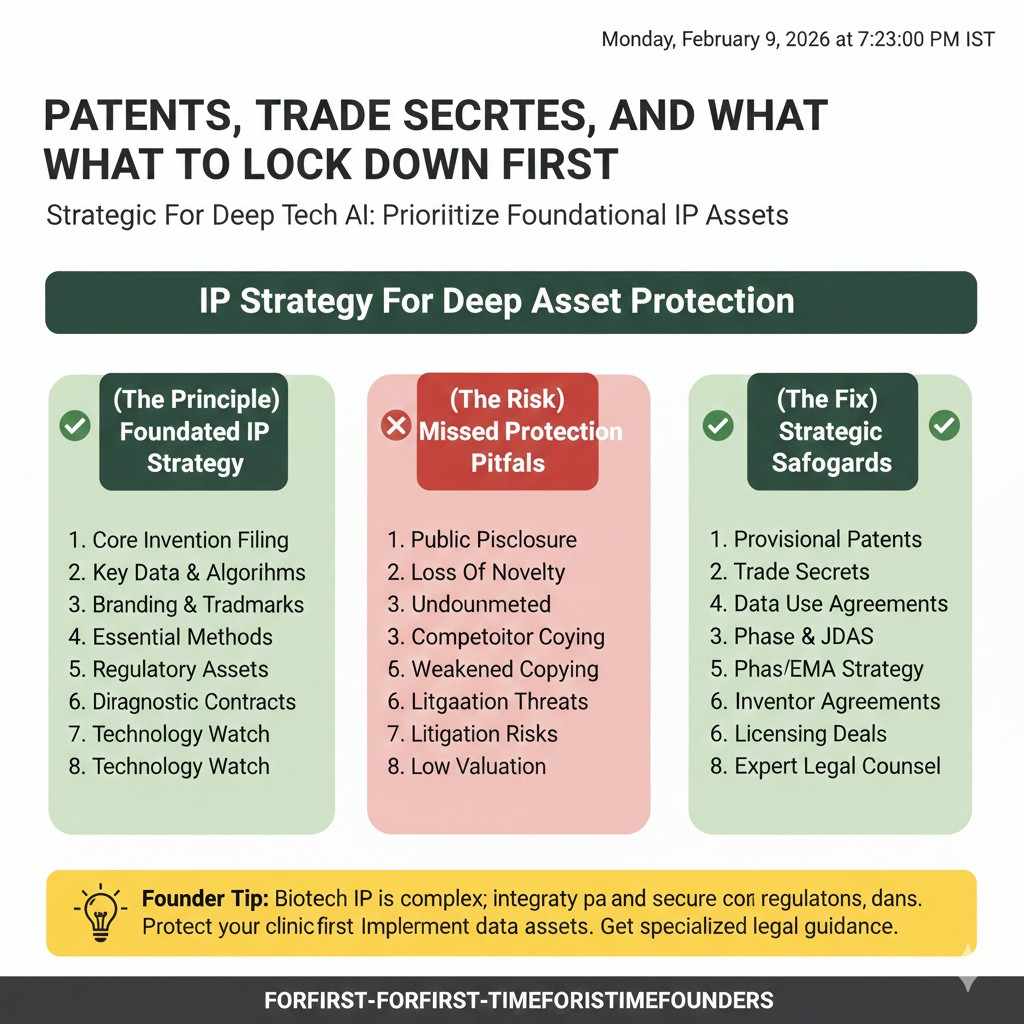
Early biotech teams often ask, “What should we patent?” A better question is, “If a sharp competitor saw our plan, what would they copy first?” That one thought will point you to the part that deserves protection now, not later.
In biotech, the thing that gets copied is not always the headline idea. It is often the step that makes the system work in real life. Sometimes it is a sample prep trick. Sometimes it is a stability step. Sometimes it is a manufacturing shortcut that turns a lab result into a repeatable product.
When you identify that “copy-first” piece, you can build the rest of your IP plan around it. You stop guessing. You stop filing based on what sounds fancy. You start filing based on what keeps you ahead.
If you want help doing this mapping quickly, Tran.vc’s in-kind IP support is built for early teams who need a clear plan without wasting months. You can apply anytime here: https://www.tran.vc/apply-now-form/
Think in Layers, Not a Single “Patent”
Many founders treat patents like a single object. In biotech, a strong position is more like a layered shield. If one layer gets challenged, the others still hold. This matters because biotech products evolve, and your first version is rarely the one you ship at scale.
One layer might cover the composition, like a sequence, construct, vector, or formulation. Another layer might cover the method, like how you make it, how you deliver it, or how you measure it. Another layer might cover the system, like a workflow, device + reagent bundle, or software-assisted pipeline.
When you plan these layers early, you avoid a painful problem later. That problem is when your “main patent” ends up narrow, and every improvement you make is unprotected. You do not want your own progress to weaken your moat.
A practical move is to ask, “If the core thing changes, what stays the same?” The part that stays the same is often your real layer-one claim. The part that changes becomes layer-two or layer-three filings as you learn.
The Fastest Way to Miss the Moat
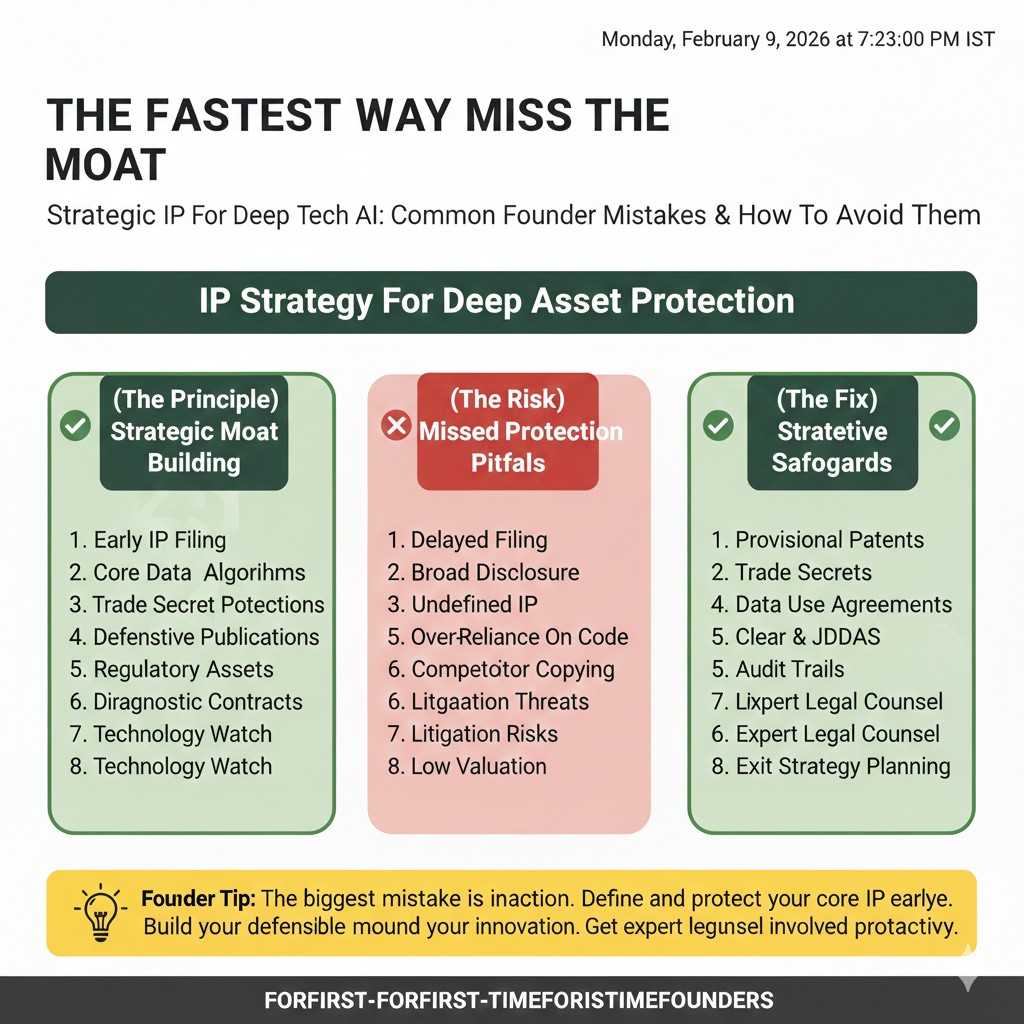
A common miss is to patent the result and ignore the step that created it. Founders will patent a “new biomarker panel,” while the advantage is the way they clean noisy data. Or they patent a “new cell therapy,” while the advantage is the manufacturing process that keeps cells consistent across batches.
Competitors do not need to copy your exact result to hurt you. They only need to copy the step that makes your approach cheap, stable, or scalable. If you do not protect that step, you may still “own” your invention on paper, but lose the market in practice.
This is also why early patent conversations must include the technical person who knows the ugly details. The moat is often hidden inside the ugly details.
Patents vs Trade Secrets in Biotech
Some parts of biotech belong in patents. Some parts belong as trade secrets. The difference is not moral or emotional. It is about what you can keep hidden, and what will be exposed by normal business activity.
A patent is useful when your work will become visible through use, testing, partnerships, or regulatory steps. If you cannot keep it secret, you should consider patenting it. A trade secret is useful when you can keep it secret for a long time through process control and internal discipline.
In biotech, manufacturing know-how is often a strong trade secret, especially when it depends on tight process control. But if you will need to share the details with many third parties, secrets can leak. The more people who must know it, the harder it is to keep it secret.
For many early teams, the best answer is not “all patent” or “all secret.” The best answer is a split: patent what will be exposed, and keep the rest as controlled know-how that only a small group can access.
A Simple Test for Trade Secret Risk
Ask yourself a blunt question: “If we sell this product, can a smart lab figure out how it works?” If the answer is yes, trade secret is fragile. If the answer is no, and the key value sits in process steps that are not easy to reverse engineer, trade secret may be strong.
Now add another test: “Will we need to hand this to a partner or vendor?” If you must share it widely, secrecy becomes harder. You can still use NDAs, but NDAs are not magic. People change jobs. Vendors work with competitors. A “secret” that leaves your building often stops being a secret over time.
This is where early strategy matters. You can design your development path so that fewer people need to see your most sensitive steps. That is not paranoia. It is good operating practice.
The First Filing Should Buy Time, Not Create Pressure
Founders sometimes believe the first patent filing must cover everything. That mindset creates stress, delays, and weak writing. In reality, the first filing should do one main job: buy you time while keeping your core idea protected.
A good first filing is detailed enough to support real claims. It is also structured so you can build on it later without contradicting yourself. It captures the variations you already know matter, and it signals the future variations you can reasonably defend.
This is why “timing” matters more than “speed.” Filing fast is helpful only if the filing is strong enough to carry your future story. A weak early filing can become a bad anchor that drags you down.
Tran.vc’s model exists because early teams need that careful balance. You need speed, yes, but you also need quality and a plan you can execute. If you want to explore that support, apply here: https://www.tran.vc/apply-now-form/
Data Strategy That Strengthens Patents, Not Just Your Deck
Data Is Not “Extra” in Biotech IP
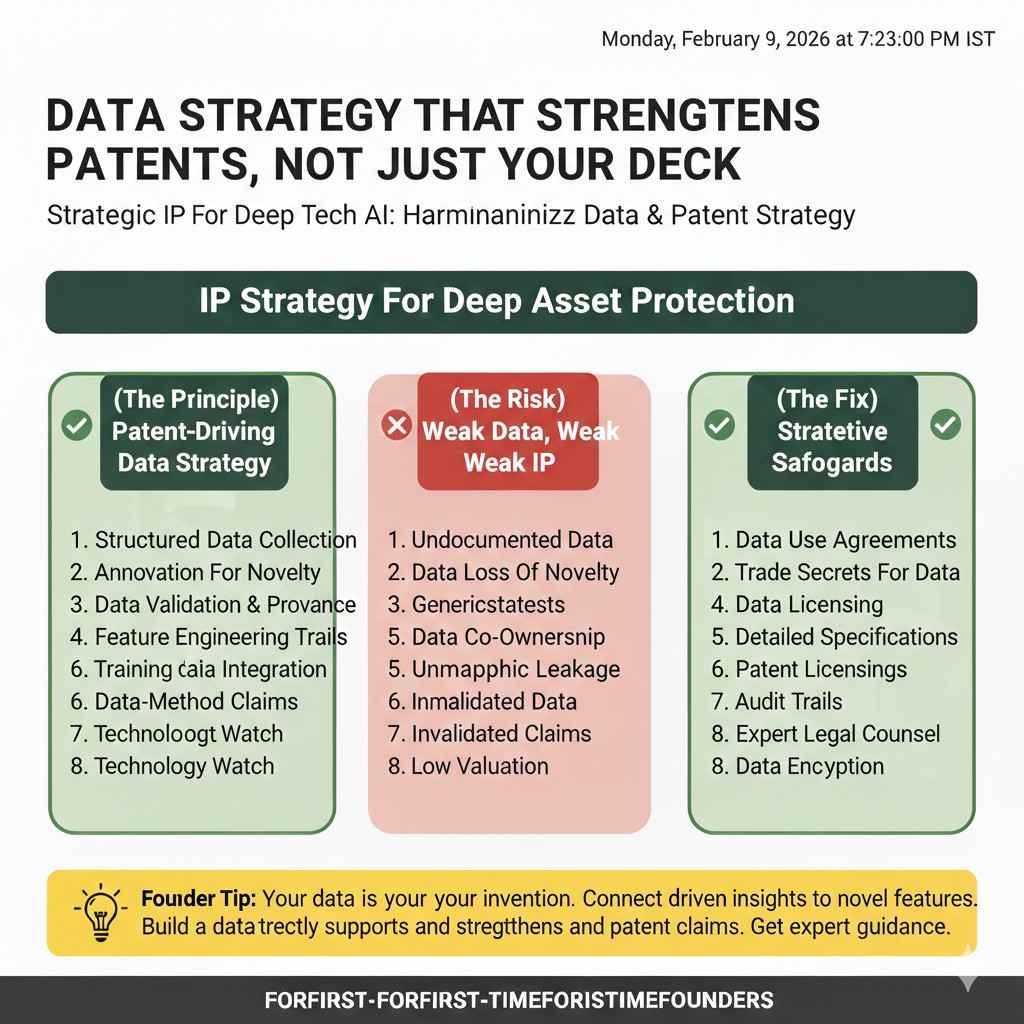
In biotech, data is often the difference between a patent that holds and a patent that collapses. Data helps you show your approach is real, not just a concept. It also helps you defend your scope when a reviewer or competitor argues, “This is obvious,” or “This will not work across that broad range.”
This matters more than many founders realize. A biotech patent is not judged only on whether it is new. It is also judged on whether the application teaches enough detail for someone skilled in the field to make and use it.
When your filing is thin on real examples, you risk being pushed into narrow claims. Narrow claims can still be useful, but they are easier to work around. Your goal is to earn the broadest protection you can honestly support.
Plan Your Experiments With IP in Mind
This does not mean you should run experiments “for the patent.” It means you should recognize that some experiments do double duty. They move the science forward and also strengthen your ability to claim what matters.
Early teams often run experiments that are interesting but not decisive. For IP, decisive experiments are the ones that show a clear effect and draw a boundary around your invention. They answer questions like, “What range works?” “What fails?” and “What is required for success?”
If you can show that a specific feature is the reason your approach works, that feature becomes claim-worthy. If you can show that your approach works across meaningful variation, you can justify broader protection.
This is why IP and lab planning should not be separate meetings. When they are separate, teams waste money and time. When they are aligned, you get cleaner results and stronger filings.
Keep a “Claim Map” Next to Your Lab Notes
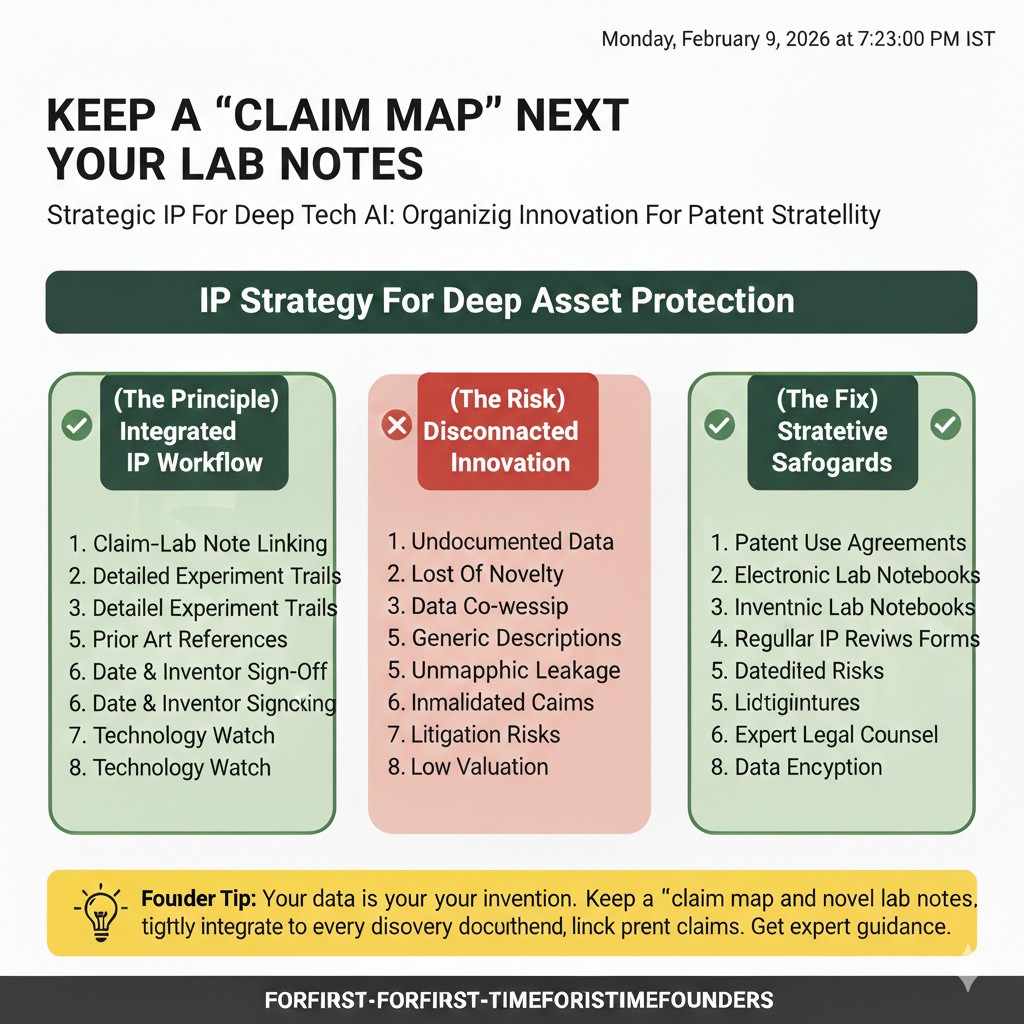
A practical habit is to keep a simple internal claim map. Not legal language. Just a living note that says, “Here is what we think we can claim,” and “Here is what we still need to prove.”
As new data comes in, you update that map. You may discover your original “main” idea is not the strongest claim anymore. That is normal in biotech. The best teams adapt fast.
This also helps you avoid a common trap: over-sharing the wrong story. If your team knows what the claim spine is, you can talk to investors and partners without revealing enabling detail that harms your position.
What Data Should You Protect as a Secret?
Some data should be shown. Some data should be kept quiet. This choice depends on what the data reveals about how to replicate your work.
Performance data that shows outcomes may be safe to share if it does not reveal the mechanism. But protocol-level data that teaches the “how” can be dangerous to share too early. Once the “how” is public, your patent clock starts ticking, and your ability to file in many places can shrink fast.
This is why early teams should decide, ahead of time, what they will share at conferences, in preprints, in demos, and in pitch decks. You do not want a rushed decision made the night before a talk.
A good rule is to separate “results” from “recipe.” Results can often be discussed earlier. Recipes should usually wait until your filings are in place.
The Quiet Risk of Preprints and Posters
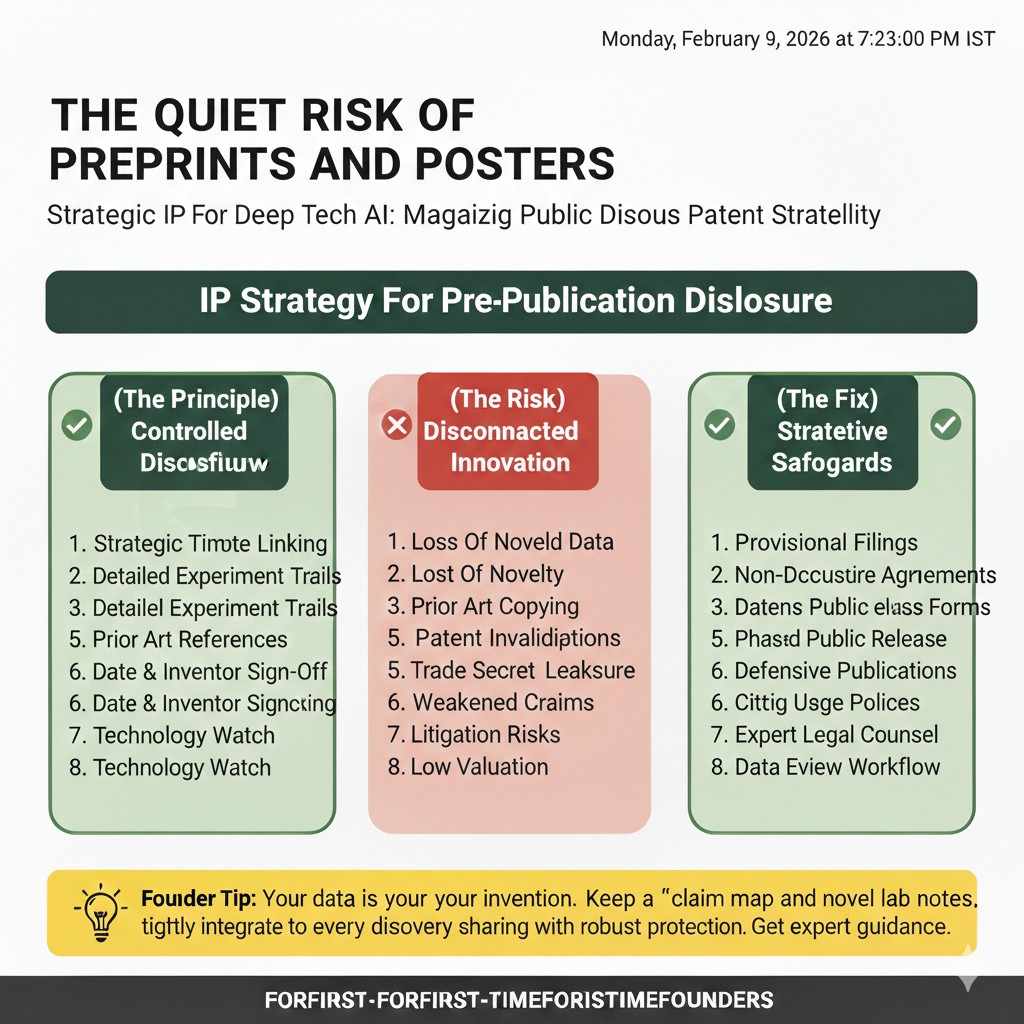
Preprints and posters are useful for hiring, credibility, and community. They can also quietly damage patent options if they include enabling details. Many founders do not realize how quickly a public disclosure can travel, get archived, and get used against them.
If you want to publish early, you can still do it. You just need a filing plan first. A well-timed filing lets you publish with confidence. Without it, you are betting your company on a hope that nobody notices.
If you are unsure, treat it as a high-risk moment and get advice before you release anything public. This is one of those decisions that is cheap to do right and expensive to fix later.
Tran.vc helps teams set this up early, so you can share progress without accidentally giving away the store. If you want that kind of guidance, apply anytime: https://www.tran.vc/apply-now-form/
Regulatory Timing: The Hidden Clock That Controls Disclosure
Why Regulatory Steps Change Your IP Strategy
Regulatory work is not just a hurdle to clear. It shapes what you must document, what you must prove, and what you may be forced to reveal. Even when the details are not fully public, the trail you create can leak through partners, filings, audits, or the normal flow of industry knowledge.
That is why regulatory timing is a clock. It sets deadlines for when your “secret” might become visible. If you wait until you are deep into regulatory work to think about IP, you may find that your best claims are already exposed.
The goal is not to patent everything before you start. The goal is to identify which parts are likely to become visible as you move into regulated pathways, and then protect those parts before the reveal happens.
Different Paths, Different Disclosure Patterns
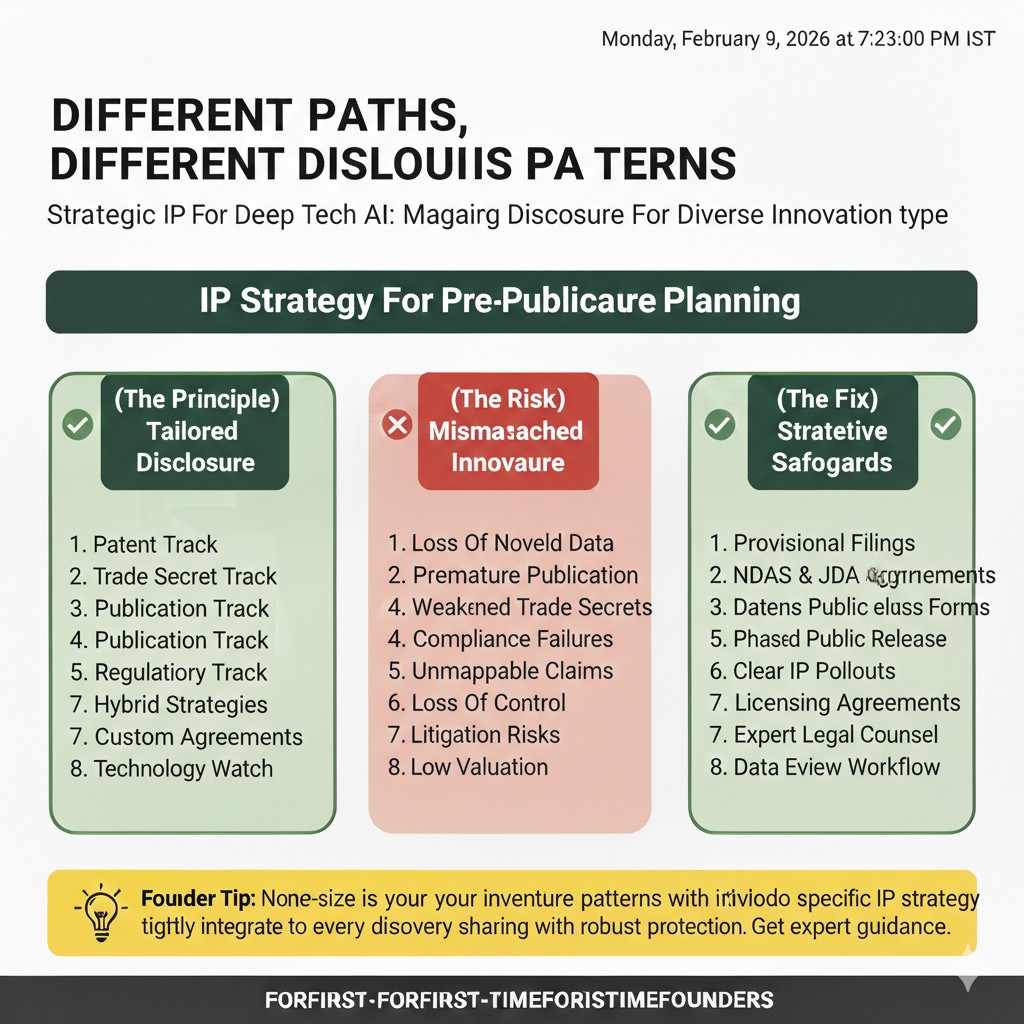
Diagnostics, therapeutics, devices, and tools each have different patterns of exposure. A diagnostic path may require detailed performance data and clear intended-use language. A therapeutic path may require clinical plans, manufacturing detail, and safety evidence that creates a paper trail. A device path may expose mechanical or workflow elements that competitors can copy.
Even if the regulator does not publish your full file, the market often learns the outlines. Competitors watch trials, hires, vendors, suppliers, and presentations. Over time, the “what” becomes known. If the “how” becomes known too, and you did not file, you are exposed.
This is why a good biotech IP strategy is a timing strategy. You are always asking, “What will become obvious later?” and “What will remain hidden?”
Use Regulatory Milestones to Plan Filing Waves
One of the cleanest ways to plan filings is to tie them to major regulatory milestones. Not because the regulator demands it, but because those milestones often come with new data, new partners, and new visibility.
As you approach a milestone, you often produce the strongest dataset you have ever had. That dataset can support stronger claims. That same period is also when more outsiders get involved, which increases leak risk.
So you plan a filing wave before key moments. That way, you can move faster with partners and regulators without fearing accidental disclosure.
This is a disciplined way to build a patent family without filing randomly. You file when your knowledge jumps and your exposure risk rises.
A Note on “We’ll File After We Raise”
Many founders delay IP because they think, “We’ll handle it after the seed.” The problem is that fundraising itself creates disclosure. You share decks. You share science. You take calls. You send follow-ups. Even careful founders can leak enabling details when they feel pressure to prove depth.
If you wait until after you raise, you may find that your idea was already discussed widely enough to complicate your filings. Or you may be forced into a weak filing because you need something on record fast.
The smarter move is to do enough early work so you can raise without exposing your core. That is exactly why Tran.vc funds IP work in-kind up to $50,000. It helps you build protection early so fundraising becomes calmer and more controlled. Apply here if you want to explore it: https://www.tran.vc/apply-now-form/