
Most startups treat patents like a fire drill. Something breaks. A big company starts copying. An investor asks, “What’s defensible here?” Then everyone scrambles, digs through old docs, and calls a lawyer in panic.
A patent pipeline is the opposite of that.
It is a simple, steady way to capture your best ideas as you build—so you never have to “remember” your inventions later. It helps you turn day-to-day work (code changes, model upgrades, new sensor setups, new data flows, new control loops) into real business assets. Not vanity assets. Useful ones. The kind that make it harder for others to copy you, and easier for serious investors to trust you.
If you are building in robotics, AI, or deep tech, you already create patent-worthy work all the time. The problem is not lack of invention. The problem is that invention stays trapped inside Jira tickets, Git commits, Slack threads, and late-night whiteboard talks.
This article will show you how to build a patent pipeline inside your startup without slowing your team down. It will feel like a routine, not a burden. You will know who owns what, how ideas move from “rough” to “filed,” and how to keep quality high while moving fast.
And if you want help doing this with real patent attorneys—without burning $50,000 in cash—Tran.vc can invest up to $50,000 in in-kind patent and IP services so you can build a strong foundation early. You can apply anytime here: https://www.tran.vc/apply-now-form/
Why a Patent Pipeline Matters in a Startup
Patents are not paperwork, they are leverage
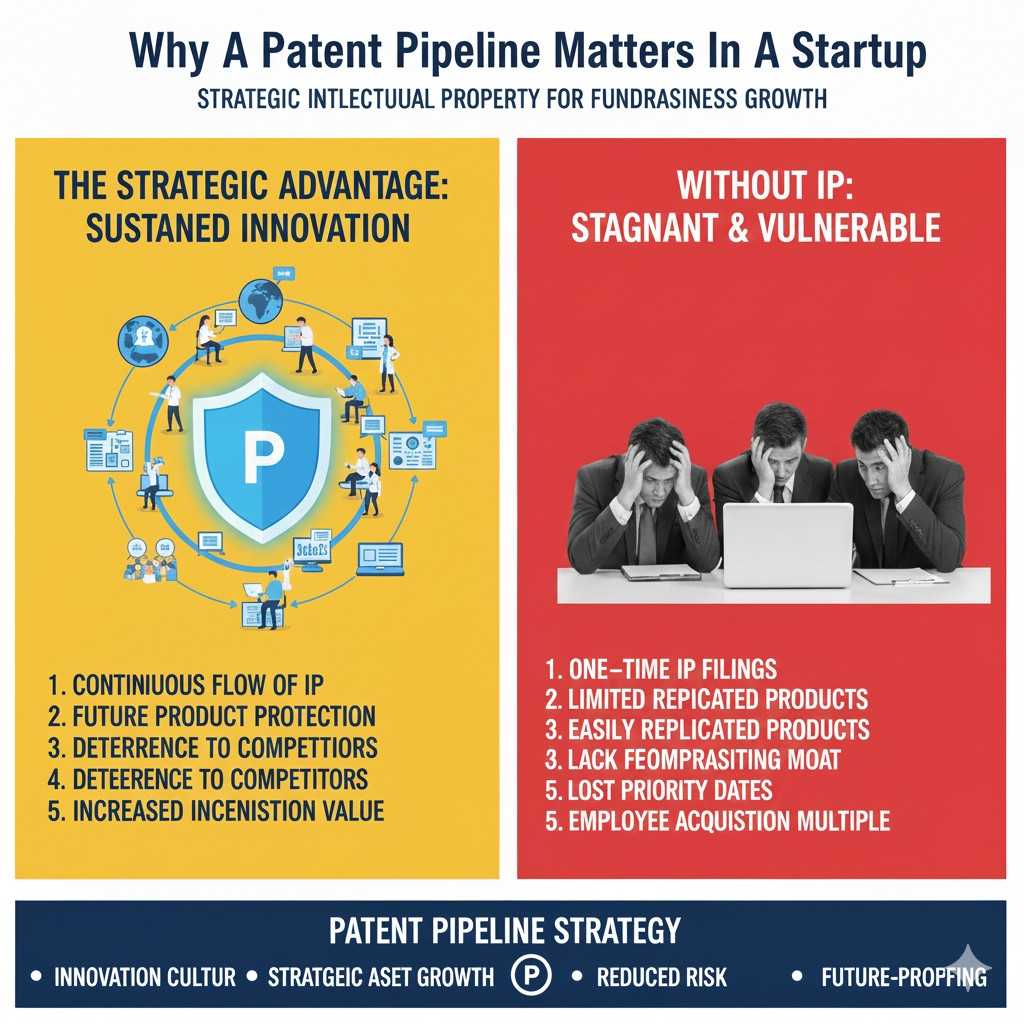
In a startup, speed is everything, but speed without protection can turn into regret. If you build something useful and others can copy it, your effort becomes their shortcut. A patent pipeline helps you keep the advantage you worked hard to earn.
It also changes how you talk to investors. Instead of saying, “We have great tech,” you can show that your tech has been captured as real assets. When an investor sees a steady flow of invention disclosures and filings, they see discipline. They see a team that understands how to build a moat while still shipping product.
Startups create inventions every week and lose them just as fast
Most technical teams do not “forget” their inventions on purpose. They lose them because invention happens inside normal work. A model is tuned, a sensor is fused, a control loop becomes stable, a latency issue gets solved, or a deployment method becomes reliable.
Then the team moves on. The next sprint starts. The context fades. Months later, when you try to write a patent, you can’t reconstruct what was truly new, what tradeoffs you tested, or why the final method works. A pipeline prevents this loss by capturing invention while it is still fresh.
The goal is a repeatable system, not a one-time filing
A patent pipeline is not “file a patent.” It is “create a habit.” It means your startup has a clear path from idea to disclosure to review to filing. It means you can do this without drama, without pausing product, and without relying on one person’s memory.
This also lets you choose the right moments to file. You will not file too early with vague claims. You will not file too late after you already shipped and showed the world. You will file with strong detail and clear scope, on your schedule.
If you want to build this system with support from real patent attorneys, Tran.vc invests up to $50,000 in in-kind patent and IP services for deep tech, AI, and robotics startups. Apply anytime here: https://www.tran.vc/apply-now-form/
What “Internal Patent Pipeline” Actually Means
It is a simple flow from build work to IP assets
When founders hear “pipeline,” they imagine a complex legal machine. In reality, a startup patent pipeline can be very simple. It is a flow that starts where invention naturally happens, then ends with a filed application.
The core idea is that every time your team solves a hard problem in a new way, there is a lightweight step to capture it. That capture becomes a short internal record. That record becomes a decision. That decision becomes a draft. Then you file.
It connects engineering, product, and legal without slowing anyone down
A pipeline works when it respects time. Your engineers should not feel like they are writing legal essays. Your product team should not feel like they are playing judge. Your patent counsel should not feel like they are guessing what the system really does.
A good pipeline uses short forms, short meetings, and clear ownership. It also uses plain words. The job is not to sound smart. The job is to be accurate and complete so the filing is strong.
It creates a shared language inside the company
One hidden value of a pipeline is that it forces the company to describe what is special about the work. Startups often say, “We are different,” but they cannot clearly explain why.
A pipeline makes you name the new parts. It makes you describe the steps, the data flows, the constraints, and the results. That clarity helps patents, but it also helps hiring, onboarding, sales, and fundraising because you can explain your edge in a clean way.
The Two Biggest Mistakes Startups Make with Patents
Waiting for the “perfect time”
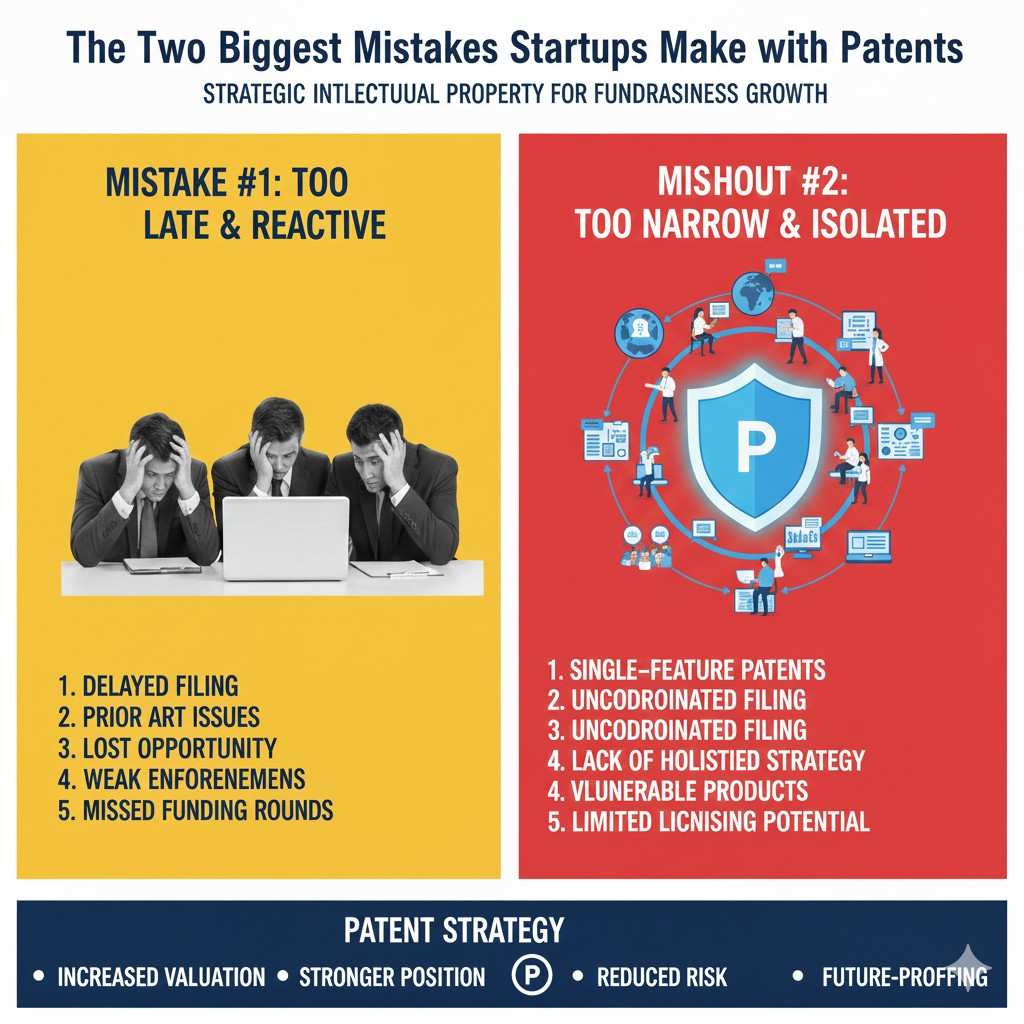
There is no perfect time. If you wait until the product is fully stable, you might miss early versions that were truly novel. If you wait until revenue, you might face copycats before you have protection. If you wait until a round, you might rush and file weak claims.
The pipeline solves this by creating steady capture. You do not need perfection. You need motion. You want a system that gathers inventions early, then chooses which ones to file when the details are strong.
Filing too much, too fast, with thin detail
Some startups swing to the other extreme. They file many patents with little depth because they think quantity alone impresses investors. That can backfire. Thin patents are easy to work around. They can also cost time and money to maintain without real benefit.
A pipeline helps you build fewer, stronger filings. It pushes you to collect real detail, test results, and design choices. It helps you find what is truly new and worth owning, not just what is new to your team.
Setting Up the Pipeline in Week One
Pick an owner and give them real authority
Every system needs an owner. In a startup, that owner is usually a founder, CTO, or senior engineer who understands the tech deeply. This person does not need to be a patent expert, but they must care about quality and follow-through.
Their job is to run the routine. They decide when disclosures are due, who joins review, and what gets escalated to counsel. Without a clear owner, the pipeline becomes optional, and optional means it disappears when things get busy.
Choose a single place where invention gets captured
Do not scatter invention notes across tools. Pick one place, even if it is simple. A shared doc folder, a Notion database, or a private repository can work. What matters is consistency and access control.
When the team knows where to put invention, you reduce friction. You also reduce risk because sensitive details stay in the right place. This becomes your internal memory for innovation.
Create a short invention capture form that engineers will actually use
The form should feel like an engineer wrote it, not a lawyer. It should ask for the problem, the old way, the new way, and why the new way is better. It should also ask for diagrams or a rough flow, because pictures often carry the key idea.
It should not ask for perfect wording. It should not ask for claims. The goal is to capture enough detail so counsel can draft a strong application later.
Building the Invention Capture Habit
Tie it to moments that already happen
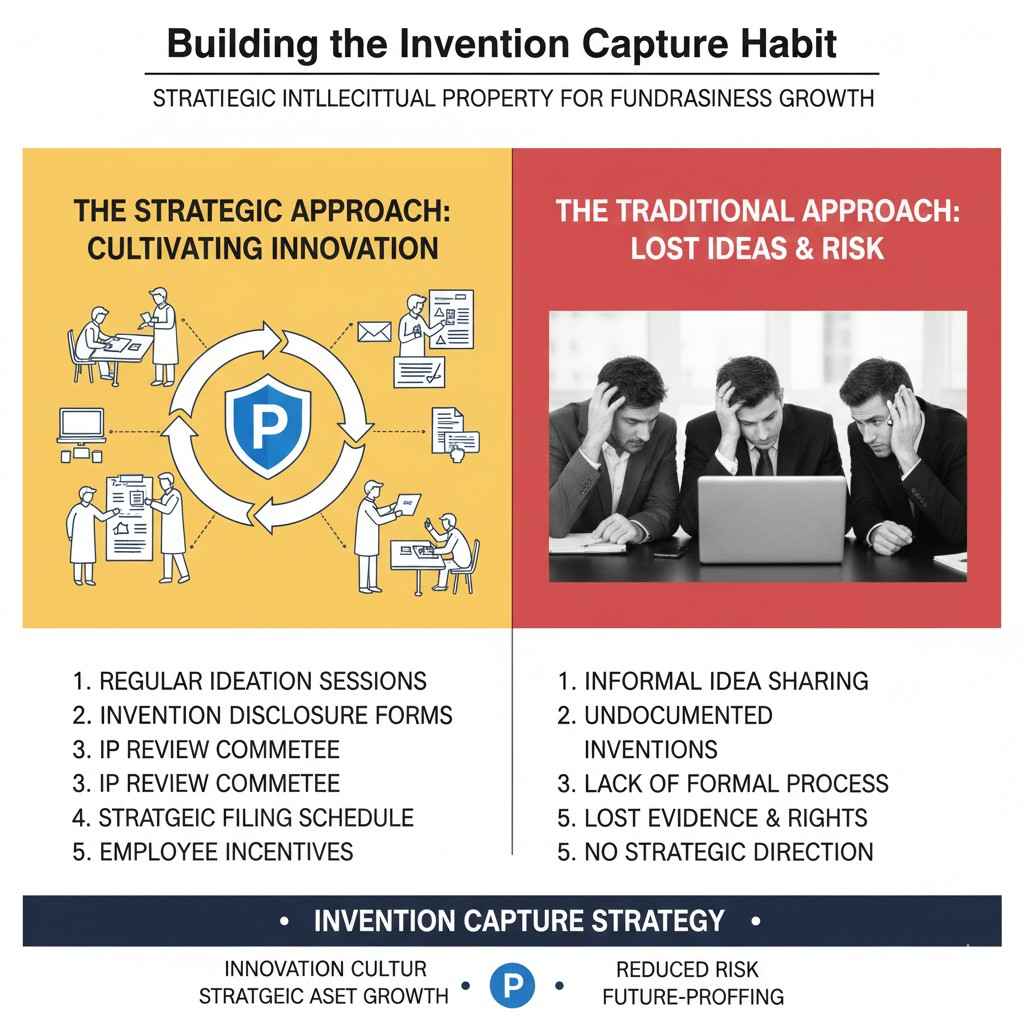
The easiest habit is one that rides on an existing habit. You can tie invention capture to sprint demos, architecture reviews, or post-mortems. When the team already meets to discuss technical progress, you can add one small step: “Did we create anything new enough to capture?”
This keeps invention capture close to the work. It also means the team does not need a new calendar burden. The pipeline becomes part of shipping, not a side project.
Train the team on what counts as patent-worthy
Many engineers think patents are only for big breakthroughs. In startups, inventions are often smaller but still valuable. A better data labeling method, a safer robot motion planner, a more reliable perception stack, a faster inference path, or a unique calibration process can all be patent material.
Training should use examples from your own product. When the team sees that real daily work can become IP, they start to notice invention sooner.
Keep the first capture lightweight and forgiving
If you punish imperfect capture, people stop submitting. Early on, the main goal is volume of raw ideas. Quality comes later through review and follow-up questions.
A good rule is to accept rough notes, then have the pipeline owner ask for missing detail. Over time, the team learns what detail matters, and the capture gets better without stress.
The Review Step That Prevents Waste
Use a short monthly or bi-weekly invention review
A patent pipeline does not need endless meetings. A short review every two weeks or once a month is enough for many startups. The purpose is simple: decide what is worth deeper work now, what should wait, and what is not worth filing.
This review also helps you spot patterns. You may notice that several disclosures point to a larger core method. Instead of filing three small patents, you may be able to craft one stronger filing that covers the whole system.
Review for novelty, business value, and timing
Novelty matters because a patent must be new. Business value matters because even a novel idea may not be central to your edge. Timing matters because you do not want to file too early, but you also do not want to miss the window.
This is where startups win when they are thoughtful. You are not trying to patent everything. You are trying to protect the core moves that define your product and your future roadmap.
Track decisions so nothing disappears
In startups, the biggest leak is not bad decisions. It is lost decisions. If you decide “not now,” you need a reminder. If you decide “file,” you need a next step.
A pipeline should record each disclosure status clearly. That status should include who owns the next action and when it is due. This is the difference between a real pipeline and a pile of ideas.
Tran.vc helps teams build this kind of working system with real legal support, so your filings become strong assets instead of rushed paperwork. Apply anytime here: https://www.tran.vc/apply-now-form/
Working With Patent Counsel Without Losing Momentum
Give counsel clean inputs so drafting is faster
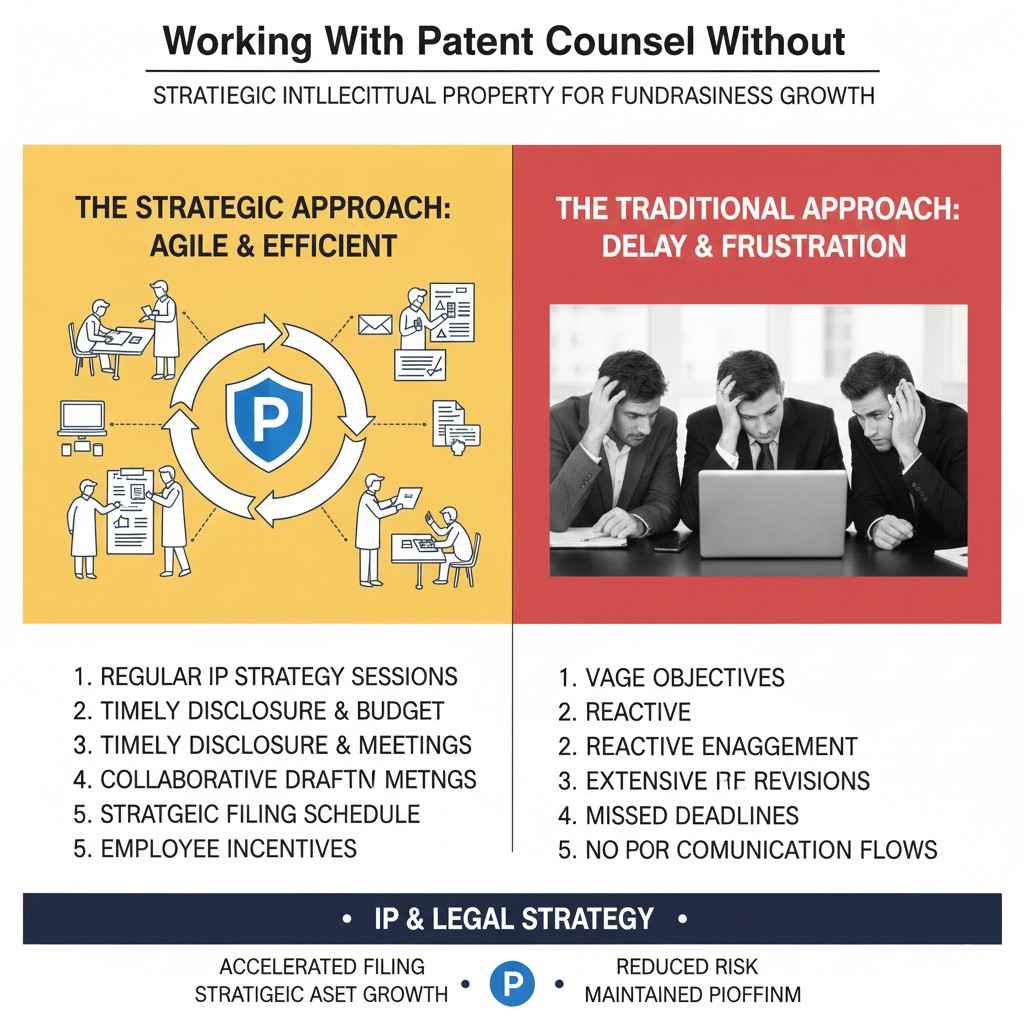
Patent drafting becomes slow when counsel must guess. Your pipeline should feed counsel a strong invention package. That package should include a clear description, diagrams, test results, and edge cases.
When counsel has that, they can write faster and better. Your engineers also spend less time in back-and-forth because the details are already captured. This is one of the biggest time savers in the entire system.
Use one technical lead as the main point of contact
If five engineers all talk to counsel separately, you get confusion and delay. The pipeline works best when one technical lead collects input, answers questions, and reviews drafts with focus.
This does not block others. It reduces noise. Engineers can still contribute details, but the legal process stays clean and directed.
Make draft review structured and focused
Draft review should not be a free-for-all. It should focus on technical accuracy, the range of variations, and the key claims. The team should check that the patent describes the method broadly enough that competitors cannot copy it with small changes.
This is where your pipeline matters. If the pipeline already captured variants and tradeoffs, review becomes faster because the draft already reflects reality.
How to Spot Patentable Ideas in Robotics and AI
Look for solutions that remove a real constraint
Most patent-worthy work in robotics and AI comes from solving a hard limit. It may be a speed limit, a power limit, a compute limit, a data limit, or a safety limit. When your team finds a way around a real constraint, that is a strong signal you may have an invention.
In robotics, constraints show up in motion, sensing, control, calibration, and reliability in the wild. In AI, constraints show up in model size, latency, privacy, labeling cost, drift, robustness, and deployment. If your fix is not just “we tried harder,” but “we changed the method,” you should capture it.
Pay attention when the team argues, then aligns
A surprising clue is healthy conflict. When engineers debate two designs, it usually means the problem is non-trivial. When they finally agree on an approach, the winning idea often includes a fresh concept, a new flow, or a new set of tradeoffs.
Those moments vanish fast. People remember the result, but forget why it matters. Your patent pipeline should treat design debates as invention gold. Not every debate becomes a patent, but many patents begin as, “We had to solve this, and the old way kept failing.”
Notice “hidden” inventions inside boring work
Some of the strongest patents come from work that feels unglamorous. A robust way to detect sensor faults. A method to keep a robot safe when a model becomes uncertain. A process to keep data clean across many deployments. A trick to update models without breaking the system.
Teams often skip capturing these because they do not feel like breakthroughs. Yet these are the exact methods that create durable advantage. They are also the methods that competitors will copy first because they solve pain, not theory.
Turning Raw Ideas Into Strong Invention Disclosures
Write for a smart engineer, not for a lawyer
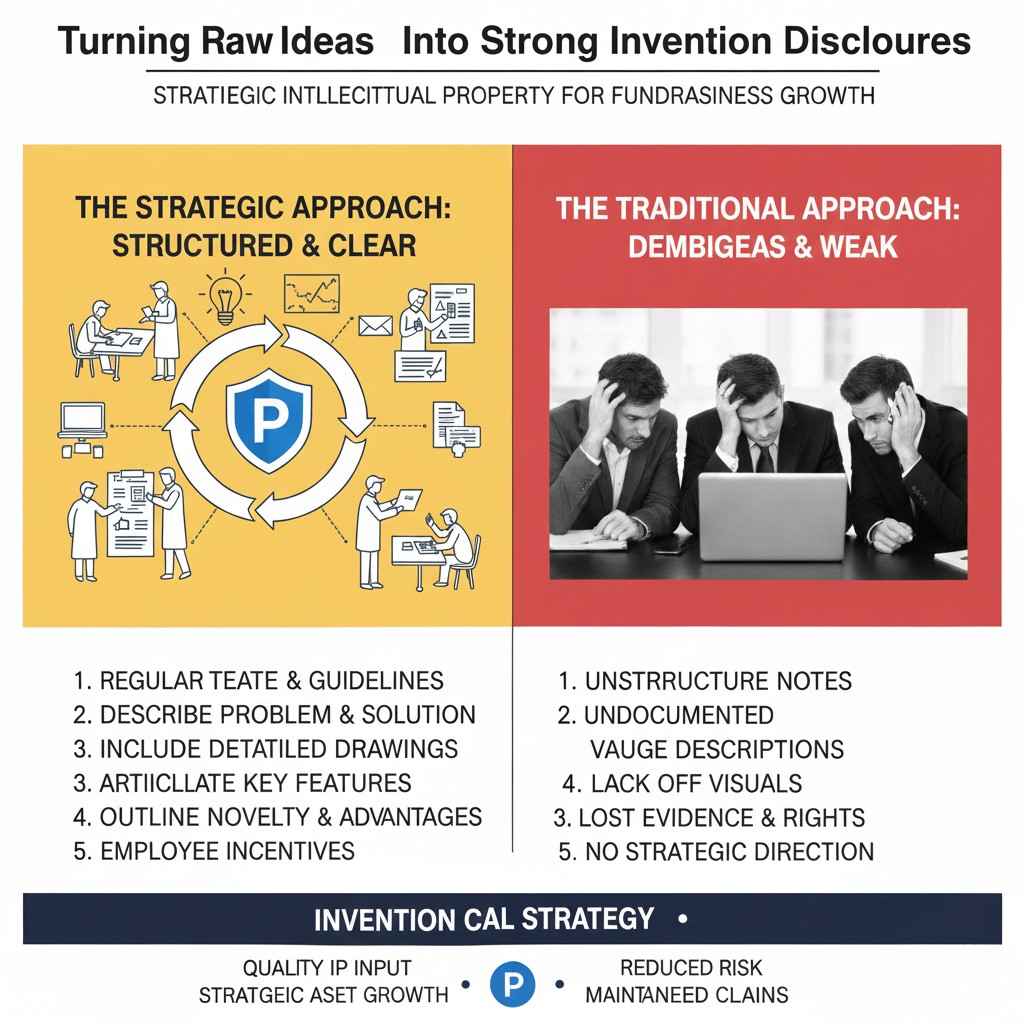
An invention disclosure is not a patent. It is a clear internal note that explains what you built, what was wrong with the old way, and why the new way is different. If your disclosure is readable by a new engineer on your team, it is usually readable enough to draft from.
Use simple words. Explain the flow step by step. If your method has stages, describe each stage and the input and output. Include any assumptions. Do not worry about perfect formatting. Clarity matters more than polish.
Capture variations so competitors cannot slip around you
A common mistake is describing only the version you shipped. That is helpful, but it is not enough. A strong disclosure also includes other versions you considered, even if you did not ship them.
If your method works with two sensor types, note that. If it works with three ways of estimating uncertainty, note that. If the same flow works with a different model family, note that. These variations become the foundation for broader protection later.
Add proof points, even simple ones
You do not need a full academic paper. But you do want some proof that the invention works. That proof can be a plot, a metric improvement, a failure rate drop, or a before-and-after comparison.
Even small numbers help. They show what the method achieves and why it matters. They also help counsel describe the benefit in the filing in a way that feels real and concrete.
Designing the Pipeline So Engineers Don’t Hate It
Make invention capture feel like part of shipping
If the pipeline is seen as “extra,” it will lose every time. If it is seen as “how we protect what we ship,” it earns respect. The easiest way to get there is to tie capture to done-work.
When a feature ships, when a major experiment lands, or when an architecture change becomes final, you have a natural moment to ask, “Did we create a new method here?” That simple question, repeated often, builds a culture where invention is noticed.
Keep the time cost predictable
Engineers fear open-ended tasks. If invention capture might take two hours, they will avoid it. If they know it takes fifteen minutes, they will do it.
Your pipeline owner should set a standard. For example, the first version of a disclosure should be short, and follow-up questions will come later if needed. This makes the time cost feel safe.
Make it clear that credit is tracked fairly
People submit more ideas when they trust the system. Your pipeline should clearly record who contributed. In many startups, inventions are team efforts, and that is normal. A good record avoids conflict later.
This is not just about feelings. Inventor lists matter in patents. If you miss inventors, you create legal risk. If you add people who did not contribute to the inventive step, you also create risk. Tracking credit carefully is part of building clean IP.
What to Capture for Robotics Inventions
The physical world is messy, so robust methods matter
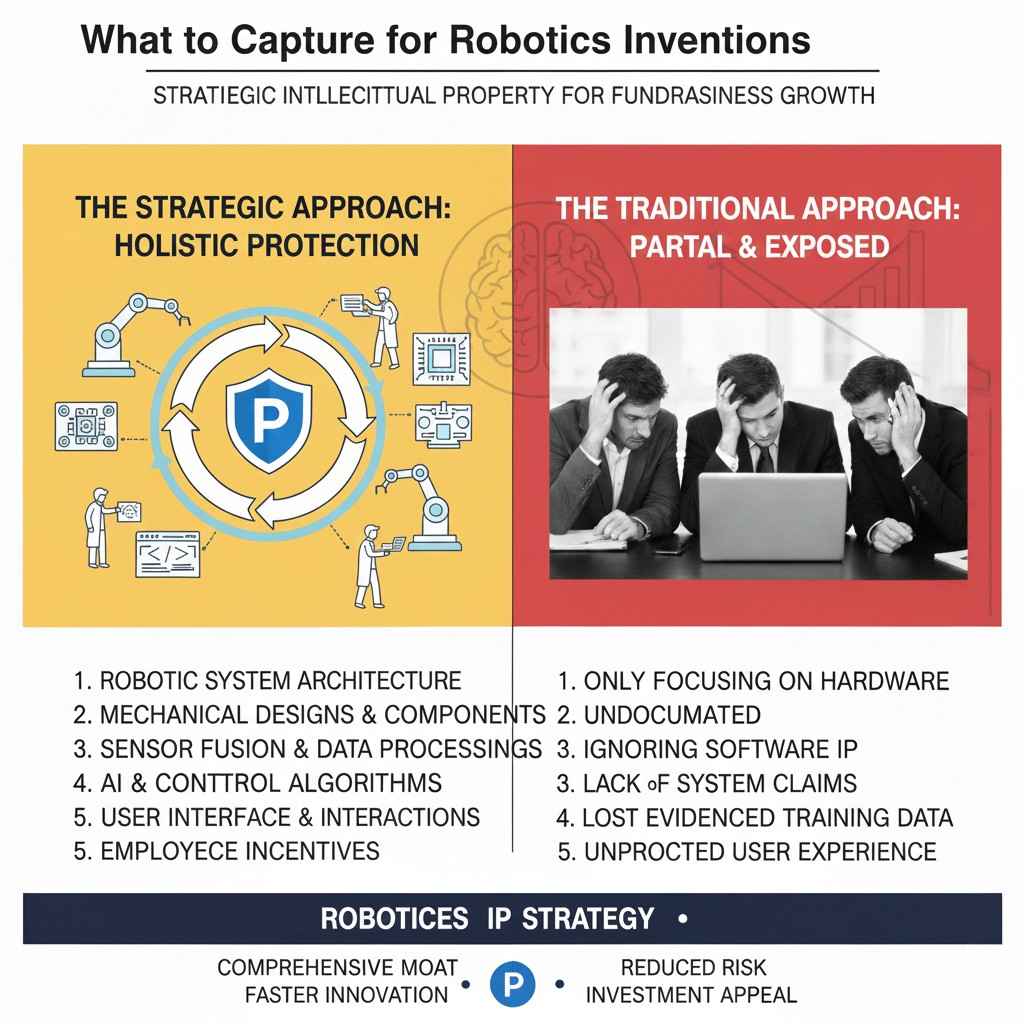
Robots face friction, wear, dust, lighting shifts, sensor noise, and user behavior. If you build methods that keep performance stable under messy conditions, you may have valuable IP.
Examples include calibration routines that work in the field, control schemes that handle slip, safety layers that catch edge cases, and sensor fusion methods that stay stable when one sensor drifts. These methods are often hard to copy without deep experience, which makes them strong patent candidates.
Integration is often where the invention lives
Many robotics inventions are not a brand-new sensor or a brand-new actuator. They are the way you connect parts. The timing, the data flows, the fallback modes, and the system-level design can be the key.
If your robot works because you found a special way to coordinate perception and control, capture that. If you reduced latency by changing where compute happens, capture that. If you improved safety by adding a structured “stop and recover” behavior, capture that.
Field learnings can become protectable methods
Startups learn things in deployment that labs never see. Maybe the robot fails in a specific lighting pattern. Maybe vibration changes a sensor reading. Maybe a user behavior breaks a model.
If you create a method to detect and fix those failures, that method can be patentable. Your pipeline should treat field fixes as invention opportunities, not just bug fixes.
What to Capture for AI Inventions
Data workflows are often more defensible than models
Models change quickly. But your method to build, clean, label, and maintain data can remain core for years. If you have a unique way to select training examples, reduce labeling cost, detect drift, or keep privacy, those workflows can be strong patent material.
If your team built a repeatable loop that improves quality over time, that loop itself may be the invention. A pipeline helps you describe the loop clearly before it becomes “just how we do things.”
Deployment constraints create real inventions
In AI products, deployment is where theory meets reality. Latency, memory, cost, and reliability all push teams to innovate. Methods like model compression flows, split inference designs, uncertainty gating, or on-device privacy steps can be very valuable.
If your solution changes the structure of the system, not just the size of a model, capture it. Those changes often become the heart of a strong filing because they are tied to real product needs.
Safety and alignment work can be patent-worthy
If you built methods to prevent unsafe outputs, reduce hallucinations in specific settings, or keep a model within strict rules, those methods can be important IP.
This is especially true in regulated areas or in robotics, where AI decisions have physical effects. If your system has a special safety layer, a special human-in-the-loop step, or a special confidence gating method, those details matter.
Tran.vc often helps founders identify these “quiet inventions” that teams overlook, then turn them into strong filings with real patent attorneys. If you want that support early, apply anytime here: https://www.tran.vc/apply-now-form/
The Internal Roles That Make the Pipeline Work
The pipeline owner keeps the machine moving
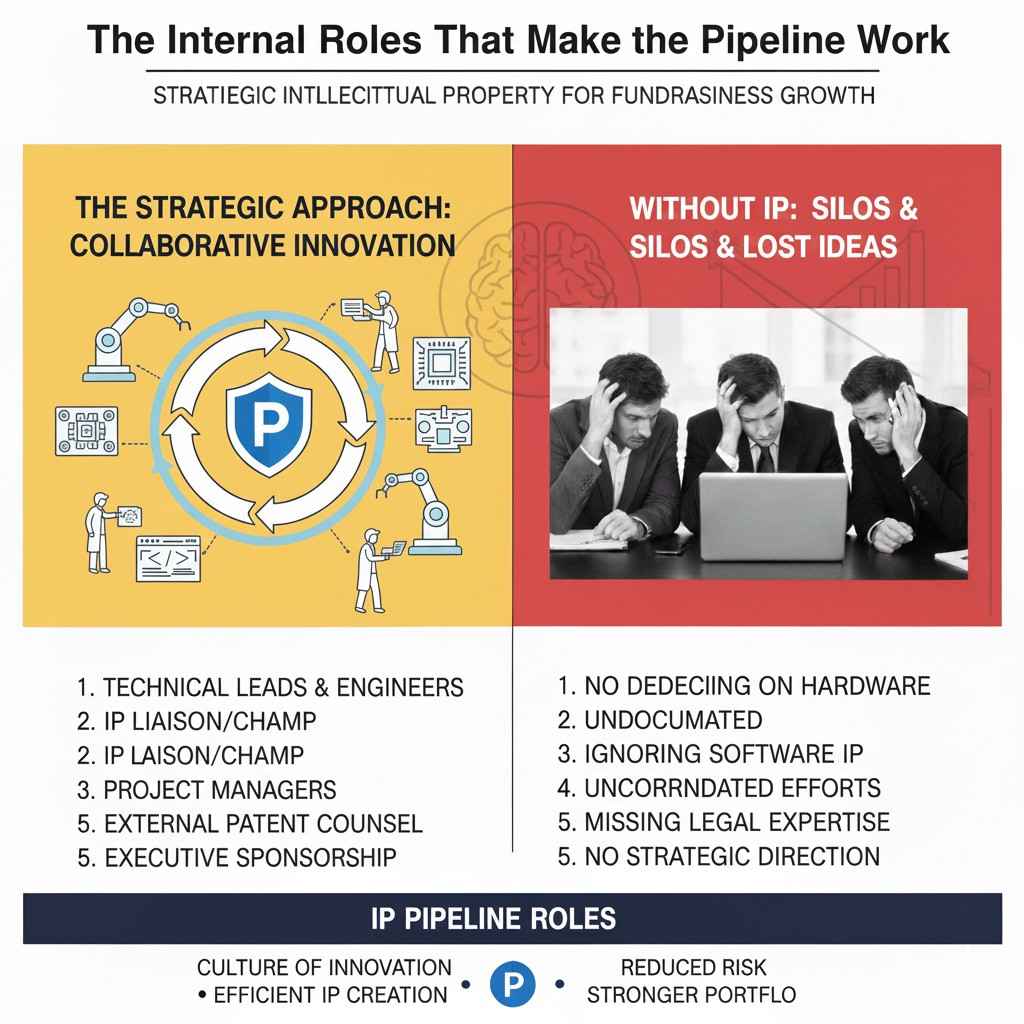
Robots face friction,cadence, reviews disclosures for completeness, and makes sure decisions turn into actions. They also protect the team from busywork by keeping the process simple.
In many startups, the owner is a CTO or a senior engineer who has both technical depth and enough authority to set habits. If the owner is too junior, the system becomes easy to ignore.
A small review group keeps standards high
You do not need a big committee. You need a few people who can judge novelty and business value quickly. That usually means one technical leader, one product-minded leader, and counsel or an IP advisor when needed.
This group should be able to say, “This is core,” “This is nice but not worth filing,” or “This is good, but we need more detail.” That clarity keeps the pipeline clean.
Counsel turns your captured detail into strong filings
Patent counsel is most effective when they are not starting from zero. The pipeline feeds them the right content so they can focus on strategy and claim scope.
When counsel is involved early enough, they can also guide your team on what to capture next time. Over a few cycles, your disclosures get better, and drafting becomes smoother.