
If you are building in AI, robotics, or deep tech, your product will not stay still. Your code changes. Your model improves. Your robot learns new moves. Your hardware gets smaller, faster, cheaper. And every time the product shifts, your risk shifts too—because what you protected six months ago may not fully cover what you sell today.
That is why smart startups do not treat a patent filing like a one-time event. They treat it like a living plan.
Two of the most useful tools for expanding patent coverage over time are called continuations and divisionals. The names sound legal and heavy, but the idea is simple: you file once, then you keep building coverage from that same starting point—without losing your earliest filing date.
That “early date” is a big deal. In patents, dates matter. If you file first, you often win. If a competitor publishes or files after your date, your earlier filing can help block them. So when you can keep using that early date while adding more claims, you get more leverage without starting from zero.
This matters even more for startups because you are always under pressure. You may not have time to file a brand-new application every time you improve the system. You may not have budget to do that either. But you still need a real moat, not just a pitch deck story.
Continuations and divisionals help you do three things that founders care about:
You can keep your options open as the product evolves.
You can push for broader coverage when you learn what the market values.
You can create multiple layers of protection so copycats have fewer easy paths.
Here is the key: these tools work best when your first filing is done the right way. If the first application is thin, unclear, or too narrow, you cannot “grow” much from it later. But if it is written with care—covering core ideas, strong variations, and real technical detail—then continuations and divisionals let you expand that base into a full fence around your product.
This is exactly the kind of planning Tran.vc helps founders do early. Tran.vc invests up to $50,000 in in-kind IP and patent services so technical teams can protect what matters while they build. If you want to turn your inventions into assets investors respect—and competitors fear—you can apply here anytime: https://www.tran.vc/apply-now-form/
Continuations and Divisionals: How Startups Expand Patent Coverage
Why this matters for startups
Startups rarely build the final product on the first try. The first version is usually a test, and the second version is what customers actually want. By the time you reach a real market, the system has changed in ways you could not fully predict early on.
That is normal. But it creates a quiet problem. If your patent plan is fixed while your product keeps moving, the gap between what you protect and what you sell can grow fast. That gap is where copycats live.
Continuations and divisionals exist to close that gap. They help you expand patent coverage without starting over, and they let you turn one strong early filing into a bigger, stronger shield over time.
The simple idea behind “expanding coverage”
A patent is not only the story of your invention. It is also a set of legal boundaries called claims. Those claims define what others cannot do without your permission.
Expanding coverage usually means adding more claim angles. You may want to protect the core method, the training pipeline, the robot control loop, the sensor fusion logic, the safety system, or the deployment setup.
The best time to do all of this is not always “right now.” Early on, you may not know which angle will matter most. These follow-on filings give you room to learn first, then claim smarter later.
A quick note before we go deeper
Continuations and divisionals are not the same thing. They are related, and they often show up in the same patent family, but they solve different problems.
If you mix them up, you can waste time, money, and years of advantage. If you use them correctly, you can build a clean, layered patent fence around your product.
Tran.vc helps founders design this kind of plan early, so every filing supports the next one. If you want that level of support, you can apply anytime at: https://www.tran.vc/apply-now-form/
Start with the base: the first application is the “root”
Think of the first filing like a tree trunk
Your first patent application is the root and trunk for everything that comes later. Continuations and divisionals grow out of that first filing. They borrow its earliest date and rely on its technical detail.
This is why early quality matters so much. If your first filing describes only one narrow version of the invention, you will struggle to expand later. If it captures the bigger idea and several good variations, you have room to grow.
A strong first filing does not need to predict the future perfectly. It just needs to describe the invention broadly and clearly enough that later claims can still be supported by what you wrote at the start.
What “supported” really means in plain words
When you file later, you cannot magically add new technical content and pretend it was there from day one. The later filing can only claim what the original application already explains.
So “support” means this: if you point to a later claim and ask, “Where does the first filing teach this?”, you must be able to show it. Not vaguely. Not with hand-waving. With real description.
For AI and robotics teams, support often comes from describing multiple system versions, multiple data flows, and multiple ways to implement the same goal. It also comes from describing what you are doing, why it works, and what parts can change without breaking the idea.
Why founders should care about this early
If you are raising money, investors may not read your patents word-for-word. But strong IP changes the feel of a deal. It signals seriousness. It reduces risk. It makes competitors less confident.
Also, a good root filing gives you leverage later. You can add claims when you learn what the market values, and you can do it while keeping the early date that makes your position harder to attack.
If you want help shaping that root filing so it can support future growth, Tran.vc is built for that. Apply here anytime: https://www.tran.vc/apply-now-form/
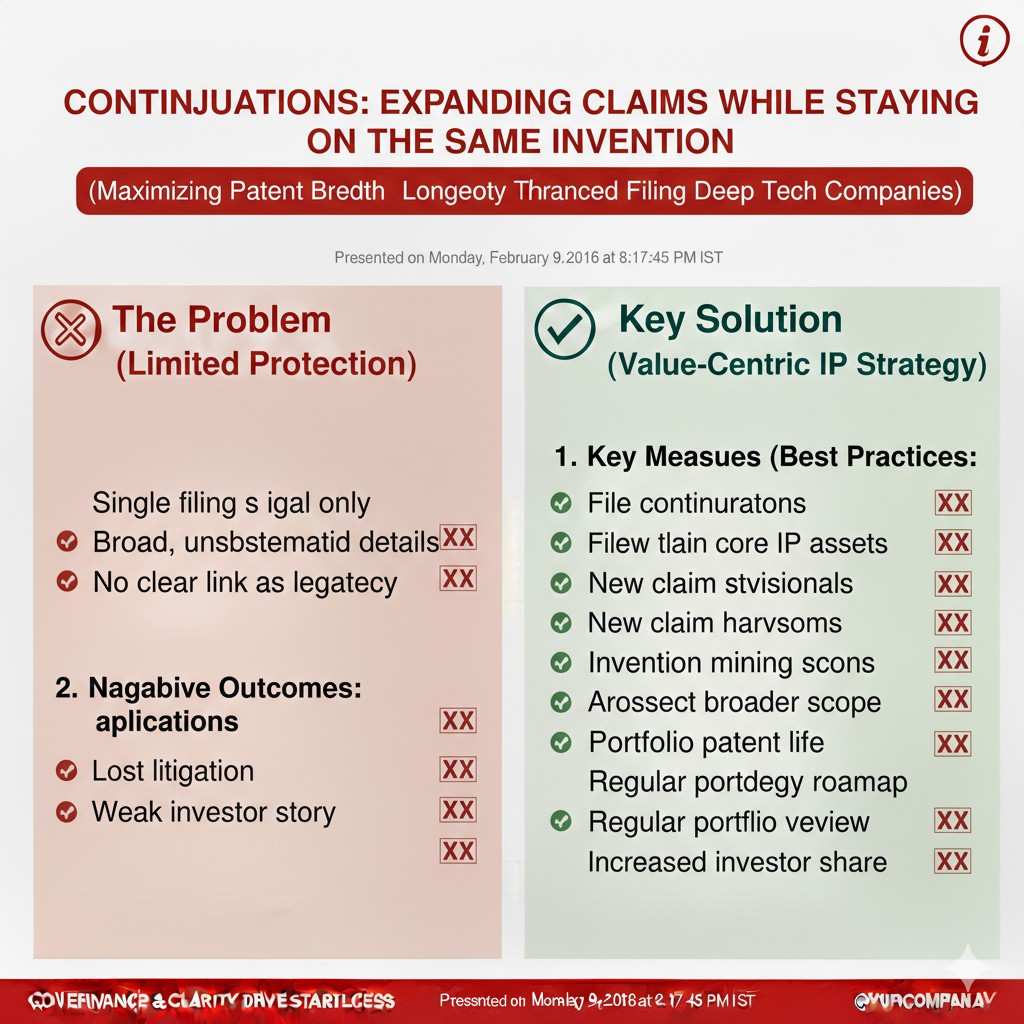
Continuations: expanding claims while staying on the same invention
What a continuation is, in simple terms
A continuation is a new patent application that keeps the same core description as the earlier filing, but asks for a different set of claims.
Think of it like this: the invention story stays the same, but you redraw the boundary lines. You might aim broader, narrower, or just different. The point is to get more coverage angles without changing the underlying disclosure you already filed.
This is one of the most practical tools for startups because it lets you adapt your patent protection to what you learn after you ship, sell, and see competitors react.
What problem continuations solve for startups
The early stage is full of uncertainty. You do not always know which feature is the “money feature.” You may think the value is the model, but customers may love the data pipeline. You may think the value is the robot motion planning, but the real differentiator could be calibration or safety recovery.
A continuation lets you adjust your claims once you know what matters. You can point your protection at the parts that drive adoption, margins, or defensibility.
It also helps when the patent office pushes back. If you get rejections, you may choose to narrow claims to get something granted. A continuation lets you still pursue broader claims separately, instead of giving them up forever.
A continuation does not mean “new invention”
This is where people get confused. A continuation is not for adding brand-new features you invented later. It is for claiming what you already described in the original filing, but did not claim in the first round.
So if your original filing already described three different ways to do sensor fusion, but you only claimed one way, a continuation can be used to claim the other two ways later.
If the original filing never described those other two ways, a continuation cannot rescue you. You would need a new filing, often called a continuation-in-part, which is a different tool with different tradeoffs.
How continuations create “layers” of protection
Many founders believe they need one perfect patent. In practice, strong IP often looks like a set of patents that surround the product from multiple angles.
Continuations help you build those angles over time. One patent might focus on system claims, another on method claims, another on training flow, another on deployment, and another on real-time control logic.
This layered approach makes it harder for competitors to design around you. Even if they avoid one claim set, another may still catch them.
When continuations are most useful
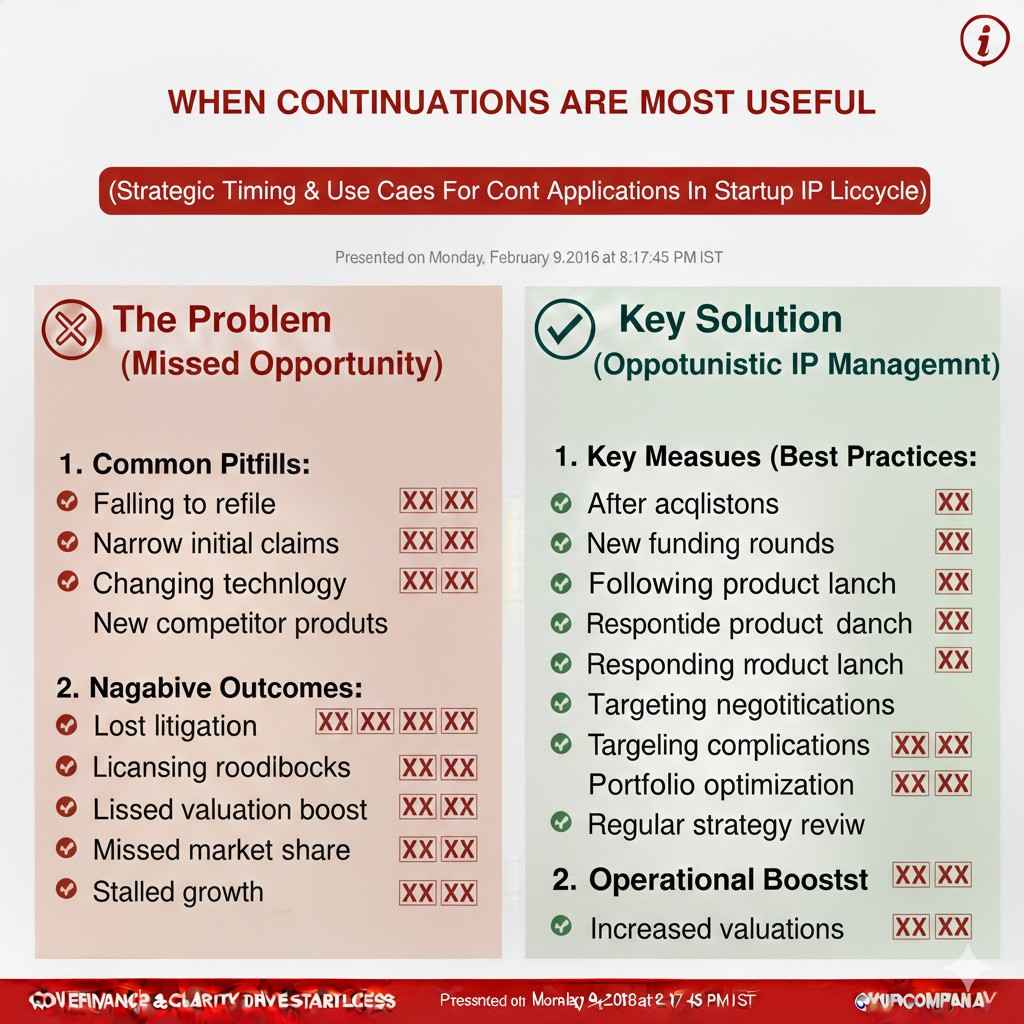
Continuations shine when your product is moving fast, your market is becoming clearer, and you expect competitors to copy what works.
They are also helpful when you want flexibility in fundraising. A growing patent family signals momentum, and it can support stronger conversations with seed investors who care about defensibility.
If you want to build that kind of family deliberately, Tran.vc supports founders with patent strategy and filings as in-kind services, up to $50,000. You can apply here anytime: https://www.tran.vc/apply-now-form/
Divisionals: splitting inventions when the patent office says “pick one”
What a divisional is, in simple terms
A divisional is a new patent application that comes from an earlier application because the patent office says your original filing covers more than one invention.
Instead of letting you claim everything together, they require you to split it. You keep one group of claims in the original application, and you move the other group into a divisional.
This is not a punishment. It can actually be a strategic advantage if handled well, because it can lead to multiple patents that each protect a different part of the system.
Why divisionals happen so often in deep tech
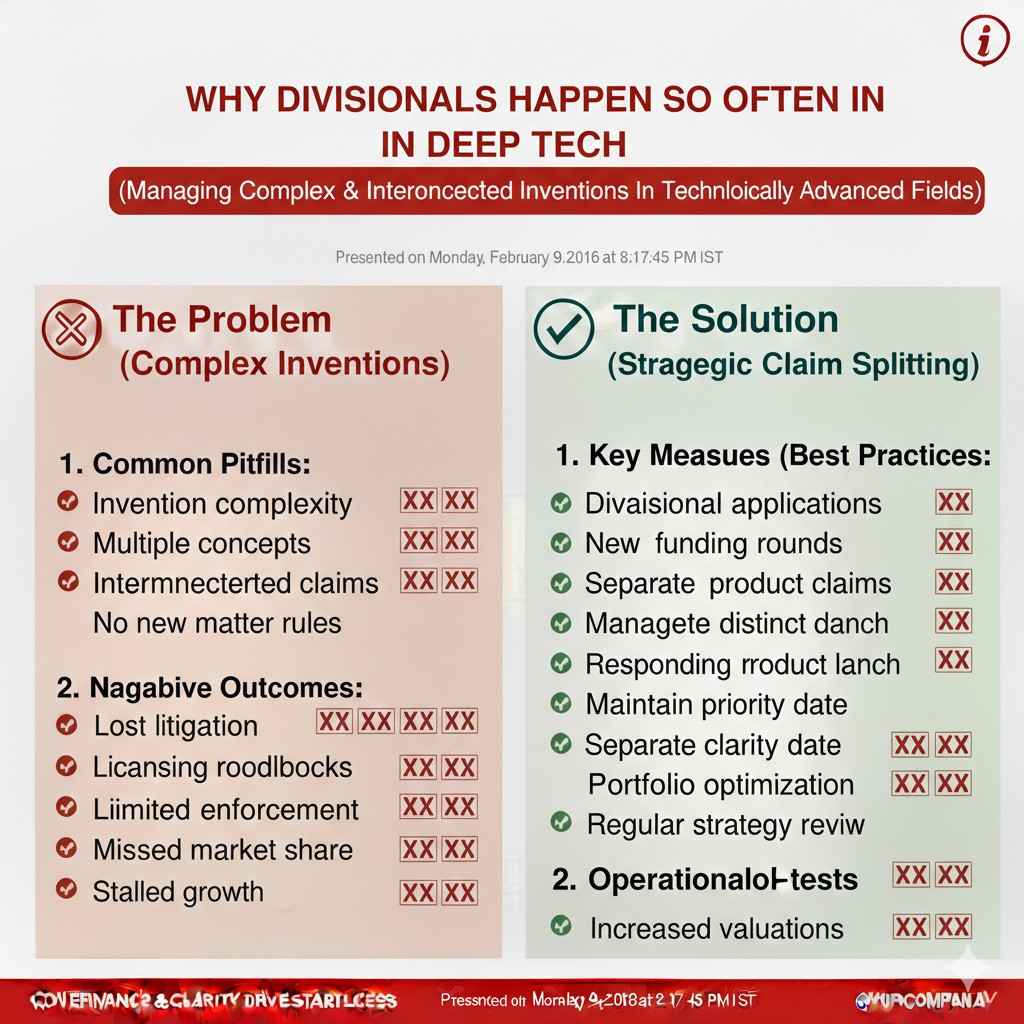
AI and robotics systems are naturally multi-part. A single product may include hardware structure, sensor setup, control logic, learning loop, safety layer, and a cloud service for updates.
When you write a strong first application, you may describe and claim several of these parts. The patent office may say they are not one invention, and they may issue what is often called a restriction requirement.
At that point, you decide which claims stay in the original filing and which claims get “divided out” into a divisional application.
How a divisional is different from a continuation
This distinction matters. A continuation is usually your choice for expanding claim angles on the same invention. A divisional is usually triggered by the patent office telling you to separate inventions.
A continuation is about different claiming strategies around one core inventive concept. A divisional is about splitting distinct inventive concepts that were originally filed together.
In real startup terms, a continuation might protect different ways to do the same robot path planning method. A divisional might separate robot path planning from a novel gripper design, because the office treats those as different inventions.
Why divisionals can be a hidden advantage
If the office forces you to split, you may end up with multiple patents instead of one. That can give you broader business coverage across the product stack.
It can also help in enforcement later. If each patent focuses on one clear invention, it can be easier to show infringement and easier to explain value to investors or acquirers.
Divisionals can also keep options open. You can continue working on the main case while separately pursuing protection on the divided subject matter.
The risk if you mishandle a divisional
The main risk is letting valuable subject matter die because it gets separated and then ignored. If you do not file the divisional in time, you may lose the chance to claim that part of the invention while keeping the early date.
Another risk is choosing the wrong group to pursue first. If you pick the weaker angle as the main case and push the stronger angle into a divisional you never fund, you may end up with a granted patent that looks nice but does not protect the real business value.
This is where strategy matters more than paperwork. Tran.vc helps founders make these choices with experienced IP support, so the strongest business angles get protected first. Apply here anytime: https://www.tran.vc/apply-now-form/
Continuations vs divisionals: the clearest way to think about it
“Same invention, new claim approach” vs “split inventions, keep both”
A continuation is best understood as a new attempt to claim the same disclosed invention in a different way. You are not splitting because you want to. You are expanding because it is smart.
A divisional is best understood as a split forced by the office because your application contains multiple inventions. You are not changing the story. You are separating the inventions so you can protect each one cleanly.
Both can keep the earliest filing date, which is the main reason they are powerful for startups.
How they affect your patent family over time
Continuations often create a chain where the same core invention gets claimed from multiple angles. That is how you build a layered fence around one key differentiator.
Divisionals often create branches where different inventions from the same original filing become separate patents. That is how you protect multiple parts of a complex system without losing any of them.
In practice, a strong startup patent portfolio often includes both. The best teams plan for that early, even if they do not file every follow-on case right away.
How this ties back to fundraising and leverage
Investors may not ask for “a continuation strategy” using those exact words. But they do look for defensibility, and they do respond to clear signals of long-term advantage.
When you can show a roadmap for expanding coverage, you are not just saying “we have a patent.” You are saying, “We know what matters, we know how to protect it, and we are building assets that get stronger over time.”
If you want that kind of plan without burning cash, Tran.vc is designed to help. Apply here anytime: https://www.tran.vc/apply-now-form/
Real Startup Scenarios: When to Use Continuations and Divisionals
Scenario One: Your AI model improves after launch
You filed your first patent when your AI model was still in beta.
At that time, you described the core architecture, the training loop, and the way your system processed input data.
Six months later, you release version two.
The accuracy jumps. Latency drops. Customers now care deeply about one specific part of your pipeline that was only one section in your original filing.
This is where a continuation becomes powerful.
If your first application described multiple training approaches, loss functions, or data processing paths, you can now file a continuation that focuses claims directly on the part customers value most.
You are not changing the invention.
You are sharpening the boundary around the part that now drives revenue.
Instead of filing something brand new and losing your early date, you build on your original foundation.
This is how startups turn learning into leverage.
Scenario Two: Your robotics system has both hardware and control logic
Imagine you built a robotics platform with a novel gripper and a unique motion control algorithm.
You filed one strong patent application covering both.
The patent office reviews it and says the hardware and the control logic are separate inventions.
They require you to choose one group of claims to examine first.
Now you must decide.
You may keep the motion control claims in the original case and move the gripper claims into a divisional.
Or you may do the opposite, depending on which part gives you stronger market position.
This is not just a legal choice.
It is a business choice.
If your competitive edge is mostly in the software stack, you might push that first.
If the hardware is harder to copy and central to your value, you may prioritize that instead.
A divisional allows you to protect both, but you must be intentional about timing and funding.
Scenario Three: You narrow claims to get something granted
Many founders believe a patent must be broad to be valuable.
That is not always true.
Sometimes you narrow claims during examination to secure allowance faster.
This can help when you are fundraising or entering partnerships and want a granted patent in hand.
But narrowing does not mean surrendering your broader vision.
A continuation lets you keep pursuing broader claims while the narrower version moves toward grant.
You split your strategy without losing ground.
This approach balances speed and ambition.
You secure an asset today while still fighting for wider coverage tomorrow.
Scenario Four: A competitor appears
You notice a competitor entering your market.
Their product looks similar but slightly adjusted.
When you review your original patent claims, you realize your application described variations that could cover their design, but you never claimed those variations.
A continuation gives you a second chance.
If those variations are properly described in the original filing, you can craft new claims aimed at closing that design-around path.
You are not reacting emotionally.
You are using the flexibility built into your original filing.
This is why early depth in drafting matters so much.
Without it, you have nothing to build from.
Tran.vc works closely with technical founders to draft early filings that anticipate this kind of evolution.
That preparation makes later continuations far more powerful.
You can apply anytime here: https://www.tran.vc/apply-now-form/