
Most founders pick equity splits the same way people guess a number in a jar.
They sit in a coffee shop. They feel the energy. They remember who had the idea first. They think about who is quitting their job. They try to be “fair.” Then they pick a split—50/50, 60/40, 70/30—and hope it still feels fair two years later.
But equity is not a feeling. Equity is a long-term contract.
And early-stage work is not steady. One cofounder may sprint for six months, then slow down. Another may start slow, then carry the company through a hard year. In robotics and AI, the swings can be even bigger: the person doing core research might be vital at first, while the person turning prototypes into a product might become vital later.
So a fixed split, made in week one, has one big flaw: it locks in a guess.
Dynamic equity splits are a smarter option. They replace guessing with a clear, living system that updates as people actually contribute. When the work changes, the split changes too. This reduces resentment, helps you keep good people, and makes hard talks easier because you are not fighting over opinions. You are following a rulebook you all agreed to.
If you are building a deep tech company and you want to avoid a slow-burning equity conflict, this is worth your time.
And if you are also thinking about protecting what you are building—your code, models, methods, hardware designs, and the little “tricks” your team learned the hard way—Tran.vc can help you turn that work into defensible IP early, without giving up control too soon. You can apply any time here: https://www.tran.vc/apply-now-form/
Why fixed splits break in real life
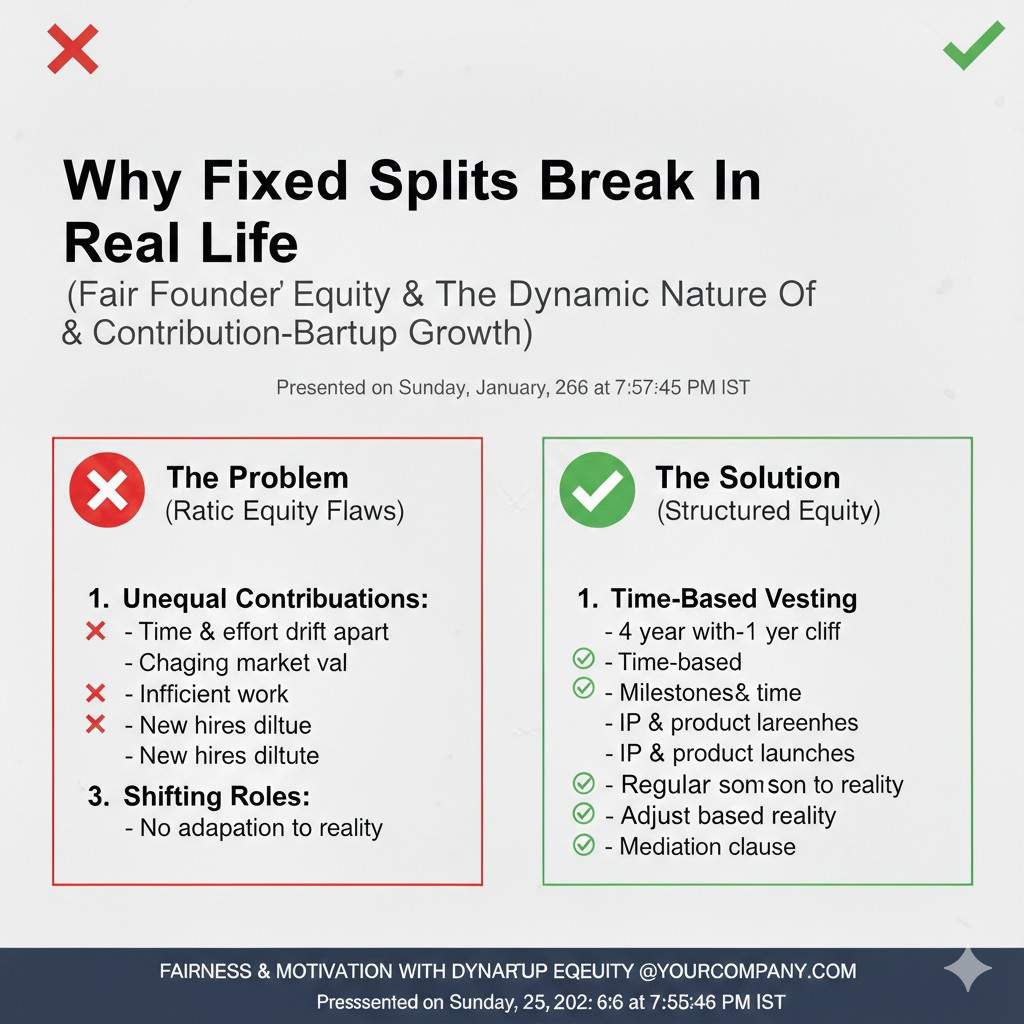
A fixed split assumes the future will match your early plan.
But early plans change fast.
A common story goes like this:
Two friends start a company. One is the “idea” person. The other is the “builder.” They do 50/50. Three months later, the builder is working nights and weekends, shipping demos, writing code, talking to early users, and fixing bugs. The idea person is busy at their job and helps “when they can.” The builder starts to feel trapped. They are doing most of the work, but they cannot change the deal without a painful fight.
Another common story:
A technical founder gives a big chunk of equity to a “business” cofounder early because they feel they need sales. Six months later, the product is not ready for sales. The business cofounder has little to do. They get bored. They leave. Now the company has a large dead equity block sitting on the cap table, which makes later hiring harder and fundraising harder.
These are not rare stories. They are normal. It happens because the early stage is full of unknowns.
Fixed splits also break because they reward timing, not value.
If one person joins first, they often get more equity, even if their long-term input is smaller. If one person is loud or confident, they may negotiate better. If someone is conflict-avoidant, they may accept less than they should. None of these things track the real question: “Who is creating the company’s value over time?”
Dynamic equity splits aim at that real question.
What “dynamic equity” really means
A dynamic equity split is a way to allocate founder and early team equity based on contribution, as it happens, using a shared method.
Instead of saying, “You get 40% and I get 60%,” you say something closer to:
“We will track what we each put in. We will convert it into a simple score. Equity will match the score.”
This does not mean you track every minute like a timesheet. That would be painful and would ruin trust. The goal is not to become a compliance office. The goal is to build a system that is:
- clear enough to be fair
- simple enough to run
- flexible enough for reality
The benefit is huge: the split becomes a result, not a debate.
You stop arguing about what someone “deserves.” You look at what they actually did, and what they actually risked.
The real problem dynamic equity solves: the “value gap”
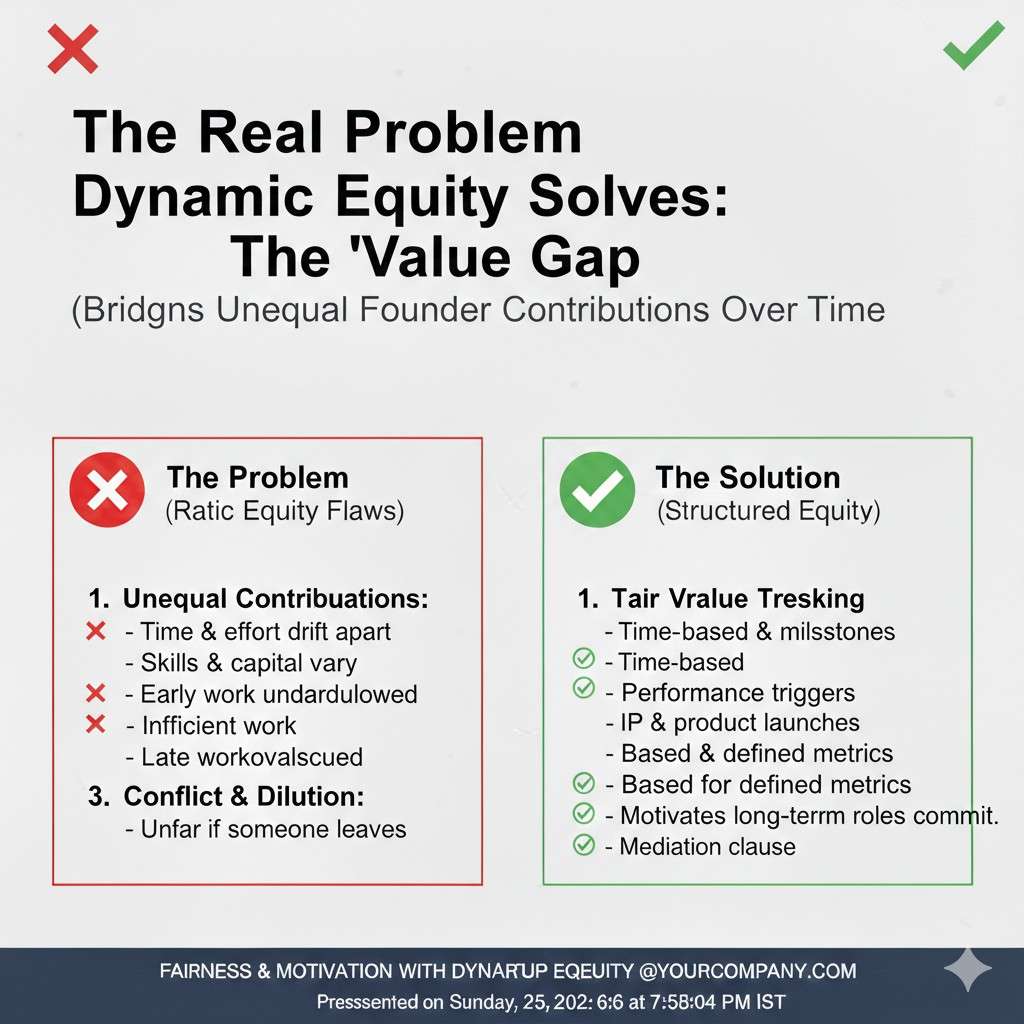
Equity fights usually come from a value gap.
A value gap happens when one person believes they are putting in more than they are getting back.
At first, the gap is small. People ignore it. They tell themselves it will even out. They focus on building.
Then a bad month hits. A demo fails. A customer ghosts. A grant gets rejected. Stress goes up. And the gap gets loud.
This is the moment where founder relationships crack. Not because people are evil. Because they are tired and scared, and the deal feels wrong.
Dynamic equity reduces the value gap because the system updates as the work updates. When someone carries the load, the split moves in their favor. When someone steps back, the split stops moving for them.
It is not perfect. Nothing is. But it is far better than locking a guess in stone.
The simplest way to think about contribution
In the earliest stage, contributions usually fall into a few buckets:
Time: Who is doing the work day to day?
Cash: Who is paying for tools, prototypes, travel, legal, cloud?
Risk: Who quit their job? Who is living off savings? Who is taking the biggest personal hit?
Skills: Who is doing hard work that would cost a lot to hire?
Relationships: Who is opening doors that truly move the company forward?
The mistake many teams make is treating these as equal without thinking.
For example, “I introduced you to an investor once” is not the same as “I built the model training pipeline and ran experiments for four months.” Both matter, but they do not carry the same weight.
Dynamic equity forces you to decide, up front, how you will value these inputs. That decision is the real work.
When you do it early, calmly, you avoid doing it later during a fight.
Two common styles of dynamic equity
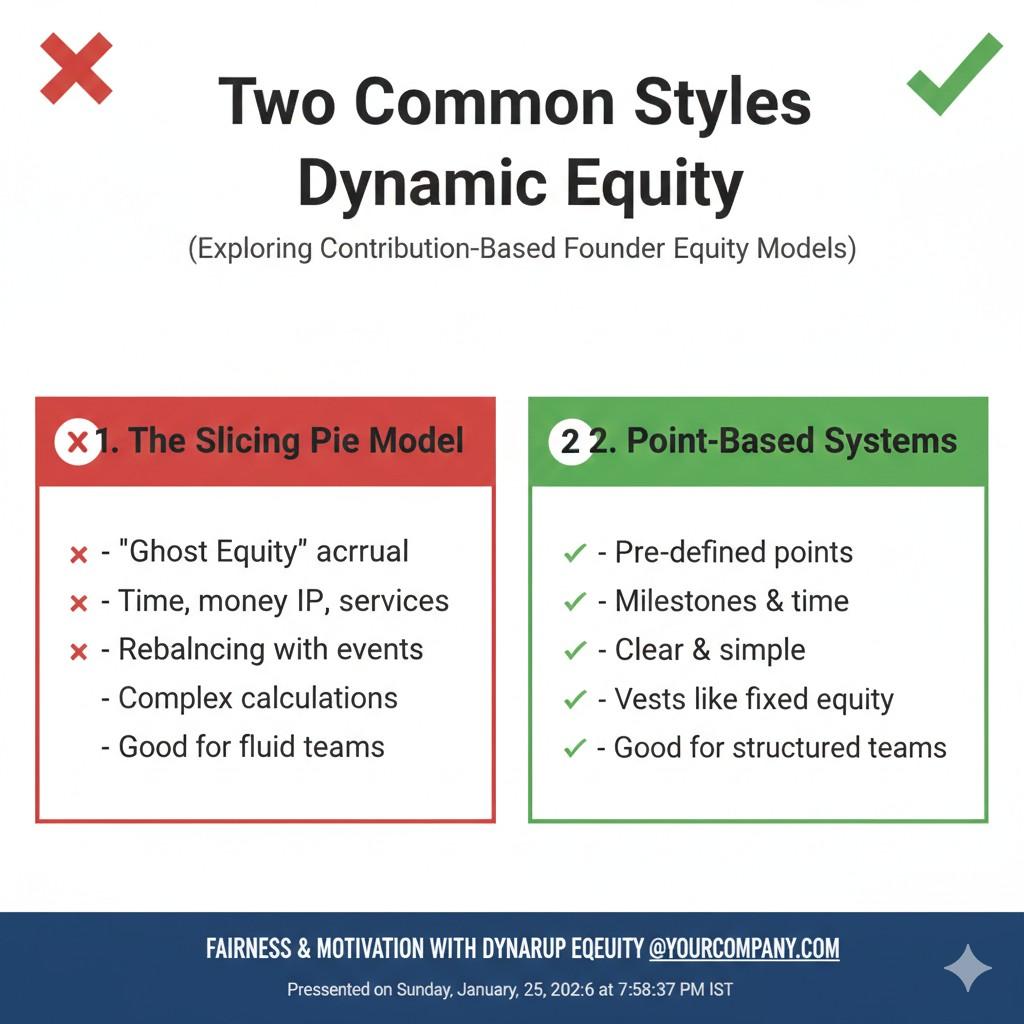
There are many ways to do this. In practice, most teams end up in one of two styles.
Style one: “Points that convert to equity later”
You track contributions as points. Points accumulate over time. At a set moment—often when you raise a priced round, or when you incorporate and set founder stock—you convert points into a final split.
This style works well when you are still forming the team and you do not want to commit to a final equity split yet. It is also useful when you have part-time contributors early.
The key is to have a clear conversion moment. Otherwise, the system can drag on too long.
Style two: “Equity moves over time”
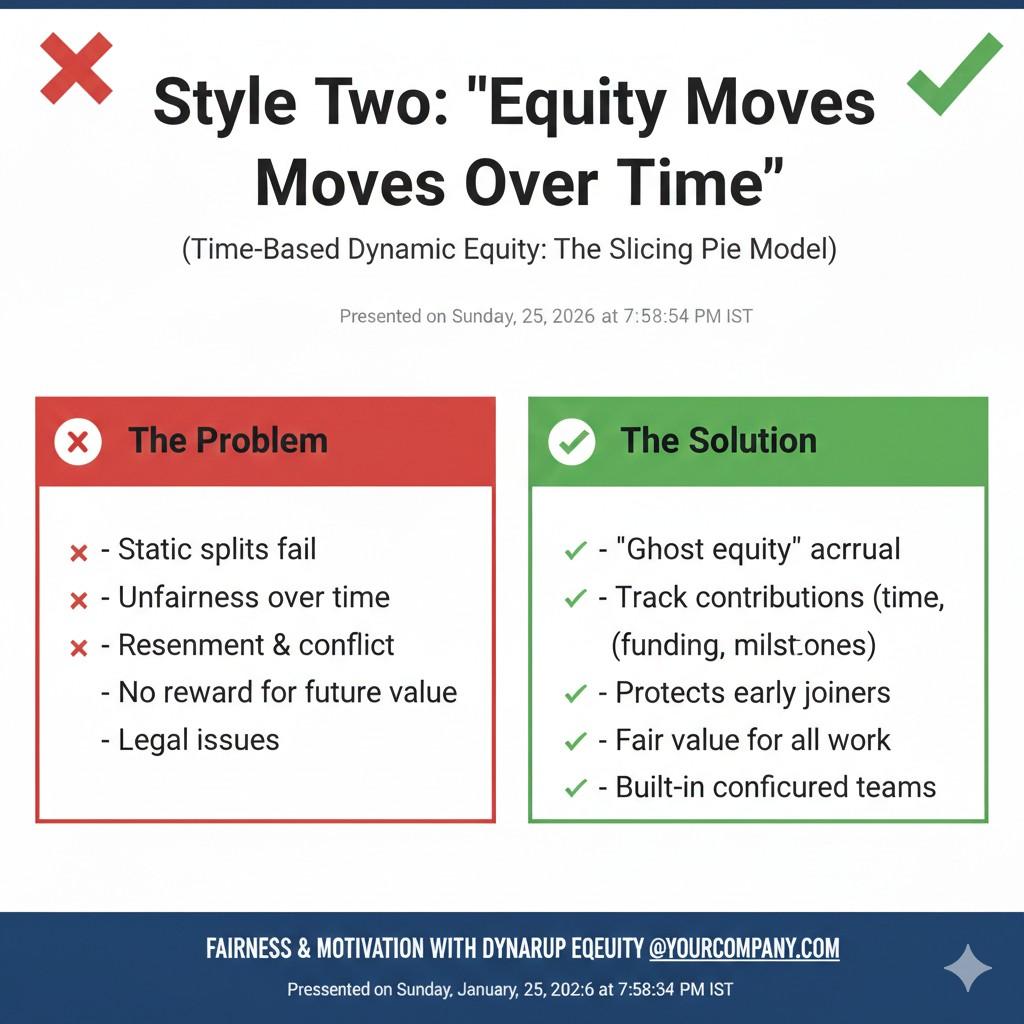
You set up a structure where equity can shift based on ongoing contribution. This is more complex legally and can be tricky to run cleanly, but it can be done with the right setup and counsel.
Most very early teams choose Style one because it is easier.
A tactical starting framework you can actually use
Here is a practical approach many founder teams can run without making it their full-time job.
You pick a “unit” that is easy to measure, and you adjust it with a multiplier that reflects risk.
One simple unit is cash cost. You can translate time into a cash cost by using a fair market rate (not a Silicon Valley fantasy rate, but a realistic early-stage rate). Then you apply a risk multiplier.
Example:
- If a founder works full-time and takes no pay, you estimate what it would cost to hire them for that work.
- If they also quit a job and carry higher risk, you multiply that contribution by a risk factor.
- If someone is part-time and still employed, their risk factor is lower.
This is not about punishing anyone. It is about matching equity to what people truly put on the line.
A founder who quits a job is not “better,” but they are taking a bigger bet. Dynamic equity has room to reflect that.
The system becomes something like:
Contribution Score = (Time Value + Cash Value + Key Expenses Paid) × Risk Multiplier
You do not need a hundred categories. In the beginning, keep it simple and consistent.
The conversation you must have before you track anything
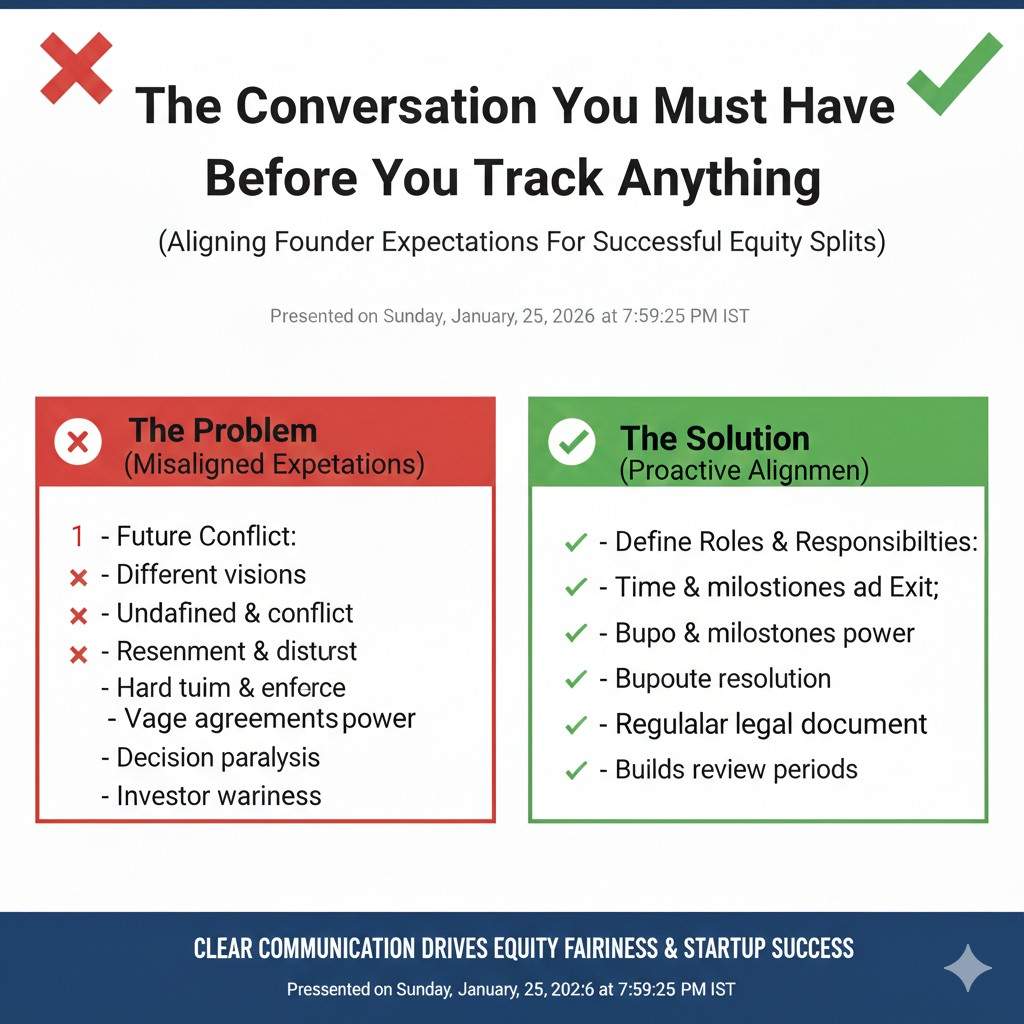
Dynamic equity only works when you agree on the rules while you still like each other.
This is the talk to have:
- What are we building, and what does “done” look like in the next 3–6 months?
If you cannot agree on near-term targets, equity tracking will feel random.
- What counts as contribution?
Be specific. “Helping” is not a category. “Shipping the demo by March 10” is.
- How will we value time?
Pick a rate per role, or a single blended rate. Your goal is fairness, not perfection.
- How will we value cash?
Usually cash is counted at face value. But you should decide if you treat it like a loan (paid back later) or like a contribution that earns equity.
- How will we handle risk?
This is where most teams avoid the topic because it feels personal. Do not avoid it. Talk about it with respect.
- When do we stop being dynamic?
At some point you will want stable ownership for fundraising and hiring. Pick the moment now.
- What happens if someone leaves?
You still need vesting and clear exit rules. Dynamic equity does not replace vesting. It works with vesting.
This is not legal advice, but as a practical founder move: write your rules down in plain language, even if you later ask a lawyer to formalize it.
A shared doc that everyone signs and dates is better than a vague memory.
The hidden benefit: it makes founder roles clearer
A dynamic system forces you to define roles with less fiction.
If someone says they are the “business cofounder,” but the next six months are all engineering, then dynamic equity naturally gives more weight to engineering work during that period. Later, if sales and partnerships matter more, the system will reflect that shift too.
This prevents a very common early-stage trap: giving a large slice of ownership for a role that is not yet needed.
In deep tech, timing matters a lot. Many companies do not need a full-time sales leader until the product is stable enough to sell. Many do not need heavy marketing until they have a clear user and a repeatable message.
Dynamic equity helps you match ownership to timing.
Where deep tech teams must be extra careful
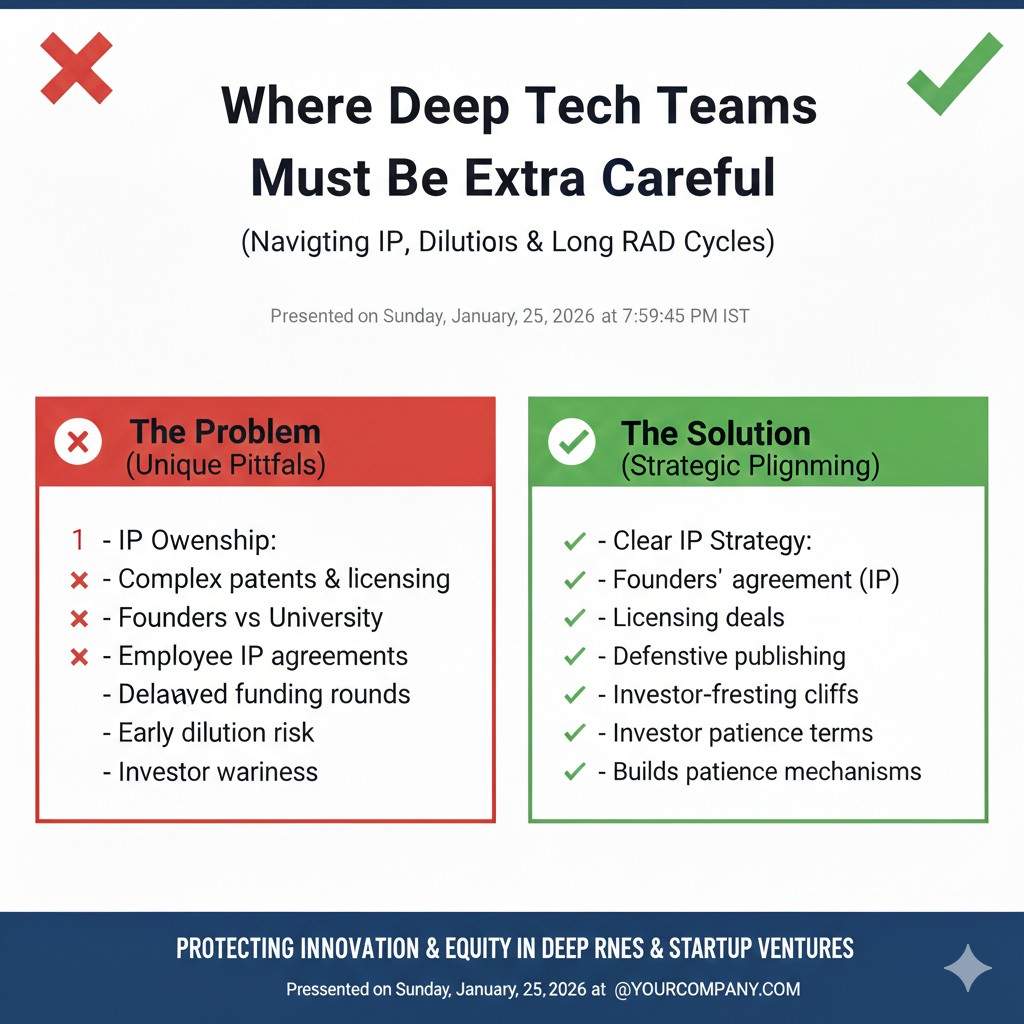
Robotics, AI, and other hard tech teams run into special equity issues:
Research and engineering work can be invisible to non-technical teammates. It may look like “nothing is happening,” when in fact you are de-risking the entire company.
Hardware work often has long lead times and many failed iterations. People can confuse slow progress with low effort.
IP creation is real value, but teams often forget to count it. A key invention, a key method, or a key system design can raise the ceiling of the company.
Dynamic equity can include IP work as a valued contribution. The key is to define it in a way that is not vague.
For example, “file a patent” is clear. “Think about patents” is not.
This is also where Tran.vc can help in a very direct way: we work with technical founders to turn real inventions into patent strategy and filings early, as in-kind IP services worth up to $50,000. If you want to build a moat while you build the product, apply here: https://www.tran.vc/apply-now-form/
The most common ways dynamic equity fails
Dynamic equity is not magic. It can fail if you run it poorly.
Here are the patterns that cause trouble:
People do not update contributions regularly.
If months pass, you will end up debating old work with bad memory. Set a rhythm. Even once a month is enough.
The system is too complex.
If it takes an hour per week, people will stop doing it. Keep it light.
The categories are unclear.
If people can game it, they will, even without meaning to. Good rules reduce “grey area.”
The team avoids hard talks.
Dynamic equity reduces conflict, but it does not remove the need for direct conversations about performance and commitment.
It is used as a weapon.
If someone starts saying, “I’m tracking your points,” you have already lost trust. The system should feel like a shared mirror, not a threat.
When you see these risks early, you can design around them.
A simple monthly process that keeps it clean
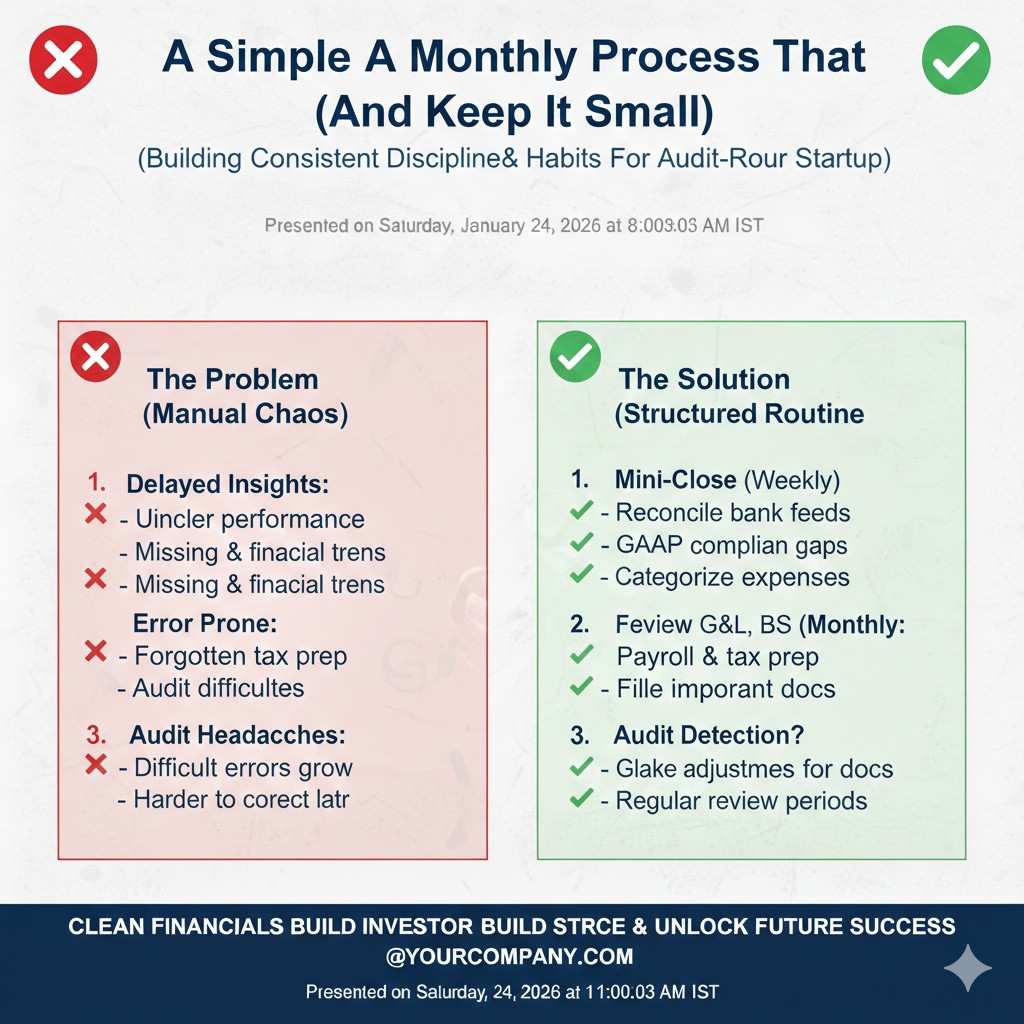
Here is a process that works well for many small teams:
Once a month, you hold a short “equity check-in.” Not long. Not dramatic.
Each person shares:
- what they did that month
- what they will do next month
- any changes in time, cash, or risk
Then you update your tracker. You do it together. In the open.
The goal is not to judge. The goal is to stay aligned.
This meeting often improves execution too, because it forces clarity.
Why investors tend to like this when done right
Investors do not want founder drama. They do not want a cap table full of dead equity. They do not want a team that will break under stress.
A well-run dynamic equity approach signals maturity.
It tells a story: “We handled fairness early, with structure, so we could focus on building.”
It also reduces the risk that a cofounder who contributed little owns a huge slice forever.
That matters when you need to hire. Strong hires want meaningful equity. If the cap table is clogged, you cannot offer it.
Tie-in: dynamic equity and IP strategy work well together
Dynamic equity is about aligning ownership with real value creation.
IP strategy is about turning value creation into a defensible asset.
When you do both, you get a powerful effect:
- your team feels the split is fair
- your company owns protectable assets early
- your story becomes stronger for seed investors
- your moat is real, not just talk
This is exactly the kind of foundation Tran.vc is built to support. We invest up to $50,000 as in-kind patent and IP services so technical founders can protect what matters before they raise a big priced round. Apply any time: https://www.tran.vc/apply-now-form/
Why fixed splits break in real life
The early handshake is not a real forecast
Most equity splits are decided when the company is still an idea and a shared rush of hope. At that moment, nobody knows what the next year will demand. Yet the split becomes permanent in people’s minds. When the work later shifts, the split does not. That mismatch is where quiet tension starts.
Equity guesswork rewards timing, not impact
A fixed split often pays the person who arrived first, spoke the loudest, or negotiated best. It can also reward the person who had a title, not the person who carried the hardest work. Over time, the team begins to notice the gap between what the company needs and what the cap table rewards.
The “I’m doing more” feeling grows slowly
At first, people try to be kind and flexible. They tell themselves it will balance out next month. Then deadlines stack up, sleep goes down, and stress goes up. That is when fairness stops being a soft topic and becomes a sharp one. If the split is locked, the only way to fix it is a hard conversation that feels personal.
Deep tech makes the gap wider
In robotics and AI, the work is uneven by nature. One month is heavy research. The next month is hardware fixes. Another month is data work and training runs. A fixed split assumes a steady pace, but deep tech rarely moves in a straight line. If the split cannot reflect those swings, resentment tends to show up faster.
What dynamic equity really means
A living split based on real work
Dynamic equity is a system where ownership matches contribution over time. Instead of locking a percentage on day one, you agree on rules and track inputs. When the inputs change, the outcome changes. This replaces opinion-driven debates with a shared method.
Not a timesheet, not a punishment
A good dynamic system does not turn founders into accountants. You are not tracking every message or every late-night idea. You are tracking meaningful contributions that move the company forward. The tone matters here, because the system should feel like a tool for trust, not a tool for control.
The split becomes the result, not the argument
When the rules are clear, the equity outcome is not something you “win.” It is something you earn through visible contribution. This reduces the need for repeated negotiation, because the system already contains the agreement. In many teams, this is the first time equity feels calm instead of emotional.
It works best before things get tense
The best time to set dynamic equity is when the team still has goodwill and patience. Once people feel wronged, any system can look like a trick. Early agreement is not just helpful, it is protective. It keeps the company from having to rewrite its foundation during a storm.
The real problem it solves: the value gap
What the value gap looks like in daily life
The value gap is the space between what someone believes they give and what they believe they receive. It can show up as small comments, missed meetings, or quiet withdrawal. People may still work, but their enthusiasm drops. That loss of energy is often more damaging than the split itself.
Why it turns into founder conflict
Founders do not fight because they enjoy conflict. They fight because the company is hard, and equity feels like the one thing that should be fair. When effort and reward look misaligned, every other problem feels bigger. A delayed bug fix turns into “I’m the only one who cares.” A missed call becomes “You don’t show up.”
Dynamic equity narrows the gap over time
When the split updates as work happens, the gap does not have as much room to grow. If one person carries the company for a season, the system reflects it. If someone steps back, their share stops growing as fast. This keeps fairness closer to reality, which keeps trust healthier.