
Most founders think fundraising comes first. You build a deck, you polish a demo, you meet investors, and you “talk about IP” in one slide near the end.
But in deep tech, AI, and robotics, that order can cost you leverage.
Because the minute you start fundraising, you start talking. And the minute you start talking, you start giving away pieces of what makes you different. Sometimes it’s not obvious. It sounds like normal founder talk: how your model works, how your robot learns, how you reduce latency, how you detect defects, how you plan motion, how you fuse sensors, how you keep it safe.
To you, it is “just explaining the product.”
To the world, it is a free map.
Filing before fundraising is not about being paranoid. It is about being prepared. It is about turning the work you already did into an asset you can point to with confidence. It is about walking into investor meetings knowing you are not forced to hide your best ideas or water down your story. It is about raising with strength instead of fear.
This article is about what to do before you fundraise, and why it matters. Plain and simple. No legal fog. No fancy terms. Just the steps that protect your edge and help you raise on better terms.
And if you want help with this, Tran.vc can support you with up to $50,000 in in-kind patent and IP services for AI, robotics, and other technical startups. You can apply anytime here: https://www.tran.vc/apply-now-form/
Why filing first changes the whole game
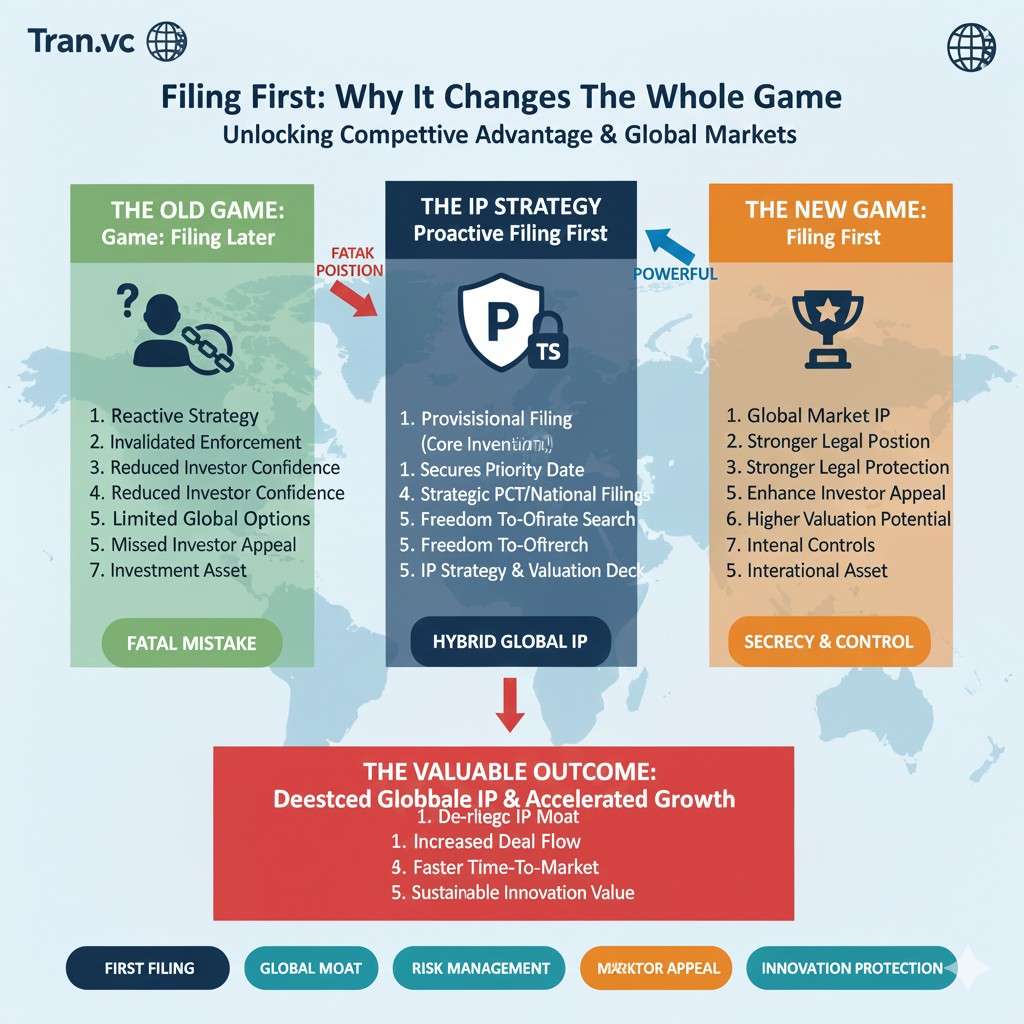
Let’s start with the real reason this matters: fundraising is a communication event.
Even if every investor signs an NDA (most will not), you still end up sharing key parts of how you work. Over time you speak to 20, 40, sometimes 80 people. Partners. Analysts. Advisors. “Friendly” founders. Pilots. Customers. Recruit candidates. You do it because you must. Early-stage teams sell the vision before the product is perfect.
If you wait to file until after you raise, you are doing it in the most risky period of your company. The period where you talk the most and protect the least.
Filing early gives you three concrete benefits that show up fast.
First, it lets you speak freely. When you have a filing on record, you can tell the full story of what makes you special without feeling like you have to keep your mouth shut. You can be direct and clear. That alone improves fundraising outcomes because investors do not fund vague stories. They fund clear technical advantage.
Second, it gives investors a reason to believe the moat can last. Deep tech investors often say, “We like the team, but can they hold this lead?” A good IP plan answers that question. Not with empty claims, but with proof that you are building defensible ground.
Third, it keeps your options open. Maybe you raise VC. Maybe you do grants. Maybe you grow on revenue first. Maybe you partner with a bigger company. In every one of those paths, having filings early makes your company easier to back, easier to value, and harder to copy.
If you are building AI or robotics, your risk is not just that someone steals your code line by line. The bigger risk is that a strong team at a well-funded company hears your approach and builds a similar system in a cleaner, faster way. They do not need to copy you to compete. They only need to understand the idea.
Filing does not stop all competition. But it does stop the lazy copy. It can slow the fast followers. It can give you a clear place to stand. And it can turn your invention into something that can be licensed, defended, or used in deals.
“But we’re too early for patents” is often the wrong belief
A lot of founders delay because they think patents are for later. They say things like:
- “We need product-market fit first.”
- “We don’t have enough to file.”
- “We’re still changing things.”
- “Our tech is not final yet.”
- “We’ll do it after the seed round.”
Here is the truth: the best time to file is often when the core method becomes clear, even if the product is not finished.
Patents are not about “final code.” They are about the new method or system you created. The thing you do that others do not. The unique steps that make the outcome better, faster, cheaper, safer, or more reliable.
In AI, the “thing” can be how you train, how you label, how you reduce data needs, how you compress, how you deploy, how you do guardrails, how you explain, how you detect drift, how you fuse signals, how you adapt, how you personalize, how you do retrieval, how you do tool use, how you keep privacy.
In robotics, it can be how you sense, plan, act, calibrate, align, detect failure, recover, reduce power, reduce weight, improve gripping, improve safety, improve timing, coordinate multiple robots, or handle edge cases.
If you have built something and it works, even in a rough form, you likely have enough to file.
Also, filing does not mean you are locked. A smart filing strategy expects change. It aims to cover the core idea broadly, then build around it as you learn. Early filings can be followed by later filings. Think of it like placing the first stake in the ground.
If this already feels like something you want help with, you can apply to Tran.vc here: https://www.tran.vc/apply-now-form/
They invest up to $50,000 in in-kind patent and IP services so you can build your moat before you raise.
What “filing before fundraising” really means in practice
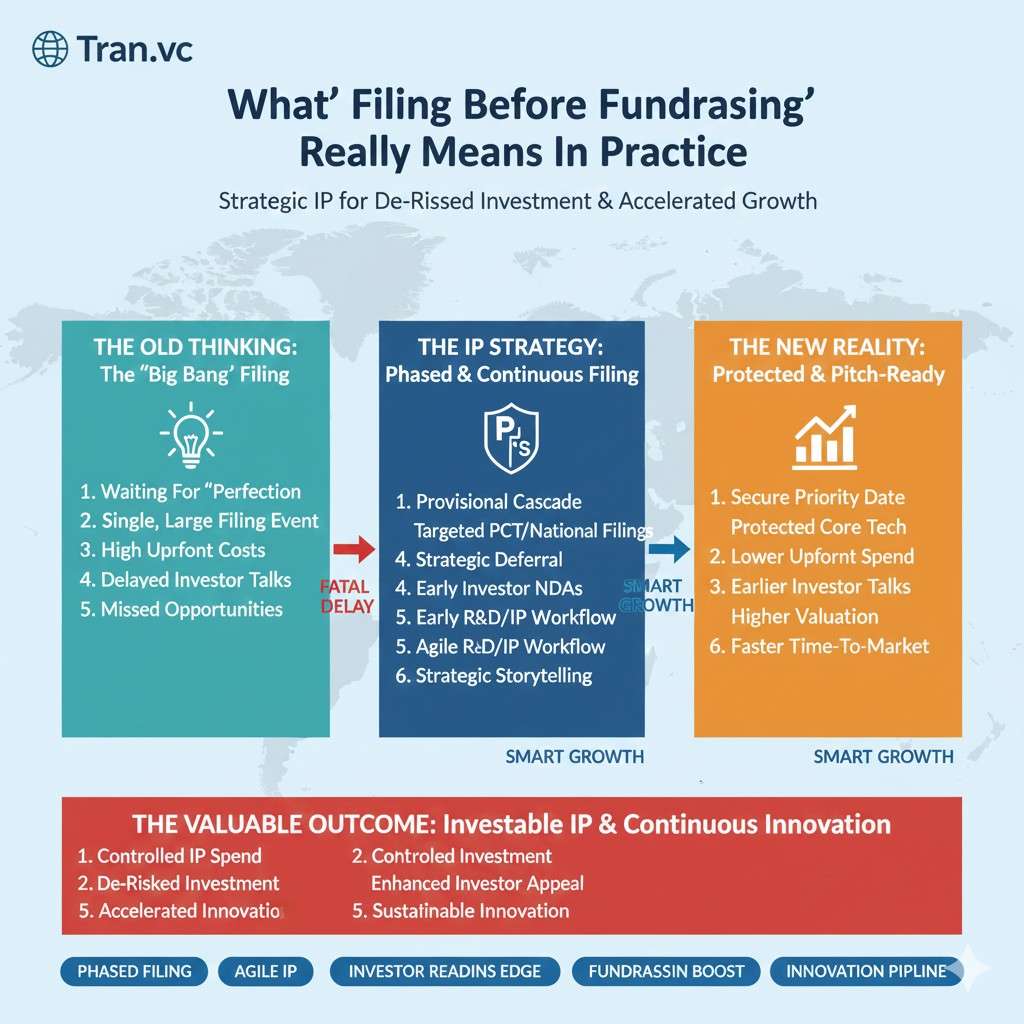
It does not mean you stop building.
It does not mean you spend months writing paperwork.
It means you take a focused sprint to do three things:
- capture your key inventions,
- reduce the risk of accidental disclosure,
- walk into fundraising with a clear IP story.
That sprint can happen while you build. The goal is not perfection. The goal is coverage.
If you do this well, you get a simple result: you can show investors that you are thoughtful, serious, and hard to copy.
And you can do it without turning your company into a legal project.
Step one: decide what is truly “yours”
Founders often confuse “our product” with “our invention.”
Your product might be a robot that picks items in a warehouse.
Your invention might be a new way to estimate object pose in low light using a blend of event data and RGB data, plus a control loop that adapts grip force based on micro-slip.
Your product might be a platform that automates customer support.
Your invention might be a method that routes tasks between a small model and a large model based on risk score, with a special way to build that risk score using past failure patterns.
Investors want both, but only one is hard to copy.
To decide what is truly yours, you want to answer one question in plain words:
“If a smart team had our deck, what part would still be hard for them to rebuild?”
That part is where you look for filings.
The mistake is to file the obvious part. The “robot arm does a thing.” The “AI predicts a thing.” Those are crowded. They do not help much.
The better approach is to find the hidden edge. The part in your work that took you weeks of tests, strange failures, and small insights. The part that feels like “we figured it out” and others would not guess quickly.
Often it is not one big invention. It is a chain of smaller choices that work together. That is fine. A good IP strategy can cover systems and methods, not just single parts.
Step two: keep a clean “invention record” while you build
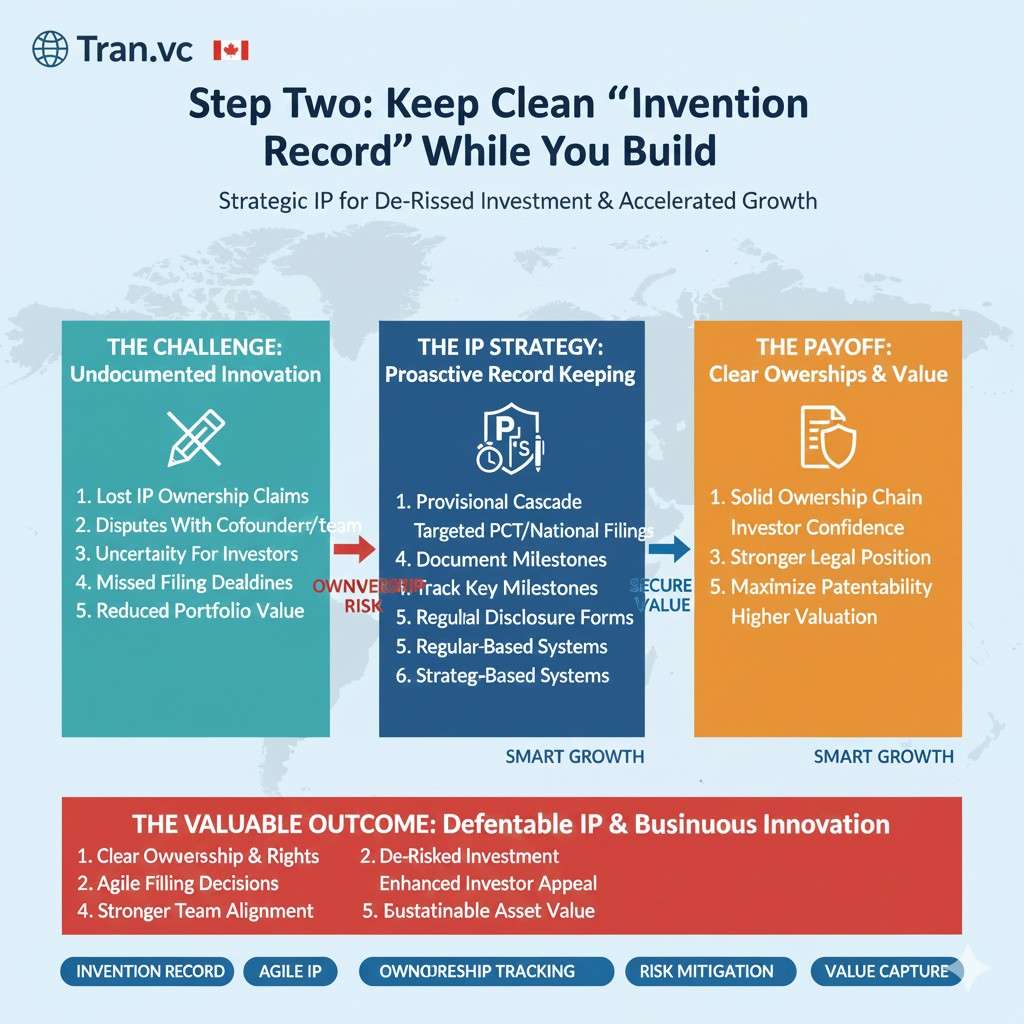
Most teams do not document inventions. They document tasks.
They have Jira tickets. They have Git commits. They have Slack messages. They have half-finished notes.
That is not the same as an invention record.
An invention record is simply a short, clear explanation of:
- what problem you faced,
- what you tried,
- what worked,
- why it is different than normal approaches,
- and what results you saw.
This matters because it becomes raw material for filings. It also helps you later when an investor asks, “What is the real secret sauce?” You can answer without making things up on the spot.
Here is a simple practice that works:
Every time you hit a real breakthrough, write a one-page note that a smart engineer could follow. Add simple drawings if helpful. Add the dates. Add who contributed. Save it in one place.
Do not overthink it. The point is to capture the “why” while it is fresh.
If you do this, you will be shocked how much value you already have by the time you start fundraising. Most inventions are not born in a single day. They are built through small steps. This practice catches them.
Step three: run a “fundraising disclosure” check
This step is where founders get burned, and it is avoidable.
Before you start fundraising, list out the ways you will talk about your system. Not in a big spreadsheet. Just in your head, then on paper.
You will have a pitch deck.
You will have a demo.
You will have a data room.
You will have calls where you share your screen.
You will have follow-up emails where you answer questions.
Each one is a chance to disclose more than you meant to.
A fundraising disclosure check is simply asking:
“What parts of our story, if shared, could help a competitor recreate our edge?”
Those parts are either:
- things you should file before you share, or
- things you should describe at a higher level until you file.
This is not about hiding the entire business. It is about being smart about the order of exposure.
A common example in AI:
You put model performance charts in your deck. Investors ask, “How did you get these results with so little data?” You start explaining your data engine, your labeling trick, your augmentation pipeline, your curriculum, your distillation method, your retrieval setup. Now you have told the full method.
If you filed first, you could answer with confidence and detail.
Without a filing, you either reveal too much or you sound evasive. Both hurt fundraising.
Step four: file the right first layer
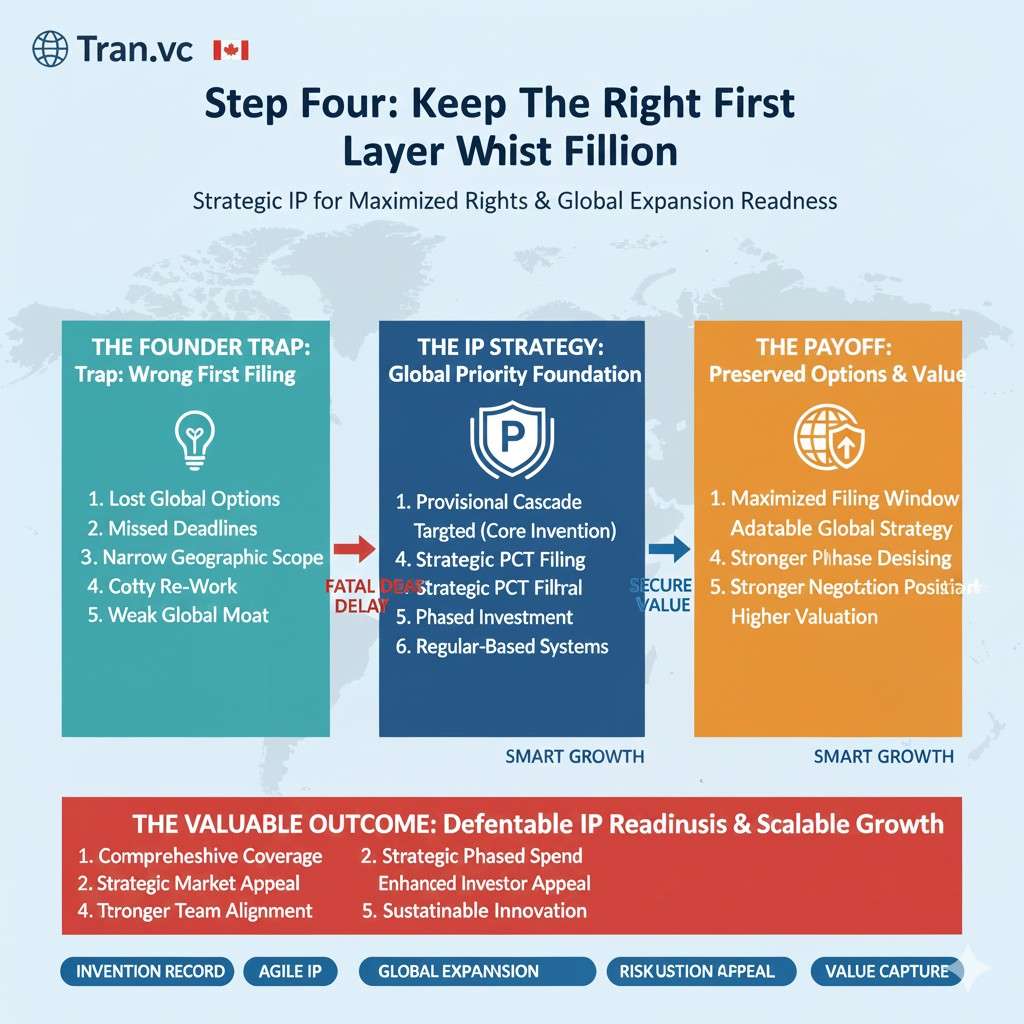
Many founders think filing means hiring a law firm, spending a big amount, and disappearing into a slow process.
It does not have to be like that.
The “right first layer” is usually a filing that:
- covers the core method broadly,
- includes a few strong examples,
- is written in a way that allows future growth.
You are not trying to predict every future feature.
You are trying to cover the core mechanism that makes your results possible.
A good first layer should match how your tech works, not how you market it.
If your real advantage is the training loop, file the training loop.
If your real advantage is deployment at the edge with low power, file that.
If your real advantage is safety or verification, file that.
If your real advantage is robotic calibration and self-correction, file that.
This is where working with people who understand both patents and startups matters. Because deep tech filings are not just paperwork. They are strategy.
Tran.vc is built for this exact gap. They invest up to $50,000 in in-kind patenting and IP services, and they help you shape a strategy that fits early-stage reality. Apply anytime: https://www.tran.vc/apply-now-form/
Step five: build an IP story that investors actually care about
Even if you file, you can still lose the investor’s attention if you describe IP the wrong way.
Investors do not want a lecture on legal terms. They want to know:
- Is this defensible?
- Can it become a real moat?
- Does the team understand what they have?
- Will this reduce risk?
- Will this increase value?
So your IP story should be simple, clear, and tied to outcomes.
Instead of saying, “We filed patents around our system,” say something like:
“We filed on the method that lets us do X with Y constraints, which is what drives our 3x improvement. We plan to file two more layers as we expand into A and B.”
That tells them you have a plan, not just a document.
Also, do not wait for investors to ask. Bring it up early, but keep it short.
The right tone is calm and confident, not defensive.
A common fear: “If we file, we’ll expose ourselves”
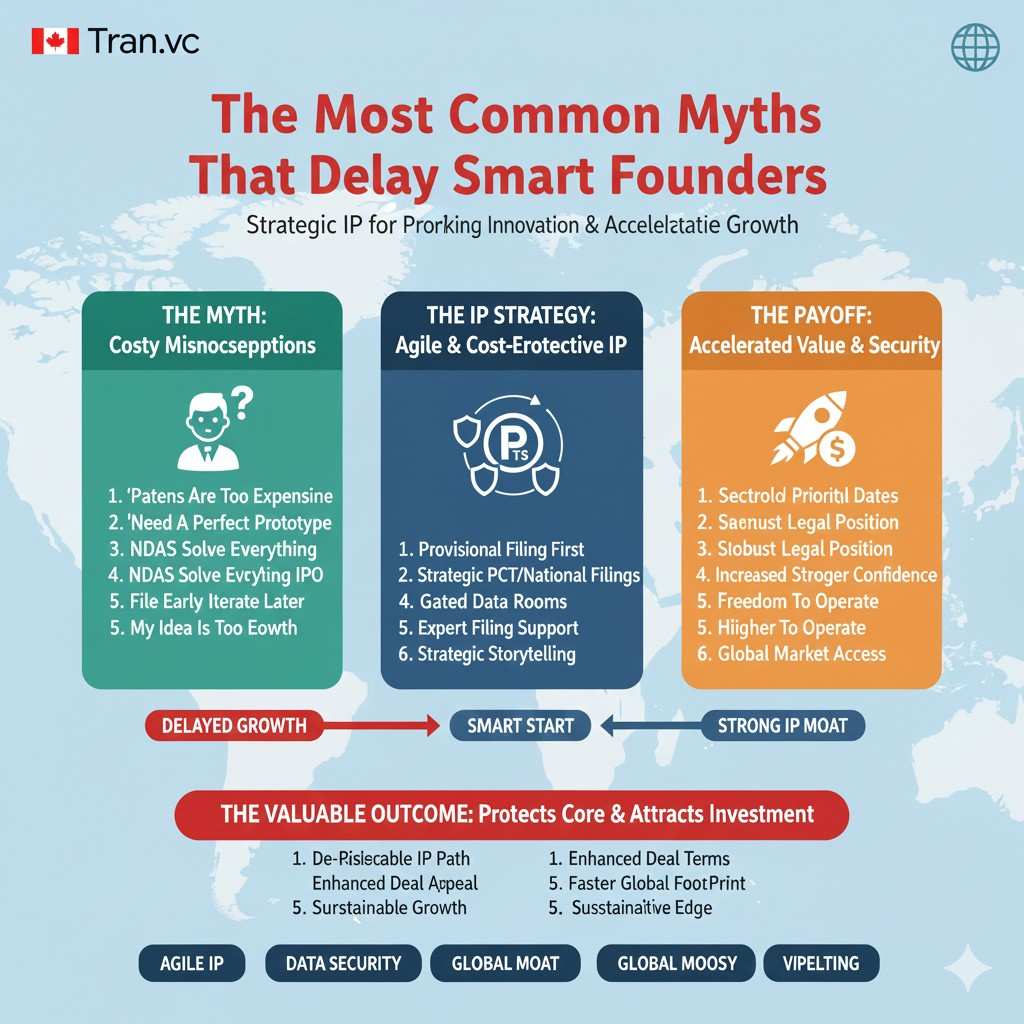
Some founders worry that filing means publishing the secret.
That fear comes from a real place. Patent documents do become public at some point. The details matter.
But the key is this: you do not file to give away your edge. You file to protect the edge while you scale.
A good strategy balances what you disclose and what you keep as trade secrets. Many companies use both. Patents for what must be protected in the open. Trade secrets for what can stay internal and hard to reverse.
The goal is not to put your entire brain on paper. The goal is to claim the core invention so others cannot use it freely.
This is why “strategy” matters more than “paperwork.”
The biggest mistake: fundraising first, then scrambling
If you take nothing else from this intro, take this:
When you start fundraising, you lose control of timing.
Investors move fast. They ask questions quickly. They request materials. They schedule partner meetings. They want to bring in experts. They want to see the technical depth.
If you wait until that moment to start thinking about filing, you are already behind.
Now you are scrambling. You are trying to file while also fundraising, hiring, building, and selling. That is when mistakes happen. That is when you overshare. That is when you make rushed IP choices that do not cover the real invention.
Filing before fundraising keeps you in control.
And control is the one thing early-stage founders never have enough of.
Filing Before Fundraising: What to Do and Why
The real reason this matters
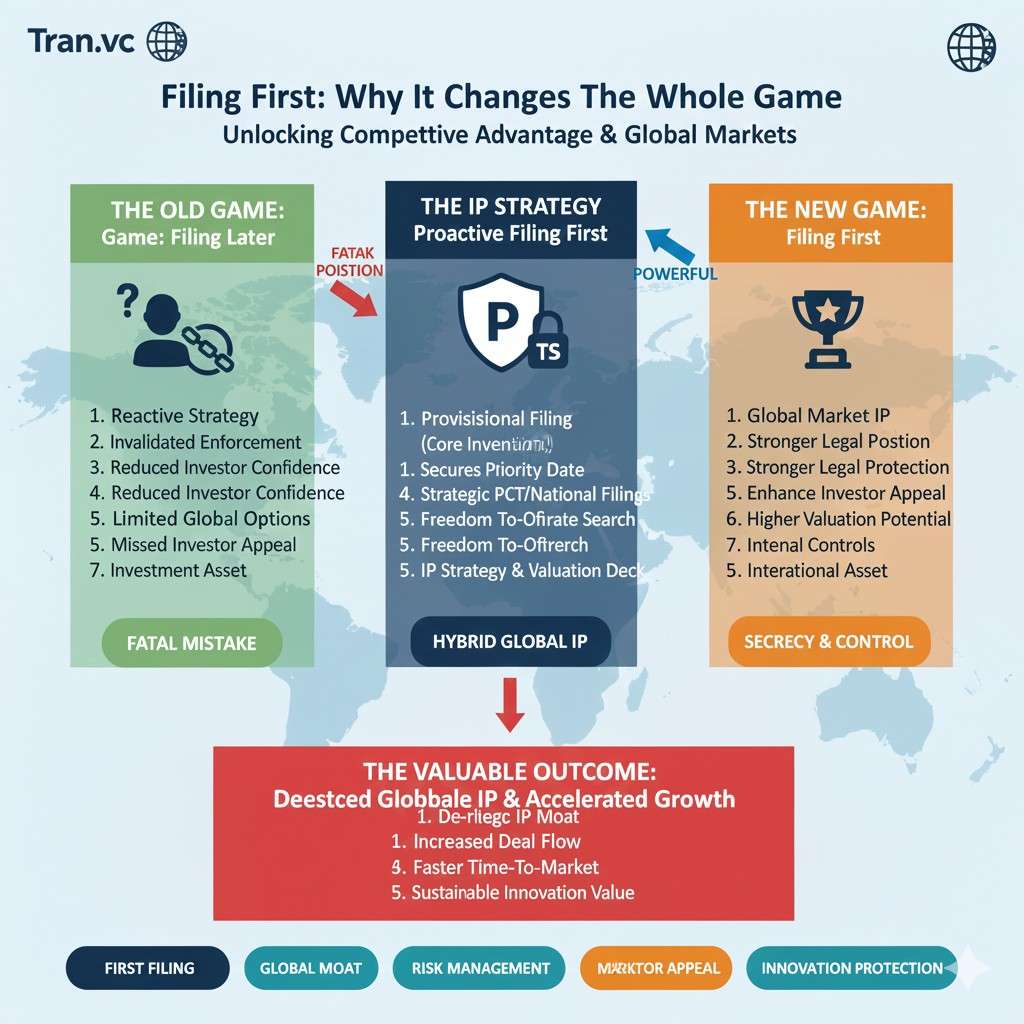
Fundraising is not just meetings and a deck. It is a long season of talking. You explain the same thing again and again, to many different people. And every time you explain, you risk giving away the parts that make you hard to copy.
In AI and robotics, the biggest danger is not someone stealing your exact code. The bigger danger is a strong team hearing your method and building something similar in their own clean way. They do not need your repo. They only need your map.
Filing before you fundraise is how you keep control of that map. It lets you share your story with confidence, without feeling like you must blur the most important parts. It also shows investors you are building something real, not something easy to clone.
What “filing first” really changes
When you have a filing in place, you can be clear. You can talk about what makes your system work without speaking in vague words. That helps because investors do not fund mystery stories. They fund clear advantage.
It also changes how investors judge risk. A thoughtful IP plan signals you understand what you own, what is unique, and what needs protection. That makes your company feel more durable, even if you are early.
Most of all, it changes leverage. You stop acting like you need permission to talk about your own invention. You walk into meetings knowing your core idea has a stake in the ground.
Where Tran.vc fits
Tran.vc supports technical founders by investing up to $50,000 in in-kind patent and IP services. That means real strategy, real filings, and real help shaping what to protect first. If you want to build an IP-backed moat before you raise, you can apply anytime at https://www.tran.vc/apply-now-form/
Why fundraising makes your ideas fragile
Fundraising is a disclosure machine
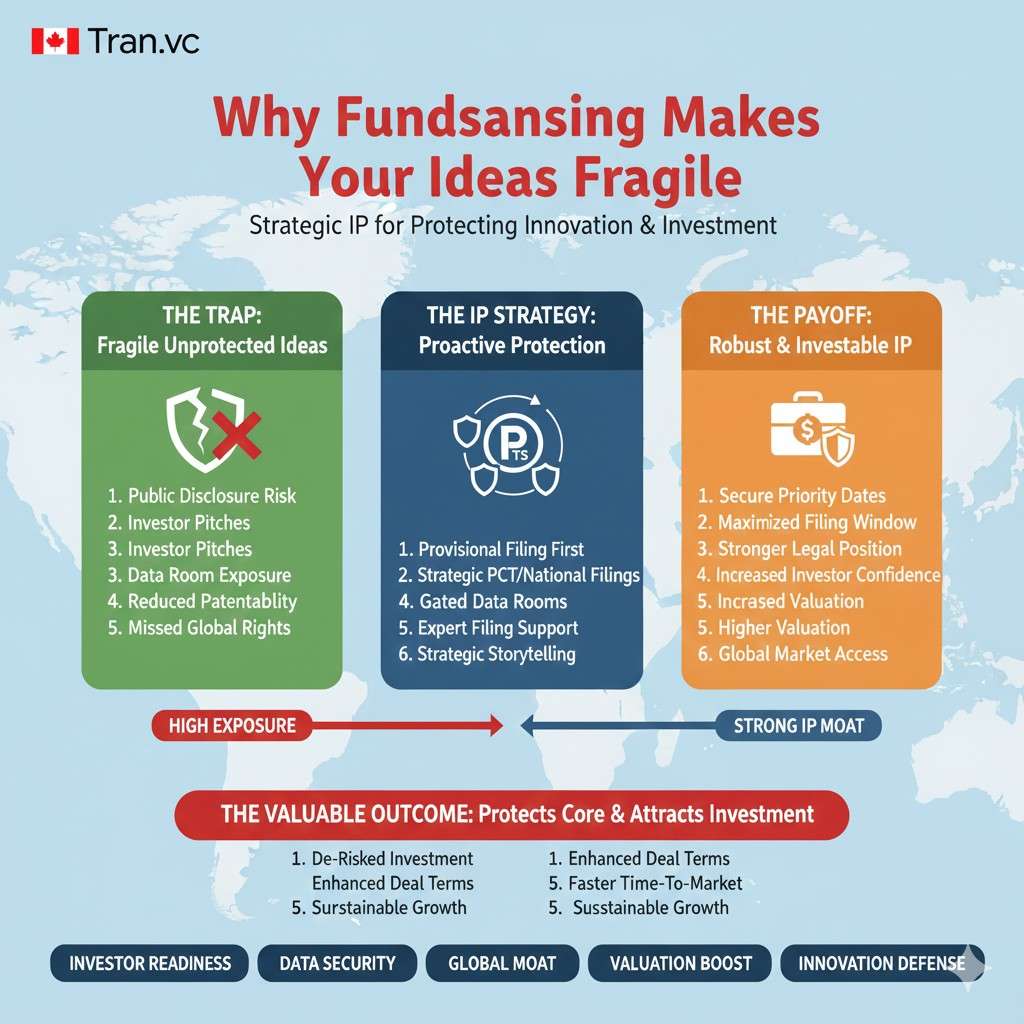
Even if you try to be careful, fundraising pulls details out of you. An investor asks a normal question, and your brain naturally wants to explain. You start with the outcome, then you explain the method, then you share the special trick that made it work.
Over time you may talk to dozens of people. Partners, associates, experts, and advisors. Some are honest. Some are careless. Some will leave the firm and take knowledge with them. The more you talk, the more your edge spreads.
This is not meant to scare you. It is meant to make the risk feel real. If you file first, you do not need to fear normal questions. You can answer like a confident builder, not like someone guarding a secret with nervous hands.
The “helpful detail” trap
Founders often give away their best work by trying to be helpful. You want investors to understand you. You want them to see you are strong. So you show the clever part.
In AI, that might be the way you reduce training data needs, or how you route tasks between models, or how you keep answers safe. In robotics, it might be the way you fuse sensors, handle grasp failures, or correct drift over time. These details are the true advantage, and they are also the easiest to leak during fundraising.
If you have filed, you can share these details to build trust. Without a filing, you either overshare or you hold back and sound uncertain. Neither is good.
The timing problem most teams miss
When you start fundraising, your calendar stops being yours. Investors push for quick follow-ups. They want deeper technical sessions. They invite extra people. They ask for documents and metrics. They expect you to respond fast.
If you decide to file only after fundraising starts, you are trying to do two hard things at once. You are building, selling, and hiring, while also rushing IP decisions. That is when teams make choices they regret later.
Filing first is not about being perfect. It is about getting ahead of the chaos that fundraising creates.
The most common myths that delay smart founders
“We are too early for patents”
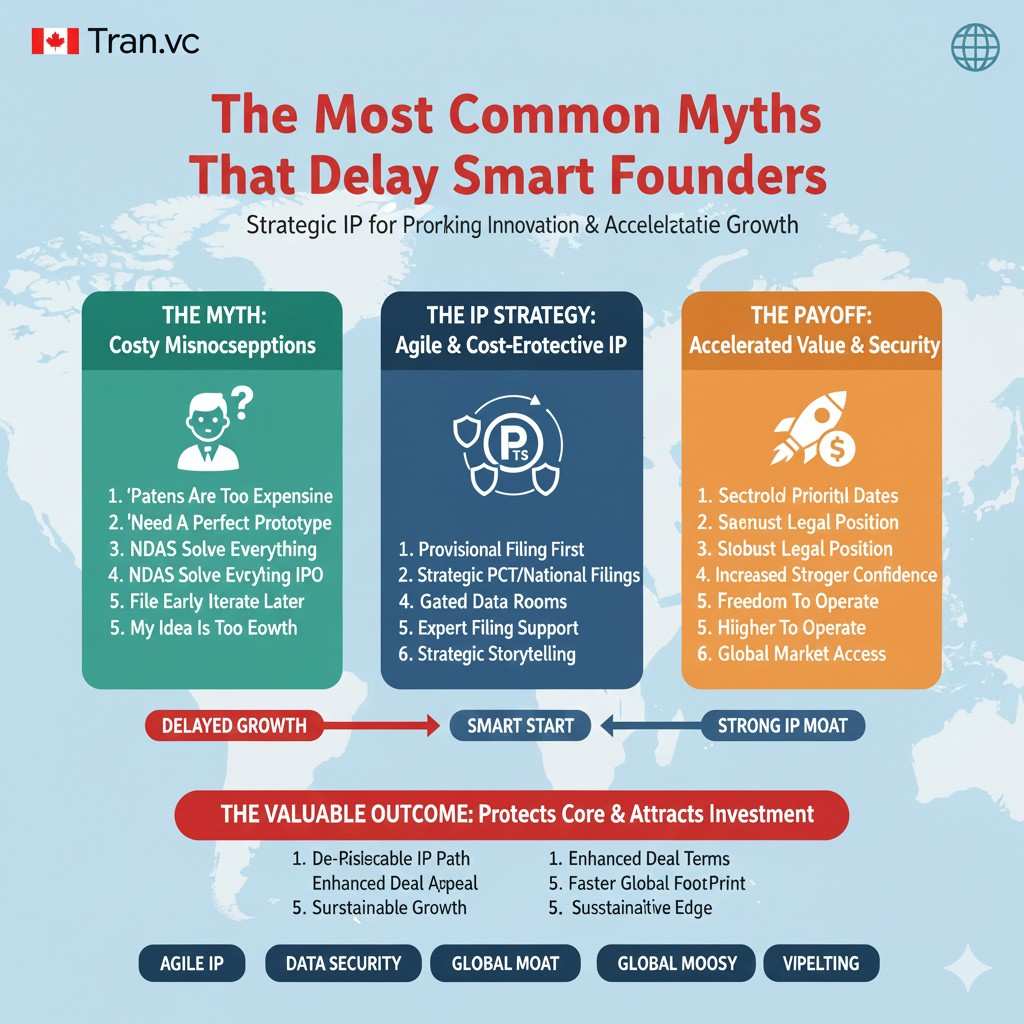
Many founders believe patents are for later stages. They think you need a finished product, a stable feature set, and a clear market before filing. That belief sounds reasonable, but in deep tech it often leads to the worst outcome: heavy disclosure before protection.
A patent is not about “final code.” It is about the method you created to get a result. If you have a working prototype, even a rough one, you likely have enough to file something meaningful.
Early filing is not a lock that traps you. It is a starting stake. As you learn, you can file more. Your first filing is the first layer, not the whole fortress.
“We are still changing things”
Of course you are changing things. Every early-stage company changes things. The key is to separate what will change from what will stay true.
Your UI will change. Your pricing will change. Your integrations will change. But the core technical trick that drives your advantage often stays stable. The method may be refined, but the heart is the same.
The goal is not to file every small tweak. The goal is to file the core idea, the core system, and the core flow that makes your results possible.
“We will do it after the seed round”
This is the most expensive delay, because the seed round is usually when you talk the most. You are meeting people at full speed. You are explaining the story to anyone who might help. You are trying to sound confident while also staying guarded.
If you file after the seed round, you may already have disclosed the most valuable parts of your invention. Even if nothing bad happens, you raised under more pressure than you needed to. You traded leverage for speed, without realizing it.
If you want to raise with strength, file first. Then fundraise with a clear voice.
What to do before you ever take an investor call
Step one: separate your product from your invention
A product is what users buy. An invention is the method that makes the product hard to copy. These are not the same thing, and confusing them is how teams file the wrong ideas.
Your product might be a robot that picks items. Your invention might be the way the robot finds the best grasp in messy bins, even when the camera view is blocked. That method is the part you want to protect, because it is the part that gives you long-term advantage.
Your product might be an AI tool for customer support. Your invention might be the way you score risk and route questions between models while keeping cost low. The invention is not the support tool. The invention is the system underneath.
If you cannot say your invention in simple words, it is hard to protect and hard to pitch. So the first job is clarity.
Step two: find the “hard-to-rebuild” part
Here is a simple test. Imagine a strong competitor had your pitch deck, your website, and your demo video. What part would still be hard for them to rebuild quickly?
That part is often not the headline feature. It is the hidden work. The training pipeline that cuts data needs. The control loop that keeps the robot stable. The calibration method that reduces error. The safety layer that prevents bad actions.
When you find that part, you have found the start of your IP plan. It becomes the first thing you protect, because it is the first thing that truly matters.
Step three: start an invention record that is easy to maintain
Most teams record tasks, not inventions. They have tickets and commits and chats. But those do not tell the story of what you created and why it is new.
An invention record is a short note you write when you hit a real breakthrough. It explains the problem, what failed, what worked, and what is different about your approach. It also captures who contributed and when.
This is not paperwork for paperwork’s sake. It becomes fuel for filings, and it helps you pitch with confidence later. It also prevents a common disaster: forgetting the key steps that led to your best results.
Step four: do a disclosure check on your fundraising materials
Before you send a deck to anyone, you should know what parts of the story are “safe to share” and what parts are “core invention.” This is not about hiding everything. It is about controlling the order of exposure.
Decks, demos, and follow-up emails create pressure to explain the method. Investors naturally ask, “How did you do that?” If your answer reveals the core trick, you should file first.
A disclosure check is simply looking at your materials and asking, “If this got forwarded, what would a competitor learn?” If the answer is “the secret,” you have your priority list for filing.
How to choose what to file first in AI companies
Focus on the method, not the model name
Many founders talk about their model as if the model itself is the moat. But model choices change fast. What lasts longer is the method you built around it.
If your advantage comes from training with less data, focus on the training method. If your advantage comes from better retrieval, focus on the retrieval flow and how you rank and filter. If your advantage comes from safe actions, focus on the safety system and how it decides what is allowed.
This framing keeps your filing relevant even as tools and model families shift. Investors also like it, because it shows your advantage is not tied to a single vendor or trend.
Protect the pipeline that produces your results
Most AI advantage lives in the pipeline, not the prediction. The pipeline includes how you collect signals, how you label, how you clean, how you evaluate, and how you deploy.
If you built a special way to auto-label, or a special way to detect bad labels, or a special way to generate training tasks, those are strong filing targets. They are also the parts that competitors copy when they try to match your performance.
The more your pipeline is tied to measurable outcomes, the more valuable it is to protect. It becomes a true asset, not a vague idea.
File around deployment realities, not just training
A lot of AI teams forget that deployment is where pain lives. Latency limits, memory limits, privacy rules, cost caps, and uptime needs are what make real AI hard.
If you built a way to run strong models under strict limits, that is often a better filing target than the model itself. Investors care about this because it connects to the business. It means your product can ship and stay stable.
How to choose what to file first in robotics companies
Protect the loop that makes the robot reliable
Robotics is not magic. It is loops. Sense, decide, act, and recover. Most robots fail not because of one big flaw, but because of small errors that pile up.
If you built a control loop that reduces drift, handles uncertainty, and recovers from failure, that is often the heart of your advantage. The “recovery” part especially is where great teams stand out.
A strong filing often covers the full flow, not just one component. It claims the method that keeps performance steady in messy real life.
Capture sensing and perception that works in the real world
Robotic perception looks easy in perfect demos and hard in real warehouses, farms, factories, and hospitals. Glare, dust, occlusion, motion blur, and odd objects break naive systems.
If you found a way to combine sensors, handle missing data, or estimate pose under poor conditions, those are high-value inventions. They are hard-earned and often not obvious from textbooks.
Filing here is powerful because competitors can copy hardware, but they struggle to copy a proven perception method that works across edge cases.
File around calibration, safety, and constraints
Robots live in a world of constraints. Weight, torque, battery, heat, and safety rules shape everything. If you built a method that makes the robot safer, cheaper, or easier to maintain, that can be a strong protection target.
Calibration methods are often underrated. If your system can self-calibrate, detect misalignment, or adapt over time without manual work, that is real value. It also connects to scaling, which investors care about deeply.
How to talk about IP during fundraising without sounding legal
Keep it tied to outcomes
Investors do not want a legal speech. They want to understand why your lead can last. The best way to explain IP is to tie it to what it enables.
You can say, in plain words, that you filed around the method that drives your key performance gain. Then you can say what you plan to protect next as you expand.
This makes IP feel like part of product strategy, not a side project. It also makes you sound like a founder who thinks ahead.
Use confidence, not secrecy
There is a difference between being careful and being secretive. Secretive founders create doubt. Investors wonder if the tech is weak, or if the team is hiding gaps.
If you have filed, you can be open and confident. You can explain the core idea clearly. You can answer questions without twisting words. That builds trust and moves deals forward faster.
If you have not filed, you will often feel forced into vague language. That usually slows fundraising down, even if your tech is strong.
Show the plan in a simple way
A good IP plan is not a list of legal steps. It is a story of layers. The core invention first, then follow-on filings as product expands, plus trade secrets where it makes sense.
When investors hear a layered plan, they see maturity. They see you are not just building. You are building with protection in mind. That is rare early, and it stands out.
Where Tran.vc can help before you raise
Turning invention into assets without slowing you down
Tran.vc is designed for technical founders who want to protect what they are building before they step into fundraising. They invest up to $50,000 in in-kind patent and IP services, so you get strategy and filings without draining early cash.
This is not a passive program. The focus is practical: identify what is truly novel, capture it cleanly, and file in a way that supports fundraising and long-term defense.
If you want to build your moat early, you can apply anytime at https://www.tran.vc/apply-now-form/
Building a fundraising-ready IP story
A filing is helpful, but the story around it is what investors feel. Tran.vc helps founders shape that story so it is clear, credible, and tied to business value.
That includes deciding what to share in the deck, what to save for deeper sessions, and how to answer questions without giving away more than you should.
When you can speak clearly and safely, you fundraise faster and with more confidence.
Moving with speed while staying careful
Founders move fast. Your IP approach must match that speed. The goal is not to create a legal burden. The goal is to protect the core work while the company is still forming.
Tran.vc’s model is built for this moment. Early, technical, and high-stakes. If that sounds like you, apply anytime at https://www.tran.vc/apply-now-form/