
Deep tech founders have a tricky problem. You build something real—new code, new models, new chips, new robots—yet a bigger team can copy the idea faster than you can sell it. A global patent strategy is how you slow that down. It helps you protect what matters, raise with more power, and avoid getting boxed out later. The hard part is doing this without spending a fortune.
This guide will show you how to think about global patents when your budget is tight and your team is small. We’ll keep it practical, simple, and focused on what actually works. And if you want help turning your inventions into strong IP from day one, you can apply anytime at https://www.tran.vc/apply-now-form/
The real goal of a global patent strategy (and what it is not)
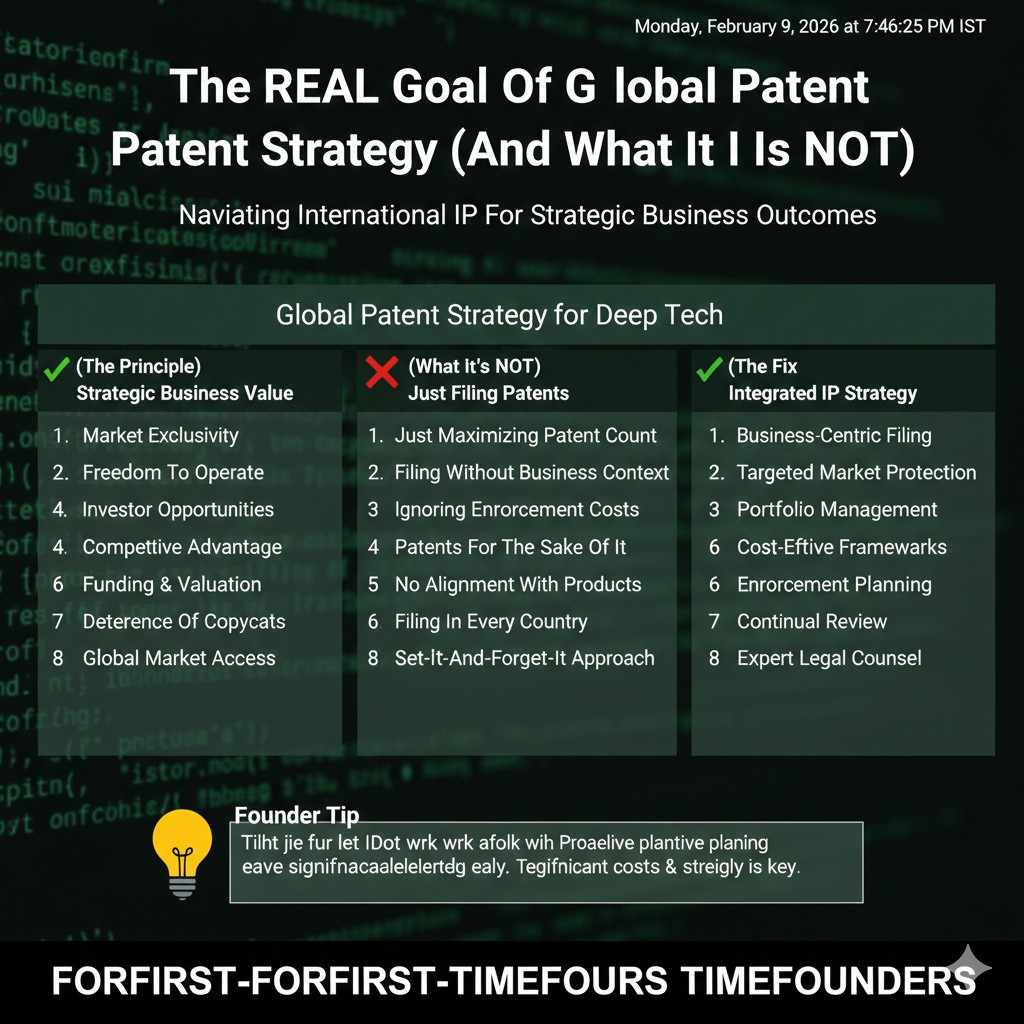
A lot of founders hear “global patents” and imagine filing in 20 countries on day one. That is not the goal. The goal is to buy time, reduce risk, and protect the few parts of your tech that give you a lasting edge.
Think of patents like a fence. You do not need a fence around the whole planet. You need a fence around the door that matters.
For deep tech, the “door” is often one of these:
It could be a training method that makes your model work with far less data.
It could be a control loop that keeps a robot stable in a messy real-world setting.
It could be a sensor fusion method that gives reliable results with cheap parts.
It could be a manufacturing step that makes your hardware cheaper and better at the same time.
It could be an on-device AI pipeline that runs fast without draining power.
In deep tech, the most valuable invention is often not the flashy demo. It is the hidden method that makes the demo possible.
A global strategy is mostly about choosing what to protect, when to file, and where to file. You want the best result with the least spend. That means you need a plan that matches your stage.
If you are pre-seed or seed, your job is usually not “file everywhere.” Your job is “create defendable options.” You want to keep doors open so that when you learn where revenue is coming from, you can expand protection in the right places.
This is also why a strategy is more important than a pile of filings. Ten weak patents filed too early can be worse than two strong filings filed at the right time. Weak filings create false comfort. Strong filings create leverage.
If you want a clear plan and real help from people who do this daily, Tran.vc can support early teams with up to $50,000 in-kind patent and IP services. Apply anytime here: https://www.tran.vc/apply-now-form/
Why deep tech startups are different when it comes to patents
Many software startups can rely on speed, brand, or network effects. Deep tech teams often cannot.
Deep tech takes longer. Hardware takes time. Robotics takes time. Getting AI into a regulated space takes time. Even when your code moves fast, the real world moves slow. That gap creates a window where others can learn from your work.
Deep tech also has two other issues:
First, the value is often in “how,” not “what.” A competitor can copy a feature, but the hard part is copying the method that makes it reliable.
Second, deep tech funding often depends on proof. Investors and partners ask, “Can you own this?” Patents are not the only answer, but they are a clear signal. They show you have thought about long-term defense.
There is a simple way to decide if patents matter for your startup:
If it took real skill to build, and someone else could copy the idea after watching a demo, you should take patents seriously.
That does not mean you file everything. It means you plan.
Budget reality: what you can do now, and what can wait
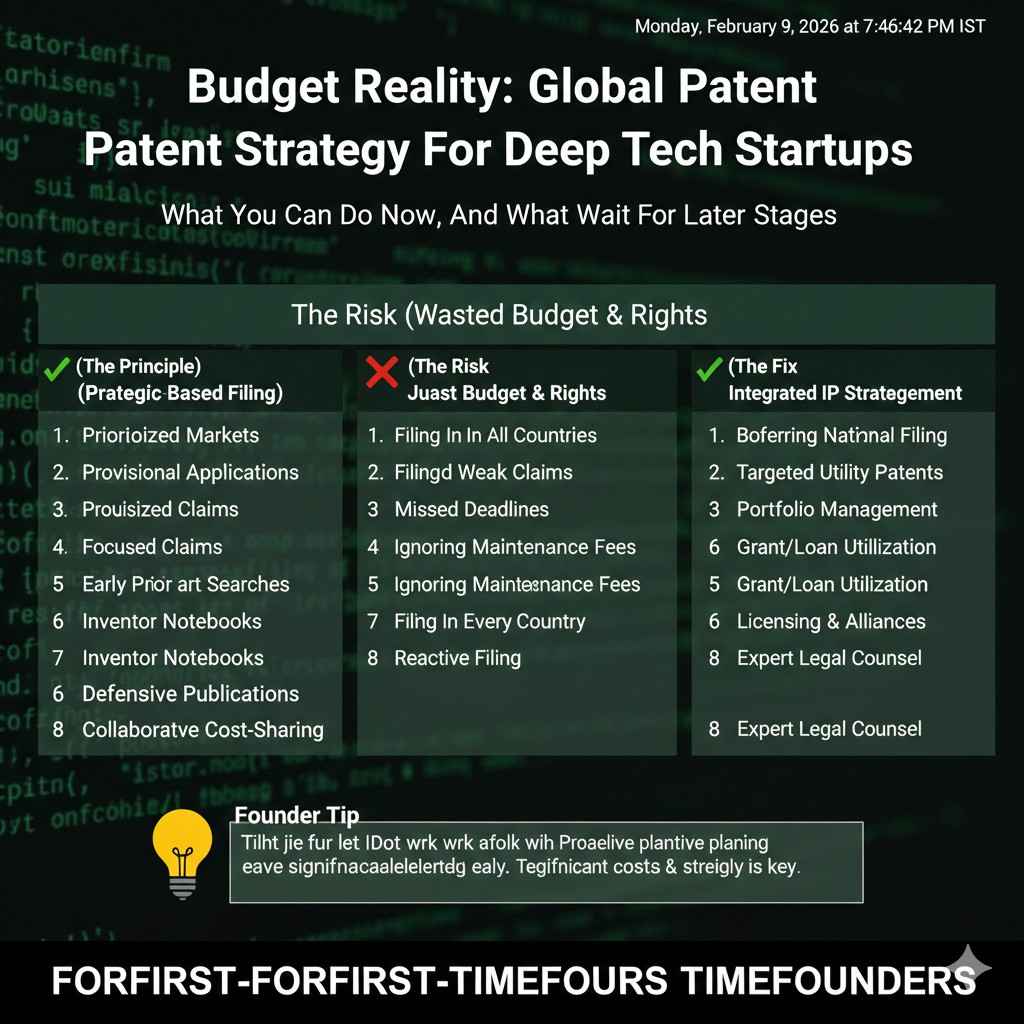
When money is tight, you need to separate “now actions” from “later actions.”
Right now, you can do three things that change your outcome without burning cash:
You can capture your inventions before they drift or get forgotten.
You can prevent accidental public disclosure that ruins patent rights in many countries.
You can file a first application that buys time and gives you a clear date.
Most founders lose money on patents in two ways:
They file too early, before the invention is stable, so they keep paying to patch holes.
Or they file too late, after sharing too much, so they cannot protect the best parts.
A smart budget strategy sits in the middle. You file when you have enough clarity to describe the core method, but not so late that you have already shown it to the world.
This is where founders get stuck. They ask, “When is it ready?”
Here is a simple test: can you explain the method in a way that a skilled engineer could build it without guessing the key steps? If yes, you likely have enough for a solid first filing.
If no, you may still file, but you must be honest about what is real versus what is still wishful. A rushed filing that only describes a dream rarely helps.
The hidden risk: public disclosure and why it can break your global plan
This part is not fun, but it is important.
Many countries require that you file before you disclose your invention publicly. Public disclosure can include:
A conference talk
A paper
A poster
A thesis posted online
A blog post
A product launch page
A demo video
Some investor decks (if widely shared)
Some open-source releases
Even a casual tweet can create trouble if it teaches the key idea.
In the United States, there is a grace period in many cases. In many other places, there is not. That means if you disclose first, you may lose rights in large markets even if you can still file in the US.
This is why a global strategy starts with one rule:
Do not teach the secret parts in public until you have filed.
You can still market. You can still sell. You can still talk about outcomes. You just avoid teaching the “how.”
Instead of saying, “We use method X with steps A, B, C,” you say, “We improve accuracy in low light and reduce compute cost.” Outcome is safe. Method is sensitive.
If you are in a lab culture where publishing is the norm, this needs extra care. You can still publish, but you should file first. A simple early filing can protect you and still let you share the work.
This is one of the biggest areas where Tran.vc helps. Founders often do not need more hustle. They need a clean process so they do not step on a landmine. If you want that kind of guidance, apply anytime at https://www.tran.vc/apply-now-form/
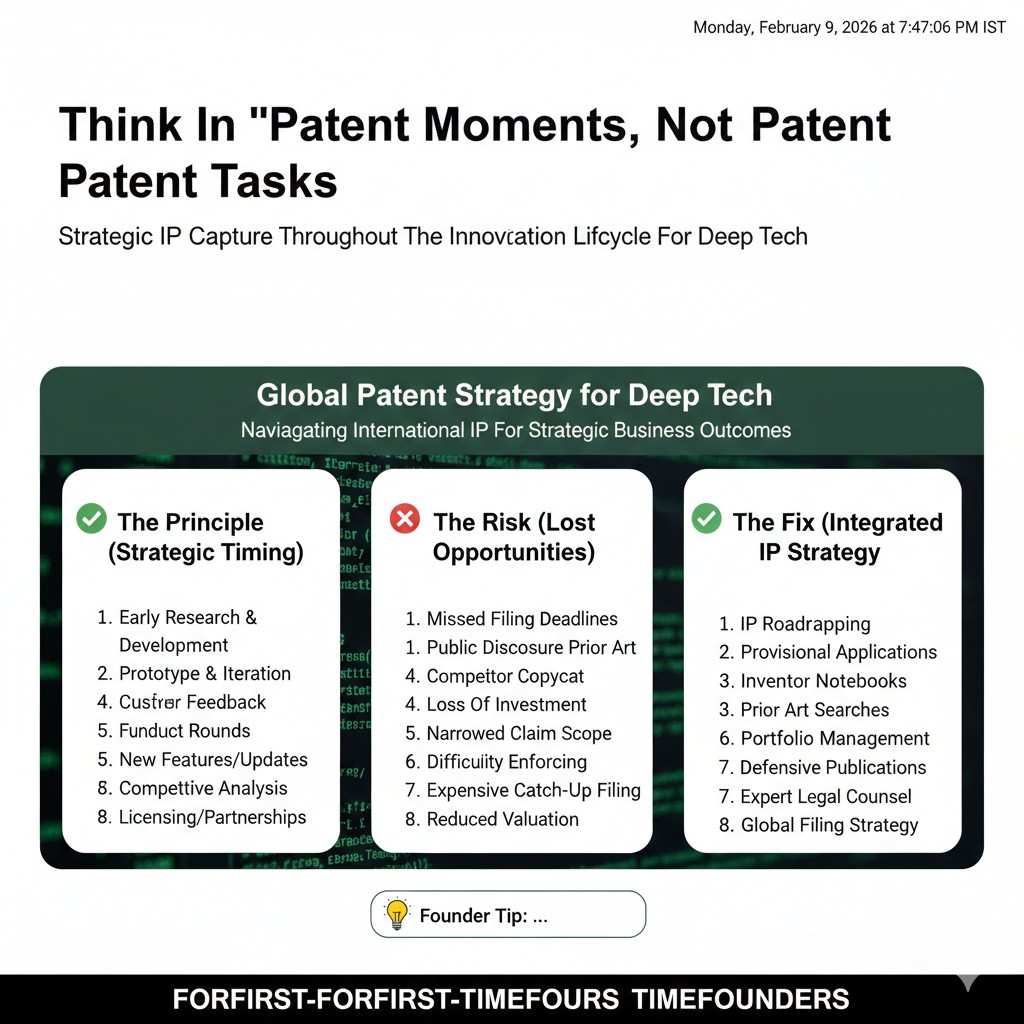
Think in “patent moments,” not “patent tasks”
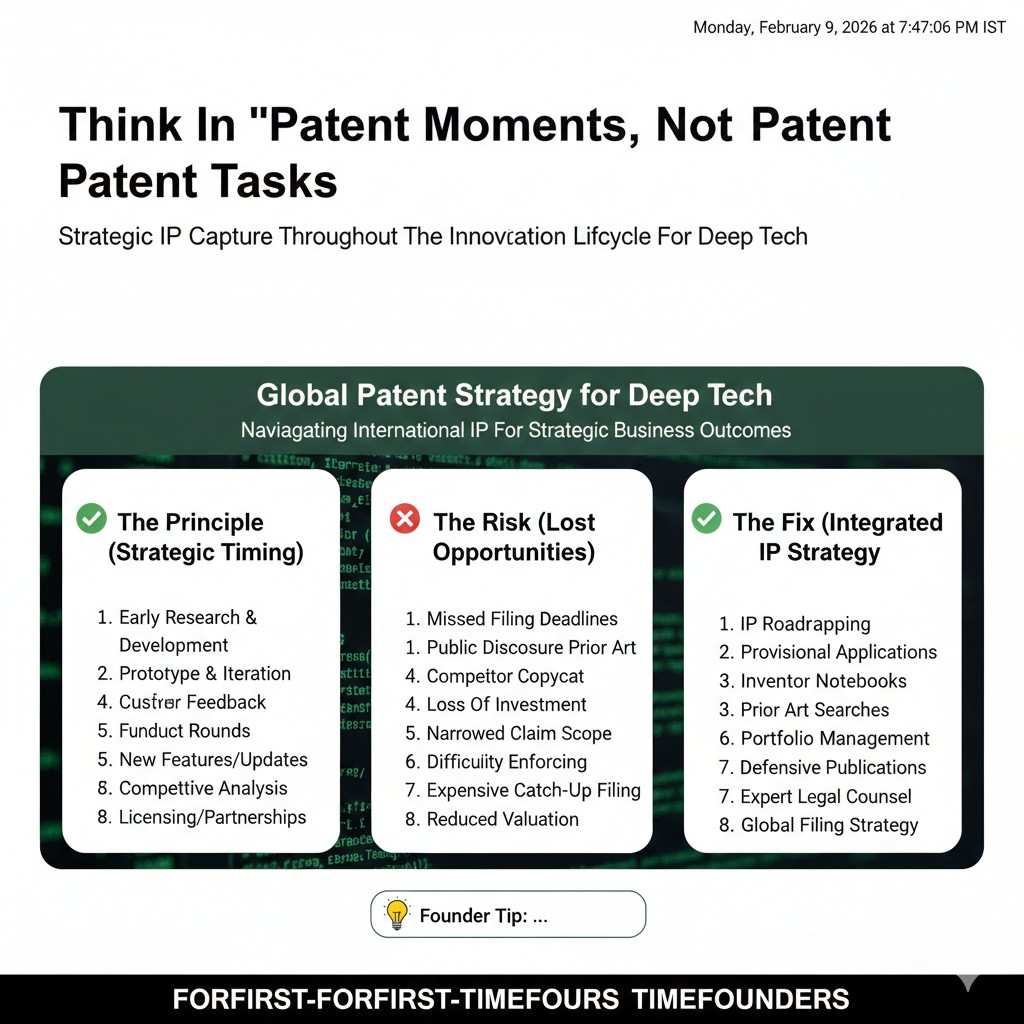
Most founders treat patents like a chore. It becomes a task list: write invention, file, pay, repeat. That approach drains energy.
A better approach is to build your strategy around “patent moments.” These are moments when your risk changes, or your leverage changes.
Common patent moments in deep tech:
You are about to publish a paper or present at an event.
You are about to demo to a large group.
You are shipping a product that reveals the key method.
You are about to sign a big partnership.
You are about to raise.
You have a new breakthrough that improves performance a lot.
At each moment, you ask one question:
What is the one thing we cannot afford to lose?
Then you protect that one thing first.
This keeps spending focused and prevents “random patents” that do not connect to your core advantage.
The core structure of a budget-friendly global plan
A global plan on a budget usually works like a funnel.
At the top of the funnel, you create one strong first filing that captures the core invention. That first filing is like a stake in the ground. It gives you a priority date, which matters later when you expand.
Then, you use time to learn. You learn where customers are. You learn which features matter. You learn what competitors are doing. You learn what your real moat is.
Later, you decide where to spend big. You do not guess too early.
The mistake is trying to solve everything at once.
The right move is to build options.
This is the mindset shift: you are not buying “global patents” on day one. You are buying the right to choose global protection later.
Start with an “invention map” that is simple enough to use weekly
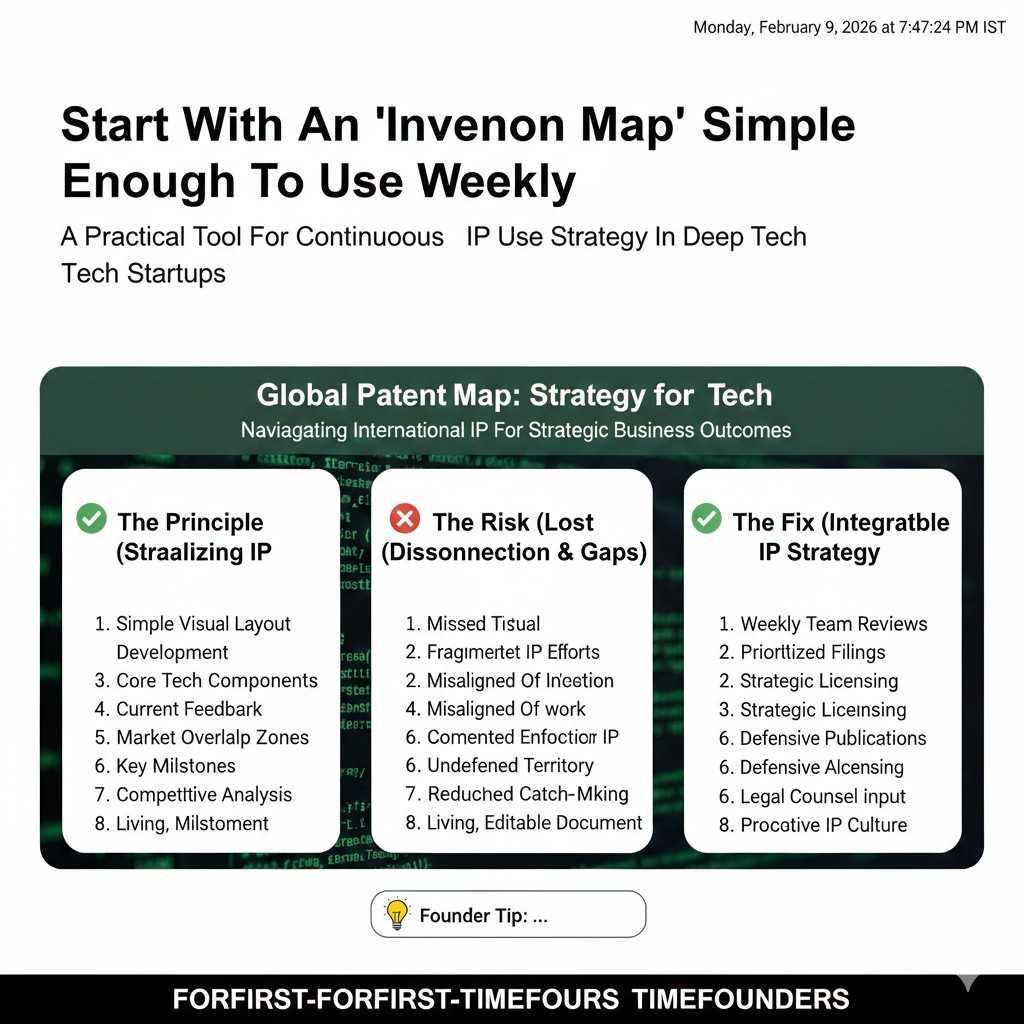
Before you file anything, you need to see what you are protecting. Not in a huge spreadsheet. Not in a fancy system. Just a simple map you can use.
Here is what this looks like in plain language:
You write down the key parts of your tech in four buckets:
The thing you built (the system)
The steps that make it work (the method)
The parts that make it faster/cheaper (the optimization)
The edge cases that make it reliable (the robustness)
Deep tech patents often win on method, optimization, and robustness. The system alone is often too broad and easy to design around.
So you want to capture the “how” at a level that is both real and hard to copy.
If you are building a robot, your method might include how you detect slip, how you adjust grip, how you reduce jitter, how you recover from sensor noise, how you plan paths in clutter, how you blend learning and control.
If you are building an AI platform, your method might include how you select data, how you label with weak signals, how you compress, how you adapt to new domains, how you test drift, how you enforce safety.
Your map should be short. It should fit on one page. The goal is not perfection. The goal is clarity.
Once you have this map, you can spot what is patent-worthy and what is not.
A good test is this:
If a competitor copied this exact method, would your product lose its edge?
If the answer is yes, it belongs on the map.
Choose a “first filing” that is broad and true
Founders often hear that patents should be “broad.” That is true, but only in a specific way.
A broad patent is not one that makes big claims with no details.
A broad patent is one that covers many versions of the same core idea.
You do that by describing the core concept clearly, then describing variations that still use the concept.
For example, if your invention is a way to reduce compute cost by changing when you run a model, you might describe:
Different triggers that decide when to run it
Different sensors that can feed the trigger
Different ways to measure confidence
Different hardware setups
Different workloads
Same core idea, many shapes.
That is how you get useful scope.
The budget-friendly trick is to spend effort on thinking through variations now, because it is cheaper to write them once than to file new applications later to patch the gaps.
But again, it must be true. If you claim variations you have not tested, you can still describe them as possible implementations, but you need to do it carefully. The goal is to show enough detail that the idea is believable and enabled.
This is where working with people who understand both patents and deep tech helps a lot. Patent language is its own craft. It is easy to accidentally narrow your own protection by using the wrong words.
Tran.vc’s model exists because early teams need this craft without burning all their cash. If you want to build a real moat without wasting months, apply anytime at https://www.tran.vc/apply-now-form/
Keep your first filing aligned with fundraising, not just engineering pride
Engineers love the most elegant part of the system. Investors care about what creates long-term power.
Sometimes those overlap. Sometimes they do not.
A smart first filing usually ties to one of these:
A performance gap you can defend
A cost gap you can defend
A compliance or safety gap you can defend
A deployment edge that makes adoption easier
If your patent covers something impressive but not tied to value, it may not help you raise or win deals.
So before you lock a filing, practice one sentence:
“This invention matters because it makes ___ better in a way others cannot easily copy.”
If you cannot fill that blank, step back. It may still be patent-worthy, but it may not be the first one.
The most common budget-killer: filing too many “small” patents
A lot of teams try to patent every small improvement. That can be a trap.
Small patents can be useful later, especially as a portfolio grows. But early on, your time and money should go toward core claims that anchor your advantage.
If you file too many small applications early, you create three problems:
You spend money on filings that do not move the business.
You distract the team from product and sales.
You create a messy story for investors because the portfolio looks random.
A tighter portfolio is often stronger.
Think of it like this: your early patents should form a clean wall, not a pile of bricks.
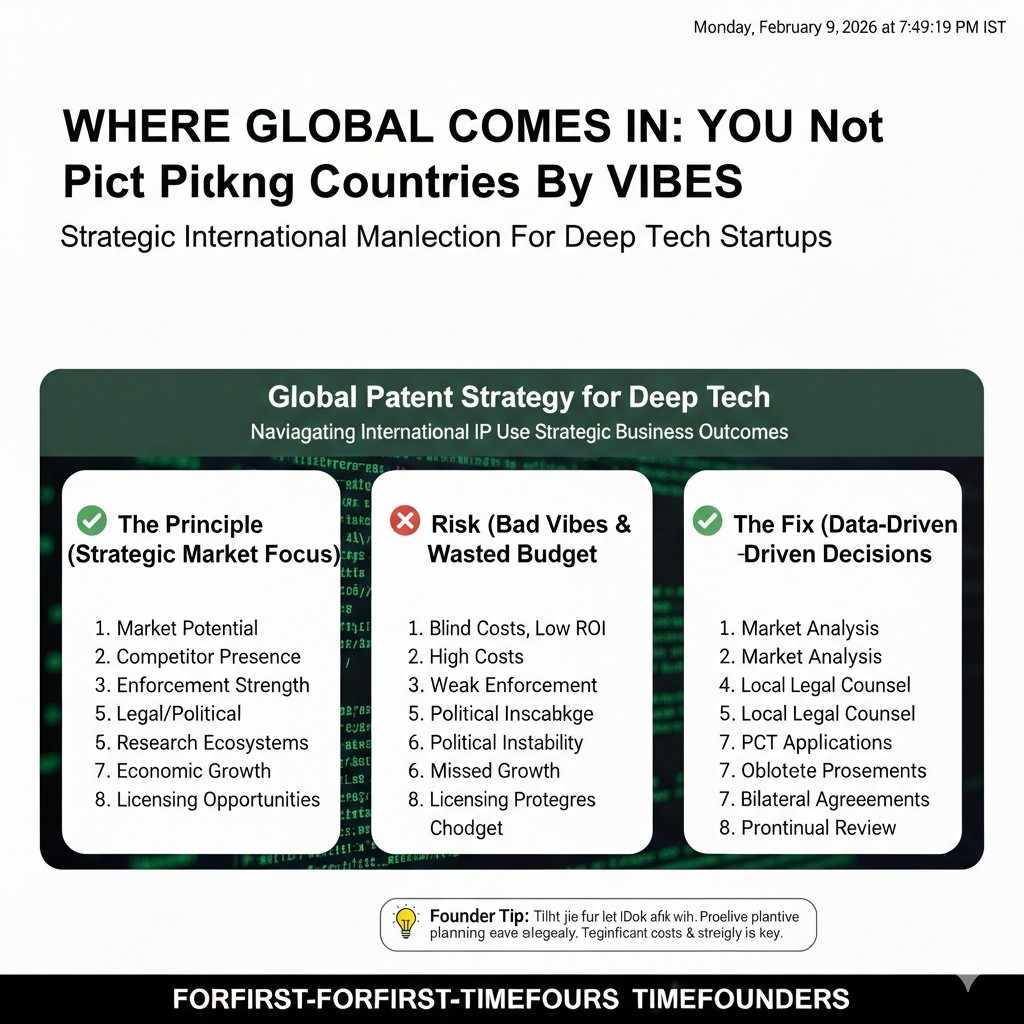
Where global comes in: you do not pick countries by vibes
This is the part founders hate, because it feels like paperwork. But if you get it right, you save a lot later.
When you choose where to pursue patents, you are usually choosing based on four factors:
Where customers pay
Where competitors build or sell
Where manufacturing happens
Where enforcement is practical
On a small budget, you usually cannot chase all four everywhere. So you rank them.
For many deep tech startups, “where customers pay” comes first. If your buyers are in the US and EU, that matters.
If your product is manufactured in a certain region, that can matter too, but it depends on your business model. If you are selling hardware, manufacturing regions can be more important. If you are licensing software, customer markets matter more.
Competitor location matters when you expect direct copying by teams in a certain area.
Enforcement practicality matters because a patent that you cannot enforce is mostly a signal, not a shield. Signals can still help, but you should be honest about what you are buying.
The point is not to be perfect. The point is to choose based on business reality, not guesswork.
The budget timeline that works in the real world
Start with the outcome you need, not the form you file
A strong patent plan is not “provisional vs PCT” first. It starts with your business timing. Ask what you need the patent work to do in the next 6 to 18 months. For most deep tech startups, the answer is simple: protect the core idea, avoid disclosure mistakes, and show investors you can own what you build.
Once you know the outcome, the filing path becomes easier. The right path is the one that buys you time and options. You want to delay the big spend until you know where the business is going, while still locking in a date that protects you from copycats.
The simple timeline most budget teams follow
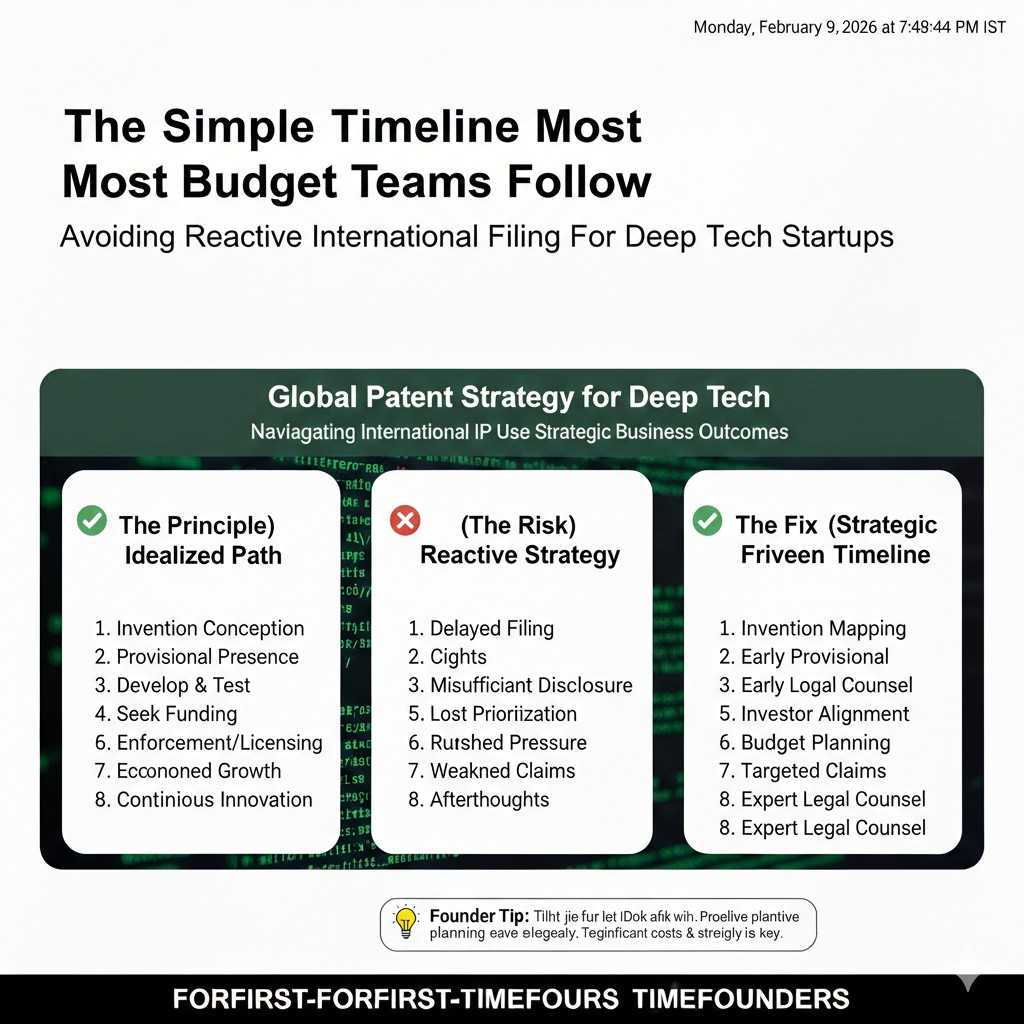
On a tight budget, many startups begin with one strong first filing, then use the next months to learn. During that learning window, you improve the invention, validate customers, and tighten your story. Later, you decide which countries truly matter and which ones do not.
This approach reduces waste. It stops you from filing in places you may never sell, and it prevents you from over-investing in features that later become less important. It also gives you breathing room to align IP decisions with fundraising.
How to plan around your next raise
Patents help most when they support a clear story. If you plan to raise in six months, you do not want a rushed filing the week before you start meetings. You want your core filing done early enough that you can speak about it calmly, show maturity, and answer questions with confidence.
A good rule is to have your key filing in place before you begin broad outreach. That way, your pitch does not depend on “we will do it soon.” It becomes “we have already protected the core.” This shift sounds small, but it changes how investors hear you.
Apply anytime if you want help mapping this to your exact raise timeline: https://www.tran.vc/apply-now-form/
Provisional, PCT, and national phase in plain words
What a provisional is meant to do
A provisional filing is often used as a low-cost way to lock in an early date. It can be very useful, but only if it is written with care. The main job of that filing is to describe the invention in enough detail that you can rely on it later.
Some founders treat a provisional like a placeholder. That is where trouble begins. If the document is thin, and the best parts are missing, your later application may not get the benefit of the earlier date. That can weaken the whole plan.
When a provisional makes sense for deep tech
A provisional makes sense when you have a real method that is working, but you know it will evolve. Robotics and AI teams often improve weekly. You might change model structure, add sensors, tune control, or revise your pipeline. A good provisional captures the core idea plus variations so the early date still protects you as you improve.
It also makes sense when you have a disclosure coming soon. If you must present, publish, or demo, filing before that moment can keep your global options open. In many cases, that is the difference between having rights in key regions and losing them.
What a PCT is meant to do
A PCT filing is not a “world patent.” It is a structured way to delay country-by-country costs while keeping your ability to enter many countries later. This is why startups often use it. It can give you more time to decide where to spend, and it can give you a clearer view of prior art through international search results.
For budget planning, PCT is often a bridge. It helps you hold global options while you gather customer proof. It also helps you avoid making expensive country choices too early.
What “national phase” really means
National phase is the stage where you pick specific countries or regions and begin the local process. This is where costs can rise, because each place has its own rules, fees, and timelines. This is also where strategy matters most, because you are committing money to specific markets.
A budget-friendly approach is to enter only where your business needs real protection. That usually means your largest buyers, your highest-risk competitor zones, or the places where partners require strong IP coverage.
How to choose countries without wasting money
Start with where money will actually come from
The cleanest filter is revenue. If you expect paid pilots, enterprise buyers, or licensing deals in certain regions, those are the first places to consider. It is not about prestige. It is about where the patent can support real deals and real leverage.
Many deep tech startups start with one or two major markets, then expand later once sales patterns are proven. The goal is to match protection to business traction, not to hope.
Use competitor reality, not fear
Founders sometimes pick countries because they are scared of large companies. That fear is normal, but it can lead to costly choices. A better way is to look at where competitors sell, where they manufacture, and where they file their own patents. That pattern tells you where they care, and where conflict is most likely.
You do not need to chase every country where a competitor exists. You need to protect the markets where you will collide. That is a smaller set than most founders assume.
Remember manufacturing and supply chains
If your advantage lives in a hardware design or a manufacturing step, supply chain regions can matter more. If someone can copy your method at the factory level, you may want protection closer to where production happens. But this is not always required, especially if your business model relies on software updates, cloud control, or proprietary calibration.
Your plan should reflect how your product can be copied in practice. Patents are strongest when they match real-world copying paths.
Align your IP plan with your product roadmap
Protect the core mechanism, not the interface
Deep tech products often have visible features and hidden mechanisms. The visible features are what people talk about. The hidden mechanisms are what make the product work. A budget strategy focuses first on the hidden part, because that is where copying hurts the most.
In AI, the hidden part might be how you train, adapt, or verify models. In robotics, it might be your control logic, safety layers, or sensing method. In chips, it might be power management, layout strategy, or data movement.
File around milestones, not calendar dates
Instead of thinking “we file every quarter,” tie filings to real milestones. A milestone could be a new algorithm that improves performance by a big margin. It could be a design change that cuts cost. It could be a safety improvement that unlocks a regulated market.
When you file around milestones, your patents stay meaningful. They track your real progress and support your story. Random filings based on the calendar tend to create clutter, and clutter creates cost.
Build a portfolio that tells one clear story
Investors and partners do not want a bag of unrelated patents. They want to understand what you own. That means your filings should connect to a single moat narrative. Even if you file multiple inventions, they should feel like chapters of the same book.
A clean story is also easier to defend. It reduces design-around risk because the claims work together. And it reduces internal stress because your team understands why each filing exists.
If you want help building that kind of story without draining your runway, apply anytime: https://www.tran.vc/apply-now-form/
Protecting AI inventions without giving away the secret
Focus on process claims that reflect real steps
AI patents often fail when they only say “use AI to do X.” That is too vague, and it is too easy to challenge. Strong AI protection usually describes a process: what inputs are used, what transformations happen, how the model is trained or adapted, how outputs are checked, and how the system behaves under uncertainty.
The key is to claim the method in a way that covers variations. You do not want to lock yourself to one model type or one dataset. You want the claim to protect the idea across different architectures, as long as the core logic stays the same.
Capture what makes your model practical, not just accurate
Accuracy is not always the moat. In the real world, moats often come from making AI usable: lower compute cost, faster inference, less data needed, better performance on edge devices, stronger privacy, or stable results under shift and noise.
If your advantage is “we run this on-device with low power,” that is a very patentable direction when described as a method and a system. If your advantage is “we learn from weak labels and still perform well,” that is also strong if you describe the workflow in real detail.
Write patents that survive your own iteration
AI changes fast inside a startup. If your patent only covers the version you built this month, it can become outdated quickly. A stronger approach is to define the core principle, then describe multiple ways to implement it.
This makes the patent useful even as you shift tools. Your team may move from one model family to another, but the protected insight remains the same. That is how you avoid paying for filings that become irrelevant.
Protecting robotics inventions when hardware and software mix
Describe the loop, not just the parts
Robotics inventions are often about how sensing, decision, and control work together. A patent that lists sensors and motors is rarely enough. A better approach is to describe the loop: what is sensed, how it is interpreted, how decisions are made, and how actions are corrected when reality differs from the plan.
This is also where you can claim the hard-earned reliability features. Those are usually the most defensible parts, because they come from real-world pain and real testing.
Claim safety and recovery behavior as first-class features
Robots fail. The best teams plan for failure. If your robot can detect risk early, switch modes, slow down, re-plan, or recover gracefully, that can be patent-worthy. These behaviors are not “nice extras.” They are often the reason enterprise buyers trust the system.
When written well, patents around safety behavior can also become strong talking points in sales. They show you built with responsibility and real deployment in mind.
Capture calibration and setup advantages
Many robotics products struggle not in the lab, but in setup. If your system installs faster, calibrates itself, adapts to new sites, or stays stable across different environments, those are valuable inventions. They reduce customer friction and they scale adoption.
Founders sometimes ignore these parts because they feel unglamorous. In practice, they are often the edge that wins deals. And because they are hard to discover from the outside, they can be strong IP anchors.
The disclosure trap, revisited, with practical examples
Marketing is safe when it talks about outcomes
You can talk about what your tech achieves without explaining how it works. This lets you sell and recruit without harming your patent plan. “We cut inspection time by 60%” is usually safer than “we use a specific sensor fusion method that does X in steps A, B, C.”
Your team should build a habit of separating outcome language from method language. Outcome language goes into public materials. Method language stays internal until you have filed.
Demos can reveal more than you think
A demo video can leak key information. A careful observer can infer steps from timing, system behavior, or UI details. This is not a reason to hide. It is a reason to file before major exposure and to review what the demo teaches.
If you treat every major demo like a “patent moment,” you reduce risk. You stop accidental disclosures that later block your global options.
Open-source needs a plan
Open-source can be strategic, but it must be intentional. If you open-source the core method before filing, you may give away rights in many regions. If you file first, you can sometimes open-source parts while keeping the important edge protected.
This is not one-size-fits-all. But the rule stays consistent: file before you teach.
Apply anytime if you want a clear disclosure-safe plan that fits your product and community goals: https://www.tran.vc/apply-now-form/