
If you build hard tech—AI, robotics, new sensors, new chips, new models—your work does not happen in a straight line. It happens in loops. One person tests. Another tweaks. Someone spots a bug. Someone else finds a new path. Over a few months, the “real” invention starts to feel like a shared thing. That is normal. It is also where co-inventor disputes begin.
A co-inventor dispute is not just a hurt feeling problem. It can become a legal problem. It can slow down a patent filing. It can scare off investors. It can break trust inside the team. In a research-heavy company, the risk is higher because the work is deep, layered, and often done by many hands.
The good news is this: most co-inventor fights are not caused by bad people. They are caused by unclear process. People do not know what “inventor” means in patent law. They confuse invention with effort. They do not track who added what, and when. Then, right before a filing or fundraising, the pressure spikes. Someone asks, “Why am I not on the patent?” Another person says, “Because you did not invent it.” And now the team has a fire to put out at the worst time.
This article will show you how to avoid that fire—before it starts—using simple habits that fit real startup life. You will learn how to set expectations early, how to record contributions without slowing the team, how to run invention reviews, and how to keep credit fair without turning your lab into a courtroom. If you do this well, patents become a trust builder, not a trust breaker.
Tran.vc helps research-heavy founders do this the right way from day one. We invest up to $50,000 in-kind through patent and IP services, so you can build a real moat without burning cash too early. If you are building AI, robotics, or deep tech and want a clear IP plan with fewer team risks, you can apply anytime here: https://www.tran.vc/apply-now-form/
Why Co-Inventor Disputes Happen So Often in Research Teams
The quiet mix-up between “helped a lot” and “invented”
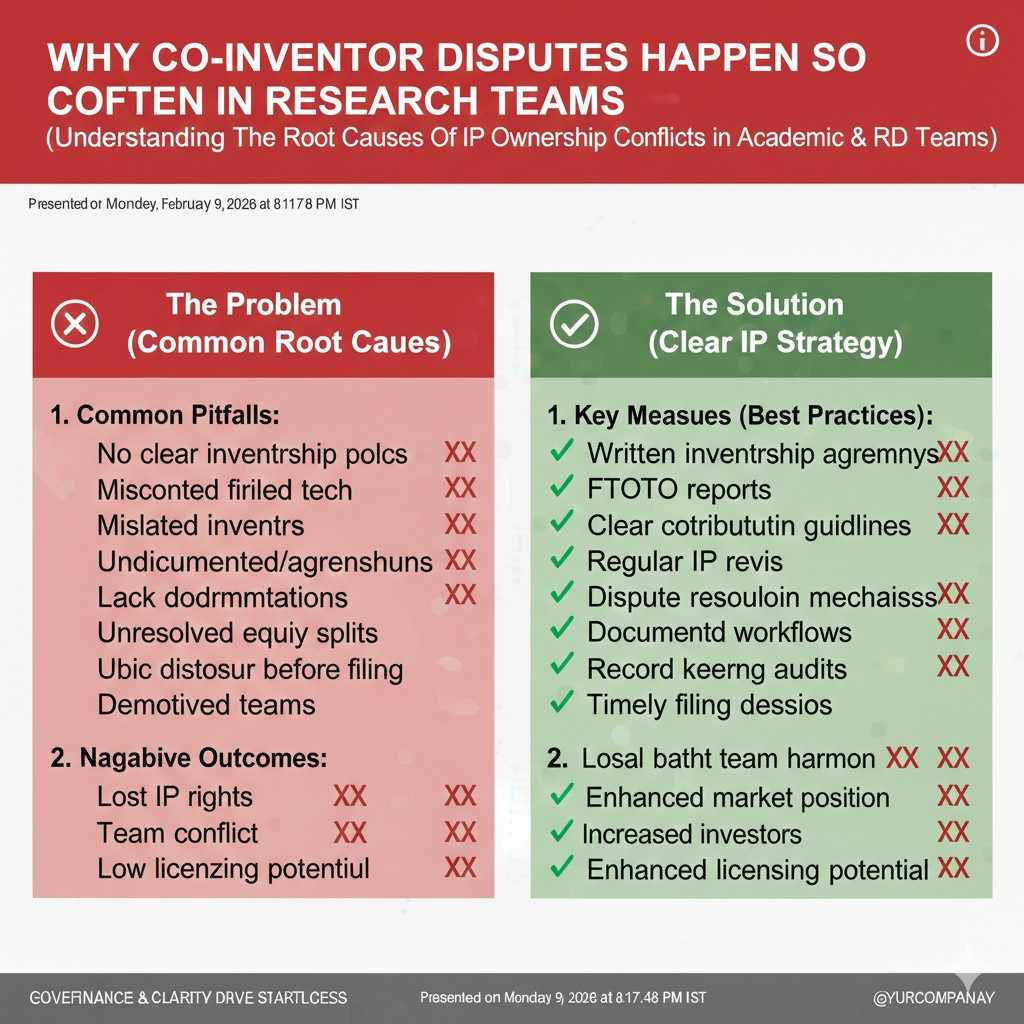
In research teams, people often blend two different ideas. One is effort, like long nights, fast fixes, and deep testing. The other is invention, which is about who shaped the actual new idea that ends up in the patent claims.
Both matter in a company, but they are not the same thing in patent rules. When a team does not talk about this early, people make their own meaning in their heads.
Later, when a patent comes up, that hidden meaning turns into tension. Someone feels ignored, even if the team did not mean harm.
The fastest way to reduce this risk is to name the difference early, in plain words, and repeat it often so it becomes normal.
Research work is layered, so credit feels blurry
In product teams, work can be easier to point to. One person built feature A. Another built feature B. In research-heavy teams, the work is stacked in layers.
A dataset choice changes model results. A sensor tweak changes control logic. A small change in loss function changes the whole training run. Over time, it becomes hard to tell where the “invention” begins.
This is why disputes show up even in teams with good trust. The invention is real, but the path to it is shared and messy.
If you do not build a clean way to track key idea moments, you are forcing the team to rely on memory. Memory is not fair, and it is never complete.
Pressure makes small doubts turn into big fights
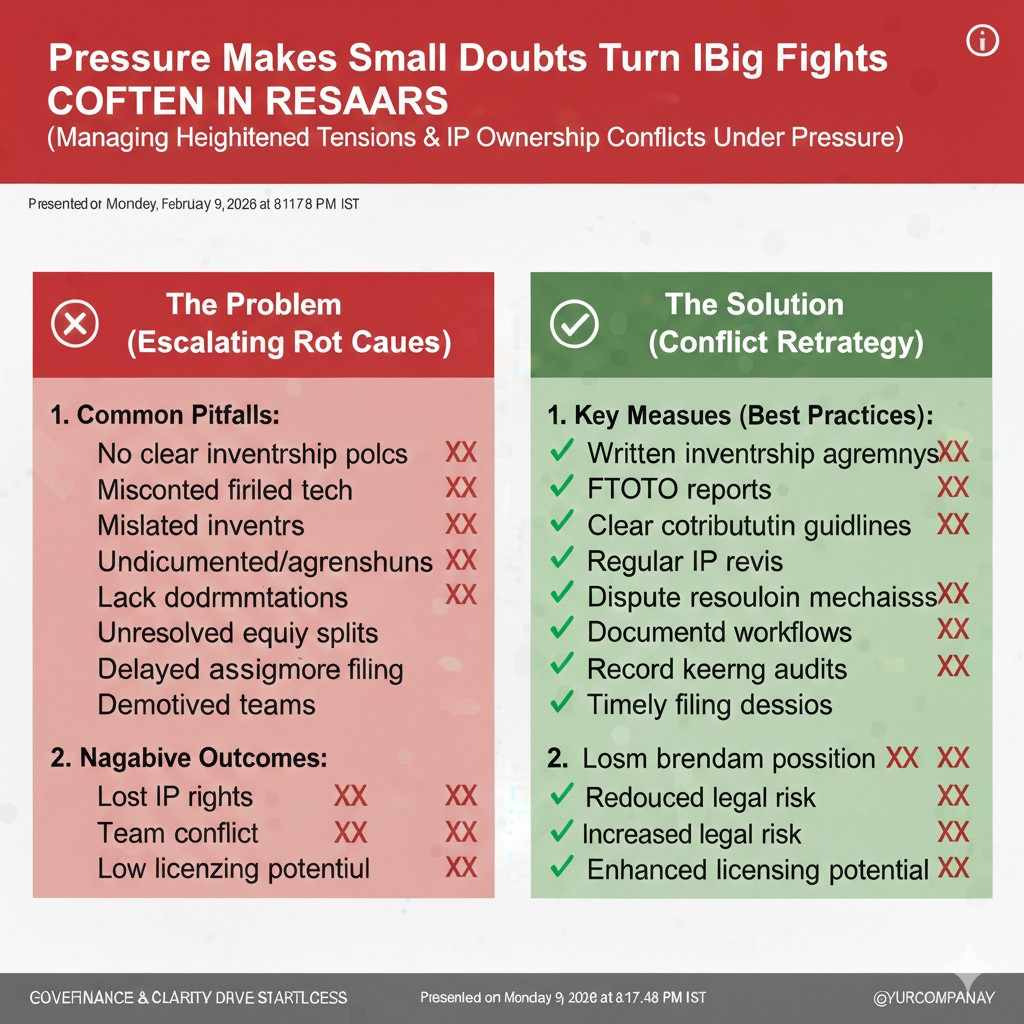
Most co-inventor disputes do not start with anger. They start with a doubt that sits quietly. A person wonders if they will get credit. They watch decisions happen fast, and they are not sure if their work is being seen.
Then a moment arrives that adds pressure. A seed investor asks about defensibility. A customer asks if you own the tech. A demo goes viral. A competitor pops up.
Now the company wants to file quickly. That is when the doubt becomes a direct question, and the question can become a fight if nobody has a process ready.
The goal is not to remove emotion from humans. The goal is to build a calm system that works even when people feel stressed.
Patents feel like status, so people treat them like a scoreboard
In many labs and startups, patents are seen as proof that someone is “core.” That is not always said out loud, but people feel it.
When patents become a status signal, inventorship starts to feel like a reward for loyalty or hard work. That is where teams get into danger, because patent inventorship is not a company award.
It is a legal label tied to the claims in the patent. If the team uses it like a bonus, you create two problems at once.
First, you risk filing with the wrong inventors, which can cause legal trouble later. Second, you risk making people feel used, which can break the culture.
What “Inventor” Really Means in Patent Terms
A simple way to think about it
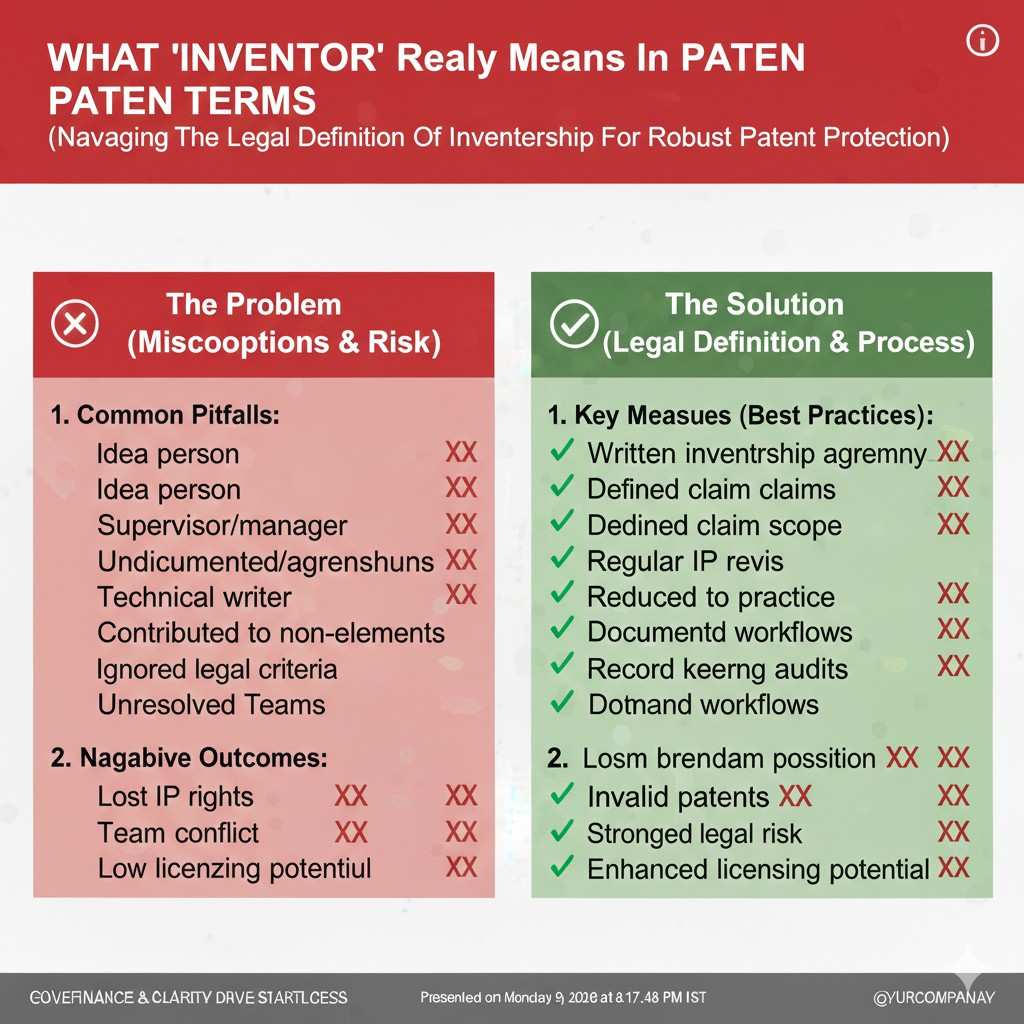
An inventor is a person who helped create the new idea that the patent claims cover. The key word is “claims,” because patents do not protect your whole project. They protect the specific new ideas written in the claims.
So inventorship is not about who wrote the most code. It is not about who ran the most tests. It is not about who managed the team.
It is about who contributed to the inventive step inside the claims. This is why inventorship can change as the patent draft changes.
If your team learns this early, you remove a lot of future confusion. It becomes easier to talk about credit in a clean way.
Why effort alone does not make someone an inventor
In research teams, effort can be huge without changing the core inventive idea. For example, someone might run weeks of experiments to prove a concept works. That work is valuable. It may even be the reason the company survives.
But if the inventive idea was already formed, and the experiments only confirmed it, inventorship may not apply. That can feel unfair if the team never explained the rules.
The right answer is not to bend inventorship into a thank-you gift. The right answer is to build other ways to reward effort, like equity, bonus, title growth, public praise, or lead roles.
When teams separate “legal credit” from “company appreciation,” they protect both the patent and the culture.
Why small idea inputs can count more than big labor
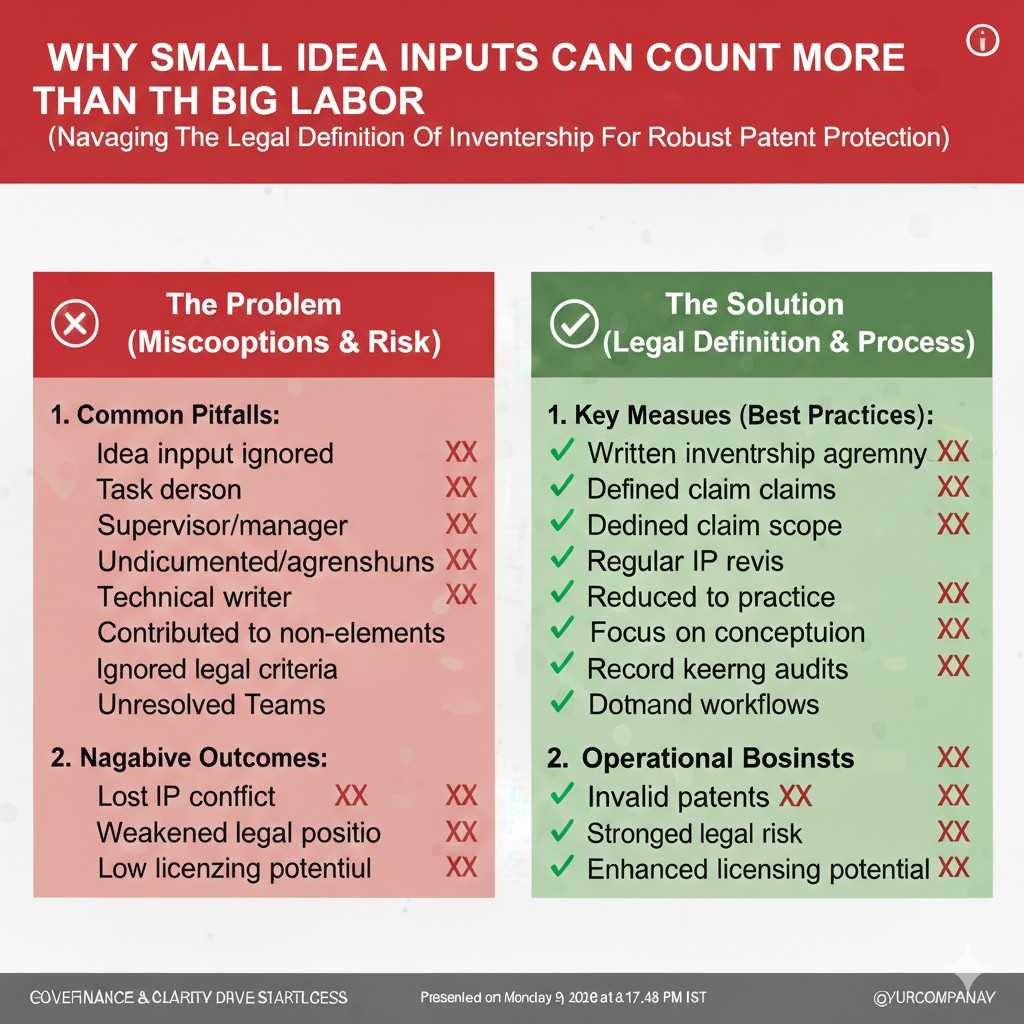
The opposite is also true, and it surprises people. Someone can contribute a small but key idea that becomes part of the claims. That person may be an inventor even if they did not do much of the later work.
In a robotics team, a single change to how feedback is computed could be the novelty. In an AI team, a small training trick could be the new step that makes the system work in a way others cannot copy.
This is not meant to reward “drive-by opinions.” It is simply how patents work. Claims focus on what is new and non-obvious, not who worked the hardest.
If you do not explain this, you create a false expectation that inventorship is a measure of sweat. That false expectation causes disputes.
Inventorship is tied to each patent, not to a person’s role
Another common problem is role-based thinking. Teams sometimes assume the CTO must be on every patent, or a senior researcher must be on everything.
That can lead to incorrect inventorship. It also creates resentment, because others may feel their ideas are being taken.
The clean rule is simple: each patent stands on its own. The claims define the invention. The inventors are the people who contributed to those claims.
When a team uses role-based inventorship, it is not just risky. It is also a signal that politics matter more than truth. That signal damages trust fast.
The Real Cost of Getting Inventorship Wrong
The legal risk you do not want to discover during fundraising
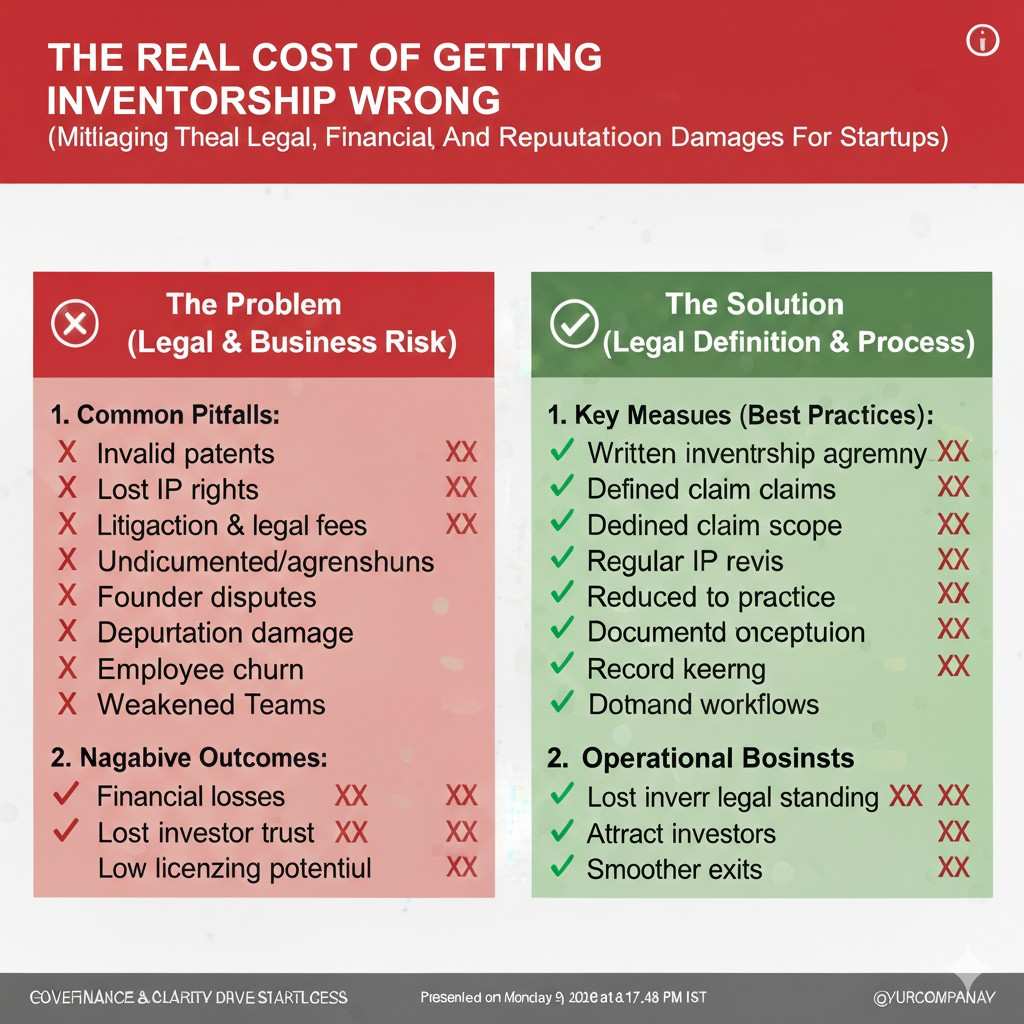
Investors do not expect perfection, but they do expect your core IP to be clean. If inventorship is wrong, it can create a cloud over ownership.
In some cases, a left-out inventor can challenge the patent or claim rights. Even the worry of that can slow a deal.
Fundraising already has enough friction. You do not want inventorship questions showing up in diligence when you are trying to close a round.
The best time to reduce that risk is before the first filing, not after a term sheet arrives.
The team risk that shows up as slow execution
Even if there is no legal fight, inventorship disputes create a “drag” in the team. People stop sharing early ideas because they fear losing credit.
They keep notes private. They avoid brainstorming in open meetings. They start to hold back, and the work slows down.
Research-heavy teams win by combining minds, not by running isolated lanes. When credit feels unsafe, the team loses its biggest advantage.
A clear inventorship process keeps idea-sharing open. It tells people, “Speak up early, and you will be seen.” That unlocks speed.
The culture damage that lasts longer than the patent
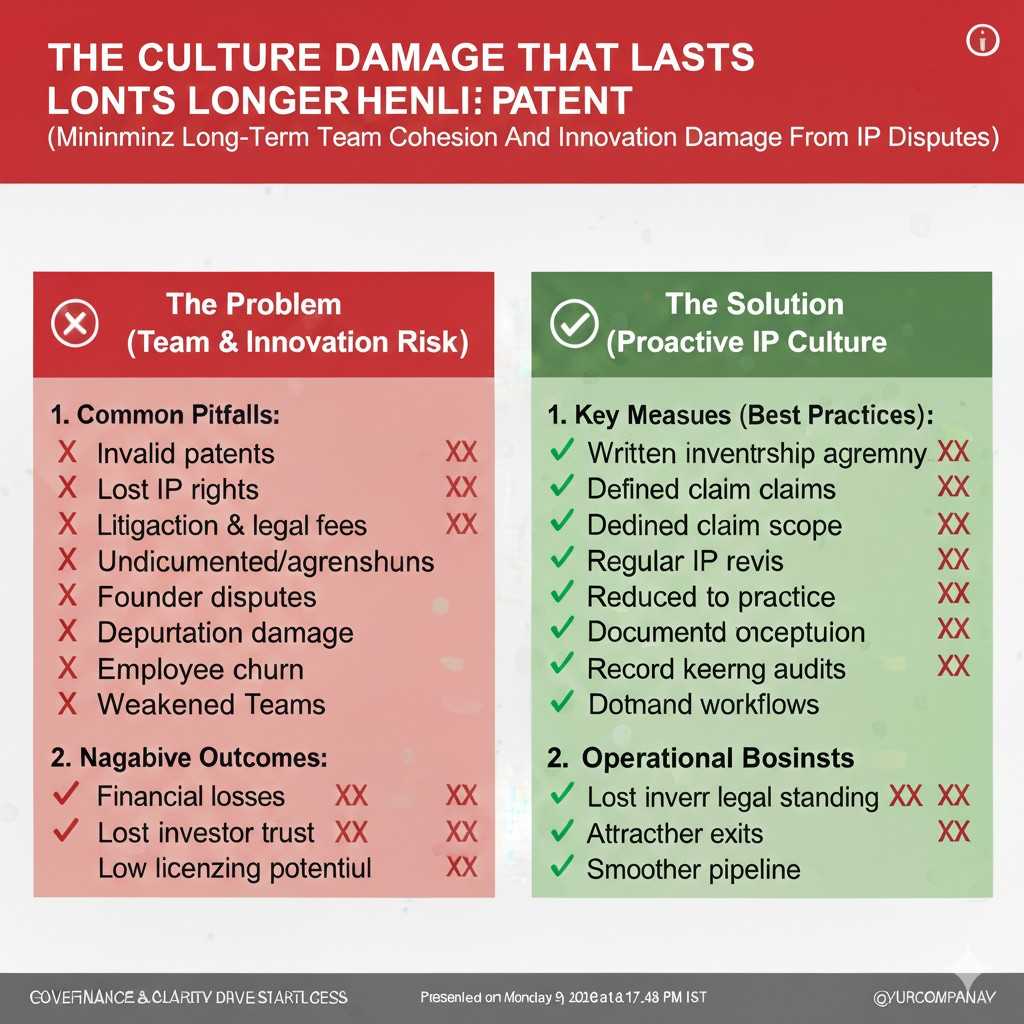
A patent filing is a moment in time. A broken relationship can last for years.
If a teammate feels they were used, they may leave. If they leave angry, they may talk. Even if they do not, the rest of the team sees what happened and learns a lesson.
The lesson might be, “Protect yourself.” That is the opposite of what a young company needs.
When you handle inventorship with care, you send a different lesson. You show that truth matters, fairness matters, and people matter.
How to Avoid Co-Inventor Disputes in Research-Heavy Teams
Start with one clear conversation in week one
Most teams wait too long to talk about inventorship. They wait until a patent is on the table. By then, people have already formed opinions about what they “deserve.”
A better move is to talk about it in week one, while everything is calm. This is not a legal lecture. It is a simple alignment talk that sets the tone.
You can say, in plain words, that patents have a legal rule for who is an inventor. You can also say that the company will still reward hard work in other ways, even when inventorship does not apply.
When people hear this early, they do not feel tricked later. They may still be disappointed sometimes, but the surprise is gone, and surprise is what turns mild pain into conflict.
Make “inventor” a process, not a debate
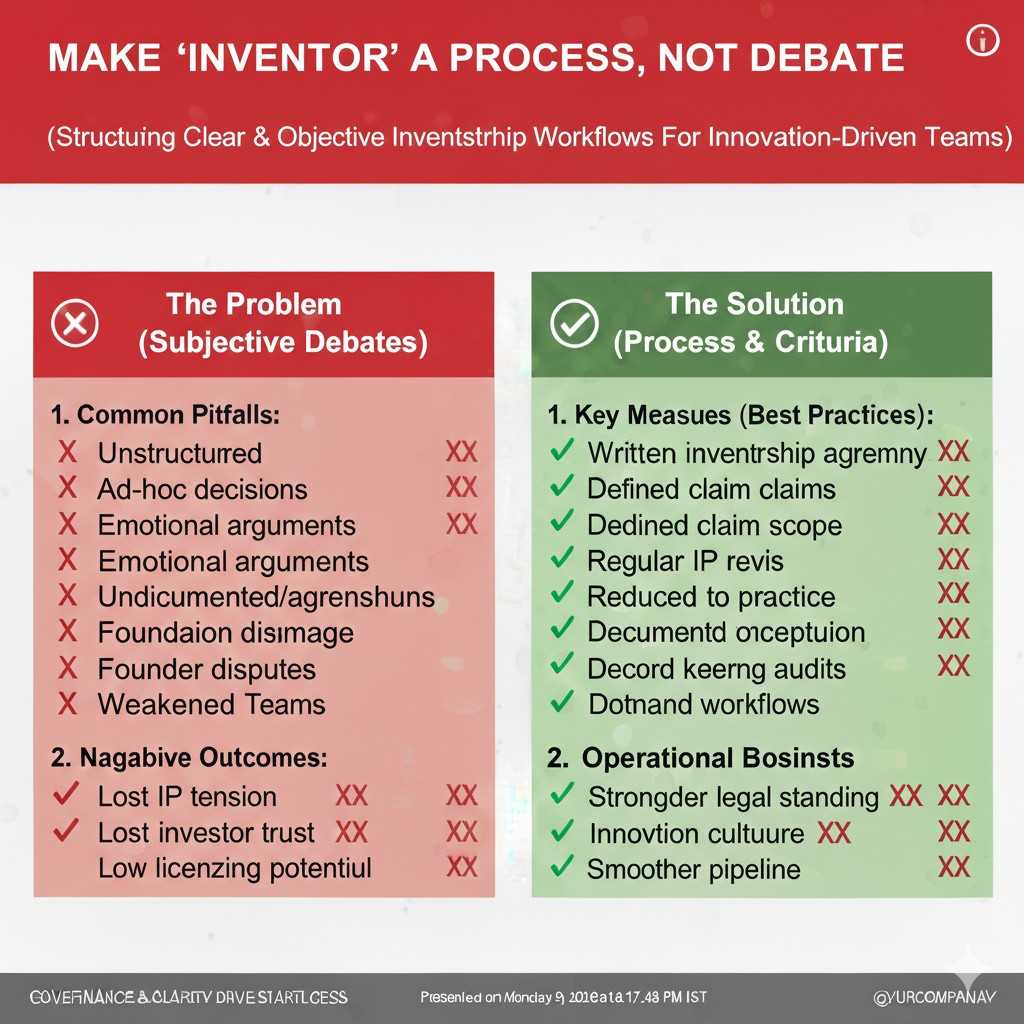
A dispute often starts when inventorship is handled like a personal argument. One person argues for themselves, another pushes back, and the CEO gets stuck as judge.
That is a bad position for any founder. Even if you decide fairly, somebody may think you picked sides.
Instead, treat inventorship like a routine process. Make it clear that no one “decides” inventors based on feelings. The team follows a repeatable review that links contributions to the draft claims.
When a process exists, the conversation shifts. It becomes less about status and more about evidence. This alone prevents many fights from ever forming.
Set the tone: credit is serious, and so is appreciation
Research teams need two kinds of credit. One is legal inventorship, which must match the rules. The other is human appreciation, which must match reality.
If your company only celebrates patents, you are pushing people to fight for patent spots to feel seen. That is not their fault. It is the incentive you set.
You can fix this by celebrating other wins with the same energy. Celebrate research write-ups, strong test plans, hard debug wins, clean data work, and system integration.
When people feel valued in many ways, they do not treat inventorship as the only door to respect. That reduces conflict without any complicated policy.
Document Contributions Without Slowing Down the Team
Keep a simple “idea trail” as you build
In research-heavy work, ideas change fast. If you do not capture key moments, the team will later rely on fuzzy memory. That is where disputes grow.
The goal is not to create paperwork. The goal is to leave an “idea trail” that shows how the invention formed. A light trail can be enough.
A simple approach is to create one shared place where key idea steps are logged. It can be a doc, a lab notebook, or an internal page.
The entries should be short, but meaningful. What changed, why it mattered, and who suggested it. When done weekly, this takes minutes, not hours.
Use meeting notes as proof, not as busy work
Many teams already have weekly research meetings. The easiest move is to make the meeting notes slightly more useful.
When a new technical idea is proposed, capture it in the notes with a date and names of who shaped the idea. Do not write an essay. Just note the core point.
Later, if a patent is drafted, those notes become a timeline. The timeline makes inventorship review calmer because it is tied to real records.
A team that keeps decent notes rarely ends up in a “he said, she said” fight, because there is something to point to besides feelings.
Make version control part of your IP hygiene
Code commits, experiment logs, and design docs already exist in many technical teams. The mistake is treating them only as build tools, not as proof tools.
When your commits and docs include clear descriptions of why a change matters, they help show who contributed what. That does not automatically decide inventorship, but it supports the story.
This also helps when you work with patent counsel. Counsel can understand the invention faster when the technical path is clear. That often leads to better claims too.
The key is not to force long commit messages. It is to encourage a habit of writing the “why” in simple terms.
Avoid private notebooks for core invention work
Some researchers like personal notebooks. That can be fine for learning and rough thinking. But when core invention work lives only in private notes, the team loses shared clarity.
Private notes can also create fear. Others may worry that someone is building a private claim to credit. Even if that is not true, the worry itself harms trust.
A good balance is to keep personal notes for rough work, but require that key invention steps are captured in the shared system.
When the record is shared, the team feels safer. Safety leads to more open sharing, which leads to better research outcomes.
Run “Invention Checkpoints” Before You Draft a Patent
Do short reviews while the work is still fresh
Most inventorship disputes show up when a patent is being drafted under time pressure. That is the worst time to discover that people disagree about contributions.
Instead, run quick invention checkpoints during the research cycle. This can be a short meeting every month or every milestone.
The point is not to decide inventors forever. The point is to ask, “What is the new idea here, and who shaped it?”
When this happens early, people can raise concerns politely. It also encourages the team to document key steps as they happen, not months later.
Separate “who contributed” from “what we will file”
A common trap is mixing two questions. One is, “Who contributed to the new idea?” The other is, “What exactly will we file as a patent?”
These questions are linked, but they are not the same. Sometimes you will choose to file only a slice of the work. Sometimes you will split it into multiple filings.
If you treat the filing choice as a credit choice, people may feel manipulated. They may think, “You are filing the part I did not touch so you can exclude me.”
You can prevent that feeling by being transparent. Explain why you are filing a certain slice first. Explain that more filings may follow as the work grows.
Use plain-language claim sketches early
You do not need a full patent draft to talk about inventorship. What you need is a clear sketch of the invention in plain words.
A helpful method is to write a short “claim-like” summary that explains what is new, what parts work together, and why it is different from what exists.
Then ask the team, “Who contributed to these specific parts?” Keep it focused on the idea, not the labor around it.
When the team is aligned on the plain-language sketch, the later legal draft has fewer surprises. That reduces the chance of a sudden conflict near filing.
Create a Fair, Calm Way to Decide Inventorship
Do not make the CEO the final referee alone
Founders often become the default judge because they lead the company. That can feel efficient, but it can backfire.
When the CEO decides alone, the decision can look political even if it is fair. People may assume bias based on seniority, friendship, or role.
A better approach is to involve a neutral process. This can include patent counsel and a simple internal review method that uses evidence from docs and meeting notes.
The founder still leads, but the decision is not “because I said so.” It is “because the record and the claims show this.”
Treat inventorship as claim-by-claim, not person-by-person
Inventorship is not a popularity contest. It can change based on what ends up in the claims.
A calm way to explain this is to review the invention in pieces. For each key part of the invention, ask who contributed the idea that made that part new.
This keeps the discussion specific. It also helps people see that inventorship can be shared in a clean way, without stretching the rules.
When teams talk in specifics, emotions drop. Vague talk like “I built the model” leads to fights. Specific talk like “I proposed the new training step that made X possible” leads to clarity.
Build a “credit map” that the whole team can see
A credit map is a simple document that lists the key inventive points and the names tied to each point. It is not a legal filing. It is an internal clarity tool.
This helps in two ways. First, it reduces fear because people can see their contributions being captured over time.
Second, it makes patent work smoother because counsel can ask the right questions faster. The team is not starting from zero each time.
If you keep this map updated, inventorship becomes less dramatic. It becomes part of normal operations, like sprint planning or experiment tracking.