
If you build AI, you live with a tension every day.
On one hand, you need protection. You need something real that shows the world you did the hard work. Something investors respect. Something a bigger competitor can’t copy and ship in six months.
On the other hand, patents require disclosure. They ask you to explain your invention well enough that someone skilled in the field can make it work. That can feel like handing over your playbook.
So founders often freeze. They either avoid patents completely, or they write something so vague it can’t protect anything. Both paths are expensive in the long run.
Here’s the good news: you can patent AI methods without handing out your secret sauce.
Not by hiding everything. Not by playing games. But by being smart about what you claim, what you describe, and how you frame the invention so it is defensible—while the parts that make you special stay protected through careful drafting, good trade secret habits, and the right filing strategy.
This matters even more in AI than in many other fields. Models change fast. Tools shift. Today’s training stack may look different in a year. But the valuable parts—your method, your pipeline, your system choices, your way of using signals, your way of controlling errors, your way of making outputs safer or cheaper—those can still be protected if you describe them the right way.
This article will walk you through that playbook in plain words. We’ll talk about what you can safely disclose, what you should keep private, and how to write a patent that protects the heart of your method without exposing the parts that give you an edge. You’ll also learn how strong teams build an “IP wall” early, before raising a priced seed, so they negotiate from strength instead of stress.
And if you’re building in AI, robotics, or deep tech and you want help doing this the right way, Tran.vc can support you with up to $50,000 in in-kind patent and IP services—so you can build protection early without burning cash. You can apply anytime here: https://www.tran.vc/apply-now-form/
What a patent must reveal and what it does not
The simple rule most founders miss
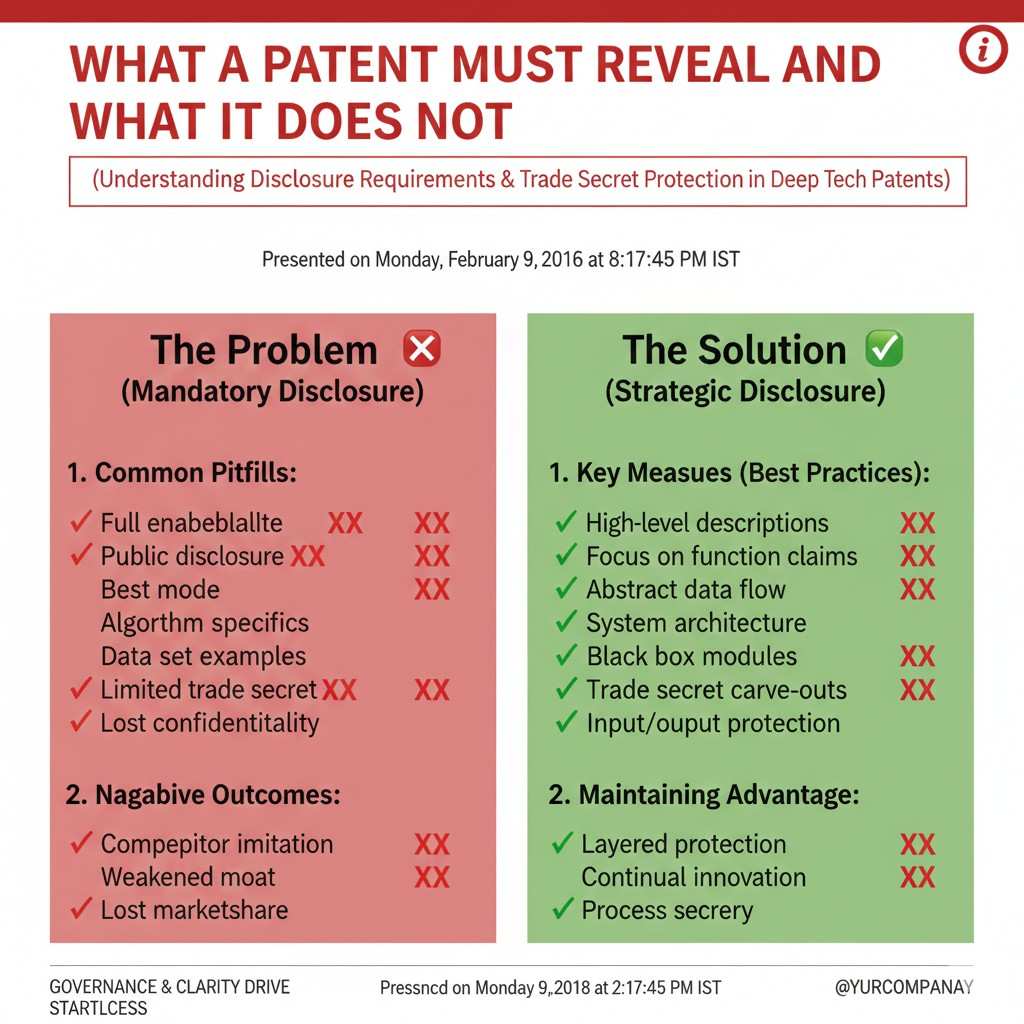
A patent is not a diary of your work. It is not a step-by-step lab notebook. It is a legal document that must teach the “invention” well enough that a skilled person could make and use it.
That sounds scary at first, because AI work often feels like a chain of small choices. But the patent system does not require you to publish every choice. It requires you to disclose enough to support what you claim as new.
In plain terms, you do not have to reveal everything. You have to reveal the parts that make your claimed invention possible, believable, and repeatable in a general way.
What “enough detail” really means for AI
For AI methods, “enough detail” usually means describing the flow. What goes in, what happens in the middle, and what comes out.
You explain the steps in a way that a skilled engineer can follow, even if they do not have your exact code. You show how the method works across many settings, not just one narrow example.
You can write this without giving away the tiny tuning knobs that make your system shine. Those knobs often belong in trade secret practice, not in a patent.
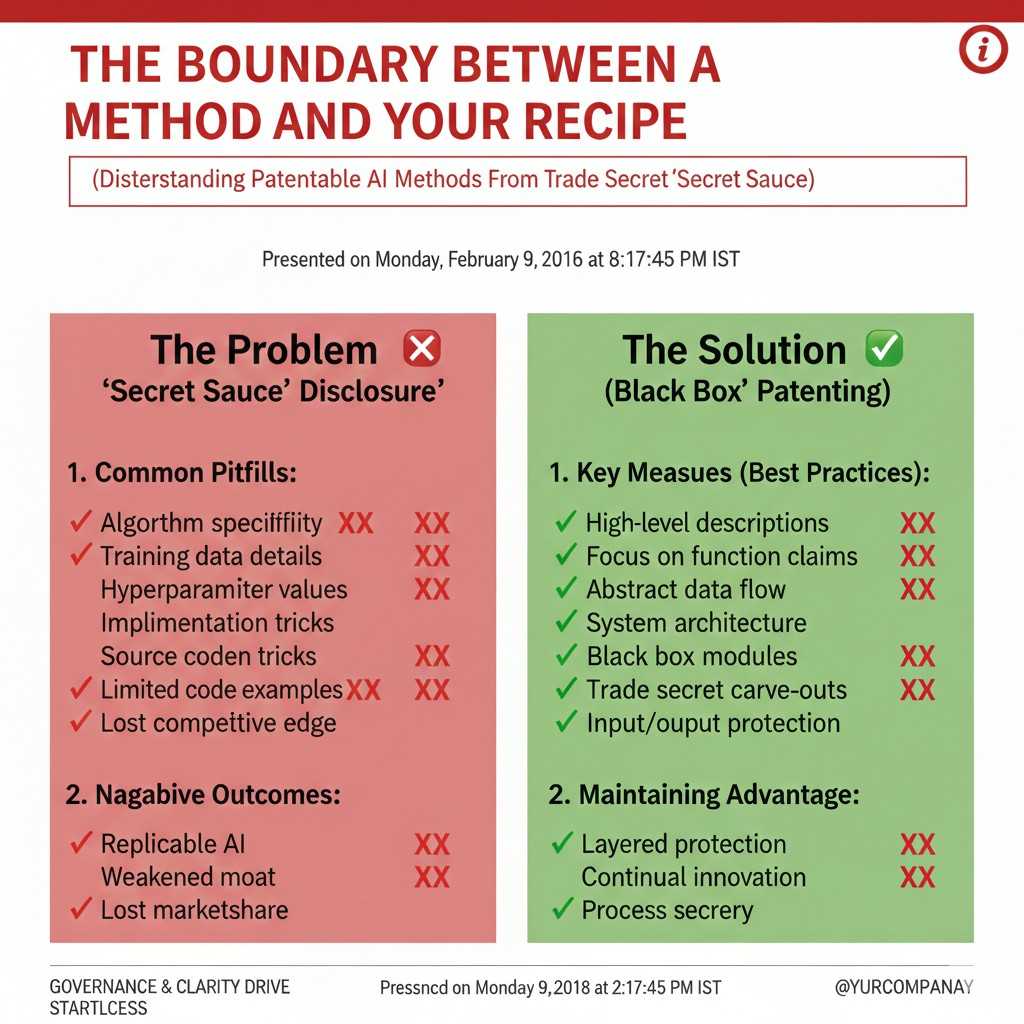
The boundary between a method and your recipe
Think of your AI work like cooking.
The method is the structure: prep, cook, finish, plate. The recipe is the exact amounts, timing, and small tricks you learned after ten failed batches.
Patents are best at protecting the structure that others would copy if they could. Trade secrets are best at protecting the exact tricks that are hard to guess.
You do not have to choose one or the other. Strong teams use both on purpose.
Why you should not hide your invention on purpose
Some founders try to file a patent that is intentionally vague. They avoid clear steps, avoid clear examples, and avoid specifics.
This usually backfires. If the patent does not enable the invention, it can be rejected during review. Even if it issues, it can be attacked later.
The goal is not to be foggy. The goal is to be clear about the invention while being careful about which parts are essential and which parts are optional.
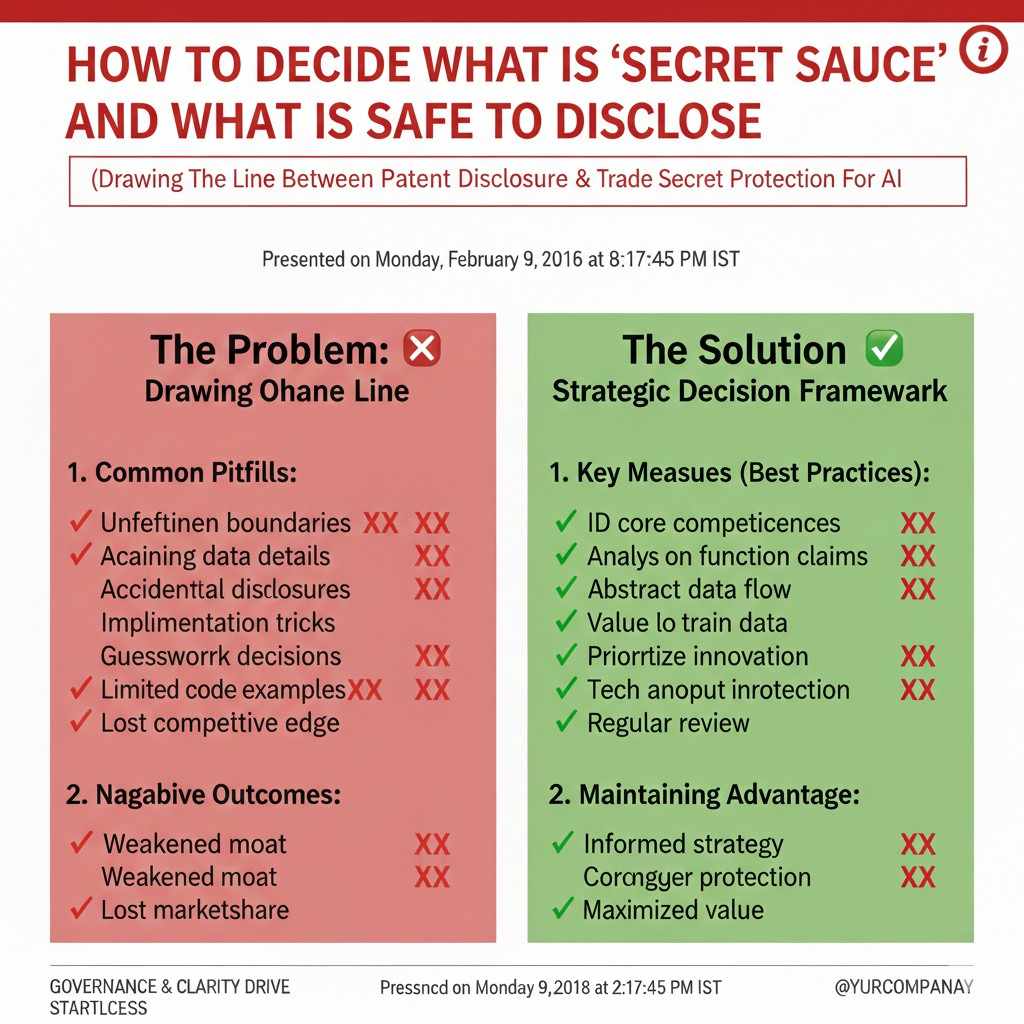
How to decide what is “secret sauce” and what is safe to disclose
Start with what makes money, not what feels cool
Founders often think the “secret” is the model choice or the prompt chain. Sometimes it is. Often it is not.
The real moat is usually tied to one of three things: a unique signal, a unique method of using the signal, or a unique way of reducing cost or risk while keeping quality.
To decide what to disclose, start from the business. Ask what part of your AI, if copied, would hurt you the most.
Separate the invention from the implementation details
Your implementation details include things like exact hyperparameters, exact data filtering thresholds, exact feature weights, and the exact schedule of training runs.
These details can be valuable. But they also change a lot. They evolve as you test, ship, and learn.
Your patent should focus on the stable idea that stays true even when your engineering choices improve over time.
Identify what can be swapped without breaking the invention
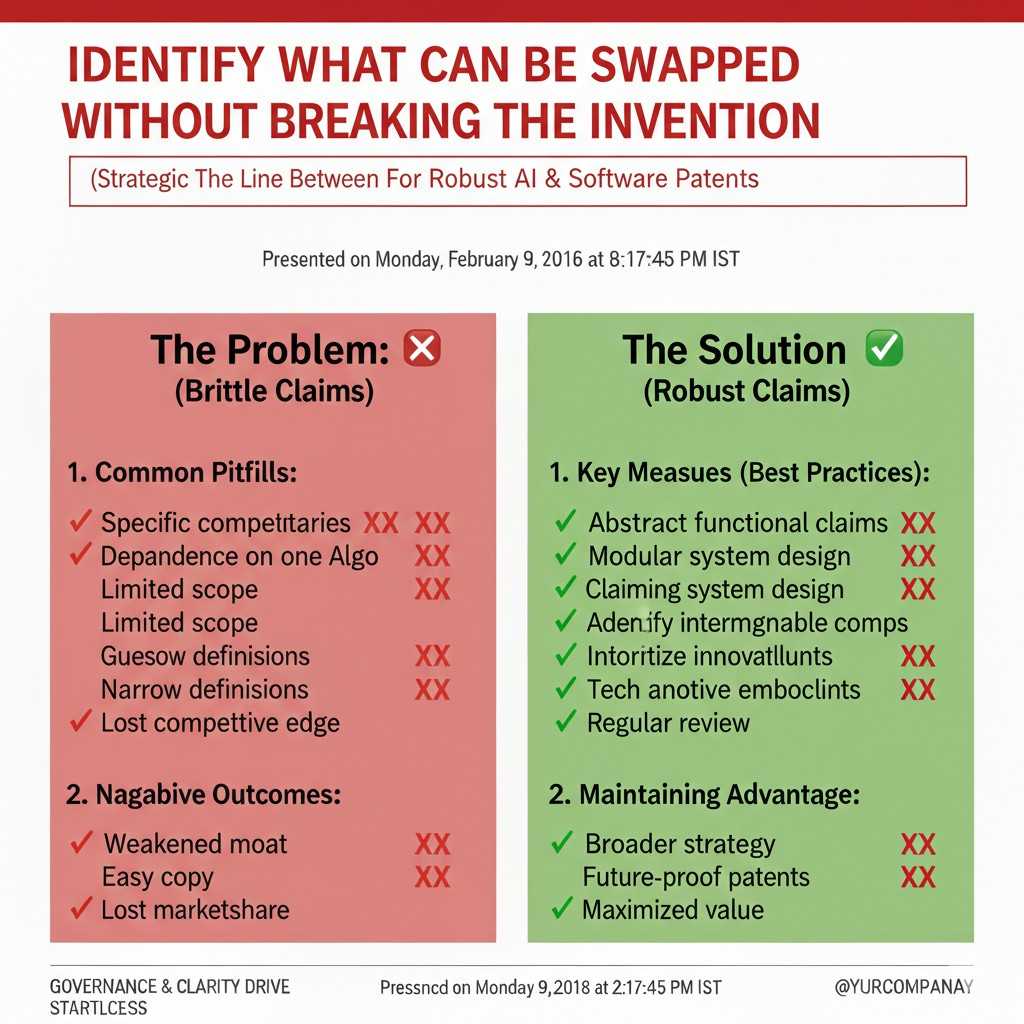
A good trick is to list what parts you could replace while still keeping the core method.
If you can swap the backbone model and still keep the benefit, then the backbone is not the invention. If you can swap the optimizer, the batch size, or the exact prompt text, those are not the invention either.
What remains after you remove the swappable parts is usually what you should protect.
Know the four common “secret sauce” categories in AI
Many AI teams hide the wrong things.
What tends to matter most is the data advantage, the labeling or feedback loop, the control layer that makes outputs safe, and the system design that makes it fast and cheap.
A patent can protect parts of these, but you often want a split: protect the method, keep the exact values and exact datasets private.
How to write claims that protect the core without exposing the details
Claims are the lock, the description is the story
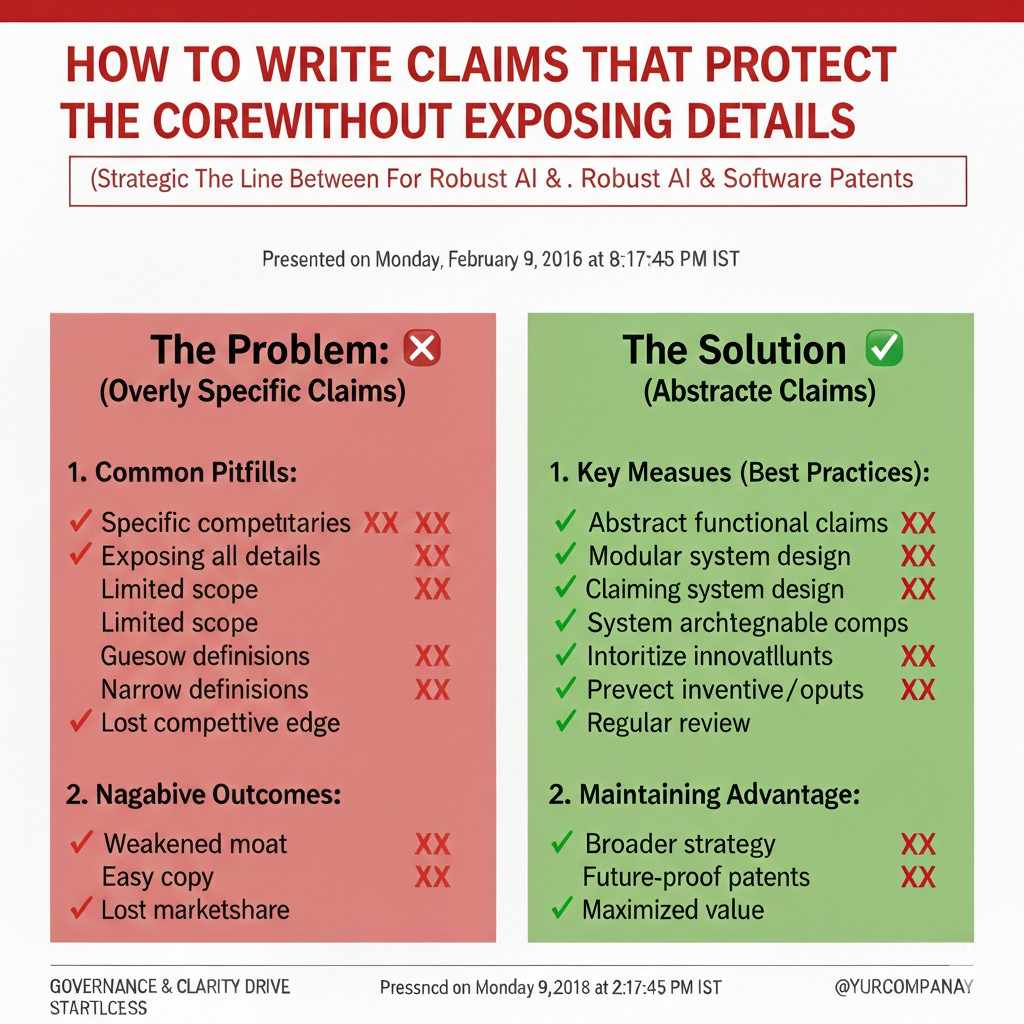
In a patent, the claims matter most. Claims define the legal boundary.
Your written description supports the claims. It gives examples, explains the flow, and shows variations.
If you want protection without oversharing, you must design claims that cover the heart of your approach while letting the description stay general on the sensitive points.
Claim the method as steps, not as “we trained a model”
Many AI filings fail because they sound like this: “We trained a model to do X.”
That is not an invention by itself. It is a result. Examiners and courts want the “how.”
Instead, you claim steps like receiving inputs, transforming them in a specific way, applying constraints, generating intermediate outputs, and producing a final output with a measurable improvement.
This lets you protect the method, even if the underlying model changes over time.
Use functional language carefully
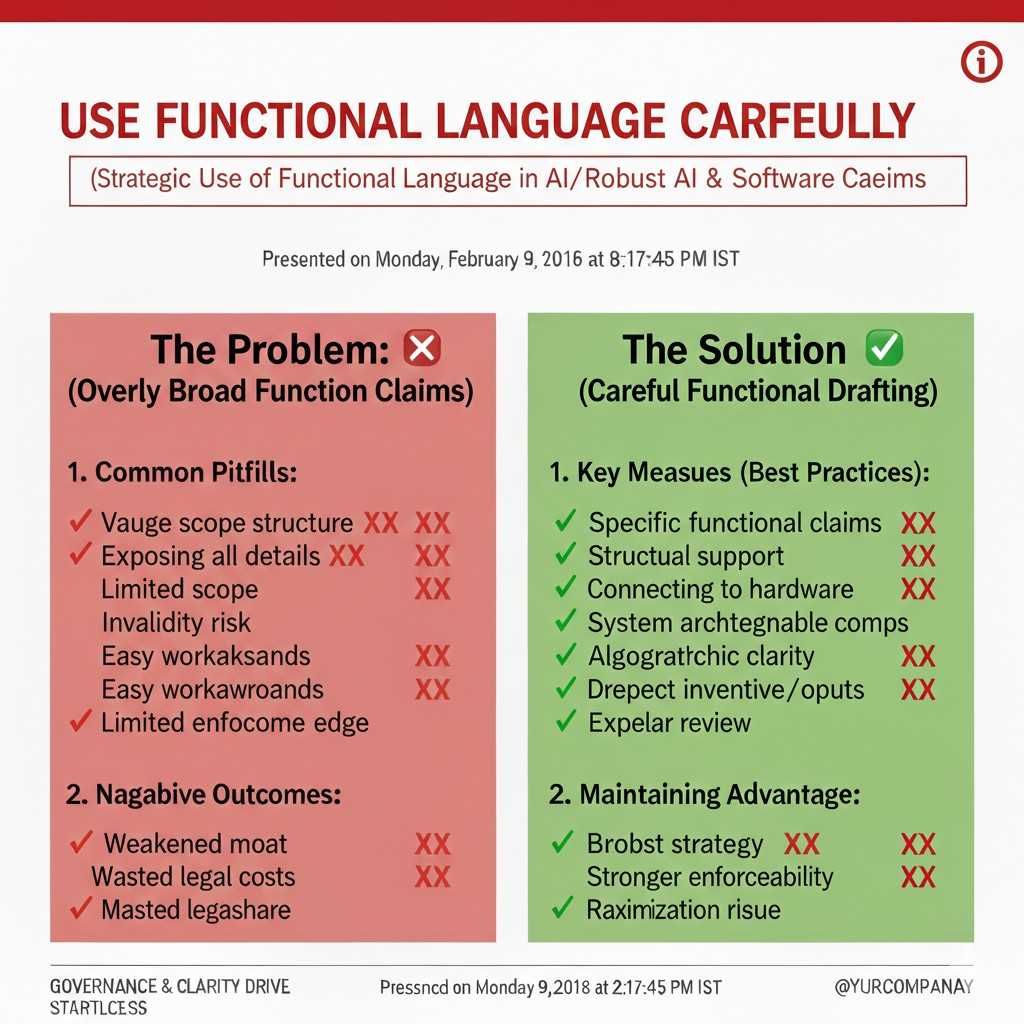
Functional language means describing what a part does, not what it is made of.
For example, you can describe a “feature extractor configured to generate embeddings” instead of listing every layer and every setting. You can describe a “ranking module configured to score candidates based on constraint satisfaction” instead of revealing the exact scoring weights.
Used well, functional language keeps your patent broad and reduces the need to disclose the small details.
Used poorly, it becomes too abstract and may be rejected. The solution is to include enough structure and examples so it feels real, not magical.
Protect the improvement, not the entire universe
A strong AI patent often focuses on a specific improvement, such as reducing hallucinations in a defined workflow, improving latency under a defined constraint, or improving precision for a defined type of input.
That does not mean your protection is narrow. If drafted well, the improvement can cover many products and many industries.
But it does mean you avoid claiming “all AI that does X.” Those claims are weak, slow to prosecute, and easy to reject.
Build a claim set like a funnel
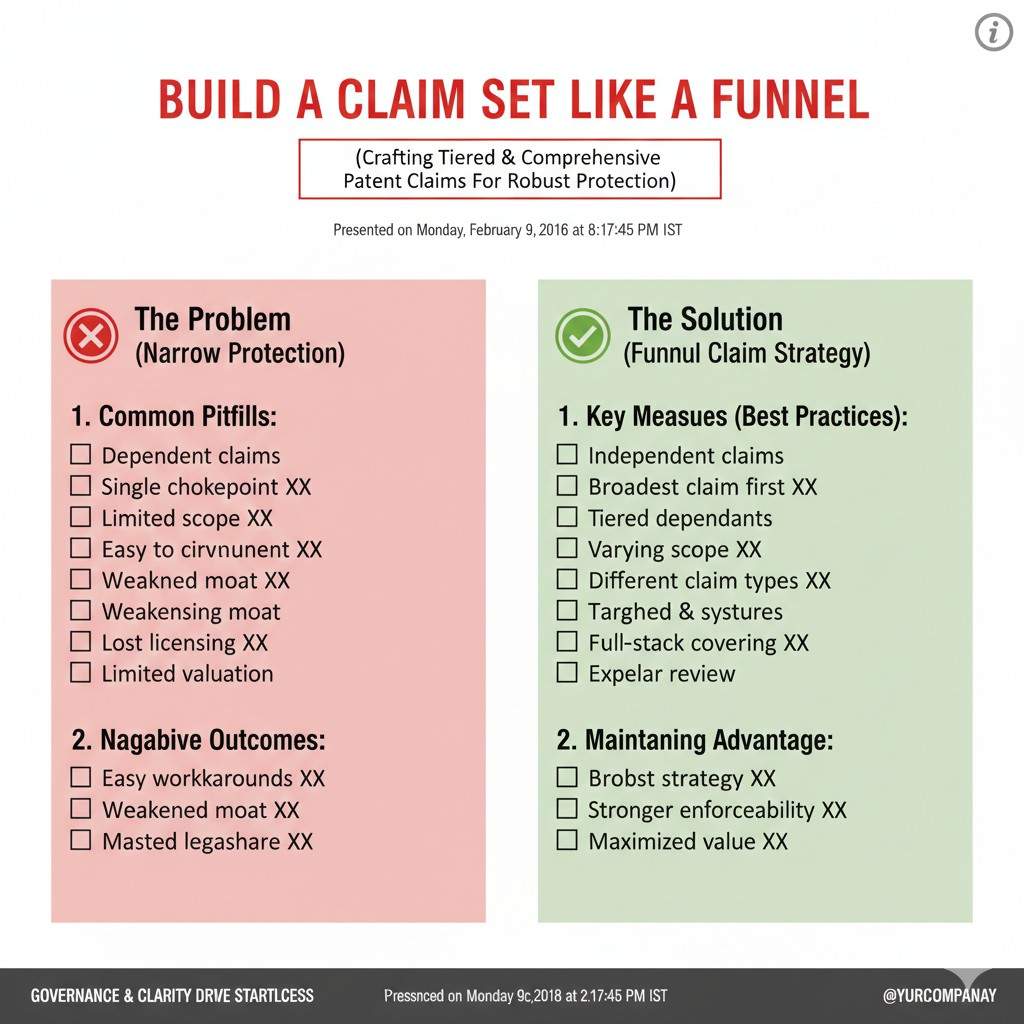
You want broad claims and also narrower backup claims.
The broad claims cover the big idea. The narrower claims add the special details that make your method hard to design around.
This way, if the examiner pushes back, you have room to adjust without losing the core protection.
Tran.vc helps founders build this funnel early, so you are not forced into a narrow corner later. If you want help, you can apply anytime: https://www.tran.vc/apply-now-form/
How to disclose enough without naming the exact ingredients
Describe ranges instead of exact numbers
If a threshold matters, you do not always need to disclose the exact number.
You can describe a range, or describe that the threshold is chosen based on a measured property, such as noise level or confidence distribution.
This protects the concept while keeping your exact operational values private.
Use multiple examples, but do not reveal your best one
Many teams think they must show their “best run” and publish the magic settings.
You do not. You can provide representative examples that demonstrate the invention works.
Your best dataset mix, your most refined prompt chain, or your most tuned threshold can stay internal, as long as the patent still teaches how to practice the invention in a general way.
Describe optional components as optional on purpose
If your system has an extra trick that improves performance, you can describe it as one optional version.
This can protect the trick while also making it harder for competitors to argue that your patent requires that specific trick in every case.
The key is clear writing: what is required for the invention, and what is an added layer that can further improve results.
Avoid unnecessary disclosure of training data sources
In many AI patents, you do not need to disclose the full dataset or where you got every piece of it.
You can describe the categories of data, the labeling process, and the properties the data should have.
This is often enough to support the claim while keeping your data advantage protected as a trade secret.
The safest way to combine patents and trade secrets
Patents and trade secrets are not enemies
A patent can protect the method, and a trade secret can protect the exact way you implement the method.
This is not a workaround. It is a normal strategy.
The mistake is assuming you must put every valuable detail into the patent. The smart move is deciding which details must be disclosed to secure a strong claim, and which details can stay private while still practicing the invention.
Keep what changes fast as a trade secret
AI systems evolve quickly.
If you disclose a detail that will change in six months, you might be giving away a short-lived advantage while locking yourself into old language.
Keep fast-moving details internal. Patent the stable architecture and the stable method steps that stay valuable even as your stack improves.
Protect what is easy to copy with a patent
If a competitor can understand your product, replicate your workflow, and ship a similar result, that is a strong sign you need patents.
Patents help most when copying is straightforward once the method is known.
If the value comes from deep operational knowledge, unique data collection, or hard-to-recreate feedback loops, then trade secrets may carry more weight.
Often, the right answer is both.
Treat “disclosure” like a budget
You have a limited disclosure budget. Spend it on what buys you strong claim coverage.
Do not spend it on things that feel impressive but do not increase the legal boundary.
When Tran.vc supports founders, this is one of the biggest wins. Good patent strategy is not just filing. It is knowing what to say, what not to say, and how to do both with confidence. If you want that support, apply here: https://www.tran.vc/apply-now-form/
How to Structure an AI Patent So It Stays Strong for Years
Focus on the problem before the model
Many AI patents start by talking about the model. They explain neural networks, embeddings, transformers, or agents.
That is usually the wrong starting point.
A strong patent begins with the problem in a clear and grounded way. What is broken in the current systems? Where do they fail? Where do they waste time or money? Where do they create risk?
When you define the problem well, your invention becomes the answer to that problem. This makes the patent stronger and harder to dismiss as abstract.
It also gives you room to evolve your models later. If the core problem stays the same, your protection can still apply even if your stack changes.
Anchor the invention in real-world impact
Courts and examiners look for real-world effect. They want to see that your method changes something concrete.
In AI, this can mean reduced latency, improved accuracy under a constraint, lower compute cost, safer outputs, better routing, or improved hardware control.
Do not just say your model is “better.” Explain how it changes a measurable outcome in a system.
For example, if your method reduces hallucinations in a legal drafting tool, describe how it limits output to verified sources and reduces incorrect citations. Tie it to a real workflow.
This moves your patent away from abstract math and into applied engineering.
Describe the system, not just the algorithm
An AI method rarely lives alone. It sits inside a system.
There are input modules, preprocessing steps, inference engines, post-processing layers, monitoring components, and sometimes human feedback loops.
When you draft your patent, describe the full system around the AI. Show how the pieces work together.
This does two things. It makes the invention feel real and technical. It also makes it harder for a competitor to design around your claims by tweaking one small part.
Build room for future versions
Your current version is not your final version.
When drafting, include variations. Explain that the model can be replaced by other architectures. Explain that certain modules can be implemented in software, hardware, or a mix.
Explain that thresholds can adapt based on feedback. Explain that training can be supervised, semi-supervised, or reinforcement-based.
You are not being vague. You are showing that your invention is a framework, not a one-time experiment.
This protects you when your product grows.
How to Avoid the “Abstract Idea” Trap in AI Patents
Why AI patents get rejected
One of the biggest risks in AI patents is being labeled as an abstract idea.
If your claims read like “using a computer to do what humans already do,” without a technical improvement, they can be rejected.
This is common in areas like finance, marketing, or workflow automation powered by AI.
To avoid this, your patent must show a technical solution to a technical problem.
Tie your invention to technical constraints
Every AI system runs under limits.
You have memory limits, latency limits, compute limits, power limits, data quality limits, hardware limits.
If your method solves a problem under these constraints, say so clearly.
For example, if your system dynamically adjusts model depth to meet latency targets in edge devices, that is a technical improvement.
If your system compresses intermediate representations to reduce bandwidth between components, that is technical.
These details make your patent grounded in engineering, not business logic.
Show transformation of data in a specific way
Another way to avoid the abstract label is to describe how data is transformed in a concrete sequence.
Explain what format the data starts in. Explain how it is structured, filtered, embedded, ranked, constrained, or fused.
Explain how the final output differs in structure or reliability from the input.
The more you show technical movement and structure, the stronger your position.
Use diagrams to clarify without oversharing
Diagrams are powerful.
You can show modules, data flow, and system architecture without exposing every internal setting.
A well-designed block diagram can explain your invention in one page. It gives clarity without exposing your fine-tuned weights or secret datasets.
This is one of the smartest ways to protect structure while keeping your inner layers private.
How to Time Your AI Patent Filings
File before you raise, not after
Investors care about defensibility.
If you walk into a seed round with nothing filed, your leverage is lower. If you already have a well-drafted provisional on file, the conversation shifts.
You are no longer just a team with code. You are a team building protected assets.
That is why many strong founders file before or during pre-seed, not after.
Tran.vc was built around this idea. Instead of pushing founders to raise fast, we help them file smart and build a real moat first. You can apply here: https://www.tran.vc/apply-now-form/
Use provisional filings wisely
A provisional application can secure an early filing date.
But a rushed or thin provisional can hurt you. If it does not support your later claims, you may lose priority.
Treat the provisional seriously. Include strong descriptions, multiple examples, and variations.
It does not need to be perfect, but it should reflect real strategy.
Update as your product evolves
AI products evolve fast. You may add new modules, new workflows, or new optimizations.
Do not assume your first filing covers everything forever.
Many strong teams file follow-on provisionals as they build. This creates a growing portfolio that reflects real progress.
Over time, this becomes a wall, not a single brick.
Think in families, not single patents
One patent rarely protects an entire AI company.
You may need separate filings for your core method, your data processing pipeline, your control system, your hardware integration, or your user feedback loop.
When planned well, these filings support each other.
They create layered protection that makes copying painful and risky.
How to Work With Patent Counsel Without Losing Control
Do not hand over strategy blindly
Many founders assume the attorney will “figure it out.”
But you know your system best. You understand what makes it special.
Before drafting begins, write down in simple words what you believe is the core invention. Explain the problem, the solution, and what would hurt most if copied.
Bring this clarity into your meetings.
Insist on technical depth
AI patents require technical understanding.
Your counsel should ask detailed questions. They should want diagrams. They should challenge your assumptions.
If the draft feels generic, push back.
A generic AI patent does not protect much. A tailored one does.
Review drafts like a product spec
Do not skim your draft.
Read it as if you were a competitor trying to design around it. Ask yourself where the gaps are. Ask whether the claims truly cover your business direction.
This takes time. But your patent can define your leverage for years.
At Tran.vc, we work side by side with founders and experienced patent attorneys to shape filings that reflect real product strategy, not surface-level language. If you want that level of support, apply anytime: https://www.tran.vc/apply-now-form/
Keep your long-term roadmap in mind
When reviewing claims, think about where your company will be in three to five years.
Are you planning to move from software-only to hardware integration? From single-model systems to multi-agent frameworks? From enterprise to regulated markets?
Your patent strategy should leave room for that growth.
Protection should not box you in. It should open doors.