
Most deep tech founders have the same fear about patents:
“If I start patent work now, I’ll slow the team down.”
That fear makes sense. You have a small team. You have a hard build. Every week matters. And most patent processes feel like a long, heavy project that steals focus from product.
But here’s the good news: patenting does not have to fight your momentum. If you do it the right way, patents can protect momentum. They can help you move faster with more confidence, because you stop worrying about being copied, and you stop wasting time rebuilding the same “secret sauce” in private. You build it once, you document it once, you protect it once, and then you move.
The real problem is not patents. The real problem is bad patent timing and messy patent workflow.
A lot of founders meet a patent attorney too early, with ideas that are still foggy. Or too late, after the core technique already leaked into a demo, a paper, a GitHub repo, or a customer deck. Or they meet an attorney at the right time, but with the wrong process, so every call turns into a long “explain your whole company” session.
That’s what slows you down.
This article is about the opposite. It’s about how to patent deep tech in a way that fits inside real startup life: fast sprints, limited time, messy data, and constant change.
We’re going to talk about how patenting actually works when your product is AI, robotics, chips, autonomy, computer vision, edge inference, simulation, or some other “hard” tech. We’ll cover how to pick the right invention moments, how to capture them without stopping the build, how to avoid the common traps that force rewrites, and how to create a simple rhythm that your team can follow.
And we’ll do it in plain words. No legal maze. No fluff.
One important note before we go on: you do not need “a perfect final product” to file. You also do not need a giant patent plan that takes months. The best early patent work is small, sharp, and steady. It happens in short bursts. It rides alongside product work, like a safety rail. It should feel like part of building—because it is.
This matters even more in deep tech because your value is often hidden in the “how,” not just the “what.” Two teams can build the same feature. But the team that owns the method, the system, and the key design choices has leverage. That leverage shows up when a big company tries to copy you, when a customer asks why you’re different, and when an investor tries to decide if you have a real moat or just a demo.
That’s also why Tran.vc exists. Tran.vc invests up to $50,000 worth of in-kind patent and IP services for deep tech startups, so founders can protect what matters early—without burning cash, without losing control, and without turning patenting into a second job. If you want help building an IP plan that matches your build speed, you can apply anytime here: https://www.tran.vc/apply-now-form/
Now, let’s set the stage with one simple idea:
Patenting should follow your product, not lead it.
If patenting leads, you end up writing about guesses. You burn time describing an approach that you later abandon. You create a patent that is either too narrow (only covers the first version) or too vague (so it’s easy to work around). And because the work feels painful, you avoid doing it again.
If patenting follows too far behind, you end up in panic mode. You discover that your team already disclosed key details in a pitch deck, a grant, a blog post, a demo day talk, or a customer proposal. You rush a filing. You miss the best angles. Or worse, you don’t file at all because you feel like you’re “already late.”
The sweet spot is patenting that runs parallel. You build. You learn. You make one or two real technical breakthroughs. You capture them quickly. You file. Then you go back to building.
Done right, it feels like taking short notes after a lab session, not writing a textbook.
So how do you do that in real life?
You start by learning to spot “patent moments.”
A patent moment is not “we built a feature.” It’s not “we launched a dashboard.” It’s not “we added a model.”
A patent moment is when you solve a hard problem in a way that is not obvious. It is when your team had to make a tradeoff and found a clever method. It’s when you got a big jump in speed, cost, accuracy, stability, safety, or reliability by changing the system design. It’s when you found a new way to use known tools together.
In robotics, a patent moment might be a control loop that stays stable in messy real-world conditions where others fail. It could be a clever calibration method that removes the need for expensive hardware. It could be a sensor fusion approach that keeps performance strong even when one sensor drops out. It could be an approach to labeling, simulation, or domain shift that makes training cheaper and faster.
In AI, a patent moment might be a new way to compress a model on edge devices without losing key accuracy. It could be a method to detect drift early and auto-adjust. It could be a training trick that cuts data needs in half. It could be a pipeline design that reduces hallucinations in a narrow, high-stakes setting. It could be a system that makes inference faster and more reliable under strict limits.
In chips or hardware, it might be a layout, a thermal approach, a power trick, a packaging choice, or a system-level design that gets you a real advantage.
Here’s the key: patent moments usually happen quietly. They show up in a late-night commit message, a note in a lab notebook, a diagram on a whiteboard, or a line in a Slack thread where someone says, “Wait—what if we do it this way?”
Most startups miss these moments because they’re too busy shipping.
And that is exactly why you need a lightweight capture habit.
Not a “big patent project.” A habit.
Imagine a simple rule inside your team: when you hit a breakthrough that changes performance or cost in a meaningful way, you take 20 minutes to write it down in a clean format.
That’s it.
Not a full legal draft. Just the technical story, in a structure that makes it easy for a patent team to turn it into a strong filing later.
What does that 20-minute write-up look like?
It’s basically four things, written like you’re explaining it to a smart engineer who hasn’t seen your code:
First, the problem. What was failing before? What was too slow, too costly, too brittle, too unsafe, too noisy, too hard to scale?
Second, the old ways. What do most teams try? Why doesn’t it work well enough in your case?
Third, your approach. What did you change, exactly? If there are steps, say the steps. If there is a system diagram, sketch it. If there is a key formula, include it. If there are edge cases, name them. If there is a trick that makes it work, highlight it.
Fourth, proof. What results did you see? Even rough results are fine. “We cut inference time from X to Y.” “We improved grasp success from A to B in these conditions.” “We reduced labeling hours by Z.” Numbers help because they show what the invention is for.
That’s not hard. It’s the kind of write-up many teams already do informally. The shift is: you do it on purpose, and you save it in one place.
This one habit prevents the biggest momentum killer in patenting, which is the long back-and-forth later where everyone tries to remember what happened three months ago.
When you capture the story while it’s fresh, patent work becomes fast.
Now let’s talk about the second reason patents slow teams down: founders often think patenting is a “one-time thing” that requires a perfect plan.
In deep tech, that mindset hurts you.
Deep tech changes. Your first version is rarely your final version. Your data evolves. Your constraints change. Your deployment environment changes. Your system becomes more complex as you learn what matters. If you try to file one “master patent” that covers everything, you’ll either wait too long, or you’ll create something fuzzy.
A better approach is to think in “layers.”
You file early around the core method that makes you different. Then you file again when you harden it, when you add key parts, when you find a new use case, or when you create a new system design that gives you another advantage.
It’s like building your product roadmap, but for protection.
This is how strong IP is built: steady, not dramatic.
And it’s also why a firm like Tran.vc can be a fit at the earliest stage. Because the goal is not to push founders into expensive, heavy filing. The goal is to create a simple plan that matches your build speed, so you protect your best work without losing weeks of engineering time. If you want to see how that looks for your tech, apply anytime here: https://www.tran.vc/apply-now-form/
One more thing before we move beyond the intro: many founders confuse “patents” with “paperwork.” They imagine long forms, slow reviews, and endless edits.
In reality, good patenting for startups is mostly about clear thinking.
What exactly is new?
What exactly is valuable?
What exactly is hard to copy?
What exactly would a competitor do if they saw your product?
When you answer those questions well, the legal part becomes much smoother. The biggest win is not the patent document. The biggest win is the clarity you gain about what your real moat is.
That clarity helps product decisions too. It helps you choose what to keep inside the company, what to publish, what to show in demos, and what to build next.
A Simple Workflow That Keeps You Shipping
The goal is not “more patents”
The goal is to protect the few technical moves that make your product hard to copy.
When you treat patents like a giant project, your team resists it. It feels like extra work. It feels like switching contexts. It feels like meetings.
A better way is to treat patenting like a light layer that sits beside your build. You keep shipping. You keep testing. You keep learning.
Pick one owner, not a committee
If everyone owns IP, no one owns IP.
You need one person to run the process. This can be the CEO, CTO, or a senior engineer who likes structure. Their job is not to write patents.
Their job is to make sure the best technical wins get captured and sent to the patent team quickly.
Use a “capture rhythm” that fits sprints
Most teams already do weekly check-ins or sprint reviews.
Add one small habit to that rhythm: a short “what did we solve” check. Not a long meeting. Just a moment where you ask one question.
“What changed this week that made the system better in a way that others would struggle to copy?”
If nothing, move on. If something, you capture it while it’s fresh.
Keep the capture format simple
The capture should be easy enough that an engineer can do it fast.
It should feel like writing an internal note, not a legal document. If you need a perfect write-up, it won’t happen.
A clean capture is usually a short explanation of the problem, your approach, and what improved.
Don’t wait for perfect data
Deep tech teams often delay because they think they need final benchmarks.
You don’t. Early proof can be messy. “In our tests, we saw a clear drop in failure rate” is useful.
The point is to lock the invention story while your team remembers the decisions that made it work.
What Counts as a Patent-Worthy Invention in Deep Tech
Features are not inventions
A feature is what the user sees.
An invention is the method that makes the feature possible in a new way.
Two products can show the same feature. The invention is often hidden in the pipeline, the system design, or the training loop.
Look for “hard tradeoff” solutions
In deep tech, breakthroughs often come from tradeoffs.
You may have improved speed without hurting accuracy. You may have improved safety without adding expensive sensors.
Whenever you solve a tradeoff that others struggle with, you should pause and consider capturing it.
Pay attention to repeated “we tried everything” moments
These moments are gold.
If your team tried three normal approaches and they all failed, and then a new approach worked, that is often patent-worthy.
It signals that your method is not just a standard move. It’s a real solution to a real constraint.
System inventions matter more than model inventions
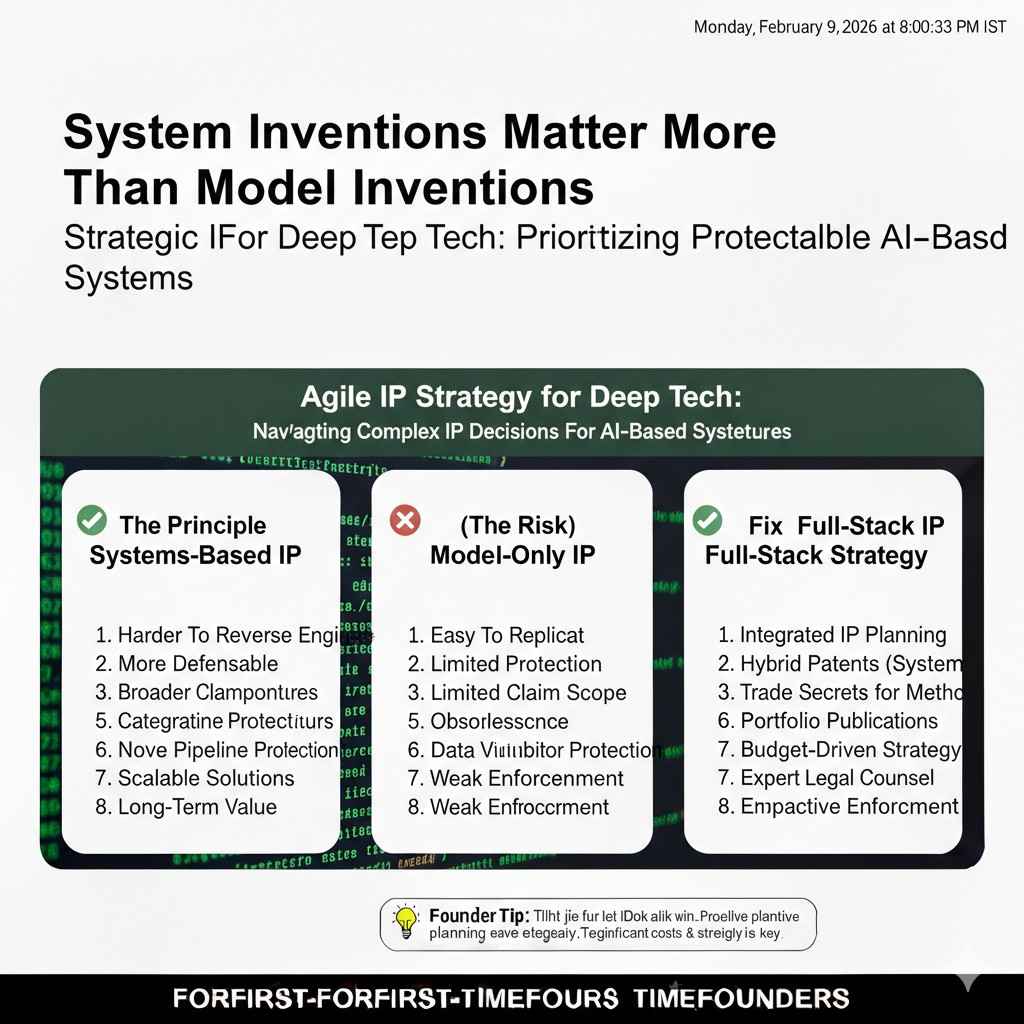
Many founders think patents must be about a new model.
In practice, the strongest IP often lives at the system level. The way data flows, the way decisions are made, the way sensors are combined, the way edge and cloud split work.
Competitors can swap models. They can’t easily copy a system that took you months to refine.
How to Document Without Draining Engineering Time
Capture the story, not the code
Engineers often think patenting means sending the whole repo.
That is rarely needed and often unhelpful. Code changes fast. Patents need the underlying idea.
Your job is to explain what the system does, what steps happen, and why those steps matter.
Use diagrams as your secret weapon
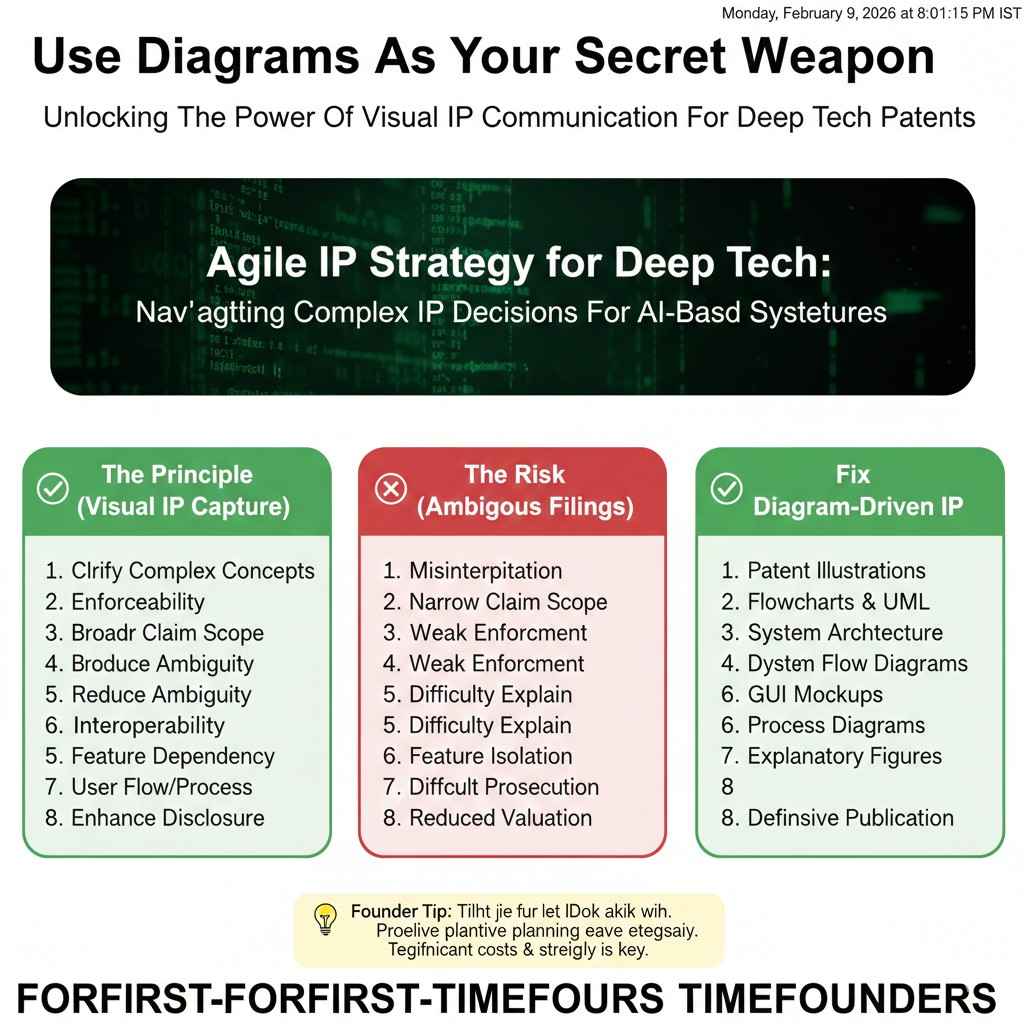
A simple diagram can save hours of back-and-forth.
It can show where data enters, how it is transformed, what decisions are made, and what comes out. It also makes it easier to describe variations.
When a patent attorney can “see” the system quickly, the drafting moves faster and the result is stronger.
Write like you’re teaching a new hire
This is a good mental trick.
If a smart engineer joined your team today, how would you explain your approach so they can build on it?
That level of detail is usually perfect for early patent work. It is clear, practical, and grounded.
Save the messy details in one place
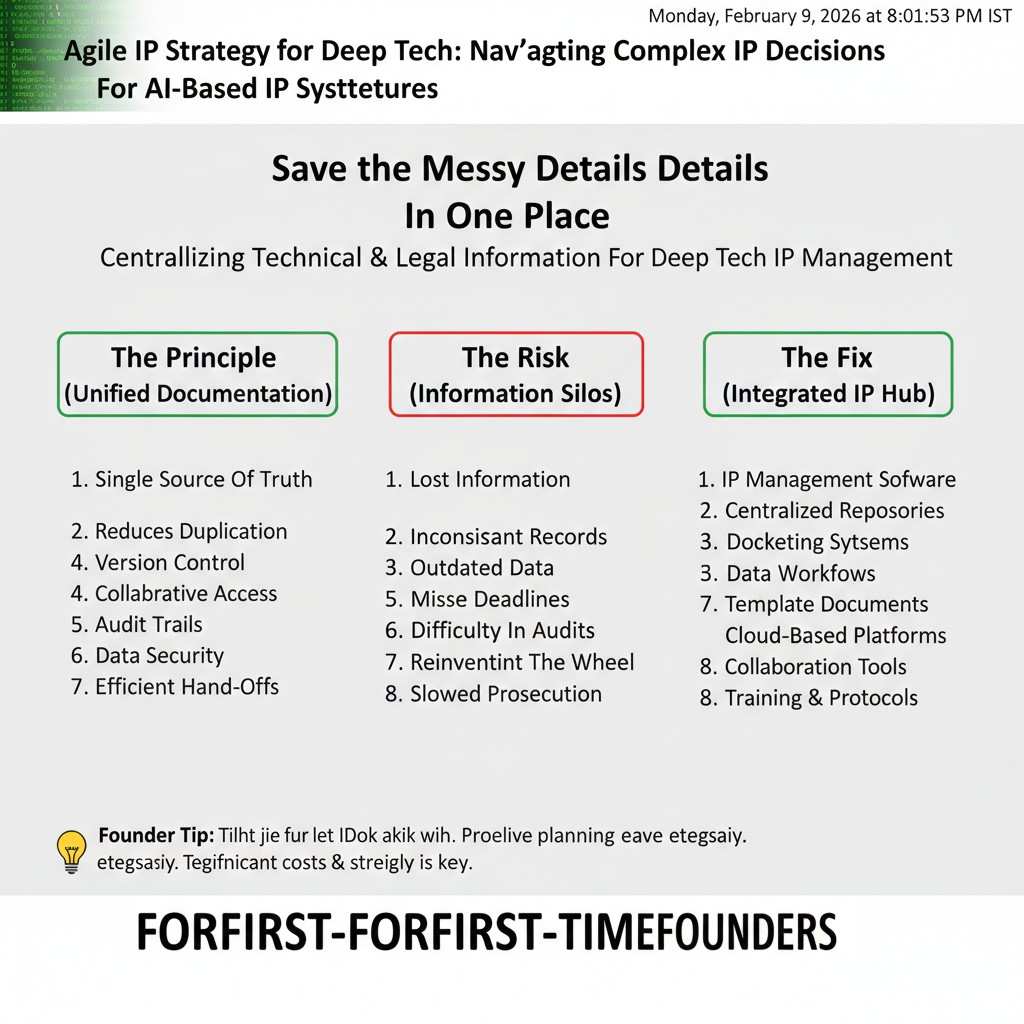
Deep tech inventions usually have edge cases.
Maybe it only works in low light. Maybe it fails at certain speeds. Maybe it needs a fallback.
Those details are not “bad news.” They are part of what makes your method real. Save them.
They help your patent team write broader coverage because they can describe variants and safety paths.
Timing: When to File Without Freezing the Roadmap
File when the approach stops changing every day
If your team is still flipping between three ideas, wait.
But once one method becomes the clear winner and the team starts building around it, that is often the right time.
You do not need a final product. You need a stable technical direction.
File before public demos, talks, and papers
Many founders forget that disclosure can create problems.
A demo at an event, a slide deck shared widely, a blog post, a conference abstract, even a public repo can reveal your invention.
If you plan to show the “how,” file first. It protects you while you market and sell.
File when the invention becomes part of your “repeatable build”
A good signal is when the invention stops being a one-off experiment.
If it becomes part of your pipeline, part of your deployment, or part of your architecture, you want it protected.
This is the moment where copying becomes easier for others, because the idea is now baked into your product.
How Tran.vc Helps You Keep Momentum While You Patent
Patents should feel like support, not friction
Many early teams delay because they expect patenting to be slow and expensive.
Tran.vc is built for the opposite. They invest up to $50,000 in in-kind patent and IP services so founders can protect core tech early without burning cash.
The focus is speed with quality, using a process designed around startup reality, not large-company habits.
You get a plan that matches your build speed
Deep tech teams don’t need a long, rigid IP plan that locks them in.
They need a flexible plan that follows real product learning. Strong coverage where it matters, and simple next steps when the next invention shows up.
If you want to explore this for your startup, you can apply anytime at https://www.tran.vc/apply-now-form/
You get help turning technical work into protectable assets
The hardest part is often translation.
Engineers know what they built, but they don’t always know how to frame it as an invention with strong boundaries and useful variants.
A good IP partner helps you shape the story the right way, so you protect the method and the system—not just one narrow implementation.
The Biggest Mistakes That Slow Teams Down
Trying to patent the whole company at once
This is the fastest path to stalled progress.
When you try to capture everything, you create huge scope. Huge scope creates long calls. Long calls create delays.
A better approach is to start with the core invention that gives you leverage, then build outward over time.
Waiting until fundraising pressure hits
A lot of teams start IP work when they are about to raise.
That’s often too late for calm thinking. You rush. You cut corners. You miss angles.
The best time is earlier, when you can file steadily without stress and show investors a thoughtful foundation.
Treating patents like a legal task only
Patents are also a product strategy tool.
They force you to define what is unique. They help you decide what to keep private and what to reveal.
When founders treat patents as “paperwork,” they miss the strategic value and often end up with weak protection.