
A side project can be a joy. It can also be a slow leak that drains trust, time, and ownership from the startup you are trying to build.
Most founder problems are not about bad intent. They are about fuzzy lines.
A founder builds a small tool on a weekend. A friend asks for help. A past client sends a “quick” request. A new idea feels too good to ignore. Soon, the startup has two products, three promises, and one legal mess.
This guide is about keeping your company safe without crushing creativity. You will learn how to set clear rules, protect IP, avoid future fights, and stay clean for investors.
And if you want help doing this the right way from day one, Tran.vc invests up to $50,000 worth of in-kind patent and IP services for AI, robotics, and deep tech teams. You can apply anytime at https://www.tran.vc/apply-now-form/
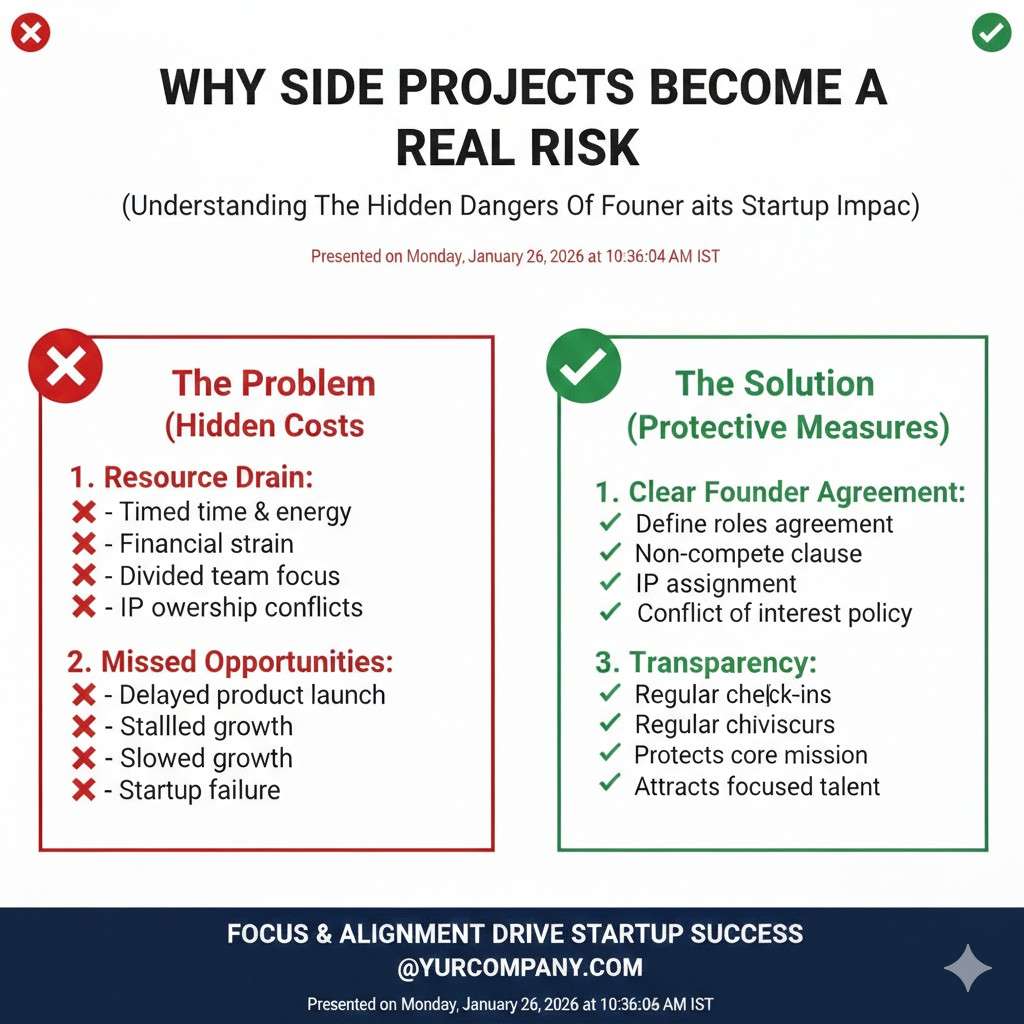
Why side projects become a real risk
Founders are builders. Builders build. Side projects feel normal.
But a startup is not only code. It is also ownership, rights, proof, and trust.
When a founder works on something outside the company, four risks show up fast.
First, time risk. The side work steals the best hours. Not the leftover hours. The hours where hard problems get solved.
Second, focus risk. A side project changes how you think. It pulls the mind away from the startup’s core problem. You start shipping small wins elsewhere instead of pushing through the hard part inside the company.
Third, team risk. Your co-founder and team might not say anything. But they notice. A small gap turns into doubt. Doubt turns into distance.
Fourth, IP risk. This is the big one. Investors care about it. Buyers care about it. Even partners care about it. If your IP is mixed up, your startup becomes harder to fund, harder to sell, and easier to copy.
Side projects are not evil. But unmanaged side projects are dangerous.
The goal is not to ban them. The goal is to box them. Clear lines. Clean paperwork. Simple habits.
The most common ways founders accidentally damage the company
Let’s talk about what actually happens in real life.
A founder has a GitHub repo from two years ago. The startup uses parts of it. No one writes down what moved over. Later, a new investor asks: “Who owns that code?” The room gets quiet.
A founder does contract work to pay rent. They reuse a module from the startup because “I wrote it anyway.” Now the startup’s code is inside a client project. Who owns it? It depends. And “it depends” is expensive.
A founder works on a side project using the same core idea as the startup, but “for a different market.” Later, it looks like two companies. Investors worry the startup is not the real priority.
A founder builds a quick feature at night and ships it into the startup product without review. It works. Everyone is happy. Two months later, it turns out the feature included a library with a license that forces you to open-source your code. Now you have a fire.
A founder files a patent later, after months of side work and startup work mixed together. When the patent lawyer asks: “When did this invention happen and under which company?” the answer is not clear. That can break the filing.
None of these founders were trying to harm the company. They were trying to move fast.
So we need a system that works when life is messy.
Start with one hard truth: investors assume the company owns everything
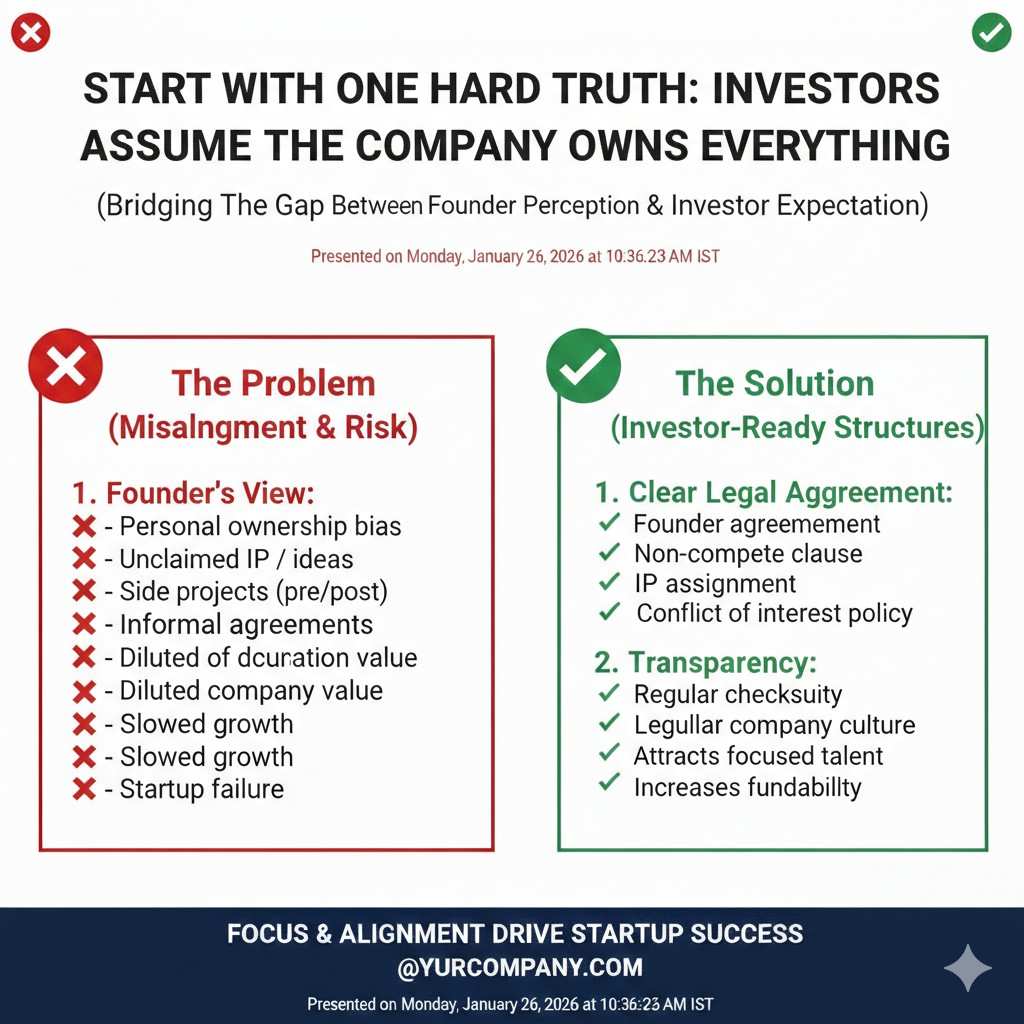
When you raise money, the default assumption is simple: the startup owns the work that matters.
If that is not true, you must prove why. And proof is not “trust me.” Proof is signed documents, clean timelines, and clear ownership.
If you cannot prove it, investors often do one of three things:
They delay the round and ask for cleanup. That can kill momentum.
They reduce valuation because risk went up.
They walk away because they have other deals with cleaner IP.
Even if you do not plan to raise soon, you may later. Or you may want a strong partner. Or a buyer. So you should act like the company will be checked someday.
Because it will.
If you want Tran.vc to help you set up clean IP from the start—patent strategy, filings, and strong ownership—apply anytime at https://www.tran.vc/apply-now-form/
Define “side project” in a way that actually works
Most founders try to solve this with a simple rule like: “No side projects.”
That sounds strong, but it usually fails. It is too rigid. People hide work instead of talking about it.
A better approach is to define side projects in a way that matches reality.
A side project is any work that is not clearly owned by the startup, and that touches any of these areas:
The same customer problem
The same core tech
The same data
The same model approach
The same hardware approach
The same brand space
The same distribution channel
The same team time
Even if you think it is “different,” if it looks close, treat it as close.
The core idea: if it could later be argued that the startup should own it, it needs a clear rule now.
Build a simple boundary: “company lane” vs “personal lane”
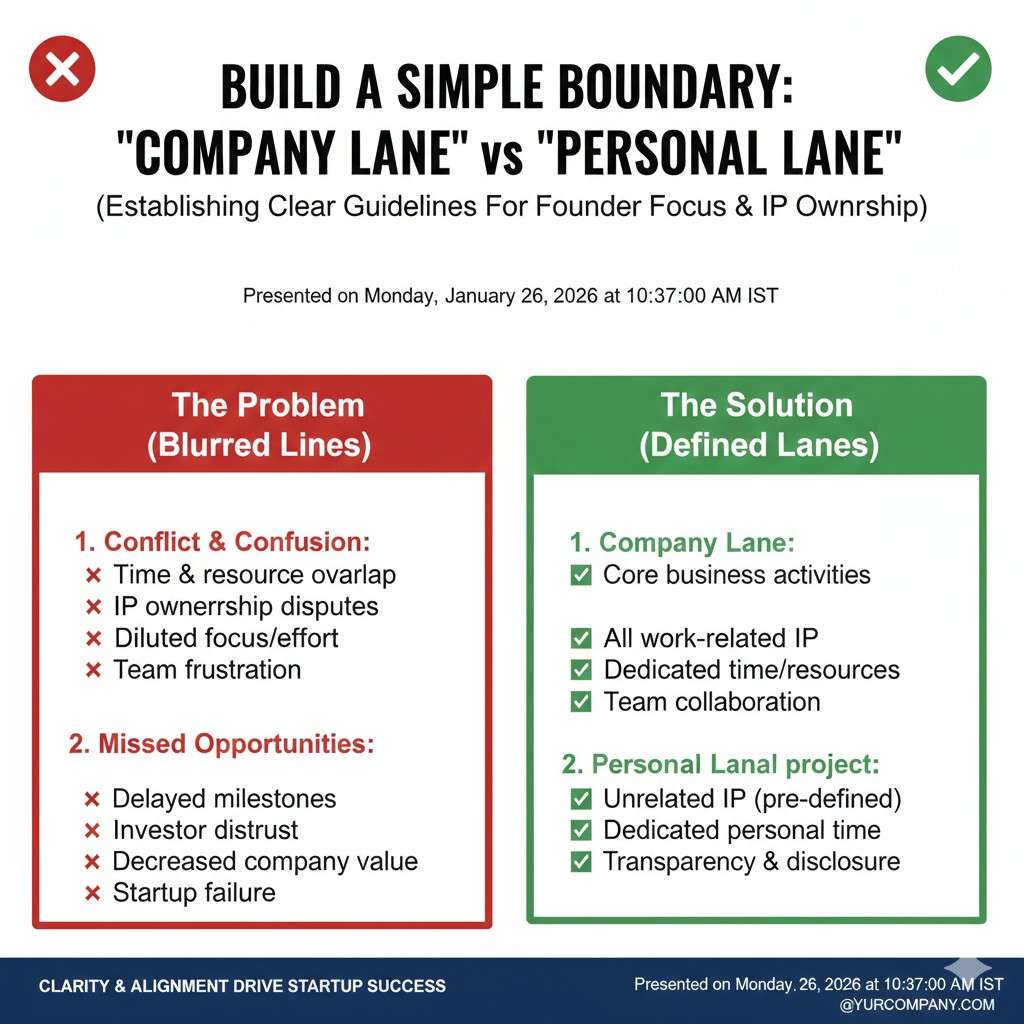
This is the cleanest mental model.
The company lane includes anything that supports the startup’s product, roadmap, research direction, or competitive edge.
The personal lane includes hobbies, learning projects, art, small experiments, and work that has zero overlap with the startup.
The problem is the gray lane. That gray lane is where fights happen.
So your job is not to decide “yes or no” to side projects. Your job is to avoid the gray lane.
If a project lives in the gray lane, do one of two things:
Move it fully into the company lane with written ownership.
Or move it fully out by changing the topic, tools, and time so it cannot overlap.
When you do this, you protect the startup and you protect the founder too.
Because it stops future “you stole my idea” claims from any direction.
Put the rules in writing early, before emotions show up
Founders often wait until there is tension. That is the worst time. Because now it feels personal.
Do it early. When you like each other. When the startup is still hopeful.
There are four documents and policies that matter most.
1) A strong invention assignment agreement
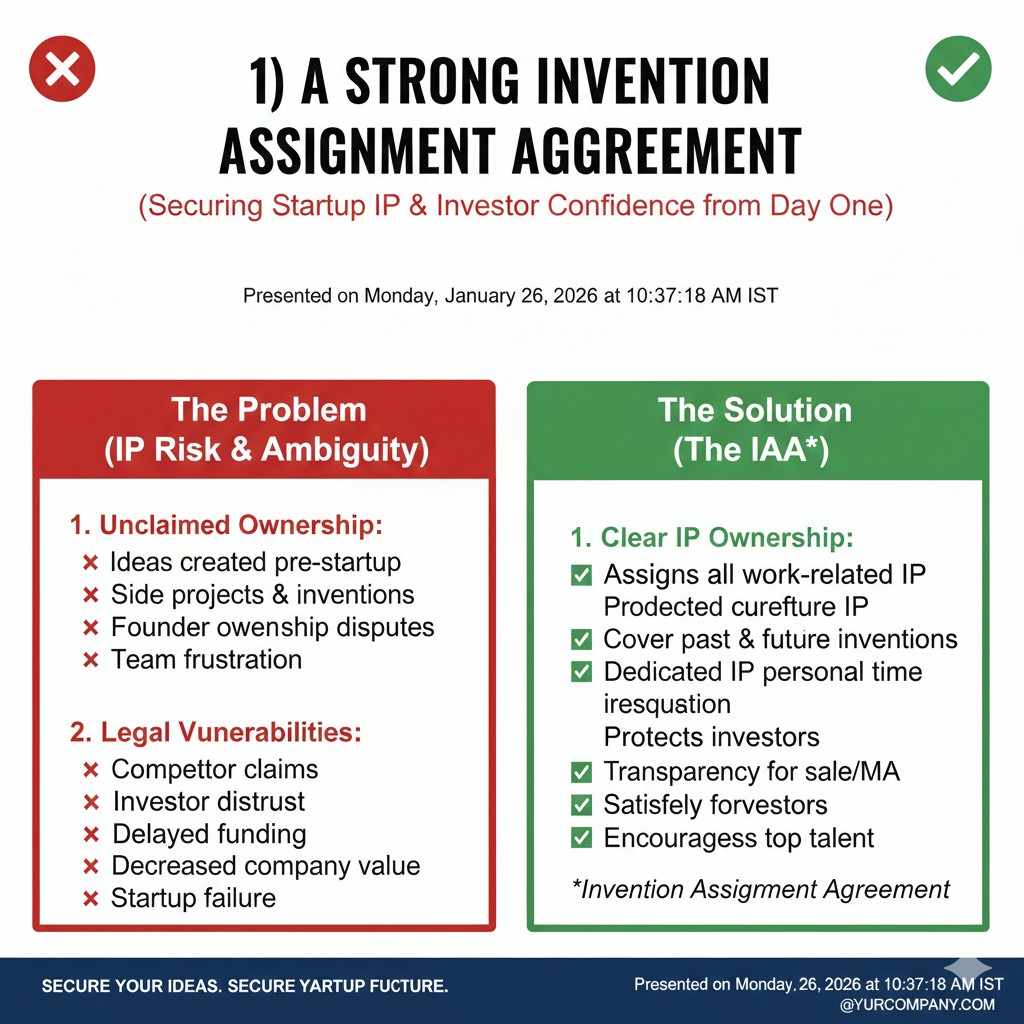
This is the document that says: work created related to the company belongs to the company.
Many startups sign a basic version. But basic versions can be weak. Especially for deep tech teams where invention dates and scope matter.
A good one is clear about:
What “related” means
What tools and resources count
What happens to past work
What happens to future work
How patent rights transfer
This is not just legal “paper.” This is what protects your moat.
2) A “side project disclosure” habit
This does not have to be scary. It can be simple.
The rule can be: “If you start a project that could overlap, you tell the other founder(s) in writing within a week.”
Not for permission. For clarity.
A short message is enough: what it is, what it is not, what tools you use, and when you work on it.
This one habit prevents most disasters.
3) A clear policy on tools and accounts
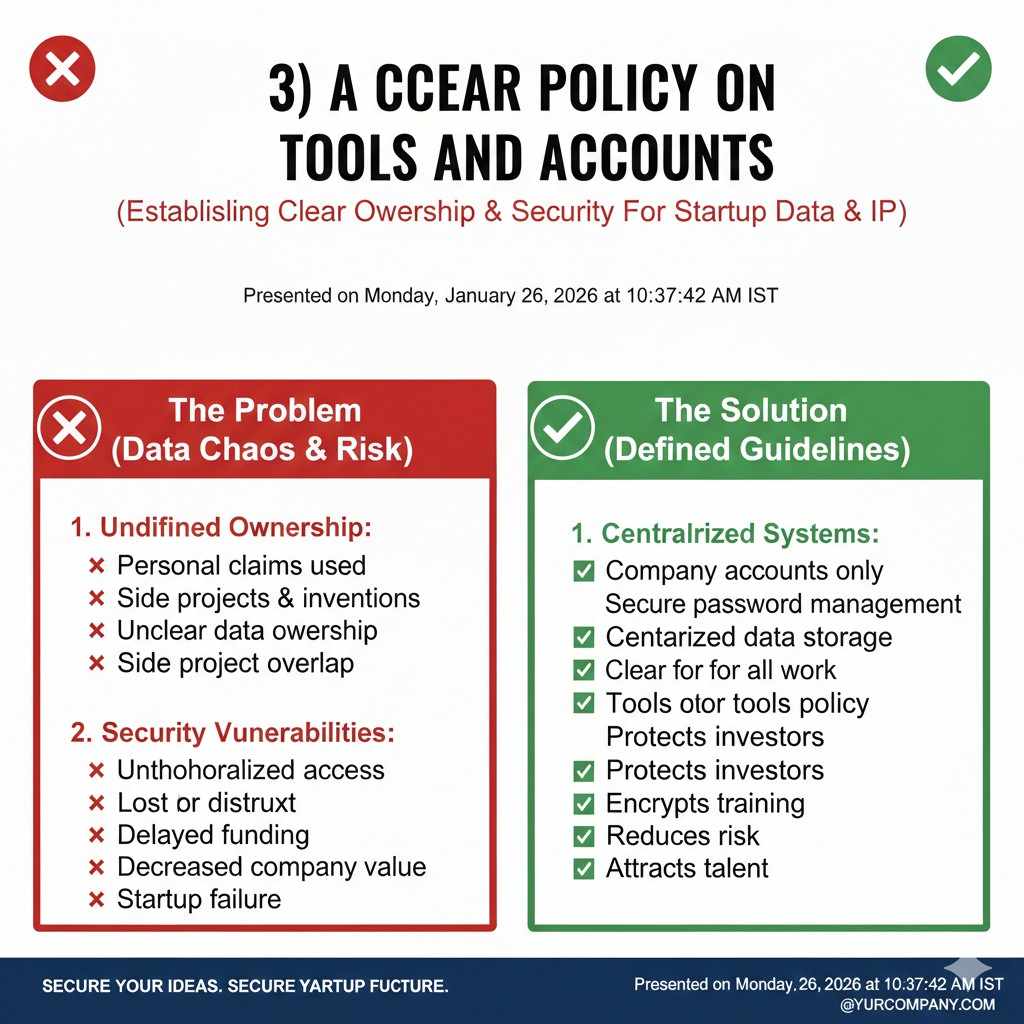
If you work on a personal project on a company laptop, using company GitHub, company Figma, company Slack, or company cloud credits, you just created an ownership mess.
So set a strict rule:
Company work uses company tools.
Personal work uses personal tools.
No mixing.
It sounds small. It is not. This is one of the fastest ways investors find risk.
4) A clean “pre-startup IP schedule”
Most founders bring something into the startup: code, notes, a prototype, an old repo, a research idea.
That is fine. But it must be listed and either:
Assigned to the company, or
Carved out as personal IP that will not be used
This should be written as a simple schedule attached to your founder agreements.
Clean input leads to clean output.
Tran.vc helps teams do this the right way, especially when the tech is complex and patentable. Apply anytime at https://www.tran.vc/apply-now-form/
The “time problem” is not solved by trust. It’s solved by visibility.
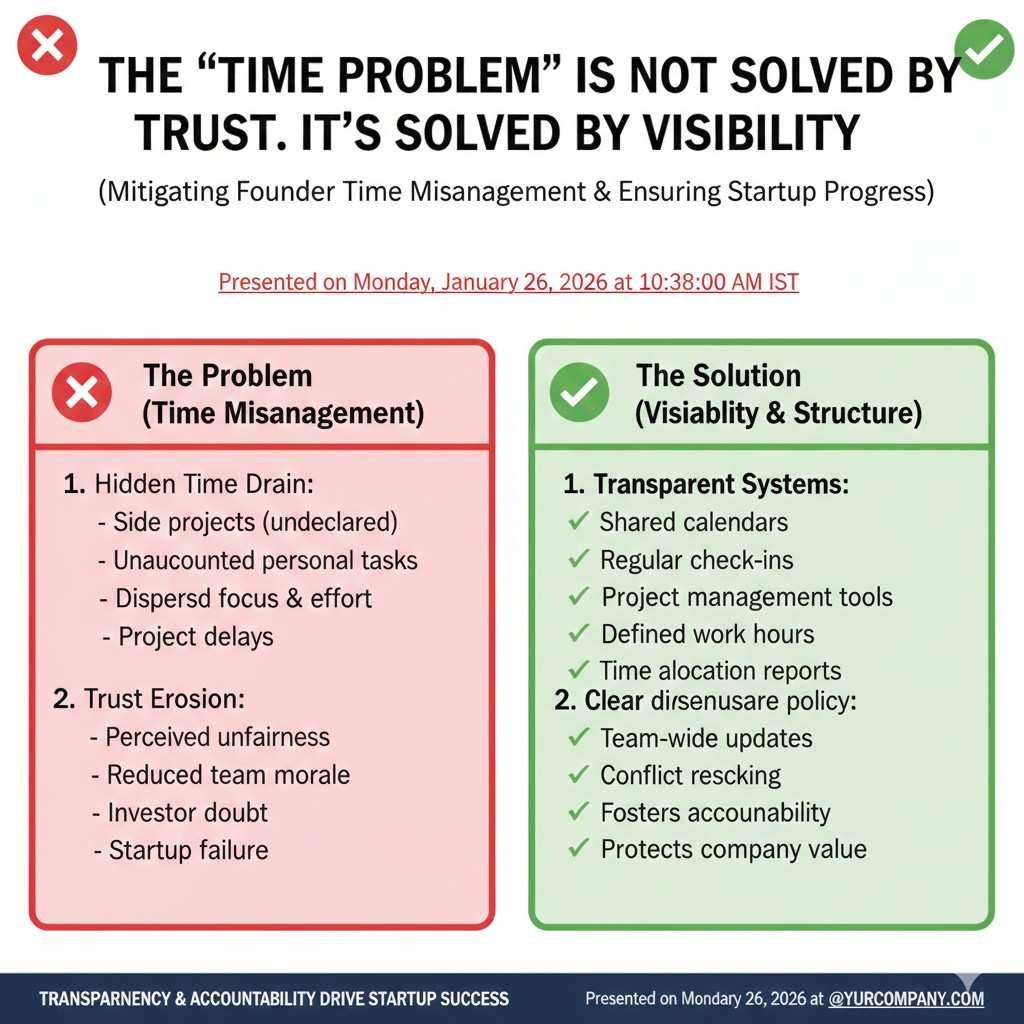
A founder can honestly believe they are not distracted and still be wrong.
Side projects often steal the best energy because they feel easier. The startup feels heavy. The side project feels clean.
So instead of arguing about effort, measure it in a calm way.
Not with spying. With simple visibility.
You can do this without long meetings.
Have a weekly founder check-in with one question:
“What did you spend time on that is not the core plan?”
This is not a shame question. It is a protection question.
It makes drift visible early, when it is still fixable.
It also helps you spot burnout. Sometimes a side project is a sign that the founder needs a break, or needs a smaller win inside the startup.
You can fix that by changing how you work, not by fighting.
Protect your code base from accidental “IP leakage”
Even if side projects are clean, code can leak in sneaky ways.
Here are the most common paths.
A founder copies a small function from the company repo into a side repo “just to test.” Later, they forget and commit it. Now the code exists outside the company.
A founder uses the company’s private model weights or training data to speed up a personal experiment. That’s a major IP leak.
A founder shares internal code snippets in public forums to get help. It feels harmless. It often is not.
The fix is mostly process.
Keep your main repo private.
Use clear access controls.
Avoid copy-paste across repos. If you must reuse something, do it through a controlled shared library that is owned by the company.
Create a rule: no internal code in public issue threads. If you need help, rewrite a minimal example.
Also, track third-party licenses. A “side” dependency can infect the core.
This is boring work. It is also how serious companies stay serious.
If you are in AI or robotics, the risk is bigger than you think
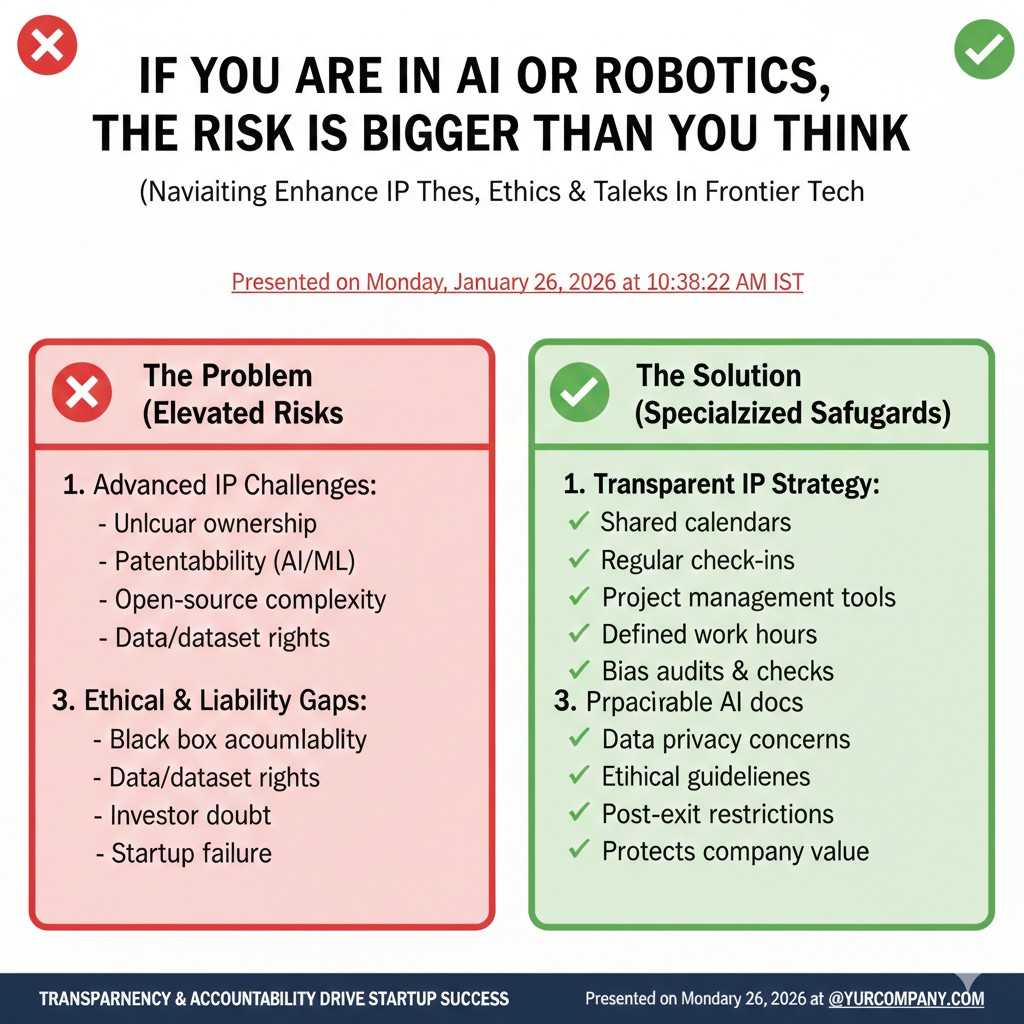
In deep tech, “side project” does not only mean software.
It can mean:
A model approach
A training pipeline
A data labeling method
A control loop trick
A sensor fusion method
A mechanical design
A calibration step
A dataset
A new evaluation metric
A production process
These are the assets that become patents. These are the things that make you hard to copy.
But they are also easy to blur because they live in notebooks, lab notes, CAD files, and informal demos.
So you need to treat these like real assets.
Use lab notebooks that are time-stamped.
Store designs in company systems.
Document invention moments as they happen.
If you invent something while building the startup, capture it. Do not wait until “later.”
Later is when memory fades and stories change.
Tran.vc specializes in this early capture. They help founders turn messy invention work into clean, defensible filings. Apply anytime at https://www.tran.vc/apply-now-form/
Deal with contract work the right way (without panic)
Many founders do contract work early. It can keep you alive. It can also create a conflict.
The problem is not the contract work itself.
The problem is overlap.
If you do contract work, set three rules:
Do not use company tools.
Do not reuse company IP.
Do not build anything that looks like your startup product.
Also, read the contract. Some contracts claim ownership over anything you create during the contract term, even if it is unrelated. That can become a nightmare later.
If you must take contract work, try to keep it in a different domain, with different tech, different customers, and clear written carve-outs.
If you cannot do that, you may be trading short-term cash for long-term pain.
A clean alternative is to bring paid work into the startup as company revenue, if possible. Then the company owns the work and the relationships are cleaner.
The quiet danger: co-founder resentment
Legal risk is obvious. Emotional risk is quiet.
If one founder is doing side work, the other founder starts asking questions:
Are we building this together?
Am I carrying more weight?
Will this person leave?
Does this side project compete with us?
Even if no one says it, the doubt changes how they act.
They may stop sharing ideas.
They may stop taking big swings.
They may start protecting themselves.
That is how companies break.
So you need a norm where side projects can be discussed without drama.
The way you do that is by separating two topics:
Is it allowed?
Is it wise right now?
Sometimes a project is allowed but unwise. Like starting a second product while you are still pre-PMF.
Have the wise conversation more than the allowed conversation.
Make it about outcomes: speed, clarity, team trust.
Not about morality.
When a side project is actually helpful
Not all side projects are bad. Some are useful.
A learning project can make you better.
A small tool can become an internal asset.
A demo can attract talent.
A mini experiment can uncover a breakthrough.
The key is to keep it aligned and owned.
If the project helps the startup, consider making it a company project. Put it in the company lane. That gives you clean ownership and keeps focus.
If it does not help the startup, keep it truly separate. Different topic. Different tools. Different time.
The worst version is when it “kind of helps” but not enough to justify the risk. That is the gray lane again.
How to handle pre-existing side projects before you incorporated
This is where many teams get stuck.
A founder has an old product. Or an old repo. Or an old research idea. The startup is new. The lines are blurry.
Do not try to solve it with vibes.
Do a simple inventory.
What did each founder build before the startup?
What parts might be used?
What parts will not be used?
Then decide, item by item:
Assign it to the company, or carve it out.
If you assign it, do it in writing. Include code, documentation, and related IP rights.
If you carve it out, also do it in writing, and agree not to pull it into the startup without a clear transfer later.
This protects everyone.
It prevents the future story where one person says: “That was mine before the startup,” and the other says: “No, we built it together.”
Memory is not evidence. Paper is evidence.
How to stop “idea drift” from side projects
Sometimes the side project is not a separate repo. It is a separate idea.
A founder starts pitching a new angle.
They start adding “maybe we should also do X.”
They start building small features that support the new idea.
Now the startup is not one story. It is a bag of stories.
That hurts fundraising and sales.
The fix is to lock your company story in a simple way.
Write down:
Who you serve
What pain you solve
What you do not do
Then treat any new side idea as a test against that. If it does not fit, it is not a “quick add.” It is a separate company-level decision.
This keeps founders from building random branches.
Protect your patents from side project confusion
Patents are powerful for deep tech teams. But they depend on clean inventorship and clean ownership.
Side projects can damage this in two ways.
First, they can mix timelines. If you invented the core method while doing personal work, but later implemented it in the startup, you may create uncertainty about whether the company owns it.
Second, they can mix contributors. If a friend helps you on a side project and later that work ends up inside the startup, that friend may be an inventor. That can create ownership issues.
To protect yourself, capture inventions early.
When you think you found something new, write down:
What is new
When it happened
Who was involved
Where it was developed
Even a simple dated note helps, but it is better when stored in company systems.
Then talk to an IP team early. Not when you are “ready.” When the invention is fresh.
Tran.vc was built for this stage. They help founders shape a patent plan that fits the product path, not a random stack of filings. Apply anytime at https://www.tran.vc/apply-now-form/
What to do if a founder already mixed side work with company work
If this already happened, do not freeze.
Most teams can fix it if they act early and are honest.
Start with a calm internal review.
What work was done?
Where was it stored?
What company assets were used?
Did anyone outside the company contribute?
Did any client or employer have claim?
Then do a cleanup plan.
Move relevant work into the company repo with clear authorship notes.
Remove company code from personal repos.
Replace copied parts with clean rework if needed.
If outside contributors exist, get proper assignments or remove the work.
If there is any serious overlap, talk to an IP attorney. This is not a place for guessing.
The goal is to reach a simple state: company assets are in company systems, owned by the company, with no hidden claims.
This is exactly the type of “early cleanup” Tran.vc supports, especially before a fundraising push. Apply anytime at https://www.tran.vc/apply-now-form/
How to keep your culture healthy without making founders feel trapped
Founders fear one thing: losing freedom.
If your rules feel like a cage, people will resist. They will hide side work. That makes everything worse.
So frame your rules as protection, not control.
The message is:
“We want you to explore. We also want to protect what we are building, so it can grow and be fundable.”
Then give a safe path.
If a founder has a side idea, they can bring it up quickly, get a clear “company lane or personal lane” decision, and move forward.
No drama. No long meetings. Just clarity.
The best teams treat this like security. You lock the door at night. Not because you distrust each other. Because you respect what is inside.
A practical way to decide if a side project is safe
When you are unsure, use this simple test.
If your investor asked about this project in due diligence, would you feel relaxed?
If the answer is no, treat it as risky.
Or ask another simple question:
If the company shut down tomorrow, would you want to keep this side project and build it into a company?
If yes, it is probably too close to your startup’s core, and it should be owned and managed like company work now.
These questions cut through rationalization fast.
Protect the startup brand from “shadow brands”
Side projects can also create brand risk.
A founder starts posting about a personal product using similar words, similar visuals, similar positioning.
Now the market is confused.
Customers do not know what to trust.
Partners do not know who to talk to.
Investors wonder if the founder is building a second company in public.
So keep brand lines clean too.
Company brand stays with company channels.
Personal work stays personal and does not borrow company identity.
If you want to build in public, do it under the startup. That builds the real asset.
A note about open-source side projects
Open source is great. Many deep tech teams build with it and contribute to it.
But open-source work can become a trap when it is close to your core tech.
Two risks show up:
You may accidentally give away the crown jewels.
You may use a license that later limits how you can sell your product.
If you want to open-source something, do it intentionally.
Decide what is safe to share.
Choose a license with care.
Make sure contributions are owned properly.
And keep the “core moat” protected.
Open source should be a strategy, not a reflex.
What investors look for when founders have side projects
Investors are not trying to police your life. They are trying to reduce risk.
When they hear “side project,” they think:
Is focus split?
Is IP mixed?
Is there a hidden claim?
Is there a future conflict?
If you can show clear rules, clean ownership, and transparent habits, it becomes a non-issue.
If you cannot, it becomes a reason to slow down or say no.
So treat this as part of being fundable.
Not because you want permission, but because you want leverage.
When you raise with leverage, you keep control longer.
That is also the heart of Tran.vc’s approach: build real assets early, so you can raise on your terms. Apply anytime at https://www.tran.vc/apply-now-form/
The founder’s clean playbook (without turning your life into paperwork)
You do not need a heavy system. You need a clean one.
Keep it simple and consistent.
Separate tools: company accounts for company work, personal accounts for personal work.
Separate time: keep side work in clear blocks so it does not leak into core hours.
Separate topic: avoid the gray lane. If it is close, bring it into the company lane or drop it.
Write it down: capture what existed before the startup and what moves into the company.
Talk weekly: one short check-in question about off-plan time.
Protect inventions early: write down invention moments and file when it matters.
That’s it.
The point is not to become a legal machine. The point is to keep your startup clean enough to scale.
Where Tran.vc fits if you want to do this the smart way
If you are building in AI, robotics, or deep tech, you are likely creating patentable work without even trying.
That is good. It can become your moat.
But only if ownership is clean and your inventions are captured early.
Tran.vc helps technical founders do that before the seed round.
They invest up to $50,000 in in-kind patent and IP services. That can include:
Patent strategy that matches your product path
Guidance on what to protect and when
Support to keep founder side work from damaging company IP
Help turning your inventions into assets investors take seriously
If you want to build with leverage and protect what you are creating, you can apply anytime at https://www.tran.vc/apply-now-form/
Closing thoughts
Side projects are not the enemy. Confusion is.
When a startup has clear lanes, clear ownership, and clear habits, founders can still explore. They can still learn. They can still create.
But the company stays protected.
And when the time comes to raise, partner, or sell, you will not be stuck cleaning up a mess you did not even realize you made.
If you want expert help setting up clean IP and strong patent foundations early, Tran.vc is built for teams like yours. Apply anytime at https://www.tran.vc/apply-now-form/