
You are about to make one of the biggest “small” choices in your whole startup life.
Not because incorporation is sexy. It is not.
But because the first set of legal decisions you make will shape everything that comes after: how you split ownership, how you raise money (or don’t), how you pay taxes, how you protect your work, and what happens when things get hard.
If you are building in AI, robotics, or deep tech, this matters even more. You are not just selling a landing page. You are building real invention. Real IP. And the way you form your company can either help you lock that value in… or leak it out without you noticing.
This guide is “Incorporation 101,” written for founders who want plain words, clear steps, and fewer regrets. No fancy legal talk. Just the stuff you must decide, in the order it tends to hit you.
And if you are the kind of founder who wants to build a real moat early—before you chase money—you can apply to Tran.vc any time. Tran.vc invests up to $50,000 in in-kind patent and IP services, so you can protect what you are building from day one. Apply here: https://www.tran.vc/apply-now-form/
What “incorporation” really means (and what it does not)
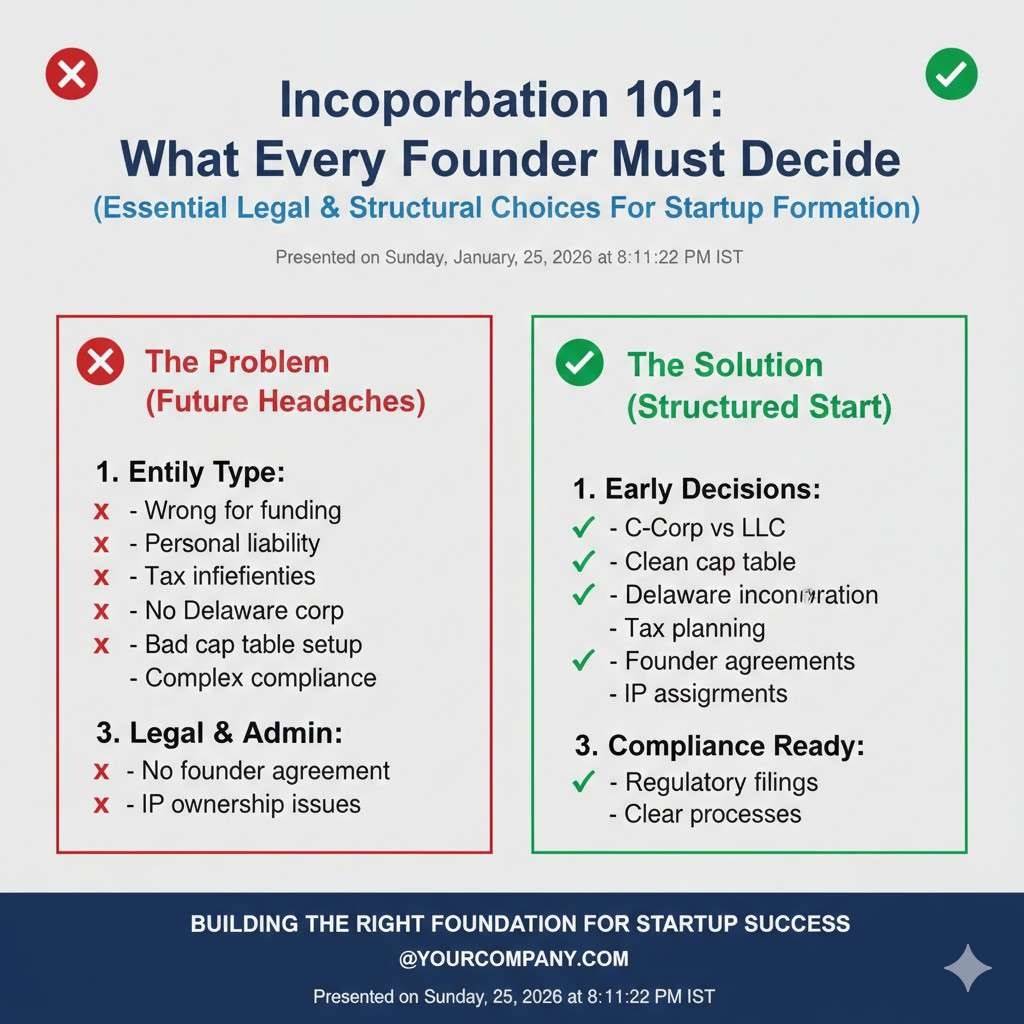
When you “incorporate,” you are creating a legal person. A separate thing that can own assets, sign contracts, get sued, open a bank account, and hold IP.
That is the core idea: your company becomes its own box.
Inside the box goes your code, your designs, your name, your customer deals, and later your patents. Outside the box is your personal life—your savings, your home, your future.
Incorporation does not make your product better. It does not make you “real.” It does not fix co-founder issues. It does not guarantee investors will take you seriously.
But it does three huge jobs:
It draws a line between you and the business.
It creates a clean place for ownership.
It gives you a place to store and protect IP.
For AI and robotics founders, that last part is not optional. If you want to raise money later, serious investors will ask: “Does the company own the invention?” If the answer is messy, you will feel it during diligence.
Tran.vc is built around solving this early. They help founders turn invention into assets—patents, filing plans, and clean ownership—so investors can say yes faster. If that sounds like what you need, apply here: https://www.tran.vc/apply-now-form/
Decision #1: When should you incorporate?
This is the first trap. Many founders rush into forming a company because they feel behind. Others wait too long and create a cleanup project later.
A practical way to think about it is simple: incorporate when you start doing “real world” things that create risk or value.
You are close if any of these are happening:
You are talking to customers and they want a contract.
You are taking payments or handling sensitive data.
You are building with a co-founder and writing serious code together.
You are hiring anyone, even contractors.
You are using a name and want to protect it.
You are creating invention you want the company to own.
You are discussing fundraising, even casually.
If you are just exploring ideas alone in your room, you may not need to incorporate yet. But the moment you start building something that could become valuable IP, time matters.
Why? Because invention has a timeline. Who made it, when it was made, and under what relationship matters. If you and a friend build something before the company exists, then later you incorporate and “move it in,” you are already doing a transfer. Transfers are doable, but they need paper. Paper done late is expensive and stressful.
A clean approach is: form the company early enough that it can own what you build going forward. You want the default to be simple: the company owns it because the company paid for it or because the work was done under company agreements.
If you are building in AI or robotics, and you think you might patent anything, early structure helps even more. Patents care about inventorship and assignment. If you mess up assignment, you can still fix it later, but it is painful.
This is one reason founders work with Tran.vc. Their whole model is “seed-strapping”: build a moat early, protect the invention, raise with leverage later. If you want that path, apply here: https://www.tran.vc/apply-now-form/
Decision #2: Where should you incorporate?
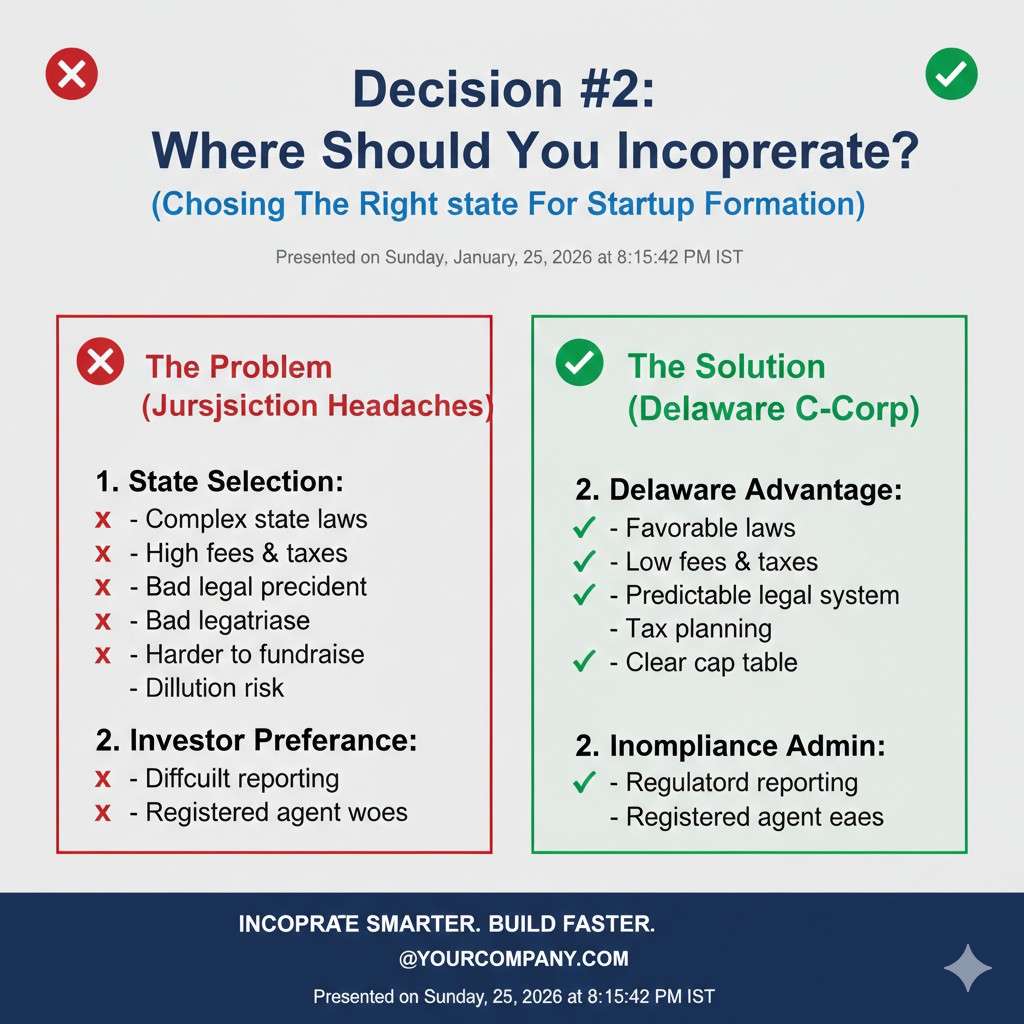
This is not the same as where you live.
You can live in one place and incorporate in another. But you should not do random choices based on what a friend did. The right place depends on who you will sell to, who will invest, where your team is, and what legal system you want.
Most venture-backed startups in the US incorporate in Delaware. Not because Delaware is magical, but because the rules are clear and widely used. Investors and lawyers see it every day. That lowers friction.
But not every startup should start in Delaware.
If you are not raising venture money soon, and you are operating locally, you may consider incorporating in your home state. Sometimes it is simpler and cheaper at the start. Sometimes it is not. The key is to think one step ahead: if you will likely raise from US seed investors, Delaware becomes more attractive.
For founders outside the US, the “where” question gets more complex. You may build the tech in one country, sell in another, and raise money from US investors. Many teams do a structure where the parent company is in the US and the operating team is elsewhere. This can be done, but it should be done with care because IP ownership and tax rules get tricky fast.
Here is a clean test:
If you want US investors, and you want to make it easy for them to say yes, Delaware C-Corp is usually the path.
If you want to stay local and bootstrap, a local structure might be enough.
If you are unsure, do not guess. Structure mistakes are hard to unwind.
One helpful way to reduce risk is to focus on IP first. Even if you are not sure where the final parent company will live, you can still build a clear plan for invention ownership, assignments, and filing strategy.
Tran.vc helps founders do that planning early—so later, when you do form the final structure or raise money, you are not rebuilding the airplane mid-flight. Apply here: https://www.tran.vc/apply-now-form/
Decision #3: What type of company should you form?
This is where people start arguing online.
Let’s make it simple. In the US, the common choices are:
LLC
C-Corporation (C-Corp)
S-Corporation (S-Corp)
For most startups that plan to raise outside money, issue stock, and scale, a C-Corp is the standard.
Why?
Because investors prefer it. Stock plans are easier. Ownership is clean. Future rounds are built for it. And many tax and legal systems around startup equity assume the C-Corp model.
LLCs are often great for small businesses, consulting, or companies that want flexible tax treatment and fewer formal steps. But LLCs can become awkward if you plan to raise venture money, issue lots of equity grants, or handle complex ownership over time.
S-Corps have rules that often do not fit startups that want to scale and raise from many investors.
So, if you are building an AI or robotics startup and you expect you might raise a priced round later, the default is often: Delaware C-Corp.
But “default” is not “always.” The real issue is your plan.
If you are planning to bootstrap for a long time, or you want cash flow early, an LLC might make sense at the start. But you should know what conversion later will take. Conversions can be done, but they add cost and risk.
Also, if you are building patentable tech, think about ownership. You want the company to own invention clearly. That can be done with any entity type, but you must do it with care.
This is one of those times where a little expert help early saves a lot later. Tran.vc exists for that early stage. They invest up to $50,000 in in-kind patenting and IP services—so you are not guessing while building valuable tech. Apply here: https://www.tran.vc/apply-now-form/
Decision #4: Who are the real founders, and how will you split ownership?
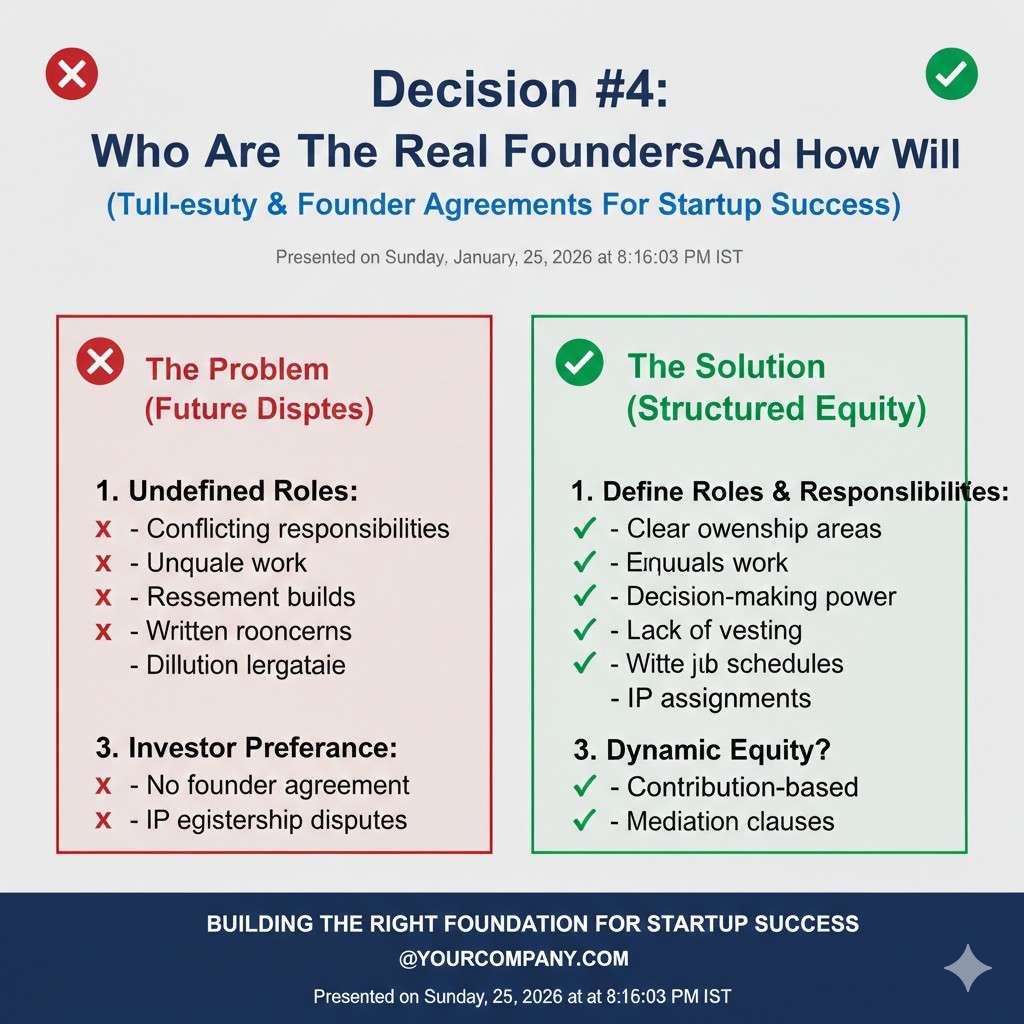
This is the decision that can end your startup even if the product is great.
The reason is not greed. It is confusion.
Many teams split equity based on friendship, not based on reality. Or they split it “even” to avoid a hard talk. Or they delay the talk until after work has been done, at which point feelings are stronger and the stakes are higher.
Here is a simple truth: you are building a relationship where stress will be high. If you cannot talk clearly about ownership now, it will be much worse later.
When you incorporate, you will set up the cap table. The cap table is just a record of who owns what. But it becomes the scoreboard of your company. Investors will read it. Employees will ask about it. Lawyers will check it. If it is messy, it signals risk.
So how do you split?
You do it by looking at three things:
Who is doing the work now.
Who will do the work later.
Who is taking real risk.
“Risk” is not just quitting a job. It can also mean putting money in, bringing key customers, or carrying the legal and hiring burden. But the biggest driver is usually ongoing execution.
One more key point: equity should almost never be “fully earned” on day one.
This is where vesting matters.
Vesting means founders earn their shares over time. If someone leaves early, they do not keep the full chunk. This protects the team and the company.
A common structure is four years of vesting with a one-year cliff. That means if a founder leaves before one year, they earn nothing. After one year, they earn a portion, then the rest monthly.
You can set different terms, but you need some structure. Without vesting, you can end up with a “dead equity” problem: someone who left owns a huge piece and does nothing. That scares investors and poisons morale.
This is also tied to IP. If someone leaves, who owns the invention they worked on? You want the company to own it. That requires proper invention assignment agreements and clean paperwork.
If this is starting to feel heavy, that is normal. This is exactly why Tran.vc exists. They work with technical founders early to build a defensible base—ownership clarity, IP strategy, and patent execution—so you can grow without hidden traps. Apply any time: https://www.tran.vc/apply-now-form/
Decision #5: What will you do with work you created before the company existed?
This is a quiet issue that becomes a loud issue later.
If you wrote code before incorporation, or built prototypes, or designed hardware, that work is not automatically owned by the new company. It was created by you, as an individual, before the company existed.
To make the company own it, you typically need to transfer it in writing. This is often called an assignment.
If you do not do this, you may build your whole product on an unclear foundation. Then when you raise money or file patents, you have to unwind it.
The simple action step is: make a list of what existed before incorporation. Code repos, CAD files, datasets, designs, documents, domain names, brand names, and any invention ideas that were already formed.
Then decide what should be assigned to the company.
The goal is not paperwork for paperwork’s sake. The goal is simple: one owner. The company.
For AI founders, data sources matter too. If your model depends on data you gathered personally or under a prior job, you must be careful. You do not want to bring in something you do not have rights to.
For robotics founders, hardware prototypes may include parts made at a university lab, a prior employer, or a shared maker space. Again, ownership and rights matter.
If you are unsure about any of this, do not guess. The cost of guessing can be huge later.
Tran.vc helps founders do this cleanup the right way and plan filings so your inventions become real assets, not fuzzy stories. If you want support, apply here: https://www.tran.vc/apply-now-form/
Decision #6: How will you handle IP from day one?
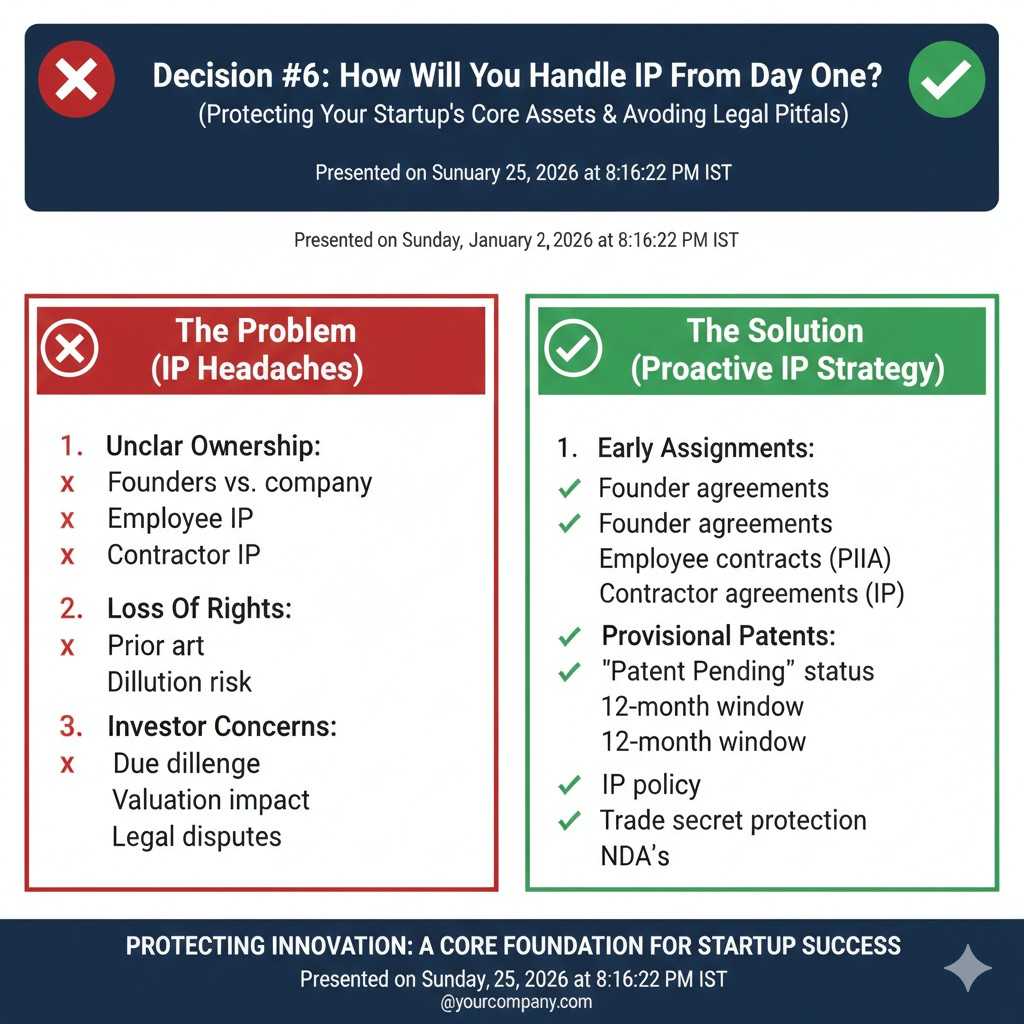
If you are building deep tech, your IP is not a “nice to have.” It is often the core of your value.
But here is what many founders get wrong: they treat IP like a task you do later, after product-market fit.
That works for some software companies. It often fails for robotics and AI teams building novel systems, models, hardware, sensors, or unique training methods. In these areas, the early invention can be the moat.
Also, patents have timing rules. Public disclosure can limit options. If you post a full technical breakdown online, present at a conference, publish a paper, or demo in a way that reveals the invention, you may start clocks that you cannot pause.
So the “incorporation” conversation should include an “IP hygiene” conversation.
At a basic level, you want:
Clear invention assignment: everyone who contributes signs agreements that assign inventions to the company.
Clean records: keep notes about what you built, when, and who built it.
A filing plan: not “file everything,” but “file what matters.”
A publication plan: know what you can share and when.
The biggest practical mistake is waiting until you are about to raise money to think about patents. By then, you have usually already disclosed too much, or you have lost track of who contributed what, or you have contractors without proper agreements.
This is Tran.vc’s home field. They invest up to $50,000 in in-kind patenting and IP services to help founders build protection early—before the world sees the details. Apply any time: https://www.tran.vc/apply-now-form/
Decision #7: How many shares should you authorize?
This sounds like a boring math question. It is actually about flexibility.
When you form a corporation, you set an “authorized” number of shares. Think of it as the total slices you are allowed to create. You do not have to issue them all on day one, but you need enough room for founders, employees, and future investors.
Startups often use a large number like 10,000,000 shares. That way, you can grant small pieces without using decimals. It is easier to read and manage.
But the key is not the number itself. The key is: you want a cap table that can grow without constant changes.
This choice also connects to your option pool later. If you plan to hire, you need room to grant equity. Founders often forget this and then have to restructure early.
If you are building a technical team, equity is one of the few tools you have to attract strong people before you have big cash. Plan for it now, even if hiring is months away.
Decision #8: Will you set up a stock option plan now or later?

A stock option plan is the legal tool that lets you grant equity to employees and sometimes advisors. You do not always need it on day one. But you should know when you will need it.
If you are hiring soon, set it up early. If you wait until you have a candidate you love, you will be doing legal work under pressure. Pressure leads to mistakes.
If you are not hiring for a while, you can wait, but keep it on your roadmap.
One practical tip: if you are planning to raise seed money soon, many investors will expect you to have an option pool. They may also ask you to create it before they invest, which can dilute founders. This is normal, but you should understand it before you are in the middle of negotiating.
Decision #9: Who will be on the board, and how will decisions be made?
In the early days, the board can be just the founders. That is fine.
But you should still be clear about how major decisions happen. Even with two founders, you need a plan for:
Who signs contracts.
Who controls the bank account.
What happens if you disagree.
What needs both signatures.
You do not want to discover your decision process during a crisis.
As you raise money, the board will change. Investors may want seats. This is another reason structure matters early: it sets the baseline for control and governance.
Tran.vc’s approach is very aligned with founders who want to keep control early and build leverage before they raise. If that is you, apply here: https://www.tran.vc/apply-now-form/
Decision #10: What tax choices will you make in the first year?
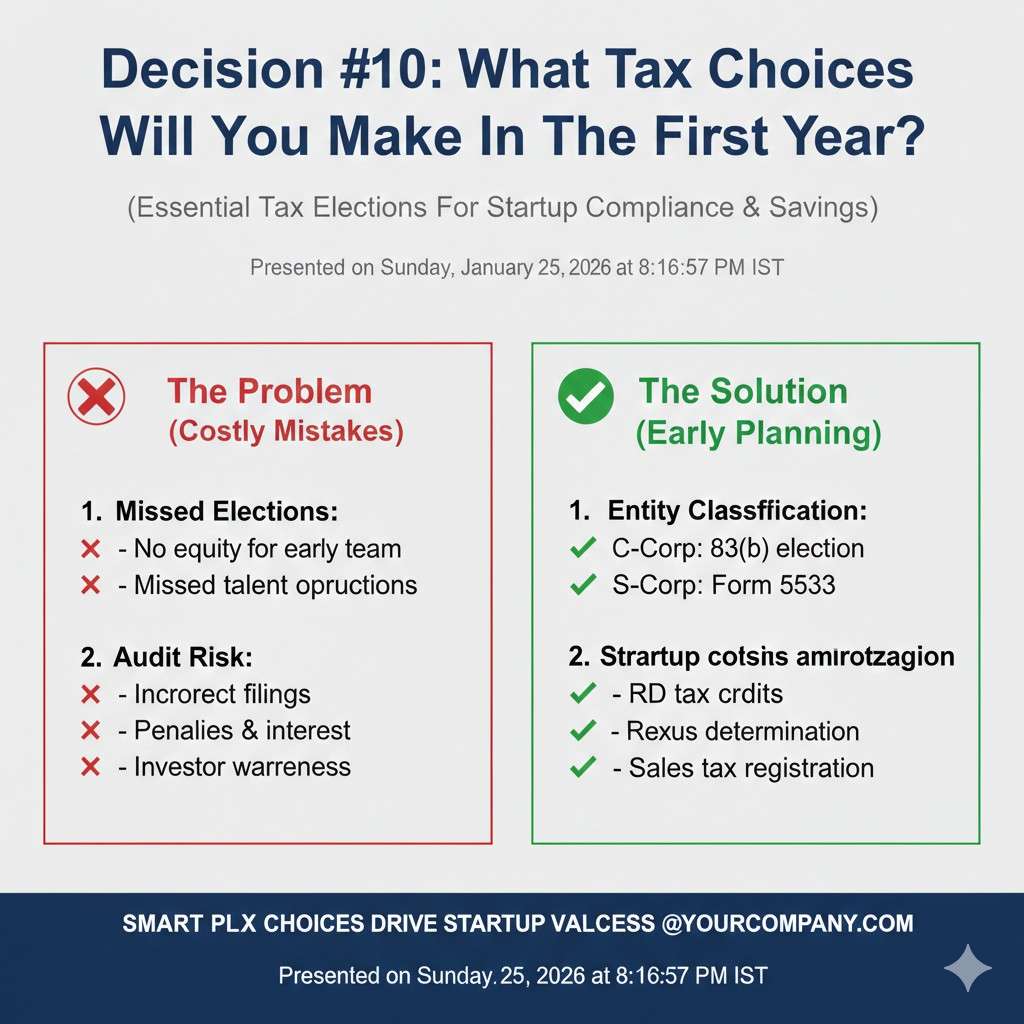
Taxes are not fun, but early choices matter. Some elections have deadlines. Some filings are required even if you have no revenue.
At a practical level, incorporation means you now need to:
Track expenses.
Separate personal and company spending.
File required forms on time.
Understand how founder equity is taxed.
Founder stock can create tax issues if you do not handle it properly. One well-known example is the 83(b) election in the US for restricted stock subject to vesting. If it applies to you and you miss the deadline, it can cost you real money later.
I am not giving legal or tax advice here, but I am saying this: do not treat early tax paperwork as optional. Put it on a calendar. Get help if you need it.