
Open source can be one of the best growth moves a technical founder can make. It can bring users, trust, and a strong community faster than any ad spend ever will.
But open source is also a one-way door.
Once code is public, you cannot “unshare” what the world has already seen. And if you publish the wrong thing at the wrong time, you can make it harder (or sometimes impossible) to protect the parts that matter most—your real invention, your real edge, your real moat.
This article is about how to plan your IP before you go open source, so you can share with confidence instead of regret. I’ll keep this simple, practical, and founder-friendly—because the goal is not to scare you away from open source. The goal is to help you do it in the right order.
If you’re building in AI, robotics, or deep tech and you want help shaping an IP plan before you publish anything, Tran.vc can help. We invest up to $50,000 in in-kind patent and IP services to help you build a defensible foundation early. You can apply anytime here: https://www.tran.vc/apply-now-form/
The Real Goal of IP Planning Before Open Source
What you are protecting is not “the repo”

Most founders think the risk is the code itself. In deep tech, that is often not the real risk. The real value is usually the method behind the code. It is the system design that makes results repeatable. It is the way your model is trained, tuned, tested, and shipped. It is the way your robot stays stable in the messy real world.
When you open source, you are not only sharing files. You are sharing your thinking. That includes scripts, configs, docs, examples, and even the way you explain the work. A smart competitor does not need every line to copy you. They need the “why” and the “how” that sits behind your choices.
The best outcome: share for growth, keep leverage for funding
Open source can be a growth engine. It can also be part of your credibility story when you talk to buyers and investors. But growth without leverage can turn into a trap. If anyone can copy the full value of your system, you will spend your time running while others draft behind you.
A clean IP plan lets you share in a way that grows adoption while still keeping real leverage. That leverage can come from patents, trade secrets, tight licensing, or the way your product is packaged and sold. The point is not to hide everything. The point is to share on purpose.
Where Tran.vc fits in early
This is exactly the kind of decision that is hard to make alone, because it mixes product, business, and law. Tran.vc helps founders decide what to protect first, what to publish later, and what to keep private. We invest up to $50,000 in in-kind patent and IP services so you can move fast without stepping on landmines.
If you want that support before you publish anything public, apply anytime at https://www.tran.vc/apply-now-form/
Know Your IP Types Before You Publish
Patents protect the “how”
A patent is meant to protect a new technical idea. It is about how something works, not just that it exists. In AI and robotics, this can cover core methods like control approaches, system architectures, special training methods, safety constraints, or a new way to combine hardware and software.
A patent is public. You disclose the invention and, in return, get legal rights that can block others from using it without permission. That trade can be worth it when you have something truly distinct and valuable.
Trade secrets protect the “how we do it”
Trade secrets are the opposite of patents in one key way. They stay valuable only if they stay private. Many deep tech companies rely on trade secrets for the parts that are hard to explain cleanly in a patent, or the parts that keep changing as the product improves.
In practice, trade secrets often include internal data flows, training recipes, evaluation pipelines, tuning steps, deployment tricks, cost controls, and operational know-how. These are the parts competitors would love to learn because they shorten years of trial and error into a weekend.
Copyright protects the code you wrote
Copyright protects the expression of your work, which includes your source code and documentation. Open source licenses sit on top of copyright. That is why the license matters. It tells the world what they can do with your code, what they must share back, and what rights you keep.
This is the point many founders miss. When you choose a license, you are not only being generous. You are setting business rules that can shape sales, partnerships, and even acquisition discussions later.
Public Disclosure and Why Timing Matters
Once it is public, you cannot rewind it

The largest open source mistake is simple. A founder publishes first and “figures out IP later.” But publishing can count as public disclosure. That matters because it can reduce or even remove patent options, depending on where you want protection.
Even in places that allow some time after disclosure, waiting can create fights later. Someone might argue the invention was already public. Or your own earlier posts might be used to narrow what you can claim. The result is more cost and less leverage.
What “public” includes beyond GitHub
Public disclosure is not only a code repo. It can be a blog post that explains your method. It can be a demo that shows key steps. It can be a slide deck with enough detail to reproduce the approach. It can even be a preprint or a recorded talk.
Founders often forget that documentation can be more revealing than code. A README that explains the architecture clearly can teach a competitor more than a thousand lines of source. A “how to reproduce” section can be the real giveaway if it shows the missing steps.
The safe rule: protect first, publish second
If a part of your system might be patent-worthy, the safest order is to file first and publish second. This does not mean you must patent everything. It means you should not accidentally give away the most valuable part before you decide how to protect it.
A good IP partner can help you move fast here. The goal is not delay. The goal is to keep options open while you ship.
Separate “Adoption Code” From “Moat Code”
Adoption code is what reduces friction
Adoption code is the part that helps users try the product easily. It removes setup pain. It helps developers integrate quickly. It makes the first experience smooth. This is often where open source shines.
In many companies, adoption code includes client libraries, SDKs, connectors, examples, and evaluation harnesses. These pieces can be open without giving away the core method that drives performance.
Moat code is what makes results hard to copy
Moat code is the part that delivers the outcome buyers pay for. In robotics, this might be control logic that makes motion stable, a safety system that prevents failures, or a special sensor fusion method. In AI, this might be a training approach that makes outputs better, a data loop that improves over time, or a system design that makes inference fast and cheap.
Moat code is not always a single file. Often it is spread across design choices, configs, and the way components interact. That is why you need to define it clearly before you share anything.
The practical split most founders should aim for
A strong open source plan often shares adoption code widely, while protecting moat code through patents, trade secrets, or careful packaging. This gives you the best of both worlds. You get the market pull and trust that open source brings, without losing the advantage that makes you fundable and defensible.
If you want help doing this split cleanly, Tran.vc can guide you through it early and back it with real filings when needed. Apply anytime at https://www.tran.vc/apply-now-form/
Do a Core Value Map Before You Open Source
Start with the buyer’s reason to pay

If you sell to businesses, the buyer does not pay because your repo exists. They pay because you reduce cost, time, risk, or failure. They pay because you make something possible that was not possible before. Your core value map should start with that business outcome.
Once you name the outcome, you can trace back to what truly creates it. That is usually where your defensibility sits. It might be a method that improves accuracy, a system that increases uptime, or a pipeline that makes learning faster over time.
Find the “one thing” you must not give away early
Most early-stage companies have one key advantage. It may be small today, but it is the seed of the moat. If you publish that advantage too early, you may still grow, but you will grow with less leverage.
This one thing might be your control loop logic, your training recipe, your data engine, your safety constraints, or your hardware-software co-design. Your job is to name it in plain words and treat it as a protected asset.
Treat docs, configs, and examples as part of the product
Founders often protect the “core code” but forget the surrounding materials. In deep tech, the surrounding materials often contain the true secret. Configs show what matters. Notebooks show the real steps. Examples show the workflow. Docs explain the decisions.
So your core value map must include everything you plan to publish. Not only what is in the src folder, but what sits around it and makes it usable.
A Practical Pre-Open-Source IP Checklist You Can Do This Week
Step one: inventory what is truly new
You are looking for what is not obvious. What would another strong engineer not do by default? What did you learn through pain that changed outcomes? What design choice made a big jump in performance, stability, safety, or cost?
Write those items in simple sentences. Do not worry about fancy words. Clarity matters more than vocabulary. This list becomes the starting point for deciding patents versus trade secrets versus open source.
Step two: label each item by how it should be protected
Some items are best kept private as trade secrets because they change often or are hard to describe cleanly. Some items are best suited for patents because they are distinct, stable, and valuable, and you want protection even if the world learns them.
Some items are safe to share because they drive adoption but do not reveal the core method. The point is not perfection. The point is making a conscious call on each key piece.
Step three: check what your public materials already reveal
Look at your website copy, pitch deck, demo videos, and any talks or posts. Many founders realize they have already shared more than they thought. That does not mean you are doomed. It just means you need to plan the next steps carefully.
This check also helps you tighten what you will say in your repo docs. Sometimes the biggest leak is not the code, but the explanation that sits beside it.
Step four: file what you need to file before launch
If your inventory includes patent-worthy ideas, this is where you talk to an IP partner and decide what to file before you publish. A fast, founder-friendly filing process can protect the key ideas without slowing product work.
Tran.vc exists to make this step easier for early founders. We invest up to $50,000 in in-kind patent and IP services so you can protect what matters while keeping momentum. Apply anytime at https://www.tran.vc/apply-now-form/
License Choice Is Part of Your Business Model
A license tells others how they can use your work

A license is not a decoration. It is the rulebook for how others can copy, change, share, and sell what you publish. That includes friendly users, future partners, and also competitors.
Some licenses help spread fast. Some licenses help ensure improvements come back to the community. Some licenses can limit certain uses. What matters is matching the license to your go-to-market plan.
License choice can help or hurt enterprise sales
Many B2B founders learn this late. Enterprise buyers have legal teams, and legal teams have strong opinions about licenses. If your license is unclear, adoption can slow. If your license creates fear about risk, deals can stall.
So you want a license that supports trust, not confusion. You want a simple story you can tell a buyer about what is open, what is paid, and what rights they have.
Licenses can include patent language too
Some licenses include patent grants or clauses that change behavior around patent disputes. This matters more than most founders realize, especially if you plan to build a patent-backed moat.
You do not need to become a license expert. But you should not pick a license in five minutes without thinking about how you will sell.
Build an Open Core Plan That Does Not Break Later
Open core is not “hide the good stuff”
A common mistake is to treat open core like a trick. Founders open a small slice and keep everything useful locked up. Developers notice quickly. They feel used, and the community stays thin.
A strong open core plan feels fair. The open part should be genuinely useful. It should solve a real problem on its own, even if the best experience is paid. When the free version is real, people trust you. When it is only bait, they do not.
This matters because open source is not only a distribution channel. It is also a reputation channel. If you want the market to see you as a serious team, you need to give real value in public.
Decide what “open” means in your product story
Before you choose what to publish, define what the open part stands for. In many B2B deep tech products, the open part is one of three things.
Sometimes it is the standard interface layer, so the world can build around you. Sometimes it is the evaluation and testing layer, so users can trust results. Sometimes it is the tooling and integration layer, so adoption is easy.
When you choose one role for the open part, your product story becomes simple. Customers understand what they get. Developers understand why the repo exists. Investors understand how the company can still win.
The paid core should be about outcomes, not access
When founders keep the core private, they sometimes frame it as “you pay to get the secret code.” That framing can make buyers uneasy. They do not want mystery. They want outcomes and reliability.
A better approach is to make the paid offering about what businesses truly want. They want support, uptime, security, compliance, clear service terms, and stable releases. They want a hosted option that works without drama. They want features that save them time and reduce risk.
This is also where your moat can live without sounding defensive. You are not hiding. You are building the version that enterprises can trust.
Avoid Accidental Disclosure Through “Helpful” Extras
The quiet leak: configs, weights, and pipelines

Founders often protect the main algorithm but forget the parts that make it work in practice. In AI, this can be the training pipeline, fine-tuning settings, data cleaning steps, and evaluation tricks. In robotics, it can be calibration methods, control gains, safety thresholds, and the exact timing setup.
These details are usually not obvious to outsiders. They are earned through experiments, failures, and field work. That is why they are valuable. If you publish them casually, you may be giving away the hardest part.
A good rule is to treat every file as a teaching tool. If a competitor could learn something critical from it, it belongs in your “think twice” pile.
The demo problem: you show more than you think
Demos are meant to be clear. The clearer your demo, the more likely someone can copy it. This is not a reason to stop doing demos. It is a reason to plan what the demo reveals.
For example, you can show that your system works without showing the full steps that make it work. You can show results, benchmarks, and behavior while keeping the core method protected. You can show an interface and workflow, while keeping the key training recipe private.
Your goal is to make people want the product, not to hand them the blueprint.
The “reproducibility” trap in deep tech
In research culture, reproducibility is a virtue. In business, full reproducibility can be a gift to competitors. This becomes tricky for AI and robotics teams because many founders come from labs where sharing everything is normal.
You can still be credible without revealing every step. You can publish evaluation code without publishing the entire data pipeline. You can share a baseline training setup without the full production recipe. You can provide a model card that is honest and useful without exposing the knobs that drive your edge.
The key is to separate what users need from what competitors want.
Contributor IP: The Part Almost Everyone Forgets
Once others contribute, ownership gets complicated
When you open a repo and accept contributions, your product is no longer written only by you. That can be great for speed and quality. But it can also create IP confusion if you do not set clear rules.
If you plan to build a company, you want confidence that you can use, sell, and license the code long term. You do not want a future buyer or investor to worry that parts of your core product have unclear rights.
This is why you need a contribution policy early, before your first serious outside contributor shows up.
Clarify contributions in a way that feels respectful
You do not need to treat contributors like enemies. You can set clear rules while being kind. The goal is to make sure everyone understands the basics.
You want to be clear that contributions are accepted under the project’s license. You also want clarity that the contributor has the right to submit what they submit, and they are not copying from their employer or a private repo.
This is not about paperwork for its own sake. It is about preventing future disputes that can become expensive and distracting.
Keep the company’s core clean from day one
A simple practice helps here. Keep a clean line between the open repo and any private repos. Avoid copying code back and forth casually. Document what comes from where. If you later file patents or build enterprise features, you want a clear story of authorship and ownership.
The founders who do this early look “adult” to investors. It signals maturity, not paranoia. It also makes diligence easier when the time comes.
Patent Planning That Works With Open Source
Start by identifying what is truly patent-worthy

Not everything should be patented. Patents cost time and money, and they are public. But some inventions are worth it, especially in robotics and AI where a clear technical leap can become your market shield.
The best candidates are usually methods that are distinct, stable, and hard for others to avoid. If your idea is easy to design around, a patent may not give much leverage. If the idea is broad and fundamental, it can be worth serious attention.
This is where a patent strategy session with the right experts pays off. You are not only deciding what to file. You are deciding what to keep as secrets and what to share as open source.
File in a way that supports your product roadmap
Many founders think patents must perfectly match the product today. But your product will change. A smart filing plan protects the core principles that will remain true even as features evolve.
In practice, this means focusing on the underlying method, not the exact code implementation. It also means writing the patent in a way that covers different versions of the system, not just one build.
When done well, your open source release can actually support your patent story. You can publish adoption tooling publicly while keeping the protected invention filed and secured.
Be careful with what your repo implies
Even if you file before you publish, you still want to be careful about what the repo reveals. Public material can affect how others interpret your claims. It can also become evidence in future disputes.
This does not mean you should speak like a lawyer in your README. It means you should avoid publishing details that reduce your options later. A clean plan prevents these issues before they happen.
If you want help building this plan with real patent attorneys who understand startups, Tran.vc can help. We invest up to $50,000 in in-kind patent and IP services and guide you through what to file, what to hold, and what to publish. Apply anytime at https://www.tran.vc/apply-now-form/
A Release Process That Prevents Regret
Treat open source like a product launch
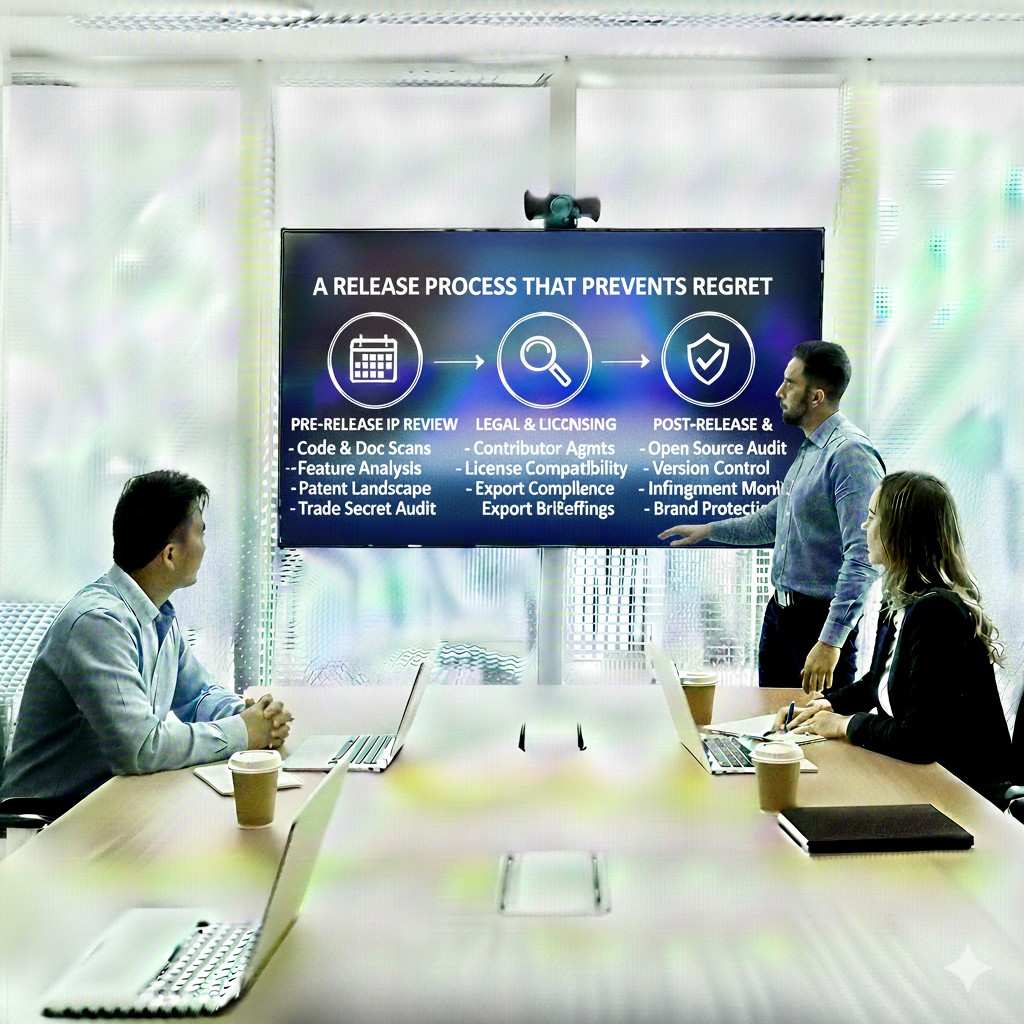
A repo launch is not just a push to GitHub. It is a public event that shapes how people see your company. So the release deserves a process, even if it is lightweight.
You want to review code for secrets, keys, internal endpoints, and private notes. You want to review docs for revealing details. You want to verify the license, contribution rules, and branding. You want to check that the project builds cleanly without your internal environment.
This is not bureaucracy. It is basic hygiene.
Create a simple “public-safe” standard
Before you publish, define what is safe to share publicly. This becomes your internal standard and saves time later. Team members can write code and docs with that standard in mind, instead of guessing every time.
Over time, this also reduces accidental leaks. Your team learns the difference between what helps adoption and what gives away the moat. That clarity becomes part of your culture.
Decide how you will handle issues and security reports
As soon as you are public, people will open issues. Some will be helpful. Some will be noise. Some may point to security risks.
You should decide how you will respond, even if it is simple. A calm and consistent response style builds trust. For enterprise buyers, this matters. They watch how you handle problems.
You do not need a large team to do this well. You need a clear owner and a steady routine.