
Building deep tech is hard. You’re not just shipping an app. You’re turning math, code, data, sensors, chips, robots, and real-world systems into something that works in the wild.
And here’s the part most technical founders learn too late: if you don’t protect what you build, you don’t really own your advantage.
IP strategy is not paperwork. It’s not a “legal thing” you do after product-market fit. It’s a business move you make early so you can:
- keep competitors from copying your core idea,
- show investors you have a real moat,
- avoid stepping on someone else’s patents,
- and build leverage before you raise.
This playbook is written for founders who are building AI, robotics, hardware, infrastructure tech, or anything “deep” where the real value sits under the hood. It is not meant to scare you. It’s meant to give you control.
Because the best IP strategy is simple: protect the parts that make you hard to replace, and do it in a way that supports your product, your timeline, and your funding plan.
That’s exactly what Tran.vc helps with.
Tran.vc is a pre-seed venture partner that invests up to $50,000 in in-kind patent and IP services for deep tech startups. Not theory. Not templates. Real support from people who know how patents work, how startups work, and how investors think. If you’re building something defensible and you want to do this right from day one, you can apply any time here: https://www.tran.vc/apply-now-form/
Before we go into the full playbook, here’s what I want you to keep in your head while you read:
A patent is not the goal. The goal is a company that can win.
A patent is one tool to help you win. Sometimes it’s the best tool. Sometimes it’s one part of a larger plan. But when you are building deep tech, it’s usually the difference between “cool demo” and “real business.”
Step 1: Understand What IP Strategy Really Means for Deep Tech
IP is not a legal task. It is a business plan.
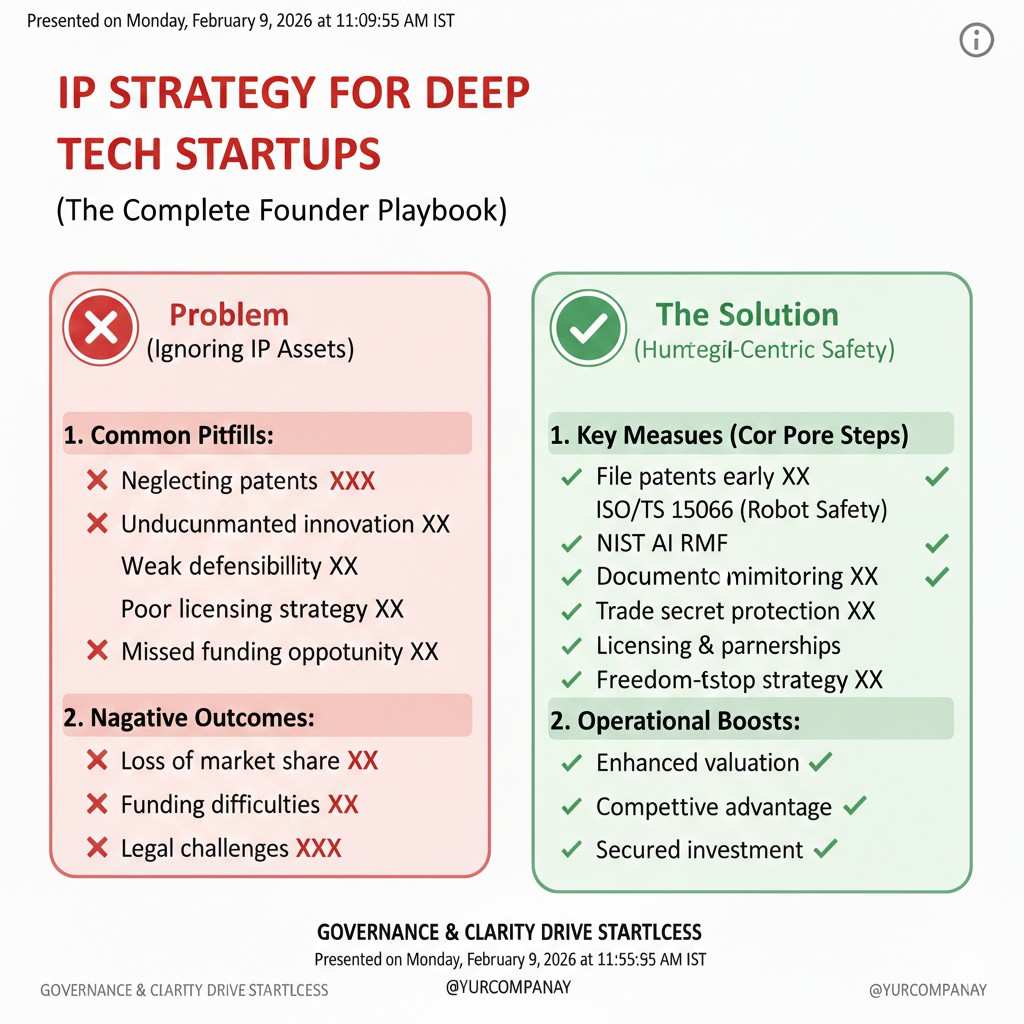
Most founders think “IP” means “file a patent.” That is only one part of it. IP strategy is the plan for how you will keep your edge when someone bigger notices you and tries to copy what you built.
For deep tech, the edge is often hidden. It can live inside a model pipeline, a control loop, a calibration method, a sensor fusion trick, or a way your hardware and software work together. If you don’t name that edge clearly, you cannot protect it well.
A good IP strategy also helps you stay out of trouble. You do not want to build a product that later gets blocked by a patent you did not check. You also do not want to publish key details too early and lose your chance to patent them.
If you want Tran.vc to help you build this plan from the start, you can apply any time here: https://www.tran.vc/apply-now-form/
Why deep tech needs IP earlier than most startups
In many software startups, speed and distribution can act like a moat. For deep tech, speed alone is not enough. If your core value is a technical method, someone can copy it faster than you think once you show results.
Deep tech also takes longer. You may spend months on R&D, testing, and pilots before revenue. During that time, investors want proof that your work is turning into assets, not just burn.
When you can show a clear patent plan, strong invention records, and early filings that match your product direction, you look like a team that knows how to win. You reduce investor doubt, and you often improve your terms when you raise.
The biggest mistake founders make in the first year
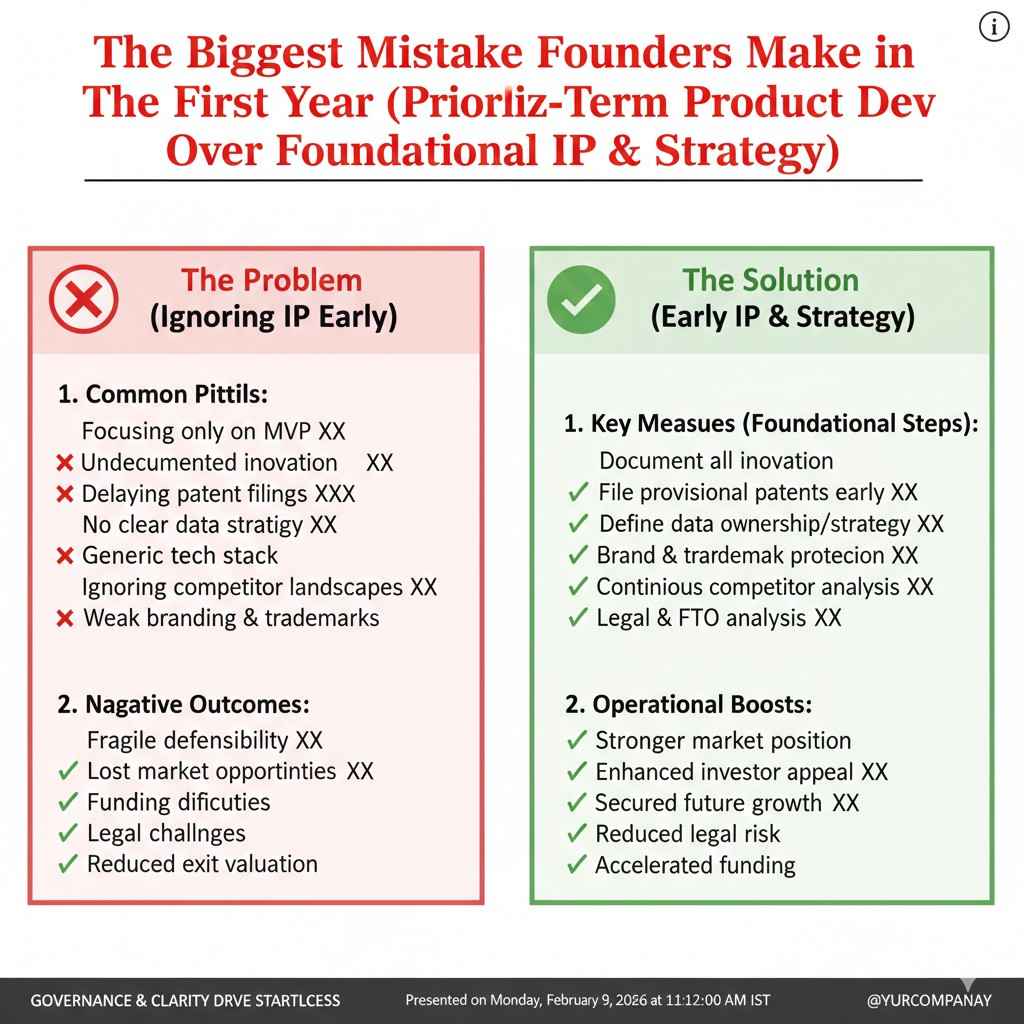
The most common mistake is waiting until the product feels “done.” The second mistake is filing too early with weak content that does not match what you will ship.
Both mistakes come from the same root issue. The founder does not have a system for capturing inventions and turning them into a clean, staged plan.
You do not need dozens of patents to start. You need the right first filings, tied to the parts of your tech that will still matter in two years.
That is what the rest of this playbook will help you do.
Step 2: Map Your “Real Value” Before You Think About Patents
Separate what is impressive from what is protectable
Deep tech teams often have a lot of “cool” pieces. A fast model. A clean demo. A strong metric. A robot that moves well in a lab.
The question is not “what is cool.” The question is “what will a competitor copy if they get one look at this?”
Protectable value is usually a method. A system. A pipeline. A hardware-software link. A step-by-step process that turns inputs into outputs in a new way. It can also be a design that solves a hard problem with a clever structure.
If the value is only “we trained on more data,” that may be harder to patent. If the value is “we built a new training method that makes small data work,” that is often much stronger.
Use a simple value map to find your patent targets
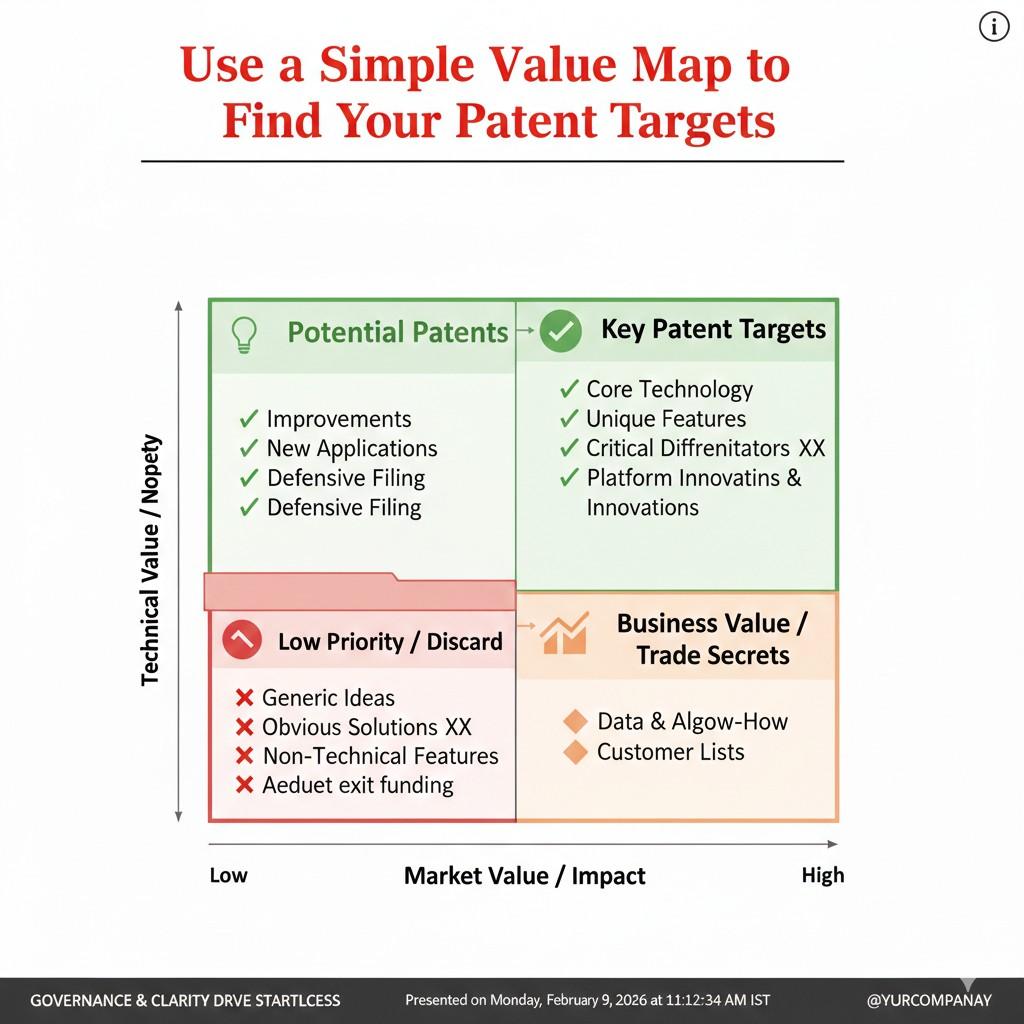
You want to map your product into layers. Not in a fancy way, but in a way that forces clarity.
At the top is the user result. The measurable thing the customer cares about. For example: fewer defects, faster picking, safer driving, lower energy use, better uptime.
Under that is the system that creates the result. This is where the real work is: models, sensors, controls, edge compute, data pipelines, and feedback loops.
Under that are the “hard parts.” These are the points where your team spent real time solving a problem that other teams will also face. If your solution is not obvious, it may be protectable.
When you have that map, patents become less confusing. You stop guessing. You start choosing.
Deep tech founders often forget the “integration inventions”
A lot of real inventions are not a single model or a single mechanical part. The invention is the way parts work together.
For example, in robotics, the novelty is often in coordination. How perception triggers planning, how planning triggers control, how the robot recovers when a sensor fails, or how the system stays safe under uncertainty.
In AI infrastructure, novelty can be in how data is selected, labeled, compressed, filtered, and fed into training, then monitored in production with a loop that reduces drift.
In hardware, novelty can be in how you reduce noise, handle heat, or simplify manufacturing while keeping performance.
These “integration inventions” are often the most valuable. They are also the easiest to miss if you only look for one “big idea.”
If you want help identifying these hidden inventions, this is exactly the kind of work Tran.vc supports. Apply any time here: https://www.tran.vc/apply-now-form/
Step 3: Decide What to Patent and What to Keep as a Trade Secret
Patents and trade secrets are different weapons
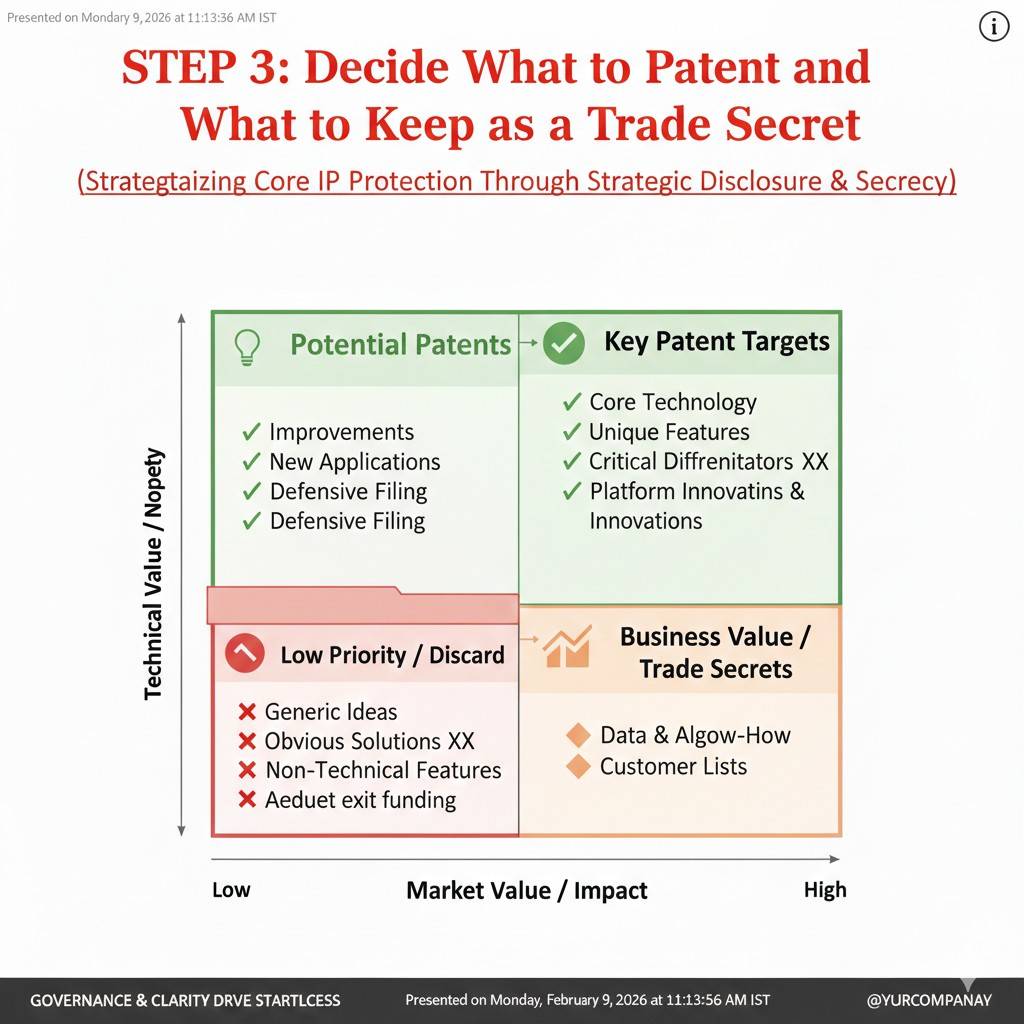
A patent gives you a public right. You teach the world how something works, and in return you get the ability to stop others from using it in the places where the patent is granted.
A trade secret is private. You do not publish it. You protect it with process and access control. It can last a long time if you keep it secret.
Deep tech often needs both. The trick is choosing which parts belong in which bucket.
If the secret can be reverse-engineered from your product, keeping it secret may not work. In that case, a patent can be a safer path.
If the value comes from data, tuning, or internal process that others cannot see, a trade secret can be stronger and cheaper.
A practical way to choose between patent and secret
Ask one question: if a strong competitor buys your product and takes it apart, will they learn the key method?
In software, that might mean model behavior, API calls, or edge deployment. In hardware, it might mean the physical structure, board layout, or sensor placement. In robotics, it might mean the control behavior and recovery patterns.
If the answer is yes, you should lean toward patents for that piece, because the secret is fragile.
If the answer is no, and the method lives in your training process, dataset, internal evaluation system, or manufacturing know-how, trade secrets may be the better choice.
You can also mix them. Patent the “system shape” and keep the tuning details secret. That often gives you strong coverage without giving away your best tricks.
Watch out for the “we’ll keep it secret” trap
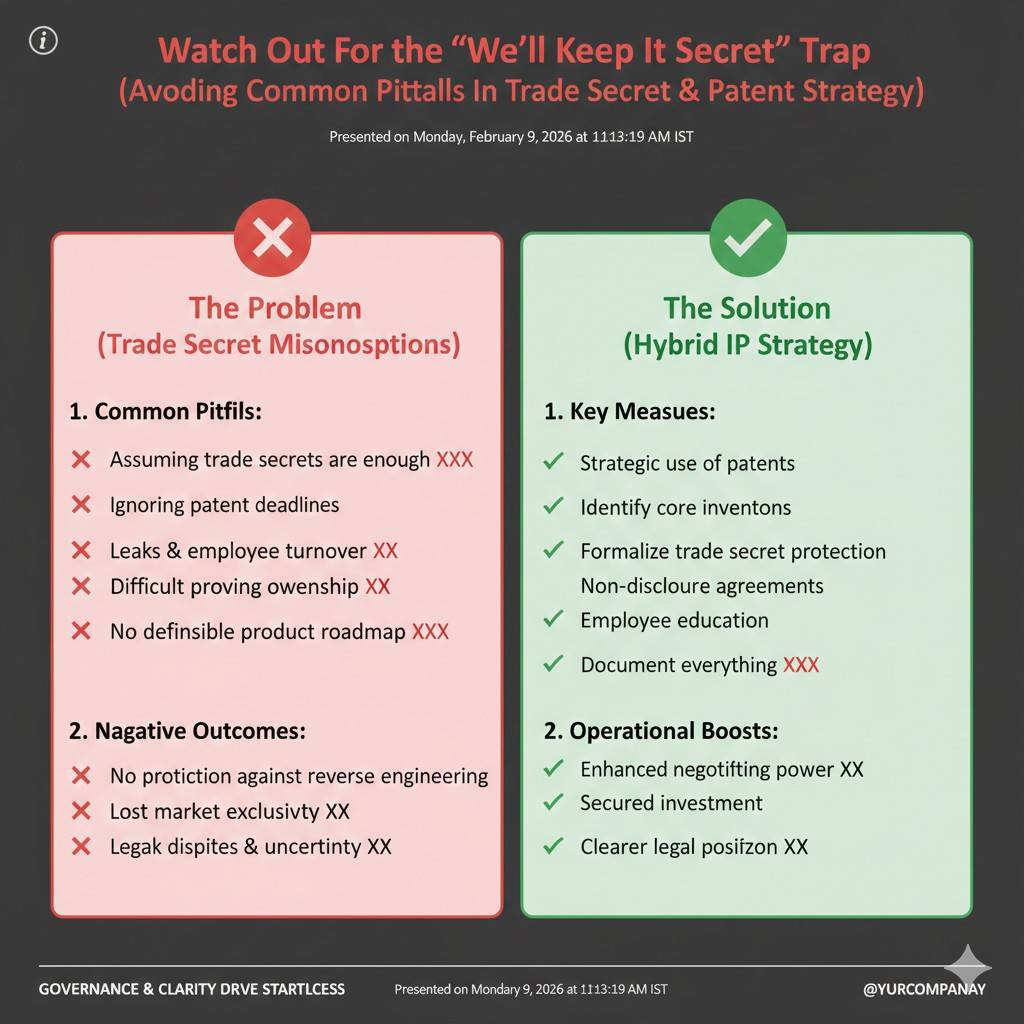
Some founders say “we’ll keep it secret” but do not actually protect it. They share too much in decks, demos, blog posts, and hiring materials.
Trade secrets require discipline. You need basic controls like limited access, clean internal docs, and clear agreements with employees and contractors.
You do not need to be paranoid. You do need to be deliberate.
A strong IP plan is not only about filing. It is also about how you talk about your tech in public.
Tran.vc helps founders build a plan that fits how startups actually operate, not how large companies operate. If that’s what you want, apply here: https://www.tran.vc/apply-now-form/
Step 4: Build an Invention Capture System So You Don’t Lose Good Ideas
Your team is inventing more than you think
In deep tech, invention happens every week. It happens when you hit a wall and find a workaround. It happens when you reduce latency. It happens when you make the system stable in edge cases.
But most of these inventions get lost. They live in Slack threads, messy notebooks, and temporary branches. Then months later, when you finally want to file, nobody remembers the clean story.
A simple capture system fixes this. It turns scattered progress into a pipeline of protectable assets.
What “invention capture” looks like in a startup
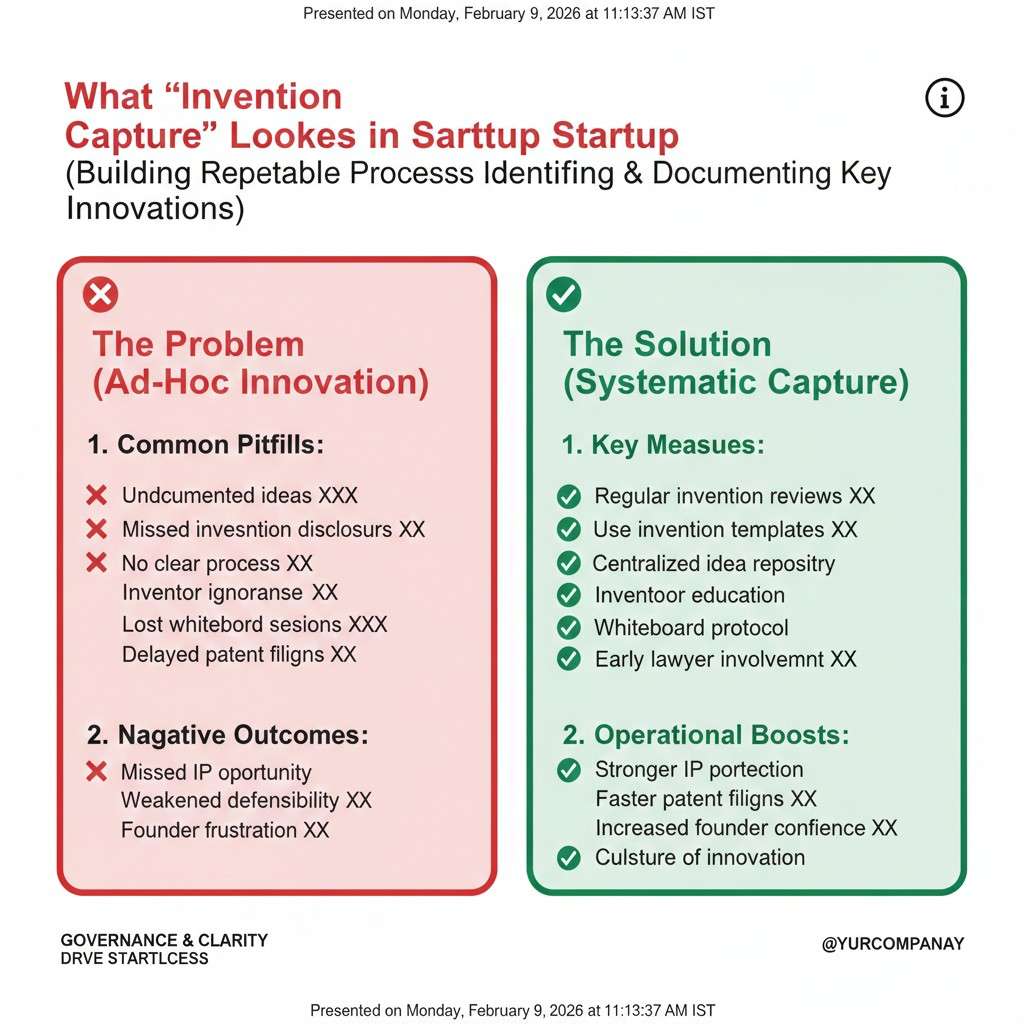
You do not need a heavy process. You need a repeatable habit.
When you solve a hard problem, you write down four things while it is fresh: what the problem was, why normal methods failed, what you did differently, and what improved because of it.
You also keep a record of dates, names of contributors, and a rough diagram. The goal is not to write a patent. The goal is to preserve the invention in a way that a patent attorney can later convert into a strong filing.
This habit takes minutes when done weekly. It takes weeks when done once a year.
A founder-led cadence that works
A practical cadence is a short invention review every two weeks. Not a meeting that kills momentum, but a focused check-in.
You ask the team what changed in the system that would be hard for others to copy. You collect two or three items. You pick one to develop further. You park the rest in an idea bank.
Over time, this becomes your IP backlog. It also becomes a better way to lead R&D, because it forces clear thinking about what matters.
This is one of the easiest ways to look more “fundable” without spending money. You start acting like a team that turns research into assets.
Step 5: Make Your First Patent Filings Match Your Product Roadmap
The first filings set the direction, so they must be chosen carefully
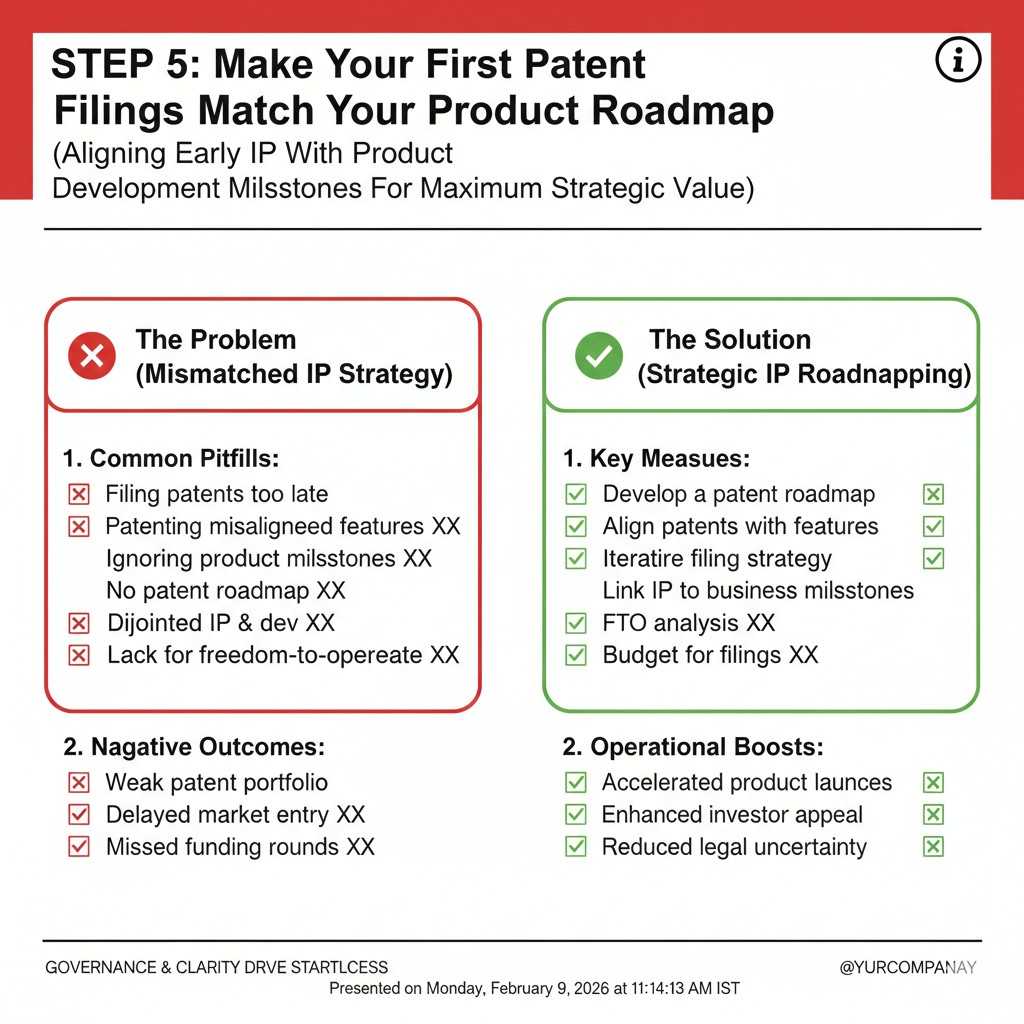
Your earliest filings matter more than you think. They create your first “priority date,” which can be valuable later. They also set the base for future filings that build on the same core idea.
If you file on the wrong thing, you waste time and money. If you file on the right thing but describe it too narrowly, you may not cover future versions of your product.
The goal is to file on the core method that will still be true as the product evolves.
Think in “product truths,” not in implementation details
Your code will change. Your model will change. Your hardware parts will change.
But some truths stay stable, like the system’s structure, the flow of information, the safety logic, or the way you handle uncertain inputs.
Your first filings should focus on those stable truths. They should be broad enough to cover future versions, but specific enough to be real and defensible.
A strong patent is not vague. It is clear, complete, and flexible.
Timing matters more than perfection
Founders often delay because they want the invention to be perfect. That is a mistake.
You want to file when the invention is real enough to explain and support, and when the risk of public disclosure is rising.
Public disclosure can happen faster than you think. It can happen in a pitch deck, a demo day, a customer pilot, a GitHub repo, a paper, a blog post, or even a job post that reveals too much.
A good partner helps you pick the right moment and the right scope.
Tran.vc was built for exactly this stage: when you have strong technical work and you want to convert it into defensible leverage before you raise. Apply any time here: https://www.tran.vc/apply-now-form/
That brings us through the early foundation: what IP strategy means, how to find what matters, how to choose patents versus secrets, how to capture inventions, and how to plan first filings around the roadmap.
Step 6: Learn the Patent Basics You Actually Need as a Founder
What a patent really is, in plain terms
A patent is a right to stop others from using an invention in places where the patent is granted. It is not a trophy and it is not a stamp that says “we are innovative.”
What matters is what the patent claims say. The claims are the legal lines that define what is protected. If the claims are too narrow, people can go around them. If they are too broad without support, they can be challenged.
As a founder, you do not need to become a patent lawyer. But you do need to understand what makes a patent useful, because you are the only person who fully understands your product and why it is special.
When Tran.vc supports a startup, this is one of the first wins: you stop guessing, and you start making IP choices with clarity. If you want that kind of support, you can apply any time here: https://www.tran.vc/apply-now-form/
Provisional and non-provisional, and why founders get confused
A provisional application is often used as an early filing to lock in a date. It is not examined on its own. It can be a smart move, but only if it is written well and has real detail.
A non-provisional application is the one that gets examined. It is the one that can become an issued patent.
Many founders treat a provisional like a rough note. That can backfire. If your provisional is thin, it may not support your later claims, and you may lose the benefit of that early date.
The safe way to think about it is simple: a provisional should be detailed enough that, if you had to, you could hand it to an engineer and they could build what is described. It does not need to have every number perfect. It needs to show the invention clearly, with examples and variations.
What makes a deep tech patent strong
In deep tech, strength comes from how well you describe the system and its alternatives. The best patents do not describe only one version. They describe a family of versions.
If your invention is a robotics method, you do not want protection only for “robot arm A with sensor B.” You want protection that covers the method even if the competitor uses a different arm or a different sensor.
If your invention is an AI pipeline, you do not want protection only for the exact model type you used today. You want protection for the method of how you choose inputs, process signals, train, and run feedback, even if the model changes.
This is why early founder involvement matters. A patent attorney can draft the language, but only your team can explain the real system choices and the paths a competitor might take.
Step 7: Build an “IP Story” That Investors Understand in 60 Seconds
Why investors care, even when they say they don’t
Some investors will tell you, “we don’t invest based on patents.” What they usually mean is they do not invest in patents alone.
But investors absolutely care about defensibility. They want to know why you will still be ahead after the market learns what works. For deep tech, IP is one of the cleanest ways to answer that.
A good IP story does not sound like legal talk. It sounds like business logic.
You are explaining what you built, why it is hard to copy, and how you are protecting the core pieces while the product grows.
The simple structure of a strong IP story
A strong IP story has three parts.
First, you name the core problem in the industry and why existing solutions fail. You make this clear and concrete, not dramatic.
Second, you explain your technical insight in a way that a smart person can follow. You do not dump details. You explain the key idea and how it changes the result.
Third, you show your protection plan. You do not say, “we filed a patent.” You say, “we are building a wall around the core method, and we are doing it in stages as we ship and learn.”
That is what makes an investor feel safe. They start thinking, “Even if this space gets crowded, this team will hold ground.”
How to talk about patents without revealing too much
Founders often swing between two extremes. They either hide everything and sound vague, or they share too much and lose leverage.
The middle path is to speak at the system level. You describe the category of invention and the benefit, without giving away the exact steps that make it work.
You can also talk about what you are not doing. For example, you can say, “Our advantage is not just model size or data volume. It is the method that turns weak signals into stable actions in real time.” That tells a clear story without giving a recipe.
This is where a good IP partner helps. Tran.vc helps founders say the right things in the right places, so you protect your value while still raising effectively. Apply any time here: https://www.tran.vc/apply-now-form/