
Most tech founders do the hard part first.
You build something real. You write the code. You run the tests. You get the first users. You fix bugs at 2 a.m. You do the work that actually makes a product.
Then the world asks a tough question:
“What stops a bigger team with more money from copying you?”
That is not a rude question. It is a fair one. Seed investors ask it. Enterprise buyers think it. Partners worry about it. Even future hires quietly wonder it.
And here is the painful part: in AI, robotics, and deep tech, a lot of “value” lives in things that are easy to copy once they are seen. A workflow. A model trick. A sensor setup. A data loop. A method that looks simple after it works.
This is where IP helps. Not as a fancy badge. Not as a legal hobby. But as a real business tool that gives you leverage.
At Tran.vc, we help technical founders turn what they built into protected assets early—before the seed round—so they can raise with more strength and build with more calm. Tran.vc invests up to $50,000 in-kind as patent and IP services for robotics, AI, and other tech startups. That means strategy, filings, and hands-on help from people who have done this before.
If you want to explore working with Tran.vc, you can apply anytime here: https://www.tran.vc/apply-now-form/
The problem most founders meet too late
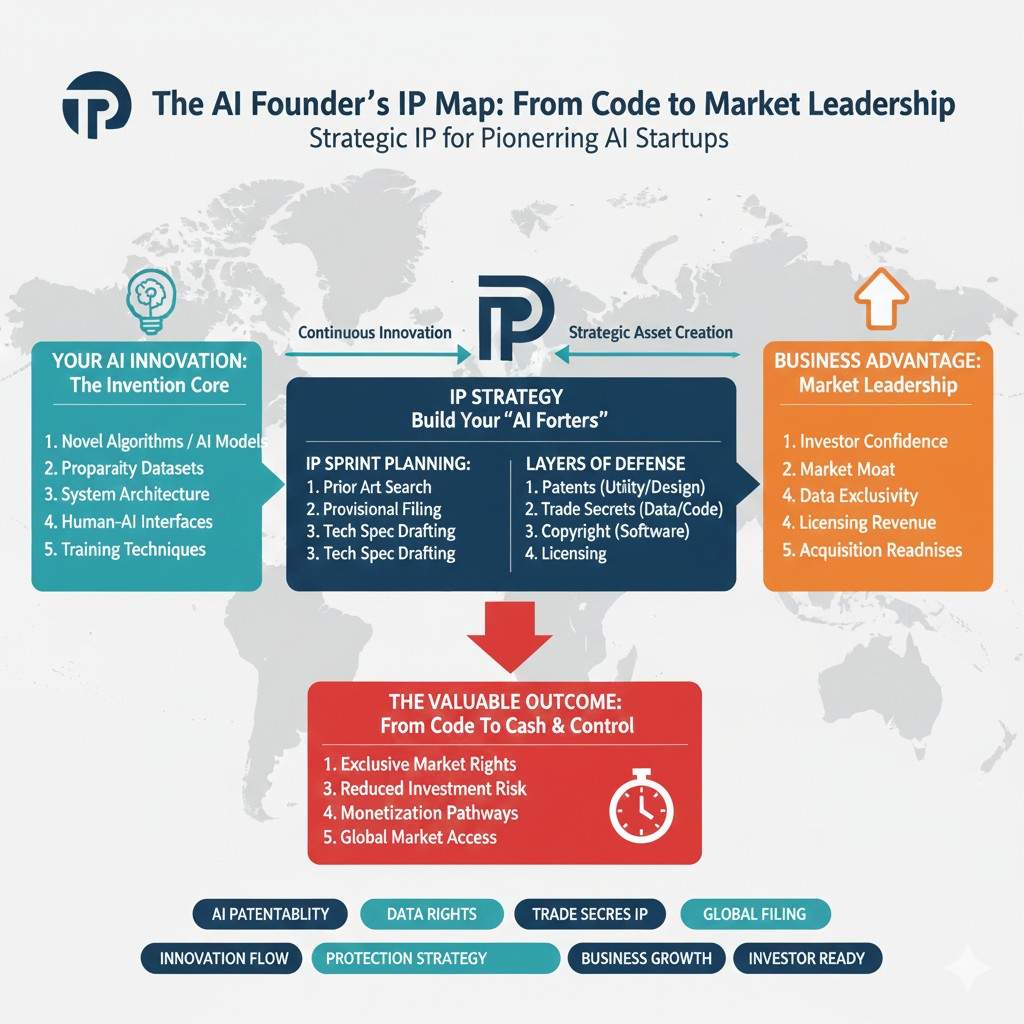
Most technical founders build first and explain later. That is normal. You are trying to make something that works, not write a story about it. But once your product starts to look real, people outside your team begin to ask one sharp question.
What keeps a larger company from copying you after they see your demo, your pitch deck, or your first customer case study. In AI and robotics, this worry shows up fast because many breakthroughs look “simple” once someone has seen the result.
Why IP is not a “legal task” in deep tech
IP is not just paperwork. It is a way to turn your work into an asset that you can defend and use to get better terms later. It can help you raise money with more power, sell to careful buyers, and hire strong talent who want to join a team that is building something lasting.
Tran.vc invests up to $50,000 in-kind as patent and IP services for robotics, AI, and other tech startups. The goal is simple. Help founders protect the parts that matter early, without slowing product progress.
If you want to see if Tran.vc is a fit, you can apply anytime at: https://www.tran.vc/apply-now-form/
What “defensible” really means for AI and robotics
Defensible is not the same as “hard to build”
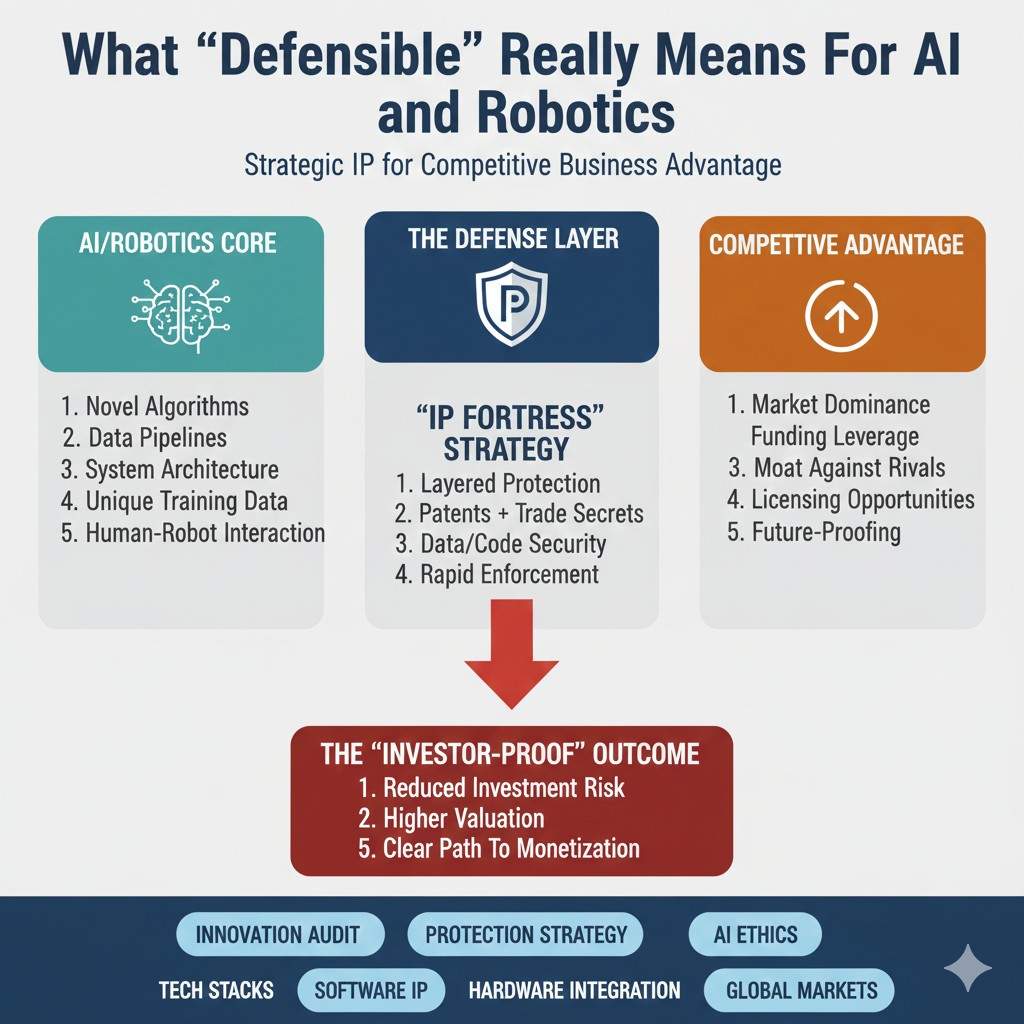
A lot of founders think defensibility means the product is hard to build. That can be true, but it is not the full story. Many hard things can still be copied if the steps become clear. Once a big team knows what to copy, they can often catch up faster than you expect.
Defensible means your company owns something that stays valuable even when others try to follow. It is the difference between “we are first” and “we can stay ahead.”
The real risk: your best work becomes a feature
In AI software, the risk is that your best work becomes a feature inside someone else’s platform. In robotics, the risk is that a larger team recreates your system design and ships with their supply chain and sales reach. If you cannot point to protected building blocks, your advantage can shrink into a story instead of a shield.
This is why early IP planning matters. It gives you a way to protect key methods and system designs before they spread.
What investors listen for when they ask about your moat
When an investor asks about your moat, they are not only asking about patents. They are asking if your edge is real and if it can last. They want to know if your team understands what is special in your approach and if you have taken steps to protect it.
A calm, clear answer is powerful. It signals maturity and focus. It shows you are building the company with intent, not just shipping fast.
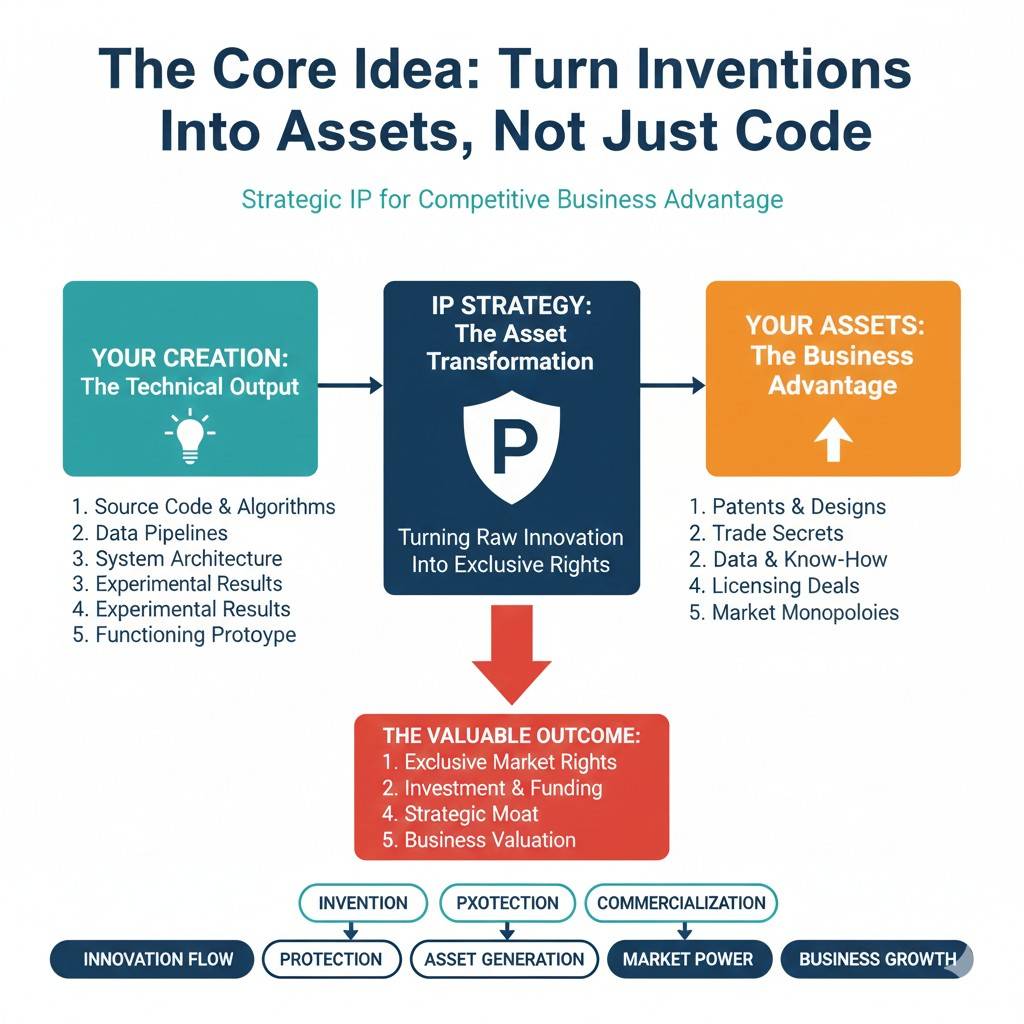
The core idea: turn inventions into assets, not just code
Code changes, assets stay
Code is alive. It changes every week. That is a good thing. But it also means code alone is a weak form of protection. You cannot rely on “we wrote it first” as a long-term defense. If a competitor builds a similar output with different code, your lead can fade.
An asset is different. An asset is something you can point to, value, defend, and use in deals. Patents, trade secrets, and well-managed know-how turn your progress into something that lasts longer than a sprint.
What counts as an invention in a startup
Founders often miss inventions because they think inventions must be huge. In reality, inventions can be small but important. A novel training method for a model. A robotics calibration routine that cuts setup time. A sensor fusion pipeline that improves safety. A control loop tweak that makes the system stable in messy conditions.
If it solves a real technical problem in a new way, it may be worth protecting. The point is not to chase quantity. The point is to protect the few things that make your product hard to replace.
Why early protection is cheaper than late repair
If you wait until after a big demo, a launch, or a public paper, you may lose options. Public disclosure can reduce what you can file, depending on where you want to protect. Even when filing is still possible, late filings often become weaker because the story is already out in the open.
Early protection is like locking the door before you leave the house. It is simpler than trying to fix a break-in later.
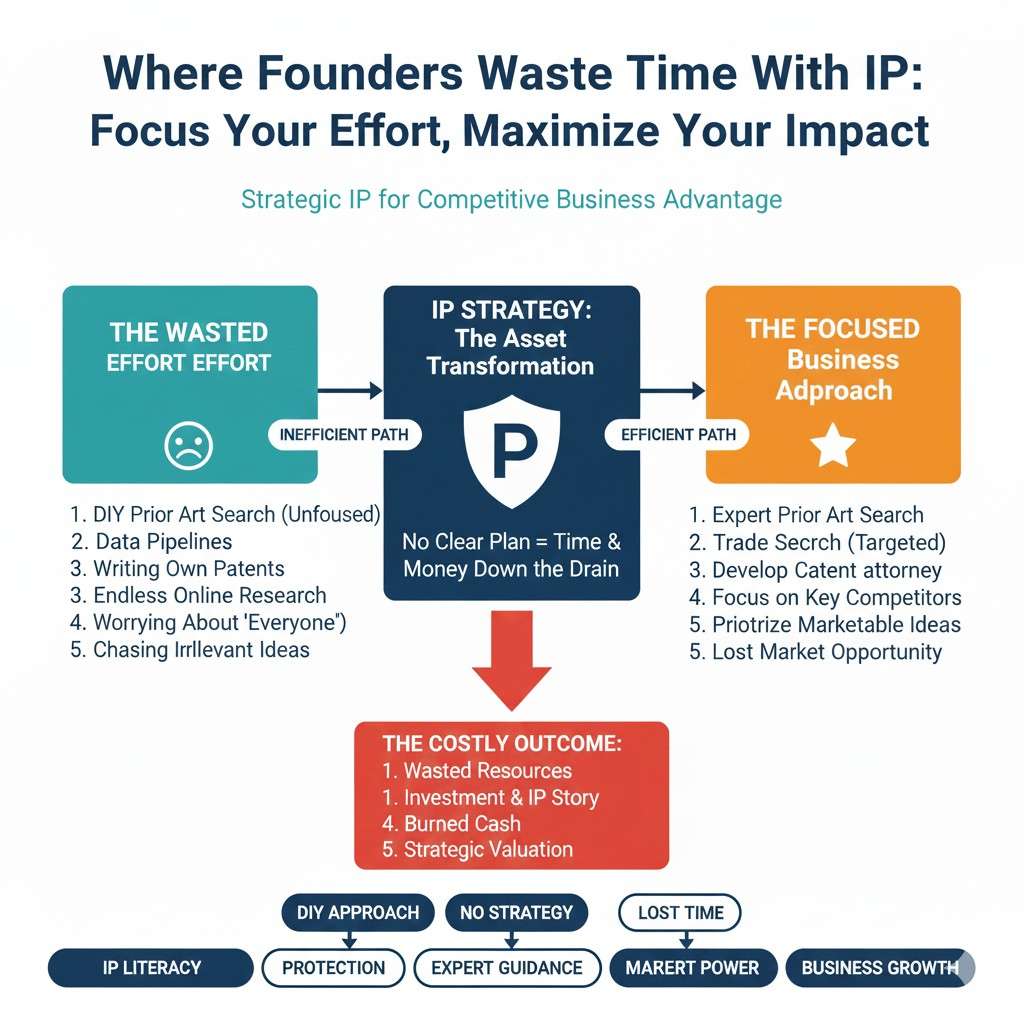
Where founders waste time with IP
Filing too soon without knowing what matters
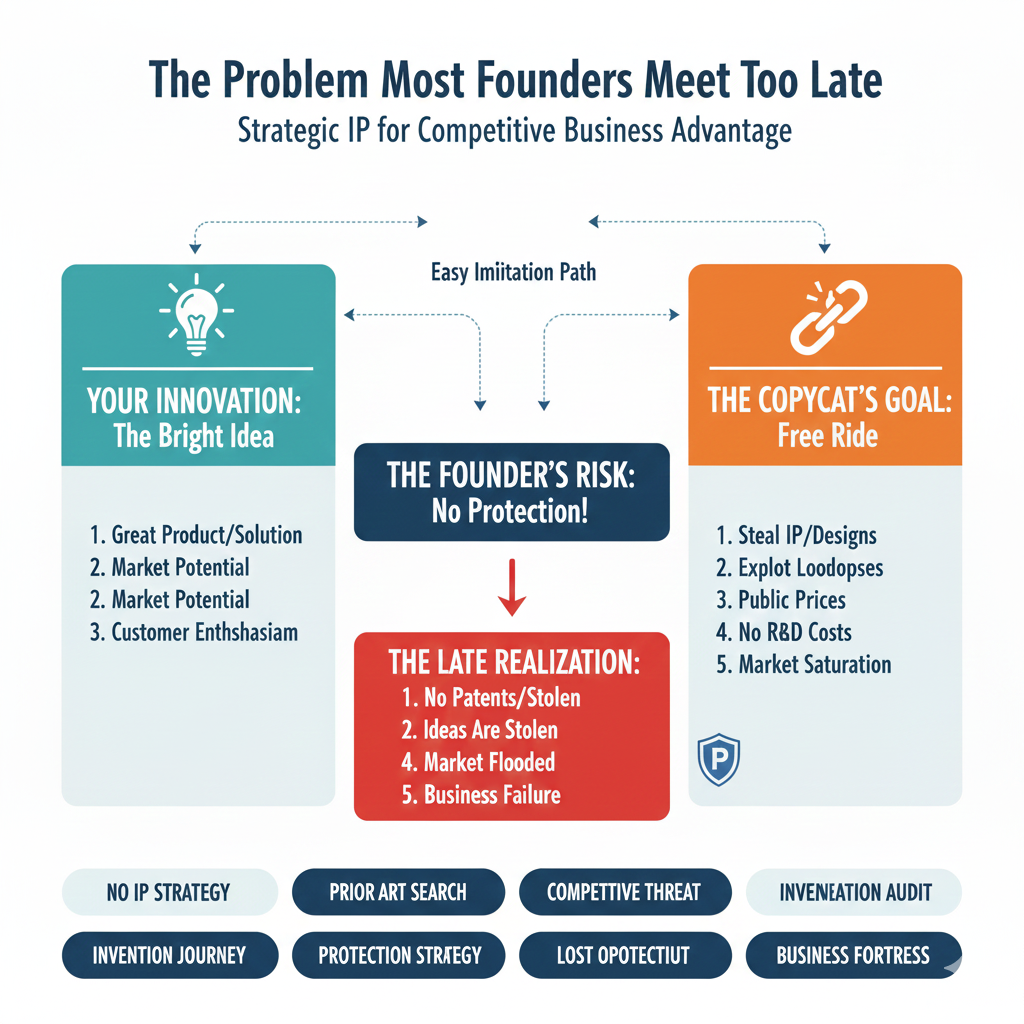
Some teams file early because they heard they “should.” The result can be a rushed filing around the wrong thing. If your product is still shifting, you can end up protecting an early version that you no longer use.
Good IP work starts with learning what part of the system is likely to stay. The goal is to protect the stable core, not the temporary wrapper.
Writing patents like marketing
A patent is not a pitch. If it is full of big claims and light on real technical detail, it becomes weak. It may look nice on paper, but it does not protect much. Strong IP is specific, grounded, and clear. It teaches the reader what the invention is, while still drawing boundaries around what others cannot copy.
Ignoring trade secrets when they are the better choice
Not every advantage should be patented. Some advantages are better kept secret. If the value is in data pipelines, internal tools, or tuning methods that are hard to reverse engineer, trade secret control may be smarter.
The best strategy uses both. It chooses the right tool for each part of the system.
A simple way to spot what to protect
Start with “what would hurt if it leaked”
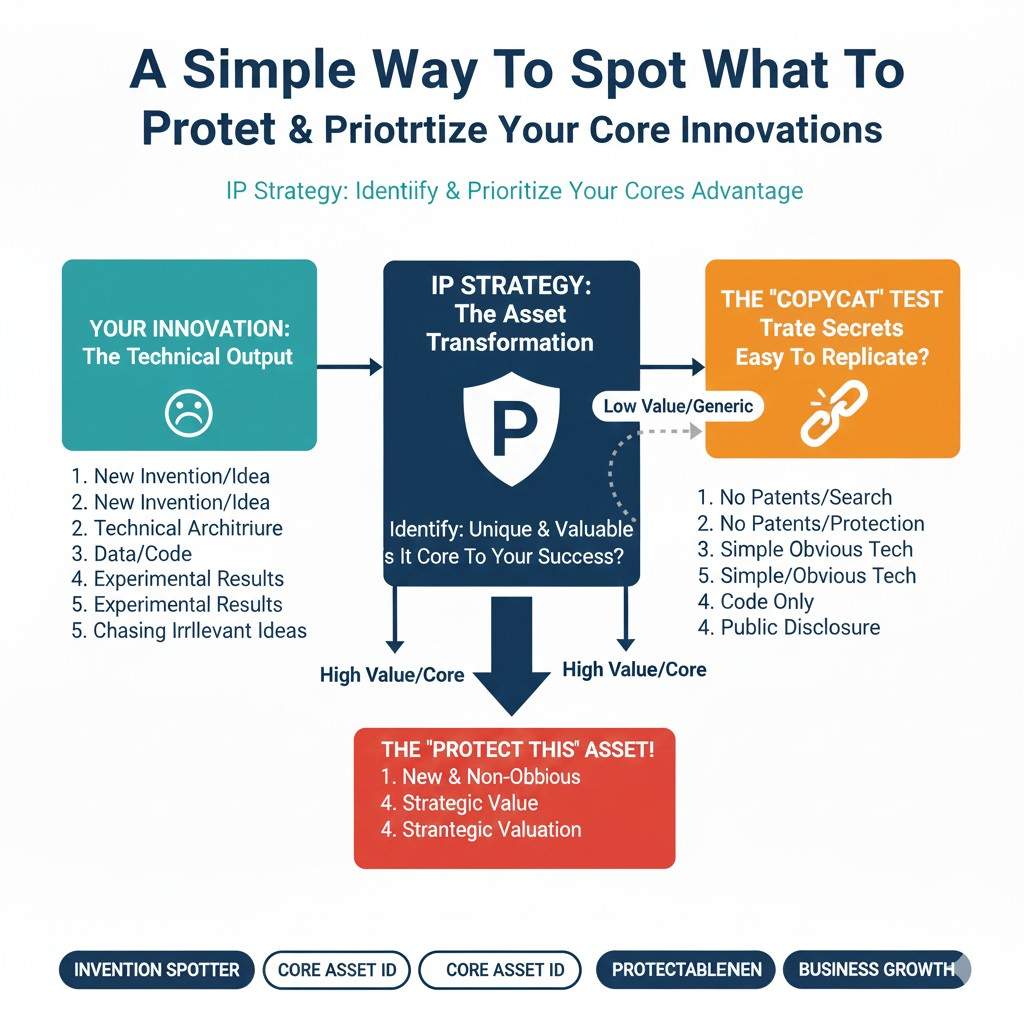
A useful exercise is to ask one direct question. If a competitor saw one internal document, what would hurt the most. What would shorten your lead from a year to a month. What would let them sell into your target customer faster.
That answer is often your protectable core. It may be a method, a system design, a workflow, or a special technical step that creates your key result.
Look for repeatable methods, not one-time hacks
Investors and patent teams both care about repeatable methods. A one-time hack that helped you through a demo is not always worth protecting. But a repeatable method that improves performance each time you run it is different. It becomes part of how your company works.
In robotics, repeatable methods can include assembly steps, calibration flows, safety checks, and control logic that stays consistent across deployments.
Separate “product features” from “technical mechanisms”
A feature is what the user sees. A mechanism is how you make it happen. Many founders talk about features because they are easy to explain. But patents and strong defensibility tend to live in mechanisms.
If your feature is “robots that pick faster,” the mechanism may be your grasp planning method, sensor fusion logic, or error recovery flow. If your feature is “AI that flags issues,” the mechanism may be how you label data, how you train, and how you reduce false alarms.
How Tran.vc helps founders do this without slowing down
The point is speed with clarity, not paperwork
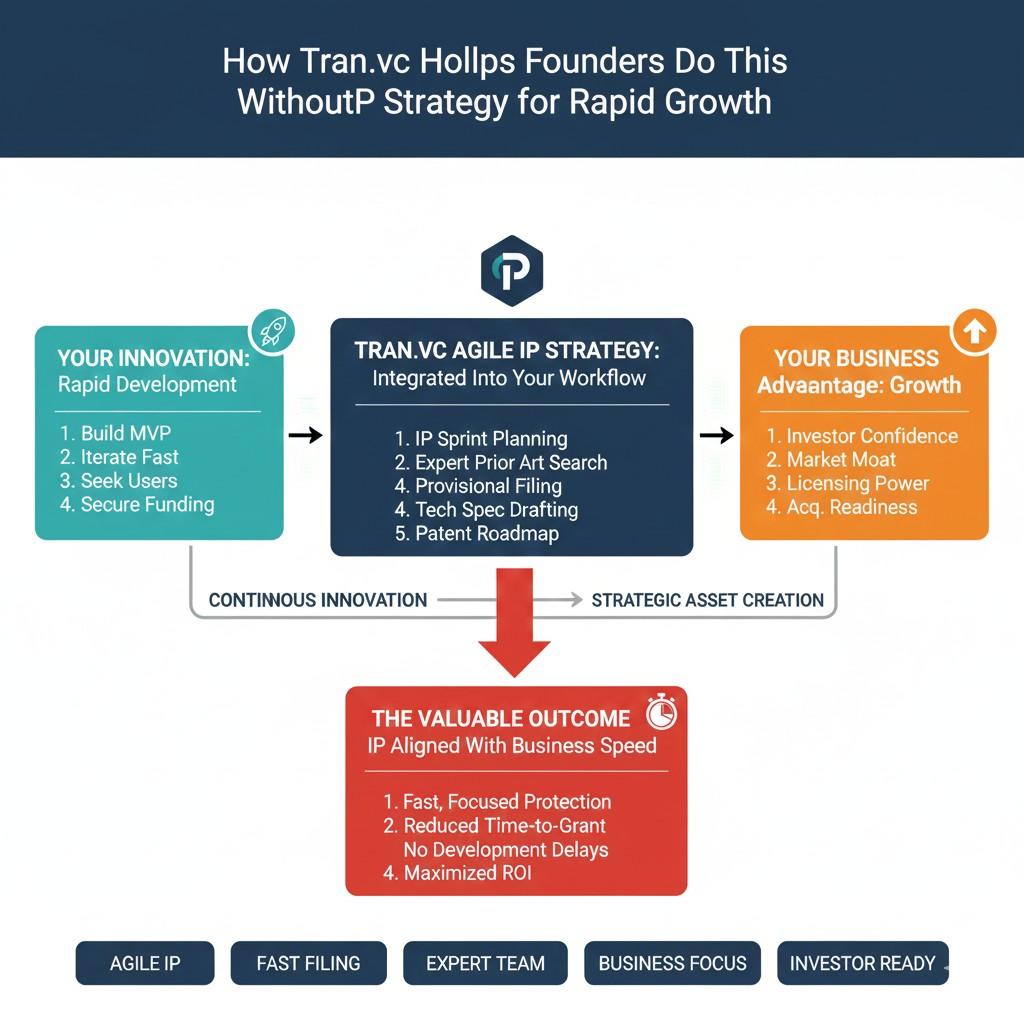
Founders worry that IP work will slow product work. That fear is fair, because bad IP processes create drag. Good IP work is the opposite. It gives you clarity about what matters, and it helps you document that core while you keep building.
Tran.vc’s model is designed to support early teams. The investment is up to $50,000 in-kind IP services, focused on strategy and action that fits your stage.
You get a strategy that matches your roadmap
IP is most useful when it matches your roadmap. If your next six months are focused on a new sensor stack, the IP should focus there. If your roadmap is about scaling to many customer sites, the IP might focus on deployment systems and reliability methods.
The strategy should feel like it belongs to your engineering plan, not like a separate legal plan running in parallel.
You build leverage before the seed round
When you enter a seed round with a strong IP foundation, you do not have to “promise” that you will be defensible later. You can show it. That changes the tone of fundraising. It can also help you avoid giving up too much too early, because your company looks less risky.
If you want to explore this, apply anytime at: https://www.tran.vc/apply-now-form/
The founder’s IP map for AI startups
Protect the method, not the model name
In AI, the model name is not the invention. Many models are based on common architectures. What can be new is how you train, how you structure the inputs, how you build feedback loops, how you handle edge cases, and how you make the system reliable in real use.
A strong filing often focuses on these methods, because they can remain valuable even if the model changes later.
Guard your data advantage with process control
If your advantage is data, you must protect the process that creates better data over time. That can include labeling flows, capture methods, quality checks, and active learning loops. Often, parts of this are better as trade secrets, because they are internal and hard to observe.
Still, some parts can be patented if they involve a novel technical process. The key is to choose wisely, not to force everything into one bucket.
Make your deployment and monitoring a defensible system
Many AI startups win because their deployment is smooth and their monitoring is solid. That is not “basic.” It is hard. If you have a unique way to keep performance stable, detect drift, and recover fast, you may have protectable inventions.
This is also where enterprise buyers care a lot. They want to know you can run the system safely and predictably in the real world.
The founder’s IP map for robotics startups
System design is often the real invention
In robotics, the invention is often the system. It is how hardware and software work together. It is how you manage sensing, control, planning, and safety as one reliable machine. That system-level approach can be very hard for others to copy without stepping into your protected space.
Founders sometimes miss this because they focus only on one part, like a gripper or a camera. But the system design can be the strongest place to protect.
Calibration, safety, and recovery are powerful moats
Robots fail in real life. Dust, glare, vibration, bad parts, human mistakes. If your robot can recover, self-check, and stay safe better than others, that is a real business edge. It can reduce downtime, lower support costs, and win trust with operators.
These flows can also be protectable because they are technical and specific. They often reflect a deep understanding that takes time to build.
Manufacturing and field deployment can be protected too
Many robotics teams treat manufacturing and deployment like “operations,” not inventions. But if you have a novel way to assemble, test, or deploy that improves yield or reduces setup time, it may be valuable IP.
This is especially true when the process is part of what makes your product scalable and cost-effective.
How to talk about IP without sounding like you are hiding
Be clear about what you do share and what you do not
Founders sometimes swing between two extremes. They either share everything, or they refuse to share anything. A better middle is to be clear. You can explain the problem, the impact, and the high-level approach while keeping key technical steps private until the right time.
A good IP strategy gives you confidence here. You know what is protected, what is secret, and what is safe to say.
Use “proof” language instead of “promise” language
When you talk to investors, it helps to use proof language. Instead of saying, “We will file patents,” you can say, “We have identified our core inventions and are protecting them with a clear filing plan.”
Instead of saying, “We have a moat,” you can explain the protected mechanisms and the real-world results they enable.
Show that IP is tied to business outcomes
IP talk becomes stronger when it is tied to business outcomes. Faster deployment. Lower failure rates. Better accuracy at lower cost. Safer operation. Higher uptime. Stronger compliance. These are reasons buyers and investors care.
When you connect IP to outcomes, the conversation feels grounded and confident.
How IP changes the way you raise money
Raising without IP puts you in a weaker seat
When a founder raises without clear IP, the conversation often shifts in a subtle way. Investors may like the team and the product, but they see more risk. That risk shows up in terms. More dilution. More control. More pressure to move fast, even when fast is not healthy.
This does not mean the investor is bad. It means they are reacting to uncertainty. If your advantage feels easy to copy, they protect themselves.
IP gives you something solid to point to
When you raise with protected inventions, the tone changes. You are no longer asking people to trust that your lead will last. You are showing that you have taken steps to make it last. This does not guarantee a better deal, but it gives you leverage.
Leverage matters most early, when every percent of ownership and every board seat has long-term impact.
Why seed investors care more than they admit
Many seed investors do not say “IP” out loud in the first meeting. But they think about it. They think about what happens at Series A. They think about what later investors will question. They think about whether this company can become a real category leader or just a feature.
Clear IP answers make it easier for them to say yes, and easier for them to support you later.
Using IP to slow down bad competition
You cannot stop everyone, but you can shape behavior
IP is not about stopping every competitor. That is not realistic. It is about shaping how others behave around you. When your core methods are protected, competitors have to work around you. That takes time and money.
Even a small delay can matter. It can give you space to sign customers, improve the product, and grow your brand.
Deterrence is often more powerful than enforcement
Most IP value comes from deterrence, not lawsuits. When a company sees that you have filed around your core system, they may decide it is not worth copying you directly. They may move to a different angle or market.
This silent effect is hard to measure, but very real. It keeps your space cleaner.
Partners treat you with more respect
Large partners and enterprise buyers often look for IP clarity. They want to know they are not stepping into a legal mess later. Strong IP signals that you are serious, prepared, and thinking long-term.
This can make deals smoother and faster, especially in regulated or safety-focused markets.
IP as an internal alignment tool
It forces the team to agree on what matters
One quiet benefit of IP work is internal clarity. When you decide what to protect, you are forced to agree on what truly matters. This can align engineering, product, and leadership around the same core ideas.
It reduces wasted effort on side paths that do not strengthen the company.
It helps new hires ramp faster
When inventions are clearly documented, new hires can understand the “why” behind the system faster. They see the core methods, not just the surface code. This can improve quality and consistency as the team grows.
It also helps protect knowledge when people leave, which is part of building a stable company.
It creates pride in real engineering work
Good engineers like to see their work recognized as real invention. When a method becomes protected IP, it validates the depth of the work. It shows that the company values careful thinking, not just speed.
This can help with retention and culture, especially in deep tech teams.
Common fears founders have about IP
“We are too early”
Being early is often the best time. Early does not mean filing everything. It means thinking clearly. You can map inventions, choose what to protect now, and plan what to protect later.
Waiting until everything is “done” usually means waiting too long.
“We cannot afford it”
This fear is real. Good IP work is expensive if done the wrong way. That is why Tran.vc invests up to $50,000 in-kind as IP and patent services. The goal is to remove cost as a blocker and replace it with smart prioritization.
You do not need dozens of filings. You need the right ones.
“It will slow us down”
Bad processes slow teams down. Good ones do not. When IP work is aligned with your roadmap, it becomes part of how you build, not a pause in building.
Founders who do this well often say it helped them think more clearly, not less.
How Tran.vc approaches IP differently
Built by operators, not just advisors
Tran.vc was built by people who have built companies, written code, filed patents, and dealt with real trade-offs. The advice comes from experience, not theory. The goal is to help founders make decisions that fit real startup life.
This matters because early-stage teams do not have time for abstract plans.
Focus on quality, not volume
The strategy is not about filing many documents. It is about filing strong ones. Each filing should protect something important and durable. If a filing does not clearly support the business, it should be questioned.
This keeps the IP clean and useful.
Support that matches founder reality
Founders are busy. Tran.vc’s support is designed to respect that. The work is structured to pull knowledge out of the team efficiently, without endless meetings or heavy writing tasks.
You stay focused on building while the IP foundation takes shape around you.
If this sounds helpful, you can apply anytime here: https://www.tran.vc/apply-now-form/
Building an IP mindset without becoming legal-focused
Think like a builder, not a lawyer
Founders do not need to become IP experts. They need a mindset. That mindset is about noticing when you solve a hard problem in a new way and asking, “Is this important enough to protect?”
You can stay in builder mode while still making smart IP choices.
Make IP part of regular product review
Some teams add a simple habit. When a major technical milestone is reached, they ask if anything new and stable has emerged. If yes, they flag it for review. This keeps IP aligned with progress.
Over time, this becomes natural and light.
Use IP to guide future work
Once your core is protected, you can build around it with more confidence. You know where your safe ground is. This can encourage bolder moves, because your foundation is stronger.
This is one of the hidden benefits of early IP work.
Preparing for Series A with an IP foundation
Series A questions are sharper
At Series A, investors look deeper. They ask how you win long-term, not just how you start. They want to know if your advantage scales and survives competition.
An early IP foundation makes these questions easier to answer.
Clean IP reduces friction in diligence
Messy IP can slow or kill deals. Unclear ownership, rushed filings, or missing assignments create risk. Clean, well-planned IP reduces this friction and keeps momentum during diligence.
This can matter more than founders expect.
IP supports multiple exit paths
Whether you aim to grow independently, partner, or exit, IP helps. Buyers value protected technology. Partners value clarity. Even staying private is easier when your core is defended.
IP keeps options open.