
Medical Devices: Global Filing Strategy and Regulatory Timing
You can have the best medical device in the world, and still lose the market if you file late, file in the wrong places, or file in a way that gets boxed in by your own regulatory steps. Patents and regulatory work do not live in separate rooms. They bump into each other every week. If you plan them together from day one, you protect more, spend less, and move faster with fewer surprises.
If you’re building a medical device and you want help shaping a global filing plan that matches your real regulatory timeline, you can apply anytime here: https://www.tran.vc/apply-now-form/
The hard truth about medical devices: timing is the product
In software, you can ship, learn, and patch. In medical devices, you still learn, but you often cannot patch your way out of a bad early decision. Your early claims, your early disclosures, your early testing plans, even your early “we’ll just demo it” choices can lock you into a corner.
A strong global filing strategy is not “file a provisional and worry later.” A strong strategy is a map that answers simple questions:
Where will we sell first, second, and never?
What will regulators ask us to prove, and when?
What data will we generate, and when will it become public?
What changes will we make in the next 12 months, and will those changes still be covered?
If you can answer those in plain language, you can build a plan that works.
And yes, the plan will change. But starting with a plan means you change it on purpose, not in panic.
Why regulatory steps can quietly ruin patent rights
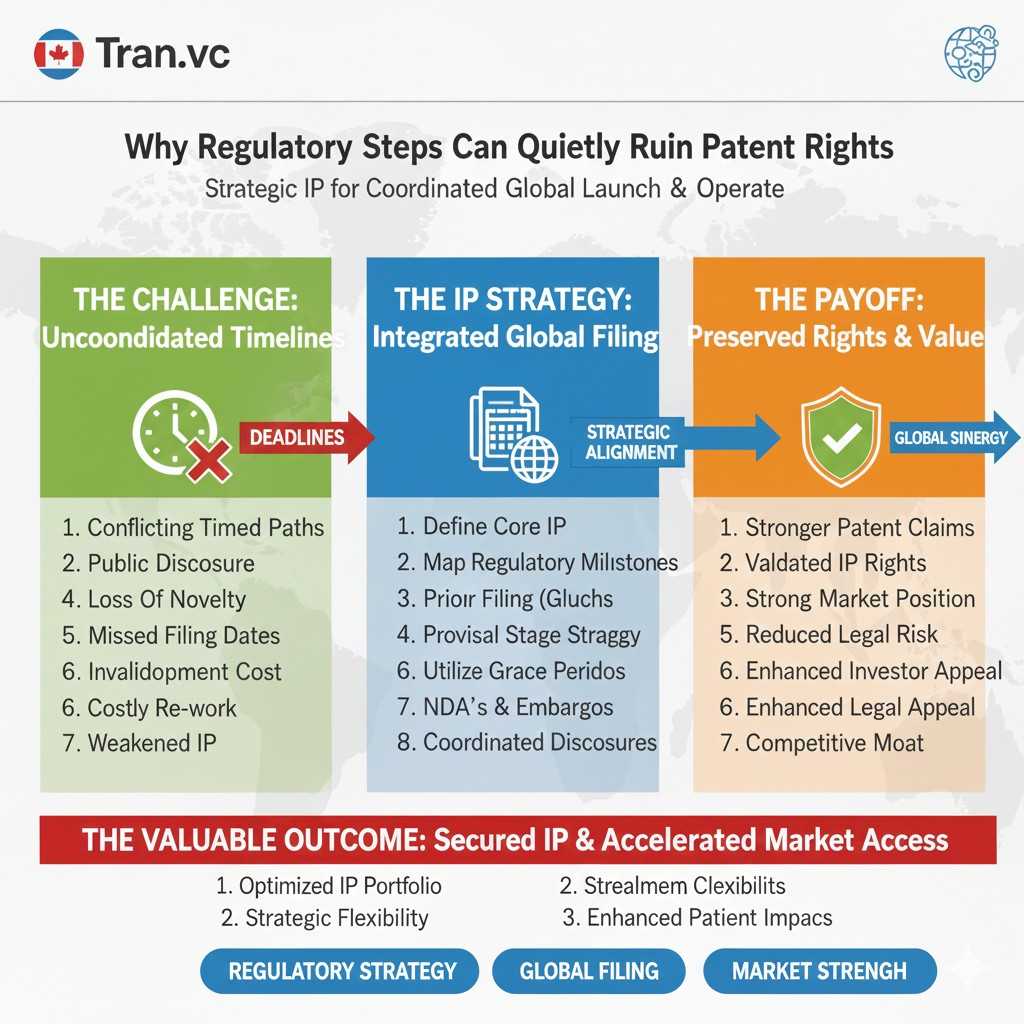
Most founders learn one basic rule: “Don’t publicly disclose before filing.” That is true, but it is not enough.
In medical devices, you can “disclose” without meaning to. Here are common ways it happens:
You share a slick investor deck that includes how your sensing method works.
You give a hospital partner a training slide with your key diagrams.
You submit an abstract to a clinical conference.
You show real performance data in a grant application.
You post a hiring page describing your unique approach.
You run a webinar for clinicians and answer technical questions.
None of these feels like “publishing a paper.” But any one of them can become prior art against you, especially outside the United States.
This matters because global filing is less forgiving. Many countries do not give you the same grace period that the U.S. may offer. So a single early disclosure can cut off options for Europe, China, Japan, and many other key places. In medical devices, those places are not “nice to have.” They are often where the real scale is.
So the safer mindset is: regulatory work and partner work create disclosure risk. Treat them like a live wire.
The other trap: filing too early can also hurt you
This sounds odd, but it happens all the time.
If you file a broad patent before you truly understand what your device will become, you might lock your story into a version of the product that you will not ship. Then, later, when you improve the design (which you will), your old filing may not cover the new version well enough.
In medical devices, change is not cosmetic. It often includes:
a new placement method
a different sensor stack
a new material choice
a new control loop
a new calibration method
a new sterilization approach
a different software logic for alarms
a new training flow that changes the workflow
Many of these changes are driven by regulatory feedback and real-world testing. If your patent does not track the changes, you end up with a “patent” that sounds impressive but does not protect what you sell.
That is why the smartest teams do not just file once. They file in a way that matches the product’s evolution and the regulatory timeline. Think of it as a series of captures, not a single photo.
Tran.vc exists to help teams do exactly this kind of capture early, while you still have leverage and before you burn money on the wrong filings. If you want to talk about your device and your timeline, apply here: https://www.tran.vc/apply-now-form/
Start with a simple global question: where does your device win first?
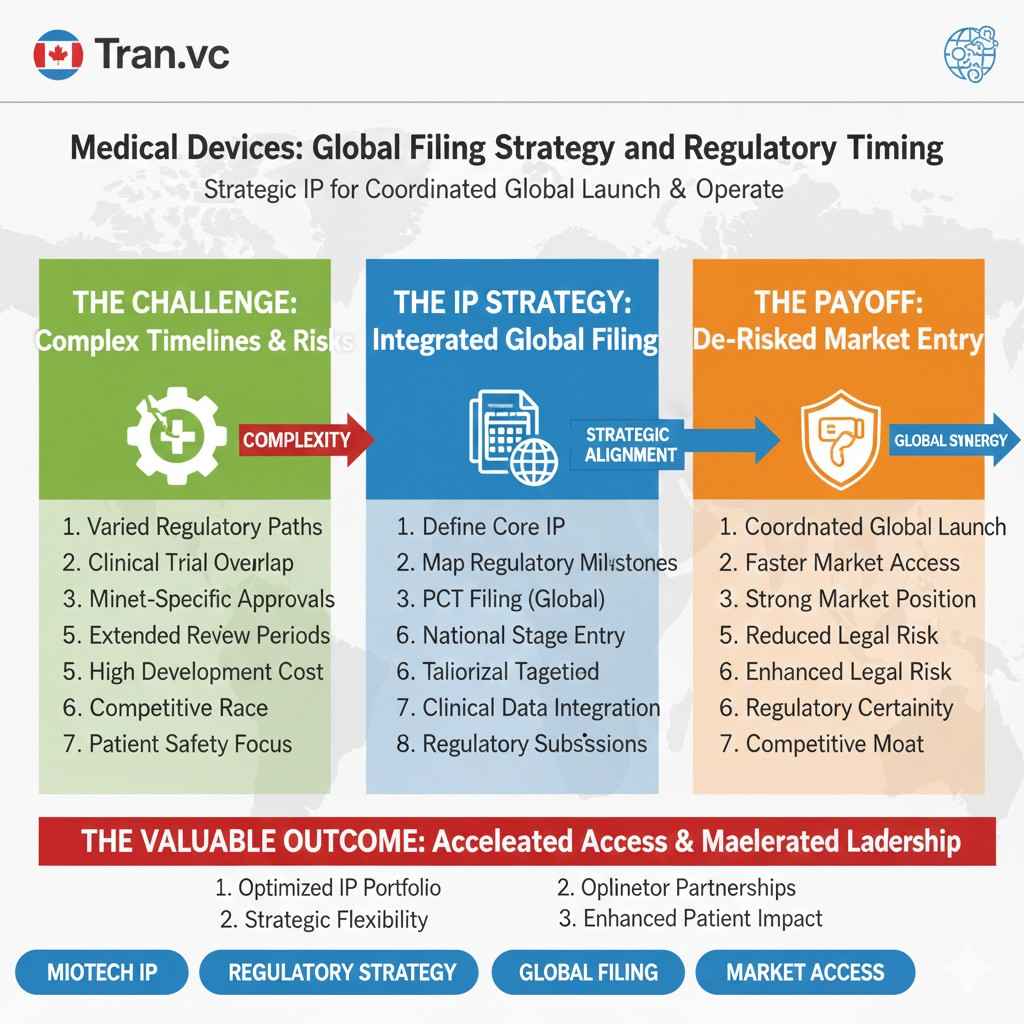
When people say “global filing strategy,” they often jump straight to country lists. That is backwards.
Start with where you win first. Not where you hope to win. Where you have the shortest path to a real, repeatable sale.
For many medical device startups, the first win is one of these:
A focused set of U.S. hospitals in one specialty
A European pathway that is faster for your class of device
A partner-led route in Japan through an established company
A private-pay route that avoids reimbursement delays early
A research use pathway that funds the next step
Each first win creates a different timing pattern for patents.
If you go U.S. first, you may have more flexibility on timing of some disclosures, but you still want to protect global options early. If you go EU first, you must be stricter about anything public before your earliest filing. If you go partner-led in Asia, you need to plan for deep diligence and aggressive contract terms around ownership and improvements.
So before you choose countries, choose a launch story that you actually believe.
The “regulatory clock” and the “patent clock” do not tick the same way
Regulatory timelines are driven by studies, submissions, reviews, and audits. Patent timelines are driven by filing dates, priority dates, publication, office actions, and national stage deadlines.
The key is not to memorize the clocks. The key is to line up the major “events” on each clock so they do not collide.
For example, in many device programs, you will hit a moment when:
You need to talk about performance publicly to raise money, sign partners, or recruit sites.
At the same time, you are generating new data that changes your claims.
At the same time, you are preparing a submission that will contain details you do not want to give away too soon.
If you wait until the last minute, you will either disclose too much with weak coverage, or file too narrow because you rushed.
A good strategy creates “coverage points” right before major regulatory and public moments.
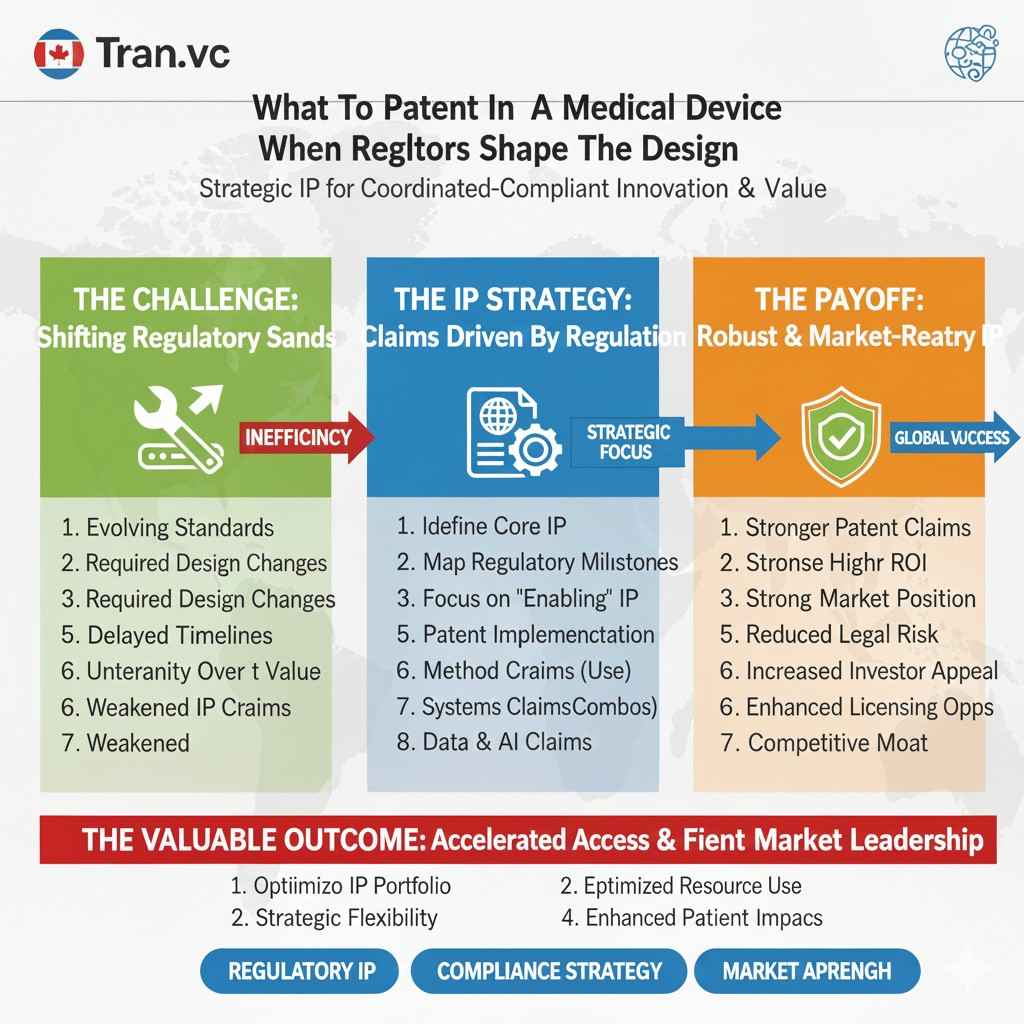
What to patent in a medical device when regulators shape the design
Founders often ask, “What is the invention here?” Because medical devices are a mix of hardware, software, workflow, and clinical value.
Here is the mental model that works: patent the parts that will stay true even as the exact design shifts.
So instead of anchoring everything on one physical shape, you look for things like:
the sensing principle and how you turn signals into decisions
the control logic and safety logic
the calibration method and error handling
the way your device fits into a clinician’s steps
the method that reduces risk or improves accuracy
the way you handle variation across patients
the way you detect failure and respond safely
the way your system learns or adapts within safe bounds
These are the “spine” of the product. The outer “skin” may change during regulatory work, but the spine should remain.
This is also why medical device patents are not only about the device. They are often about the method and the system. If you only patent a physical object, competitors can change the shape and escape. If you protect the method and the system behavior, it is harder to design around.
A practical filing path that matches how devices mature
Most strong device programs follow a pattern, even if it looks different on the surface.
First, you capture the core concept early enough to protect global rights. This is often when you have a working prototype and a clear thesis, even if the design is still changing.
Next, you capture the upgrades as you learn. This often happens when you finish your early bench testing, when your first clinical feedback comes in, and when you finalize the build you will use for studies.
Then, you shape the claims to match what the market will pay for and what the regulator will accept. This is important: the product you can sell is shaped by labeling, indications, and claims you can support with data.
Patents should support that sellable story.
This is also where many teams waste money. They file a lot of “nice” ideas that do not support the final label or the final workflow. That might feel productive, but it is not strategic.
Strategic patents protect revenue and leverage. That is the point.
If you want Tran.vc to help you choose what to file, when to file, and how to keep it aligned with regulatory timing, you can apply anytime: https://www.tran.vc/apply-now-form/
The most important deadline most founders miss: the 12-month window
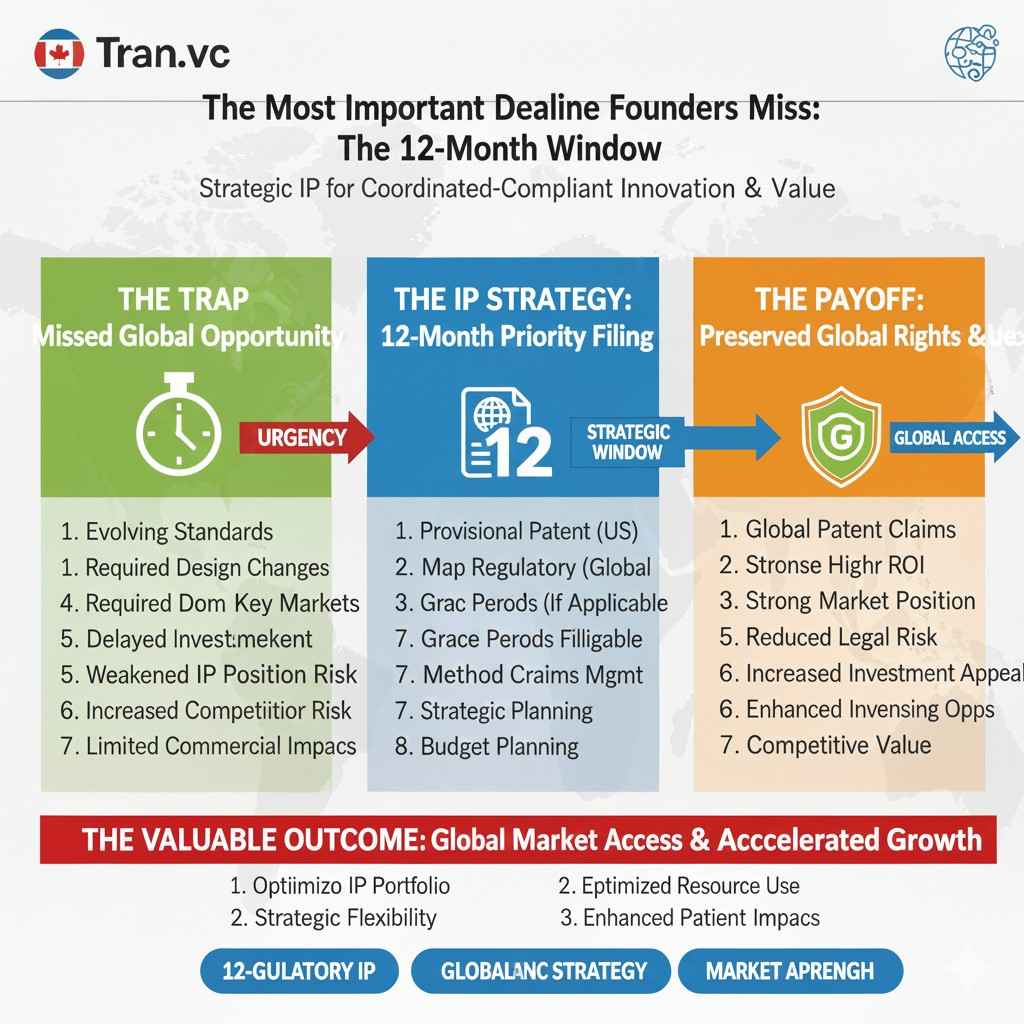
Once you file a first application, you often start a 12-month priority window (depending on the filing route). Many founders treat this as a simple reminder: “We have a year to file more.” But in medical devices, that year flies because regulatory work and product changes pile up.
If you do not plan that year, two bad things happen:
You reach month 11 and rush a global filing with weak updates.
Or you miss the chance to add key improvements before you lock in.
What you want instead is a deliberate “priority year plan,” tied to your testing and regulatory milestones.
If you know you will finish key bench tests in month 4, plan an IP update near month 4.
If you know you will lock your design for a study in month 7, plan another capture near month 7.
If you know you will present early results around month 9, plan a defensive filing before that.
This is not complicated. It is simply planned.
The hard part is doing it while you are busy building. That is why founder support matters. The teams that do well have someone helping them keep this aligned.
How global market choices change the filing strategy
Now let’s talk about the global piece, without drowning in country names.
The main reason to file internationally is not pride. It is leverage. Investors, partners, and acquirers care whether you can block copycats in the markets that matter.
But “the markets that matter” differ by device type.
For example, some devices win in the U.S. because reimbursement is strong. Some win in Germany or the Nordics because adoption pathways are smoother for certain hospital buying patterns. Some win in Japan because pricing and hospital systems can favor specific categories, especially with the right partner. Some win in China because volume can be huge if you navigate the system well.
So your filing plan should match your likely revenue map.
And your regulatory plan also shapes that revenue map.
If your regulatory plan suggests you can reach EU clearance faster than U.S. clearance, you might prioritize EU protection earlier, because you may have real sales earlier, and real copy risk earlier. If you plan to generate clinical data in Europe first, you might also face early disclosure events there, which can impact global patent rights if you are not careful.
This is why it is useful to plan the two together, not separately.
A note on “publication” and why it matters for devices
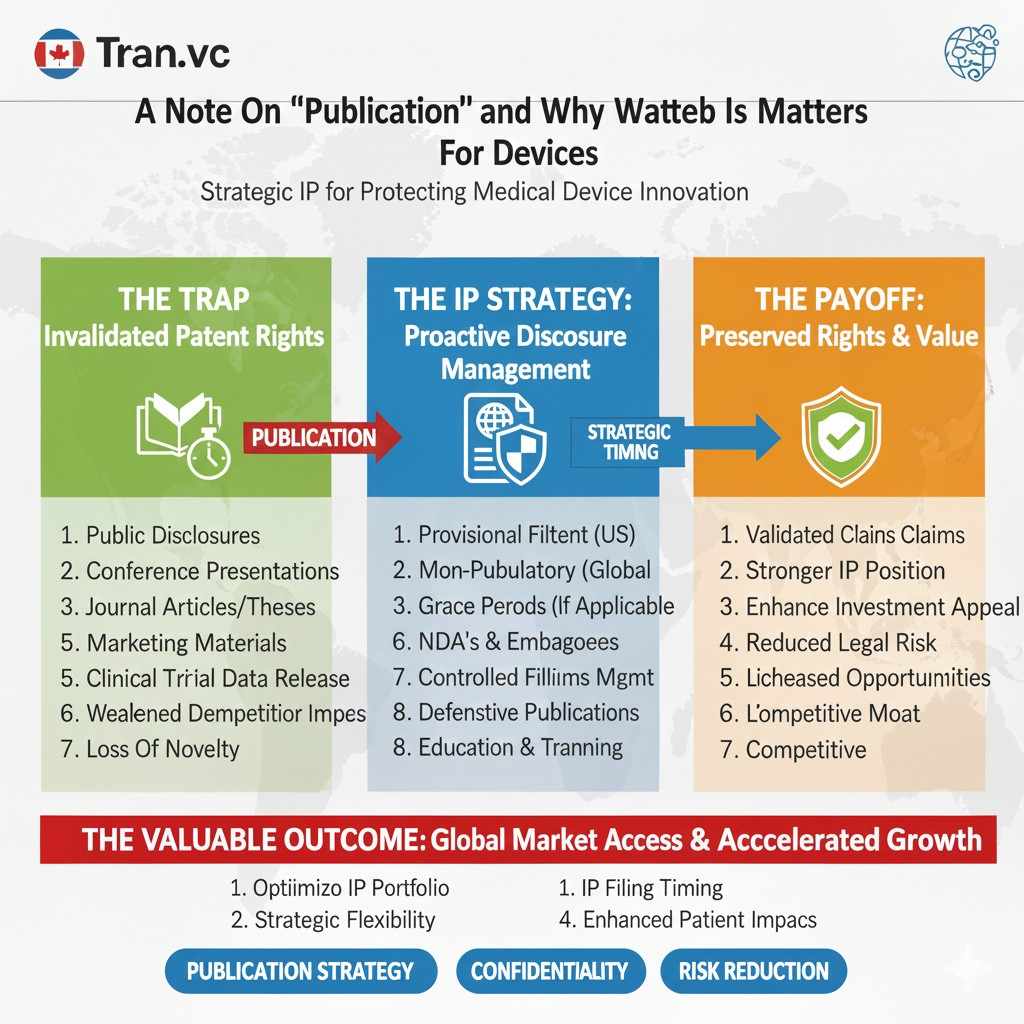
Most patent applications publish after a set period (often around 18 months from earliest priority in many systems). When they publish, competitors can read them. That can be good or bad.
It can be good because it warns others off. It can create fear and delay competitors. It can also help your recruiting and credibility if handled carefully.
It can be bad if you disclosed your approach too early, before your product is ready, and you did not file follow-on coverage for the improvements. Then you gave away your early playbook and did not protect the next one.
So part of strategy is deciding what to put in the first filing versus what to hold for later filings, while still meeting legal requirements. You do not want to under-disclose, but you also do not want to dump everything into one document and then never update.
The best approach is usually: protect the spine early, then file upgrades as you learn.
Why investors care about this more than founders think
Early investors in medical devices look for risk control. Regulatory risk is obvious. IP risk is also obvious, but it often hides behind vague statements like “We filed a provisional.”
A sophisticated investor will ask:
What is actually protected?
Does it cover the product you will sell after regulatory feedback?
Can it block a big player from building a “similar” device?
Is the freedom-to-operate story even considered?
Does the IP align with the intended label and claims?
If you can answer these calmly and clearly, you stand out.
And if you cannot, you may still raise, but you will often raise with less leverage. That means worse terms, more dilution, or slower momentum.
So think of global filing strategy as part of fundraising readiness. Not in a hype way. In a “we have thought this through” way.
Tran.vc is built for this exact gap. If you want patent strategy support as in-kind funding—up to $50,000 worth of work—so you can build an IP-backed foundation early, apply here: https://www.tran.vc/apply-now-form/
Medical Devices: Global Filing Strategy and Regulatory Timing
Why this topic decides who wins
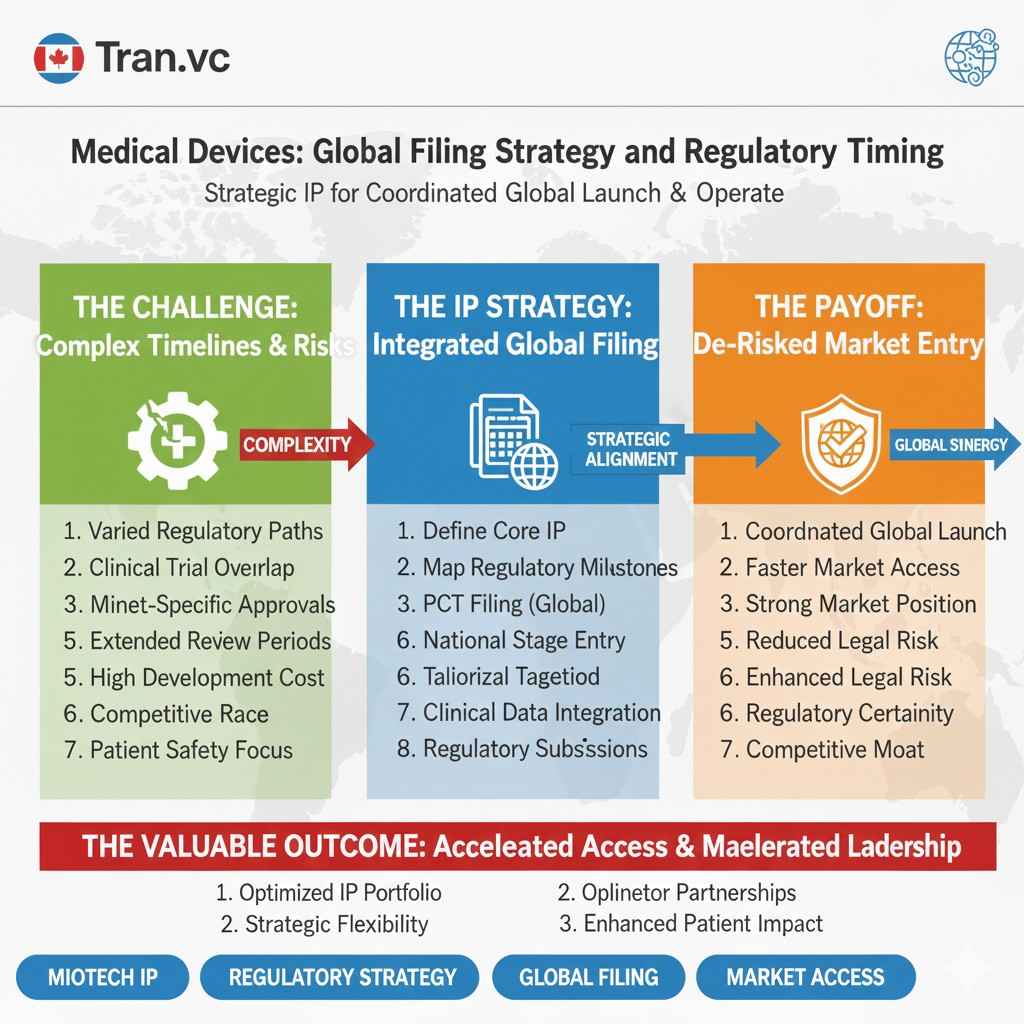
Medical device founders often think patents and regulatory work run on two separate tracks. In real life, they touch each other all the time. Your testing plan shapes what you can claim. Your submission plan shapes what you must reveal. Your fundraising plan shapes what you feel forced to say out loud. When those things are not lined up, you end up filing in a rush, spending too much, and still leaving gaps.
This article is about building a global patent plan that matches the real pace of medical device approval. The goal is simple: protect what you will actually sell, in the places that matter, before key moments make your work public. If you do that well, you create leverage with partners, investors, and buyers.
If you want Tran.vc to help you do this with up to $50,000 in in-kind patent and IP services, you can apply anytime at https://www.tran.vc/apply-now-form/
The two clocks that control your company
The patent clock
The regulatory clock
Every medical device startup lives under two clocks. The patent clock cares about filing dates, priority dates, and the order in which you tell your story. The regulatory clock cares about evidence, risk, labeling, and what you can safely claim in the real world.
These clocks do not move at the same speed, and they do not reward the same habits. Regulatory work pushes you to document everything, share with sites, and talk to experts early. Patent work pushes you to hold sensitive details until you have protected them. If you do not plan for that tension, you end up making “small” choices that become expensive later.
A good strategy does not try to stop either clock. It simply makes sure they do not crash into each other. You set clear moments when you capture inventions, and you set clear rules for what is safe to share before those moments.
Where founders get surprised
What “misalignment” looks like
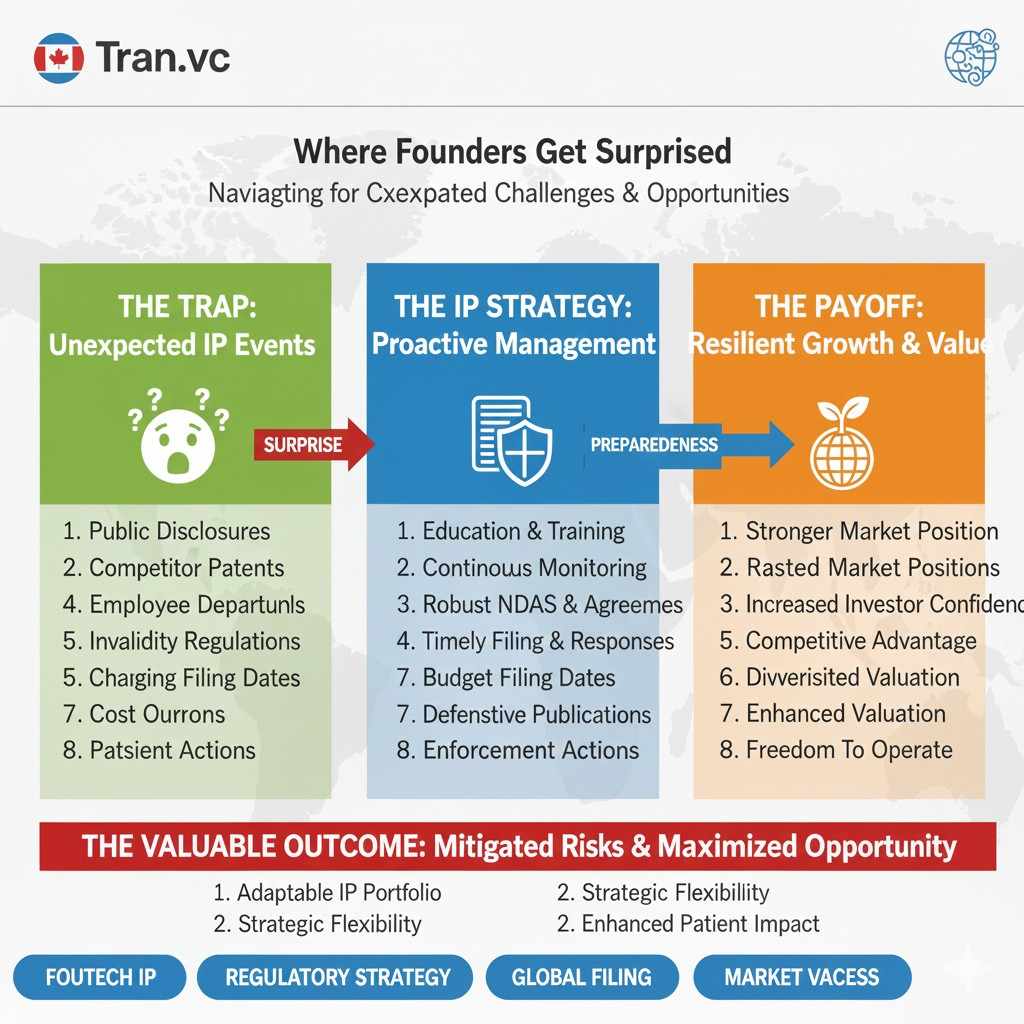
Misalignment usually shows up when a team is doing well. You get traction with clinicians. You start a pilot. A partner asks for deeper details. A conference invites you to present. An investor wants proof, not promises.
Then you realize your patent coverage is thin, or your filings describe an older version of the product. You might still file, but now you are filing under pressure. Pressure makes people write narrow claims, skip important variants, and forget international rules that are stricter than the U.S.
You do not need a perfect plan. You need a living plan that keeps pace with how your device will change during testing and approvals.
Regulatory work creates disclosure risk in quiet ways
The obvious disclosures
The hidden disclosures
Most teams know not to publish a paper before filing. What catches them is the quiet ways information becomes public. A hospital training slide can spread. A grant application can be shared. An early abstract can get posted online. A webinar can be recorded. A “friendly” advisor can forward materials to someone you have never met.
In many countries, once the core idea becomes public, you cannot get it back. Even if you later file a patent, the earlier public detail can be used against you. This is especially painful for device startups because many of the best markets outside the U.S. expect strong patent positions.
The safe way to think is this: any document or talk that explains how the device works is a possible disclosure. Treat it that way until your filings are in place.
Submissions and the “paper trail” problem
How to stay safe without slowing down
Regulatory programs create a lot of documents. Testing protocols, risk files, design history files, and performance summaries all exist for good reasons. The problem is that these documents often travel beyond your core team. Site staff, consultants, and reviewers may see parts of them. Partners may request them as part of diligence.
You do not need to become secretive or paranoid. You need simple controls. Before you share technical details outside your tight circle, you want to know which inventions are already protected and which are not. If something important is not protected yet, you either file first or you share a safer version that does not give away the “how.”
That balance is easier when you work with IP experts who understand device timelines, not just paperwork.
If you want that support built into your early journey, apply anytime at https://www.tran.vc/apply-now-form/
Filing too early can also hurt you
The “prototype trap”
The “final product drift”
Founders usually fear filing too late. But filing too early can also weaken your position. If your first filing locks your story to a prototype that will not survive regulatory feedback, your claims may end up protecting a version of the device you do not sell.
This happens because medical devices evolve under real pressure. Clinicians push back on workflow. Sterilization rules force material changes. Human factors testing changes shapes, buttons, and screens. Safety requirements reshape your control logic. Study results push you to adjust thresholds and calibration.
If your patent story is mostly about one physical design, these changes can leave you exposed. A competitor can copy the core value, tweak the form, and argue they are outside your claims. That is not the outcome you want after spending years building.
How to protect the “spine” of the invention
What stays true when design changes
The stronger approach is to protect what stays true across versions. For most devices, the durable value is not only the outer shape. It is the sensing method, the control method, the way signals become decisions, the safety logic, and the workflow steps that make adoption possible.
When you file, you want to describe the invention in a way that covers many forms. You show examples, but you avoid tying the core to one exact layout. You also plan follow-on filings as you learn, so your protection grows with the product.
This is the heart of IP strategy in medical devices. You are not taking one snapshot. You are building a film strip that follows the product as it matures.
Start with the market story before you pick countries
“Global” does not mean “everywhere”
Your first launch shapes everything
A global filing strategy should start with a business reality, not a map. The right countries depend on where you can win first, where copy risk is high, and where partners or buyers will demand coverage.
If your first real sales will be in the U.S., your early timing may revolve around FDA milestones and U.S. fundraising events. If you plan to enter Europe first, the rules around disclosure can be less forgiving, so filing discipline becomes even more important. If you plan to go partner-led in Asia, your IP position becomes a negotiation tool, and your filing choices can change deal leverage.
When founders skip this step, they often spend money on filings that do not match revenue. Later, they realize the country they truly needed is the one they did not prioritize.
A simple way to choose priorities
What to ask yourself early
Instead of asking “Where should we file?” ask “Where will we be forced to defend value?” That usually means markets where you expect meaningful revenue, or markets where a big competitor could copy and crush you.
You also want to think about where you will generate early clinical data. Data tends to become visible through talks, posters, and partner conversations. If your first data comes from Europe, and you have not planned filings correctly, you can accidentally reduce your options in key markets.
The best plans connect these dots early, even if you only pick a small number of initial targets.
The priority year is your most valuable year
Why the first 12 months matter
How founders waste this window
Once you file your first application, the next 12 months can become a make-or-break window for many global paths. This is the period when teams learn the fastest. It is also when many teams get distracted by building, hiring, and running studies.
If you drift through this year, you often reach late in the window and rush decisions. Rushed filings are rarely strong. They tend to be narrow, messy, and expensive because the team is trying to capture too much at once without a clear structure.
A smarter approach is to plan the year like a series of checkpoints. You decide in advance when you expect major technical changes, when you expect meaningful data, and when you expect public moments like pitches or presentations. Then you schedule IP captures ahead of those moments.
Aligning filings with real milestones
What “good cadence” looks like
A good cadence means your filings track your device as it becomes more real. Early on, you capture the core method and system. As your bench testing ends, you capture the key improvements that testing forced you to make. As you lock a design for a study, you capture the study-ready version and the safety logic that supports it.
This cadence creates two benefits. First, your protection stays matched to what you are building. Second, you reduce the risk of a single public moment exposing your work before it is protected.
This is also where founder support matters. Most teams can do the technical work. The challenge is keeping the legal timing in step while the team is sprinting.
If you want Tran.vc to help set and run this cadence with you, apply anytime at https://www.tran.vc/apply-now-form/
Building claims that survive regulatory change
The patent should match the sellable label
Why indications and claims shape IP
Regulators do not approve your “vision.” They approve specific uses, specific risks, and specific claims supported by evidence. That means your product story becomes more precise over time. The approved label may be narrower than your early pitch. The workflow may be more defined than your early prototype.
Your IP should support the product you can actually sell, not just the dream version. This is why it helps to connect IP planning to regulatory planning. When you understand how the label is likely to land, you can draft claims that protect the value inside that label.
This is not about limiting yourself. It is about protecting the version that becomes real, because that is the version competitors will try to copy.
Protecting methods, not just shapes
The mistake that makes design-arounds easy
Many teams over-focus on the device form. They patent a structure, a layout, or a mechanical shape. Then a competitor changes the shape and keeps the same underlying method. The competitor gets the benefit while you have a hard time enforcing.
For many medical devices, method claims and system behavior claims are where the strongest protection lives. The sensing method, the signal processing path, the control logic, the failure detection, and the safety response often matter more than a single physical design.
You can still protect hardware. But you want the hardware protection to be part of a broader net, not the entire net.
How regulatory timing should influence what you share
The “public moment” map
Practical rules for teams that move fast
Every device startup has moments when it wants to speak louder. Fundraising, partner talks, site recruitment, and conferences all push you to share proof. The safest teams do not avoid these moments. They plan for them.
You can map out the next six to twelve months and mark the moments when you are likely to share details. Then you make sure filings are placed before those moments. This is not hard, but it does require discipline.
A practical rule is to treat every external share as a potential publication. That does not mean you stop sharing. It means you decide what is safe to share right now and what requires protection first. Over time, this becomes a habit, and it reduces stress.
It also makes your company look more mature. Partners and investors notice when a team can talk clearly without over-revealing.