
Edge AI is moving fast for one simple reason: it saves time, money, and risk.
When your model runs on the device—on a robot, a camera, a wearable, a phone, a factory sensor—you can cut cloud costs, reduce delay, keep data private, and keep working even when the internet fails. That is real value. And real value is worth protecting.
But here is the problem most founders run into.
They think “I should patent my model.”
Then they learn: models change, weights change, and a lot of “AI stuff” sounds like math to a patent office. So they freeze. Or they file something too broad that gets rejected. Or they wait too long, ship product, publish demos, and accidentally weaken their own IP.
This guide is here to help you avoid that.
If you are building edge AI or on-device inference, you usually do have patentable work. Not because your model is “smart,” but because you solved hard, practical problems that others will copy the moment you show traction.
The best patents in edge AI are often not about the “idea of AI.” They are about the way you make AI work in the real world. The messy world. The world of tiny chips, heat limits, battery drain, poor lighting, noisy sensors, dropped frames, privacy rules, safety needs, and strict timing.
If you have ever said any of these things, you may have strong patent material:
You found a way to run faster on cheap hardware.
You reduced memory use without killing accuracy.
You made your system stable when sensors go bad.
You adapted the model to each device or each user without sending raw data to the cloud.
You made the model “self-check” so it knows when it is unsure.
You built a pipeline that picks which parts run locally vs remotely, based on battery, network, or heat.
You used special compression, quantization, pruning, distillation, caching, early exit, or a custom runtime trick that changes performance in a real way.
You built a sensor fusion setup that turns messy signals into clean decisions on-device.
You designed a safety fallback for robotics when the model output is risky.
That is where protectable value lives.
Now, a quick truth that helps you make good choices: a patent is not a trophy. A patent is a business tool. It is there to give you leverage. Leverage with investors. Leverage with partners. Leverage with copycats. Leverage in a market that is about to get crowded.
And if you are early-stage, you do not need twenty patents. You need the right two or three. The ones that map to your product and your revenue. The ones that are hard to design around. The ones that make a strong story: “We can win because we have a moat, not because we are louder.”
That is exactly what Tran.vc helps founders do. Tran.vc invests up to $50,000 in-kind in patent and IP services so you can build a defensible base early—without giving up control or rushing into VC before you are ready. If you want help shaping your patent plan while you build, you can apply anytime here: https://www.tran.vc/apply-now-form/
What counts as “Edge AI” and “On-Device Inference” in a patent
The simple meaning founders should use

Edge AI means your AI work happens close to where the data is made. That could be a camera, a robot arm, a wearable, a drone, a factory sensor, or a phone. The key point is that your system does not depend on sending every input to a cloud server to get an answer.
On-device inference is the moment your model turns live data into a decision on the device itself. It is the “run” step, not the “train” step. Training can be in the cloud, in a lab, or even partly on-device. But inference is the real-time part that powers the product.
For patenting, this difference matters because training is often broad and crowded. Inference on tight hardware limits is where many teams create real, unique solutions. If your product works when others fail, the reason is often in your on-device inference pipeline.
Why “edge” is not only about location
Many teams describe edge AI like it is only a place: “We run on the edge.” But in patents, the most useful framing is not the location. It is the constraint.
Edge AI usually includes limits like low power, limited memory, limited compute, limited bandwidth, strict delay needs, heat limits, and privacy needs. When you write your invention story around these real limits, your patent becomes clearer and stronger.
This also helps you avoid vague claims that sound like “AI on a device,” which tends to be too broad. Instead, you anchor your claims in the technical reasons your system is better.
The three layers you are really building
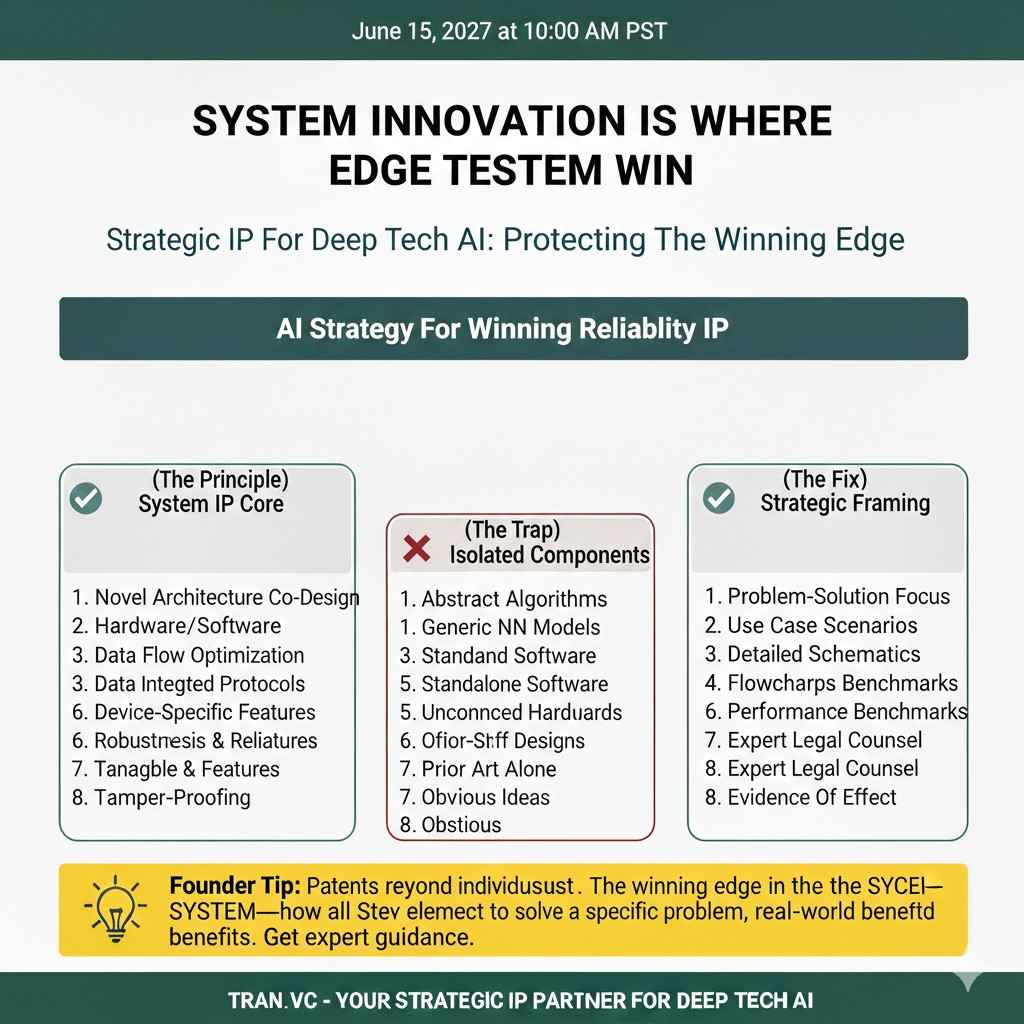
Most edge AI products have three layers, even if your team does not name them that way. First is the device layer: chips, sensors, and operating limits. Second is the model layer: the network, features, and outputs. Third is the system layer: scheduling, caching, updates, safety checks, and decision logic.
Patents get stronger when you show how these layers work together. Many founders only talk about the model. That is risky because model-only claims are easier to challenge and easier to design around.
If your solution is “model plus runtime plus data handling plus fallback,” you have a much better chance of protecting something that competitors cannot copy quickly.
What is usually patentable in edge AI
Focus on “how it works,” not “what it is”
A common mistake is to think patents protect a concept like “detecting defects with AI.” That is usually too broad because many people can detect defects with AI.
What is often protectable is the specific way you do it on-device under hard limits. For example, your method of selecting frames, compressing intermediate features, and running only the needed parts of the network may be novel. Your method of fusing sensor signals and rejecting noise before inference may be novel.
In other words, your patent value is usually in the mechanism. Not the label.
Compute tricks that create real advantage

Edge AI forces tradeoffs that cloud AI does not face as sharply. You may have built a way to keep accuracy while lowering latency. Or you may have built a method to reduce memory use without losing stability. Or you may have found a way to run on a cheaper chip while meeting safety timing.
These are the kinds of inventions that often survive scrutiny. They are also the kinds of inventions that map directly to cost savings and product performance, which is what investors and customers care about.
When you describe these inventions, you want to explain the bottleneck first, then show your solution, then show measurable outcomes like lower power draw, fewer dropped frames, or faster response time.
Privacy and data control methods that are more than policy
Many teams say, “We are private because we run on-device.” That is a good start, but patents need more.
If you have a method that controls what data leaves the device, what gets stored, how it is encrypted, and how updates happen safely, that can be very strong. Especially if it is tied to inference quality. For instance, if you send only a small summary signal and keep raw video local, and that summary is designed to preserve enough detail for monitoring, that is not just privacy. That is a technical system.
A well-written patent can protect the method of creating that summary and using it, not just the idea of privacy.
Reliability and safety features are often overlooked gold

In edge AI, failure modes matter. Sensors get dirty. Lighting changes. Inputs drift. Devices heat up. Batteries drop. Networks disappear. A robot cannot “guess” the way a chat app can.
If your product includes a method to detect when the model is unsure, or to switch to a safe mode, or to use a backup rule system, you may have very strong patent ground. Competitors will need the same reliability to sell into real markets, and your patent can raise the cost of copying.
This is also where you can write claims that connect AI outputs to safe control actions in robotics, which often reads as concrete and technical.
How to separate “model innovation” from “system innovation”
Model innovation is real, but harder to defend alone
If your invention is purely “a better network,” it can still be patentable, but it is often more fragile. Many model designs look similar on paper. And many people will argue it is an obvious change from known architectures.
Also, by the time you file, the field may already be full of similar papers. Even if you never saw them, a patent examiner may find them.
This does not mean you should ignore model inventions. It means you should avoid relying on them as your only layer of protection.
System innovation is where edge teams win
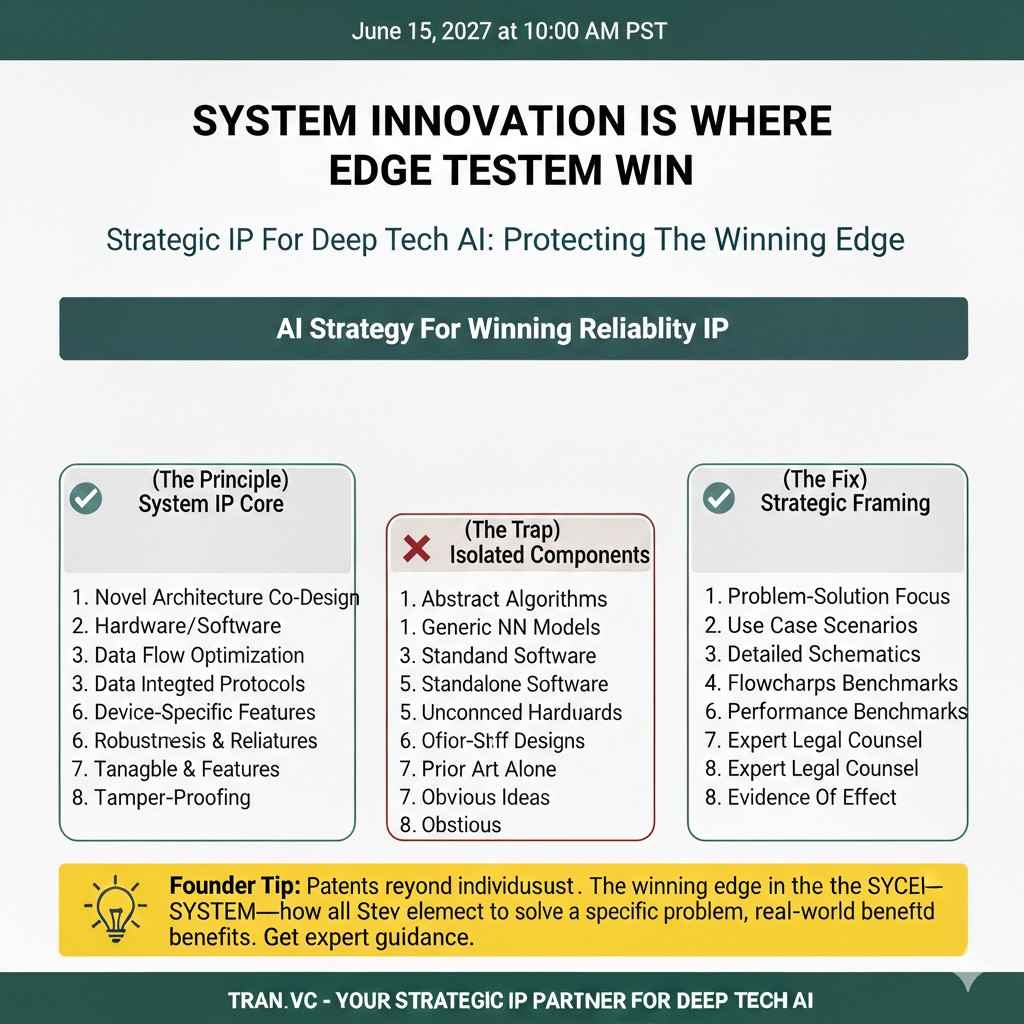
System innovation is how you handle the full pipeline on a real device. It includes how you move data from sensors to the model, how you schedule compute, how you manage memory, how you handle heat and battery, and how you update models safely over time.
Many founders do not realize they have system innovation because it feels like “engineering work.” But that engineering work is often exactly what makes the product possible.
If your system innovation is the reason your demo runs smoothly while others lag, that is likely a real invention story.
The best patents tie model and system together
A strong edge AI patent often connects a model choice to a system behavior. For example, a model that supports early exit can be tied to a runtime policy that exits earlier when confidence is high, saving power. Or a quantization method can be tied to a calibration routine that runs on-device after deployment.
When you connect these parts, your patent becomes harder to design around. A competitor cannot simply swap a model and claim they are different, because the patent protects the cooperation of components.
The founder mistakes that quietly weaken your patent rights
Waiting until the product is “ready”
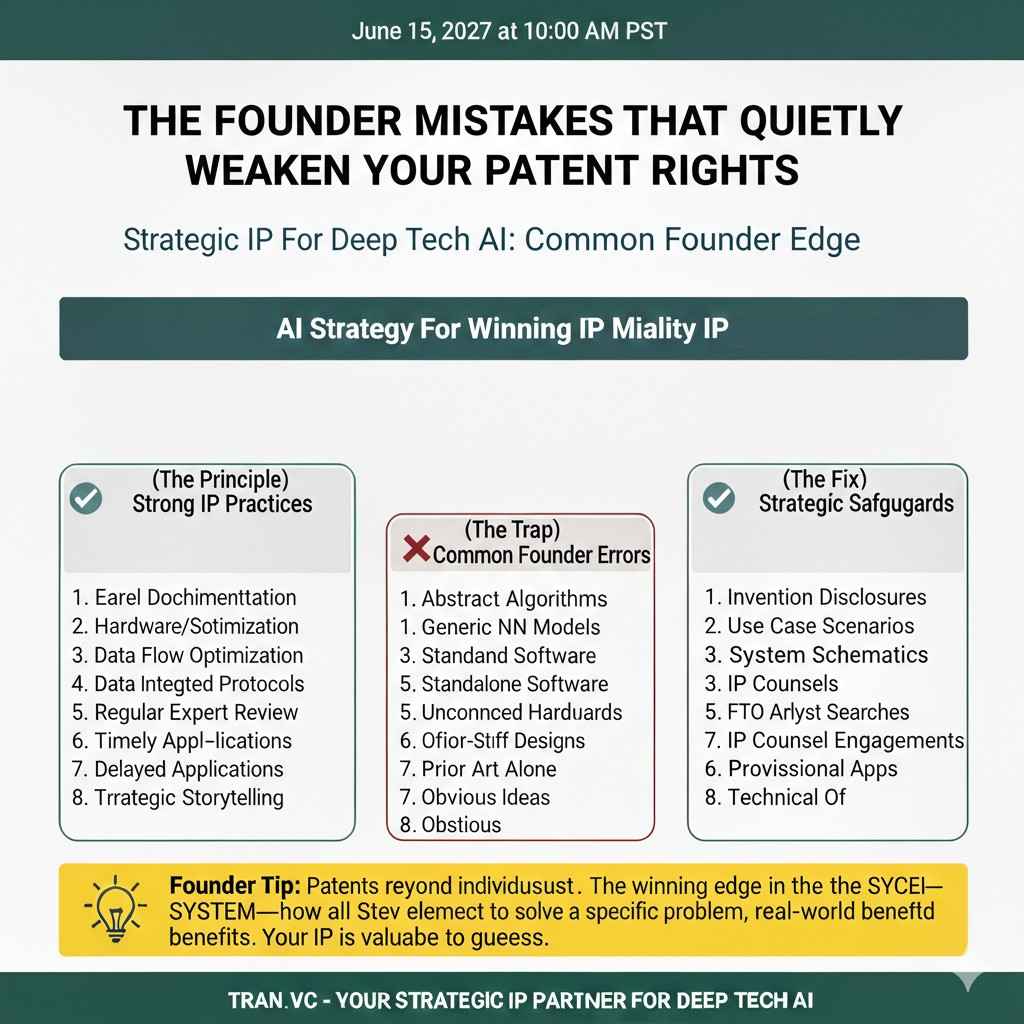
A lot of teams wait because they feel patents are for later. But patent rights are time-sensitive. In many places outside the United States, public disclosure can destroy your ability to file at all. Even in the United States, waiting can create problems if you publish, present, or sell before filing.
If you are doing demos, pilots, investor decks, conferences, or public videos, you should treat that as a risk zone. You do not need to panic, but you do need a plan.
A practical rule is this: if you are about to show something that makes people say “How did you do that?” it is time to think about filing.
Describing the invention like a research paper
Research writing and patent writing are not the same. A paper tries to prove results. A patent tries to define the boundaries of an invention in a way that blocks copycats.
Founders often write patents that read like “we used a model to do X,” with lots of math and not enough system detail. That style makes it easier for an examiner to say it is abstract or obvious.
Instead, patents should explain the steps, the components, the flow of data, and the real device limits. You want the reader to see an engineered machine, not a concept.
Filing something too broad too early
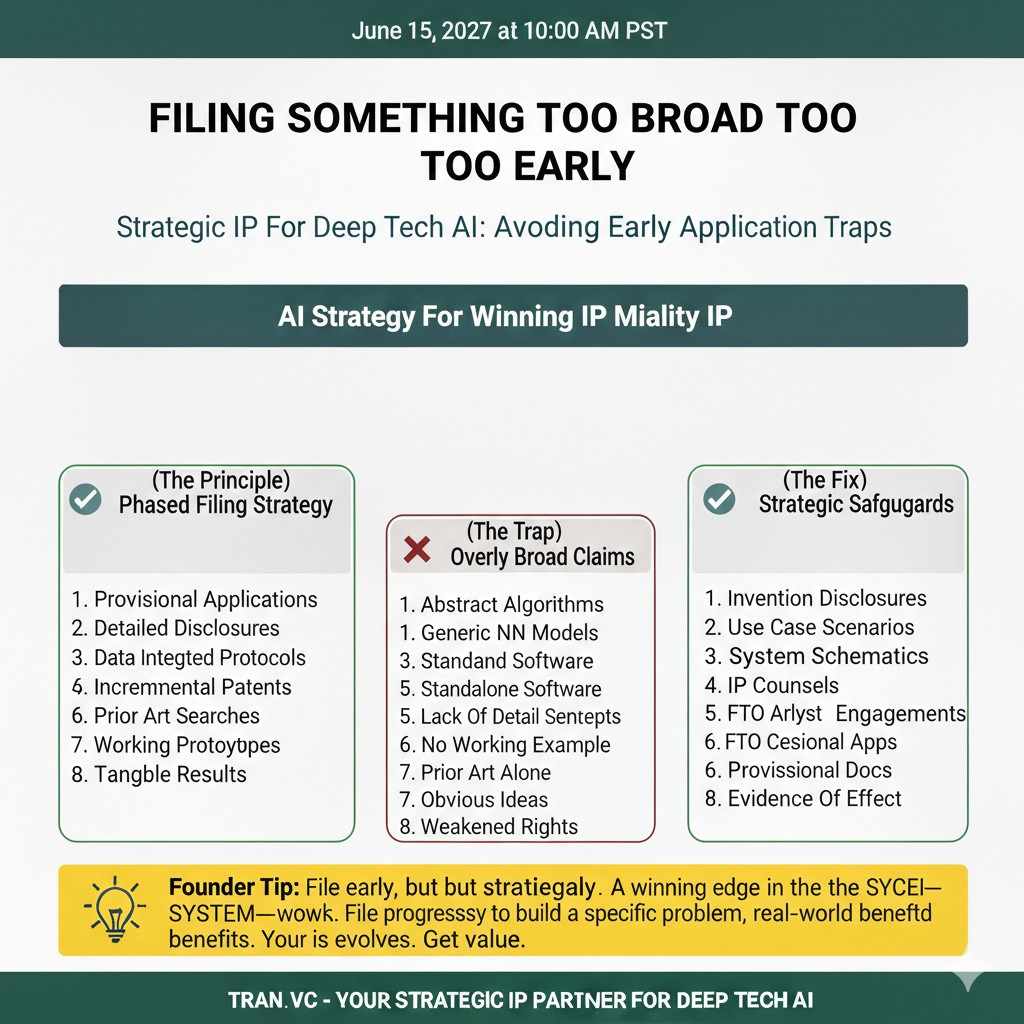
Some founders try to claim the entire category, like “running inference on-device for robots.” That kind of claim almost always gets pushed back. Examiners want specific, technical features.
It is often better to file a narrower claim that is clearly new and useful, and that maps to your product’s core advantage. Then, as you build, you can file follow-on applications that expand coverage.
This is also a reason Tran.vc’s model can help early teams. You can build a small, smart portfolio with real strategy instead of wasting money on filings that do not protect the right thing. If you want to explore that, you can apply here: https://www.tran.vc/apply-now-form/
A practical way to find patent angles in your edge AI product
Start with the bottleneck that hurt the most
Think back to the hardest technical pain you faced. Not the fun parts. The parts that took weeks. The parts that broke demos. The parts that made the device crash.
Edge AI inventions often come from solving bottlenecks like these:
Your model was accurate but too slow, so you changed the pipeline.
Your model fit in memory only after you changed data handling.
Your sensor data was messy, so you built filters and fusion logic.
Your device overheated, so you built an adaptive schedule.
Your battery drained, so you created a policy to trade accuracy for power.
Each of these is the start of a patent story because each one has a technical constraint, a technical method, and a technical result.
Then ask: what would a smart competitor copy first?
A useful exercise is to imagine a strong competitor watching your demo. What do they copy? They do not copy your logo. They copy the trick that makes it work on cheap hardware, or the trick that makes it stable in bad lighting, or the trick that allows private learning.
Those “copy-first” parts are often the ones that deserve patent attention. They are the closest to your moat.
Turn features into “steps” and “modules”
Even if you do not love legal writing, there is a simple move that helps. Take your key feature and describe it as a sequence of steps, or as modules that pass data between them.
This matters because patents often depend on clear structure. If you can describe your invention as “receive sensor data, transform it, select a model path, run inference, validate confidence, trigger an action,” you are already closer to patent language.
You do not need to write it perfectly yourself. But you do need to understand your own flow well enough to explain it clearly to a patent team.
How to patent edge AI without getting stuck in “abstract idea” trouble
Why examiners push back on AI patents
A patent office does not want to grant a monopoly on a plain idea like “use AI to decide something.” If the invention sounds like math on a computer, it can be treated as too abstract.
Edge AI founders feel this pain more than most because the work sits between software and hardware. The good news is that on-device inference often has the “real world” details that make patents easier to defend.
The goal is not to avoid AI words. The goal is to show a technical machine doing technical work under real limits, with real outcomes.
The framing that usually works
When you describe your invention, start with the device and the constraint. Explain what the device cannot do with normal methods.
Then describe your method as a controlled process. Mention how data is captured, how it is prepared, how compute is scheduled, how memory is managed, and how outputs are used.
Finally, show the effect: lower latency, lower power use, fewer crashes, stable results under noise, or better safety behavior.
This structure makes the invention feel concrete. It reads like engineering, not a business plan.
Use “system language” instead of “promise language”
Founders sometimes write like this: “Our system improves accuracy and speed.” That is a promise, not an invention.
Instead, write like this: “The device selects one of multiple inference paths based on a heat state and a confidence score, where a first path uses a low precision model and a second path uses a high precision model, and the device switches paths when a temperature threshold is crossed.”
That kind of sentence may feel long, but it is specific. It tells the examiner what is happening, when it happens, and why. This is where patents become strong.
Show how you handle inputs, not just outputs
In edge AI, the most protectable work is often before the model runs. That includes filtering, segmentation, timing alignment, sensor fusion, frame selection, and feature caching.
If your system decides which frames to keep and which frames to drop, and that decision protects accuracy while cutting compute, that can be patent material.
If your system converts sensor signals into a special intermediate form that is easier to run on a small chip, that can be patent material.
These “input side” inventions often get less attention from competitors, which is good. Quiet moats are still moats.
What to document inside your team so you do not lose patentable details
Treat invention notes like product code
Many teams lose patent value because they do not record the key turning point. They remember the final version, but not the step that made it possible.
A strong invention disclosure often needs details like:
What failed and why it failed.
What constraints were binding at the time.
What options you tried and rejected.
What exact changes you made.
What measurable effects you saw.
You do not need a complex process. But you do need a habit of capturing the moment when you solve the hard part.
The easiest habit that works
When your team fixes a painful edge AI problem, write a short internal note the same day. Keep it simple and factual.
Explain the device, the limit, and the pipeline. Describe the “before” and “after.” Include numbers if you have them, even rough ones.
Also note what is new about your method. It does not have to be perfect language. It just has to be honest and clear.
This small habit gives your patent team real material. It also prevents the common situation where a founder says, “We did something clever months ago, but I cannot explain it anymore.”
Capture diagrams, not just text
Edge AI inventions are often easier to understand as flows. A simple block diagram of modules and data paths can be more valuable than a page of words.
If you have a pipeline that branches, or a model that has early exits, or a runtime that schedules tasks by device state, a diagram makes it real.
In a patent filing, diagrams can also help broaden coverage because they show multiple variations that the claims can later cover.
Be careful with public demos and open repos
A public GitHub repo, a detailed blog post, or even a talk with slides can become prior art against you. That does not mean you cannot market.
It means you should plan the order of events. File first when possible, then share.
If you must share early, keep the technical “how” details limited until you have protection in place. You can talk about what your product does without giving away the method.
How to shape claims for on-device inference that competitors cannot dodge
Claims should protect your advantage, not your vocabulary
A competitor does not have to copy your exact words. They only need to copy your outcome by a similar method.
So the best claims focus on the mechanism that creates your advantage. If your product wins because it runs smoothly on cheap hardware, claims should cover the way you reduce compute, reduce memory, and control timing.
If your product wins because it stays private, claims should cover the way you process data locally, create a summary, and use that summary for decisions or reporting.
If your product wins because it is safe, claims should cover the way you validate outputs, detect uncertainty, and trigger safe actions.
This mindset keeps you from filing patents that sound nice but do not protect the real moat.
Put your invention into “moving parts”
On-device inference is not a single step. It is a chain.
A strong claim set often includes parts like:
A sensor interface that captures inputs.
A pre-processing stage that converts inputs.
A model execution stage with a special runtime behavior.
A post-processing stage that checks confidence.
A control stage that triggers actions and fallbacks.
You do not need to list every part in every claim. But you want your overall patent to show the full machine, so that small changes do not avoid infringement.
Cover both method and system forms
Edge AI inventions can be claimed in multiple ways. You can claim it as a method, as a device system, and sometimes as a non-transitory computer-readable medium.
This is not about being fancy. It is about coverage. Some competitors ship hardware. Some ship software. Some ship both.
A smart patent plan makes it harder for them to avoid you by changing packaging.
Protect variations, not only the one build you shipped
Your product will evolve. Your inference engine may move from one chip to another. Your model may change. Your sensor set may expand.
If your patent only describes one narrow setup, it may age badly.
Instead, you want to describe variations that still reflect your core method. For example, if your method depends on switching inference paths based on device state, you can describe different device state signals such as battery, temperature, memory pressure, or network quality.
The invention stays the same. The signals change.
This is how you keep patents useful as you grow.
The edge AI topics that often produce strong patents
Adaptive inference under device stress
Many devices behave differently as they heat up or as battery drops. If your system adapts in a smart way, you may have a strong invention.
The key is to describe how you measure device stress, how you change inference behavior, and how you keep outputs stable.
This can include switching between models, changing precision, changing frame rate, changing input resolution, or changing how often you run certain layers.