
You built something real. Not a pitch deck. Not a “concept.” Real code, real data, real results. Now a hard question shows up early: Do you protect it with a patent, or keep it as a trade secret?
This choice can change your next 12 months. It can affect how fast you ship, how you talk to customers, how you hire, and how you raise money. It can also decide whether a bigger company can copy you later.
This guide is written for technical founders building in AI, robotics, and deep tech. It is practical. It is plain language. It is meant to help you choose what to do first, and what to do next.
If you want help building an IP plan that fits your product and your stage, you can apply anytime here: https://www.tran.vc/apply-now-form/
First, what you are really choosing
When founders say “patent vs trade secret,” they often think it is one or the other. In real life, it is rarely that clean.
Most strong teams use both over time.
- A patent is a public claim. You tell the world what you invented, in exchange for a legal right to stop others from using it for a limited time.
- A trade secret is a private asset. You do not publish it. You protect it by keeping it hidden and controlled.
So the real decision is not “patent or secret forever.”
The real decision is:
What should be public on purpose, and what must stay hidden to keep your edge?
And the second decision is:
Which one do you start with, given what you must do next (ship, sell, raise, hire)?
If you choose wrong, two bad things can happen.
You might file a patent too early. You lock yourself into details that later change. You spend money on claims that do not match your final product. You end up with a paper asset that looks nice but is hard to enforce.
Or you might keep everything secret for too long. You talk to partners, pilots, and early customers without a real protection plan. You show just enough that others can rebuild it. You later learn you cannot patent it anymore because you already shared it.
So yes, it is a legal choice. But it is also a product choice. A sales choice. A fundraise choice. A timing choice.
Patents vs Trade Secrets: What to Choose First
The real choice you are making

You built something real: working code, working systems, working results. Now you have to decide how to protect it before the world sees too much. That decision is usually framed as patents versus trade secrets, but in practice it is almost never a clean “one or the other.”
What you are truly choosing is what you will share on purpose, and what you must keep private to stay ahead. This is about control. It is also about timing, because early moves can lock you into paths that are hard to undo later.
When founders delay this choice, they often do it because it feels legal, slow, or expensive. The problem is that the risk starts before you feel “ready.” The risk starts the moment you demo, the moment you send a deck, and the moment you let someone else touch your product.
If you want help shaping a protection plan that matches your exact tech and stage, you can apply anytime at https://www.tran.vc/apply-now-form/
Why “first” matters more than “forever”
A patent is a public trade. You publish details about what you built, and in return you get a legal right to stop others from using it for a set time. A trade secret is the opposite. You do not publish it, and you protect it through strict control, process, and internal discipline.
The reason “first” matters is that one step can block the other later. If you share too much publicly before filing, you can lose patent options in many places. If you patent too early, you can lock in details that your product will outgrow.
That is why the best teams think in phases. They decide what must be locked down now, what can wait, and what should stay private even if they patent other parts. This is how you build an IP base that supports shipping, selling, and raising.
What Tran.vc does at this stage
Tran.vc works with technical founders who want to build strong IP early, without giving up control or chasing big checks too soon. Tran.vc invests up to $50,000 in-kind IP and patent services, so you can build a plan and filings that match what you are truly building.
This matters most in AI, robotics, and deep tech, where small technical edges can become big market edges. If you want to protect what you are building with a clear plan, apply here: https://www.tran.vc/apply-now-form/
Understanding patents in simple terms
What a patent really gives you
A patent gives you the right to stop others from using the same invention, even if they built it on their own. This is important. It is not about copying. It is about blocking. If your patent is strong, a bigger company cannot legally ship the same solution without dealing with you.
For early-stage founders, this right changes power. It gives you leverage in talks with investors, partners, and acquirers. You are no longer just a team with code. You are a company with protected ground.
This only works if the patent matches what you are truly building. A weak or vague patent does not scare competitors. It only looks good on paper.
What can be patented and what cannot
Patents protect ideas that are new, useful, and not obvious. In AI and robotics, this often means systems, methods, workflows, and technical approaches. It is rarely about a single line of code or a basic model.
What matters is how things work together. How data moves. How decisions are made. How hardware and software interact. These combinations are often where the real value lives.
If your invention can be clearly explained step by step, and if those steps solve a real technical problem in a new way, you may have something patentable. This is where many founders underestimate their own work.
The biggest mistake founders make with patents
The most common mistake is filing too late. Founders talk to customers, run pilots, publish demos, and pitch openly for months. Then, when they finally think about patents, the window has already closed in key regions.
The second mistake is filing too early without strategy. They patent an early version that later changes. The claims no longer match the product. The patent exists, but it does not protect the business.
Good patent strategy sits between these two extremes. It moves early enough to secure rights, but smart enough to leave room for growth.
How patents affect fundraising
Investors do not expect a full patent portfolio at pre-seed. What they look for is intent and clarity. They want to see that you understand what is defensible and that you are taking steps to protect it.
A pending patent, filed with the right scope, can signal seriousness. It shows you are building something hard to copy. It also shows you think long term, not just about shipping fast.
This is one reason Tran.vc focuses on IP-first investing. Strong IP changes how investors view risk and upside from day one.
Understanding trade secrets in practice
What a trade secret really is

A trade secret is any valuable information that stays valuable because it is secret. This could be data pipelines, tuning methods, internal tools, pricing logic, or operational know-how that is hard to see from the outside.
Unlike patents, trade secrets can last forever. There is no expiration date. The moment they become public, though, the protection is gone.
This means trade secrets are not protected by filing. They are protected by behavior. Who has access, how it is stored, and how it is shared all matter.
When trade secrets work best
Trade secrets work best when something is hard to reverse engineer. If someone cannot figure it out by using your product, secrecy can be very powerful.
They are also useful when things change fast. In early AI systems, where models and methods evolve quickly, filing patents on every change makes little sense. Keeping certain methods internal can be more practical.
Trade secrets are often strongest inside teams that move fast and keep tight control. Without discipline, they leak without anyone noticing.
The hidden risk of trade secrets
The biggest risk with trade secrets is exposure. Once information leaks, there is no way to pull it back. If someone leaves your company and takes the knowledge with them, enforcement becomes hard and messy.
Another risk is fundraising. Investors cannot see what is secret. They have to trust your explanation. Without any filed IP, some investors may worry that your advantage disappears once you scale.
This does not mean trade secrets are weak. It means they must be used with intention, not by default.
Trade secrets and team growth
As your team grows, secrets become harder to keep. More people need access. More systems are shared. More documentation exists.
This is where many startups struggle. They assume something is a trade secret, but they never set rules around it. No access control. No clear boundaries. No training.
If you rely on trade secrets, you must build habits early. Otherwise, you are not protecting anything at all.
Choosing what comes first
The question you should ask yourself

The right starting point depends on one core question: can someone rebuild this once they see it working?
If the answer is yes, patents should be considered early. If the answer is no, trade secrets may buy you time.
This is not about perfection. It is about risk. If exposure creates danger, public protection matters. If secrecy creates safety, keep it private.
Most strong companies do not choose only one. They patent what must be visible and protect what must stay hidden.
How early-stage reality changes the choice
At pre-seed and seed stages, speed matters. You are still learning. Your product is still forming. This is why flexible patent strategy matters more than filing everything.
A well-crafted early patent can protect the core idea without locking you into narrow details. This leaves room for iteration while still securing priority.
Tran.vc helps founders do exactly this. The focus is not on volume, but on relevance and timing.
Using both without conflict
Patents and trade secrets are not enemies. They work best together when planned properly.
You can patent the system while keeping tuning methods secret. You can patent the workflow while keeping data handling internal. This layered approach creates depth.
Competitors may see part of what you do, but not enough to copy it fully. This is how durable advantages are built.
How this decision plays out in real startups
Early AI founders building fast
Many AI founders start with a working model and a clear result, but the system behind it is still changing. Data sources evolve. Training methods improve. Pipelines get rewritten. In this phase, locking everything into a patent can feel risky.
What often works better is identifying the stable core. This could be how decisions are made, how feedback loops work, or how outputs are used in a larger system. That core can be patented, while model tuning and data processes remain trade secrets.
This approach lets founders keep moving fast without leaving the door open for easy copying. It also creates something concrete to point to when investors ask about defensibility.
Robotics teams dealing with hardware exposure
Robotics is different because the product is physical. Once someone sees it in action, much of the system becomes visible. This makes trade secrets harder to rely on alone.
In these cases, patents often matter earlier. Control systems, motion planning methods, sensor fusion, and mechanical designs can often be observed or inferred. If they are not protected, they can be recreated.
Strong robotics teams often patent the core system architecture while keeping manufacturing processes and calibration methods secret. This balance protects what is visible while hiding what is hard to learn.
Platform startups and hidden complexity
Some platforms look simple from the outside but are complex underneath. The user sees a clean interface, but the real work happens behind the scenes.
These are strong candidates for trade secrets, especially early on. If users cannot tell how results are produced, secrecy can be powerful. Over time, as the platform scales and becomes more visible, selective patenting can add another layer of protection.
The mistake here is assuming invisibility will last forever. Growth brings attention. Attention brings analysis. Planning ahead matters.
Timing your move without slowing the business
When founders wait too long

Many founders tell themselves they will “handle IP later.” Later often means after a demo day, after a pilot, or after a big customer meeting.
By then, key details may already be public. Even private decks can count as disclosure if not handled properly. This does not mean you failed. It means your options may have narrowed.
Early planning does not mean early filing. It means knowing where the lines are before you cross them.
Filing without freezing innovation
A good early patent does not describe every detail. It describes the invention at a level that protects the idea, not the implementation.
This is where experience matters. Poorly written patents trap founders. Well-written patents give room to grow.
Tran.vc focuses on this balance. The goal is to protect what matters now, while leaving space for where the product is going next.
Cost fears and smart use of resources
Founders often avoid patents because they fear high costs. The truth is that unfocused filing is expensive. Focused strategy is not.
One strong, well-scoped filing can do more than five rushed ones. It can anchor future filings and support fundraising conversations.
This is why Tran.vc invests in-kind IP services instead of just writing checks. The work itself is the leverage.
What investors actually look for
It is not about quantity
Investors rarely care about how many patents you have early on. They care about whether your advantage is real and protectable.
They want to know if a competitor with money and talent could catch up quickly. IP is one of the few tools that can slow that down.
A single clear patent strategy can answer this better than a long list of filings.
Signaling maturity without overbuilding
A thoughtful IP plan signals maturity. It tells investors you are not just building features. You are building a company.
This matters even more in deep tech. Investors expect technical risk. What they want to see is reduced business risk.
Patents and trade secrets, used well, do exactly that.
Making the first move with clarity
Start with mapping, not filing
The first step is not choosing patents or trade secrets. The first step is mapping what you have.
What is core. What is visible. What is changing fast. What will still matter in three years.
Once this is clear, the choice often becomes obvious.
Getting help without losing control
Early IP strategy does not require giving up equity or control. It requires experience and focus.
Tran.vc was built to support this exact moment. Founders get hands-on help from people who have filed patents, built companies, and made these tradeoffs themselves.
If you want to protect what you are building without slowing down or giving up leverage, you can apply anytime at https://www.tran.vc/apply-now-form/
How to decide what to protect first for your startup
Start from the moment you must share
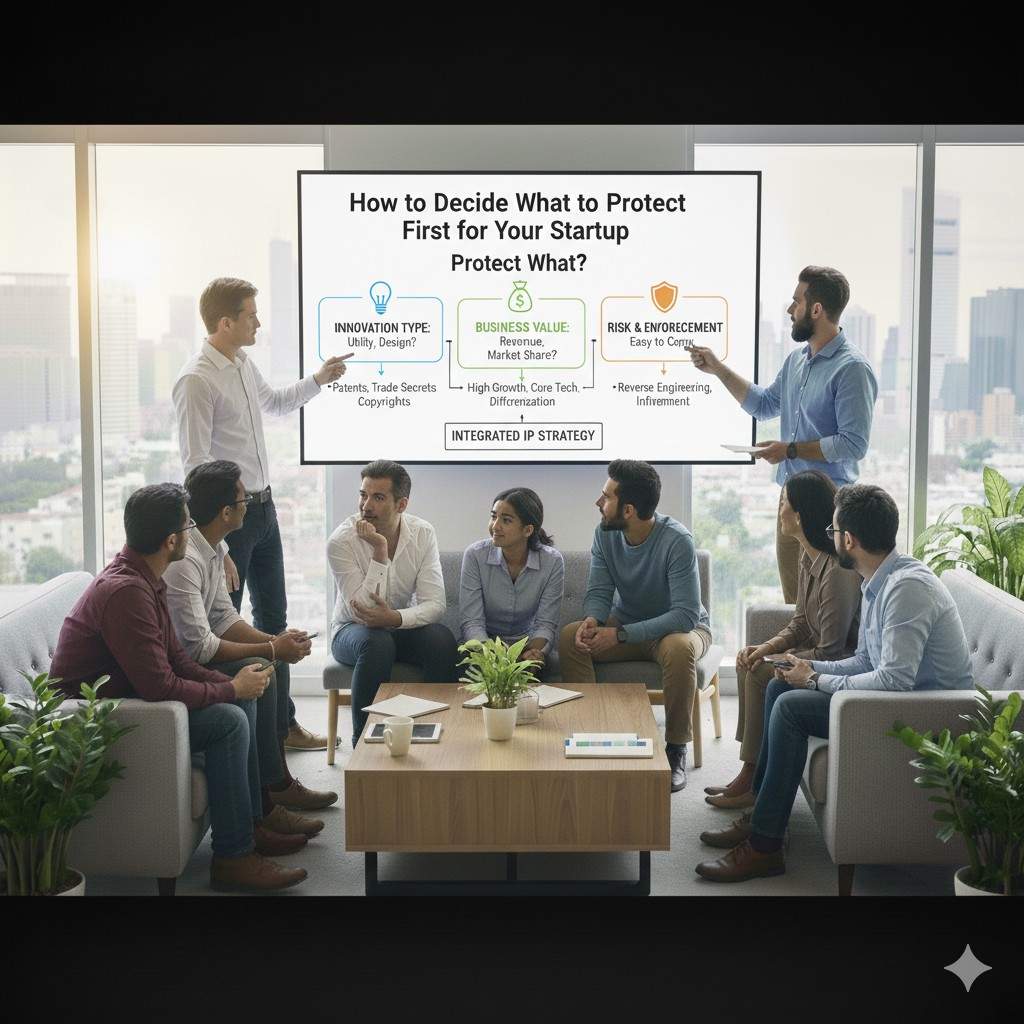
Most founders do not lose leverage because their tech is bad. They lose leverage because they share too much before they have a plan.
Look at what is coming in the next 60 to 120 days. A customer pilot, an integration, a conference demo, a hiring push, or a fundraise all increase exposure. Each of these moments forces you to explain what you do and why it works.
If that explanation would allow a skilled team to rebuild your core approach, you should lean toward filing early. If you can share benefits and results without revealing how the engine works, trade secrets can come first.
The key is not guessing. The key is walking through exactly what will be said, shown, and shipped.
Ask whether your product can be reversed
Here is a simple test that does not require legal language. Imagine a strong competitor buys your product, runs it for a month, and assigns two senior engineers to study it.
If they can learn the important parts just by observing outputs, logs, and system behavior, secrecy will not last. In that case, patents deserve serious attention early, because the invention will become visible through use.
If they cannot learn it without your internal access, trade secrets may be the better first step. Your advantage stays protected as long as your controls stay strong.
Many AI tools fail this test because model behavior can be probed. Many robotics systems fail this test because physical performance reveals underlying choices. Many data and workflow platforms pass this test early, but fail later as they scale and become more examined.
Separate “core invention” from “supporting craft”
A helpful way to decide is to separate the work into two buckets, even if you never label them this way.
The first bucket is the core invention. It is the new method, system, or mechanism that makes the product possible. It is the part that, if copied, would erase your advantage.
The second bucket is supporting craft. It is the know-how that makes the system run well in practice. It might be tuning, internal tools, operational methods, vendor decisions, or team habits.
In most strong companies, the core invention is what you patent, because it is the part that must be protected even when the world sees the product. Supporting craft often works well as trade secrets, because it is hard to capture fully in a public document and hard for outsiders to reproduce.
When founders mix these two buckets, they either patent the wrong thing or keep the wrong thing secret.
How patents and trade secrets behave under pressure
What happens when you start selling
Sales brings new pressure because buyers ask deeper questions. They want to know how you handle risk, quality, and reliability. Enterprise customers often want security reviews, architecture diagrams, and technical proof.
If your plan is “everything is secret,” sales can become slow. You may struggle to explain enough to win trust. You may also feel forced to reveal details in order to close deals.
In these cases, having patents in motion can help. You can talk more openly about approach because you have secured a filing date. You still do not need to reveal everything, but you gain room to speak.
Trade secrets still matter here, but they must be chosen carefully. Secrets that are required to explain basic trust may not stay secret for long.
What happens when you hire and scale
Hiring creates internal risk. Every new person increases the surface area of knowledge. Contractors, overseas teams, and short-term advisors add even more risk if controls are loose.
A trade secret strategy only works when access is limited and tracked. That means clear boundaries, controlled systems, and strong onboarding habits. Without this, secrets turn into shared knowledge, and shared knowledge turns into leaks.
Patents do not solve internal leaks, but they reduce dependence on perfect secrecy. They give you protection even if someone learns the basic method later.
This is why many scaling teams shift toward a mixed approach. They patent what is foundational, and they keep operational edge as secret.
What happens when a competitor shows up
The moment a competitor appears, founders often wish they had filed earlier. It is emotionally hard to watch someone else market a similar idea. It is even harder if you have no legal leverage.
Patents, when written well, are built for this moment. They can help you stop an imitator or force a deal. Trade secrets, on the other hand, only help if you can prove theft or misuse.
That difference is important. If you keep something secret and a competitor independently builds a similar method, trade secret law may not protect you. A patent can.
Founder scenarios and what usually works best
Scenario one: your AI advantage is in the pipeline

If the real advantage is in how data is collected, cleaned, labeled, and fed into the system, you may have a strong trade secret path early. The pipeline is often invisible to users and hard to copy without insider knowledge.
But you should still look for a patent-worthy core. For example, a new way to manage feedback loops, reduce drift, or validate outputs in production can often be described and protected.
In many AI startups, the best plan is to patent the control system around the model and keep the data pipeline private. This creates a strong layered defense.
Scenario two: your robotics advantage is in motion and control
Robotics advantages often show up in performance. If your robot does something others cannot, people will study it. Over time, they will infer what you are doing.
This is where early patenting can be valuable. Control loops, planning methods, sensor processing, and system architectures are often good candidates for patents because they will not stay hidden once the robot is deployed.
At the same time, you can keep calibration, manufacturing tricks, and supplier strategies as trade secrets. These “craft edges” are hard to reverse and can stay valuable for years.
Scenario three: your advantage is speed and execution
Some startups win because they move faster, ship faster, and learn faster. This is real. But speed is not always defendable.
If your only advantage is speed, your moat can disappear when a larger competitor wakes up. In these cases, it is worth finding the invention hiding in your execution.
Often there is one. Maybe you built a new workflow, a new automation approach, or a new technical integration that reduces cost and time in a unique way. That can become a patent anchor, even if your daily execution remains the main driver.
How Tran.vc helps you choose without guessing
Strategy first, then action

A good IP decision is not a gut call. It is a structured process that matches your product and your business timeline.
Tran.vc helps founders map the core invention, decide what must be visible, and identify what should remain internal. From there, the next steps become clear, and filing becomes purposeful rather than reactive.
Up to $50,000 in-kind IP services
Tran.vc invests up to $50,000 in-kind IP and patent services. This is built to remove the common early barrier: founders know they should protect their work, but they do not want to burn cash too early.
With the right plan, you can protect what matters without slowing product progress. You can also enter investor talks with more leverage and less fear.
If you want to build your IP plan the right way, apply anytime here: https://www.tran.vc/apply-now-form/