
Raising your first round of funding can feel confusing.
Most founders hear stories about massive venture rounds, fast growth, and investors writing big checks. But what happens before all of that is where the real work begins. That stage is called pre-seed.
Pre-seed is the moment when your startup is still fragile. You may have an idea, some early code, maybe a prototype, and a strong belief that the problem you are solving matters. But investors are not funding traction yet. They are funding the possibility that your idea could become a real company.
This stage is not just about money. It is about building the right foundation so your startup has a real chance to grow.
Many founders think fundraising starts when they begin pitching investors. In truth, fundraising starts months before the first pitch. It begins when you shape your idea, protect your technology, and build something that shows investors you are serious.
The pre-seed timeline often surprises founders. Things rarely happen overnight. Conversations take time. Investors watch how you think. They look at how you solve problems. They try to understand if you are building something that can last.
For technical founders in AI, robotics, and deep tech, this stage matters even more. Your code, algorithms, and inventions can become powerful company assets. But only if they are protected early.
That is why firms like Tran.vc focus on helping founders turn raw ideas into real intellectual property and defensible technology before large venture rounds happen.
Tran.vc invests up to $50,000 worth of patent and IP services into early startups. Instead of simply giving cash, the team helps founders build real protection around their technology. This creates a stronger story when the time comes to raise capital.
If you are building something technical and want to protect your work early, you can apply anytime here:
https://www.tran.vc/apply-now-form/
In this guide, we will walk through the real pre-seed fundraising timeline step by step.
You will see what founders should focus on before fundraising begins, what happens during investor conversations, and how the round finally closes. More importantly, you will learn how to move through each step in a calm and strategic way instead of rushing.
Because the truth is simple.
Startups that raise strong seed rounds rarely get lucky.
They prepare early. They build smart. They protect their ideas. And when investors finally arrive, the company already looks real.
Pre-Seed Fundraising Timeline: What to Expect at Each Step
The Hidden Stage Before Fundraising Begins
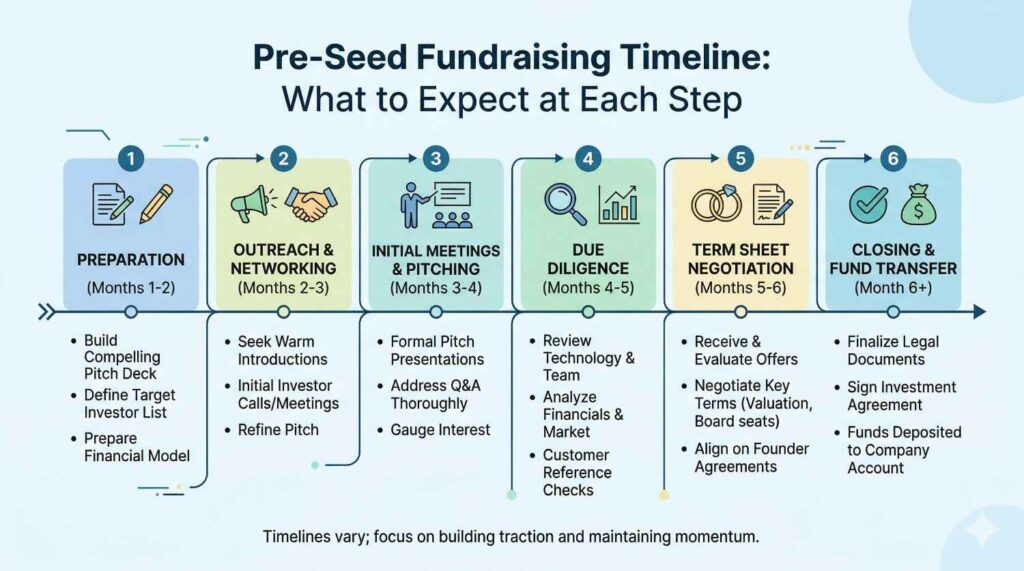
Many founders believe fundraising begins when they send their first pitch deck to investors. In reality, the timeline starts much earlier. Months before any investor hears about your startup, the foundation of the company is already being built.
This early stage is quiet. There are no announcements, no meetings with venture firms, and no public traction yet. But this is the period that shapes how investors will view your company later.
At this point, the founder is still exploring the problem. The product may exist only as an early prototype or even just a technical experiment. Yet the thinking happening here matters more than most founders realize.
Investors at the pre-seed stage are not simply looking at traction numbers. They are studying the way a founder thinks. They want to see how clearly you understand the problem, the people affected by it, and why your solution is different.
A founder who spends time here asking the right questions often moves much faster later. Instead of chasing funding in a rush, they slowly build a startup that already looks thoughtful and intentional.
This stage is where strong companies begin to separate themselves from ideas that never grow into businesses.
For technical founders working in AI, robotics, or other deep technologies, this moment becomes even more important. The technology itself may take years to mature. That means the early intellectual property behind it becomes one of the first signals investors evaluate.
Many founders underestimate how valuable their early code, models, and technical methods can become. These elements are not just features of a product. They can become assets that define the company.
That is why early intellectual property strategy matters.
Instead of waiting until a startup raises a large round, experienced founders begin thinking about patents and defensibility long before investors enter the picture. When technology is protected early, the company begins forming a moat around the work being done.
This does not mean filing patents blindly. It means understanding which parts of the technology truly matter and building protection around them in a smart way.
Firms like Tran.vc specialize in helping founders during this quiet phase.
Rather than writing a simple investment check, Tran.vc invests up to $50,000 worth of patent and intellectual property services into early stage startups. This support helps founders protect their inventions before competitors appear.
For many technical teams, this early step becomes the difference between a startup that is easy to copy and one that becomes difficult to replicate.
If you are building technology in AI, robotics, or deep tech, you can apply to work with Tran.vc anytime here:
The founders who approach fundraising calmly often spend several months in this early preparation stage. They validate the problem. They experiment with technical solutions. They refine how they talk about the product.
By the time investors first hear about the company, the idea already feels structured.
That preparation shapes everything that happens next.
Step One: Shaping the Idea Into a Real Company
Turning an Idea Into a Clear Problem
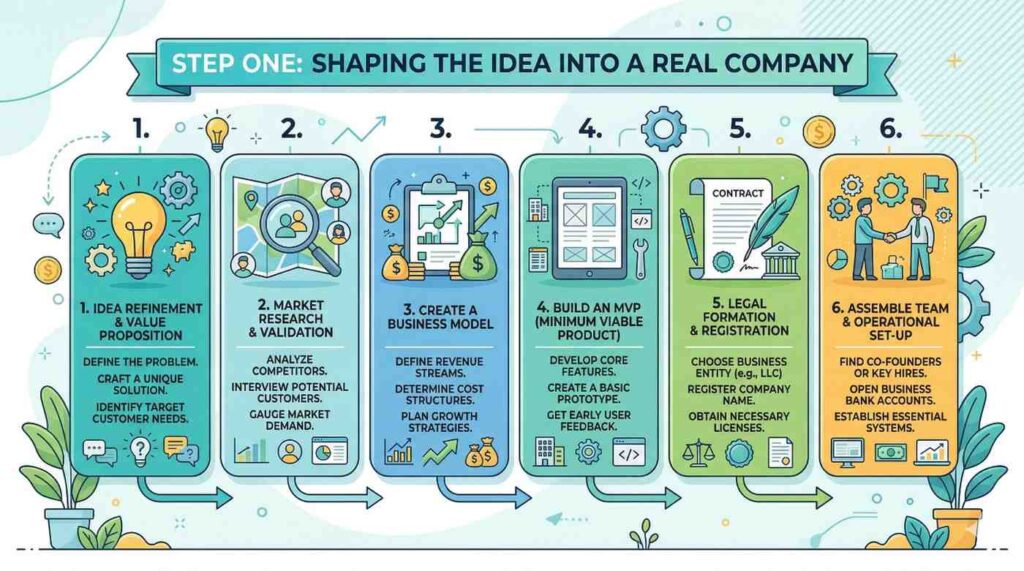
Every startup begins as an idea. But investors do not fund ideas. They fund founders who can turn ideas into real opportunities.
During the first stage of the pre-seed timeline, the goal is simple. The founder must show that the problem they are solving is both real and important.
This does not require large amounts of data or years of research. What matters is clarity. Investors want to see that the founder understands the people facing the problem and why existing solutions are not good enough.
Strong founders spend time speaking with potential users. They observe how work is currently done and where the pain exists. These conversations often shape the direction of the product more than the founder originally expected.
Many early startups change direction slightly during this stage. This is normal and often healthy. The goal is not to prove the original idea was perfect. The goal is to discover where the real opportunity lies.
Once the problem becomes clear, the founder begins building the earliest form of the solution.
In software startups this may appear as a simple product prototype. In robotics or AI companies it may appear as an early technical experiment or model that shows the idea could work.
This stage does not require a polished product. Investors understand that pre-seed companies are still forming. What they want to see is evidence that the technology can exist.
A working proof, even if rough, changes the entire conversation.
Instead of discussing theory, the founder can show something real. Even small demonstrations help investors imagine how the company might grow in the future.
For deep tech companies, this is also the stage where intellectual property begins to take shape.
If the startup has developed a unique algorithm, hardware design, or technical process, that work may become the core asset of the company. Protecting it early ensures the startup keeps control over its own innovation.
Many founders wait too long to think about this step. By the time large investors arrive, the technology may already be exposed without protection.
This is one reason many technical founders work with partners like Tran.vc early in the journey. With the support of experienced patent attorneys and startup operators, founders can build a clear strategy around their inventions.
Instead of rushing through legal paperwork later, the company develops protection while the technology is still young.
That protection eventually becomes something investors value deeply.
It signals that the startup is not just experimenting. It is building something that competitors cannot easily copy.
If you are developing new technology and want to protect your work while building your company, you can apply to Tran.vc here:
As the idea matures and the first proof appears, the founder begins preparing for the next stage in the timeline.
This is where the outside world begins to notice.
The first investor conversations slowly begin.
Step Two: Preparing for Your First Investor Conversations
Building a Story Investors Can Understand
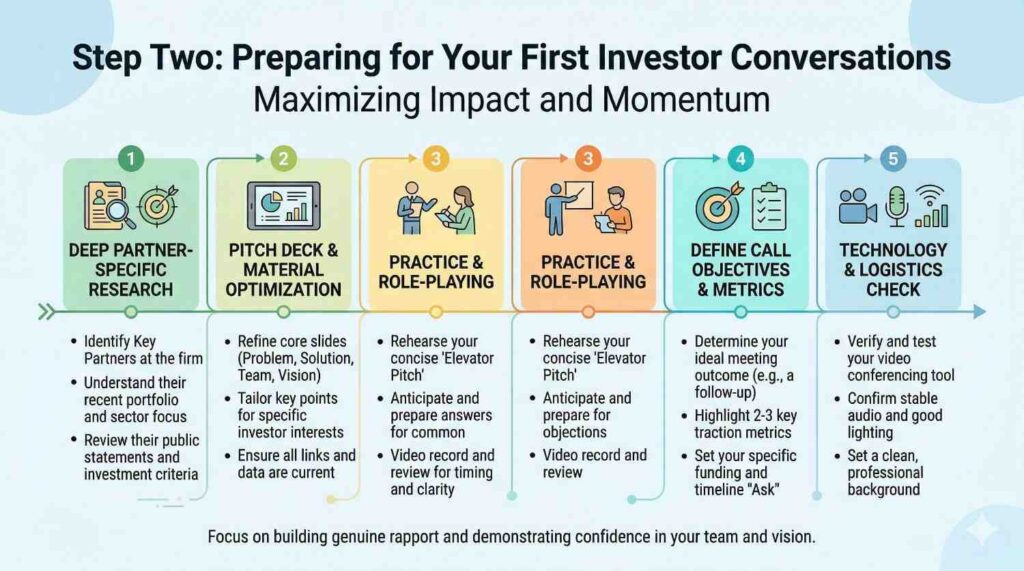
Before founders start meeting investors, there is another stage in the timeline that deserves careful attention. This is the moment when the company’s story begins to take shape.
A startup may have strong technology, an interesting idea, and a capable team. But if the story is unclear, investors struggle to understand why the company matters.
The story does not need to be dramatic or exaggerated. In fact, the best founder stories are very simple. They explain the problem clearly, show how the solution works, and make it easy for someone else to imagine the future.
At the pre-seed stage, investors are not looking for perfection. They know the product will evolve and the business model may change. What they want to see is whether the founder can explain the opportunity in a thoughtful and believable way.
That is why this stage of the timeline focuses heavily on communication.
Founders begin shaping how they talk about the company. They refine how they describe the problem. They practice explaining the technology without overwhelming the listener with technical language.
For deep tech founders, this step is especially important.
Many brilliant technical founders struggle to explain their work in a simple way. They understand the system deeply, but investors may not share the same technical background.
A strong founder learns how to translate complex technology into clear language. They help investors understand what the technology does and why it matters.
This does not mean simplifying the innovation itself. It means explaining the value behind it.
Investors want to see how the technology creates a meaningful advantage. If the solution is faster, safer, cheaper, or more accurate than existing options, that difference must be easy to understand.
During this stage, founders also begin building the first version of their pitch deck.
The deck does not need to be perfect. It simply helps guide the conversation. A good deck walks through the problem, the solution, the technology, the market, and the team.
The goal is clarity, not decoration.
Founders who spend time here often notice something interesting. As they refine their story, they begin to see the company more clearly themselves.
Questions appear that were not obvious before. Certain assumptions are challenged. Sometimes the product direction even improves because the founder had to explain the idea more carefully.
This is a healthy part of the process.
At the same time, technical founders should continue strengthening the real foundation of the company. The prototype improves. The technical proof becomes more reliable. Early intellectual property strategy continues developing.
Investors may not ask about patents in the first conversation, but experienced founders understand how valuable they become later.
When technology is protected early, it signals seriousness.
It tells investors that the company is not just experimenting with ideas. It is building something that could become a long-term advantage in the market.
This is one of the reasons Tran.vc works closely with technical founders during the earliest stages of their journey.
Instead of waiting until a company raises a large round, Tran.vc helps founders build strong intellectual property foundations early. Through up to $50,000 in patent and IP services, founders can protect the core inventions behind their technology.
This approach allows founders to move into fundraising conversations with greater confidence.
They are not only pitching an idea. They are presenting a company that already owns meaningful technical assets.
If you are building a deep technology startup and want help protecting your innovation while preparing for fundraising, you can apply to Tran.vc anytime:
Once the story becomes clear and the pitch begins to feel natural, founders move into the next phase of the pre-seed timeline.
This is when investor conversations slowly begin.
Step Three: The First Investor Meetings
Why Early Meetings Are Often Exploratory
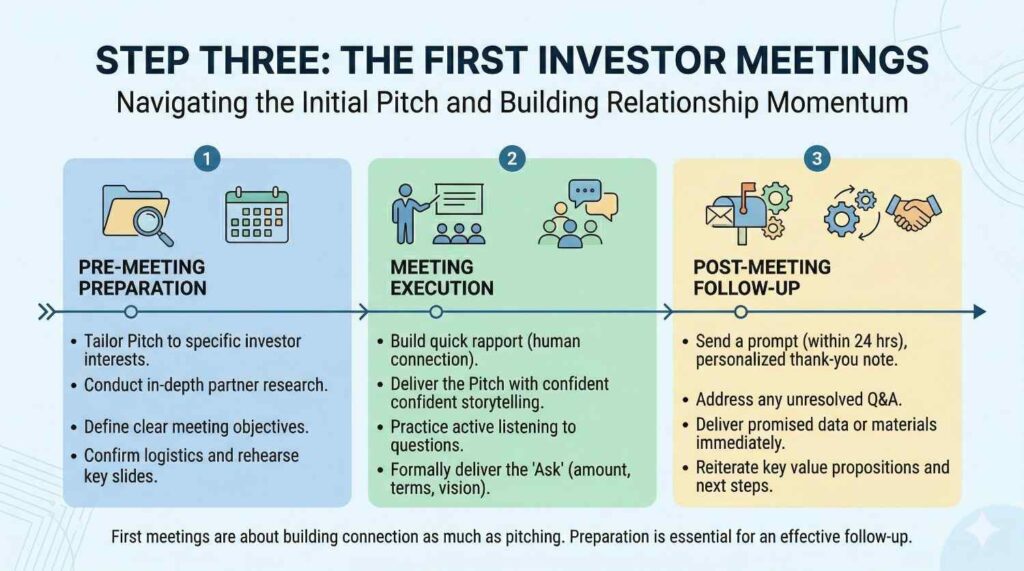
The first investor meetings are rarely about closing a round.
Many founders assume these meetings will lead directly to investment decisions. In reality, the early conversations are more exploratory. Investors want to learn about the founder, understand the technology, and observe how the company is developing.
For founders, these early meetings can feel intimidating.
Investors may ask questions that seem difficult or unexpected. They may challenge certain assumptions or point out risks the founder had not considered.
But these conversations are not meant to discourage founders. They are part of how investors evaluate potential.
At the pre-seed stage, investors understand that the company is still evolving. What matters most is how the founder thinks through challenges.
When an investor asks a difficult question, they are often looking for signs of curiosity and adaptability.
A founder who listens carefully and reflects on feedback creates a stronger impression than one who tries to defend every assumption.
These early conversations also help founders improve their own thinking.
After several meetings, patterns begin to appear. Certain questions show up again and again. Investors may ask about the same risks or the same parts of the business model.
This feedback becomes extremely valuable.
Instead of ignoring these signals, experienced founders use them to refine their company narrative and strengthen weak areas of the business.
Sometimes a founder may realize that a piece of the product needs further development. Other times they discover that their explanation of the market opportunity needs improvement.
Fundraising becomes easier when founders treat these conversations as learning opportunities rather than final judgments.
At the same time, investors are quietly evaluating something deeper than the pitch itself.
They observe how the founder approaches uncertainty. They pay attention to how clearly the founder understands their own technology. They notice whether the founder has taken steps to build real defensibility around the company.
For deep tech startups, this defensibility often comes from intellectual property.
If a startup has developed a unique algorithm, robotics system, or engineering breakthrough, investors want to know whether that innovation is protected.
This is where early IP strategy begins to influence fundraising outcomes.
When a founder can explain that the core technology is being protected through thoughtful patent strategy, the conversation changes. Investors begin to see the company not just as a product experiment, but as a business with real technical assets.
That shift can dramatically improve investor confidence.
Tran.vc was created specifically to help founders reach this stage with stronger foundations.
By investing up to $50,000 in patent and IP services, Tran.vc helps early startups protect the technology that makes them unique. This support allows founders to enter investor meetings knowing that the innovation they built is being properly safeguarded.
Instead of worrying about competitors copying their work, founders can focus on building and fundraising with confidence.
If you are preparing for early investor conversations and want to protect your technology before raising your round, you can apply here:
As investor conversations continue, something important begins to happen.
A few investors may start leaning forward.
Interest grows.
The fundraising process begins to move from exploration into serious discussion.
Why Timing Starts to Matter
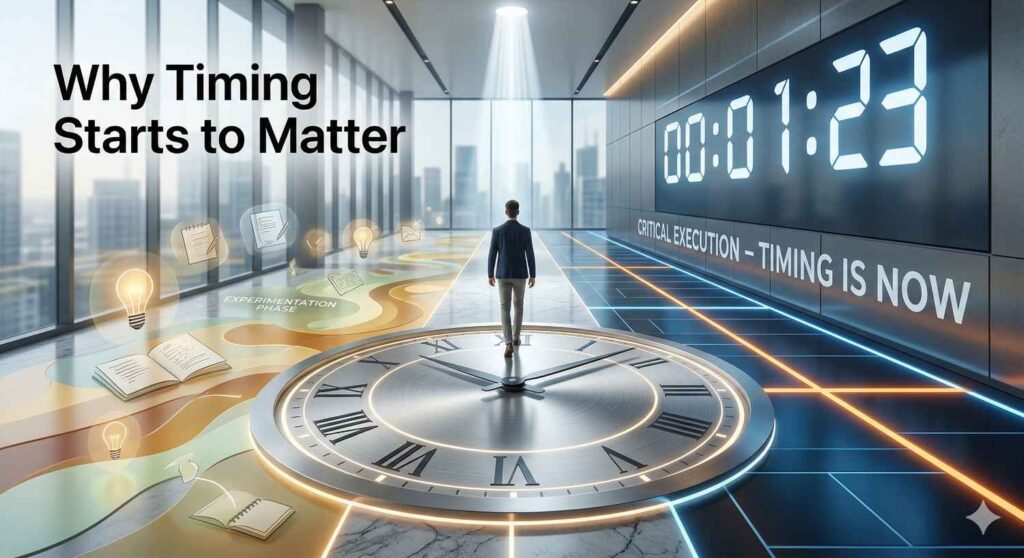
After several early conversations, something begins to shift.
At first, investor meetings feel slow and uncertain. You explain your idea, answer questions, and leave without a clear outcome. But over time, a few investors begin to show stronger interest.
They reply faster. They ask deeper questions. They want follow-up calls.
This is the beginning of momentum.
Momentum in fundraising is not about hype. It is about consistent signals of interest from multiple investors at the same time. When more than one investor starts paying attention, the process begins to move faster.
Founders who understand this stage do not rely on luck. They create momentum by being intentional.
They continue speaking with new investors while nurturing relationships with the ones already interested. They keep improving their story. They refine how they explain traction, even if that traction is still early.
Momentum grows when progress becomes visible.
This progress can take many forms. The product may improve. A prototype may become more stable. Early users may start engaging more consistently. Even small wins begin to matter at this stage.
Each update gives investors a reason to stay engaged.
At the same time, founders begin to notice a change in the type of questions investors ask.
Earlier conversations often focus on understanding the idea. Now, investors begin thinking about the future. They ask how the company will scale, how the technology will evolve, and what the next milestones look like.
These questions signal that the investor is no longer just curious. They are starting to imagine being part of the company.
This is a critical moment in the pre-seed timeline.
Many founders make the mistake of slowing down here. They assume interest will naturally turn into investment. In reality, momentum must be managed carefully.
Founders who move thoughtfully during this stage often keep conversations aligned in time. They avoid long gaps between meetings. They follow up with clear updates. They maintain energy in the process without creating pressure.
For deep tech startups, this is also where intellectual property begins to play a stronger role.
As investors move closer to making decisions, they start evaluating risk more seriously. One of the biggest risks in technical startups is whether the innovation can be copied.
If a company has no protection around its core technology, investors may hesitate. Even if the idea is strong, the lack of defensibility creates uncertainty.
On the other hand, when a founder can show that their key innovations are being protected, it builds confidence.
It shows that the company is not only building something valuable, but also taking steps to secure it.
This is where Tran.vc becomes a powerful partner.
By supporting startups with up to $50,000 in patent and IP services, Tran.vc helps founders enter this stage with real assets already in place. Instead of scrambling to think about protection later, the company moves forward with a clear strategy.
This changes the tone of investor conversations.
Founders are no longer just describing potential. They are showing that the foundation of the company is already being built with care.
If you are starting to see investor interest and want to strengthen your position before closing your round, you can apply here:
As momentum builds, the process moves into a more serious phase.
Investors begin to look deeper.
They begin to verify what they have heard.
This is the stage known as due diligence.
Step Five: Due Diligence at the Pre-Seed Stage
What Investors Actually Check
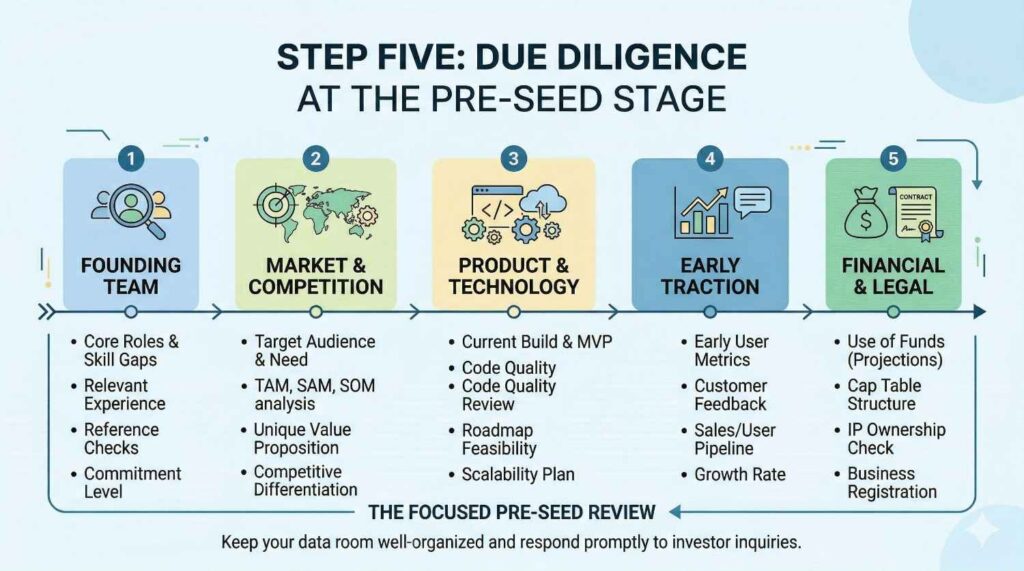
Due diligence sounds formal, but at the pre-seed stage, it is often lighter than many founders expect.
Investors are not reviewing years of financial data or complex operations. Instead, they are trying to confirm that what they have seen so far is real and thoughtful.
They revisit the core parts of the company.
They look at the product or prototype more closely. They ask deeper questions about the technology. They explore how the founder thinks about the market and competition.
This stage is less about perfection and more about consistency.
If a founder has been clear and honest throughout earlier conversations, due diligence becomes a natural continuation of the relationship.
Investors want to feel that they understand the company. They want to trust that the founder is transparent about both strengths and risks.
For founders, this stage can feel intense.
Questions become more detailed. Conversations may involve additional team members or advisors. Investors may request access to technical materials or ask for demonstrations.
The key here is not to impress, but to remain clear.
A founder who communicates openly builds more trust than one who tries to present everything as flawless.
In deep tech startups, due diligence often includes a closer look at the technology itself.
Investors may ask how the system works at a high level. They may explore what makes the approach different from existing solutions. They may also ask how the technology can be protected over time.
This is where early intellectual property work becomes highly valuable.
If the founder has already started building a patent strategy, they can explain how their innovation is being secured. Even early steps toward protection signal that the company is thinking long-term.
Without this preparation, founders often struggle to answer these questions clearly.
They may know their technology is unique, but they cannot explain how it will remain protected as the company grows.
Tran.vc helps founders avoid this situation by working with them early in the process.
Through hands-on support and expert guidance, founders develop a clear intellectual property strategy before due diligence begins. This preparation allows them to answer investor questions with confidence.
Instead of reacting under pressure, they move through this stage with clarity.
If you want to strengthen your startup before entering due diligence, you can apply to Tran.vc here:
As due diligence progresses, investors begin forming final opinions.
The process that started with simple conversations now moves toward a decision.
This leads to one of the most important moments in the timeline.
Closing the round.
Step Six: Closing the Round and Preparing for What Comes Next
How Investment Decisions Are Made
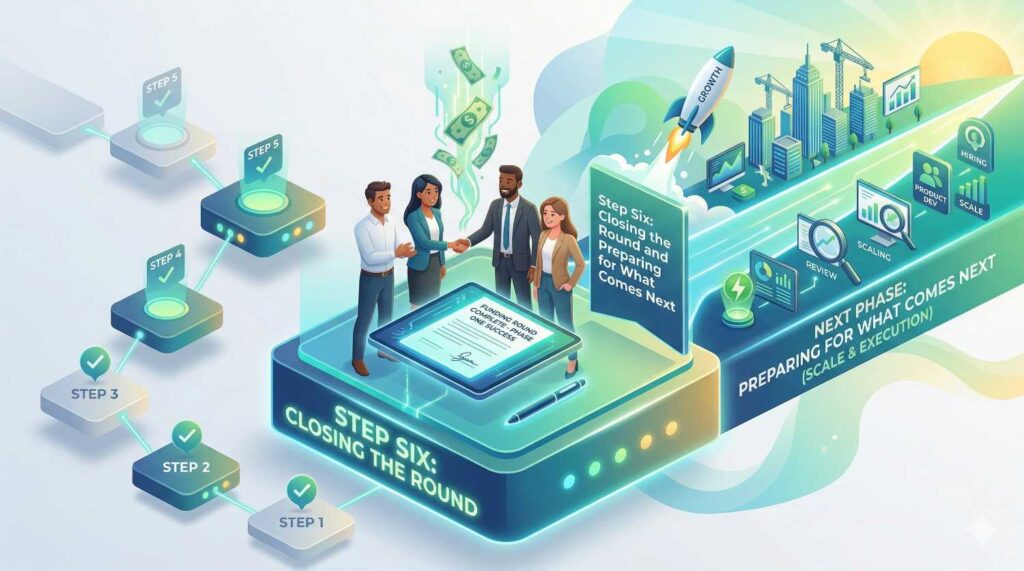
Closing a pre-seed round is often less dramatic than founders expect.
There is no single moment where everything suddenly changes. Instead, decisions build gradually. One investor commits, then another follows, and slowly the round comes together.
This process can take time.
Even interested investors may need internal discussions before making a final decision. Founders who remain patient and consistent during this stage often navigate it more smoothly.
Communication becomes especially important here.
Founders keep investors updated on progress. They share key developments. They maintain clarity around timelines without creating unnecessary pressure.
As commitments begin to form, the structure of the round becomes clearer.
The founder works with investors to finalize terms, align expectations, and ensure that everyone understands the direction of the company.
At the pre-seed stage, the focus is not only on capital.
It is also about choosing the right partners.
The investors who join at this stage often shape the company’s early journey. They influence how the founder thinks, how decisions are made, and how the company grows.
That is why thoughtful founders do not rush this step.
They look for investors who understand their space, respect their vision, and support long-term building rather than short-term pressure.
For technical founders, having the right foundation in place before closing the round can make a significant difference.
If the company has already developed a strong intellectual property strategy, it enters the next phase with a clear advantage.
Investors see a company that is not only innovative, but also protected.
This creates stronger positioning for future rounds.
Tran.vc plays a key role in helping founders reach this point with confidence.
By investing up to $50,000 in IP and patent services, Tran.vc ensures that startups are not just raising money, but building real assets from the beginning.
This support continues to matter even after the round is closed.
As the company grows, the strength of its intellectual property can influence partnerships, competition, and future fundraising.
If you are preparing to raise or close your pre-seed round and want to build a stronger foundation for what comes next, you can apply here:
Closing the round is not the end of the journey.
It is the beginning of a new phase.
The company now has more resources, higher expectations, and a clearer path forward.
The decisions made during the pre-seed timeline begin to show their impact.
Founders who prepared early, built thoughtfully, and protected what matters often find themselves in a stronger position as they move toward their next stage.
Step Seven: Life After Pre-Seed and Setting Up for Seed Round Success
What Changes After You Raise
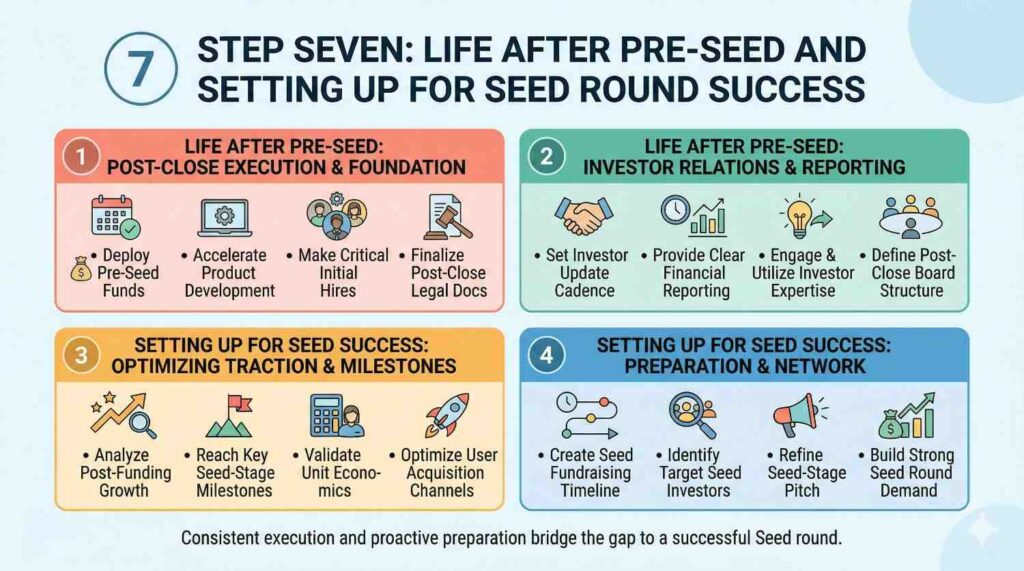
Raising your pre-seed round feels like a milestone, but it is not the finish line.
In many ways, it is the first real beginning.
The moment the round closes, the environment around your company starts to change. You now have capital, investor expectations, and a clearer path ahead. But you also have something more important.
You have validation.
A group of people looked at your idea, your work, and your thinking, and decided it was worth backing. That belief matters, but what you do next matters even more.
This stage is where discipline becomes critical.
Many founders feel pressure to move fast after raising. They hire quickly, expand the product in too many directions, or chase growth before the foundation is ready.
But the strongest companies take a different approach.
They stay focused.
They continue building carefully, just like they did before fundraising. The only difference now is that they have more resources to do it better.
The goal after pre-seed is not to look big.
The goal is to become strong.
That strength comes from clarity. Founders who understand their product, their users, and their technology move forward with purpose. They do not get distracted easily.
They build step by step.
For technical founders, this is also the phase where early intellectual property work begins to show real value.
The patents, strategies, and protections put in place during the pre-seed stage start becoming part of the company’s identity.
They are no longer just defensive tools.
They become assets.
These assets can influence partnerships. They can create barriers for competitors. They can also make future investors take the company more seriously.
When a startup enters a seed round with protected technology, the conversation changes again.
Investors are no longer evaluating only potential.
They are looking at a company that has already taken steps to secure its future.
This is why the work done before and during pre-seed fundraising matters so much.
It shapes what comes next.
At Tran.vc, this long-term thinking is built into how they support founders.
The goal is not just to help you raise your first round.
The goal is to help you build a company that lasts.
By investing up to $50,000 in patent and IP services, Tran.vc helps founders create strong technical foundations early. These foundations continue to support the company as it grows into seed and beyond.
Instead of playing catch-up later, founders move forward with confidence.
They know what they are building is protected.
They know their work has value beyond just code.
If you are thinking about your next stage and want to build a stronger company from the start, you can apply to Tran.vc here:
As the company grows, new challenges appear.
Hiring becomes important. Product decisions become more complex. The market begins to respond.
But founders who prepared well during pre-seed often handle these challenges with more clarity.
They are not guessing.
They are building on a solid base.
Step Eight: Common Mistakes That Slow Down Pre-Seed Fundraising
Moving Too Fast Without a Foundation
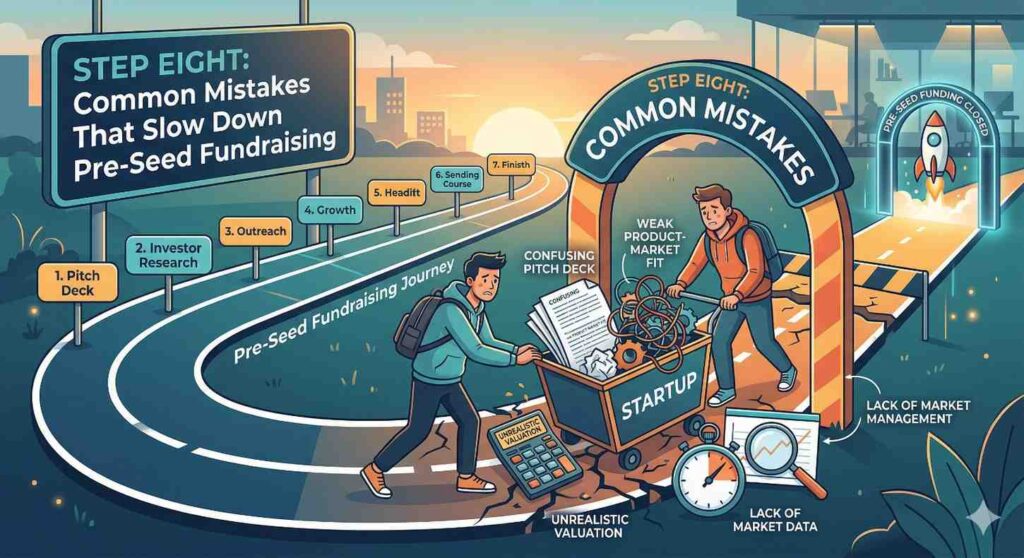
As founders move through the pre-seed timeline, certain patterns appear again and again.
Some startups move forward smoothly, building momentum and closing strong rounds. Others struggle, even when the idea itself is promising. The difference is often not talent or effort.
It is how the early stages were handled.
One of the most common mistakes is moving too fast.
Founders feel pressure to raise quickly. They rush into investor conversations before the idea is fully shaped. The story is unclear. The product is not ready to be demonstrated. The thinking is still forming.
Investors can sense this immediately.
When a company feels rushed, it creates doubt. Not because the idea is bad, but because the foundation is incomplete. Early-stage investors are not looking for perfection, but they are looking for intentional thinking.
Taking a few extra weeks or months to build clarity can change the entire outcome of fundraising.
Another common mistake is confusing interest with commitment.
An investor may seem excited. They may ask for follow-ups, introduce you to others, or speak positively about your idea. But until there is a clear commitment, the round is still open.
Founders who assume the round is closing too early often lose momentum.
They stop reaching out to new investors. They slow down communication. They wait instead of continuing to build energy in the process.
Strong founders understand that momentum must be maintained until the round is fully closed.
They continue conversations. They keep building progress. They stay active.
The third mistake is more subtle, but just as important.
Many founders ignore defensibility.
They focus on building features, improving the product, and growing early traction. But they do not think about how their technology will be protected over time.
In fast-moving fields like AI and robotics, this becomes a serious risk.
If your core innovation is easy to copy, your advantage disappears quickly.
Investors know this.
Even if they do not ask directly in early meetings, they are always thinking about it. They want to understand whether your company can maintain its edge as it grows.
This is why early intellectual property strategy matters so much.
Founders who take this seriously from the beginning build stronger companies. They create assets that last. They give investors more confidence.
Tran.vc was built around solving exactly this problem.
Instead of waiting until later stages, Tran.vc works with founders early to build and protect what matters most. With up to $50,000 in patent and IP services, founders can secure their core technology while still in the pre-seed stage.
This changes how the company is perceived.
It is no longer just an idea moving quickly.
It becomes a company building something real and protected.
If you want to avoid these common mistakes and build your startup on a stronger foundation, you can apply here:
Step Nine: How to Move Through the Timeline With Confidence
Thinking Long-Term From Day One
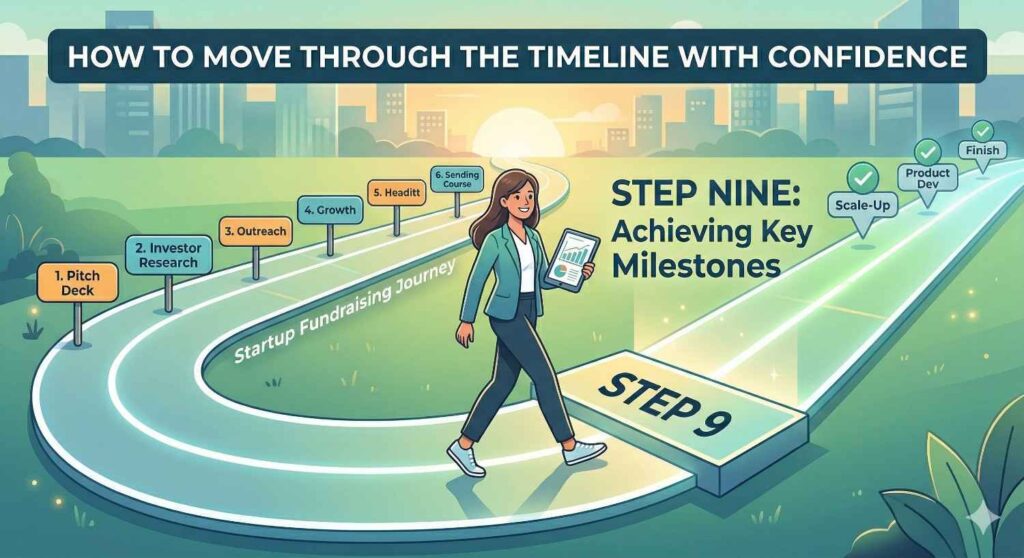
The pre-seed journey can feel uncertain.
There are long periods with no clear answers. Conversations that do not lead anywhere. Feedback that challenges your thinking.
This is normal.
What separates strong founders is not that they avoid uncertainty.
It is that they move through it with clarity.
Confidence at this stage does not come from knowing everything. It comes from understanding what matters and focusing on it consistently.
The first shift is thinking long-term from the very beginning.
Instead of asking, “How do I raise quickly?” strong founders ask, “How do I build something that lasts?”
This small change affects every decision.
It shapes how the product is built. It influences how the technology is developed. It determines how the company prepares for fundraising.
When the focus is long-term, fundraising becomes a natural step, not a desperate goal.
The second shift is learning to build quietly.
Many founders feel pressure to announce early, to share updates publicly, and to create visibility before the company is ready.
But early noise does not create strong companies.
Quiet progress does.
The best founders spend time improving the product, refining the idea, and strengthening their foundation before they seek attention.
By the time they begin fundraising, the company already feels real.
Investors can sense this difference immediately.
The third shift is staying calm.
Fundraising often creates urgency. Founders compare themselves to others. They feel like they are falling behind.
But rushing rarely leads to better outcomes.
Calm founders make better decisions.
They listen carefully. They adapt thoughtfully. They build steadily.
This approach may feel slower in the moment, but it often leads to stronger results.
For technical founders, confidence also comes from knowing that their work is protected.
When your core technology is secured, you move differently.
You are not worried about someone copying your idea after a pitch meeting. You are not holding back important details in conversations.
You can speak openly and build with focus.
This is one of the biggest advantages of working with Tran.vc early.
With the right intellectual property strategy in place, founders gain a sense of control over their own innovation.
They are not just building quickly.
They are building securely.
If you want to move through your pre-seed journey with more clarity and confidence, you can apply to Tran.vc here:
Your Next Step Starts Now

At its core, the pre-seed timeline is not about fundraising.
It is about building.
Funding is simply a result of building something that feels real, thoughtful, and valuable.
Investors do not remember every pitch they hear.
They remember the founders who stand out.
The ones who understand their problem deeply.
The ones who explain their ideas clearly.
The ones who build with intention instead of rushing.
And most importantly, the ones who protect what they are creating.
If there is one idea to carry forward, it is this.
Do not treat fundraising as the goal.
Treat it as a milestone along the way.
Focus on shaping your idea. Build your technology carefully. Protect your innovation early. Learn from every conversation.
When you do this, fundraising becomes easier.
Not because the process changes, but because your company does.
Tran.vc exists to help founders take this path.
By offering up to $50,000 in patent and IP services, Tran.vc gives technical founders the support they need to build strong, defensible startups from the very beginning.
If you are serious about turning your idea into a real, fundable company, the next step is simple.
Apply here:
https://www.tran.vc/apply-now-form/
Conclusion: The Pre-Seed Timeline Is About Building, Not Just Raising
Why Thoughtful Founders Win Early
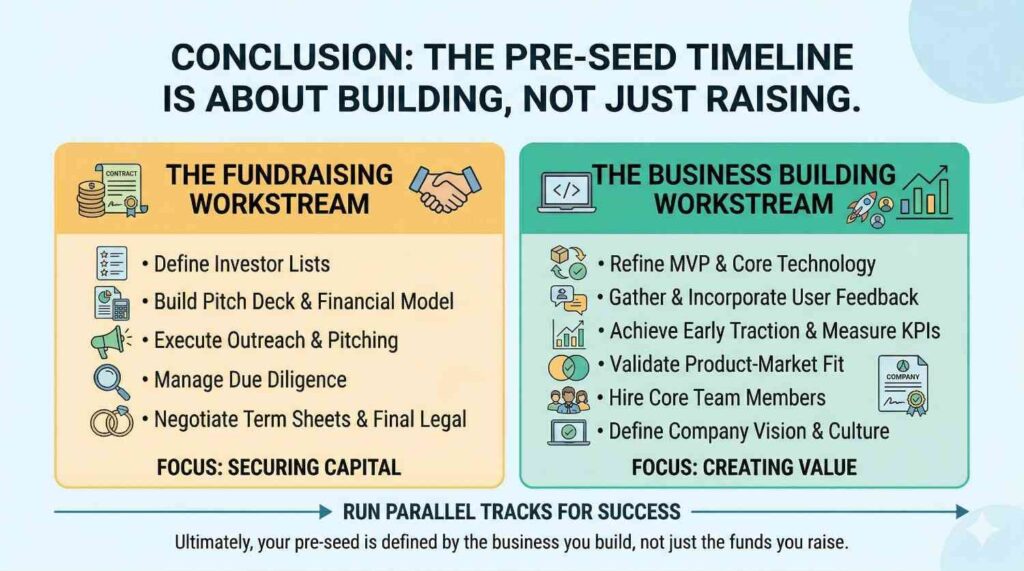
The pre-seed fundraising timeline is often misunderstood.
From the outside, it may look like a simple process of pitching investors and raising money. But in reality, it is a structured journey that begins long before the first meeting and continues long after the round closes.
Each stage plays a role.
The early phase builds clarity. The idea becomes real. The technology begins to take shape. The foundation of the company is formed.
Then the story develops. The founder learns how to communicate the vision. Investor conversations begin, and feedback helps refine the direction.
Momentum grows slowly. Interest builds. Investors begin to lean in.
Due diligence tests the strength of what has been built. It reveals whether the company is thoughtful, honest, and prepared.
Finally, the round closes.
But what truly matters is not just reaching that point.
It is how the founder moved through each stage.
Founders who rush often struggle later. They build without structure, raise without preparation, and face challenges that could have been avoided.
Founders who move with intention create something different.
They build companies that feel real from the beginning.
They understand their technology.
They protect what matters.
They communicate clearly.
And when investors arrive, they are ready.
This is where Tran.vc fits into the journey.
Tran.vc is not just a source of funding. It is a partner for founders who want to build strong companies from day one.
By offering up to $50,000 in patent and intellectual property services, Tran.vc helps technical founders turn their ideas into protected, investable assets.
Instead of chasing funding too early, founders build leverage.
They raise with confidence.
They grow on their own terms.
If you are at the beginning of your journey, or somewhere in the middle of your pre-seed timeline, you do not need to wait.
You can start building the right way today.
Apply to Tran.vc here:
https://www.tran.vc/apply-now-form/