
Robotics startups move fast. You design, test, refine, and then one day you are ready to build at scale. That usually means one thing. You need a manufacturer.
For many founders, that step feels exciting. It also feels risky. The moment you send your design files, firmware, and hardware specs to a third party, your most valuable asset leaves your hands.
If you are building a robotics company, your intellectual property is not just paperwork. It is your edge. It is your control system, your motion planning logic, your sensor fusion model, your hardware design, your firmware tricks, and the way all of it works together. When manufacturing is outsourced, that edge can leak.
This article will show you how to protect your robotics IP when production happens outside your walls. We will walk through real risks, practical steps, and smart strategy. If you are a technical founder building in robotics or AI hardware, this is not theory. This is how you stay in control.
And if you want expert help building an IP moat before you scale manufacturing, you can apply anytime at https://www.tran.vc/apply-now-form/. Tran.vc works with robotics founders early, so you do not lose leverage later.
Now let’s get into the real issue.
Why Outsourcing Manufacturing Changes the Risk Game
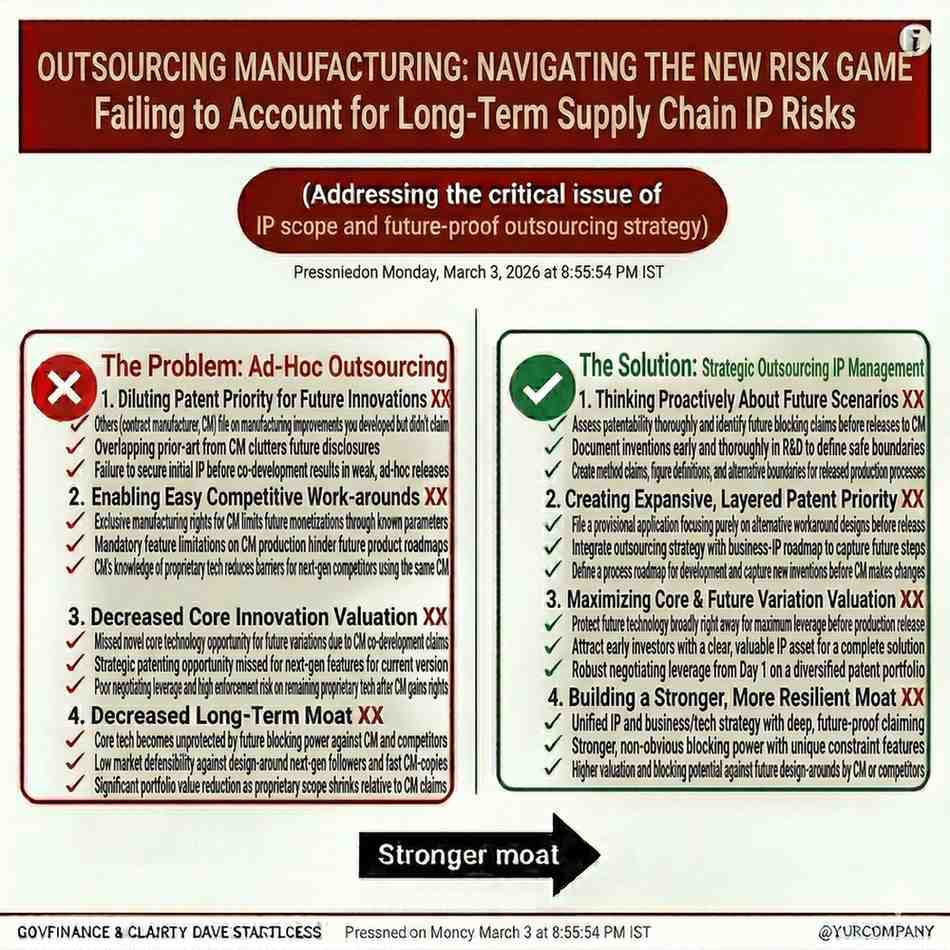
In robotics, manufacturing is rarely simple. You deal with custom boards, precision mechanical parts, sensors, firmware, and often cloud-connected software. Few early-stage startups can build all of that in-house. So you outsource.
You might work with a contract manufacturer in the US. Or you might go overseas to reduce cost. Either way, you are sharing detailed knowledge about how your product works.
Here is what most founders miss.
When you outsource manufacturing, you are not just sharing a design. You are exposing your system architecture. You are showing how parts connect. You are revealing tolerances, materials, firmware hooks, and test processes. A skilled manufacturer can learn a lot from that.
If your robotics system is truly novel, that knowledge is valuable. It can be copied. It can be reused. It can even be slightly modified and sold to someone else.
Many founders think, “We have an NDA. We are safe.” That is not enough.
An NDA is a promise on paper. It does not stop someone from learning your design. It only gives you a path to fight later. And fighting across borders is expensive and slow.
The real protection starts long before you send your files.
This is where strategy matters.
At Tran.vc, we often meet robotics founders right before they begin scaling production. They are focused on unit cost, supply chain, and timelines. Few of them have built a strong patent strategy around their core systems. That is a mistake.
If you want to raise strong capital later, and if you want to prevent copycats, you need to think about IP before your manufacturer sees your design.
You can apply to work with Tran.vc here: https://www.tran.vc/apply-now-form/. The earlier you start, the more options you keep.
Now let’s break down what is actually at risk.
What Robotics IP Is Really Worth Protecting
When people hear “IP,” they think of patents. That is part of it. But robotics IP is broader.
First, there is your hardware design. This includes mechanical structures, actuation systems, power systems, board layouts, and custom components. If you have built a unique robotic arm with a special joint mechanism, that is protectable.
Then there is your firmware and embedded software. The way your motor controllers adjust torque. The way your sensors are calibrated. The way your robot balances or adapts to terrain. These are not just lines of code. They are system intelligence.
You may also have AI models running on the edge or in the cloud. These models can be trained on unique data. That data itself can be valuable.
You also have manufacturing know-how. This includes special assembly methods, calibration steps, and quality control processes. Sometimes, the secret is not just in the design. It is in how you build and test it.
When you outsource manufacturing, parts of all these layers can be exposed.
For example, a contract manufacturer assembling your boards may see your full circuit design. A mechanical partner machining your custom frame may see tolerances and load assumptions. A firmware flashing station may access your embedded code.
If you have not locked down ownership and protection, you are relying on trust alone.
Trust is good. Legal and structural protection is better.
This is why at Tran.vc we push founders to map their IP before scaling. What is core? What is nice to have? What must be patented? What should be kept as a trade secret? What can be shared in limited form?
Many robotics startups skip this step because they feel early. They think patents are for later rounds. In reality, filing early can give you priority dates that matter deeply when you grow.
If you are still pre-seed or seed and building robotics tech, this is exactly the stage where Tran.vc can help. Instead of giving you cash and stepping back, Tran.vc invests up to $50,000 in in-kind patent and IP services. Real attorneys. Real strategy. Built around your tech.
You can apply anytime at https://www.tran.vc/apply-now-form/.
Let’s now look at how IP actually leaks during outsourced manufacturing.
How IP Leaks During Outsourced Production
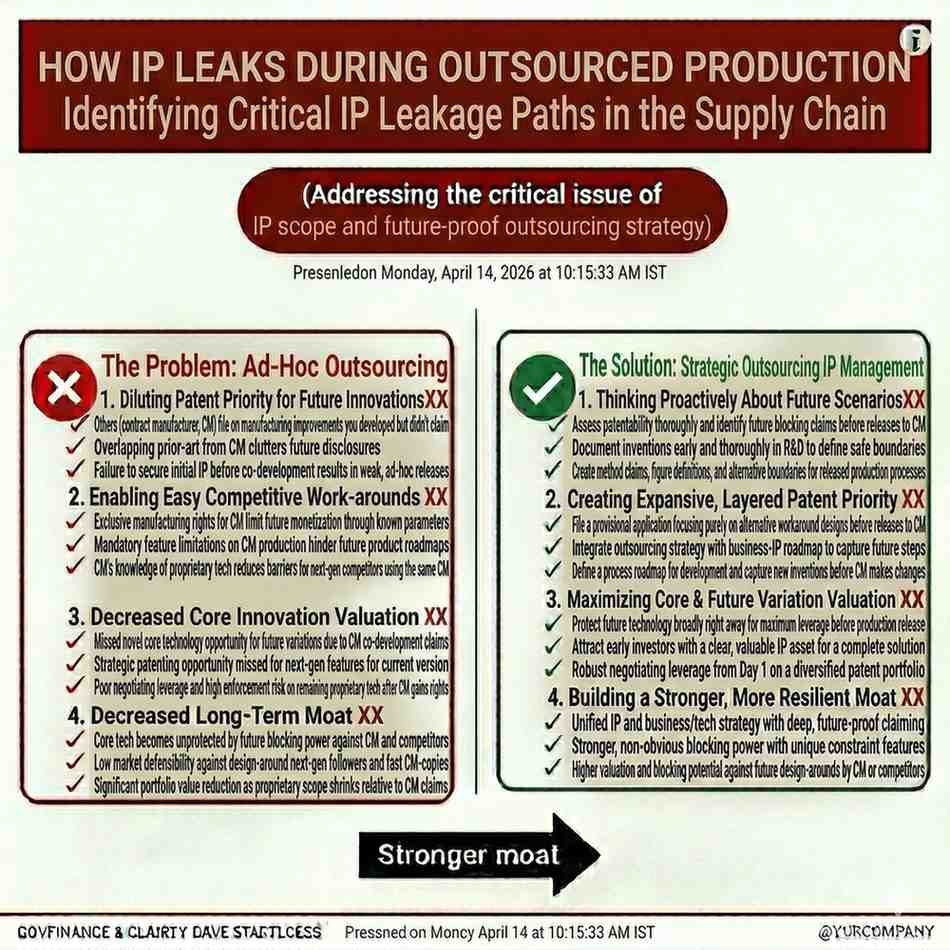
IP leaks are rarely dramatic. They are often quiet.
One common path is over-sharing.
A founder sends full CAD files, full board schematics, and full firmware to a manufacturer without asking what they truly need. The manufacturer now has everything. Even if they are honest, you have created risk.
Another path is poor contract structure.
Many early-stage founders sign standard manufacturing agreements without strong IP clauses. Some contracts even include hidden language that gives the manufacturer rights to improvements made during production.
Imagine your manufacturer tweaks a board layout to reduce noise. If your agreement is weak, they may claim partial rights over that improvement.
There is also the issue of subcontractors. Your primary manufacturer may outsource parts of the job to other vendors. Each layer adds exposure.
Overseas manufacturing adds complexity. Enforcement across borders is harder. Even if you win a case, it may take years.
Then there is the risk of “shadow production.” A factory builds extra units beyond your order and sells them quietly into other markets. This has happened in consumer electronics and can happen in robotics as well.
Founders often assume this only happens to big brands. It does not. Small, growing robotics companies can also face this risk if their product has value.
So what can you do?
You start with legal foundations. But you do not stop there.
Before you even send files, you should have filed at least provisional patents covering your core system. This gives you an early date. It signals seriousness. It also strengthens your position in any dispute.
Second, you structure your agreements carefully. Ownership must be clear. Improvements must belong to you. Confidential information must be defined precisely.
Third, you limit access. Not every partner needs full system visibility. You can modularize your design so that no single manufacturer sees the entire picture.
For example, you might separate control algorithms from mechanical fabrication. You might handle firmware flashing in-house or through a tightly controlled process.
This requires planning. It is not something you fix after a problem.
This is why robotics founders who think ahead build stronger companies. And it is why Tran.vc focuses on helping technical teams build IP-backed moats early. It is easier to prevent leakage than to fight after the fact.
If you want to build this foundation before scaling manufacturing, apply here: https://www.tran.vc/apply-now-form/.
Patents vs Trade Secrets in Robotics Manufacturing
Why This Choice Matters Before You Scale
When you outsource manufacturing, you face a core decision. What should be patented, and what should be kept secret?
This is not a legal detail. It is a business move. The wrong choice can weaken your company. The right choice can make your startup stronger with investors and harder to copy.
Robotics companies often sit at the edge of hardware and software. That means you have multiple layers of innovation. Some parts are visible once the product ships. Others are buried deep inside the system.
You need to treat them differently.
What Should Be Patented
Patents are powerful when your innovation can be reverse engineered. If someone can buy your robot, take it apart, and understand how it works, that is a sign you may need patent protection.
Mechanical structures are often visible. Custom joint systems, gripping mechanisms, drive assemblies, and power distribution designs can all be studied by a competitor. If these parts are central to your performance, they should likely be covered by patent filings.
The same goes for unique hardware architectures. If your robotics system uses a special combination of sensors and controllers that creates a measurable advantage, that structure can often be patented.
Patents also help when you plan to raise capital. Investors in robotics and AI hardware look for defensibility. A filed patent application shows that you are thinking long term. It signals ownership.
Most importantly, patents give you leverage. Even if enforcement is complex across borders, a patent can block competitors in key markets such as the United States. That alone can protect your growth.
At Tran.vc, we help founders identify which parts of their robotics stack are patent-worthy and which are not. We focus on what builds a moat, not just what sounds impressive.
If you are building robotics systems and have not mapped your patent strategy yet, you can apply anytime at https://www.tran.vc/apply-now-form/.
What Should Stay a Trade Secret
Not everything should be patented. Some knowledge is better kept quiet.
Firmware tuning parameters, calibration methods, internal test processes, and training datasets often work well as trade secrets. These elements are harder to discover from the outside.
If your advantage comes from how you tune motor response curves or how you filter sensor noise, that detail may not be visible in the final product. In such cases, secrecy can be stronger than disclosure.
Remember, patents require public disclosure. You get protection, but you also teach the world how your system works. In some cases, that is acceptable. In others, it is not.
When manufacturing is outsourced, trade secrets require extra care. You must limit who has access. You must clearly define confidential information in contracts. You must track where sensitive files are stored and who can open them.
Trade secrets are fragile. Once exposed, they are hard to reclaim.
A strong IP strategy in robotics usually combines patents and trade secrets. The balance depends on your specific system, market, and growth plan.
This is where experienced guidance matters. Filing too little leaves you exposed. Filing too much wastes time and money. Tran.vc works side by side with technical founders to design the right mix from day one.
You can start that process here: https://www.tran.vc/apply-now-form/.
Structuring Manufacturing Agreements the Right Way
Ownership Must Be Clear From the Start
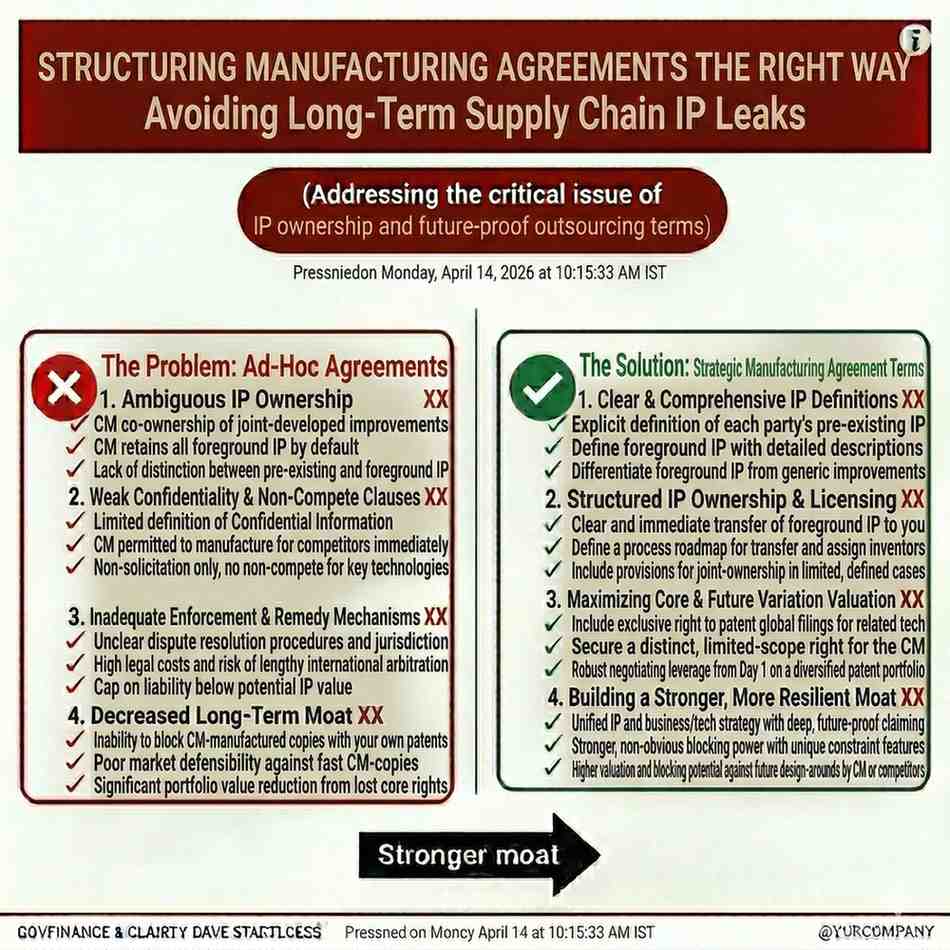
Before you send any design files to a manufacturer, your contracts must be clean and direct.
The most important clause is ownership. It must clearly state that all intellectual property related to your product belongs to your company. This includes designs, firmware, improvements, and derivative works.
There should be no vague language. If your manufacturer modifies a design to improve yield or reduce cost, that improvement should still belong to you.
Many standard templates do not protect startups well. They are written for volume manufacturing relationships where the buyer has less unique technology.
Robotics startups are different. Your innovation is often deep and technical. Your agreement should reflect that.
Control Over Improvements and Modifications
During production, manufacturers often suggest changes. Some changes are helpful. They may reduce cost or improve assembly speed.
However, if your agreement allows the manufacturer to claim rights over these modifications, you may lose partial control of your own product.
Your contract should state that all improvements related to your product are assigned to you. If needed, the manufacturer can retain a limited right to use general know-how, but not your specific design.
This small detail can have a large impact years later when your company grows.
Confidentiality That Actually Protects You
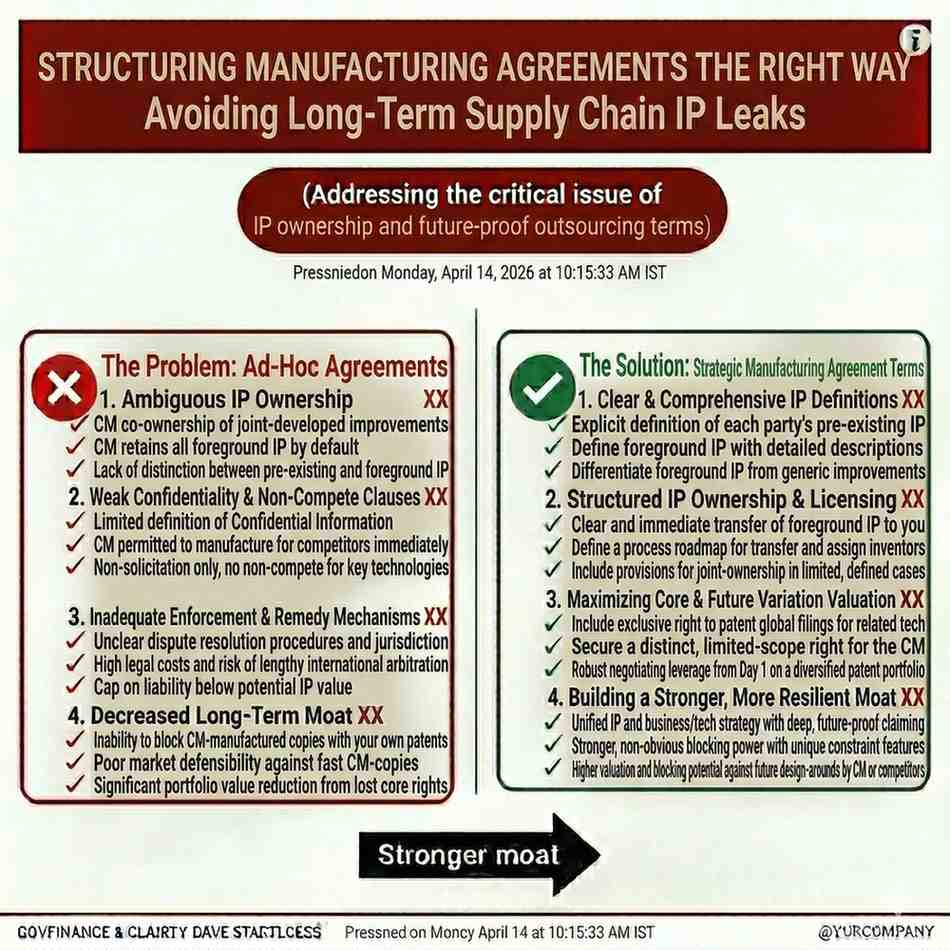
An NDA alone is not enough. Your manufacturing agreement should include strong confidentiality terms that survive even after the contract ends.
Confidential information should be defined clearly. It should include technical drawings, firmware, source code, data, and production methods.
You should also address subcontractors. If your manufacturer works with other suppliers, they must ensure those suppliers are bound by similar confidentiality terms.
Do not assume this is automatic. It must be written into the agreement.
Many founders feel uncomfortable pushing for strong terms. They fear slowing down production. But serious manufacturers expect these discussions. It shows that you value your technology.
If you are unsure how to structure these agreements around your robotics IP, this is exactly where experienced partners can help. Tran.vc supports founders not just with patent filings, but with strategic IP guidance before major manufacturing steps.
You can apply to work with Tran.vc here: https://www.tran.vc/apply-now-form/.
Reducing Exposure Through Smart System Design
Do Not Share the Entire System With One Party
One powerful way to protect robotics IP is through system separation.
Instead of giving one manufacturer full visibility into your entire system, you can divide production across specialized partners. One partner handles mechanical fabrication. Another assembles boards. Firmware flashing and final calibration can be done in-house or through a tightly controlled process.
This approach ensures that no single partner sees the complete blueprint.
Even if a partner attempts to replicate part of your design, they lack the full picture.
This method requires planning early in your design stage. It may add coordination work, but it reduces long-term risk.
Keep Core Intelligence Close to You
In robotics, the true value often sits in the control logic and data models.
You can design your product so that core algorithms are stored in encrypted firmware. You can implement secure boot processes. You can restrict access to full source code.
Manufacturers may only need compiled binaries for flashing. They do not always need readable code.
Likewise, sensitive AI models can be hosted in the cloud, with limited edge exposure. This reduces the chance of full model extraction.
These technical measures work best when combined with legal protection. One without the other is incomplete.
Design for Security From the Beginning
Many startups think about security after scaling. That is too late.
If you know from day one that manufacturing will be outsourced, build your architecture with IP protection in mind. Separate modules. Use access controls. Track file sharing carefully.
This mindset turns IP protection into a design feature, not an afterthought.
At Tran.vc, we call this building with intention. You do not rush to scale just because you can. You build foundations that last.
Robotics founders who take this approach raise stronger rounds later. Investors see that you control your technology and your supply chain.
If you are in the early stages and want to build that kind of company, you can apply anytime at https://www.tran.vc/apply-now-form/.
Managing International Manufacturing Risks
Understanding Jurisdiction Before Problems Arise
When manufacturing happens in another country, your risk profile changes in ways that many founders do not fully see at first.
Different countries have different IP laws. Enforcement timelines vary. Court systems move at different speeds. What feels solid in one region may feel weak in another.
If your robotics system is manufactured overseas, you need to think beyond just cost per unit. You need to think about where your patents are filed and where your product will be sold.
If your main market is the United States, then strong U.S. patent protection can block imported copies. That alone can protect a large part of your value.
But if you plan to sell in Europe or Asia, your patent strategy should match those markets as well. Filing in the right regions early gives you options later.
This is not about filing everywhere. It is about filing with purpose.
Tran.vc helps founders decide where protection truly matters. We do not push random filings. We focus on strategic leverage. If you want to build a robotics company that can scale globally, start by building your IP footprint wisely.
You can begin here: https://www.tran.vc/apply-now-form/.
Preventing “Shadow Production” and Unauthorized Sales
One real risk in outsourced manufacturing is overproduction. A factory builds more units than you ordered and sells them quietly into other channels.
This is not common with high-end specialized robotics, but it can happen if your product has broad demand or reusable components.
The first layer of defense is contract clarity. Your agreement must state that the manufacturer cannot produce units beyond approved purchase orders.
The second layer is operational control. Use serialized components. Track parts. Audit production numbers. Keep visibility into supply flow.
You can also design custom chips or firmware that require activation keys controlled by you. That way, even if extra units are built, they cannot function fully without your authorization.
These steps reduce temptation and create traceability.
Robotics startups often focus only on innovation. But operational discipline protects innovation.
Filing Before You Reveal
Timing is critical in IP protection. In many countries, once you publicly disclose an invention, you lose the right to patent it later.
Sending detailed design files to a manufacturer can count as disclosure if not handled properly.
That is why filing provisional patents before sharing core technical details is often wise. It gives you a priority date. It anchors your invention in time.
This does not mean filing blindly. It means filing strategically around the systems that create your competitive edge.
Tran.vc invests up to $50,000 in in-kind patent and IP services for robotics and AI startups. We help founders file smart, not wide. We help you move fast without losing ownership.
If you are about to outsource manufacturing and have not locked down your filings, this is the right moment to act.
Apply here: https://www.tran.vc/apply-now-form/.
Protecting Firmware, Source Code, and AI Models
Limiting Access to What Is Truly Needed
Not every partner needs full access to your source code.
Manufacturers typically require compiled firmware for flashing devices. They do not need editable source files. By limiting access to compiled versions only, you reduce exposure significantly.
Access control should be layered. Use secure servers. Track downloads. Restrict internal access even within your own team.
If your robotics system connects to the cloud, keep core AI logic server-side when possible. Edge devices should run only what is required for function.
This structure keeps your deepest intelligence under your control.
Encryption and Secure Boot
Technical measures strengthen legal protection.
Secure boot ensures that only authorized firmware runs on your hardware. Encryption protects firmware from being read or copied easily.
While no system is perfect, adding these layers increases the difficulty of reverse engineering.
When a competitor evaluates whether to copy your system, difficulty matters. Strong barriers often push them to move on.
IP protection is partly legal and partly practical. The harder you make it to replicate, the safer you are.