
Quantum computing feels like magic the first time you hear it.
A normal computer solves problems by trying things one step at a time. A quantum computer can explore many paths at once. That makes people dream big: faster drug discovery, better materials, stronger security, smarter models. But here is the quiet truth most founders learn late: the value is not only in the science. The value is in what you can protect.
If you are building in quantum—hardware, software, error correction, control systems, compilers, sensors, or hybrid systems—your earliest choices shape your future leverage. If you wait until “the product is ready,” you often miss the cleanest, broadest IP you will ever have. Someone else can file around you. Or you end up filing narrow claims that do not stop copycats.
At Tran.vc, we work with technical teams early, when the work is still raw, so the IP can be strong. If you want help building an IP plan before you raise your seed, you can apply anytime here: https://www.tran.vc/apply-now-form/
Quantum Computing: What IP Can Be Filed Early?
Why “early” matters more in quantum than in most fields

Quantum is moving fast, but it is also messy.
Teams build on papers, open-source tools, and shared lab methods. That makes it easy for two groups to reach similar ideas around the same time. When that happens, the team that filed first often has the stronger position. Not because they are “better,” but because they were earlier and clearer.
Early filing also protects you from your own growth.
The moment you start hiring, sharing updates, talking to partners, or pitching to labs, you create more chances for leaks. Most leaks are not evil. They are normal. A slide gets forwarded. A demo gets recorded. A partner engineer repeats your method in a meeting. Filing early removes fear from these moments.
If you are building a deep tech company, your IP story is part of your fundraise story.
Seed investors do not expect you to have a full patent wall. But they do want to see that you understand what is unique, what can be protected, and how you plan to stop a larger player from copying you once you prove demand. Filing early helps you answer those questions with calm confidence.
If you want help shaping that story and turning your work into strong filings, Tran.vc can support you with up to $50,000 in in-kind patent and IP services. You can apply anytime here: https://www.tran.vc/apply-now-form/
What “IP” really means in a quantum startup
Patents are only one piece of the protection puzzle
When people say “IP,” they often mean “patents.” But a quantum company can build a moat using a mix of tools. The right mix depends on what you are building and how easy it is to copy.
Patents can protect how something works.
That could be a method, a system design, a control flow, a calibration routine, or a special way to cut noise. A good patent can stop others even if they build it in a slightly different way.
Trade secrets protect what you keep private.
Some quantum advantages are hard to write down in a patent without giving away too much. Or they change every month as your lab learns. In those cases, keeping know-how private can be smarter.
Copyright protects code and written material.
It will not protect the idea behind your code. But it can protect the exact code, docs, and training materials you create. This can matter if you ship developer tools, compilers, or SDKs.
Contracts protect what you share.
NDAs, invention assignment agreements, and clean contractor rules matter a lot in quantum because teams work with universities, labs, and hardware partners. A patent plan without clean paperwork is like a vault with a broken door.
When Tran.vc works with founders, we look at the full picture.
We help you decide what to patent now, what to keep secret, and what to delay. The goal is to protect what makes you win, not to collect paperwork. If you want that kind of support, apply here: https://www.tran.vc/apply-now-form/
The simplest rule: file around “how you create advantage”
The big mistake: filing on the “thing,” not the “edge”
In quantum, the “thing” is often not unique.
Many teams use similar qubit types, similar cryogenic setups, similar readout chains, and similar baseline algorithms. If your filing is only “we use X qubits to do Y,” it will be easy for others to work around.
Your real advantage usually lives in the “how.”
How you stabilize the system. How you reduce errors. How you schedule pulses. How you map a problem onto hardware limits. How you estimate results with fewer shots. How you make the system usable for real users. That is where patents can be strong.
Think of your company like a recipe.
Lots of people can buy the same ingredients. Your edge is the special steps and timing that make the dish great. A smart early patent plan captures those steps, without exposing more than needed.
This is also why “early” does not mean “rush.”
You file early once you can explain your advantage clearly. Even if the product is not done, you can often describe the core method in a way that is stable enough to protect.
If you are unsure what your “how” is yet, that is normal.
A good IP partner can help you pull it out of your work. Many founders are too close to the problem. They do not realize what is special because they live inside it every day. This is exactly the kind of work Tran.vc supports. Apply anytime: https://www.tran.vc/apply-now-form/
What can be filed early in quantum computing
The “early-file” categories you should check first
Let’s get very practical.
When you are early, you want to focus on IP that is (1) likely to stay true as you improve, and (2) likely to matter to buyers, partners, and future investors. In quantum, these early wins often sit in a few areas.
The sections below are not a checklist you must follow.
They are a set of buckets that help you spot protectable ideas quickly. You may only have one strong bucket at first. That is fine. One strong filing is often better than five weak ones.
Hardware-focused IP you can file early
Qubit device structures and layouts that improve stability
If you are building hardware, many early protectable ideas show up in geometry.
That could be electrode shapes, routing choices, shielding approaches, coupling layouts, or special physical spacing that reduces crosstalk. Even small layout choices can change performance in meaningful ways.
What makes these ideas patent-friendly is that they can be described as a system.
You can show the structure, explain the purpose, and define measurable impact. The strongest filings connect the structure to a problem it solves, like better coherence, easier scaling, or more reliable readout.
Many founders wait because they think “we will change the design later.”
But early filings can be written to cover families of layouts, not only one exact drawing. If you capture the underlying principle, you can keep the protection even as your design evolves.
Packaging and integration methods that reduce noise
Quantum systems suffer from noise that classical engineers often underestimate.
A novel way to package a device, route signals, reduce vibration, manage heat flow, or control grounding can become a key moat. These are not “nice-to-have” details. They can decide whether your system is usable outside a perfect lab.
This is a great early filing area because it is often unique to your build.
If your team found a method that makes the system more stable, you likely learned it through painful experiments. That pain is value. You can convert it into an asset.
Cryogenic and thermal control approaches that improve uptime
Cryogenic needs create real-world bottlenecks.
If you have a method that reduces cooldown time, improves uptime, protects components during cycling, or improves thermal isolation, those ideas can be highly valuable. They can also apply across platforms, which makes them attractive.
A strong early filing here does not need to reveal every lab detail.
It can describe the system setup, the control approach, the sequence of steps, and the result. It can claim the method in a way that covers future versions.
Control electronics designed for quantum constraints
Many quantum founders are building the “bridge” electronics between classical control and quantum behavior.
If your electronics reduce jitter, cut latency, improve phase stability, or simplify scaling, you may have IP worth protecting early. Even if the electronics are built from known parts, your arrangement and timing can be novel.
This is where founders often miss filings.
They assume “hardware patents are only for the qubit.” But the real moat can be the control layer that makes the qubit useful at scale.
If you are building in any of these hardware areas and want to identify what is truly protectable right now, Tran.vc can help you shape those into strong filings. Apply here: https://www.tran.vc/apply-now-form/
Software and algorithm IP you can file early
Error mitigation methods that reduce cost without full correction
Full error correction is hard and expensive.
Many near-term quantum wins rely on smart error mitigation that squeezes more value out of imperfect hardware. If you found a method that reduces error impact using clever sampling, modeling, or post-processing, that can be patentable.
The key is to describe it as a method with steps.
What input you take, what transform you apply, how you estimate or correct, and what output you produce. If your method improves accuracy at lower shot counts or lower depth, that is a strong story.
Early filings here can be powerful because the method may generalize.
Even if hardware changes, the idea of “how to reduce error effect” can remain valuable across systems.
Compilation and mapping approaches that handle real hardware limits
Quantum algorithms on paper are clean.
Real devices are not. They have connectivity limits, gate errors, timing issues, and calibration drift. If your compiler or mapper solves these pain points better than others, you may have IP early.
This can include routing strategies, gate decomposition methods, scheduling approaches, or adaptive compilation that responds to device state.
Founders sometimes avoid filing because “compilers are software.”
But software methods can be patented when they provide a technical solution to a technical problem. The strongest filings tie the method to the hardware constraints it solves.
Hybrid quantum-classical workflows that improve performance
A lot of useful quantum work is hybrid.
You run a quantum step, analyze classically, then adjust the next quantum step. If you have a workflow that converges faster, uses fewer shots, improves stability, or reduces compute cost, that can be a strong early filing.
This is also a great area to protect because it is close to real customer value.
Customers do not buy “quantum.” They buy outcomes. If your workflow delivers outcomes with fewer resources, that is a business edge.
Verification, testing, and debugging systems for quantum programs
Quantum developers struggle with debugging.
You cannot “print” a quantum state the way you do in classical software. If you built a tool that detects errors, isolates sources of drift, validates circuits, or tests performance in a repeatable way, that can be valuable IP.
These tools can also become products.
Even if you are not selling them today, they can support your core platform. Protecting them early helps you keep control as the space grows.
If your startup lives more in software than hardware, the best early patents often sit in compilers, workflows, mitigation, and developer tooling. Tran.vc can help you choose what to file first so you do not waste time and money. Apply here: https://www.tran.vc/apply-now-form/
Data, calibration, and operation IP you can file early
Calibration routines that keep systems stable over time
Calibration is not a one-time step.
Quantum systems drift. If you created a calibration routine that is faster, more reliable, more automatic, or less sensitive to noise, that can be early IP.
These routines are often very hard to copy without deep experience.
That makes them great moat material. A patent can protect the method. A trade secret plan can protect the “secret sauce” parameters you do not want to share.
Monitoring and feedback loops that detect drift in real time
Many systems fail slowly, not suddenly.
A method that monitors signals, detects drift early, and triggers corrections can improve uptime and output quality. This can be a major advantage for any system that needs to run daily, not only in demos.
Patents here can cover the feedback method.
They can also cover the architecture that ties together sensors, control logic, and correction actions.
Scheduling and resource management for shared quantum systems
As quantum systems become shared resources, scheduling matters.
If you built a method that allocates resources, manages jobs, handles queue priority, or reduces conflicts while protecting performance, that can be valuable early IP. It may also apply to future “quantum cloud” setups.
This is an area where a small advantage compounds.
Better scheduling can mean more runs per day, better customer experience, and higher revenue per system.
These are not the most glamorous parts of quantum.
But they can be the parts that make your company work as a business. And investors often love IP that ties directly to scaling and revenue.
Partner-heavy quantum work: filing while working with labs and universities
The risk: unclear ownership can destroy a patent later
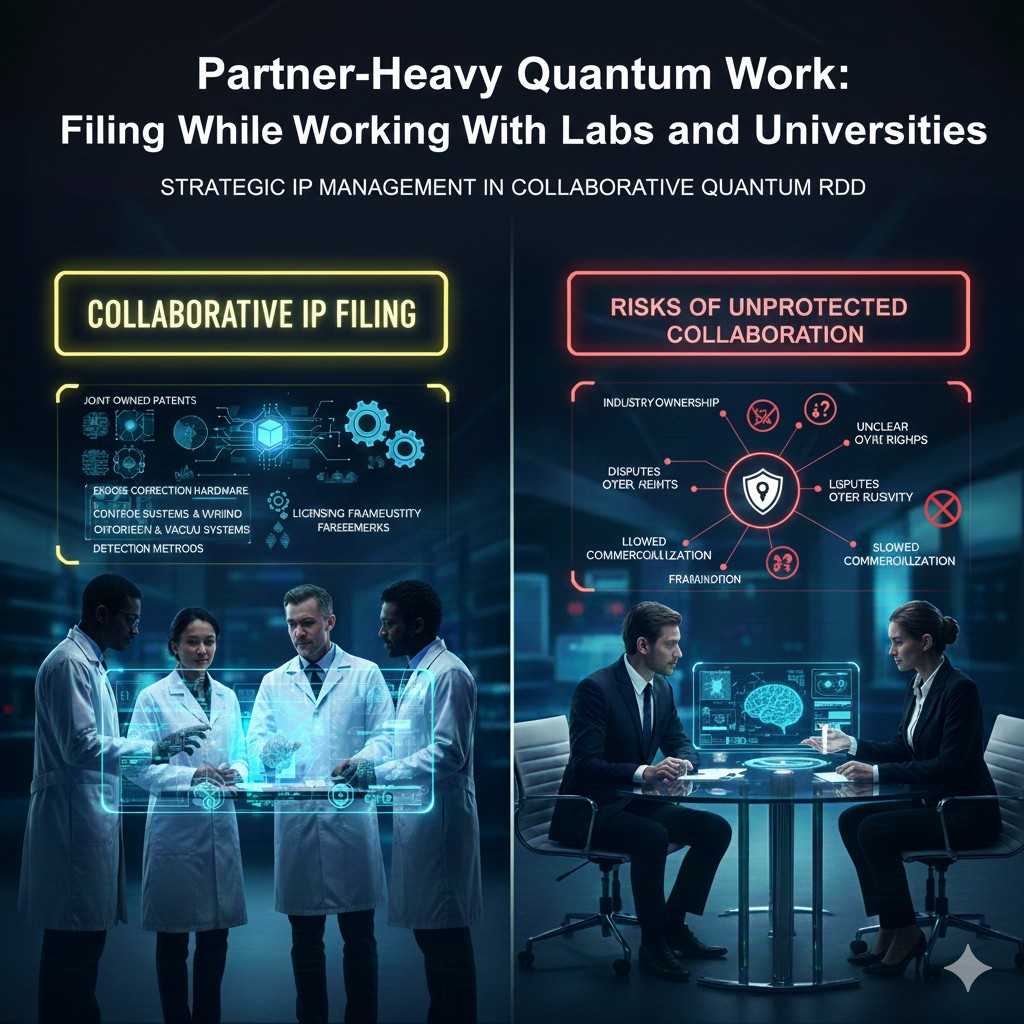
Quantum startups often come from universities.
They also partner with national labs and hardware suppliers. This is normal. But it creates a sharp risk: who owns the invention?
If a student, professor, or contractor contributed to the inventive step, your patent ownership must be clean. If it is not, the patent can become hard to enforce, or even invalid in some cases.
This is why early paperwork is part of early IP.
Invention assignment agreements, clear contractor terms, and careful handling of background IP are not “legal extras.” They are core to building a defendable company.
The win: early filings help you negotiate from strength
When you file early, you create a record.
You can show what your team invented and when. That makes licensing and partner talks easier. It also protects you from “we thought of that too” conversations later.
If you are spinning out from a lab, early filings can help define the boundary.
They can help you separate what belongs to the university and what is your company’s new work. That clarity reduces future conflict.
Tran.vc supports founders through these early, sensitive steps. If you want help building clean ownership and a smart filing plan while you work with partners, apply here: https://www.tran.vc/apply-now-form/
The first practical exercise: find your first 1–2 filings without guessing
Start from your last three hard problems

Here is a simple approach that works well for early quantum teams.
Look back at the last three hard problems your team solved. Not the easy ones. The ones that took weeks. The ones where you felt stuck. The ones where the solution surprised you.
Those solutions often contain the best early IP.
Because they usually include a real technical step, not just an idea. They also tend to be closer to performance impact, which helps you write stronger patents.
Now ask a very specific question for each solution.
If a competitor copied only this solution, would it save them months? Would it improve their system? Would it help them win a customer? If the answer is yes, you likely found a filing candidate.
Next, try to describe the idea in plain language.
What is the input, what do you do, what do you output, and why is it better? If you can explain it clearly, it is much easier to turn it into a patent draft.
This exercise is also great because it keeps you honest.
You are not filing because you “should.” You are filing because it protects something that was costly to learn and meaningful to performance.
A note on secrecy vs. patenting in quantum
When a trade secret may be smarter early on
Some quantum know-how is fragile.
It depends on a specific lab setup, specific equipment tuning, or small details that are hard to capture in a patent. If you publish a patent on it, you might give away the path for others to recreate it.
In those cases, keeping it private can be the better move.
But trade secrets only work if you treat them seriously. That means access control, clean documentation, and careful sharing rules.
When patenting is the better early move
If the idea is easy to reverse engineer, patent it.
If a buyer or partner will require you to explain the method to validate it, patent it. If the idea is likely to appear in a paper or talk, patent it before you share.
Also, if your edge is a system or workflow that others can implement once they understand it, patenting early can block them.
Many quantum teams end up with a mixed approach.
They patent the broad method and keep certain parameters and implementation details as secrets. That way they protect the concept and also keep a private edge.