
When you build a robotics startup, you are not just building a machine. You are building a new way to solve a hard problem in the real world. And if that way is truly new, you should protect it early. A good patent plan is not “paperwork.” It is how you keep your edge when someone bigger notices you.
This guide will walk you through what to file first, and why. I will keep it plain, practical, and focused on what helps you win. If you want Tran.vc to help you turn your robotics work into real, defensible IP, you can apply anytime here: https://www.tran.vc/apply-now-form/
Introduction: file the right thing first
Most founders file too late, or they file the wrong thing first.
They wait until the product “looks ready,” even though the core idea was already clear months ago. Or they rush to file a patent on the full robot, when the real value is in one small part of the system that makes it work better than anything else.
Here is the truth: in robotics, the first patent should usually cover the part that is hardest to copy without doing the same deep work you did.
That “part” might be a control method that makes motion smooth, a way to fuse sensors so the robot can see in bad light, a gripper design that handles odd shapes without dropping, or a safety method that lets humans and robots work close together. It might even be how you collect data and use it to make the robot learn faster.
A good first filing does two jobs at once. It protects what matters most, and it gives you room to grow. It makes later patents easier. It gives investors a clean story. And it keeps you from being boxed in by someone else’s patents later.
Robotics Patents: What to File First in a Startup
Your first filing should protect the “unfair” part of your robot
In robotics, many pieces look similar from the outside. A wheeled base is a wheeled base. A six-axis arm is still an arm. Cameras, lidar, and depth sensors show up everywhere. If you file a patent that mostly describes the full robot as a whole, you often end up with weak coverage. It looks broad, but it is easy for others to “design around.”
A better first filing protects the exact thing that makes your robot work when others fail. This is the part that took real thinking and real testing. It is usually a method, not a shape. It is often a mix of software and hardware working together in a special way. That is where copycats get stuck, because they cannot simply buy parts and match your results.
If you are not sure what your unfair part is, look for the moment where your team said, “This is the breakthrough.” That moment is usually your first patent. It is the piece that turns a demo into a product, and it is the piece investors care about most.
If you want Tran.vc to help you spot that unfair part and turn it into a strong filing, you can apply anytime here: https://www.tran.vc/apply-now-form/
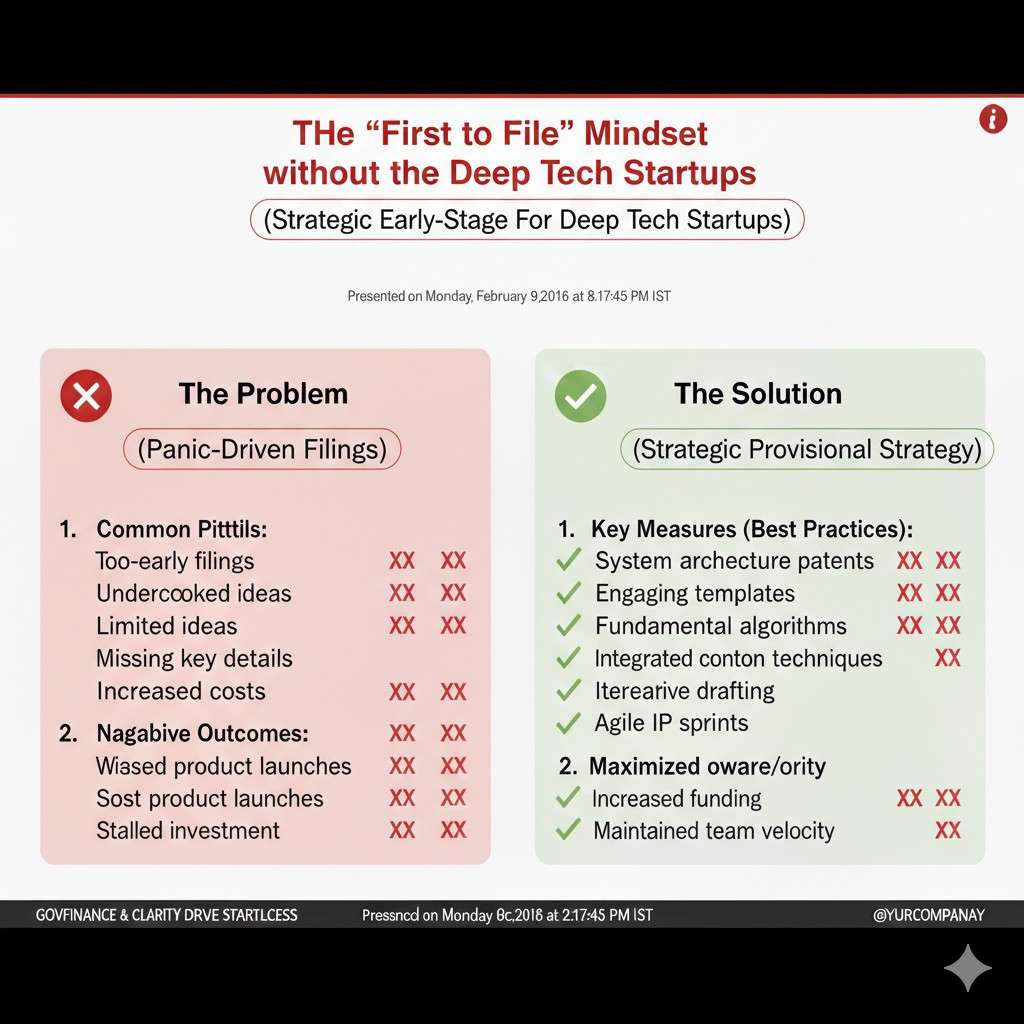
The “first to file” mindset without the panic
Many founders hear “first to file” and think they must rush. Rushing is how you file a thin patent that does not hold up later. The goal is not speed at all costs. The goal is to file early with enough detail that your core idea is clearly yours.
A good rule is simple. File when the core method is stable in your mind, even if the product is not finished. You do not need perfect hardware. You do not need final industrial design. You need a clear story of how your system works, why it is different, and what steps make it achieve the result you claim.
You can still iterate after filing. In fact, most robotics teams do. The point of the first filing is to put a flag in the ground, so your later work grows from a protected base.
A strong first patent should be hard to avoid
A weak patent is one where a competitor can change one small piece and walk away. A strong patent is one where avoiding it forces them to lose the main benefit. That is why your first filing should be built around the cause of the performance, not the outer form of the robot.
For example, if your robot can pick soft items without damage, the patent should not only describe a gripper that looks unique. It should describe the sensing, the control loop, the pressure rules, the timing, and the way the gripper adapts across items. That is what makes the result real, and that is what others will struggle to copy without stepping on your claims.
This approach also helps you later. When you improve hardware, you can file follow-on patents that still connect back to the same protected core.
Picking the first filing: start with your “value engine”
Think like an investor for five minutes
Investors do not fund robots because they look cool. They fund robots because they can win a market and keep winning. That comes from a value engine. The value engine is the method that turns inputs into a business outcome.
In a warehouse robot, the business outcome might be faster picks with fewer errors. In a field robot, it might be precise work with less waste. In a home robot, it might be safety and trust. Your first filing should tie to that outcome, because that is what makes the patent meaningful. A patent that does not support the business outcome is usually a vanity asset.
When you choose what to file first, ask one question: “If a competitor copies only one thing, what would hurt us most?” That “one thing” is your first filing candidate.
The difference between “features” and “foundations”
Robotics teams often get excited about features. A nicer UI, a smoother dashboard, a slicker enclosure, a new mode in the app. These can matter, but they rarely belong in the first patent unless they are tied to a real technical method.
Foundations are different. Foundations are the parts you cannot remove without breaking the system. Foundations include sensing pipelines, data processing steps, control logic, motion planning constraints, safety methods, calibration flows, and special mechanical layouts that enable the method.
Your first patent should focus on foundations. Features can come later, and often they change fast in early product cycles. Foundations change slower, and that makes them safer to protect early.
A simple way to rank your patent ideas
Most startups have more than one patent idea. The trap is trying to file everything at once. That drains time, money, and focus. You want one strong first filing, then a clear sequence after.
Rank ideas by three things. First, how central the idea is to performance. Second, how easy it is to detect copying from the outside. Third, how hard it would be for a competitor to recreate without your knowledge and data. The best first filing scores high on all three.
If you want help doing this ranking in a clean, founder-friendly way, Tran.vc can guide you through it as part of the in-kind IP support. Apply anytime here: https://www.tran.vc/apply-now-form/
The robotics areas that usually deserve the first patent
Control methods that create smooth, safe, reliable motion
In many robots, the true product is not the metal. It is the motion quality. If your robot moves in a way others cannot, that is often a great first patent. This includes control loops that handle contact, slip, vibration, and changing load in a stable way.
A control patent becomes strong when it explains the steps clearly. What signals you read, how you filter them, how you set targets, how you adjust gains, and how you detect risk. The patent should show how the method reacts in edge cases, because that is where the real value is.
Control patents also age well. Hardware changes, but control logic often stays at the core. That is why many robotics leaders build a big part of their moat around control.
Perception pipelines that work in messy real life
Perception is where many demos die. Bad lighting, glare, dust, rain, reflective surfaces, motion blur, and clutter can make “lab vision” fail quickly. If your team found a way to perceive reliably in the real world, you should treat that as prime IP.
A strong perception filing is not just “we use a neural network.” It explains the full pipeline. How data is collected, cleaned, aligned, and used. How multiple sensors are combined. How you handle uncertainty. How you decide when to ask for more data. How the robot changes behavior when the view is poor.
This is also where your training and data strategy matters. You often cannot patent raw data, but you can often patent the method of gathering it, labeling it, and using it to improve performance in a specific robotic setting.
Planning methods that turn limits into an advantage
Motion planning in robotics is full of tradeoffs. Speed versus safety. Smoothness versus precision. Energy use versus time. If your system makes a special tradeoff that improves the business result, that can be a very strong first patent.
This might be a method that plans paths while accounting for payload shift. Or a method that plans grasps using a short set of “good enough” checks that work faster than full physics simulation. Or a method that re-plans in real time when people are nearby.
The best planning patents are easy to explain, but hard to reproduce. They often include rules that come from real testing in a hard environment.
Mechanical designs that enable a method, not just a shape
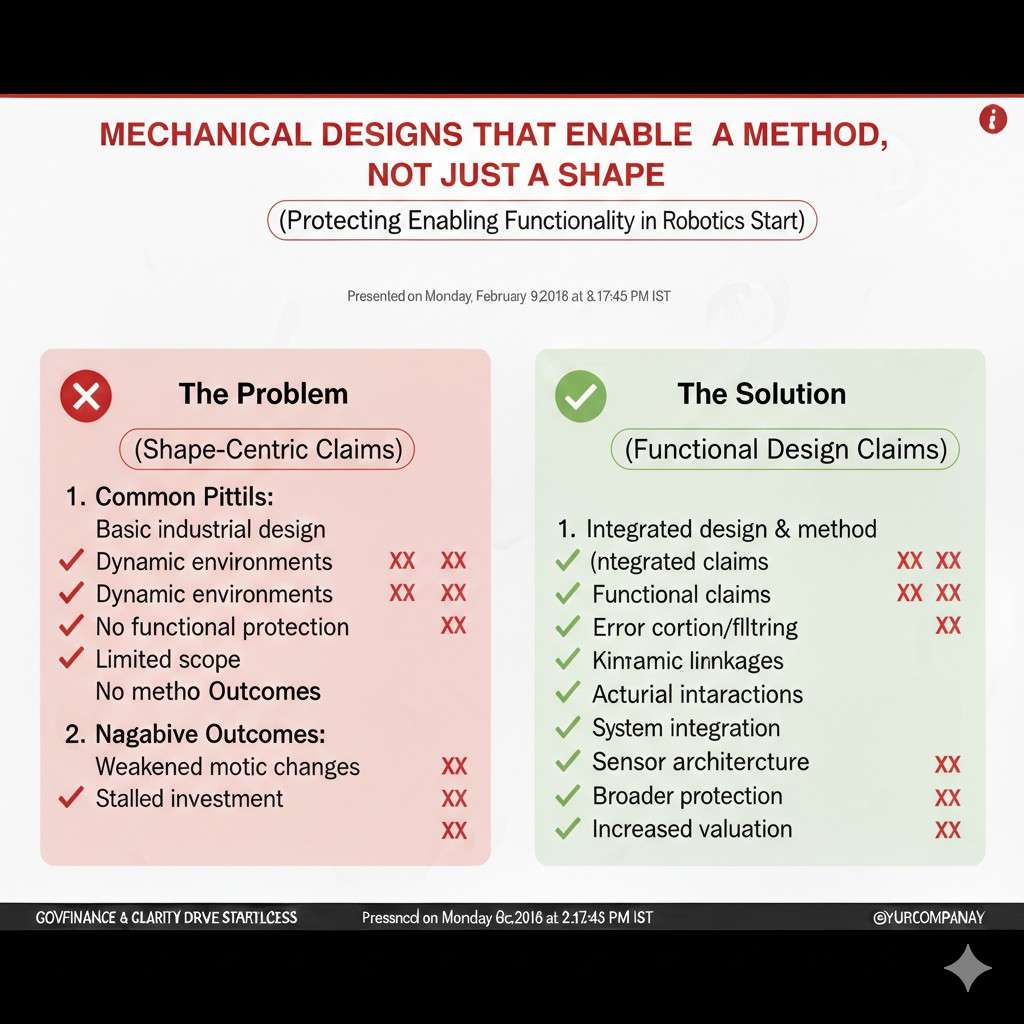
Many founders assume mechanical patents are always the first step. Sometimes they are. But the best mechanical patents in robotics are usually tied to a method. A new linkage that makes a motion possible. A gripper that changes stiffness in a simple way. A joint design that keeps accuracy while staying low cost.
If the mechanical part is the reason your method works, it can be an excellent first filing. The key is to avoid a patent that only protects a single exact shape. You want to protect the function and the relationships between parts, so small cosmetic changes do not bypass your coverage.
Safety and human interaction methods that unlock adoption
If your robot works near people, safety is not a nice extra. It is the product. Many robotics startups win because they make robots predictable, safe, and trusted, not because they are the fastest in an empty room.
Safety patents can cover how you detect people, how you limit force, how you confirm intent, how you stop, and how you recover. They can also cover the rules that let the robot work close to humans without annoying them or slowing everything down.
These patents also help in sales. Buyers often want to know you built safety into the core. A good patent story can support that message.
What not to file first, even if it feels tempting
The full robot system description without a sharp core
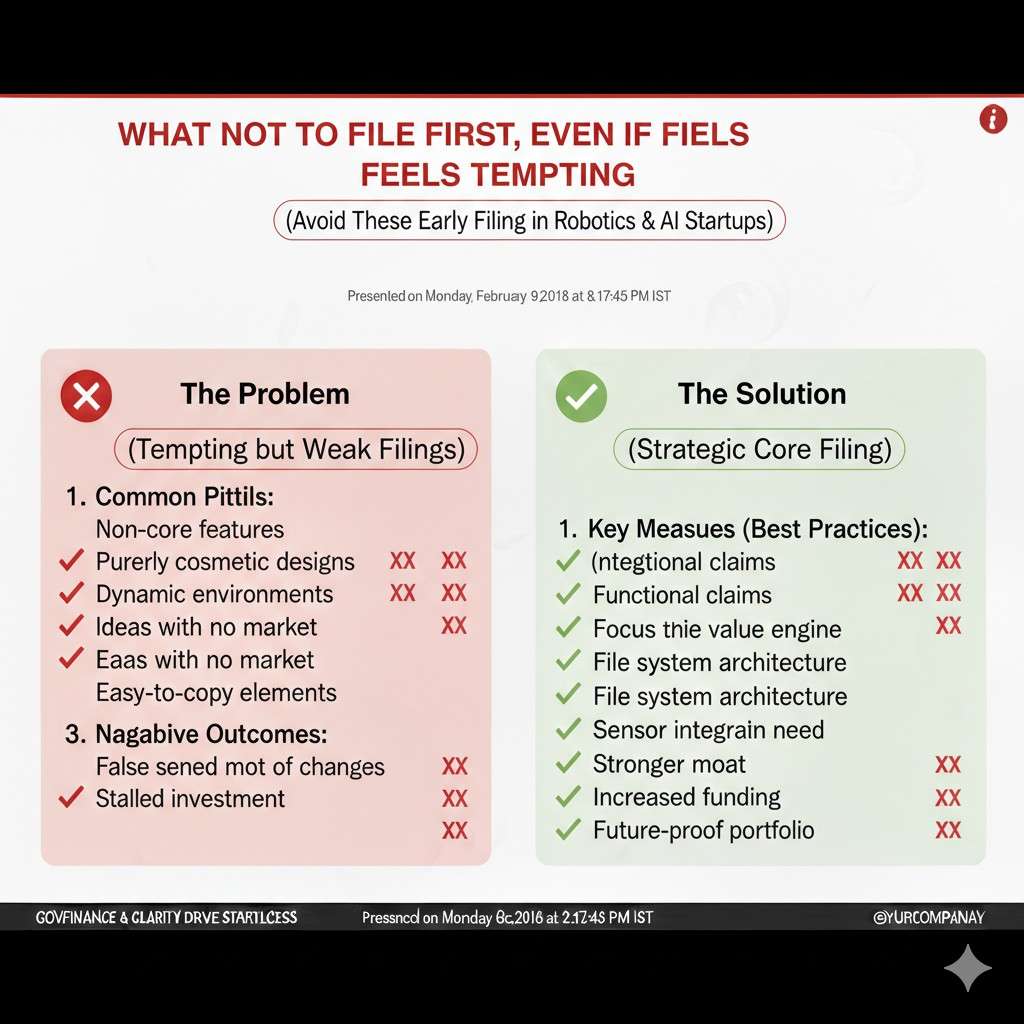
A “big umbrella” patent that describes the whole robot can sound impressive. But if it lacks a clear novel method, it often does not protect much. Patent examiners and competitors both look for what is truly new. If the novelty is scattered, claims tend to become narrow.
You can still file system-level patents later, once you have a tight set of core inventions to anchor them. Think of your first patent as the trunk, not the leaves.
A patent that depends on a vendor part
If the “new idea” is mostly a special setting of a vendor sensor, or a known library, or a standard robot arm, it is risky as a first filing. It can be hard to defend, and it may not map to a durable moat.
That does not mean you cannot patent around vendor parts. You can, if your method uses them in a new way. But your first filing should not stand or fall based on something you do not control.
UI, dashboards, and “workflow” claims without real technical steps
Many startups try to patent the user flow. In robotics, that can be weak unless it is tied to a technical solution that improves the robot’s real-world performance.
If your UI is the key to safety, calibration, or reliability, you might have something. But if the UI is mainly convenience, it is usually not the first filing. You want to protect the core technical work first.
How to turn your first invention into a patent that holds up
Write it like you are teaching it to a smart engineer
A good first patent reads like a clear technical lesson. It explains the problem in the real world. It explains why older methods fail. Then it explains your method step by step, with enough detail that another skilled person could build it.
Founders sometimes fear that detail gives away secrets. In patents, detail is the price of protection. If you are too vague, you may not get meaningful claims. The art is sharing enough to secure coverage, while keeping certain implementation choices as trade secrets when that makes sense.
This is one reason working with experienced patent counsel matters. The goal is not “write more.” The goal is “write the right details” so your claims can be strong.
Show variations so competitors cannot escape
The easiest way to weaken your own patent is to describe only one narrow version of the idea. Competitors love narrow patents. They change one part and move on.
Your first patent should include variations. Different sensor types. Different thresholds. Different ways to compute the same signal. Different placements of key parts. Different timing rules. Different ways to train or tune the model. This does not mean writing a messy document. It means showing that your idea is a family, not a single point.
When you include variations early, later filings become easier too. You already established a broad base.
Tie claims to outcomes, but do not make promises you cannot support
A patent should connect the method to a result. But it should not claim magical performance you cannot reasonably justify. If you claim more than you can support, you risk problems later.
It is better to describe the outcome in a careful way. For example, “reducing slip events,” “improving stability,” “reducing calibration time,” “increasing detection confidence,” or “limiting contact force.” These are grounded outcomes. They also map to real buyer value.
If you have test results, you can mention examples in the patent, but you do not need to publish your whole dataset. You mainly need enough examples to make the invention feel real and repeatable.
Build a filing sequence, not a one-off
The first filing is the start, not the finish. The best robotics IP plans are a sequence. First you protect the core method. Next you protect key improvements. Then you protect special hardware, calibration flows, safety layers, deployment tools, and data loops.
A simple plan is to aim for a core filing now, then add follow-ons as you hit real milestones. The goal is to keep your IP aligned with your product progress, so every new lesson becomes an asset.
Tran.vc is built for this style of founder-led IP building. If you want hands-on help from people who have done this before, apply anytime here: https://www.tran.vc/apply-now-form/
The practical “first filing” choices for common robotics startups
If you build warehouse or factory robots
For these robots, reliability and throughput matter more than flash. First filings often succeed when they cover perception in clutter, fast planning under constraints, safe navigation near people, and grasping methods that reduce drops.
If your robot handles many item types, your first filing should often focus on the method that generalizes across items, not the special case for one SKU. The buyer cares about broad coverage, and so should your patent strategy.
If you build field robots for farms, construction, or outdoors
Outdoor robotics is harsh. Lighting changes. Weather hits sensors. Terrain shifts. Vibration is constant. A first filing often belongs in perception robustness, terrain adaptation, slip detection, and control methods that handle uneven ground.
If you found a way to keep performance stable with cheap sensors, that can be an excellent first patent. Cost matters a lot in these markets, and protecting the method that enables low-cost reliability can be a strong moat.
If you build medical, lab, or high-precision robots
Precision robotics often lives and dies by calibration, error correction, and repeatability. A strong first filing might cover a calibration method that is faster, safer, or more accurate. It might cover how you detect drift and correct it without stopping the system.
In these settings, compliance and safety can also drive adoption. Patents that protect safety methods and verification steps can help you stand out, especially if they reduce time to deploy.
If you build home or consumer robots
In the home, trust is everything. A first filing might cover how your robot understands messy rooms, how it avoids people and pets, how it handles unknown objects safely, or how it learns routines without invasive data use.
Consumer robots also face strong copy pressure. That is why the first filing should be something hard to see from the outside. If a competitor can copy it by buying your robot and looking at it, your patent may not buy you much time.
How Tran.vc fits into this, without slowing you down
The goal is speed with quality, not delay
Early founders often avoid patents because they fear distraction. That fear is valid when the process is slow and confusing. A good IP partner removes the drag. The work should feel like a focused sprint, not a long detour.
Tran.vc’s model is built for early teams. They invest up to $50,000 in in-kind patent and IP services so you can protect the core without burning your cash. The aim is to help you file the right first patent, then build a clear roadmap for follow-ons as your product matures.
If you want to explore this path, apply anytime here: https://www.tran.vc/apply-now-form/
The hidden advantage: a cleaner story when you raise
Robotics fundraising is hard. Investors want proof that your tech is real, and proof that it can be defended. A well-built first filing helps with both, because it forces clarity.
When you can explain your invention in a clean way, your pitch improves. When you can show an IP strategy that matches your technical plan, you look more prepared. That does not replace traction, but it reduces doubt.
A strong first filing is also a signal that you understand the game. You are not just building. You are protecting what you build.