
Robots are moving out of labs and into real places: factories, warehouses, hospitals, farms, and even homes. That’s exciting. It also means one thing becomes non-optional fast: safety.
If you’re building a robotics startup, safety standards are not “paperwork for later.” They shape your design today. They affect what you can sell, where you can deploy, and how fast customers will say yes. They can also decide whether a single incident becomes a small lesson—or the end of your company.
This guide will walk you through what robotics safety standards really mean in plain language, what founders must watch for early, and how to build safety into your product without slowing down. I’ll keep the intro short, then we’ll get tactical right away.
And if you want help building an IP plan while you build safety the right way, Tran.vc invests up to $50,000 in in-kind patent and IP services for robotics and AI founders. You can apply anytime here: https://www.tran.vc/apply-now-form/
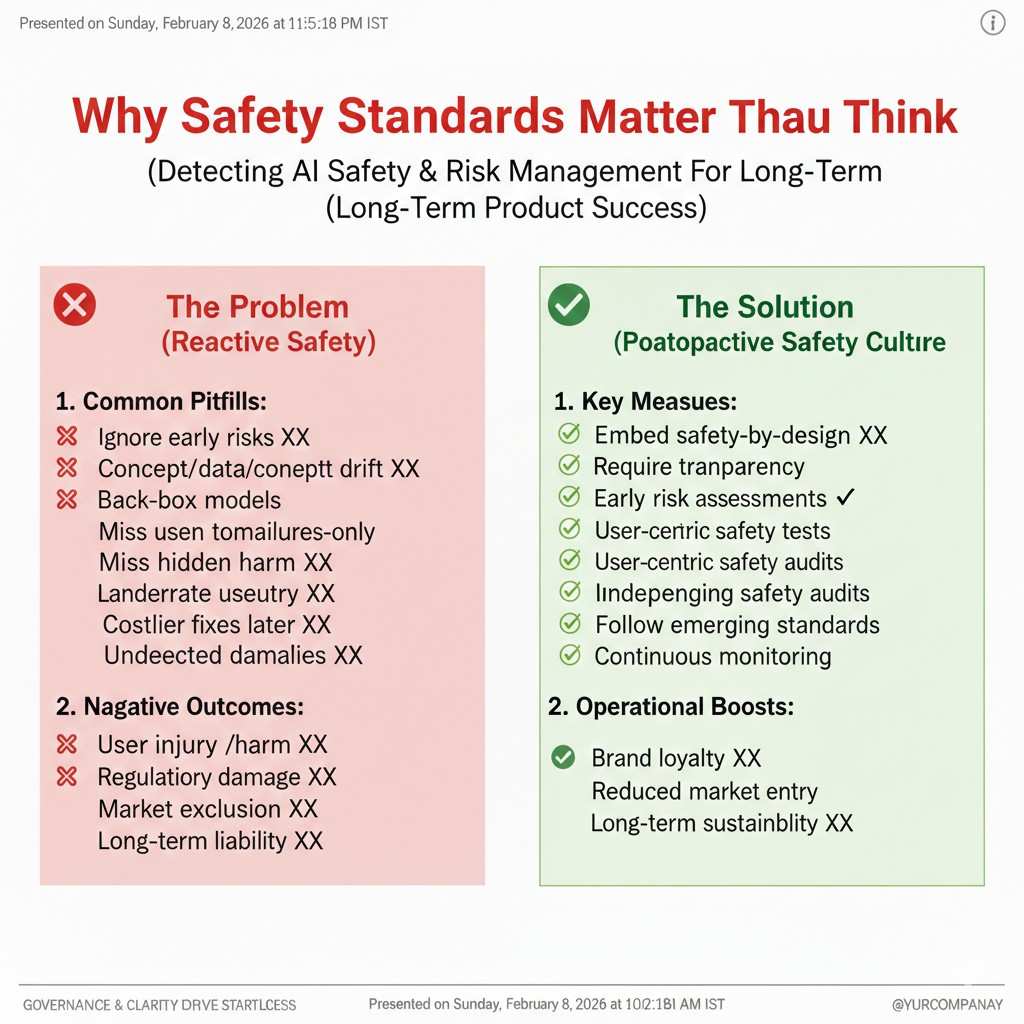
Why safety standards matter more than you think
Standards are a shortcut to trust
When a buyer looks at your robot, they are not only buying speed or accuracy. They are buying peace of mind. They want to know the robot will not hurt their people, break their site, or shut down their operations.
Safety standards act like a shared language. They tell customers, insurers, auditors, and partners that you built your system with known rules in mind. That makes decisions faster, because you are not asking them to “just trust you.”
If you want to sell into real businesses, standards help you cross the first big wall: vendor risk. Many pilots die here. A founder thinks the tech is the hard part. The buyer thinks safety and liability are the hard part.
Safety is also a growth tool
Safety work is not only about avoiding harm. It is also how you unlock bigger deals. The moment you pass a safety review cleanly, you can expand to more sites, more shifts, and more use cases.
If you ignore safety early, you will still have to do it later. The difference is that later you will be under pressure. You will be patching a system that is already shipped, already installed, and already promised to customers.
Founders who treat safety as a product feature move faster in the long run. They build fewer “dead ends,” and they avoid sudden rework that drains runway.
Standards reduce legal and business risk
If an incident happens, people will ask a simple question. Did you follow accepted safety practice for your kind of robot? Standards do not stop lawsuits by themselves, but they help show that you acted responsibly.
Also, standards help your customer’s legal team. Many corporate buyers have rules that require alignment with certain standards before they can sign. If you can speak clearly about this, you can turn legal from a blocker into a checkbox.
This is also where IP matters. Your safety design choices can become part of your moat. If you create a strong safety method that improves performance, that can be patentable in many cases. Tran.vc helps robotics founders turn these real design wins into real IP assets. Apply anytime: https://www.tran.vc/apply-now-form/
What “a standard” really is in robotics
Standards are not laws, but they influence laws
A standard is a set of agreed rules and tests. It is usually written by groups of experts from industry, labs, and regulators. In many places, standards are not laws by default.
But here is the key point: laws often point to standards. Also, contracts often point to standards. And insurance reviews often point to standards.
So even if a standard is “optional” on paper, it becomes “required” in the real world once you start selling.
Standards tell you what “safe enough” looks like
Safety is tricky because “safe” is not a yes or no word. A robot always has some risk. Even a door has risk. The real question is whether the remaining risk is low enough and well controlled.
Standards help you answer that. They describe common hazards. They explain how to reduce risk. They also show how to test and document your choices.
This matters because customers do not want a debate. They want a clear, repeatable way to check safety. Standards give them that.
Standards come with paperwork, but the paperwork has a purpose
Many founders dislike safety docs because it feels slow. But good documentation is not about pleasing a reviewer. It is about making your system easier to build, fix, and scale.
When you document hazards, you are teaching your team what to watch for. When you document controls, you are creating a playbook for new sites and new users.
If you grow fast, you will hire new engineers. You will ship new versions. You will expand into new places. Docs keep safety from living only in one person’s head.
The big idea behind most robotics safety standards
Start with hazards, not features
Founders love features. Safety starts somewhere else. It starts with hazards. A hazard is anything that can cause harm.
In robotics, hazards can come from motion, force, heat, sharp edges, electric power, stored energy, noise, or even software mistakes that make the robot act in a wrong way.
The best early move is to list hazards tied to your real use case. Not “robots in general,” but your robot in your customer’s site, around their people, with their workflow.
Risk is about harm and chance
Most standards use a risk idea that looks like this: how bad could the harm be, and how likely is it to happen. You reduce risk by reducing harm, reducing chance, or both.
This leads to practical design choices. You may reduce speed near humans. You may limit force with torque control. You may add soft covers. You may add sensors that detect a person and stop motion.
It also leads to process choices. You may require training. You may require a site survey. You may restrict use in some zones.
Use layers, not one “magic” safety feature
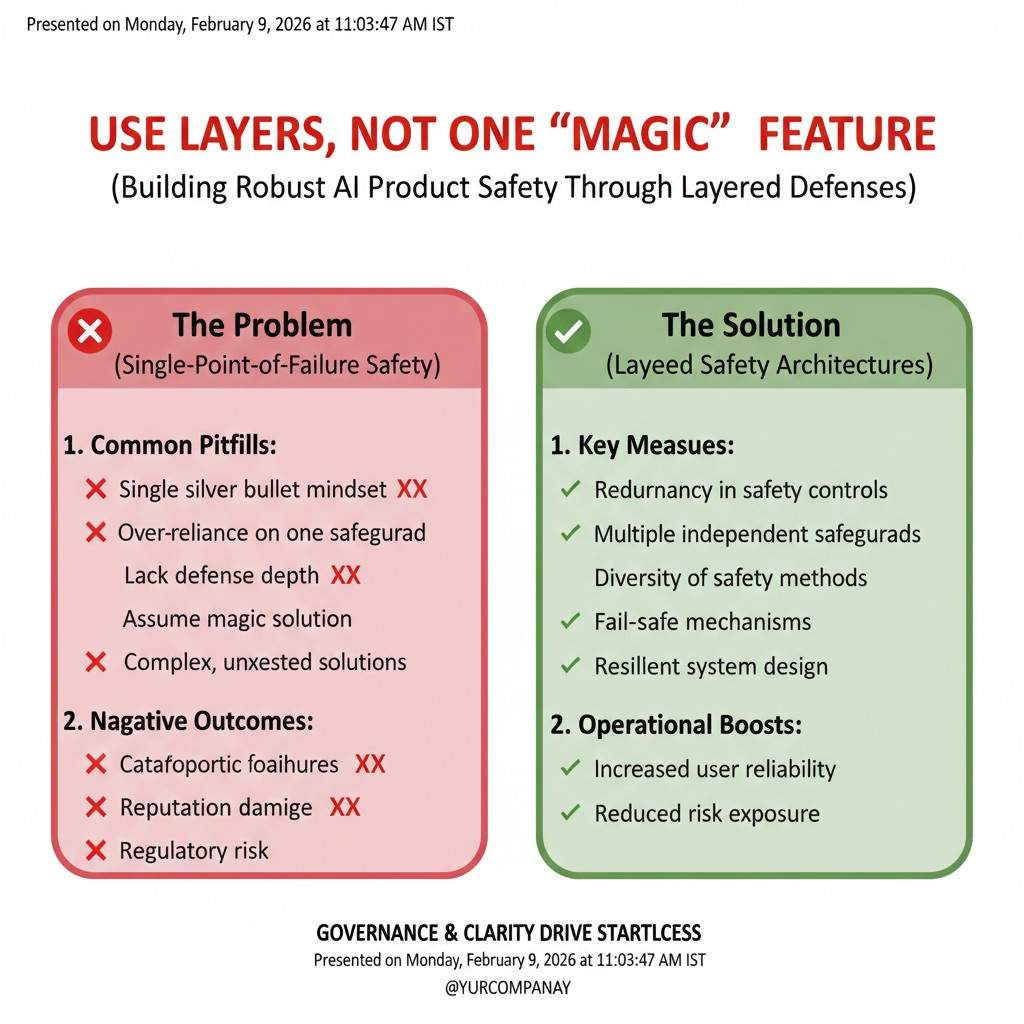
A common founder mistake is betting on one safety trick. Real safety is layered. If one layer fails, another layer still protects people.
Think in terms of: safe design first, then protective measures, then warnings and training. If your design itself is safer, you rely less on signs and rules that people forget.
In the field, humans are tired, rushed, and distracted. Your safety plan must assume that.
Define what “normal” is, then plan for “not normal”
Robots operate in messy places. Floors get wet. Lighting changes. Wi-Fi drops. People step into the path. Forklifts appear. A box falls.
Standards push you to think about both normal use and reasonably expected misuse. That does not mean you must plan for every crazy thing. It means you must plan for common mistakes and common surprises.
This is where good founders stand out. They don’t build for the demo. They build for real life.
The safety standards you will hear about most often
ISO standards are the common starting point
In many robotics deals, you will hear about ISO standards. These are widely used across countries and industries.
For founders, the practical point is not memorizing standard numbers. The point is knowing that buyers may ask, “Which safety standard are you designing to?” and expecting a clear answer.
If you cannot answer, you will look early-stage in a risky way, even if your tech is strong.
Industrial robots vs mobile robots vs service robots
Safety expectations change based on robot type. A robot arm behind a fence has a different risk picture than a mobile robot moving near people.
A warehouse mobile robot must handle foot traffic and tight aisles. A hospital robot must handle public spaces and people who may not be trained. A factory arm may move fast and carry heavy loads.
You should be able to explain what category you fit in and why. This also affects your safety testing plan.
Collaborative robots need special care
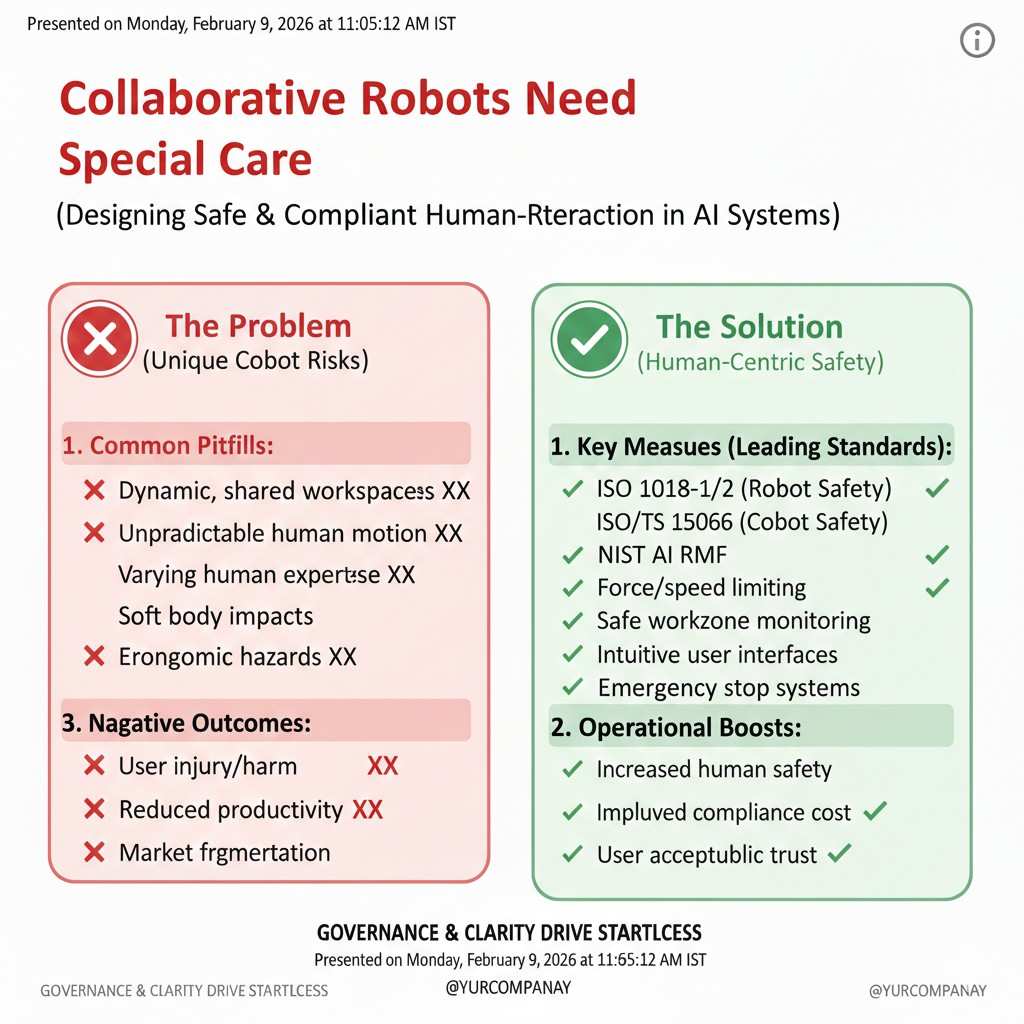
Many founders say “collaborative” because it sounds friendly. In safety terms, “collaboration” means the robot can operate near people with specific limits and controls.
If you claim your robot can work beside humans, you must prove how you control speed, force, and contact. You also must show how you detect people, how you stop, and what happens if sensors fail.
A buyer will not accept “we use AI vision” as a full answer. They will want to see how the system stays safe even when vision is wrong.
What founders should do in the first 60 days
Write a safety story that matches your use case
Before you write a single long document, write your safety story in plain words. Explain where the robot will be used, who will be near it, what it will touch, and what could go wrong.
Then explain your safety choices. Why is the robot safe around people? What limits do you enforce? How do you stop motion? How do you control access to high-risk actions?
This becomes the base for everything: sales, product, design reviews, and future audits.
Build a hazard log that your team actually uses
A hazard log is a living list of hazards and controls. The best hazard logs are not huge. They are clear, specific, and updated often.
Each hazard should connect to a real event, like “robot turns into a walkway when avoiding an obstacle.” Then connect it to a control, like “speed limit in shared zones” plus “stop when person detected inside a defined distance.”
Over time, your hazard log becomes your map. It shows what you already solved and what still needs work.
Decide early: safety-rated parts or not
Some parts and functions are “safety-rated,” meaning they meet strict rules for reliability. Examples can include certain sensors, safety controllers, emergency stop circuits, and protective devices.
Safety-rated parts can cost more, but they can reduce argument and risk. If you are selling into strict buyers, safety-rated choices can shorten the time to approval.
If you are in a lighter market, you may still choose safety-rated parts where it matters most. The key is to decide intentionally, not by accident.
Create a simple test plan that proves your controls work
Safety is not a claim. It is evidence.
You should define how you will test each safety control. For example, if you say the robot stops within a certain distance, you should measure it under real conditions. If you say it slows near people, show the speed change and how it triggers.
You do not need a huge lab to start. You need a repeatable way to test, record results, and learn.
How safety connects to IP and fundraising
Safety work creates unique methods you can protect
Many robotics teams invent new ways to reduce risk while keeping performance high. That can be real innovation.
Examples can include better motion planning limits, better human detection logic, better fault handling, safer grippers, or safer ways to hand off objects.
When you treat safety as a design challenge, you often create technical solutions that competitors will want to copy. That is when patents can matter.
Tran.vc is built for this exact point. They invest up to $50,000 in in-kind patent and IP services so you can protect what you are building while you build it. You can apply anytime here: https://www.tran.vc/apply-now-form/
Investors want fewer “unknowns”
Investors may not read standards, but they understand risk. If you can show a clear safety plan, you reduce a major unknown.
A strong safety approach signals maturity. It shows you can sell into real markets. It shows you can handle compliance, audits, and customer reviews.
That makes your story stronger, even at pre-seed.
How to choose the right standards for your robot
Start from where the robot will live
The fastest way to get lost is to start by reading random standards. The fastest way to get clear is to start with the place your robot will operate.
Ask yourself what the robot will do all day. Will it move heavy loads in a warehouse. Will it work beside people on an assembly line. Will it roll through hallways around patients and visitors. Will it be used outdoors, on uneven ground, in dust and rain.
Each setting pulls you toward a different set of safety expectations. The same robot can need different controls when it moves from a controlled factory to a public space.
When you begin with the setting, you stop guessing. You can map safety needs to real hazards that will show up in the field.
Let your first customers guide you, but do not let them guess
Early customers can be your best compass. Many will already have internal safety rules, site policies, and preferred standards.
The mistake is asking them, “What standard should we follow?” because many buyers do not want to own that answer. They want you to bring a plan.
A better approach is to say, “Here is the safety framework we are using for this type of robot and use case. Here are the controls we built. Here is the proof we can share. Are there any site rules we should align with?”
This frames you as a capable vendor. It also reduces the chance of a late surprise from their safety team.
Separate “product safety” from “site safety”
Founders often mix these together and it creates confusion in reviews.
Product safety is what your robot does by design. This includes limits on force, speed, access control, emergency stop behavior, fault detection, and safe shutdown.
Site safety is how the robot is used in a specific facility. This includes floor markings, training, traffic rules, and where the robot is allowed to go.
You need both. But you should be able to explain what is built into the robot versus what depends on the customer’s site practices. If you blur this line, you can end up promising safety based on rules that customers may not follow.
Plan for the strictest reasonable path early
A common startup trap is choosing the easiest safety route for pilots, then discovering later that your target customers require a stricter approach.
If your long-term goal is to sell to large factories, logistics firms, hospitals, or big retailers, assume you will face strict checks. Plan for that now, even if your first pilot is “friendly.”
This does not mean you build a perfect compliance machine on day one. It means you avoid design choices that will block you later, such as using non-safety-rated stop behavior when you will eventually need a safety-rated stop chain.
The safety mindset that prevents the most incidents
Treat software as part of the safety system
In robotics, software is not just “features.” Software decides motion, perception, planning, and response. That means software mistakes can create real hazards.
A safety mindset treats software changes as safety changes. It treats updates as risk events. It also treats machine learning models as components that can fail.
This matters because many robotics incidents do not happen due to a broken bolt. They happen due to a wrong assumption in code, a missed edge case, or a change that was not tested in the right way.
Design for failure, not only for success
Robots fail. Sensors get dirty. Cameras get glare. Encoders drift. Wheels slip. Batteries sag. Networks drop.
A safe robot is one that fails in a safe way. If the robot is unsure, it should slow down, stop, or move to a safe posture. If a sensor becomes unreliable, it should detect that and change behavior.
Founders who only test “happy path” demos end up shipping a robot that acts bold when it should act cautious.
A practical rule helps here. If the robot needs a signal to be safe, you should assume that signal can disappear. Then ask what the robot does next.
Make “safe state” a real, tested thing
Many teams say “the robot stops” as the safe state. But “stop” is not one action.
Does the robot cut motor power. Does it brake. Does it hold position. Does it coast. Does it drop a payload. Does it keep a gripper closed.
A safe state must be defined for your robot and your task. A robot carrying a heavy box has a different safe state than a robot with a sharp tool. A mobile robot on a slope has a different safe state than one on flat ground.
Define the safe state in plain words. Then test it in real situations, not only in a clean lab.
Core hazards that show up in most robots
Impact and crushing risk in motion
Any moving robot can hit a person. The harm depends on speed, mass, shape, and stopping distance.
Many teams focus only on top speed. But impact risk also comes from how fast you can stop, and how predictable your path is.
If your robot uses path planning, you need to think about sudden turns, tight spaces, and how the robot behaves when it meets a new obstacle. A robot that “wiggles” to solve a path can surprise a human. Surprise is a safety risk.
If your robot is mobile, study pinch points around walls, racks, and corners. If your robot is an arm, study pinch points around joints, fixtures, and the workspace boundary.
Entanglement and snagging risk
Cables, straps, loose clothing, long hair, and even jewelry can get caught. This is more common than many founders expect, especially in warehouses and factories.
Simple mechanical design choices help a lot here. Smooth surfaces, covered moving parts, and thoughtful routing of cables can reduce snag hazards.
Also think about the payload. If your robot handles bags, shrink wrap, or flexible materials, those can wrap around wheels or joints. When that happens, the robot can behave in strange ways.
Electrical, thermal, and battery hazards
Robots often carry high power systems. Batteries can heat up. Chargers can fail. Cables can rub and short.
Safety is not only about human contact with moving parts. It is also about preventing fire, smoke, and shocks.
If you use lithium batteries, you need clear rules for charging, storage, and detection of abnormal heat. If you ship to customers, you will also face shipping rules, and customers may ask for clear procedures.
Even if you are not writing those procedures yet, you should start capturing what “normal” looks like for your battery temperature and current draw.
Tooling hazards when you add attachments
A robot with a simple gripper is one thing. A robot with a blade, needle, laser, hot surface, or high-force tool is another.
Many startups add tools later to expand use cases. This is where safety risk can spike.
If you plan to add tools, design your platform with a safety boundary in mind. For example, your base robot might be safe around people, but a specific tool might require a guarded zone or restricted mode.
If you do not separate these levels, you can lose your “safe around humans” story the moment you add one attachment.
How to build safety into motion control without killing performance
Use speed and separation as your first lever
One of the simplest and most effective safety ideas is this. When the robot is far from people, it can move faster. When it is near people, it must slow down.
To do this well, you need a reliable way to estimate where people are, where the robot will move next, and how long it takes to stop.
This is not only sensors. It is also how you define zones. You can define “shared space” zones and “robot only” zones. You can also define “approach” zones where the robot smoothly reduces speed rather than stopping suddenly.
Smooth behavior matters. Humans trust robots that act in a calm, predictable way.
Make stopping distance a key metric you track
Stopping distance is one of the most useful safety metrics because it is measurable and it links design to risk.
Stopping distance depends on speed, mass, traction, brake behavior, motor control, and surface conditions. If you change tires, you change stopping distance. If you move from concrete to slick epoxy floors, you change stopping distance.
Treat stopping distance like a product spec. Measure it across surfaces and loads. Track it over time. If software changes affect braking, test it again.
When a customer asks, “What happens if someone steps in front of it,” you can answer with clear numbers and conditions, not vague promises.
Add “uncertainty behavior” into planning
Robots often use perception to decide paths. Perception can be wrong. Lighting can cause missed detections. Reflections can create false obstacles.
A safe robot plans with uncertainty in mind. If the robot’s view is degraded, it should choose safer paths or reduce speed. If the robot cannot classify an object, it should treat it as a potential person until proven otherwise.
This is not fear. This is maturity.
The best teams create a simple rule set for “confidence.” They decide what the robot does when confidence drops. Then they test that behavior under real lighting, clutter, and occlusion.
Keep logs that help you prove safety after the fact
When something goes wrong, you need to know why. A strong logging plan is a safety tool.
You do not need to log everything. But you should log the signals tied to safety controls. This includes detection events, stop triggers, speed changes, mode changes, and fault states.
Logs help you improve quickly. They also help you in customer reviews, because you can show that your robot monitors itself and records key events.
This is also a place where IP can appear. If you build a smart way to detect near-miss events or predict unsafe situations, that can be valuable and protectable.
Tran.vc can help you spot these moments and turn them into patent filings while you are still early. Apply anytime here: https://www.tran.vc/apply-now-form/