
Most founders treat patents like a “later” problem.
Then a deal comes up. An investor asks, “What’s protected?” A partner asks for a demo. A big company copies a feature. And suddenly you are trying to file fast, with messy notes, half-built code, and no clean story of what the invention really is.
A patent timeline is not paperwork. It is a control system. It helps you decide what to share, when to share it, where to file, and how to keep options open while you build.
This article is called “The Global Patent Timeline Every Founder Should Know” for one reason: the order of steps matters. Miss one step, and you can lose rights in key countries. Do one step too late, and you might pay more, file weaker claims, or lock yourself into the wrong path.
If you want to build real leverage early, Tran.vc can help you do this the smart way. They invest up to $50,000 in in-kind patent and IP services for robotics, AI, and deep tech teams, so you can protect what matters without giving up control too soon. You can apply anytime here: https://www.tran.vc/apply-now-form/
Now, let’s start with the timeline—plain and practical.
The timeline starts before you file anything

The global patent timeline starts the moment you can answer a simple question:
“What did we invent that is new, and why is it hard to copy?”
That answer is not a marketing line. It is the core of your patent strategy.
A lot of founders assume the timeline begins at filing. In truth, the biggest wins happen earlier, in the choices you make while you build:
- What you document
- What you keep private
- What you publish (or demo)
- Who sees your work
- How you define “the invention”
Here is the key idea: Patents reward the first team to file a solid story of a real invention. Not the first team to tweet a feature. Not the first team to ship a prototype. The first team to file.
So your earliest job is to create “proof of invention” habits that do not slow you down.
Your simplest early habit: write invention notes like you write code comments
You do not need fancy forms. You need a clear record.
When something important changes in your model, your robot behavior, your sensor fusion method, or your data pipeline, write a short note in a private doc:
What problem were you stuck on?
What was the old way?
What is your new way?
What does it improve (speed, accuracy, cost, stability, safety)?
What makes it different from what others would try first?
This becomes gold later. It saves legal time. It makes your patent stronger. It helps you tell a clean story to investors.
And it helps you avoid a painful mistake: filing too late, then trying to “rebuild” the invention from memory.
If you want help turning messy engineering progress into clean patent-ready invention stories, that is exactly what Tran.vc does with technical teams. Apply anytime: https://www.tran.vc/apply-now-form/
Step 1: Understand the single most important date in the whole process
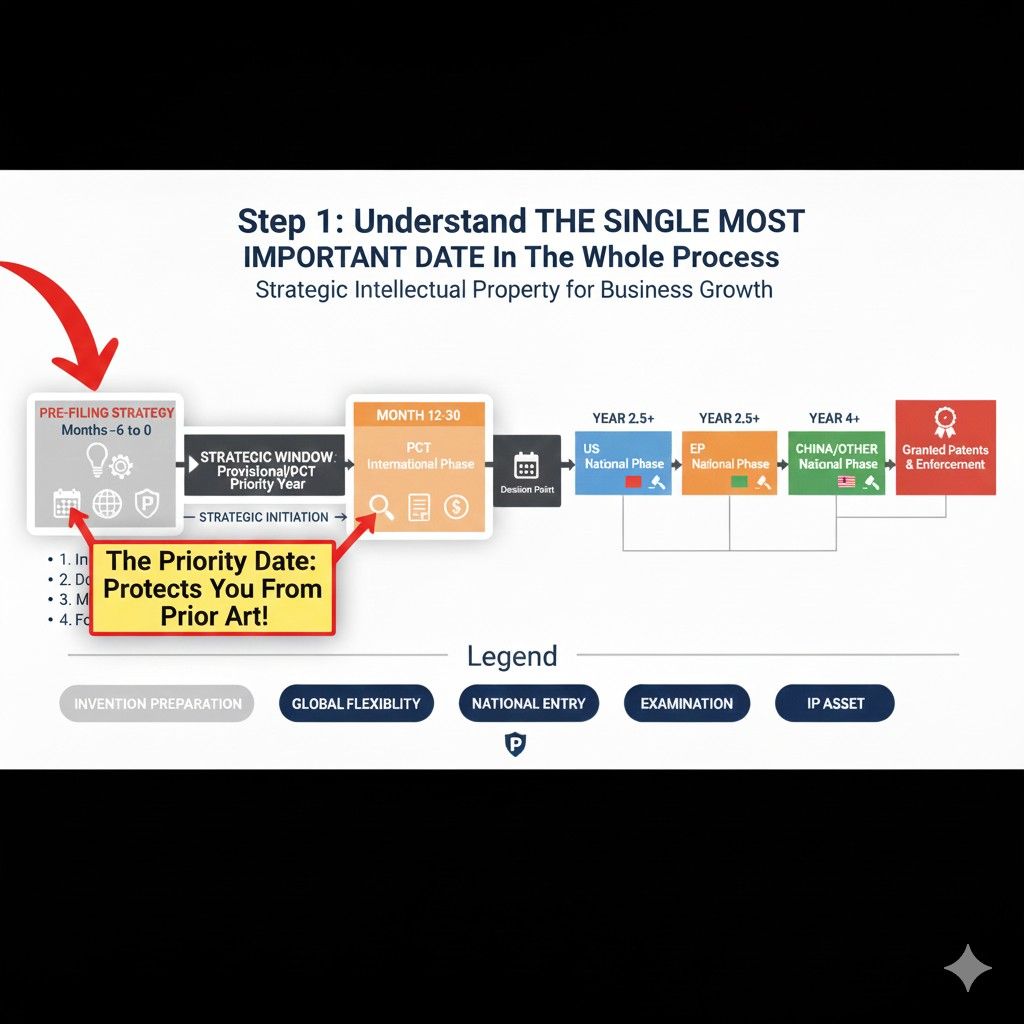
There is one date that drives almost everything else.
Your first filing date.
This is often called your priority date.
From that day, the clock starts.
Your priority date is the date you first file a patent application that properly describes your invention. “Properly” matters. If your first filing is thin, vague, or missing key parts, it might not protect what you think it protects.
Founders often ask, “Is a provisional enough?”
A better question is: “Does my first filing fully cover the version we will ship, and the versions competitors would try to copy?”
That is the standard you want.
Because once you file, you can say “patent pending,” but more importantly, you can share more safely. You can talk to partners. You can pitch. You can recruit. You can run pilots. You can publish a paper. You can show a demo.
Your first filing date is also what you will use later when you expand to other countries.
So do not treat it as a checkbox. Treat it like laying down a foundation.
Step 2: The pre-filing danger zone (and how founders lose rights)
Here is the trap: founders love to talk about what they are building. That is normal. It is also risky.
In many countries outside the United States, public disclosure before filing can destroy your ability to get a patent.
Public disclosure can mean a lot of things:
- A public demo at a conference
- A blog post with real details
- A GitHub repo
- A YouTube video showing how it works
- A paper, poster, or thesis that reveals the method
- Even a public sales deck that explains the secret sauce
In the U.S., there is a limited “grace period” concept, but relying on it is stressful and often messy in practice, especially when you want global coverage.
So the founder rule is simple:
File first. Talk later.
If you need to talk earlier, do it under strong NDAs and keep the details tight. But even then, founders often overshare. It happens in excitement. It happens in sales calls. It happens in hiring.
A strong first filing gives you breathing room.
Tran.vc’s approach is built for this. They help you file early, but not sloppy. Strategic, clean, and aligned with your product path—so you are not just “filing,” you are building a moat. Apply anytime: https://www.tran.vc/apply-now-form/
Step 3: First filing options (how most startups actually start)
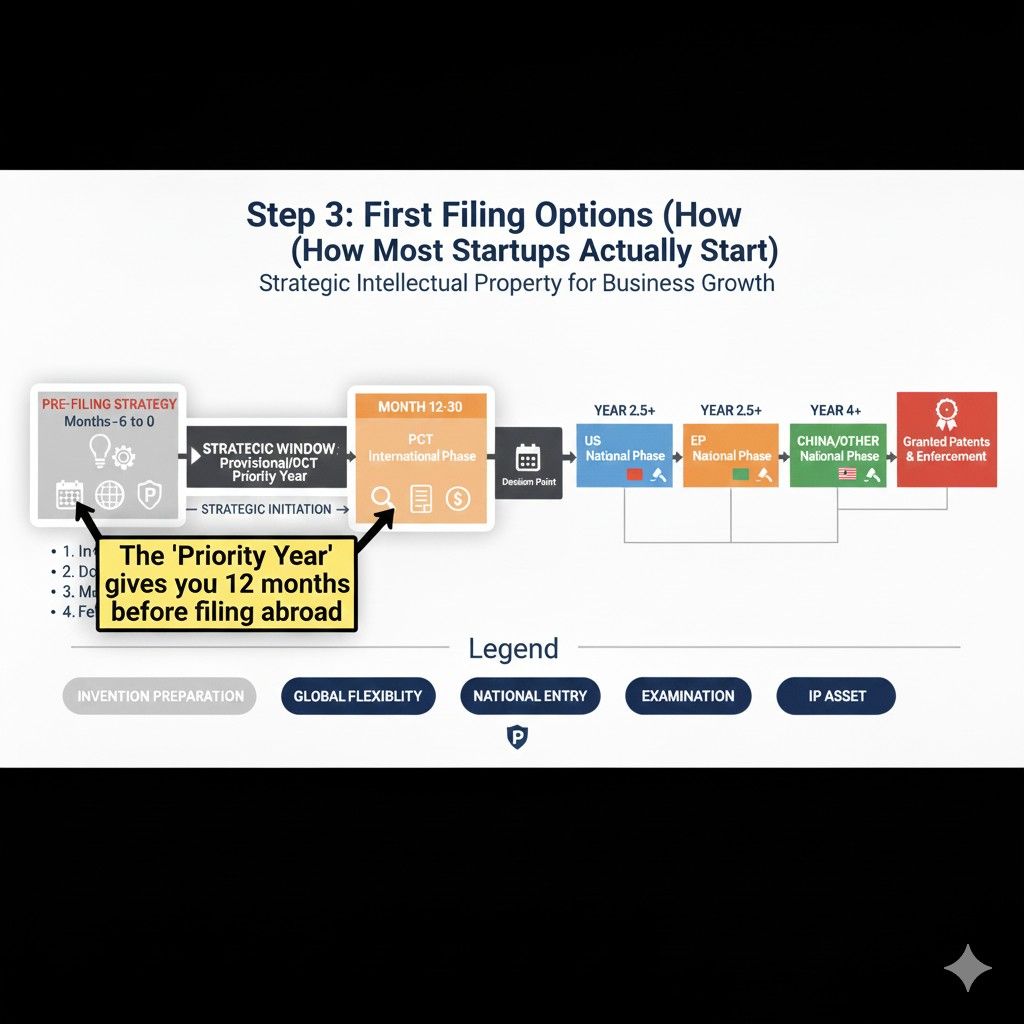
Most startups begin with one of these:
Option A: Provisional application (common in the U.S.)
This is often used to lock in a date while you keep iterating.
Option B: Non-provisional application right away
This is more formal, and can move faster toward examination.
Option C: File first in another country
Some teams file first where they are based, then use that filing to expand.
What matters most is not the label. It is the content.
The first filing should clearly explain:
- The system
- The method
- The key steps
- The main variations
- The parts that make it work better
- The “why” behind the design
If you are building robotics or AI, you want to capture more than a single model result. You want to protect the full mechanism: how data is prepared, how decisions are made, how safety is handled, how the robot adapts, how your pipeline runs in the real world.
This is where many founders under-file. They describe an output, not the invention.
A practical way to think about it:
If a strong engineer at a competitor reads your filing, could they build a copy?
If yes, your filing may be detailed enough, but you also need strong claim strategy.
If no, you might be too vague, and the patent could be weak.
The goal is: enough detail to support strong claims, not so narrow that one small change avoids you.
Step 4: The 12-month global decision window (this is the heart of the timeline)
After your first filing, you get a powerful window:
About 12 months to decide what to do next.
This window is where founders gain leverage.
In this period, you can:
- Build the product
- Test with users
- Learn what version matters most
- See who is copying
- Improve the invention
- Decide which markets are real
- Decide which countries matter
Then, before the 12 months ends, you typically choose your expansion path.
This is where global patent strategy becomes real.
Because global patents are not one filing. They are a sequence of steps, and each step buys you time and options.
And this is where many founders panic, because they did not plan for it.
The good news: you do not need to file everywhere. You need to file where it changes your outcome.
If you sell to U.S. customers, you often need U.S. coverage. If your main competitors manufacture in certain countries, those places may matter. If your acquirer is likely to be a large global company, broader coverage can increase deal value.
But you do not want to guess. You want a plan.
This is why Tran.vc focuses on IP strategy, not just filing. Because the real value is making the timeline work for you—so you can raise and sell with leverage. Apply anytime: https://www.tran.vc/apply-now-form/
Step 5: Your two big global routes after month 12
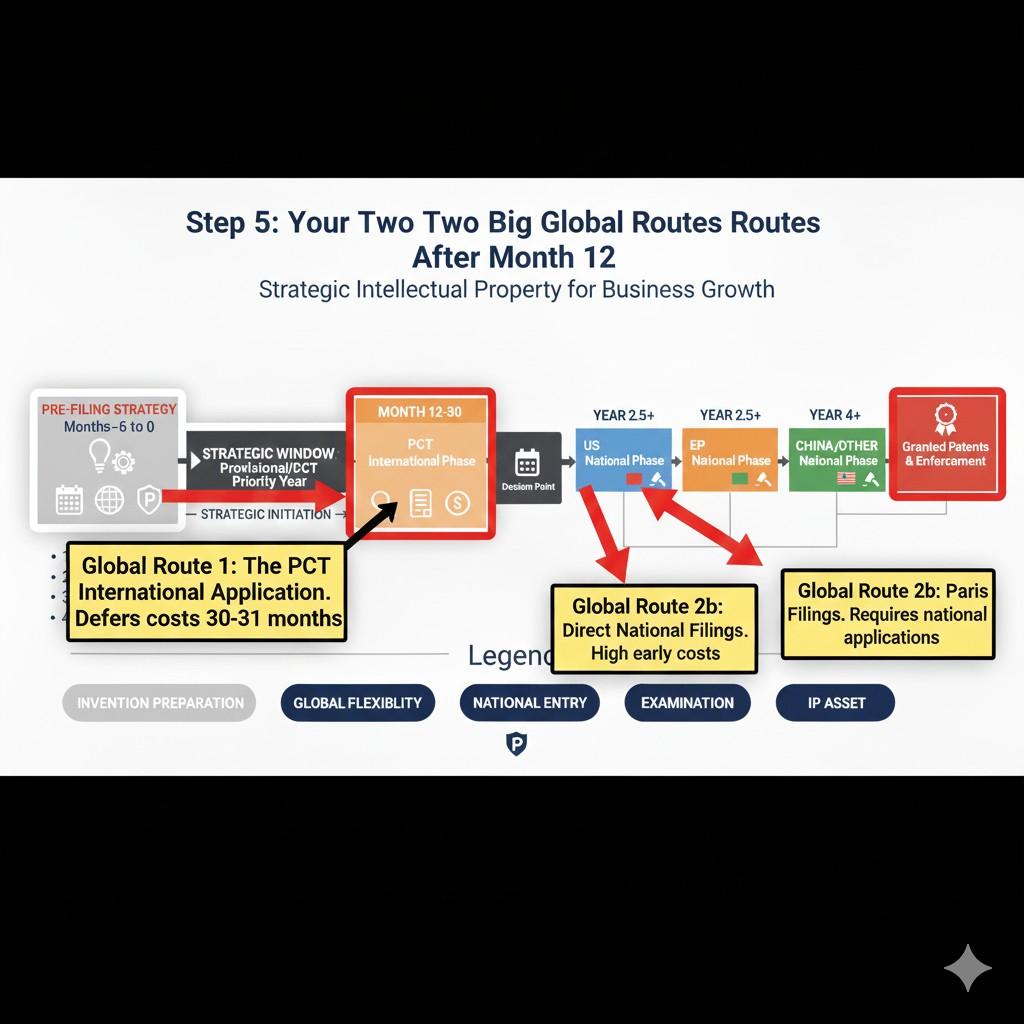
By the time you reach the end of the first year, founders usually choose one of two paths.
Route 1: Direct country filings
This means you file separate patent applications in the specific countries you care about.
This can be good when:
- You only want a few countries
- You already know where you will sell or manufacture
- You want more direct control in each place
It can also become complex fast, because each country has its own rules, costs, and timelines.
Route 2: The PCT route (the “global placeholder” many startups use)
PCT stands for Patent Cooperation Treaty. In simple terms, it is a way to file one “international” application that keeps your options open in many countries for longer.
Important: a PCT is not a final worldwide patent. It is a process that buys time and structure.
A common pattern is:
- File first application (priority date)
- Within 12 months, file a PCT
- Later, around 30 months from the priority date (this varies by country), enter “national phase” in the countries you choose
This can be founder-friendly because it delays major country-by-country costs while you learn more.
The timeline matter here is the extra runway. It is not infinite runway, but it can be enough to:
- Close seed
- Hit real product milestones
- Get pilot revenue
- Prove the market
- Narrow the list of countries
If you want a global patent story without spending like a big company on day one, this is often the path.
Step 6: What you should be doing during the first 12 months (without slowing down)
Founders often waste the first year. Not because they are lazy, but because they do not know what the timeline is asking from them.
During that first year, your job is to prepare for the next filing decision and strengthen your position.
Here are a few actions that actually move the needle:
When your invention changes, capture the change.
When you learn what customers value most, record it.
When you find a surprising failure mode and fix it, document it.
When you find a way to reduce compute, reduce power use, or increase reliability, write it down.
When you discover a clever constraint or a safety guardrail that makes the system work in the real world, do not treat it as “just engineering.” It may be a patentable advantage.
This is especially true in robotics, where real-world constraints create inventions that are hard to reproduce without your experience.
It is also true in AI, where the “secret” is rarely just the model. It is the full system: data, training, deployment, monitoring, and feedback loops.
What you are doing here is building a pipeline of inventions.
Not one patent. A story.
That story is what investors like. It signals depth. It signals defensibility. It signals maturity.
And it is exactly the kind of foundation Tran.vc is designed to help you build early. Apply anytime: https://www.tran.vc/apply-now-form/
Step 7: The publication moment (and why it changes your timeline)
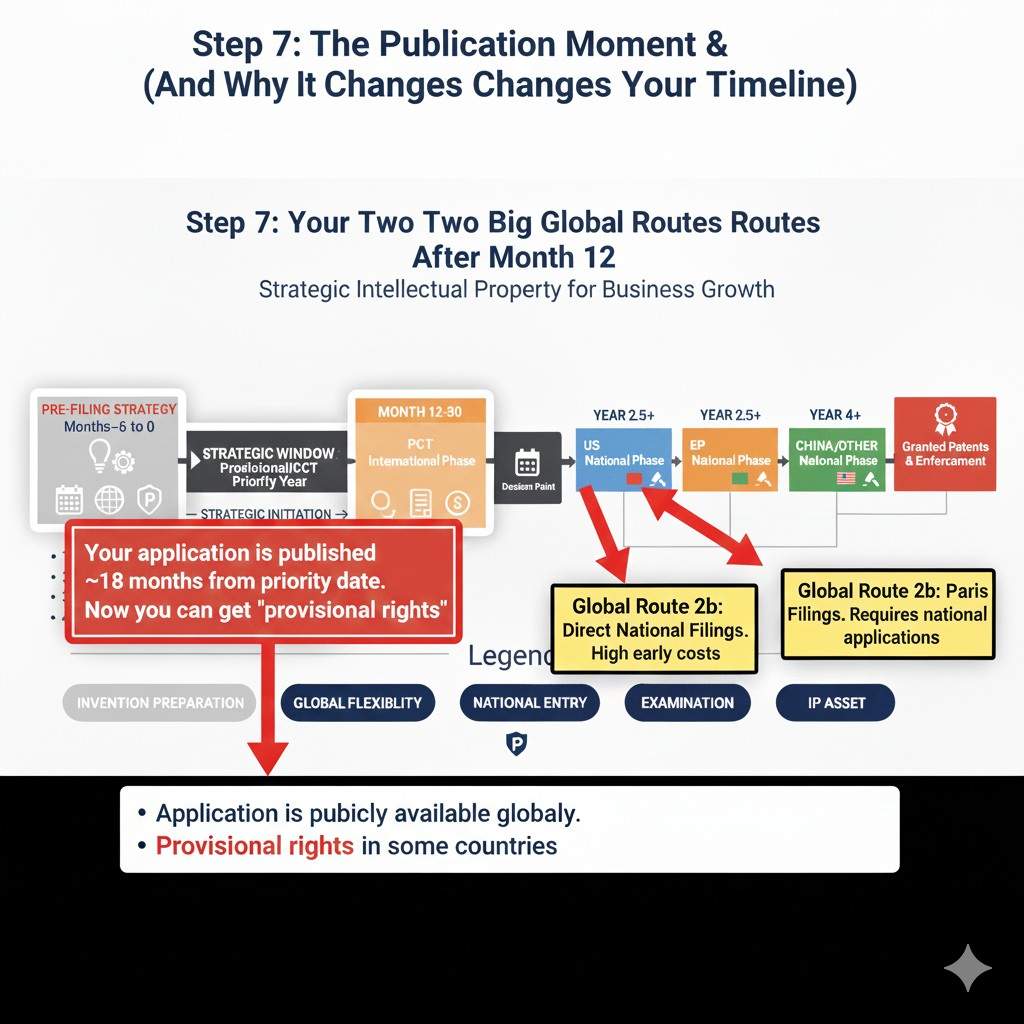
At some point, your application will publish.
In many systems, patent applications publish around 18 months from the priority date. This is not a choice. It is part of the process.
Once it publishes, competitors can read it.
That sounds scary, but it is normal. And it can be good.
Publication can:
- Warn competitors that you are serious
- Make partners take you more seriously
- Help your recruiting story
- Create a clear “we were first” record
But publication also means you should have already planned what comes next. If you publish one idea and then stop, you may give away your direction without building a broader fence.
This is why strong teams treat patents like a program, not a one-time event.
Step 8: The 18–36 month phase is where global choices become real
What changes after month 18
Around this point, your patent application often becomes visible to the world.
That means your work can be read, searched, and studied by competitors. Many founders panic when they hear this, but it is not the end of the world. It is simply the next phase of the timeline.
The right mindset is this: if your invention is worth protecting, it is also worth planning for the moment it becomes public. You want to be ready with the next filings that widen your coverage, so your first patent is not your only fence.
Why this phase is a leverage window for founders
Between month 18 and month 36, many startups are moving from “it works” to “it sells.”
This is the same period where you begin to see who is serious in your market. You notice which companies start copying. You also learn what buyers ask for again and again.
Those real signals help you pick what to protect next. You stop guessing and start targeting. Your patent plan becomes more accurate because your business plan becomes more real.
The big mistake founders make here
A common error is filing one early application and then going quiet for two years.
During that time, the product changes, the market shifts, and your team adds new features that are more valuable than the original version. If you do not capture those upgrades, you end up with a patent that protects a past version, not the one that matters.
This is why smart teams treat IP as a living timeline, not a one-time legal task.
If you want support building that timeline while you ship, Tran.vc is built for this. You can apply anytime at https://www.tran.vc/apply-now-form/
Step 9: PCT timing made simple, without legal fog
What the PCT is really doing for you
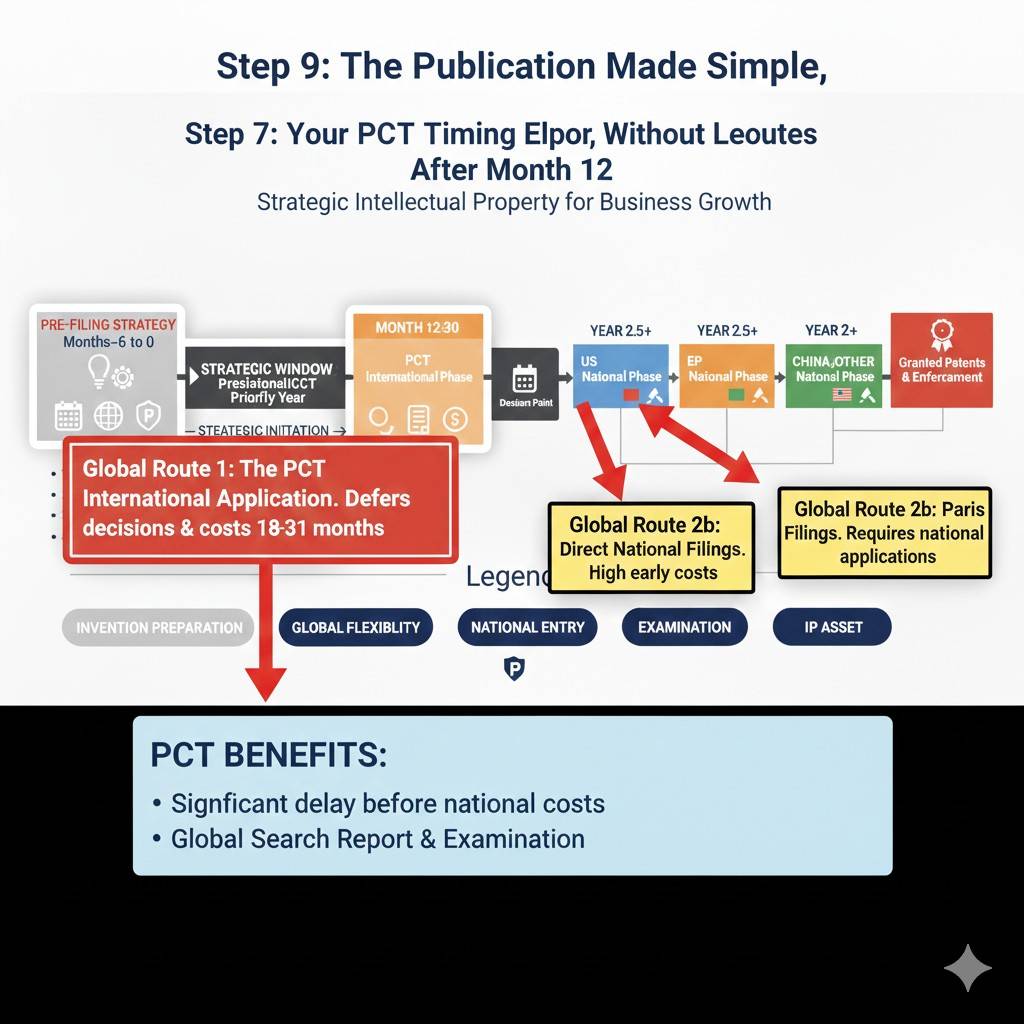
The PCT route is best understood as a way to delay expensive country-by-country filings.
You file once, then you get time to decide where you will spend money later. You also get useful search feedback that can help you adjust your claims before you go national.
This is why many deep tech teams like it. It matches how startups work. You learn as you go, and you do not want to lock every decision on day one.
The key dates you should remember
The first key date is the day you file your first application. That date starts your global clock.
The second key date is about 12 months later. That is when you usually decide whether to file a PCT or file directly in certain countries.
The third key date is commonly around 30 months from your first filing, though it varies by country. That is when you often must enter national phase if you want protection in specific countries through the PCT path.
What “national phase” means in plain words
National phase is the point where you stop being “global in theory” and become “local in practice.”
You pick the countries you want, you file in those systems, you pay their fees, and you follow their rules. From there, each country is its own journey, with its own examiner, timelines, and standards.
The important part is not memorizing the terms. The important part is planning cash and planning choices so you do not rush the decision when the deadline hits.
Step 10: Direct filings versus PCT, and how founders pick the right route
When direct filings can be the better move
Direct filings can be a strong choice if you are confident about your target markets early.
For example, if you sell only in the United States and one other region, you might prefer to go direct. It can reduce complexity, and it can sometimes speed up the path to getting an issued patent in places that matter most.
Direct filings can also be useful when you have a clear competitive threat in a specific country and you want to move quickly there.
When the PCT path usually fits startups best
The PCT path tends to fit teams that are still learning which markets will become real revenue.
It can also help when your product is still evolving, and you want time to capture improvements before you commit to many countries. That extra time can let you raise funds or reach a milestone that makes the spend feel rational, not painful.
The most common reason founders choose PCT is simple. They want options without burning cash too early.
A strong rule for choosing
If you are unsure, choose the route that keeps your options open without harming quality.
That usually means filing a strong first application, then using the next 12 months to learn, then choosing PCT or targeted direct filings based on real business signals. A rushed decision often creates wasted filings and weak coverage.
Tran.vc helps founders make these choices with clear strategy, not guesswork. Apply anytime at https://www.tran.vc/apply-now-form/
Step 11: Country choices, and how to build a clean global filing map
Start with where money is made, not where you “might” sell
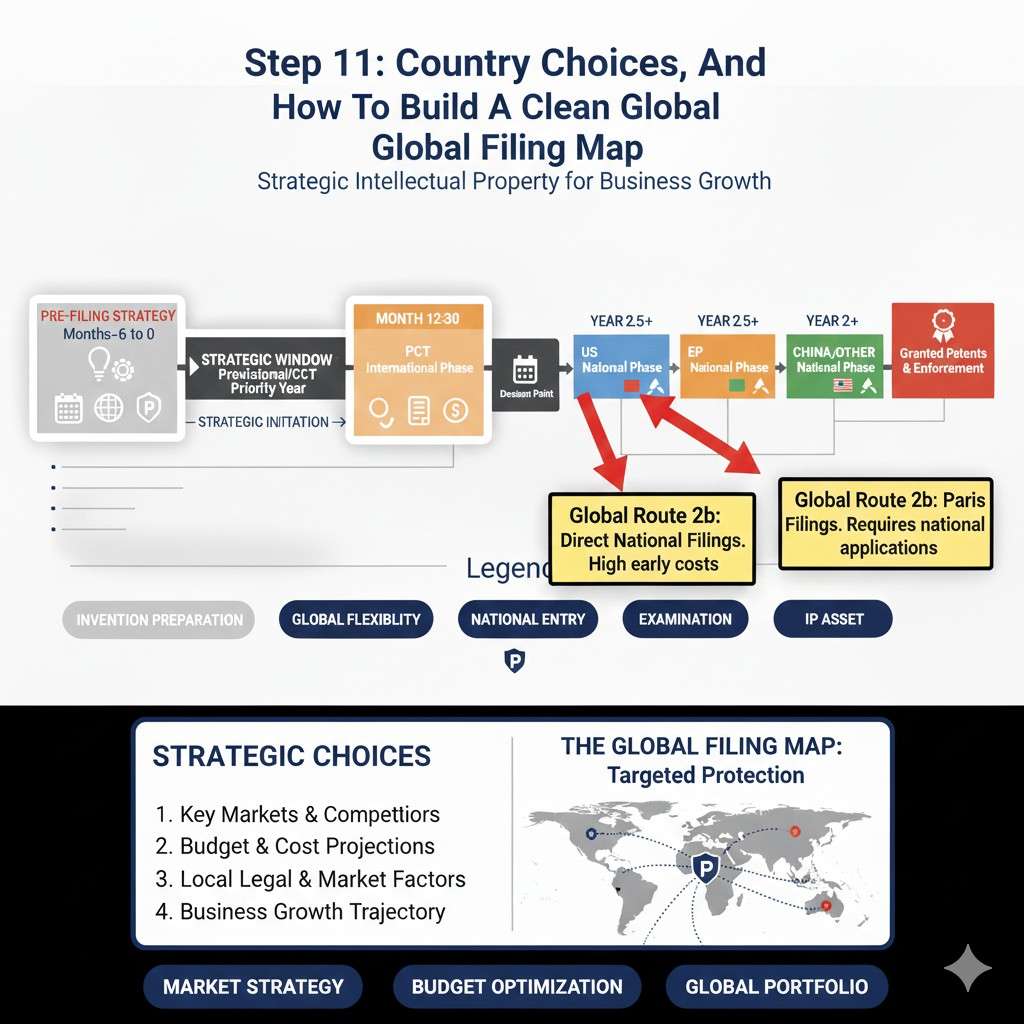
Founders often pick countries based on fear.
They imagine a competitor somewhere, so they want protection everywhere. That instinct is understandable, but it creates a costly plan that does not match startup reality.
A better approach is to start with the places that drive your business.
Where are your paying customers likely to be in the next two to three years? Where are the buyers who write the biggest checks? Where do the strongest partners operate? Those answers usually point to a small set of regions.
Then look at where competitors build, not where they talk
A second filter is manufacturing and deployment.
If your robotics product relies on certain hardware supply chains, or if a competitor’s core operations are in a specific region, that region can matter even if you do not plan to sell there right away.
The idea is to block copying at the source. You do not need to cover every country. You need to cover the countries that make copying profitable and scalable.
Keep the map small, but meaningful
A good early global map is not a long list.
It is a focused set of places that match your business, your risk, and your budget. You can always expand later through continuation strategies and follow-on filings, but you cannot get back rights you never secured.
A small, well-chosen plan often beats a wide, weak plan.
Step 12: How costs show up in real life, and how founders avoid surprise bills
Why IP costs feel “random” to founders
Patent costs often feel unpredictable because they hit in waves.
A filing creates a wave. A later filing creates another wave. National phase can create a large wave. Office actions, translations, and local counsel can create extra waves.
If you do not expect this pattern, you can feel blindsided. You may also make bad choices at deadlines because you are protecting cash instead of protecting strategy.
How to plan without overthinking it
You do not need a perfect forecast.
You need a simple timeline budget. You want to know when the big decision points are, and what range of spend is possible at each point. When you plan for the peaks, the process becomes calmer.
The best founders treat IP spend like product spend. They connect it to milestones. They do not spend heavily before learning, and they do not delay filings after learning.
What makes a filing expensive in practice
Complex inventions take more time to write well.
Robotics systems with many subsystems, AI platforms with data pipelines, and safety-driven methods can be more detailed. That detail is good. It makes your protection stronger. But it also means you want a strategy-led team that keeps the scope tight and purposeful.
This is one reason Tran.vc’s in-kind IP support can change the game. You get real guidance early, so you spend effort on what builds leverage. Apply anytime at https://www.tran.vc/apply-now-form/
Step 13: Examination timelines and what “office actions” mean for you
What happens after you file in a country
After filing, most founders assume the next step is approval.
In reality, the next step is review. An examiner searches for prior work and decides whether your claims are new and non-obvious under their local rules.
If the examiner finds similar ideas, they will push back. That pushback is not failure. It is normal.
Office actions are negotiation, not rejection
An office action is a written letter from the patent office.
It explains what the examiner thinks is not allowed and why. Your job is to respond with changes, arguments, or both. This back-and-forth is often how strong patents are shaped.
The key is to respond strategically, not emotionally. You are not trying to “win a debate.” You are trying to secure coverage that blocks competitors while still being granted.
Why founders should care about claim strategy here
The claims are the fence. The rest is support.
If you wrote your first filing well, you have room to adjust the claims without losing your core invention. If you wrote it thin, you may not have enough support to defend what matters.
That is why early quality matters more than founders expect. A good first filing gives you negotiating power later.
Step 14: How to protect improvements without restarting your whole plan
Your product will change, and your patents should keep up
Startups evolve every month.
A robotics team changes control logic, adds new safety checks, and improves calibration. An AI team changes training methods, reduces compute, or adds a new feedback loop.
Those changes can be patentable. If you ignore them, you may end up protecting the wrong version of your own work.
Follow-on filings are how you build a real moat
You do not need twenty patents.
You need a sequence that covers the core system and the valuable upgrades. When done well, it becomes hard for competitors to copy you without stepping into at least one of your fences.
This is also how you tell a strong investor story. One filing shows intent. A planned series shows depth.
Timing matters more than volume
The right time to file an improvement is when it becomes stable enough to describe clearly.
You do not want to file every small tweak. You want to file the upgrades that change outcomes and are likely to remain part of the product. This balance is what a good IP partner helps you find.
Tran.vc is designed to help founders choose those moments with discipline. Apply anytime at https://www.tran.vc/apply-now-form/