
Most seed-stage founders wait too long to think about patents.
Not because they do not care. Mostly because they are busy building, hiring, shipping, fixing bugs, talking to users, and trying to stay alive.
But here is the problem: by the time you “have time,” you may already have shared the best parts of your invention in a demo, a pitch deck, a customer pilot, a conference talk, a GitHub repo, or a partner call. And once the secret is out, your options can shrink fast.
A minimum viable patent portfolio is the simple, practical answer to this. It is not a giant stack of filings. It is not a vanity move. It is a small set of patent assets that match what you are truly building, protect the parts that matter most, and give you real leverage when you raise, sell, partner, or defend your market.
Think of it like locking the doors before you leave the house. You do not need a castle. You need the right locks on the right doors.
This is exactly where Tran.vc fits. Tran.vc is a pre-seed venture partner that puts up to $50,000 of in-kind patent and IP work behind technical founders, so you can build a real moat early without burning cash or giving up control too soon. If you are building in robotics, AI, or deep tech, you can apply anytime here: https://www.tran.vc/apply-now-form/
In this article, I will walk you through what a minimum viable patent portfolio looks like for a seed-stage startup, how to shape it around your product and roadmap, and how to avoid the common mistakes that waste time and money. We will keep it simple, concrete, and focused on what you can do this quarter, not “someday.”
The Minimum Viable Patent Portfolio for a Seed-Stage Startup
What “minimum viable” really means
A minimum viable patent portfolio is a small set of filings that protect the parts of your startup that make you hard to copy. It is not about filing “something” just to say you have patents pending. It is about choosing the right inventions, writing them the right way, and timing them to match your build and your fundraising.
At seed stage, you are still learning. Your product will change, your market may shift, and your roadmap is often a living document. So “minimum viable” means you protect what is stable enough to matter, while leaving room to adjust as you learn.
The goal is simple: when an investor, partner, or acquirer asks, “What is defensible here?” you have a clear answer that is backed by real filings, not vague plans. That answer should point to a few strong inventions that map directly to your product and your future.
Why early-stage patents feel hard
Patents can feel like a different world. The language is strange, the process feels slow, and the cost can look scary. Many founders also fear filing too early and “locking in” details that might change.
Those worries are real, but they are also manageable. A good early patent plan does not freeze your product. Instead, it frames your invention in a way that covers the core idea across many versions, so you can keep building while staying protected.
The other hard part is focus. At seed stage, everything feels important. But patenting everything is not realistic, and it is rarely smart. You need a clear way to decide what is worth protecting first.
The real job of your seed-stage portfolio
Your first portfolio has one main job: create leverage. Leverage in fundraising, because it signals you can own a space instead of renting it. Leverage in sales, because enterprise buyers like to know they are betting on a serious company. Leverage in hiring, because top talent wants to work on tech that matters.
It also creates leverage against copycats. You may not plan to sue anyone, and that is fine. The point is not fighting. The point is discouraging the easy “clone and undercut” move before it starts.
A minimum viable patent portfolio is the smallest set of moves that gets you that leverage, without draining your time, money, or momentum.
Where Tran.vc fits in this stage
Tran.vc was built for this exact moment, when your tech is real but your resources are tight. Instead of pushing you to raise money early, Tran.vc helps you build strength first, using up to $50,000 in in-kind patent and IP services so you can protect what you are building while you keep shipping.
If you are a technical founder and you want your invention to become an asset investors can see and trust, you can apply anytime here: https://www.tran.vc/apply-now-form/
What you should patent first at seed stage
Start with the “why you win” parts
The best inventions to patent are the ones that explain why your startup wins even if a bigger company tries to copy you. This often lives in the hardest technical choices you made. It can be the method that makes your model more accurate with less data. It can be the way your robot handles edge cases in the real world. It can be the control loop that makes your system stable where others fail.
If your invention is only a feature, it may not be worth leading with. Features change fast, and competitors can often build around them. What you want is the deeper idea under the feature, the part that would still matter in two years even if the product looks different.
A good seed-stage patent topic is usually “core logic,” not “surface design.” It is the piece of your system that would take real effort to rebuild from scratch.
Protect methods, not just outputs
Many founders describe what their system produces, like “we detect defects” or “we plan routes” or “we predict failures.” That is helpful for sales, but it is not enough for a strong patent story. The valuable part is how you do it, step by step, and why that method is different from the standard ways.
Patents are strongest when they claim a method that can be used in many settings, not just your current product. That method should be described with enough detail to show it is real, while still being broad enough to cover future versions.
If you are building AI, the “how” might include training steps, data handling, model structure choices, or special ways you reduce noise. If you are building robotics, it might include sensing fusion, motion planning steps, calibration methods, or safety logic.
Look for “hard to see” inventions
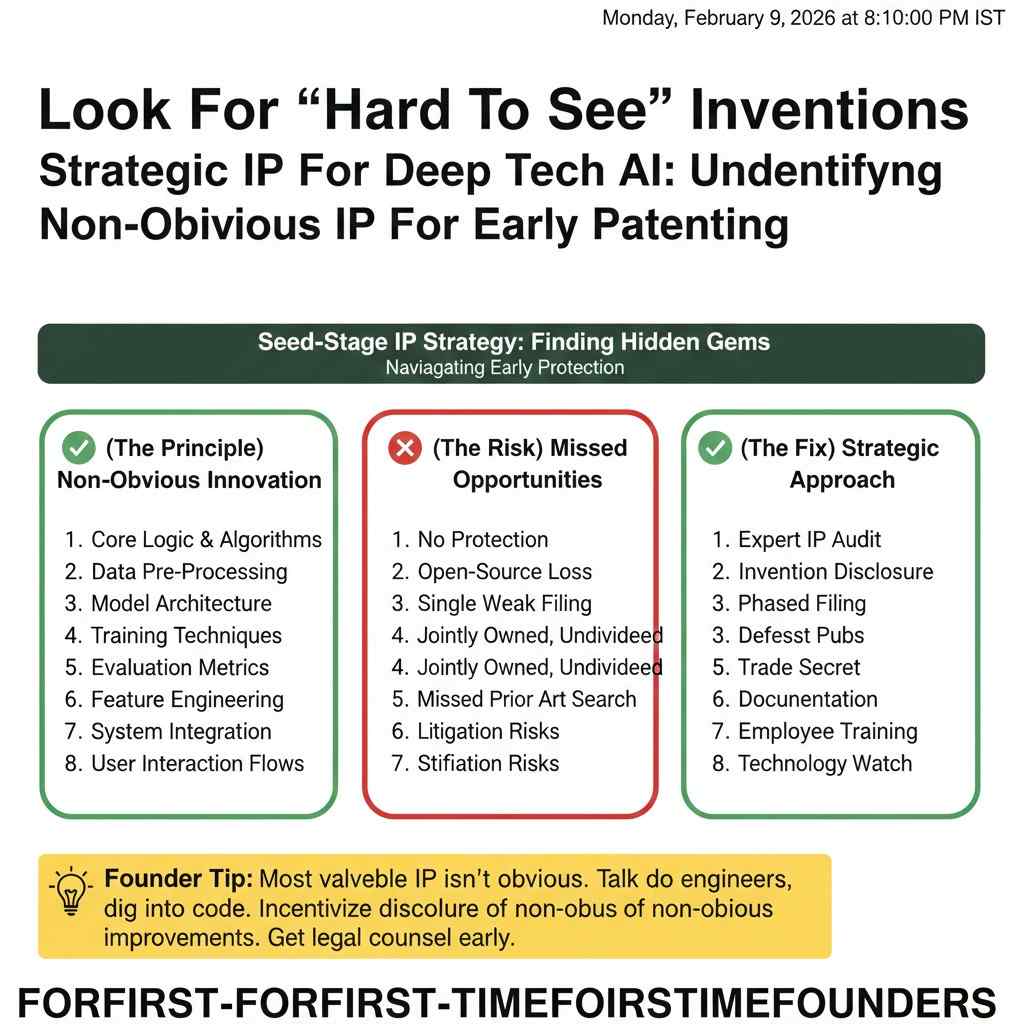
Some inventions are easy for a competitor to spot by looking at your product. Others are hidden inside the system, and those hidden parts are often the best to protect. A buyer can copy your UI in a week. They cannot easily copy a hidden pipeline, a tuning method, or a system-level trick that took you months to learn.
This is also why early patent work pairs well with technical founders. You already know what was hard. You already know what surprised you. You already know what you would never want a competitor to get for free.
When you are choosing what to patent first, give extra weight to the ideas that are not obvious from a demo.
Use your roadmap as a filter
A practical way to choose patent targets is to compare them to your next 12–18 months. If a key part of the invention is likely to be removed soon, it might not be the best first filing. If it will stay and grow, it is a strong candidate.
This is where “minimum viable” thinking helps. You are not trying to protect every branch of your product. You are protecting the trunk, the parts that you expect to keep building on.
When you align your patents with your roadmap, you also make fundraising easier. You can tell a clean story that connects your filings to what you will ship next, and why it will be hard to copy.
What the minimum viable portfolio usually includes
The role of a first filing
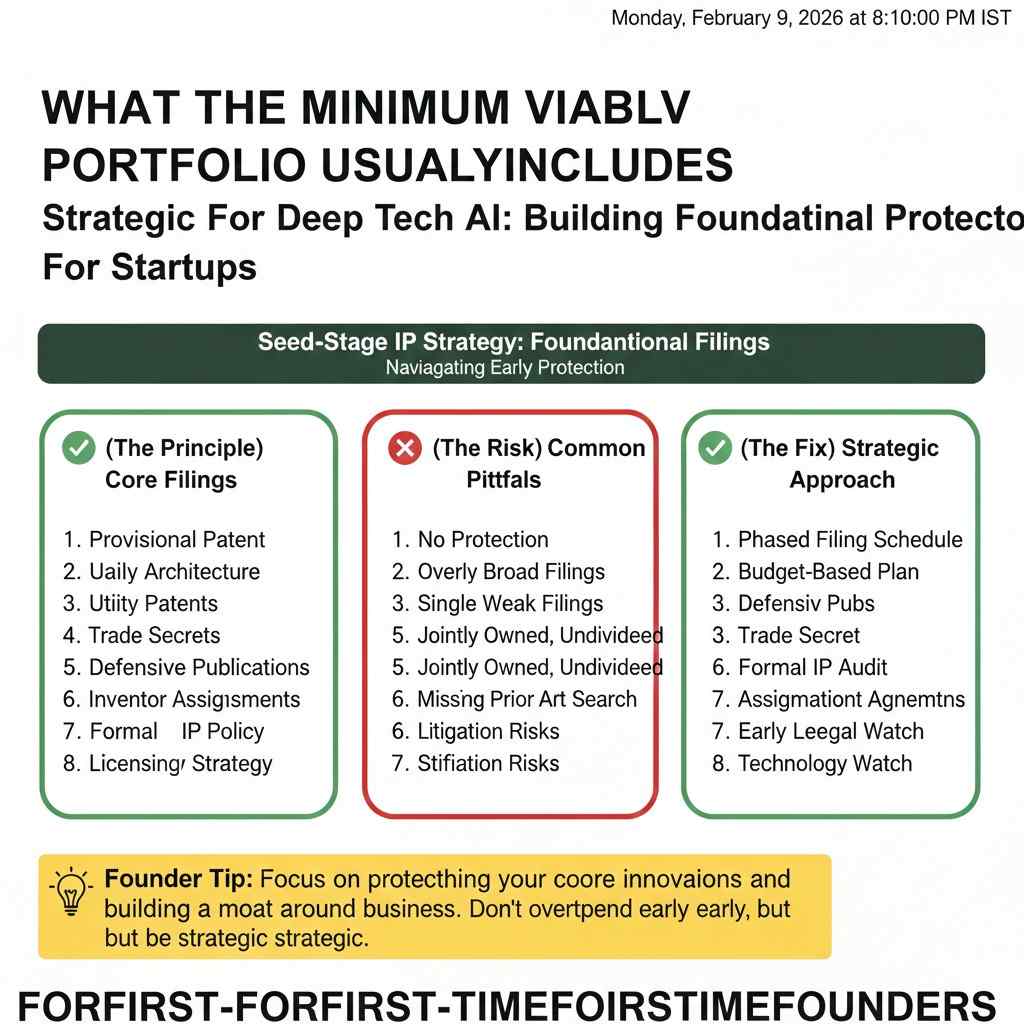
For many seed-stage teams, the first filing is the foundation. It is often a provisional application in the U.S., though your exact path can differ based on where you operate and where you plan to sell. The point of that first filing is to lock in an early date and capture the invention before you share it widely.
A strong first filing is not a rushed sketch. It should be written like a real technical document. It should include clear system diagrams, key flows, and multiple variations of the idea so you are not boxed in later.
If you do this well, that first filing becomes a platform. You can build on it with follow-on filings as your product grows.
One “core” patent family
A minimum viable portfolio usually starts with one core patent family that covers the main system idea. This is the invention that sits at the center of your product, the part you would highlight if someone asked, “What is the special thing here?”
This core filing should aim to cover the system at a high level and at a method level. It should be written so it still applies even if your implementation changes. That means you focus on the logic and structure, not just the exact code you wrote this month.
Done well, this core family can support multiple claims later, because the foundation is broad and well described.
One “edge” patent family that blocks workarounds
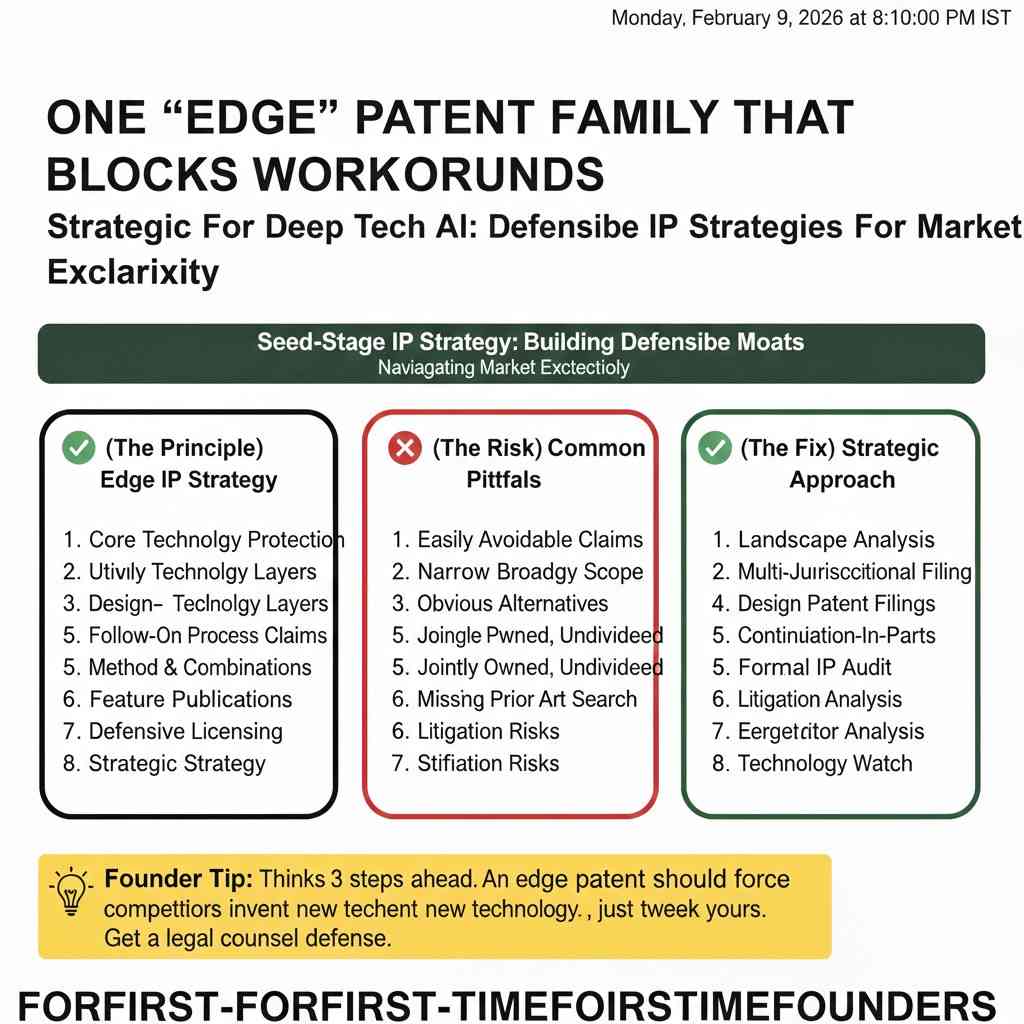
Competitors rarely copy you in a straight line. They look for a workaround. So the second common piece in a minimum viable portfolio is an “edge” family that protects an alternate path to the same outcome.
For example, if your core invention is a certain way to fuse sensors for robot navigation, an edge filing might cover a different fusion approach that you also tested, or a specific calibration method that makes the fusion reliable in the field.
This second family is not random. It is chosen to make it harder to route around your core filing. It is often based on real experiments you already ran, even if you did not ship them as the main version.
One “use-case” patent family tied to a key market
Seed-stage startups often start in a narrow market and expand later. A smart portfolio can reflect that. A “use-case” family ties your invention to a specific high-value setting where your system solves a painful problem.
This can help in two ways. First, it makes your IP story easier to understand, because it connects to a real buyer and a real workflow. Second, it can be valuable later if your company becomes known for that market and others follow.
This family should still focus on method and system logic, not just “we use it in industry X.” The idea is to protect how the invention works in that real setting, including constraints, safety needs, data limits, or hardware details.
Why “three families” is often enough early
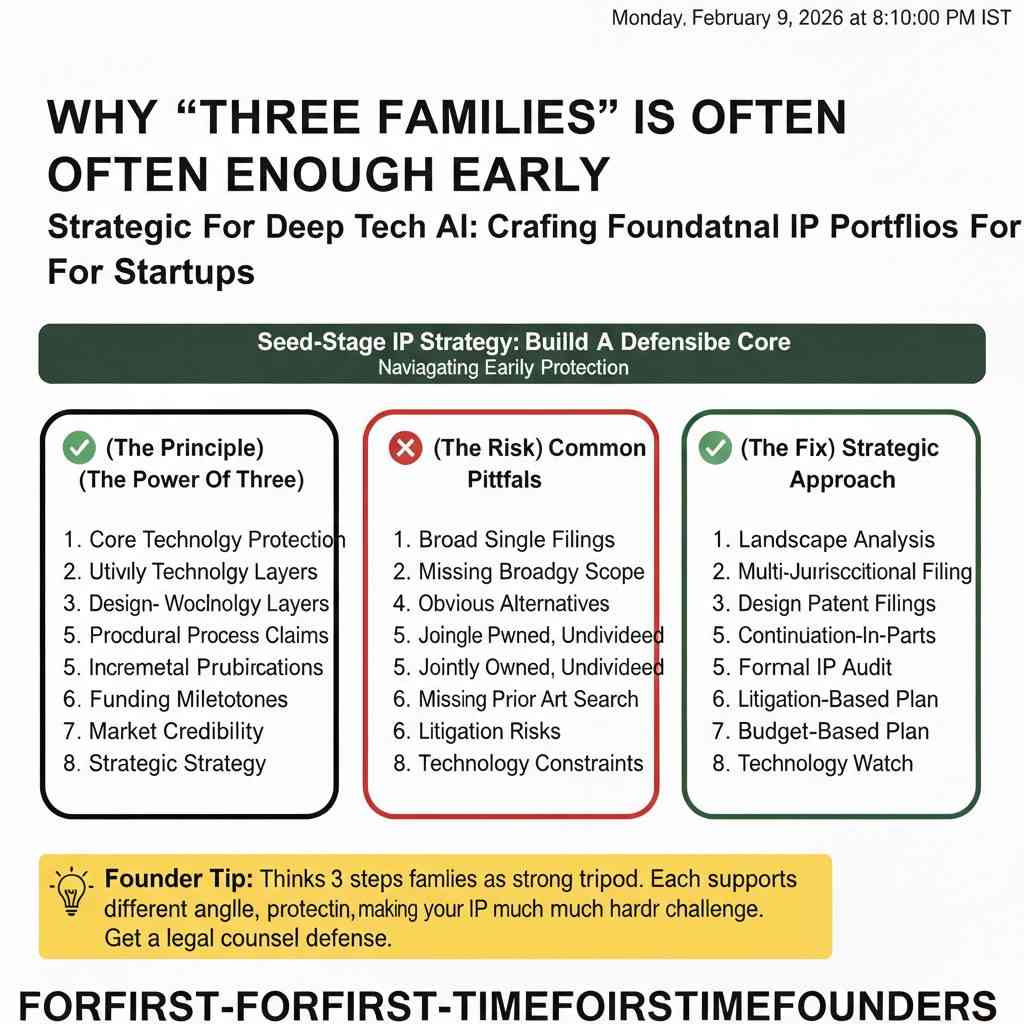
At seed stage, your goal is not a giant wall. Your goal is a strong start that you can grow. In many cases, one core family plus one edge family plus one use-case family is enough to create real leverage.
If your tech is very complex, you might need more. If your product is early, you might start with fewer. The right answer depends on what you are building and how fast you are learning.
The key is that each filing has a clear job. None of them exist “just to have patents.” Every one maps to a real part of your product and a real business reason.
Apply before you over-share
Most seed-stage teams share more than they think. A pitch deck can include enough detail to harm novelty. A demo day can reveal key steps. A pilot with a big company can expose your system to many eyes.
If you want help building a minimum viable patent portfolio that fits your tech and your stage, Tran.vc is built for this. You can apply anytime here: https://www.tran.vc/apply-now-form/
How to capture inventions without slowing the company down
Treat invention capture as part of building
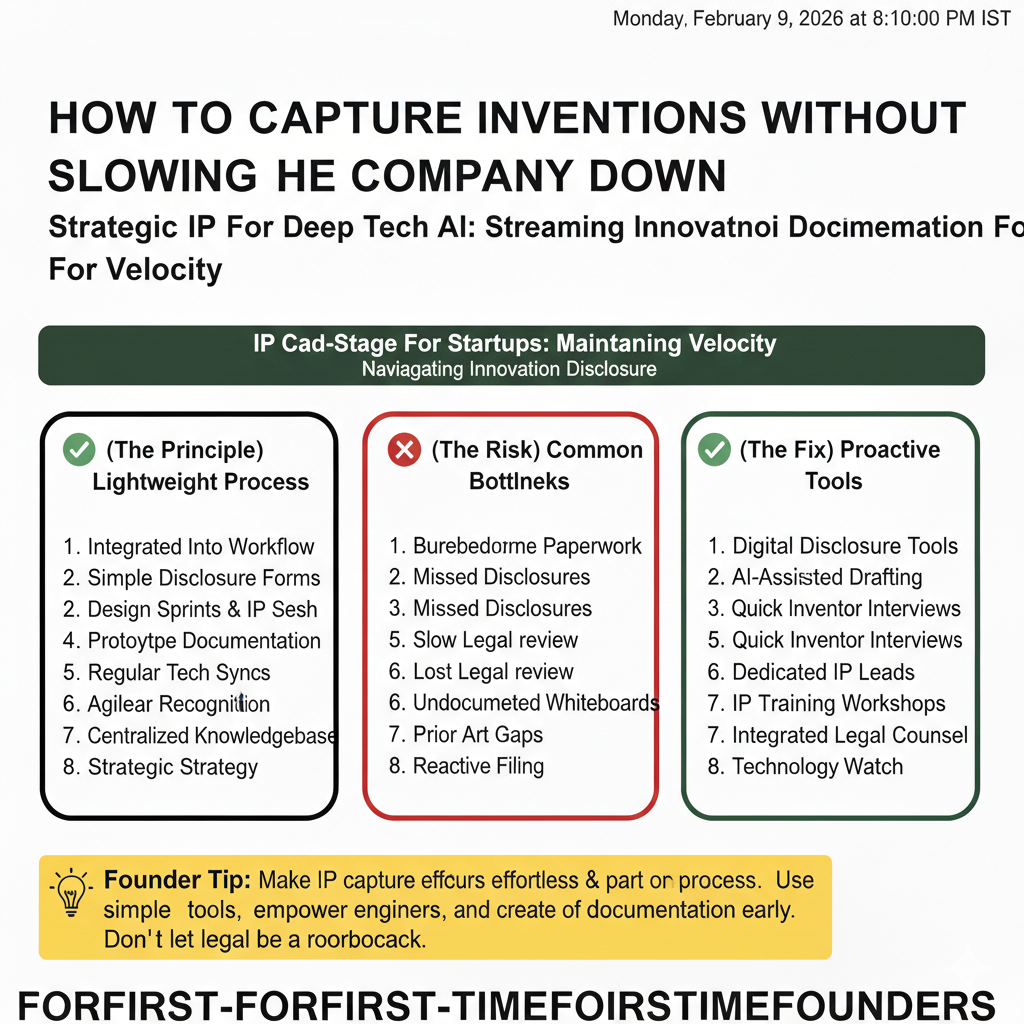
Many founders think patent work means stopping product work. In practice, the best patent inputs come directly from building. The key is not adding more meetings, but paying attention to what is already happening.
Every time your team solves a hard problem, there is potential invention there. Every time something breaks and you fix it in a clever way, that logic matters. Every time you choose one approach after testing three others, you have learned something that competitors do not know yet.
Capturing inventions is about noticing these moments and recording them while they are still fresh, not weeks later when details are fuzzy.
Use real engineering artifacts as raw material
You do not need to “think like a lawyer” to create good patent inputs. Your existing artifacts are often enough. Design docs, architecture diagrams, internal wikis, experiment notes, and even long Slack threads can hold the core of a strong invention.
The mistake is trying to rewrite these into patent language yourself. Your job is to explain what problem you faced, what options you tried, why one worked better, and how the system behaves as a result. A good patent partner can turn that into formal claims later.
This approach keeps the process grounded in reality. It also reduces the risk of filing vague ideas that sound good but do not match how your system truly works.
Build a simple invention habit
At seed stage, you do not need a heavy process. What helps is a light habit. Some teams do this by setting a short monthly check-in where founders list the hardest technical wins from the past few weeks.
These notes do not need to be polished. They just need to answer a few questions: what changed, why it mattered, and what would have happened if you had not figured it out. Over time, these notes become a map of where your real innovation lives.
When it is time to file, you are not starting from zero. You are choosing from a set of real, tested ideas that already proved their value.
Keep patents aligned with shipping
One fear founders have is that patents will describe something they no longer use. This usually happens when filings are disconnected from the roadmap. To avoid that, your patent plan should be reviewed alongside product planning, not separately.
If a major shift is coming, you can adjust what you file next. If something is core and stable, you can invest more deeply in protecting it. This keeps your portfolio alive and relevant, instead of frozen in an old version of the product.
The goal is not perfection. The goal is staying close to the truth of what you are building.
How Tran.vc supports this process
Tran.vc works closely with founders during this stage, not as a distant service provider. The focus is on pulling invention details out of real work, not forcing artificial ideas into filings.
Because Tran.vc invests up to $50,000 in in-kind IP services, you get access to experienced patent professionals who understand startups and engineering tradeoffs. That support lets you keep moving fast while still building a defensible base.
If you want to protect your inventions without slowing your team, you can apply anytime here: https://www.tran.vc/apply-now-form/
The most common early patent mistakes and how to avoid them
Waiting until fundraising pressure hits
One of the most common mistakes is waiting until an investor asks about patents. At that point, founders rush to file something, anything, just to check a box. These rushed filings are often narrow, poorly framed, and hard to build on later.
Early patent work is not about impressing investors in the moment. It is about giving yourself options. When you file before pressure hits, you can think clearly about scope, strategy, and timing.
Investors can tell the difference between a thoughtful portfolio and a last-minute scramble.
Filing without a clear business goal
Another common issue is filing patents without knowing why. If you cannot explain how a filing supports your business, it is probably not a good use of time or money.
Each early filing should answer at least one clear question. Does this make it harder to copy us? Does this support our main market? Does this help us tell a stronger story in diligence? If the answer is unclear, the filing likely needs rethinking.
A minimum viable portfolio is small precisely because every piece has a job.
Being too narrow too early
Founders sometimes describe their invention exactly as it exists today, including specific tools, libraries, or hardware choices. This feels safe, but it can limit you later.
A good early patent should focus on the idea behind the implementation. It should cover multiple ways of achieving the same result, even if you only built one so far. That way, if you refactor, optimize, or pivot slightly, your protection still holds.
This is where experience matters. Knowing how to write broadly without losing clarity is a skill that comes from working with real patent professionals.
Being too vague to be useful
The opposite mistake is being so high-level that the filing lacks substance. Statements like “we use AI to optimize performance” do not help much if they are not backed by concrete steps and logic.
A strong filing balances detail and flexibility. It explains enough that a skilled engineer could understand the approach, while still leaving room for variations. This balance is hard to strike without guidance, which is why many early filings fall short.
Forgetting about ownership and assignments
In the rush of building, founders sometimes forget to clean up IP ownership. If early contributors, contractors, or advisors were involved, you need to be sure inventions are properly assigned to the company.
This may not seem urgent at seed stage, but it becomes very urgent later. Fixing ownership issues after the fact can be painful and expensive, and it can slow down deals.
A minimum viable portfolio includes not just filings, but clean ownership from day one.
Why early guidance matters
Most of these mistakes are not about bad intentions. They come from lack of context. Patents are a long game, and early moves shape what is possible later.
Working with a partner who has seen many early-stage paths helps you avoid traps you do not even know exist yet. That is a big part of the value Tran.vc brings to technical founders.
If you want to build your patent foundation the right way, without guesswork, you can apply anytime here: https://www.tran.vc/apply-now-form/