
If you are building an AI or robotics startup, you are likely moving fast. You ship code, test models, tune sensors, and run pilots. In the middle of all that, patents can feel like “later.” But for deep tech, “later” often turns into “too late.”
A provisional patent is the simplest first step to protect what you are building. It can help you lock in an early filing date while you keep building. It can also help you speak with partners and investors with more confidence, because you are not just showing an idea—you are showing that you took action to protect it.
This guide is a practical, founder-friendly checklist you can actually use. No fluff. No hard words. The goal is to help you capture your invention clearly, in a way that a patent attorney can turn into a strong full filing later.
And if you want help doing this the right way from day one, Tran.vc invests up to $50,000 in in-kind patent and IP work for AI, robotics, and other technical startups. You can apply anytime here: https://www.tran.vc/apply-now-form/
What a Provisional Patent Really Does
It locks your date, not your final patent
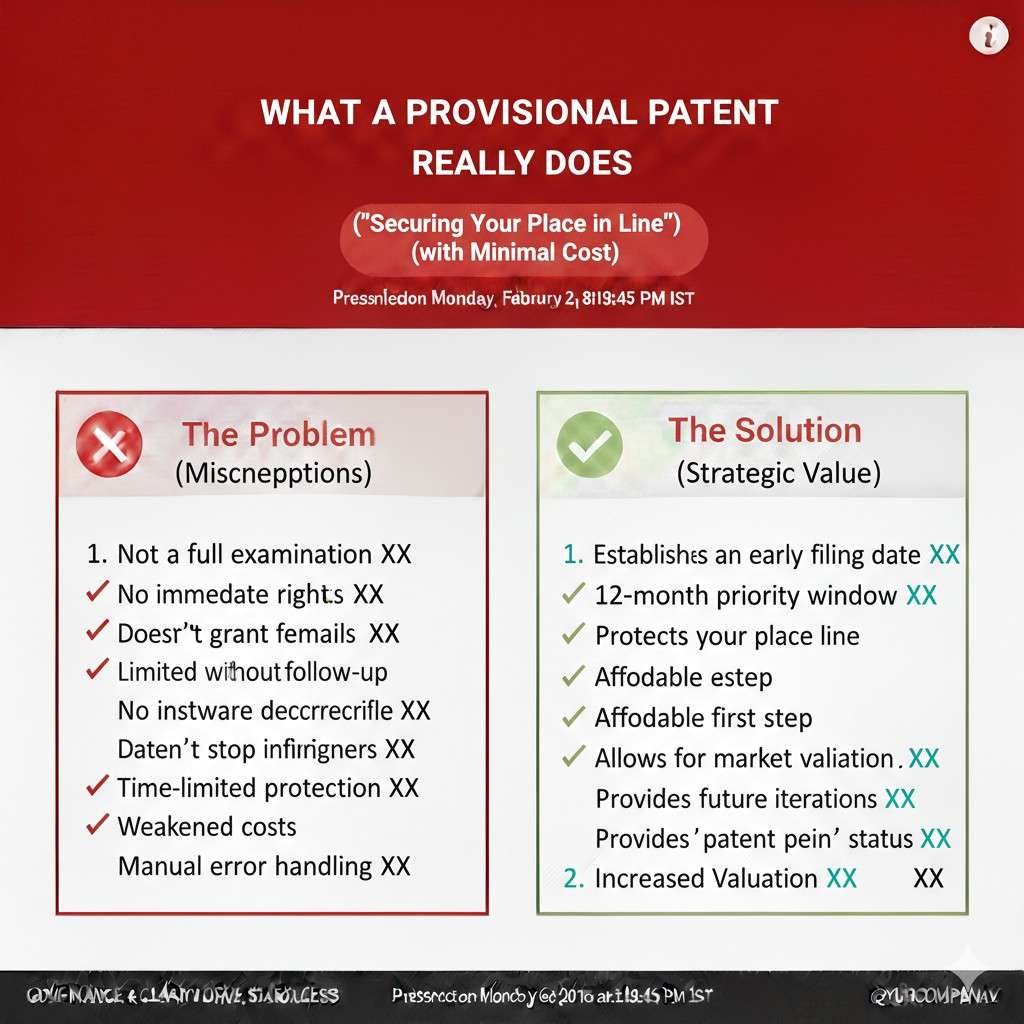
A provisional patent is like putting a time stamp on your invention. It says, “On this date, we had this working idea and we described it in this way.” That date can matter a lot later, especially if you are racing other teams building something similar.
It is important to know what it does not do. A provisional is not the final patent. It is not examined. It does not turn into a granted patent on its own. It is a first move that gives you breathing room while you keep building.
If you are moving fast, a provisional can help you stop worrying about “should we file now?” and start focusing on “did we describe it clearly enough?” That second question is the one that decides whether your early date is actually useful later.
Tran.vc helps founders make sure the provisional is written like it matters, because it does. If you want experienced patent support early, you can apply anytime at: https://www.tran.vc/apply-now-form/
It buys you 12 months to sharpen the story
After you file a provisional, you usually have 12 months to file a full non-provisional patent that claims priority to it. That year is not a break from IP work. It is a window where you can improve your product, collect proof, and refine what you want to protect.
Many founders think of that year as “we can ignore patents now.” That is when mistakes happen. If your provisional is thin, vague, or missing key parts, you cannot fix that later by wishing. The full filing can only rely on what you actually described in the provisional.
So the goal is simple: use the provisional to capture the full shape of your invention today, even if your product will be better tomorrow.
It gives you safer conversations with the outside world
You might need to share details with partners, early customers, hardware vendors, or design houses. A provisional does not replace good contracts, but it can reduce risk when you do have to talk.
In AI and robotics, it is easy to reveal the “secret sauce” by accident. Sometimes it is not even a slide. It is the way you explain your training loop, your control stack, or how you handle edge cases. A filing helps you show you had it first, in writing.
Before You Write: Get Clear on What You Are Protecting
Think beyond the demo and find the repeatable core
A demo is often a mix of clever ideas, quick fixes, and rushed glue code. A patent should focus on what will still matter when you scale. That usually means the repeatable core: the method that makes it work, and the system that makes it reliable.
For an AI startup, the core might be how you build labels, how you select data, how you reduce drift, or how you make the model explain itself in a way that drives better actions. For robotics, it might be how you fuse sensors, plan motion, detect failure, or recover safely.
If you are unsure what the “real invention” is, look for what would hurt the most if a competitor copied it. Not the UI. Not the brand. The part that gives you performance, cost advantage, safety, or speed that others cannot easily match.
Separate “what you built” from “what you discovered”
Founders often talk about invention like a product feature. Patent writing is different. It cares about what you built and how it works, but it also cares about the insight behind it.
Maybe you discovered a new way to reduce false positives in a vision system by using a specific type of temporal check. Maybe you found that a certain data filter makes your model stable under bad lighting. Maybe you realized you can use a particular feedback signal from the robot to correct predictions in real time.
Those discoveries are not “nice to have.” They are often the strongest parts of a filing, because they explain why your method is not obvious. Your provisional should capture both the build and the insight, in plain detail.
Treat “how it fails” as part of the invention
In robotics and AI, the hard part is not the happy path. The hard part is what happens when the sensor drops out, the model sees something new, the robot slips, or the network goes down.
If your system has a smart way to detect failure, switch modes, request help, slow down, or recover, that is often highly valuable. Many founders skip it because it feels like “just safety stuff.” Investors and customers care deeply about safety, and patents can protect those reliability moves.
Write down your failure modes. Then write down exactly what your system does when each one happens. That is often where your real moat is hiding.
The Provisional Patent Checklist: The Foundation
Start with a simple invention statement
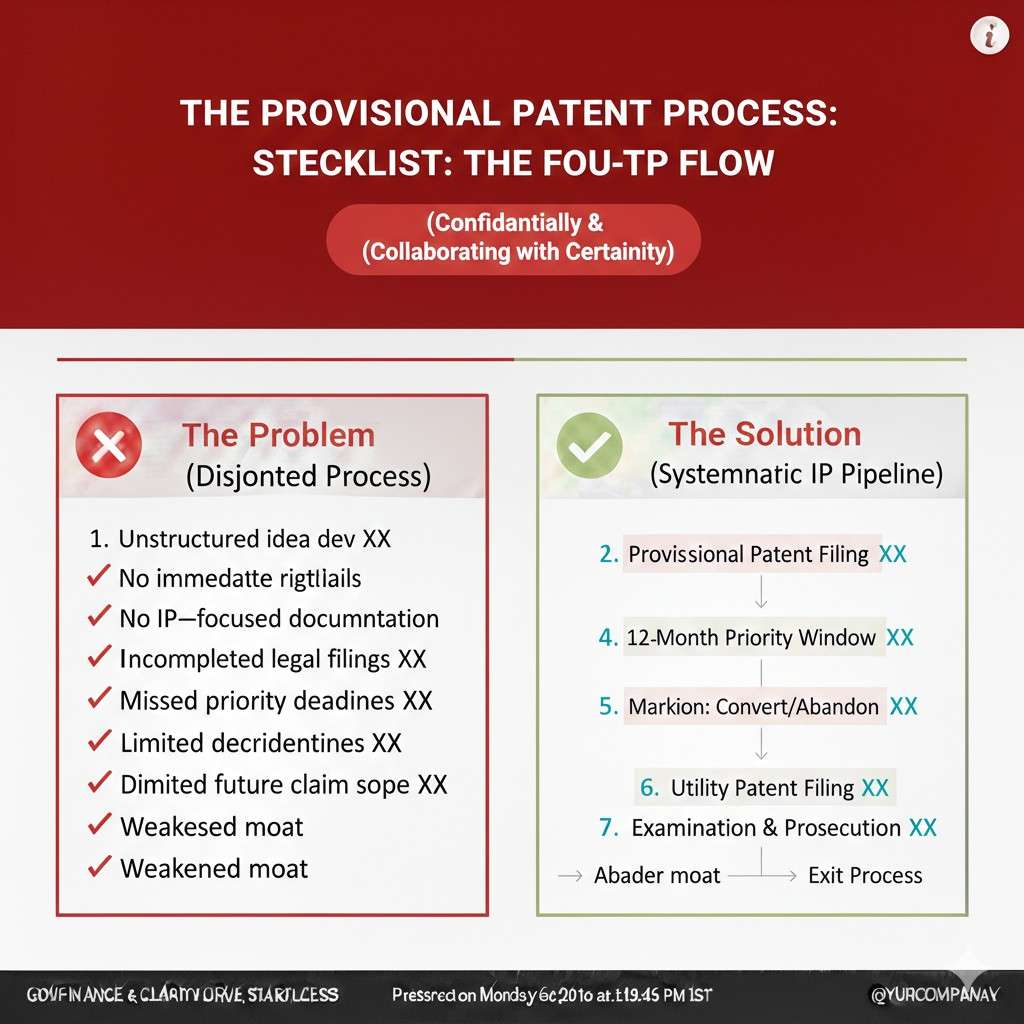
Before you write pages, you need one clear statement you can say out loud. It should explain what you built, what it does, and why it is better.
A good example is not fancy. It is direct. “We built a system that lets a warehouse robot pick fragile items by using vision plus force signals, and it learns from failed picks to adjust grip the next time.”
That sentence is not your patent. It is your anchor. If you cannot write a sentence like that, you will drift into vague talk. Vague talk is the enemy of a strong provisional.
Identify the “must include” pieces of the system
Every invention has parts that must be there for it to work. Your provisional should describe those parts clearly, including how they connect.
For AI, this might include the data input, the preprocessing step, the model type, the training loop, the evaluation, and the deployment setup. For robotics, it might include sensors, perception modules, planning, control, actuators, and safety logic.
You do not need to list every screw and library. You do need to describe the pieces in a way that another skilled engineer could rebuild the idea from your writing. That is a good internal test: could a strong engineer understand what you built without talking to you?
Write the process as a step-by-step flow
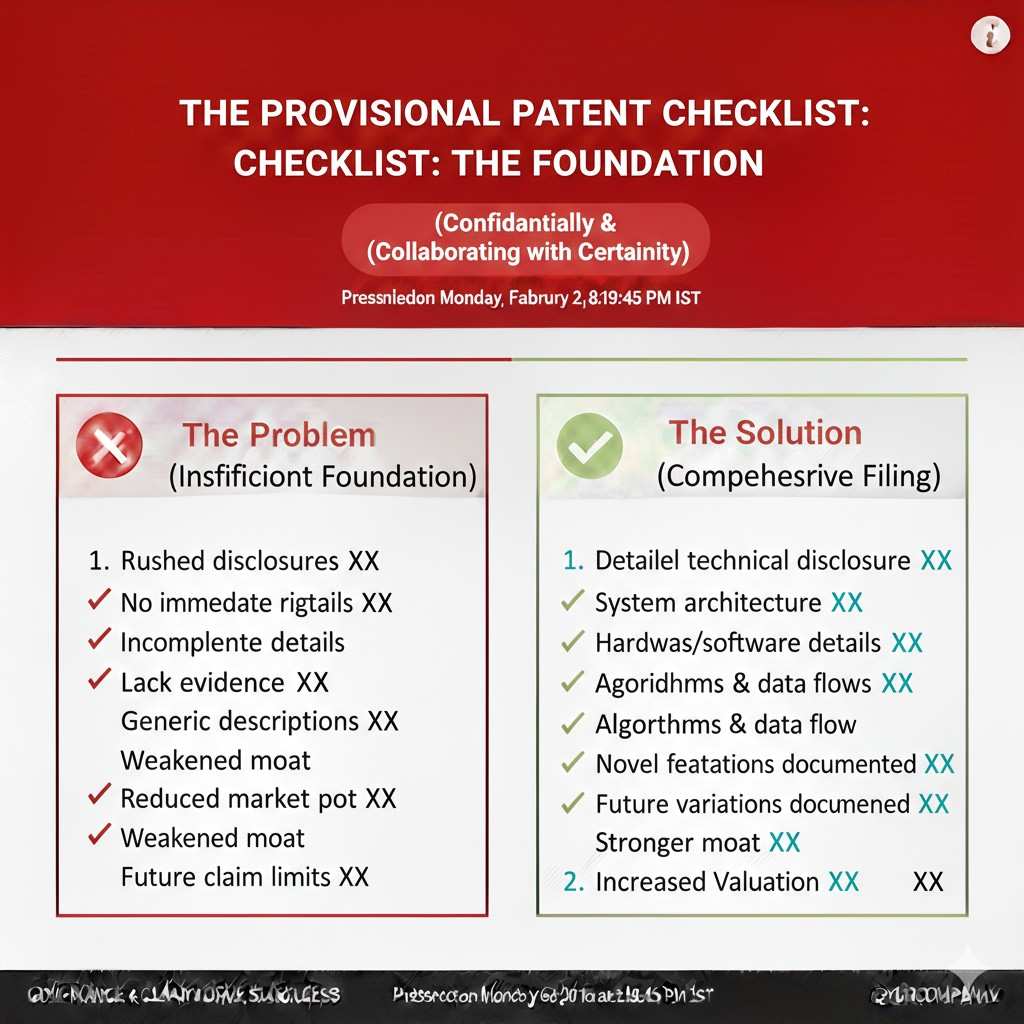
Patents love clear flows. Not marketing flows. Real flows. What happens first, what happens next, what triggers a branch, and how the system reaches an output.
For example, if your robot uses a camera feed and a depth sensor, describe when each feed is read, how you align them, how you generate a scene map, and how that map turns into a motion plan. If your AI system routes tasks between models, describe what signals decide the route and how you measure confidence.
This is where founders often skip detail because it feels “too inside baseball.” That detail is exactly what makes a provisional strong.
Capture at least one working example end to end
A provisional should include at least one full example that goes from input to output. It should be written like a case study, but technical.
What was the input? What was the environment? What constraints existed? What did your system do? What was the output? What improved compared to a baseline?
In AI and robotics, one solid example is worth many vague claims. It shows the invention is real, and it helps support later claims. It also forces you to explain details you might otherwise skip.
Document the variants you might build next
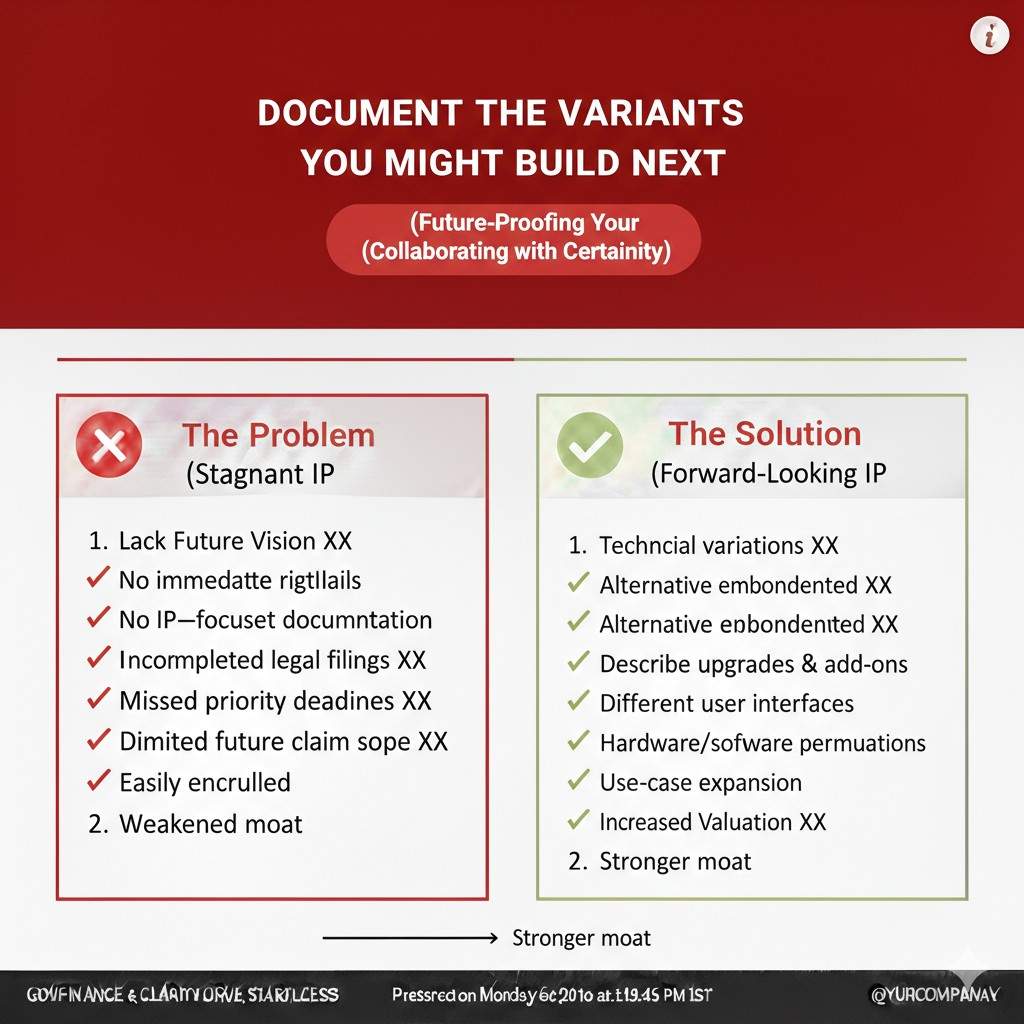
A strong provisional does not only describe the exact version you have today. It also describes reasonable variations, so you do not box yourself into one narrow path.
If you could swap a sensor, use a different model, change the training method, or move a module from cloud to edge, write that down. If your robot could work in warehouses today but hospitals next, explain how the setup changes.
The key is to describe variants that still keep your invention’s core idea. You are not trying to claim the whole world. You are trying to protect the center of what makes your approach special across many forms.
Practical Writing Rules That Make or Break Your Provisional
Use simple words, but be precise
Simple writing does not mean shallow writing. You can use plain words and still be exact. Instead of saying “advanced optimization,” say what you did. Did you reduce compute by pruning? Did you cache embeddings? Did you stop early when confidence passed a threshold?
A patent reader does not reward poetic talk. They reward clear descriptions. If you use a term like “confidence,” define what it means in your system. Is it a softmax score, a calibrated probability, a rule-based score, or a mix?
Precision is not about sounding smart. It is about leaving no room for confusion later.
Avoid “magic” language and show the mechanism
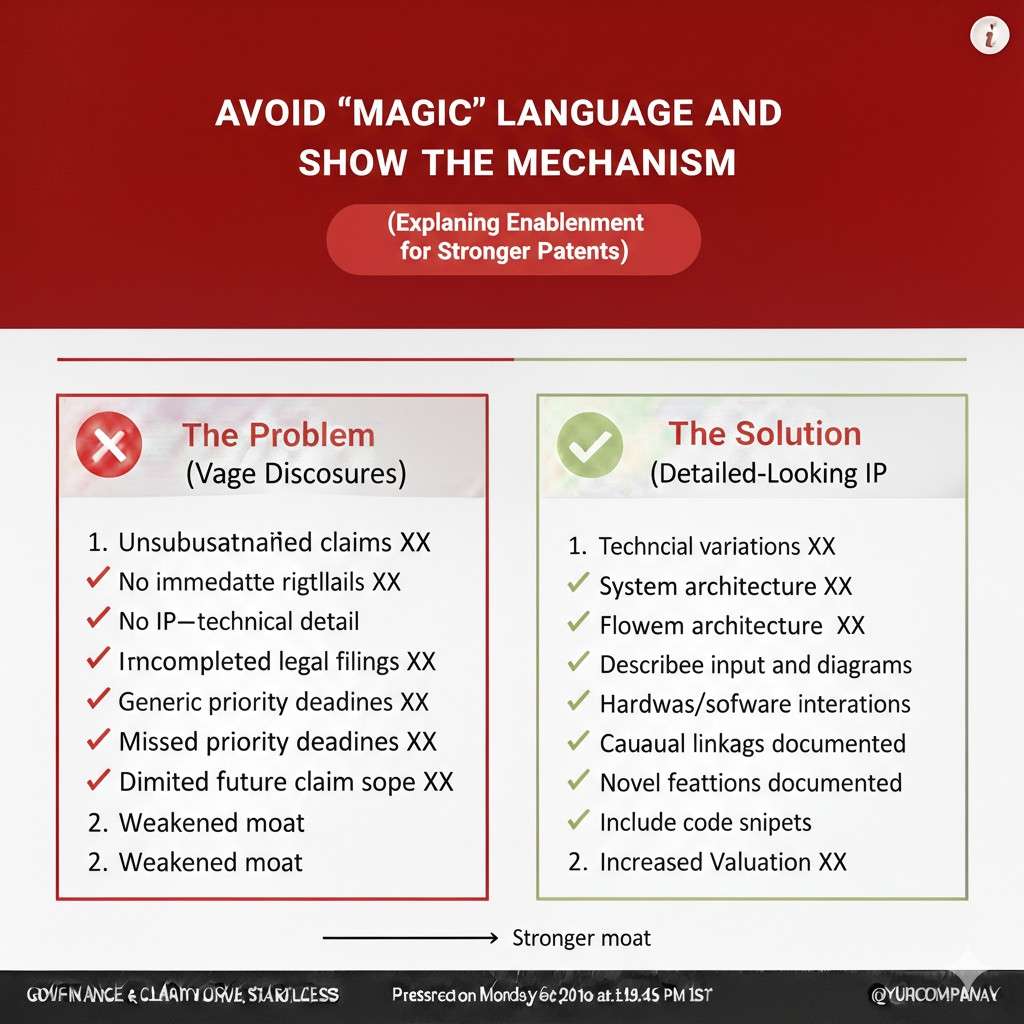
A weak provisional says, “Our system improves accuracy using a special method.” A strong provisional explains the method.
If your method uses a feedback loop, explain what signal is fed back, how often, and what changes because of it. If you use a new loss function, write it in words and give a simple formula if you can. If you use synthetic data, explain how it is generated and how you check it is close enough to real data.
Mechanism is what turns an idea into an invention. The more your writing shows the mechanism, the stronger your position later.
Write as if you are handing it to a future version of yourself
A good mindset is to imagine you are writing for “you in twelve months,” right before the full filing. That future you will be tired, busy, and dealing with product changes.
If the provisional is clear, future you will thank you. If it is thin, future you will be stuck trying to rebuild what you meant, and you may lose the ability to claim key parts.
This is one reason Tran.vc focuses so much on early clarity. Strong early documents create leverage later. If you want hands-on help, apply here: https://www.tran.vc/apply-now-form/
Capturing AI Inventions the Right Way
Do Not Just Describe the Model, Describe the Full System
Many AI founders think their invention is the model. They focus on the architecture, the layers, or the fine-tuning trick. That is important, but it is rarely the whole story.
In most real startups, the edge comes from the full system around the model. It comes from how you collect data, how you clean it, how you label it, how you retrain, and how you deploy safely.
Your provisional should describe the entire pipeline. Start with where the data comes from. Is it sensor data, user input, logs, third-party feeds, or synthetic data you generate yourself? Explain how that data enters your system and what happens before it ever touches the model.
If you only describe the model and ignore the pipeline, you leave gaps. Competitors can build a similar model but change the surrounding steps. A strong filing protects the system, not just the brain inside it.
Explain Your Data Strategy in Plain Detail
In AI, data is power. If your startup has a unique way of gathering or improving data, that can be a key part of your invention.
Maybe you collect edge-case data through active learning. Maybe your robot flags uncertain events and asks for human review. Maybe your software watches user corrections and turns them into new training signals.
Write down how new data enters the loop. Describe how you decide what to label and what to ignore. If you use scoring to pick the most useful samples, explain that scoring method clearly.
Do not assume this is obvious. What feels normal to you may be new and non-obvious to others.
Describe the Training Process as a Living System
A strong provisional should show how your model improves over time. Is it retrained weekly? Does it update in small steps? Does it adapt in real time?
If you use feedback from the real world, describe how that feedback is captured, stored, and used. If you compare different model versions before release, explain how you test and measure them.
Training is not just “we train a model.” It is a process with rules, triggers, checks, and limits. The more clearly you describe that process, the stronger your protection can be.
This is especially important in AI because examiners and courts often look for technical detail. Vague talk about “learning from data” is weak. Clear talk about how and when learning happens is powerful.
Show How You Handle Model Drift and Edge Cases
AI systems break when the world changes. Light shifts. User behavior changes. New objects appear. If your startup has a method to detect and respond to drift, that is not just maintenance. It is often patent-worthy.
Describe how you measure performance over time. Do you track error rates by region, time of day, or device type? Do you compare current data to training data and flag large shifts?
If your system lowers confidence or switches to a backup method when it detects drift, explain that clearly. Walk through a full example.
Drift handling shows depth. It shows that your system is not just accurate in a lab, but stable in the real world.
Document Deployment and Safety Controls
Deployment is often where AI meets reality. It is also where risk lives. If you have built safeguards, fallback systems, or staged rollouts, those details matter.
For example, maybe your model runs in shadow mode before full release. Maybe you limit actions when confidence drops below a set level. Maybe a human must approve certain outputs.
Explain the rules that control these safeguards. What thresholds trigger them? How are they logged? How do you improve them over time?
In robotics, safety is even more critical. If your AI controls motion, describe how it checks limits before sending commands. Does it simulate the move first? Does it check collision zones? Does it cap speed under certain conditions?
These are not side notes. They are part of the invention.
Capturing Robotics Inventions with Real Depth
Break Down the Hardware and Software Together
Robotics is rarely pure hardware or pure software. It is the tight link between sensors, processing, and motion. A strong provisional should describe that link clearly.
Start with the physical setup. What sensors are used? Where are they placed? How do they communicate with the main processor? What kind of actuators are involved?
Then explain how the software reads and interprets sensor data. How often does it sample? Does it filter noise? Does it combine multiple signals into one map or state estimate?
Finally, describe how decisions turn into movement. What path planning method is used? How are commands translated into motor signals? What checks happen before motion is executed?
This full chain from sensing to action is often where your invention lives.
Explain Sensor Fusion in a Concrete Way
Many robotics startups rely on combining data from multiple sensors. Vision, lidar, radar, touch, and force signals may all play a role.
If your startup has a unique way of combining these signals, describe that process step by step. Do you align them in time? Do you convert them into a shared coordinate frame? Do you assign weights based on confidence?
If your system ignores one sensor when it detects noise, explain how it detects that noise. If it increases trust in one signal under certain conditions, describe those conditions clearly.
Sensor fusion can be easy to say and hard to protect. The detail is what makes it defensible.