
You built something real in your home country. You have users, code, and maybe even revenue. Now you want to raise in the US.
And then you hear the same thing from every US investor:
“Love the team. Love the tech. But… you’re not set up for a US round yet.”
That “but” is what this article is about.
A “US flip” is the process of turning a foreign startup into a structure that US investors can fund without fear, friction, or delays. Done well, it feels simple. Done poorly, it can freeze your round, upset your cap table, and create tax or legal pain that follows you for years.
This guide will walk you through the basics in plain language, with practical steps, real investor expectations, and the most common traps. It is written for builders in robotics, AI, and deep tech—where IP matters more, and where the wrong structure can quietly kill a deal.
Tran.vc helps founders do this the right way from day one, with up to $50,000 in in-kind patent and IP services, so your tech becomes a real asset investors can trust. You can apply anytime here: https://www.tran.vc/apply-now-form/
Before we go deeper, let’s make sure we mean the same thing.
A US flip usually means you create a US company (almost always a Delaware C-Corp) that becomes the parent company. Your current company becomes a subsidiary under it, or gets merged into it, depending on your case. You also move key pieces—like ownership of IP and the right contracts—into the right place so a US investor can invest cleanly into the US parent.
Investors care about this for one big reason: they want a simple, safe, standard deal. Most US venture funds are set up to invest into Delaware corporations. Their lawyers have templates built for that. Their limited partners expect that. Their tax reporting is built around that. If you show up with a structure that is not standard, they will either ask you to change it, or they will walk away.
That may feel unfair. But it is not personal. It is just how the machine works.
Now, here’s the part many founders miss: a US flip is not just paperwork.
It is a trust event.
When a US investor looks at your company, they are trying to answer basic questions quickly:
Who owns the company?
Who owns the IP?
Can this company legally sell to US customers?
Can we invest without surprise tax or legal risk?
If we win, can we exit cleanly?
A good US flip makes those answers obvious.
A messy flip makes investors nervous, even if your product is strong.
So the goal is not to “get a Delaware shell.” The goal is to make your company “VC-ready” in the US sense. Clean, predictable, investable.
Let’s start with what “VC-ready” really means in practice.
In the US venture world, investors like patterns. They like deals that look like other deals they have done before. You do not need to be perfect. But you do need to be legible.
A VC-ready foreign startup, after a flip, usually has:
A Delaware C-Corp parent.
Founder stock issued under US rules, with standard vesting.
A cap table that is easy to read, with signed docs for each holder.
Clear ownership of core IP in the US parent (or a clear, investor-acceptable license).
Employee and contractor agreements that say inventions belong to the company.
Customer contracts that can be enforced in the US.
A plan for where the team sits and how payroll works.
A clean story for why the structure makes sense.
If you are thinking, “That sounds like a lot,” you are right. But the trick is that you do not do it all at once in a panic, two weeks before a term sheet.
You do it with a calm sequence.
And you do it in the right order.
Because order matters.
One of the biggest mistakes founders make is they start with incorporation, then try to “patch” everything else later. That is how you end up with a US company that does not actually own the thing investors are paying for.
In deep tech, that “thing” is usually the IP.
If you build robotics, AI models, control systems, sensors, edge compute, or any hard-to-copy stack, the buyer is not only buying your product. They are buying your ability to defend it.
That is why IP strategy is not a “nice to have.” It is part of becoming fundable.
And that is why Tran.vc exists. They do not just give advice and disappear. They invest up to $50,000 worth of patent and IP work so you can build a real moat early, without giving away control early. If you want to see if you fit, apply here: https://www.tran.vc/apply-now-form/
Now let’s talk about when you should flip.
A US flip is not always urgent. But there are moments where delaying it costs you.
If you are about to raise from US investors, and they are serious, you will almost always need the US structure before the money wires. Some investors will sign a term sheet “subject to flip.” But many will not. And even if they do, the flip can become the slowest part of the deal, which can weaken your momentum.
Also, if you are starting to sell to US customers, the pressure increases. Customers may ask for US-friendly contracts, data rules, and support terms. They may also prefer to pay a US entity.
The other timing factor is IP filing.
If you plan to file patents, timing matters because public disclosure can harm your ability to patent in many countries. Also, assignment and ownership should be clean before filings. If your IP is scattered across founders, contractors, and entities, you risk filing from the wrong owner, which can create future problems.
This is where many foreign startups get stuck: they want to raise, and they want to patent, but they have not set up clean ownership.
If you fix ownership early, everything else gets easier.
So what does the flip process look like, step by step, in a real founder’s life?
It starts with a simple question: what exactly are you flipping?
You are not flipping your team. You are not flipping your culture. You are flipping legal ownership.
There are a few common structures used for flips. I’ll keep this simple.
The most common outcome is:
New US parent (Delaware C-Corp)
→ owns
Your existing foreign company (subsidiary)
That can be done in different ways. The exact method depends on local laws, taxes, shareholder approvals, and how your cap table is set up.
But for you, as a founder, the main thing to understand is this:
Investors will invest into the US parent. They want the US parent to control the whole business. That means the US parent must own the shares of the foreign company, or must own the assets that matter.
Now let’s talk about what can go wrong.
The flip can break when:
Your current shareholders do not agree.
Your country has rules that block share swaps.
There are tax costs triggered by moving shares.
Your early investor documents do not allow the move.
Your IP cannot be transferred cleanly due to grants, university rules, or government funding.
Your contractors never signed invention assignments.
Your co-founders’ ownership is unclear.
These are not rare issues. They are very common. The good news is that most can be handled, but only if you catch them early.
A practical way to think about this is to treat the flip like a “due diligence rehearsal.” Anything that will scare an investor later will also make the flip harder now.
So before you even form the US parent, you want to do a quick internal check.
Not a huge audit. Just a founder-level review.
You want to be able to answer:
Do we have a clear list of all owners, and what they own?
Do we have signed documents for that ownership?
Do we know who wrote the code, designed the hardware, trained the model, or built the core system?
Do we have signed agreements that give the company rights to that work?
Do we have any grants, school ties, or employer claims on the tech?
Do we have any unpaid taxes or pending disputes?
If you cannot answer these in one sitting, that is your first task.
And if you want a fast way to get this clean, this is exactly the type of work Tran.vc helps founders do, alongside patent strategy and filings, so your company becomes easy to fund. You can apply here: https://www.tran.vc/apply-now-form/
Now, let’s get more specific on the question every investor will ask, even if they do not say it out loud:
“Where is the IP?”
If your IP is still owned by the foreign entity, some investors will accept it, but many will push to move it to the US parent. Why? Because if the foreign subsidiary owns the IP, then the US parent is less powerful than it looks. Also, if something goes wrong overseas, the IP can become trapped.
On the other hand, moving IP too aggressively can create tax issues in some countries, and it can create problems if you have government incentives tied to local ownership.
So there is not one answer that fits everyone. But there are two rules that usually hold:
Rule one: investors must feel the US parent truly controls the IP.
Rule two: the chain of ownership must be clean on paper.
That can be done by assignment or by license. Assignment means ownership moves. License means ownership stays but rights are granted.
In venture, assignment is usually preferred. But in some cases, a strong exclusive license can work, as long as it is written in a way that investors accept. The license must be clear, long-term, and hard to cancel.
Deep tech founders should take this part seriously. A weak IP setup is one of the fastest ways to lose leverage in a raise.
Even if you are not filing patents, you still have IP. Your code, your model weights, your training data pipelines, your hardware designs, your test rigs, your manufacturing know-how, your control loops. All of that matters.
Patents can make this stronger, because they turn your know-how into an asset with a boundary.
This is the big idea behind Tran.vc: turning your invention into something you can defend early, before competitors copy it and before investors force rushed filings. They invest up to $50,000 in patent and IP services to help you do that. Apply anytime: https://www.tran.vc/apply-now-form/
Let’s move to the next investor worry: the cap table.
A cap table is just a map of ownership. But many foreign startups have cap tables that make US investors uncomfortable.
Common issues include:
Handshake equity that is not documented.
Advisor promises that were never signed.
Unclear vesting.
Too many tiny shareholders.
Side agreements that give veto rights.
Convertible notes written in non-standard ways.
Employee equity promised verbally.
None of these are impossible. But each one adds friction. US investors want to know exactly what they are buying into.
A simple way to become VC-ready is to make your cap table “boring.”
Not small. Not perfect. Just boring.
Boring means: every share has a document, every promise is either written or removed, and every special right is understood.
If you are flipping, you will need to map every shareholder from the old company into the new US parent. That usually means each shareholder exchanges their shares in the foreign company for shares in the US company. That exchange must be documented.
If you have shareholders who are hard to reach, or who do not want to sign, that can stop the flip.
So if your company is two years old and you have old friends with “tiny promised equity,” clean it now, not later.
You do not want to discover that your former classmate owns 2% and refuses to sign unless you pay them.
This is also why founder vesting matters.
Many international founders are not used to vesting. In the US, vesting is standard. It protects the company if a founder leaves early. Investors expect it.
So when you flip, you usually set up standard vesting schedules for founder shares, often with credit for time already served. The details vary, but the goal is simple: keep it standard.
If you resist vesting, investors may read it as, “This founder might not be coachable,” or “This team might be fragile.” That may not be true. But perception matters.
Now let’s talk about the third big piece: people and payroll.
A US flip does not mean you must move everyone to the US. Many strong startups have teams in India, Europe, LatAm, and more.
But investors will ask: who employs the team?
If the US parent employs everyone directly, you need a system for foreign payroll, local compliance, benefits, and taxes. That can be done through local entities or employer-of-record services.
If the foreign subsidiary employs the team, that can work too, as long as the US parent controls the subsidiary, and contracts are clean.
What investors do not like is confusion.
They do not want to hear, “We will figure it out later.”
They want a clear operating picture. Where is engineering? Where is sales? Who signs contracts? Who owns the work product?
Again, this is not about perfection. It is about clarity.
Now, since this is “US Flip Basics,” I want to ground this in a simple tactical path you can follow.
Here is the practical sequence founders often use when they want to raise in the US:
First, decide the end state: Delaware C-Corp parent, foreign sub, clean IP chain.
Second, clean your existing ownership documents enough to execute the share exchange.
Third, create the US parent and basic governance docs.
Fourth, execute the flip steps (share exchange or merger).
Fifth, move or license the IP in a way investors accept.
Sixth, standardize founder vesting and option pool planning.
Seventh, align contracts: contractors, employees, key customers.
Eighth, prepare for US fundraising docs (SAFE, priced round docs, etc.).
Even though I just described it in steps, you do not need to treat it like a huge checklist. Think of it as clearing blocks in the order that stops deals.
And the biggest blocks are almost always: IP ownership, cap table clarity, and investor-ready structure.
This is exactly the zone Tran.vc works in. They help you build the defensible foundation early, with real patent attorneys and startup veterans, so when an investor leans in, you do not scramble. If you are building in robotics or AI and want to make your company US-fundable without giving away control early, apply here: https://www.tran.vc/apply-now-form/
US Flip Basics: Turning a Foreign Startup VC-Ready
What “VC-Ready” Really Means in the US
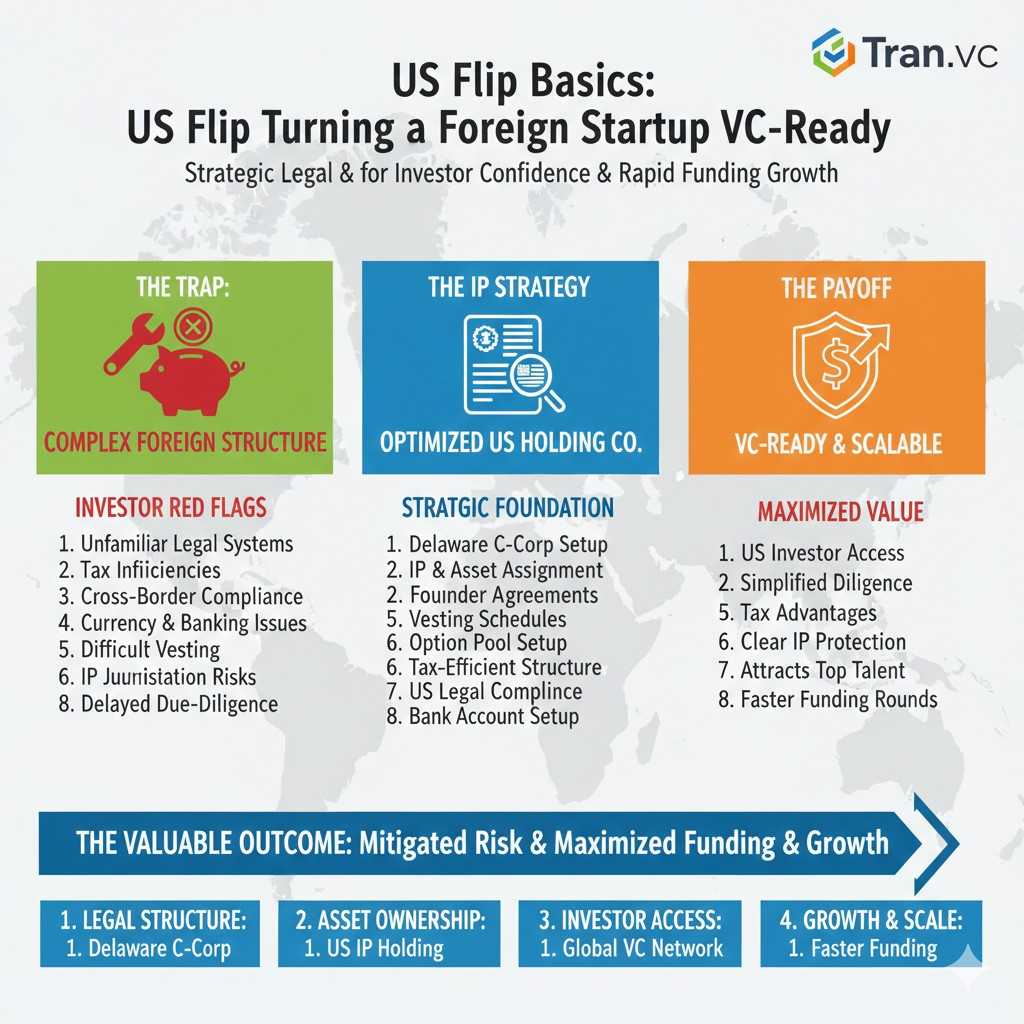
When a US investor says “VC-ready,” they are not judging your talent. They are judging risk. They are asking, “Can I invest fast, safely, and with standard papers?” If the answer is yes, you move forward. If the answer is unclear, the deal slows down or dies.
VC-ready also means your company looks familiar to their lawyers. Most US funds invest into a Delaware C-Corp because it fits their tax rules, their reporting, and their deal templates. They do not want a custom structure that needs custom legal work.
In simple terms, being VC-ready means your company is easy to understand on paper. A clean cap table. Clean ownership. Clean IP. Clean contracts. And a clear way for the investor to put money in and get stock out.
If you want Tran.vc to help you become VC-ready the right way, you can apply anytime here: https://www.tran.vc/apply-now-form/
What a “US Flip” Is, in Plain Words
A US flip is a legal change that makes a US company the parent of your business. Your current company becomes owned by the new US company, or your key assets move into the US company. The US company becomes the place investors write checks to.
This is not about changing your team or your market overnight. Many strong startups keep their engineering team outside the US. The flip is mainly about making the investment path clean and standard.
Think of it like moving your startup into a new “container” that investors trust. The product stays the same. The customers stay the same. But the legal structure becomes simple enough for a US round.
The One Thing Investors Care About Most
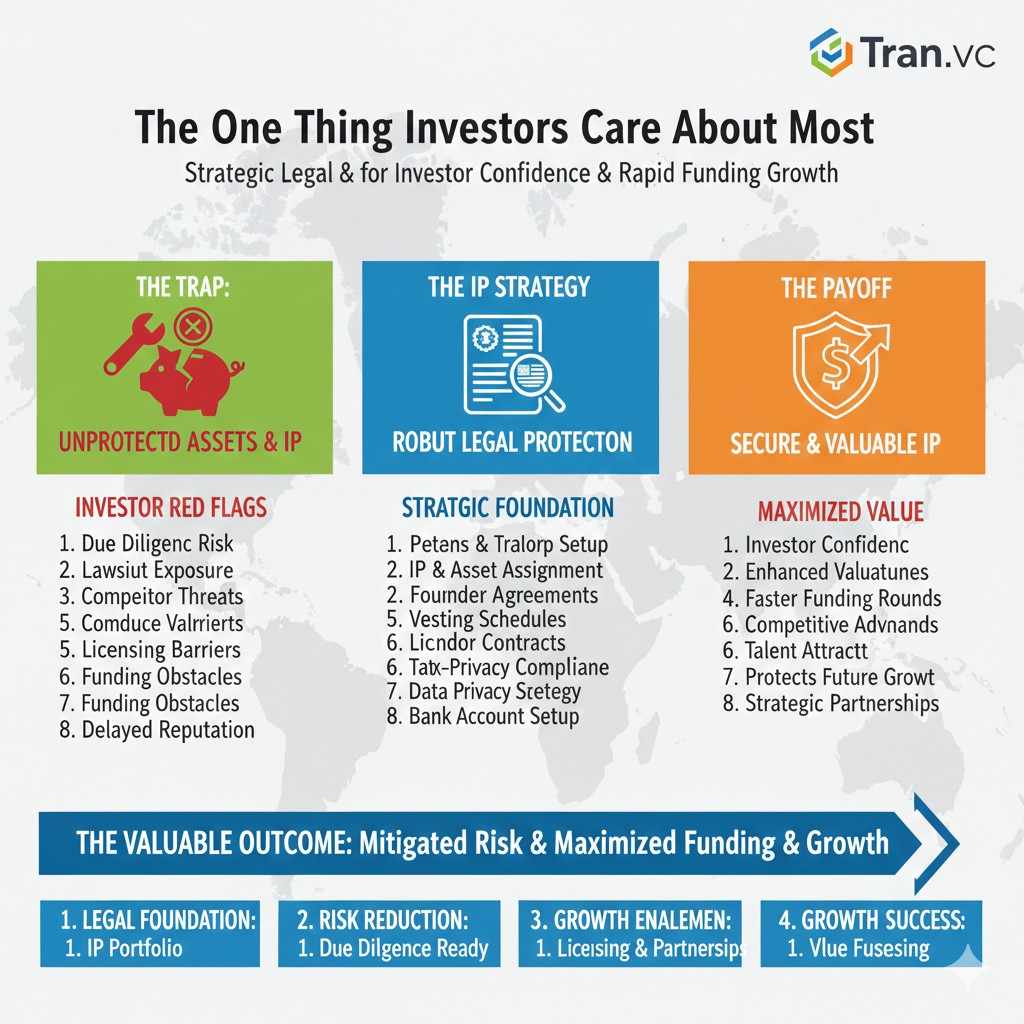
Investors can forgive many things. They can forgive early revenue. They can forgive a messy product. They can forgive imperfect sales motion. But they do not forgive unclear ownership of the tech.
If they cannot see who owns the IP, they will assume someone else might claim it later. That fear is enough to pause a deal. In deep tech, that pause is often fatal because the round loses momentum.
This is why a US flip is not only a “company setup” job. It is an ownership and trust job. It needs to be done in the right order, or you create more risk than you remove.
Tran.vc focuses on this exact foundation work, including up to $50,000 in in-kind patent and IP services for robotics, AI, and deep tech startups. Apply here: https://www.tran.vc/apply-now-form/
When You Should Flip and When You Should Wait
The Best Time to Flip Is Before You Are Under Pressure
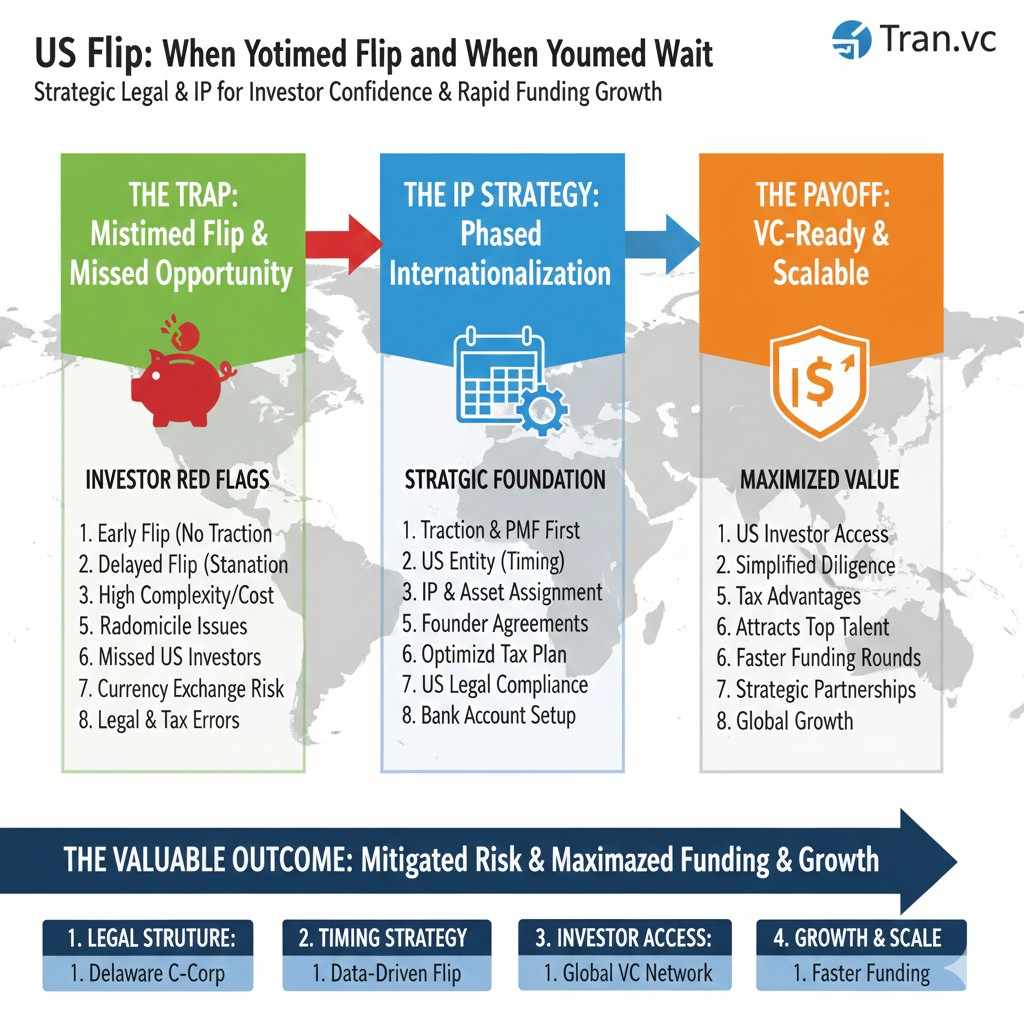
If you try to flip during an active fundraise, everything feels urgent. You are negotiating with investors, answering questions, and chasing deadlines. Legal work becomes a blocker, and blockers scare investors.
When you flip earlier, you control the pace. You can clean the cap table, fix contracts, and set up IP ownership without the stress of an investor watching every move. That calm process usually leads to better outcomes.
Early flipping also reduces the chance of surprise costs. Many founders think a flip is “quick paperwork,” then discover they need shareholder approvals, updated agreements, or missing signatures. Those surprises are easier to handle when you are not mid-round.
Signs You Should Flip Soon
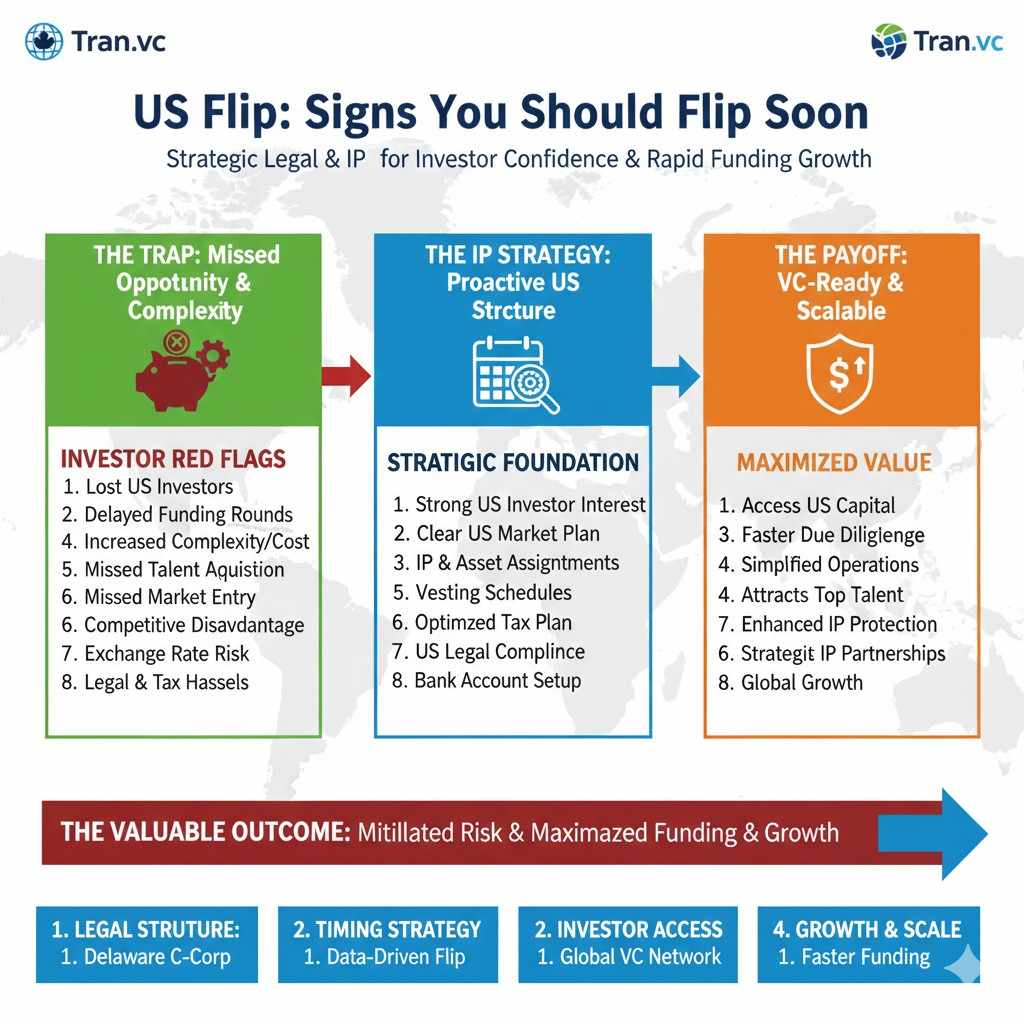
If US investors are already asking for a Delaware C-Corp, you are close to the flip moment. If a serious investor says “we can proceed after the flip,” you should treat that as a real requirement, not a suggestion.
If you are starting to sell to US customers, a flip can also help. US customers often prefer contracts with a US entity. They may also want US-friendly terms for liability, data, and payment.
Another sign is IP planning. If you are about to file patents, you want to ensure the owner is correct before filing. Filing under the wrong entity or with unclear assignments can create problems later, even if the invention is strong.
When Waiting Might Be Fine
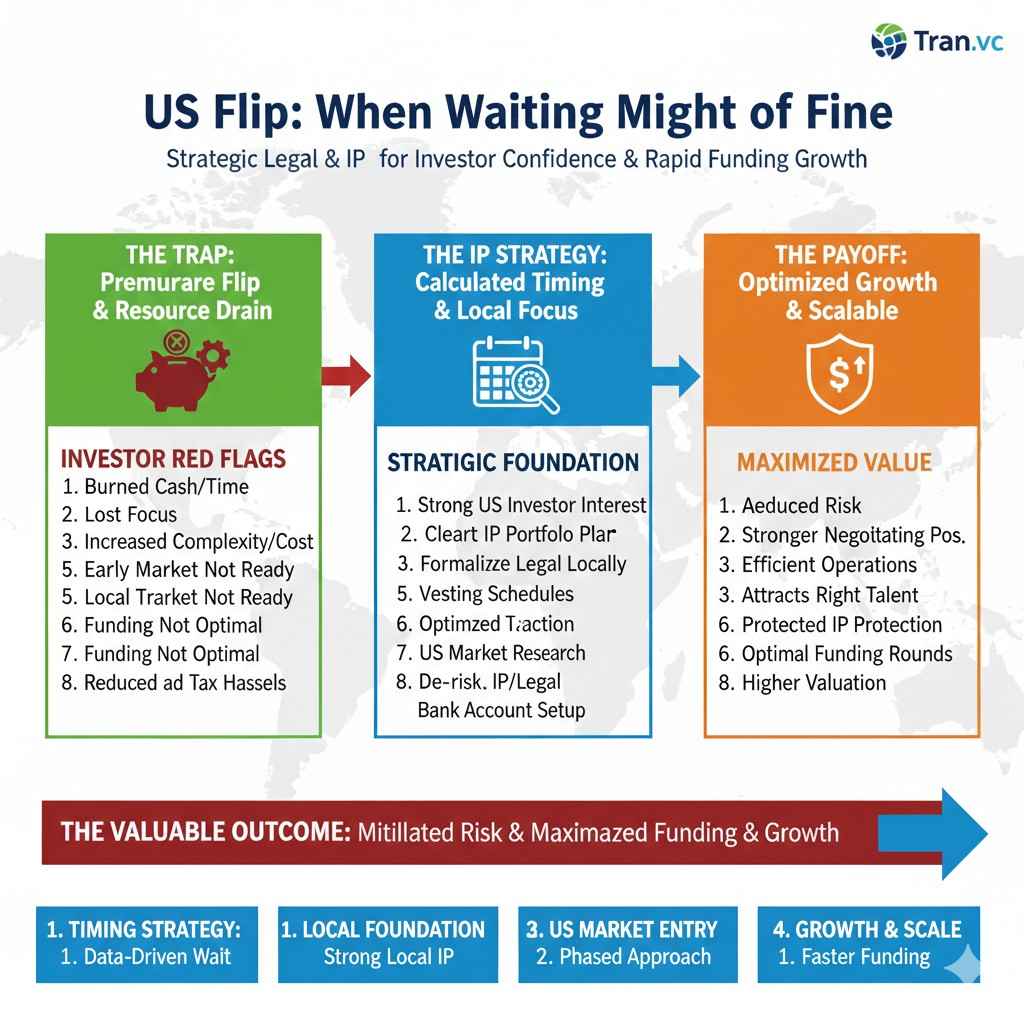
If you are not raising in the US soon, and your market is local, you might not need to flip yet. Some startups do well for years before they raise US money. If your investors are local and comfortable with your current structure, you may delay.
But even if you wait on the legal flip, you should not wait on IP and contract hygiene. Clean invention assignments, contractor agreements, and clear ownership are valuable in every country. They also make a future flip much easier.
If you want a clear plan instead of guessing, Tran.vc can help you map the right timeline and protect your tech early. Apply anytime: https://www.tran.vc/apply-now-form/
The End State: What a Clean Flip Usually Looks Like
Delaware Parent, Foreign Subsidiary
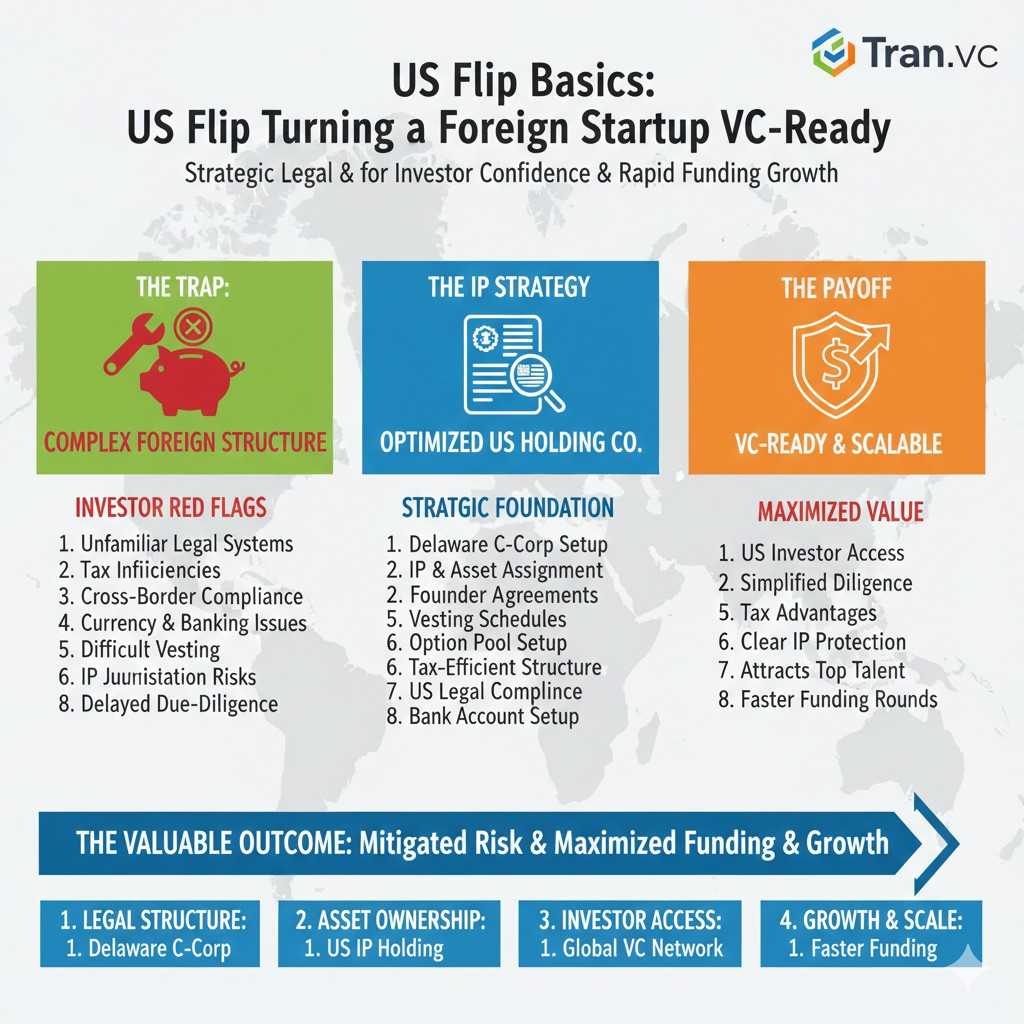
In the most common setup, you create a Delaware C-Corp as the parent company. That Delaware company then owns your current foreign company as a subsidiary. This allows the business to keep operating locally while the investment happens at the US parent level.
This setup also helps with future US fundraising because it matches what most funds expect. Their legal docs assume a Delaware parent. Their preferred stock terms assume a Delaware framework. Their board structures assume Delaware rules.
It does not mean everything must move to the US. It means the “top” of the company becomes US-based. That top layer is what investors buy into.