
Founder-market fit is the quiet force that makes early deep tech work.
In deep tech, the first big risk is rarely the code. It is the gap between what the market truly needs and what the team is able to build, ship, and defend before time and money run out. Many founders can build a strong model, a clean robot stack, or a new sensor. Far fewer can place that technology inside a real workflow, with real buyers, under real rules, and still make it win.
That is why founder-market fit may matter more than almost anything else at the start.
In early deep tech, you do not get fast feedback the way you do in simple software. Hardware takes time. Data takes time. Certifications take time. Sales cycles take time. The wrong market choice can cost you a year before you even learn it was the wrong choice. When learning is slow and expensive, the founder’s “native advantage” becomes your biggest lever. If you have lived the problem, you often see around corners. You know what will break in the field. You know what buyers will push back on. You know what a pilot really requires, and what it is safe to ignore at first.
Founder-market fit is not a slogan. It is a set of unfair advantages that lower the cost of truth.
A founder with strong founder-market fit tends to have at least one of these: deep time inside the customer’s world, a track record shipping something into that world, hard-earned trust with the people who control budgets, or a personal reason that keeps them steady when progress is slow. In deep tech, slow progress is normal. What looks like “stuck” to an outsider is often the reality of building something that must work in physical space, or must meet safety standards, or must earn trust with buyers who cannot take big risks.
If you are building robotics, you are not just building motion. You are building reliability, service, training, and support. If you are building AI for health, you are not just building accuracy. You are building data rights, privacy, audits, and clinical trust. If you are building new compute, you are not just building speed. You are building toolchains, integration, and long adoption curves. These are not “features.” They are the real product. Founder-market fit decides whether you respect these realities early, or learn them late.
Here is the tricky part: deep tech founders often believe technical depth alone is the fit. Technical depth is needed, but it is not the full fit. A brilliant technical team can still pick the wrong buyer, the wrong use case, the wrong pricing shape, the wrong channel, and the wrong proof to pursue. They can spend months perfecting the wrong demo. They can optimize for applause instead of purchase. Founder-market fit helps you avoid those traps because you have a sharp sense for what matters in the buyer’s world.
In our work at Tran.vc, we see this pattern again and again. The teams that move fastest are not always the ones with the biggest labs or the most famous degrees. They are the ones who can answer simple questions with calm clarity:
Who is hurting right now?
What is the cost of that pain?
What do they do today instead?
What would make them switch?
What would make them trust you?
What would make them pay?
And what part of your advantage can you protect so a bigger player cannot copy you once you prove it works?
That last question matters more in deep tech than most founders expect. Because once you show you can solve a hard problem, you will attract attention. You want that attention. You also want a moat. A real moat is not marketing. A real moat is an asset.
That is where strong IP thinking becomes part of founder-market fit. Not because patents are paperwork, but because patents force you to name what is truly novel. They help you draw clean lines around your invention. They help you turn “we built something cool” into “we own a defensible method that matters to a buyer.” This is one reason Tran.vc invests up to $50,000 in-kind in patent and IP services for robotics, AI, and deep tech startups. It is seed support that makes your tech harder to copy, and your story easier to believe.
If you want to explore that kind of support, you can apply anytime at https://www.tran.vc/apply-now-form/
Now, let’s define founder-market fit in a way that is useful, not vague.
Founder-market fit means your team has a natural grip on the market’s truth. You know what “good” looks like for the customer. You know what “failure” looks like, too. You understand the buying path, not just the user path. You can speak the language of the people who sign the contract. You can predict the objections before they are spoken. You can pick battles wisely, because you know what is urgent and what is “nice to have.”
This fit shows up in small decisions that outsiders miss.
A founder with fit designs the product around the customer’s daily life. They do not ask the customer to become a new person. They reduce change, because change is costly. They build onboarding that matches how teams are trained in that industry. They choose a deployment plan that aligns with IT and security habits. They package the offering so procurement can approve it. They shape the pilot so it proves the right thing, not the easiest thing.
A founder without fit often builds a product that assumes the market will meet them halfway. In deep tech, the market rarely does.
Deep tech markets are full of hidden rules. There are safety rules, compliance rules, and “this is how it is done” rules. Some rules are written. Many are social. A founder with fit knows which ones can be bent early and which ones will break you if you ignore them. This is why founder-market fit is not only about knowing the problem. It is also about knowing the constraints that live around the problem.
If you are a robotics team selling into warehouses, you must understand the pain of downtime. A robot that is 95% right may still be a bad buy if the 5% failure stops an entire line. A founder who has lived that world will push early for service design, fast swap parts, and clear escalation steps. They will plan for training and maintenance. They will build a product that operations leaders can trust at 2 a.m., not just a demo that looks good at 2 p.m.
If you are building AI for call centers, you need to know that managers care about quality scores, compliance, and speed-to-answer. If you focus only on model performance and ignore the way agents are coached, you will struggle. A founder who has run a team like that will know where the friction is. They will ship the features that remove real labor, not just add a new dashboard.
Founder-market fit also changes how you raise money.
Deep tech often requires patience. Many investors say they like patience, but their funds are shaped by time. If you are early, you need leverage. Leverage can come from smart traction, yes. It can also come from proof that you are the right team to win the market you chose. That proof is founder-market fit made visible.
When investors meet a founder with fit, they feel it quickly. The founder does not talk in slogans. They talk in crisp trade-offs. They can explain why one customer is perfect for a pilot and another is a trap. They can describe the budget owner, the user, the blocker, and the champion. They can describe the “event” that forces a purchase. They can describe what will kill the deal and how they will prevent it.
This is not charisma. This is lived pattern recognition.
And in deep tech, pattern recognition matters because the path is long. You will face long cycles, hard engineering, and many “almost” moments. A founder with real fit can endure those moments because they have a reason beyond curiosity. They are tied to the outcome. They know the cost of the problem. They have seen it hurt people or waste time or burn money. That gives them a steady fire.
If you feel that fire but want a sharper plan, this is where a strong early partner helps. Tran.vc is built for technical founders who want to build real assets early, especially IP assets. We support you with patent strategy and filings so that your deep tech story is not only “we can build it,” but also “we can defend it.” You can apply anytime at https://www.tran.vc/apply-now-form/
One more point before we go deeper in the next section: founder-market fit is not fixed. It can be built. You can earn it faster than you think if you treat it like a skill, not a personality trait.
You build it by doing the unglamorous work early. You talk to buyers, not only users. You shadow workflows. You map the budget. You learn the rules. You learn why past attempts failed. You learn what “good enough” really means. You learn what must be perfect. You learn what must be provable. You stop guessing.
That is the real advantage. In deep tech, every wrong guess is expensive.
Founder-Market Fit in Deep Tech: What It Really Means
It is not “you love the problem”
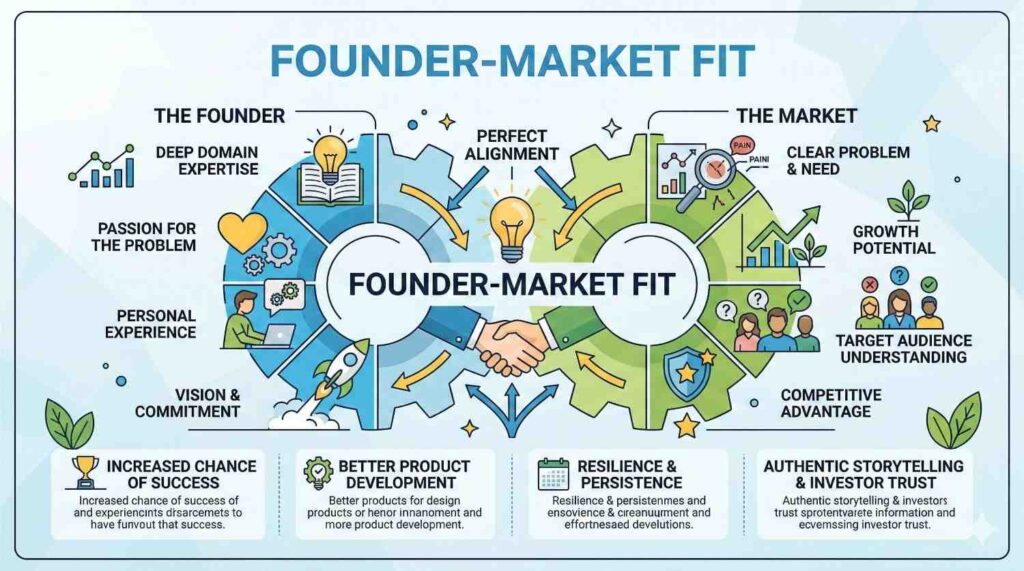
Founder-market fit is not about being excited. Many people are excited.
Founder-market fit means you have earned closeness to the market. You understand how the work gets done, what breaks, what people fear, and what they will pay to fix. You can tell the difference between a pain that feels annoying and a pain that forces a budget.
In deep tech, that difference decides if your startup becomes a company or a science project.
It is an “unfair advantage” you can explain
If your advantage is real, you can explain it without drama.
You might have spent years inside the industry. You might have shipped systems into messy real life. You might have run a team that lived with the problem every day. Or you might have built the same kind of tech before and know the traps that come with it.
The point is not your resume. The point is that you can make fewer bad bets early.
It shows up in the first product choices
Deep tech founders often assume the first product is “the model” or “the robot.”
But the first product is usually the full system that makes the outcome happen. That includes data flow, integration, safety habits, handoffs, edge cases, and support. Founder-market fit shows when you build that whole picture from day one, not only the core tech.
This is why a founder with fit can look slower in a lab, but faster in the real market.
Why Deep Tech Makes Founder-Market Fit More Important
Feedback is slow, so mistakes cost more
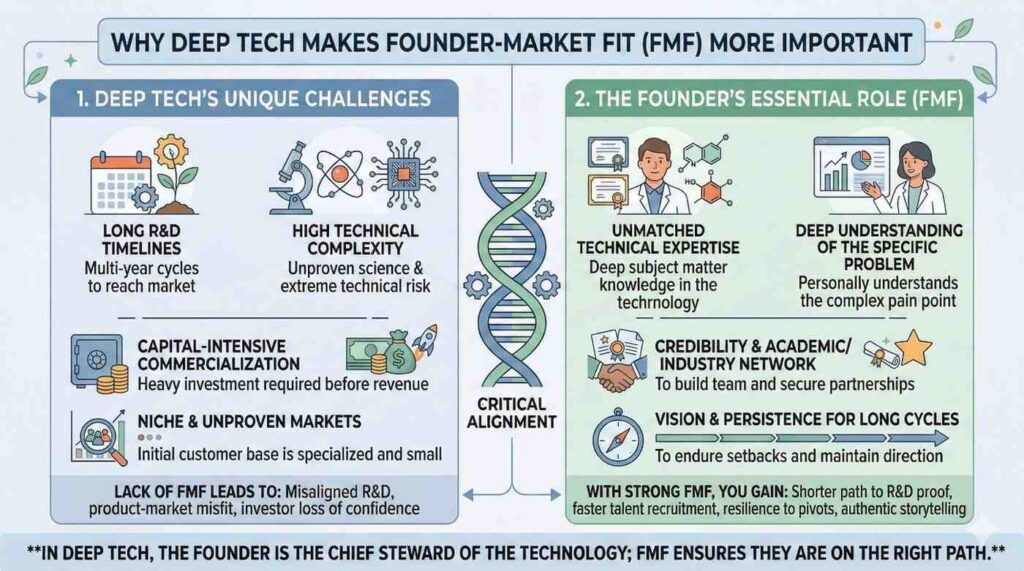
In many software startups, you can ship, learn, adjust, and ship again quickly.
In deep tech, cycles are longer. Hardware takes time to build and test. Data takes time to collect and label. Trials take time to plan. Reviews take time to pass. Even a simple pilot can take months to start.
When learning is slow, every wrong assumption can burn a season of your company’s life.
Customers demand proof, not promises
Deep tech buyers are often buying risk reduction.
They care about safety, uptime, accuracy in bad conditions, and results under stress. They want proof in their environment, with their people, and under their rules. A founder with fit knows what proof matters, and what proof does not.
A founder without fit can waste months proving the wrong thing.
Adoption depends on trust, not only performance
Many deep tech tools touch core operations.
That means a buyer has to trust you before they trust your product. They also need to trust that you will support them when something fails. Founder-market fit helps you earn that trust faster because you speak the customer’s language and respect their reality.
Trust is not a “nice add-on.” It is part of the product.
The Hidden Parts of the Market That Deep Tech Founders Must Know
The buyer is not always the user
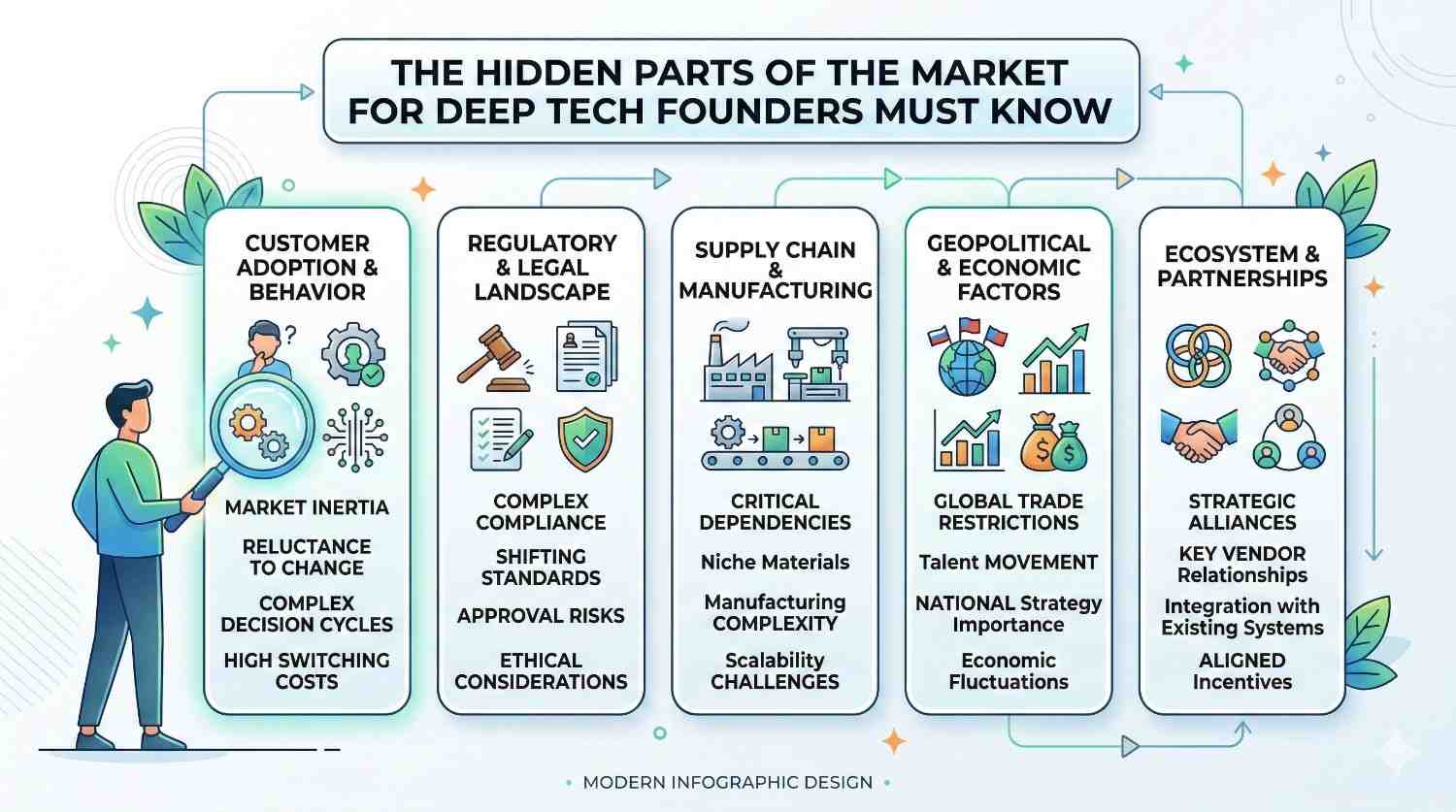
In deep tech, the user might love your product and still not be able to buy it.
The budget owner might be a different person. Procurement might block it. Security might slow it. Compliance might demand changes. A founder with fit knows how decisions move through that system and designs around it.
This is why “users said they want it” can still lead to no revenue.
The real competitor is the current workflow
A deep tech startup usually thinks it is competing with other startups.
Often, you are really competing with the way things are done today. That workflow might be slow, but it is familiar. It has training, habits, and backup plans. It is “good enough” in the eyes of the organization.
Founder-market fit means you understand what makes the old workflow hard to replace.
The market has rules that are not written down
There are written rules like safety standards and privacy law.
There are also unwritten rules like “our team does not change tools mid-quarter” or “we do not trust vendors without a local service plan” or “IT will not approve anything that touches this system.” These are real, even if nobody puts them in an email.
A founder with fit learns these rules early and treats them as design inputs.
A Practical Way to Test Founder-Market Fit Early
Start with a single clear “who”
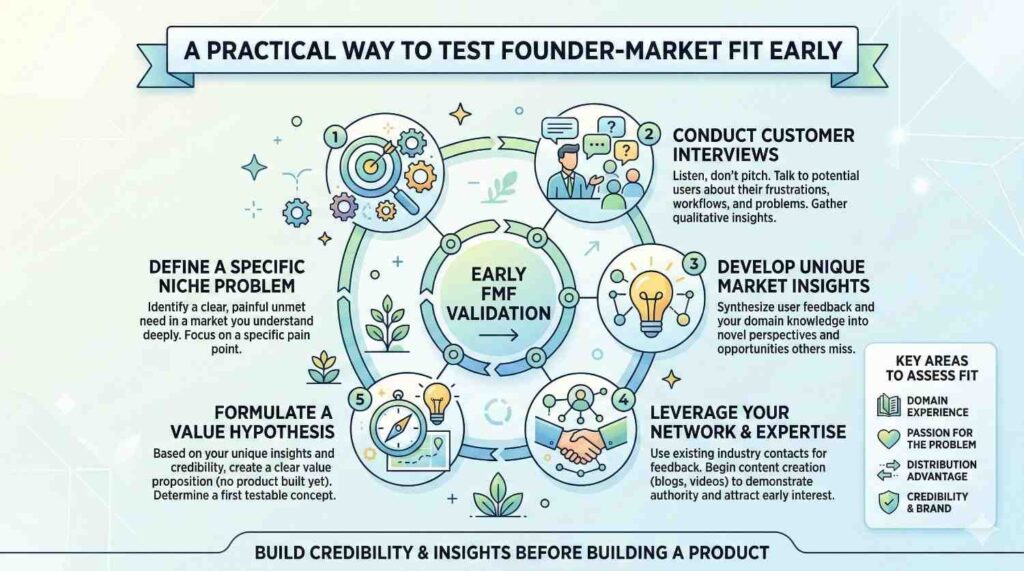
Many deep tech teams start too wide.
They say they sell to “manufacturing” or “healthcare” or “logistics.” Those words hide too many different realities. Founder-market fit becomes visible when you pick a very specific buyer world and can describe it in detail.
Not because you want to stay small, but because focus is how you learn fast.
Describe the pain in money and time
A deep tech buyer will rarely buy because something is interesting.
They buy because it saves money, saves time, reduces risk, or helps them hit a goal they are judged on. Founder-market fit means you can quantify the pain with plain logic, even before you have perfect data.
If you cannot describe the cost of the pain, you will struggle to price and sell.
Predict the objections before they show up
Here is a simple test.
If I tell you the name of a target customer, can you list the top five reasons they would say “not now”? Can you name who inside their company will say each reason? Can you explain what proof would remove each doubt?
When founders can do this calmly, they usually have stronger fit.
What Founder-Market Fit Looks Like in Day-to-Day Decisions
You design pilots to prove the purchase, not the tech
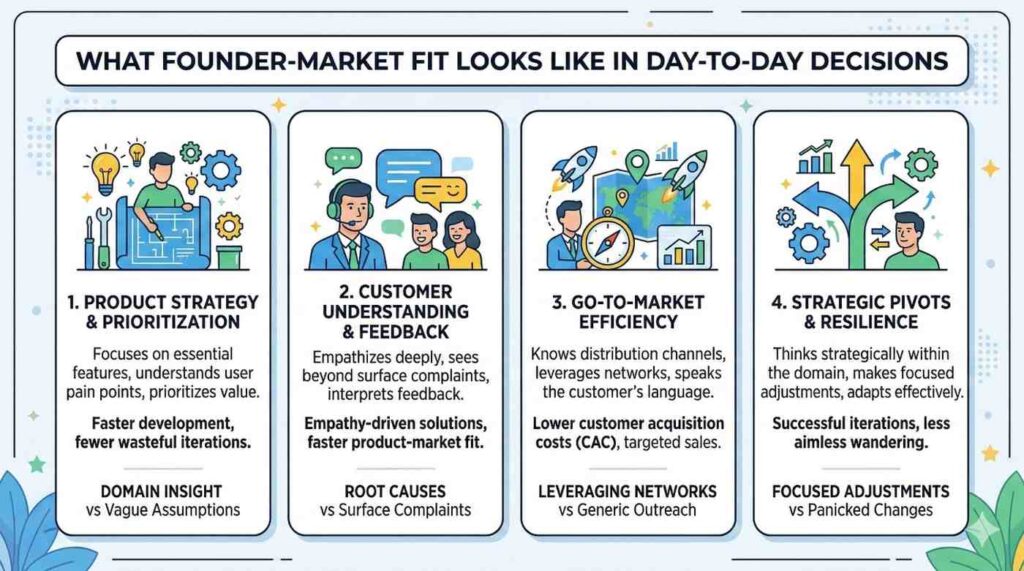
Deep tech pilots can become endless science fairs.
A pilot should prove one thing: “If this works, they will pay.” That means the pilot must measure the outcome the buyer cares about. It must be run in the real workflow, not a clean side corner. It must have a clear owner on the customer side.
Founder-market fit shows when you refuse a pilot that cannot lead to a purchase.
You choose integration paths that reduce friction
A brilliant system that is hard to adopt will lose.
Founders with fit ask early: Where does the data live? Who owns the systems we must connect to? What approvals are needed? What is the simplest first deployment that still creates value?
They do not treat integration as an afterthought. They treat it as the path to revenue.
You build support and reliability into the product from the start
Deep tech founders sometimes postpone support planning.
But if your product touches operations, your support plan is part of the offer. Buyers want to know how failures are handled, how fast you respond, and what happens when a part breaks or a model drifts.
Founders with fit build a service story early, even if it starts small.
Where IP Fits Into Founder-Market Fit in Deep Tech
Deep tech needs a moat before the market wakes up
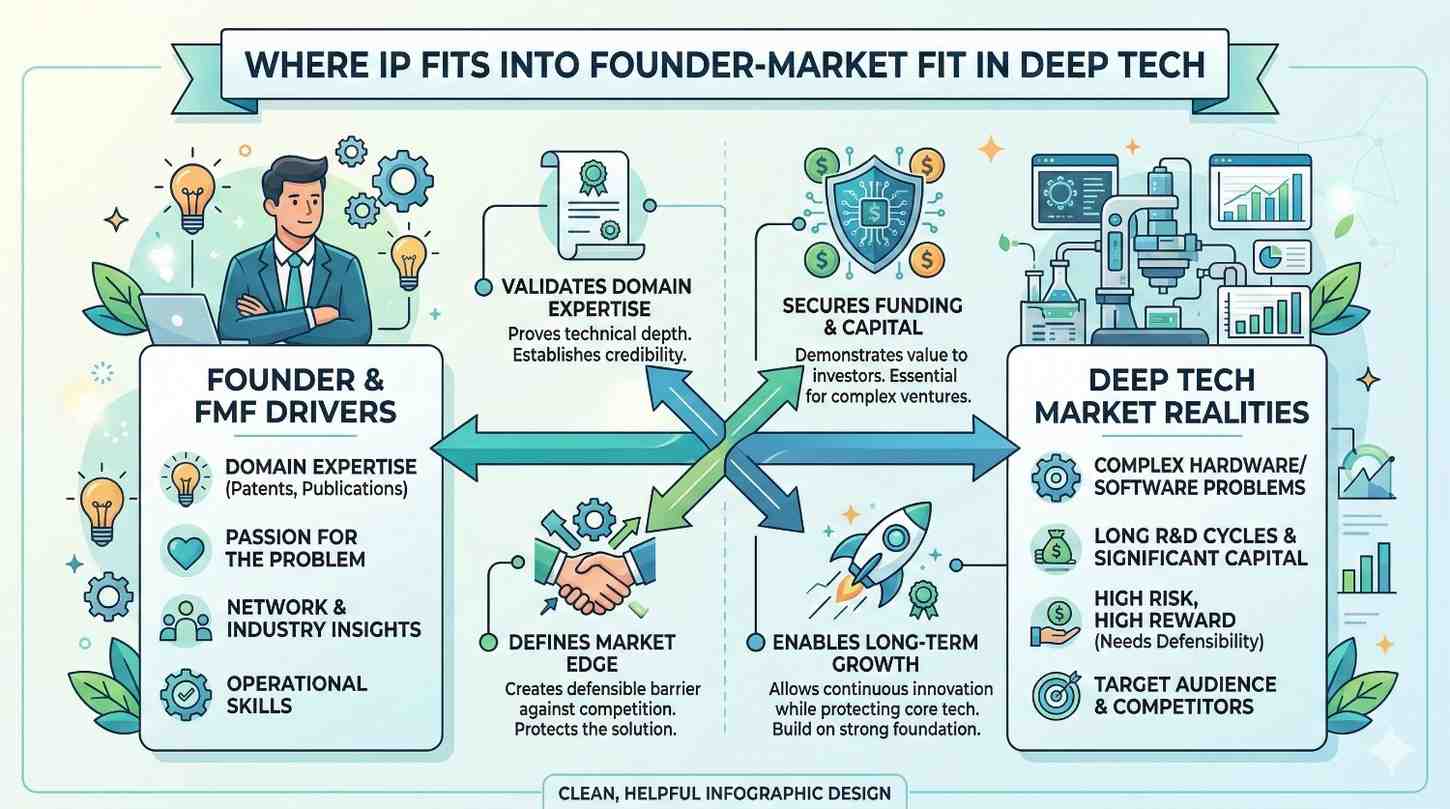
If you prove a hard thing can be done, others will notice.
Large companies can copy features. Fast teams can copy UI. But strong IP can protect the method, the system design, and key technical choices that make your results possible.
Founder-market fit includes understanding what needs to be protected and why.
Patents force clarity about what is truly new
A patent is not just a legal form.
A good patent process forces you to name your invention in a precise way. It pushes you to separate what is common from what is novel. It helps you create clean boundaries around your advantage.
That clarity helps you sell, raise, and defend your position.
Tran.vc helps founders turn inventions into assets
Tran.vc invests up to $50,000 in-kind in patent and IP services for deep tech teams.
This is not generic advice. It is practical support from people who understand early-stage building and what investors look for. The goal is to help you protect what matters before you raise big money, so you can raise with leverage.
If you want to explore that path, you can apply anytime at https://www.tran.vc/apply-now-form/
How to Build Founder-Market Fit if You Are New to the Industry
Borrow closeness before you earn it
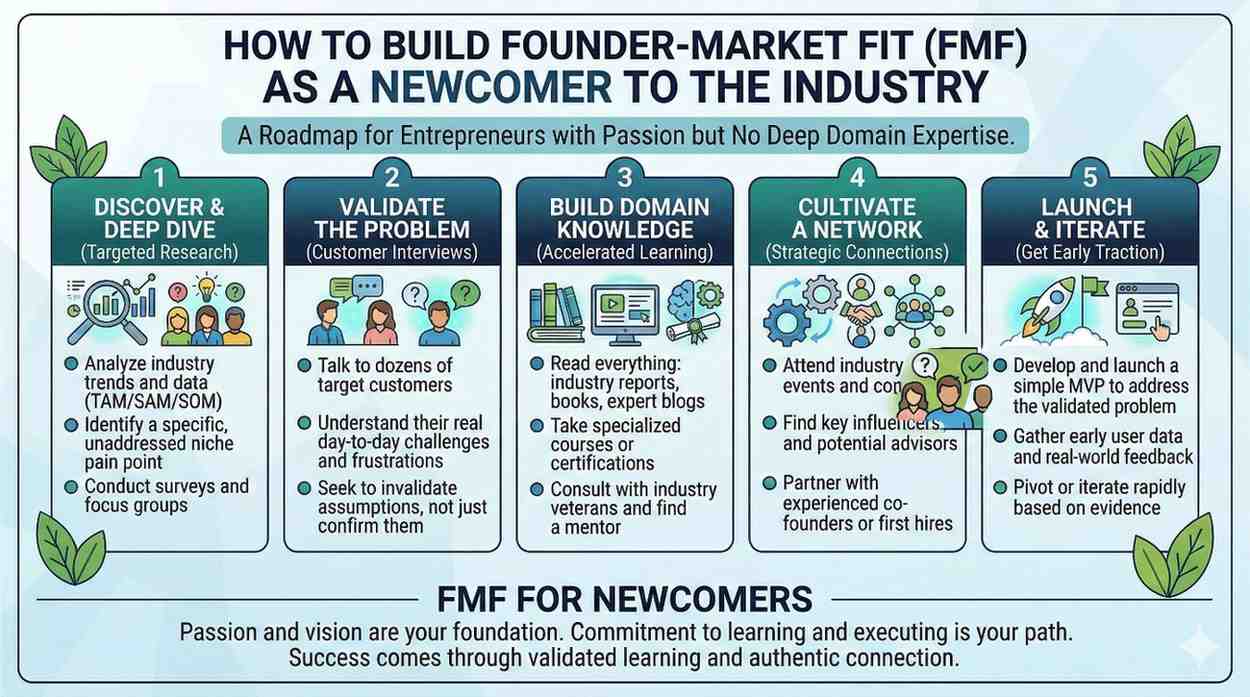
If you have not lived in the customer world, you can still build fit.
You do it by getting close to the work. You watch. You listen. You map the workflow. You learn what “good” means to them. You learn what they measure, what they fear, and what they cannot change.
The goal is not to pretend you are an insider. The goal is to stop guessing.
Choose advisors who give access, not only advice
Many founders collect advisors who look impressive.
But early on, you need access more than logos. You need people who can open doors to real buyers, help you run pilots, and tell you when your plan will fail inside a real organization.
Founder-market fit grows fastest when you get honest feedback from the field.
Build a wedge that matches your right to win
If you are new to the market, do not start with the hardest sale.
Start where your technical edge is obvious and the buying path is simpler. Pick a narrow use case where the ROI is clear, the deployment is manageable, and the proof can be gathered without a year-long trial.
A good wedge builds momentum and credibility that you can later expand.