
If you are building in deep tech—AI, robotics, hard science, advanced software, chips, sensing, or anything that took real research to create—then you are not just building a product. You are building a new capability. Something that did not exist before. Something that is hard to copy.
And that is exactly why smart investors keep asking one quiet question behind the scenes:
“What do they own?”
Not “What do they demo?”
Not “How pretty is the pitch deck?”
Not “How loud is the hype?”
They want to know what you can protect. Because in deep tech, the best teams are not always the fastest teams. The best teams are the ones that build something real—and then lock it down.
That is why VCs often love IP-first startups. Not because patents are “cool.” Not because they want paperwork. But because strong IP can turn a fragile startup into something that feels solid.
In this article, I’m going to break down why IP-first founders get taken more seriously, how it changes fundraising, what VCs are really thinking when they ask about patents, and what you can do this week to start building an IP moat without slowing down your build.
And if you want help turning your work into protected assets from day one, you can apply anytime here: https://www.tran.vc/apply-now-form/
Why VCs Love IP-First Startups in Deep Tech
The quiet question behind every deep tech pitch

If you are building in deep tech—AI, robotics, advanced software, chips, sensing, or anything that took real research to create—then you are not just building a product. You are building a new capability that is hard to copy, hard to fake, and hard to replace once it works. That difference shapes how serious investors look at you.
Behind the scenes, many VCs ask one quiet question even if they do not say it out loud: what do you truly own? Not what you can demo this week, not what looks good on a slide, but what you can protect and defend. In deep tech, “ownership” is often what turns a promising project into a fundable company.
If you want help turning your technical work into protected assets from day one, you can apply anytime here: https://www.tran.vc/apply-now-form/
What you will get from this article
This article explains why IP-first teams often get more trust from VCs, how patents and IP change the power balance in fundraising, and how investors think about risk in robotics and AI. It also gives practical steps you can take to start building an IP moat without slowing down the build.
What “IP-first” really means
IP-first is a strategy, not a stack of paperwork
IP-first does not mean you stop building and spend months writing legal documents. It also does not mean you file patents for every small idea or treat patents like trophies. In practice, IP-first simply means you build with a clear plan to protect the core thing that makes your company hard to copy.
That plan starts early, because early choices shape what is protectable later. The earlier you spot what matters, the easier it is to capture it in a clean, focused filing that matches how your system actually works.
The “core thing” is usually the method, not the feature
Deep tech edges rarely live in one surface-level feature. They usually live in the method, the workflow, and the way parts interact. A competitor might copy your user interface or describe your demo, but they cannot easily copy a method that is protected and deeply tied to performance.
For AI, that core thing might be how you train, fine-tune, compress, or deploy under strict limits. For robotics, it might be how you control motion, fuse sensors, plan in real time, or stay safe under uncertainty. For hardware, it could be a design that makes cost, power, or reliability better in a way that is not obvious from outside.
IP-first avoids the “we’ll file later” trap
Many founders delay IP because they think it costs too much, takes too long, or only matters after product-market fit. That logic sounds safe, but it can create a real trap. Once you share details too widely—through talks, papers, sales decks, demos, or online posts—you may reduce what can be protected or weaken the strongest version of your claim.
Even when you still can file, waiting often means you file while under pressure. That pressure leads to rushed decisions, scattered filings, and weak coverage that does not match what you truly built.
If you want an IP plan that keeps you moving fast, Tran.vc is designed for that. Tran.vc invests up to $50,000 in-kind patenting and IP services for deep tech teams, so you can build and protect at the same time. Apply anytime: https://www.tran.vc/apply-now-form/
Why VCs care so much in deep tech
Deep tech has different risk, so VCs look for different proof

In some software markets, speed and growth can be the main moat. If the product can be copied quickly, the winner might still win through distribution, brand, or network effects. Deep tech is different because the risks are different, and the path to scale is usually longer and heavier.
Deep tech companies often face longer build cycles, higher technical risk, harder integration, slower buyer decisions, and more safety or regulation needs. None of that is bad. It just means investors want clearer signals that your advantage will last long enough to justify the time and money it takes to scale.
IP turns “technical risk” into “defensible upside”
When a VC funds deep tech, they are often funding years of work before the market fully rewards it. That means they care less about quick imitation and more about long-term defensibility. Strong IP can turn a project that looks risky into a company that looks like it can own a category.
The best way to think about this is simple. Without IP, you might prove something works, and then larger players can learn from your path and build a similar approach with more capital and distribution. With IP, you create a fence around the methods that make your system work well, so your progress compounds in your favor.
IP is also a signal of maturity and focus
VCs do not only see patents as legal protection. They also see them as a signal. When a team can clearly explain what is novel, what is core, and what is worth protecting, it shows they understand their own advantage. That kind of clarity often maps to better product thinking and better strategy.
A team that treats IP as part of the build plan looks more prepared than a team that says, “We haven’t thought about it yet.” In deep tech, preparedness matters because execution is already hard. Investors want to know you can handle complexity without losing focus.
What VCs are really trying to avoid
The “demo trap” and why it scares investors
Some startups can build a stunning demo that looks like magic, but the demo does not translate into a scalable product. In robotics, a controlled demo can hide the real problems: edge cases, reliability, cost, maintenance, and safety. In AI, a strong benchmark can hide brittle behavior in the wild, high inference cost, or messy data pipelines.
VCs know this. So they look for anchors that go deeper than a demo. IP is one of those anchors because it forces the conversation into the underlying method. It pushes the team to explain how the system works, what is novel, and why it will keep winning as the market grows.
The “big company copy” fear
Another fear is simple: a large company can copy you once you prove the problem is real. If you have no protection and no moat, your early wins can become your public research program for someone else. That is painful for founders, and it is also painful for investors who funded the early risk.
IP does not solve everything, but it changes the game. It can slow copycats, raise their cost, and give you leverage in partnerships and acquisition talks. Even when enforcement is not the goal, the existence of strong claims changes how others behave.
The “unclear ownership” problem during diligence
During diligence, investors ask questions that are not always obvious in the first meeting. They want to know who invented what, who owns it, whether any prior employer has a claim, and whether open-source use is clean. If those answers are messy, it creates delay and doubt.
An IP-first approach tends to reduce that mess because the team tracks inventions early, documents the right details, and clears ownership issues before a round is on the line. That is not glamorous work, but it prevents painful surprises.
How IP changes fundraising power
It moves you from “please fund us” to “here’s what we own”
When your pitch is only about a roadmap, you are asking investors to believe. When your pitch includes protected methods and a clear strategy for what you will file next, you are giving investors something they can point to. It turns your company from a plan into an asset.
That shift changes the tone of the room. Instead of spending the whole meeting defending why you are special, you can explain how your advantage is structured, protected, and expanding with each release.
It supports higher confidence in long-term margins
VCs care about margins because margins are what pay for growth and create durable value. In deep tech, margins can be threatened by commoditization. If competitors can copy the core method, prices drop, and your hard work becomes a race to the bottom.
Strong IP can support pricing power because it helps you keep a unique performance edge. When your system performs better in a measurable way—and that performance is tied to protected methods—it is easier to defend premium pricing and long-term contracts.
It helps in strategic rounds and partnerships
Many deep tech companies raise money not only from traditional VCs but also from strategic investors. Strategic partners often care deeply about IP because it affects licensing, exclusivity, and long-term control of product direction.
If your IP story is weak, those partners might hesitate or demand terms that limit your future. If your IP story is strong, you can negotiate from a position of strength. Even simple partnership talks become easier when you can clearly explain what is yours and what is not.
If you want to build this kind of leverage early, Tran.vc can help you do it without slowing your build. Apply anytime: https://www.tran.vc/apply-now-form/
How IP-first differs across deep tech areas
AI: protecting methods, not just model weights
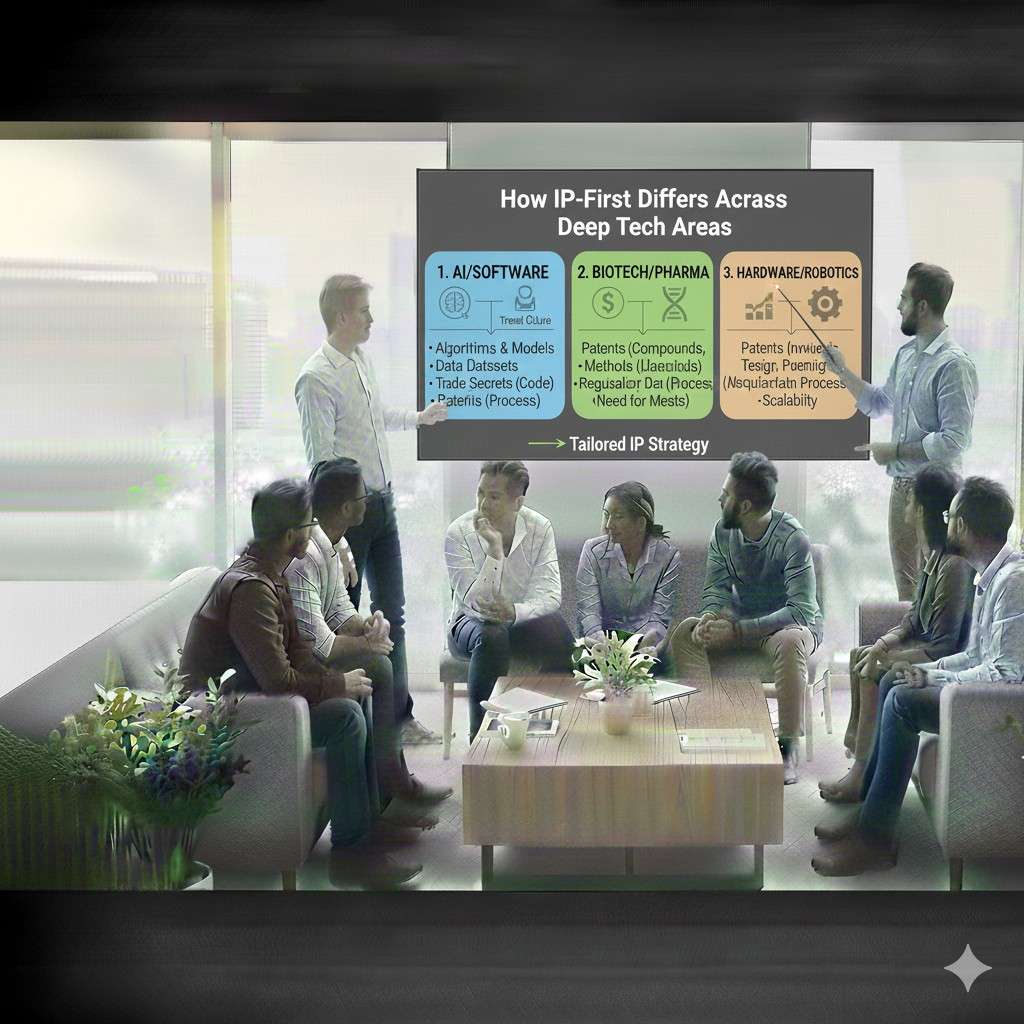
In AI, many founders assume their moat is their model weights or their data. Sometimes that is true, but often the deeper moat is the method: how you collect data, label it, train, evaluate, and deploy under constraints like cost, latency, privacy, and safety.
A strong AI IP strategy often focuses on workflow inventions that drive performance, reliability, or cost improvements. It can also focus on system design, such as how models interact with tools, sensors, or edge devices, and how the whole pipeline stays stable over time.
Robotics: protecting control loops, safety, and real-world robustness
Robotics is full of “hard-earned know-how.” The real breakthroughs often show up in how you deal with the real world: noise, drift, wear, bad lighting, slippery floors, and unpredictable objects. Those are not just engineering headaches. They are places where novel methods emerge.
Robotics IP often lives in control, perception, planning, calibration, and safety systems. It can also live in how hardware and software are designed together to create better performance at lower cost. Investors like robotics teams that can explain these inventions clearly, because it shows they understand what makes their robot work outside the lab.
Hardware: protecting designs that change cost, power, or reliability
In hardware, tiny design choices can have huge impact. A change that reduces power draw or increases reliability can be the difference between a product that scales and one that dies in field trials. The best hardware IP often captures these key design methods and the reasons they work.
Because hardware timelines are longer and prototypes are expensive, IP can matter even more. It gives confidence that the slow, costly path is building toward something defensible rather than something that becomes a commodity the moment it ships.
What to do if you have no IP yet
Start by mapping what is truly novel
You do not need a long list of patents to start. You need clarity. The first step is to map the parts of your system that are both novel and valuable. Novel means it is not obvious and not already known. Valuable means it changes performance, cost, safety, reliability, or adoption.
This mapping is easiest when it is tied to real engineering work. Ask a simple question: what did we build that we would hate to see a competitor copy next month? The answer is often where your first filing should focus.
Capture invention details as you build
Most founders do not lose IP because they are careless. They lose it because they are busy. The fix is not a huge process. The fix is a light habit: capture the “before and after” of your breakthroughs while the details are fresh.
When you solve a hard problem, write down the problem, the approach you tried that failed, the approach that worked, and what made it work. These notes are useful for engineering, onboarding, and future filings. They also make it easier for attorneys to draft strong claims that match reality.
Build an IP roadmap that matches your product roadmap
A strong IP story is not random. It matches your product plan. As your product moves from prototype to pilot to scale, new inventions appear. An IP-first roadmap plans for that and avoids scattered filings that do not connect to your core business.
This is one of the places Tran.vc helps most. The goal is not “more patents.” The goal is the right coverage in the right places, timed to your build and fundraising milestones. If that is what you want, apply anytime: https://www.tran.vc/apply-now-form/
How VCs evaluate IP during diligence
Diligence is less about count and more about clarity

When VCs dig into IP, they are not counting how many patents you have. A long list with weak focus often raises more questions than confidence. What they really want is clarity. They want to understand what problem your invention solves, why it matters, and how tightly it connects to your product and roadmap.
A single well-structured filing that clearly protects your core method can matter more than ten vague ones. During diligence, investors often ask simple questions and listen carefully to how you answer. If you can explain your IP without hiding behind legal language, it builds trust.
How investors test whether IP actually matters
VCs often run quiet mental tests. They imagine a competitor trying to copy you. They ask themselves where that competitor would struggle and whether your IP would slow them down or force them to change their approach. If the answer is yes, your IP is doing real work.
They also look at how hard it would be to design around your claims. Strong IP does not need to block every path. It just needs to block the best and most efficient path. If alternatives are worse, slower, or more expensive, your position is stronger than it looks on paper.
Ownership, assignments, and clean history
Another major focus during diligence is ownership. VCs want to be sure that the company actually owns what it claims. That means founders have signed proper assignments, prior employers do not have claims, and contractors are handled correctly.
Teams that think about IP early usually have cleaner records. Teams that wait often scramble to fix issues during a live round. Even when problems are solvable, they add stress and delay. Clean ownership keeps momentum high when it matters most.
What makes a patent “good” in a VC’s eyes
It matches how the product really works
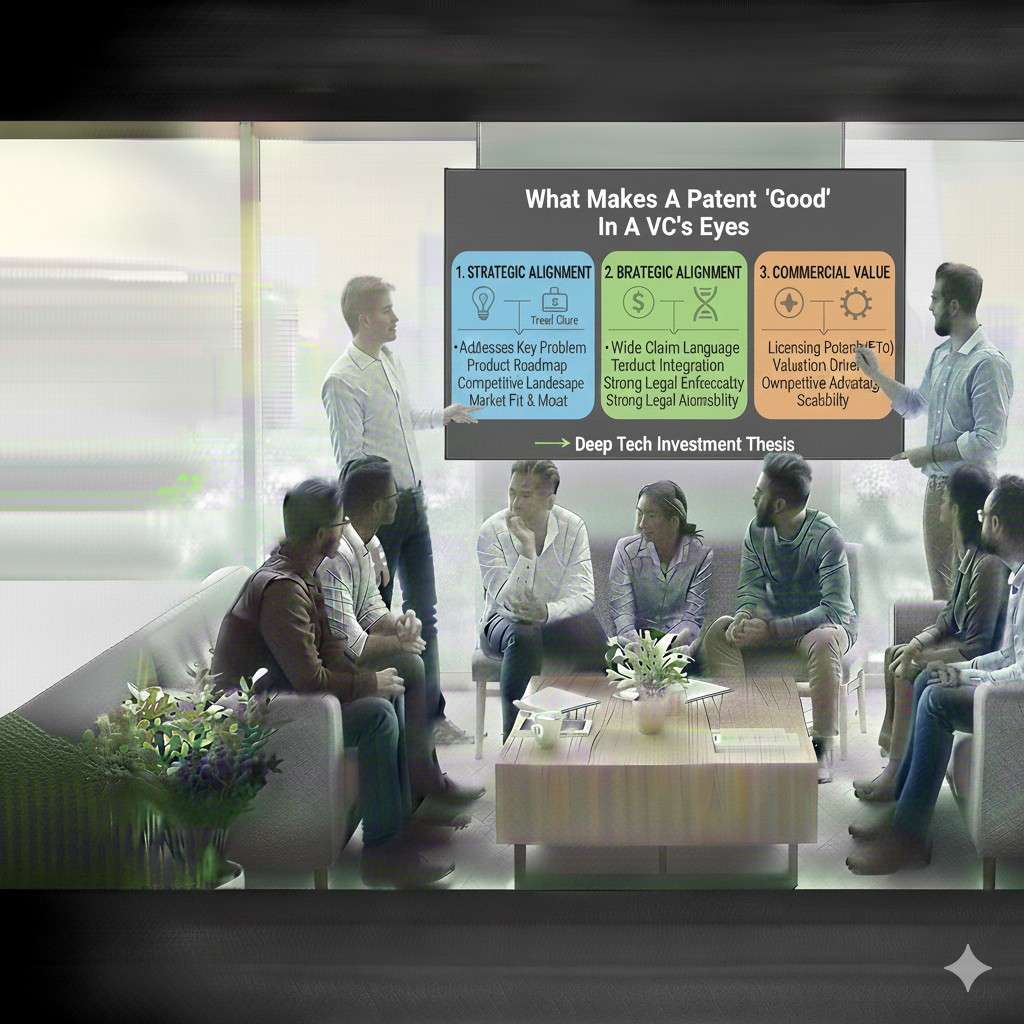
A good patent does not describe an abstract idea that lives only on paper. It describes how your system actually works in the real world. When VCs see claims that line up with the product demo and technical explanation, confidence goes up.
This alignment matters because it signals honesty and depth. It shows the team did not just file something generic. They filed something grounded in real engineering choices and trade-offs.
It protects value, not trivia
Investors quickly lose interest in patents that protect small details that do not change outcomes. What they like to see are filings that protect value drivers. These are the parts of the system that improve accuracy, speed, cost, safety, or reliability in a meaningful way.
A good rule of thumb is this: if losing this method would force you to rethink your product, it might be worth protecting. If losing it would be annoying but not fatal, it might not be core.
It fits into a larger story
VCs also like to see that IP is not an afterthought. When a team can explain how today’s filing leads to tomorrow’s coverage, it shows planning. It shows that the founders are thinking several steps ahead, not just reacting to the moment.
This does not require a complex legal plan. It requires a simple narrative: this is what we protected first, this is why it matters, and this is what we expect to protect as the product evolves.
Common IP mistakes that hurt fundraising
Filing too late, under pressure
One of the most common mistakes is waiting until a round is already moving. Under pressure, teams rush to file something—anything—just to say they have IP. That often leads to weak filings that do not match the product well.
VCs can sense this. A rushed patent feels different from a thoughtful one. Even if they do not say it directly, it can reduce confidence in the team’s judgment.
Filing too broad without technical depth
Another mistake is filing claims that are very broad but thin on technical detail. While broad coverage sounds good, it often backfires. Weakly supported claims are easier to challenge and easier to design around.
Investors with experience in deep tech know this. They would rather see narrower claims that are well-supported and clearly tied to performance than vague claims that promise everything and deliver little.
Treating IP as a checkbox
Some teams treat IP as a box to check for investors. They file because they think they have to, not because they have a clear reason. That mindset shows up in the quality of the work and the way founders talk about it.
When IP is treated as a strategic tool instead of a formality, it becomes easier to explain and easier for investors to trust.
How IP supports long-term company building
IP creates space to learn and iterate

Deep tech products often improve through real-world use. You learn from failures, edge cases, and customer feedback. Strong IP gives you space to learn without racing against copycats who did not pay the same learning cost.
That space is valuable. It lets you refine the product, build relationships, and expand into adjacent use cases while staying ahead of competitors.
IP can unlock licensing and new revenue paths
Not every deep tech company scales the same way. Some sell products, some sell platforms, and some license core technology. Strong IP keeps these options open. It allows you to say yes to opportunities that would be risky without protection.
Even if licensing is not your main plan, the option itself adds strategic flexibility. VCs like companies with options because options reduce downside risk.
IP strengthens exit conversations
Whether the exit is an acquisition or something else, IP often plays a central role. Acquirers want to know what they are buying and what they can defend after the deal. Clear, well-structured IP makes those conversations smoother.
For founders, this can mean better terms and fewer surprises late in the process. For investors, it can mean a clearer path to return.
Why IP-first founders raise with more confidence
Confidence comes from ownership, not hype
Founders who know what they own tend to pitch differently. They do not need to overpromise or rely on buzzwords. They can calmly explain their system, their edge, and why it is hard to copy.
That calm confidence is contagious. It helps investors focus on the real questions: market, execution, and scale, instead of worrying about whether the core idea will leak away.
It changes the tone of investor conversations
When IP is strong, investor conversations often shift. Instead of asking “what if someone copies you,” they start asking “how fast can you expand this advantage?” That is a better place to be.
This shift can also lead to better terms. When risk feels lower, pressure eases. Founders gain more room to negotiate and make long-term choices.
How Tran.vc fits into an IP-first approach
Built for founders who are still building

Tran.vc was created for teams that are deep in the build and cannot afford to slow down. Instead of giving cash and walking away, Tran.vc invests up to $50,000 in-kind through patent strategy, filings, and hands-on guidance from real patent attorneys and operators.
The focus is always on protecting what matters most, not filing for the sake of filing. That means aligning IP with the product, the roadmap, and future fundraising goals.
Turning technical work into fundable assets
Many founders have valuable inventions but struggle to explain them in investor terms. Tran.vc helps bridge that gap. The goal is to turn your technical breakthroughs into assets that investors can understand, respect, and value.
This approach helps you raise with leverage, not desperation. It helps you grow on your own terms while building a real moat early.
If this sounds like what you need, you can apply anytime here: https://www.tran.vc/apply-now-form/