
Robotics is moving fast. If you are building a robot, your real “product” is often not the metal. It is the software that makes the robot see, think, plan, and move. That software is also the easiest thing for a bigger team to copy once they understand how you did it.
That is why patents matter early. A good patent can turn your control stack into a real business asset. It can help you raise money with more leverage. It can also stop competitors from shipping “your” feature with different variable names.
At Tran.vc, we help robotics and AI founders do this the right way, early. We invest up to $50,000 in in-kind patent and IP services, so you can build an IP moat without burning your runway. If you want support, you can apply anytime here: https://www.tran.vc/apply-now-form/
How to Patent Robotics Software and Control Systems
Why patents matter more in robotics software than most founders think
Robotics is a copy-friendly industry. Not because people are lazy, but because the “shape” of robotics solutions is often similar. Many teams use the same sensors, the same compute stacks, and the same open-source tools. If your edge is in software, your edge can disappear the moment a strong competitor studies your demo and rebuilds the logic.
A patent does not stop all copying. But it can stop the most damaging kind: a well-funded team taking your method, shipping it at scale, and pushing you out of deals. A good patent also gives you a clean story for investors and partners. It turns “we built a cool control system” into “we own a protectable method that others cannot ship without risk.”
If you are building for factories, warehouses, hospitals, farms, or defense, your buyers also care about risk. They do not want to buy a system that can be sued into shutdown. A serious patent plan can reduce that fear, because it shows you are treating the core tech like a real asset, not a side project.
If you want Tran.vc to help you shape this early, you can apply anytime at https://www.tran.vc/apply-now-form/
Now let’s get practical.
What “robotics software” usually means in patent terms
When people say “robotics software,” they often mean a big bundle of things. Patent work gets easier when you separate that bundle into distinct parts. Each part tends to map to a different type of patent claim and a different kind of evidence.
Some software is about perception: turning raw sensor data into a map of the world. Some is about planning: deciding where to move next. Some is about control: converting a plan into motor commands that stay stable under noise, drift, and load changes.
There is also higher-level system logic, like task execution and safety rules. There is data and learning logic, like how your system adapts over time. And there is the “glue,” like timing, synchronization, and resource handling, which can be very valuable if it makes the whole robot reliable.
A strong patent plan usually does not try to patent “the robot.” It patents a few specific methods inside the robot that create the performance you can prove. That is the heart of winning claims.
The biggest misunderstanding: “software is not patentable”
You will hear people say, “You can’t patent software.” That statement is not accurate in most places where robotics companies operate. What is true is this: you usually cannot patent a pure idea, a rule, or a math formula by itself.
But robotics software is often tied to real-world action. It changes how a machine senses, moves, avoids crashes, saves power, improves precision, or keeps humans safe. Those are practical results. When your claims are written around those results, and the method is described clearly, software-based inventions can be patentable.
The key is how you frame it. You are not patenting “PID control” in the abstract. You are patenting a specific control method that solves a specific robotics problem in a specific way, with a clear technical effect.
The “control systems” part: where patents can be surprisingly strong
Control is one of the best places to find patentable value, because it is full of real constraints. A robot must be stable, safe, accurate, and responsive. It must handle delays, noise, poor contact, changing payloads, and messy environments.
If your control system does something clever to keep the robot stable, that is real engineering. It is also often hard for others to design around, because small changes can cause big failures.
Good control patents usually focus on one tight concept. For example, a method that switches control modes based on a measured contact state. Or a method that estimates torque and compensates in real time using a specific observer structure. Or a method that limits speed in a way that preserves task completion while preventing oscillation.
Even if competitors can guess your “goal,” they may not know your “how.” That is the gap patents protect.
Step 1: Decide what you are really patenting
Start with the outcome, not the code
Most founders begin by thinking about code files and modules. Patent work begins with the outcome. Ask: what problem did we solve that others struggle with, and what measurable improvement do we get?
In robotics, outcomes often show up as fewer collisions, better grasp success, smoother motion, faster cycle time, longer battery life, or stable operation in conditions where others fail. You want an outcome that you can explain in plain words without hiding behind jargon.
When you start from the outcome, you also avoid a common trap: writing claims that are too wide and too vague. Wide claims sound powerful, but vague claims are easy to reject and easy to attack later.
Find the “secret step” that makes the outcome happen
Most robotics improvements come from one or two key steps in a pipeline. There is often a moment where your system makes a decision differently than standard approaches. That decision can be the heart of an invention.
For example, your planner might pick actions based on a risk score that is updated using a special signal from the controller. Or your controller might adjust gains using a stability test that runs inside a tight loop. Or your system might fuse sensors in a way that stays stable when one sensor drops out.
That “secret step” is usually what you want to patent. Not the whole system. Not the whole robot. The step.
Separate “features” from “inventions”
A feature is something users like. An invention is a method that is new and non-obvious in a technical way. A feature can be invented, but not always.
A dashboard, a user flow, or a simple alert rule is often just product design. But if your interface changes robot behavior safely in a novel way, that could be technical. For example, a remote operator tool that changes control authority based on measured network delay can be invention-grade.
This is where founders waste time. They try to patent what sounds important, not what is technically defensible. A good IP partner will help you separate those fast.
If you want Tran.vc to help you find the inventions hiding in your stack, you can apply anytime at https://www.tran.vc/apply-now-form/
Step 2: Learn what patent examiners will ask about robotics software
“What is new here compared to known robotics stacks?”
Examiners will compare your method to what is already known. In robotics, “already known” can include academic papers, open-source repos, and industry docs. It is not just patents. This is why robotics patents must be written with awareness of common methods.
If your invention is basically a standard approach, plus a small change, you need to show why that change is not obvious. That is done by linking it to a real technical constraint and a real technical benefit, not by saying “we improved it.”
“Is this just math, or is it a technical method tied to a machine?”
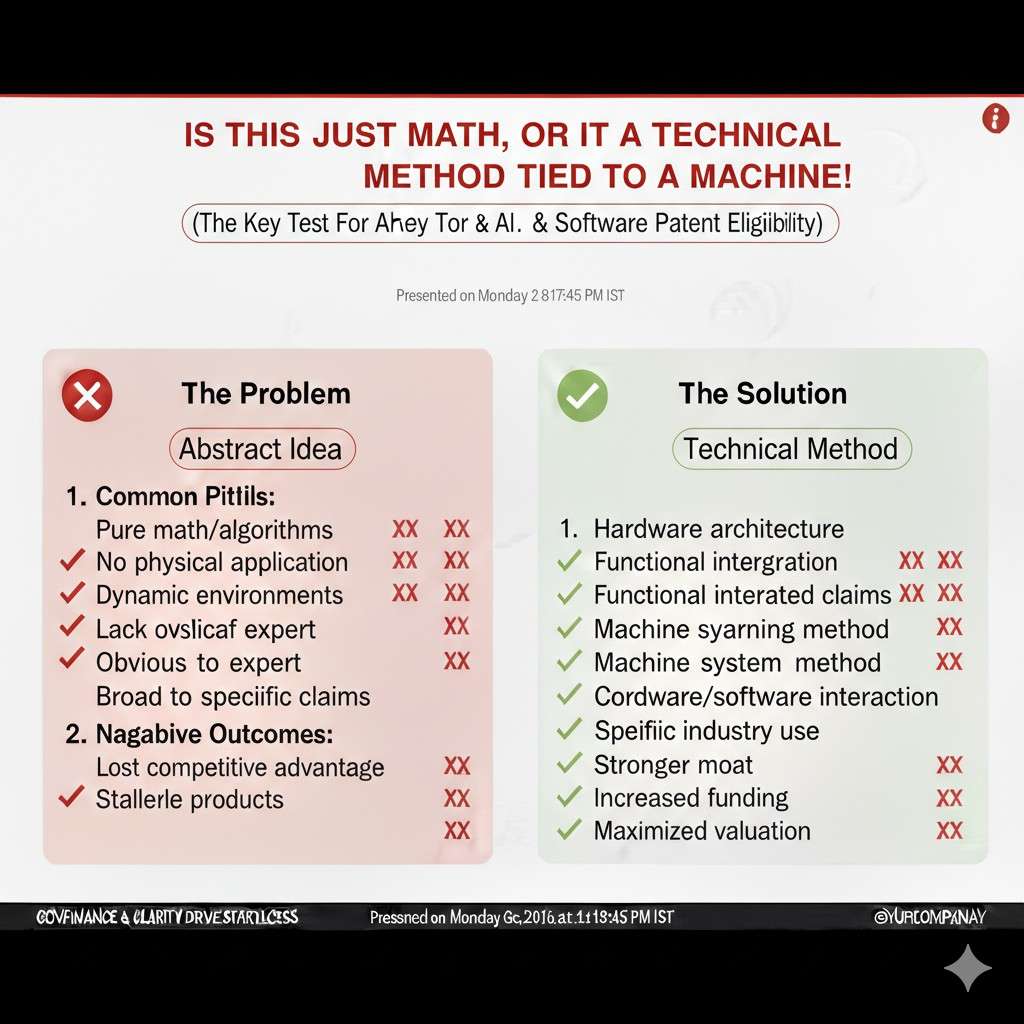
Robotics patents need strong ties to the physical system. That does not mean you must claim specific hardware, but you should explain how your method interacts with sensors, actuators, timing, and real-world limits.
If your method only exists as a formula without a system context, it is weaker. If your method changes the robot’s motion, stability, safety, or resource use, it is stronger.
“Can someone skilled in robotics implement this from your description?”
A patent is a trade: you disclose enough detail, and society gives you protection for a limited time. If you describe your invention in vague terms, you risk rejection or later invalidation.
This does not mean you must share every tuning value. But you must describe the logic clearly. You need to outline the steps, the signals, the decision points, and how data flows.
In robotics, diagrams and flow descriptions matter a lot. Timing and control loop structure matter. When those details are included, your patent looks like real engineering, not marketing.
Step 3: Map your robotics stack into patentable “units”
Perception: sensors to state
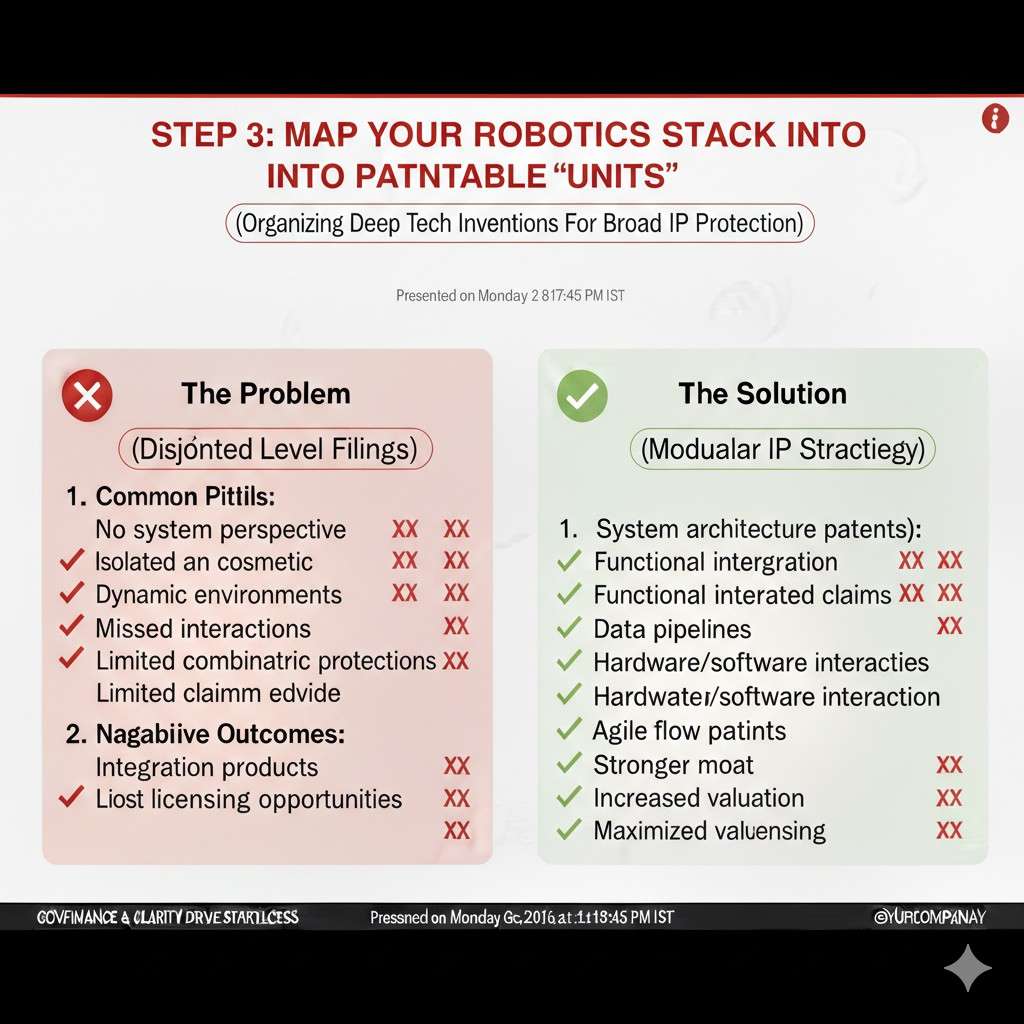
Perception is often patentable when it solves a hard sensing problem under constraints. For example, robust pose estimation under motion blur, low light, vibration, or sparse features. Or sensor fusion that remains stable when a sensor becomes unreliable.
The strongest perception patents are not “we used a neural network.” They explain how the network is used, what signals it takes, how it is trained or updated, and how the output is used to control real behavior.
If you can show that your method reduces false detections in a way that improves motion safety, you are linking software to a technical effect. That is the kind of framing that holds up better.
Planning: choosing actions under real limits
Planning becomes patentable when your planner handles real constraints in a novel way. This can include time limits, energy limits, safety zones, slip risk, human motion prediction, or uncertain maps.
If your planner adapts its horizon based on a stability signal from the controller, that link can be a strong invention. If your planner changes action choice based on a measured contact state that most planners ignore, that can also be strong.
The story matters. You want to explain why common planners fail in your setting, then explain the specific change you made, then show the benefit.
Control: turning plans into stable motion
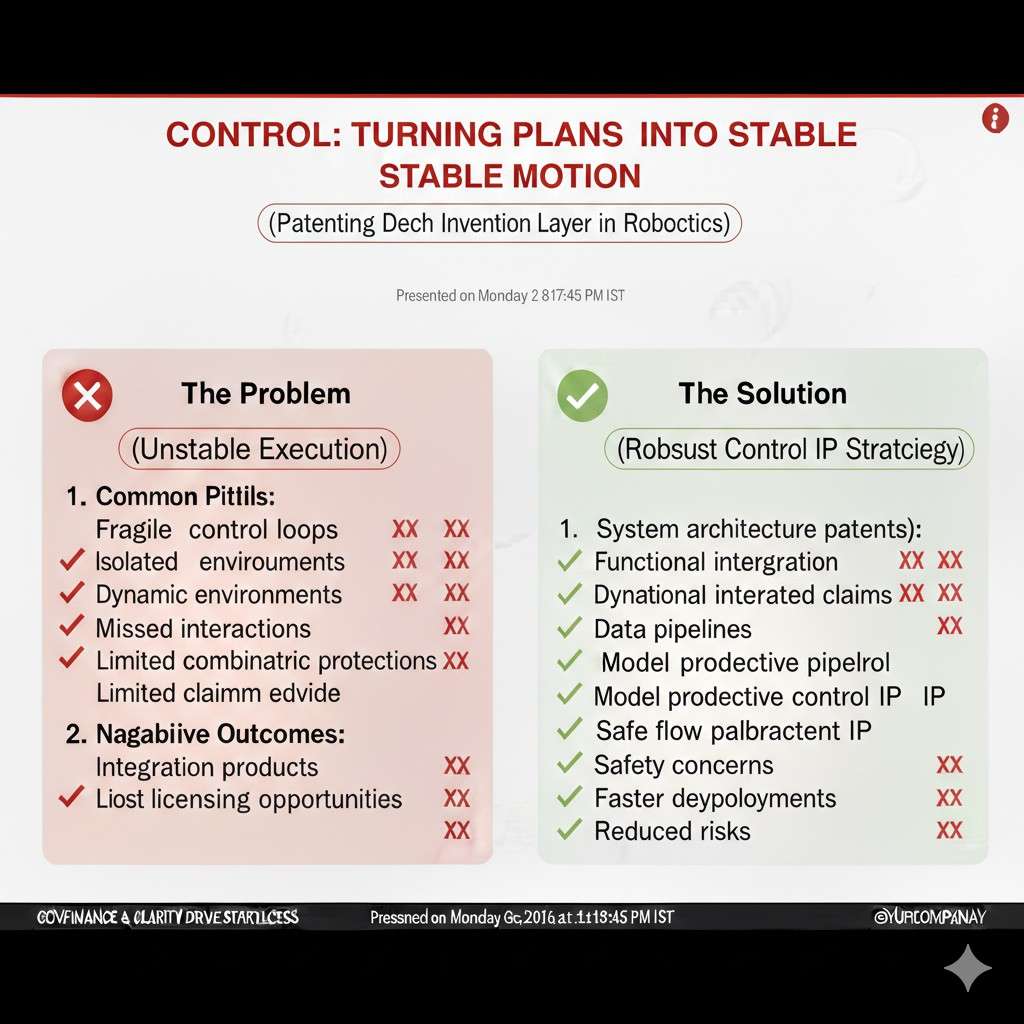
Control is a goldmine when you have real performance proof. Many control approaches are known, but novel combinations and novel switching logic can be defensible.
If your control system uses a special observer to estimate a hard-to-measure state, and then uses that state to adjust torque limits, that can be invention-grade. If your control loop handles delay in a special way that prevents instability, that can be invention-grade too.
Control patents also benefit from clear definitions. What signals are measured? What is estimated? What thresholds cause switching? What is updated each loop? A patent that reads like a control design document is often stronger than one that reads like a product pitch.
Step 4: Do a robotics-focused prior art search that actually helps
Why robotics prior art is different from normal software
Robotics is one of the most “published” fields in the world. A lot of the best work is not hidden inside company walls. It is in papers, conference slides, thesis docs, lab websites, open-source repos, and benchmark write-ups.
That is good for learning, but it makes patent work tricky. If you file a patent without checking what is already out there, you can waste months and money. Worse, you can end up with claims that look unique to you, but are already described in a paper from five years ago.
A robotics-aware prior art search is not about finding an exact match. It is about learning the landscape, so you can describe your invention in a way that highlights what is truly different.
If you want Tran.vc to run this kind of search with you and shape the filing around what is actually defensible, you can apply anytime at https://www.tran.vc/apply-now-form/
How to search without getting lost in a million papers
Start with the exact problem you solve, written in plain words. Do not begin with your internal module name. Write it like a customer would describe the pain, but keep it technical.
For example, instead of “adaptive MPC for warehouse AMR,” write “controlling a mobile robot that carries changing loads without oscillation.” Instead of “multi-sensor fusion,” write “keeping localization stable when the camera is blocked and the floor is reflective.”
Then search for those phrases and nearby phrases. Robotics papers often use different names for the same thing. “State estimation” might appear as “pose tracking.” “Slip detection” might appear as “traction inference.” “Contact-aware control” might appear as “hybrid force-motion control.”
As you search, save the key references, but focus on what they do, not what they call it. Your job is to understand the common approach and its weaknesses, because that becomes the foundation of your patent story.
What you are trying to learn from prior art
A useful prior art review answers three questions. First, what do most systems do today for this problem? Second, where do they fail in the real world? Third, what do you do differently that changes that failure mode?
If you cannot answer those three clearly, your patent draft will be fuzzy. It will also be harder for an examiner to see why your method is not obvious.
In robotics, this “failure mode” framing is powerful. Examiners are engineers. They respond well when you explain, step by step, why the standard method breaks under a real constraint, and how your method avoids that break.
The right way to use open-source as a comparison point
Many robotics stacks share the same base tools. ROS, common planners, common SLAM methods, common grasp pipelines. You can treat these like “industry baselines.”
You are not trying to attack open-source. You are using it to show what a typical skilled engineer would do. That matters because patent rules often ask what would be obvious to a skilled person.
If your method is more than a small tuning tweak on top of the baseline, you can often defend it. But you must explain the difference in logic, not just the difference in outcome.
A patent that says “we improved accuracy” without explaining the special steps is weak. A patent that shows a new step, a new decision rule, or a new control structure that produces the accuracy is much stronger.
Step 5: Document the invention in a way that does not slow the team
The simple habit that saves patents
Most founders think patent documentation is heavy. It does not have to be.
A good habit is to capture “invention snapshots” while you build. One page per idea. Not a long report. A short, clear description that answers: what problem, what approach, what signals, what key steps, what benefit, and what tests prove it.
This can be done in a shared doc. It can be done in an issue tracker. The tool matters less than the content.
The reason this works is simple. Patent drafts are easier when you already have a clean story. Without that story, the attorney must pull it out of scattered notes and code, and important details get missed.
What to capture for robotics control and autonomy ideas
Robotics inventions live in structure. It is not enough to say “we used a controller.” You want to capture how the loop is built.
Write down the sensor inputs and update rates. Write down what the system estimates. Write down what thresholds or conditions cause switching. Write down what happens during failure states, like sensor dropout, bad contact, or network delay.
If you are using learning, write down what is learned and when. Is learning offline during training, or online during use? Does the system update a model, a cost function, a constraint, or a safety bound?
Also capture what you tried that did not work. That might sound odd, but it can help show that your final method was not obvious. It can also help your attorney write around prior art by focusing on the path you took.
How to capture drawings without becoming an artist
For patent work, drawings do not need to be pretty. They need to be clear.
A simple block diagram showing modules and data flow is often enough. A flow chart showing decision steps is often enough. A timing diagram for control loops can be very helpful in robotics, because timing is part of the invention.
If you can draw boxes and arrows, you can create useful patent figures. Many strong robotics patents use simple diagrams because they communicate structure quickly.
Step 6: Choose the right filing path for robotics software
Provisional filings: what they are good for, and what they are not
A provisional application is often used as an early placeholder. It can lock in a priority date, which matters if you are going to publish, demo publicly, or pitch widely.
But many teams misunderstand the trade. A weak provisional that lacks details may not protect you later. You cannot assume you can “fix it” later and keep the early date for the improved parts. The early date only covers what you truly described.
For robotics control and autonomy, details matter. If your provisional only says “a planner selects actions and a controller executes them,” that is not enough. You want to include the key steps, the key signals, and the key logic.
The best way to think about a provisional is simple. It should read like a draft technical spec of the invention, written in a way that could be turned into claims later.
Non-provisional filings: when they make sense earlier than you think
A non-provisional is the full application that will be examined. It is more formal, and it is what turns into an issued patent.
For some robotics startups, moving to a non-provisional earlier can be smart. This is true when the invention is central to the company, stable enough to describe well, and likely to remain part of the product for years.
Control and safety methods often fit this. If your robot’s value depends on safe motion in human spaces, and you have a unique method that makes this possible, that is not a “nice to have.” That is the business.
In that case, investing in a strong non-provisional can create a real moat that you can use in fundraising and partnerships.
Timing risk: demos, customer pilots, and public talks
Robotics teams often show demos early because hardware needs buyers. The risk is that public disclosure can reduce or destroy patent options in some countries, depending on the timing and the rules in that region.
Even in places where there are grace periods, you do not want to play games with deadlines. A clean habit is to treat major demos and public talks as a trigger for an IP review.
If you are about to publish a video that reveals your system logic, or if you are about to present at a conference, you want to file first. Even a well-written provisional can protect you while you move fast.
This is a common place where Tran.vc helps. We build a filing plan around your real calendar, not an imaginary one. If you want that kind of support, you can apply anytime at https://www.tran.vc/apply-now-form/
Step 7: Turn a robotics invention into a patent story that wins
The examiner needs a clear “problem, failure, fix” narrative
A strong robotics patent is not just a list of steps. It is a story that makes the steps feel necessary.
You want to explain what the normal approach is. Then show how it fails in a real robotics setting. Then show how your method avoids that failure.
This matters because examiners often reject claims if they think the invention is a simple combination of known parts. Your story helps show why the combination is not simple, and why a skilled person would not arrive there easily.
In robotics, the best failure stories are physical. The robot oscillates. The gripper slips. The base drifts. The sensor drops out. The network delay causes instability. The system becomes unsafe near people.
When you explain a physical failure and your technical fix, the invention becomes concrete.
Write it so a smart engineer can rebuild it
The disclosure should be detailed enough that a robotics engineer could implement the core idea. That does not mean you give away every secret. It means you clearly describe the logic and the structure.
This is where many founders hold back too much. They fear giving competitors a blueprint. But a patent is already a public document. If you want protection, you must disclose.
The advantage is that your protection is legal, not secret-based. And in many cases, competitors still struggle to copy because robotics is hard. Your patent gives you the power to stop the copy when it matters.
Show multiple versions of the same invention
One of the most tactical things you can do is describe variations. Not as a long list, but as a few clear alternative paths.
For example, if your method detects contact state, you can describe different ways to detect contact. If your method adjusts a control parameter, you can describe different ways to compute that parameter.
Why does this matter? Because competitors try to design around patents by swapping one sensor or one computation step. If your patent describes reasonable alternatives, your coverage can be stronger.
This is also where good patent strategy feels like chess. You are not only protecting what you built today. You are protecting the space around it.