
Robotics grippers look simple from the outside. Two fingers. A clamp. A soft pad. But under the hood, they hide the kind of work that wins (or loses) a market: the geometry that makes a grasp stable, the control loop that stops slip, the sensor layout that “feels” without crushing, the compliance that handles uncertainty, and the little mechanical tricks that let you pick fast without dropping.
That is exactly why grippers and manipulation systems are so worth patenting.
If you are building anything in robotics—warehouse picking, surgical tools, factory cobots, lab automation, agriculture, home robotics—your gripper is often your edge. It is also the part competitors copy first, because it is visible and easy to reverse engineer once it ships.
A strong patent plan does two things at once:
It protects the parts that are hard to rebuild from scratch.
It helps you explain your value in plain business terms to partners and investors.
This guide will show you how to patent robotics grippers and manipulation systems in a way that is practical, careful, and designed for real startups. We will keep it simple. No heavy legal language. Just what to do, what to avoid, and how to turn your design into claims that matter.
If you want Tran.vc to help you build an IP plan for your gripper—before you raise and before you show too much—apply anytime here: https://www.tran.vc/apply-now-form/
What parts of a gripper are patentable?
Start with the “why,” not the shape
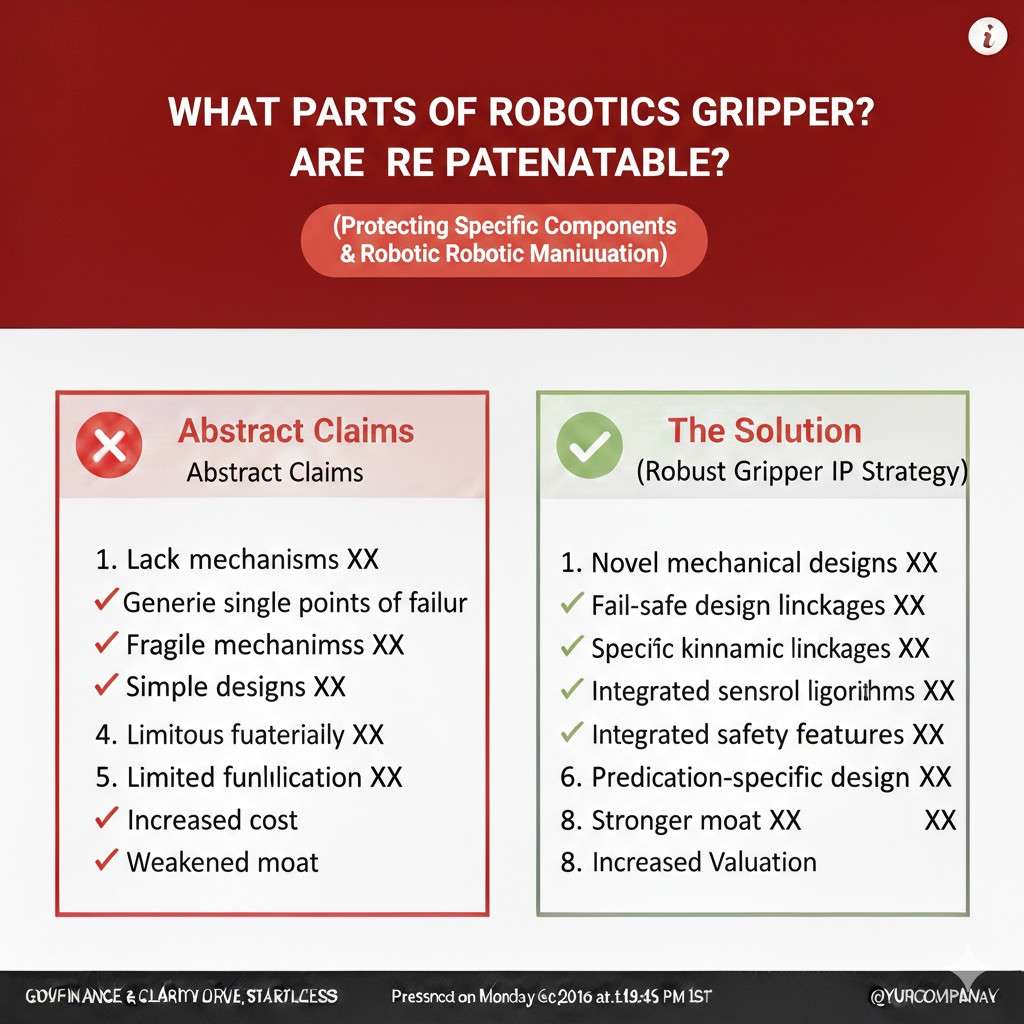
Most founders start by describing what the gripper looks like. That is natural, because the hardware is right in front of you. But patents do not reward “it has two fingers” or “it opens and closes.” They reward the reason your design works better than others.
So the first step is to write down the problem you solved. Not in marketing words. In plain words. What was hard before your design? What failed? What did you change that made it reliable?
When you frame it this way, you begin to see patentable parts everywhere. It could be how you stop slip. It could be how you sense contact. It could be how you handle odd shapes without needing perfect pose.
The mechanical structure that creates advantage
Many grippers are built from known building blocks: links, joints, gears, pulleys, springs, and bearings. “Using a gear” is not patentable. But a structure that creates a new result can be.
For example, you might have a linkage that keeps fingertips parallel while closing, but also allows a tilt mode when one finger hits first. Or you might have a jaw path that changes across the stroke, so the first touch is soft, and the final clamp is strong.
Those are not just shapes. They are mechanisms that produce a behavior. If the behavior is new and useful, it can be claimed.
A good way to test this is to ask yourself: if a competitor copied only the outside look, would they still get the same performance? If not, your patent focus should be inside the motion, the compliance, and the force path.
The end-effector surfaces that make contact predictable
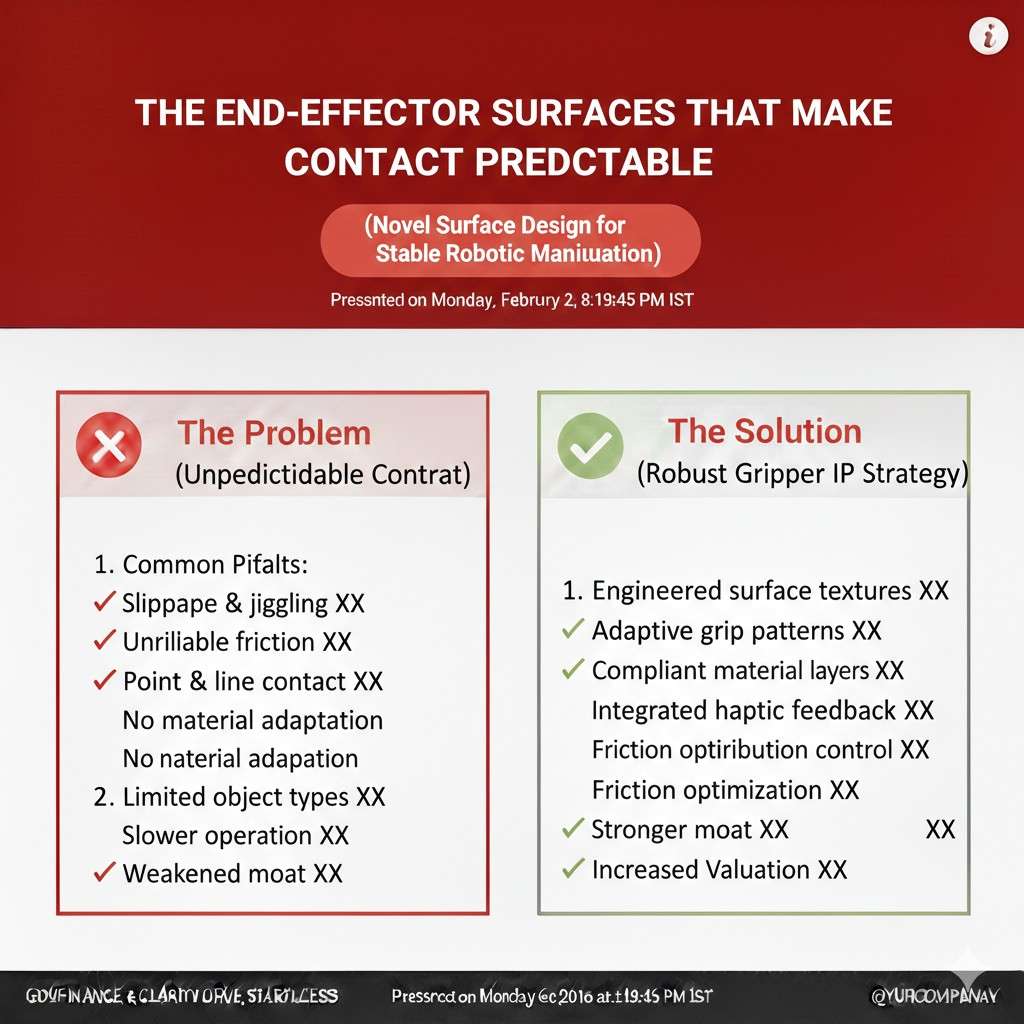
Many teams forget that contact surfaces are often patentable. The pads, textures, ribs, suction lips, and fingertip geometry can be the difference between a demo and a product.
If your fingertip has channels that reduce dust failure, or a shape that traps a corner of a box, or a soft layer that changes stiffness with strain, that is not “just a pad.” It is a system for stable contact.
You can often patent how the surface is shaped, how it is made, and how it is attached. You can also patent how it interacts with sensors or with a vacuum path.
The compliance that makes grasping forgiving
Compliance is a big word, but the idea is simple. It is the “give” that helps you grasp things that are not exactly where you expected.
Compliance can come from a spring. It can come from a flexure. It can come from a soft material. It can also come from software that changes force quickly when slip begins.
If your gripper is forgiving without being weak, there is usually something special going on. That “something” is often patentable, especially when you can describe the structure and the control behavior together.
The sensing that turns a clamp into a “hand”
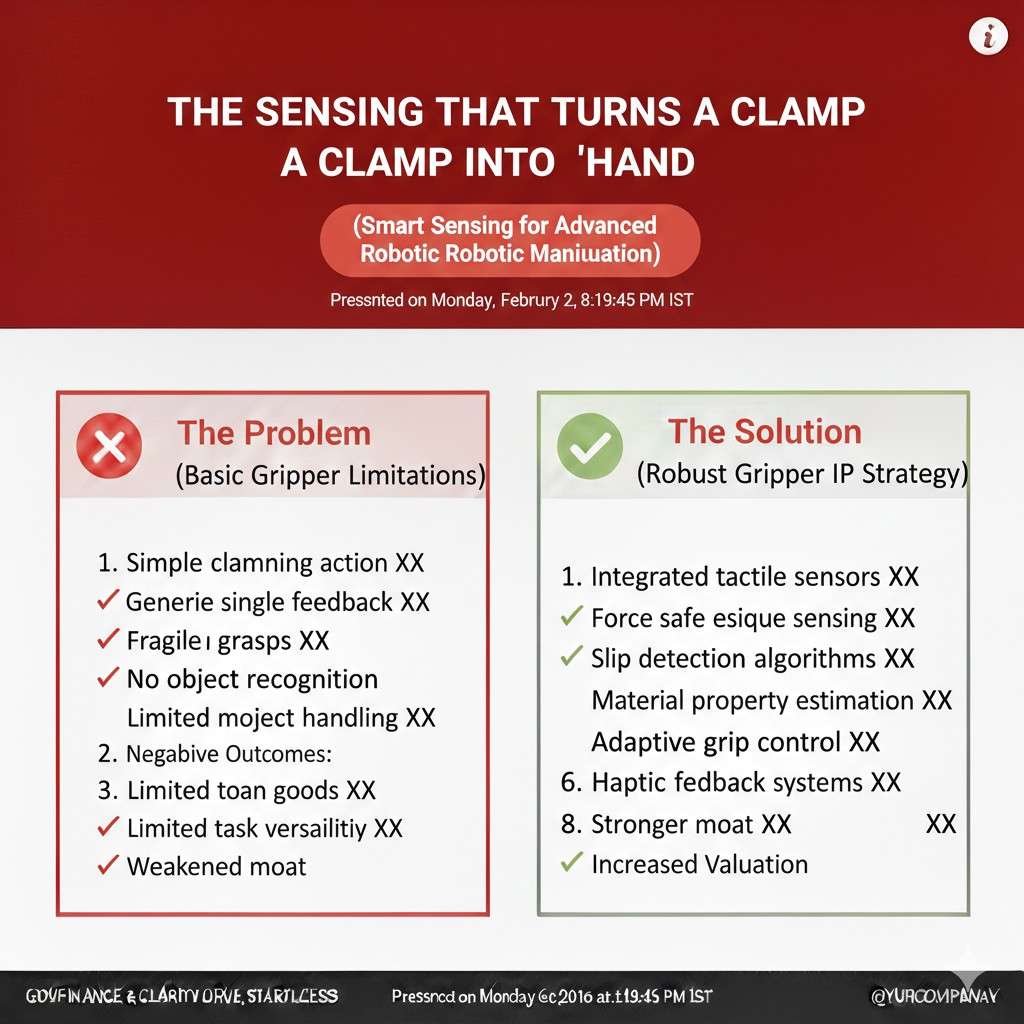
A plain gripper squeezes. A smart gripper knows when it touched, where it touched, and whether the object is stable.
If you placed sensors in a way that reduces noise, or protects them from impact, or makes calibration easier, you may have a patentable sensor layout. If you fuse a cheap sensor with a clever model to get expensive performance, that can also be patentable.
The key is to separate “the sensor exists” from “the sensor is used in a new way.” Many sensors are known. The novel part is often placement, packaging, and interpretation.
The actuation that delivers force cleanly
Actuation is how you move. It can be electric, pneumatic, hydraulic, or tendon-based. Again, the general idea is not new. The details matter.
A patentable actuation idea might be a transmission that keeps backlash low, or a tendon routing that reduces wear, or a pneumatic chamber design that produces stable force even with supply variation.
If your actuator is chosen to hit a tight cost target, and you engineered around its weak points, you may have a great patent story. It is not “we used a cheap motor.” It is “we built a system that makes a cheap motor behave like a better motor.”
The control loop that prevents slip and damage
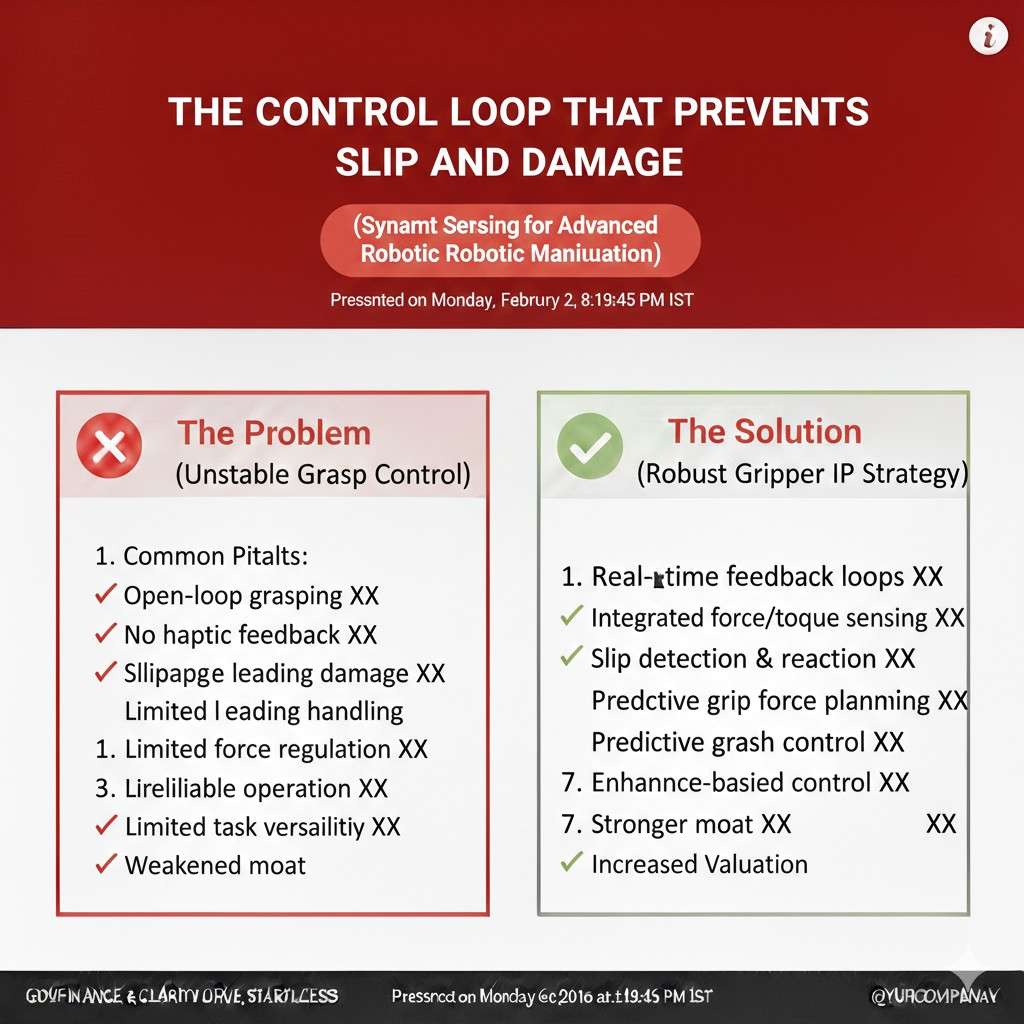
Control is often the heart of manipulation. But “we used PID” is not a patent. You need the specific control behavior tied to a real physical setup.
A strong patent angle is when your control method depends on your hardware design, and your hardware design depends on your control method. That coupling is hard for competitors to copy without copying the whole stack.
For example, if you use a small vibration pattern to detect contact earlier, and your fingertip structure amplifies that signal, you have a tight system claim. If you change grip force based on micro-slip measured through motor current, and your transmission is tuned for that, the combo can be powerful.
The “manipulation system” beyond the gripper
Many patents should not stop at the gripper. If you have a wrist that adds an extra passive degree of freedom, or a tool changer that keeps alignment tight, or a cable routing that prevents snag, those can be part of the invention.
Also, if your gripper is designed around a perception method—like picking from a bin with partial views—the invention may include how the robot approaches, how it re-grasps, or how it uses the environment to stabilize.
A manipulation system is often where the real moat lives, because it is less obvious than a pair of fingers.
If you want a team that helps you map these pieces into a clean patent plan, Tran.vc does this as part of our in-kind IP support. You can apply anytime here: https://www.tran.vc/apply-now-form/
How to find the “real invention” inside your gripper
Separate “features” from “reasons it wins”
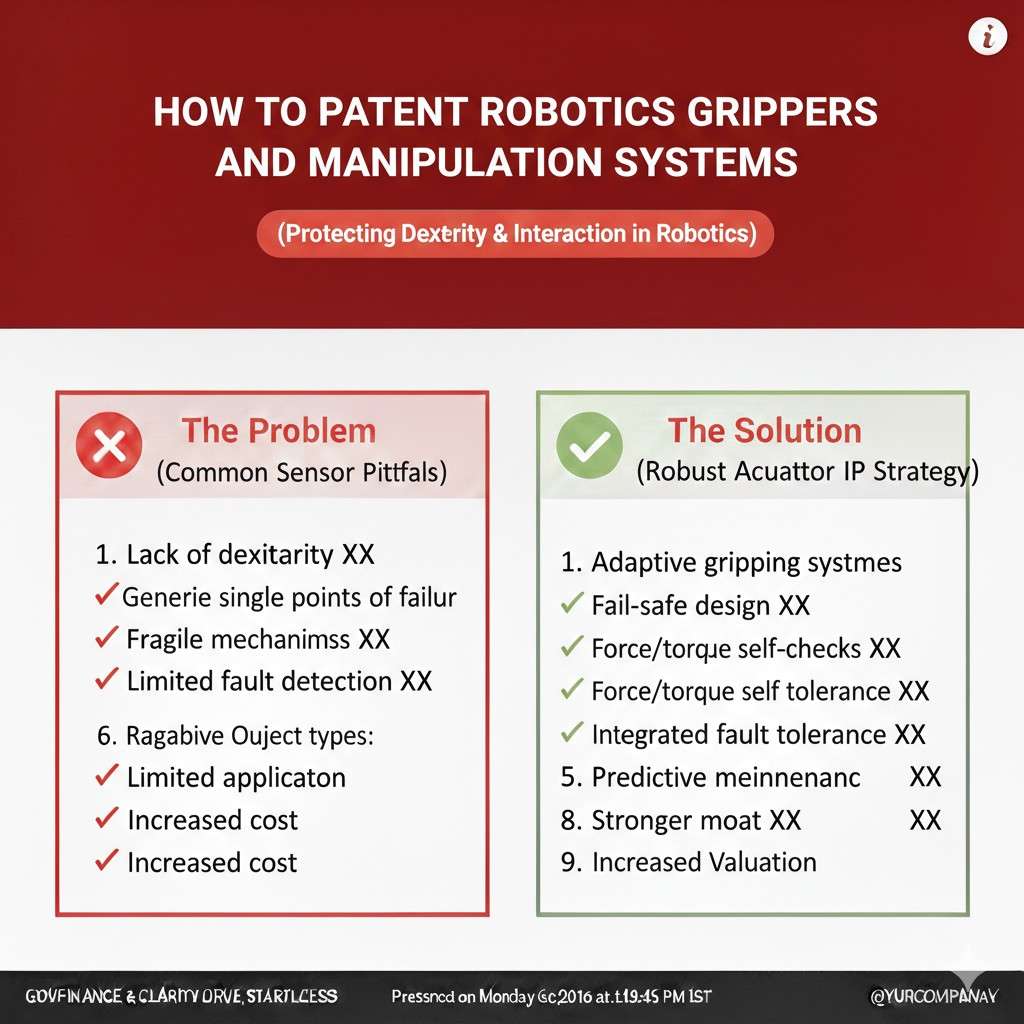
Founders often list features like this: soft pads, force sensor, quick open, light weight. That is fine for a website, but it is not enough for patents.
The patent process starts when you can explain why those features matter. What does the soft pad allow you to do that others cannot? What failure mode does it remove? What speed or accuracy does it unlock?
When you write the “reason,” you get closer to claims that stand up. Claims that only describe features are easy to copy around. Claims that cover a result and the structure that creates it are harder to escape.
Write down the top three failures you solved
A very practical exercise is to list the top three failures you had early on. Maybe objects slipped. Maybe grasping was unstable. Maybe alignment was slow. Maybe you crushed fragile items. Maybe the gripper clogged with debris.
Now write what you changed that fixed each failure. Be specific. “Improved the design” is not helpful. “Moved the sensor from the palm to the fingertip to reduce delay” is helpful.
Most strong patents begin as a story about failure. That story is real, and it is easy to prove with tests and logs later.
Look for “coupled” ideas that competitors cannot copy partly
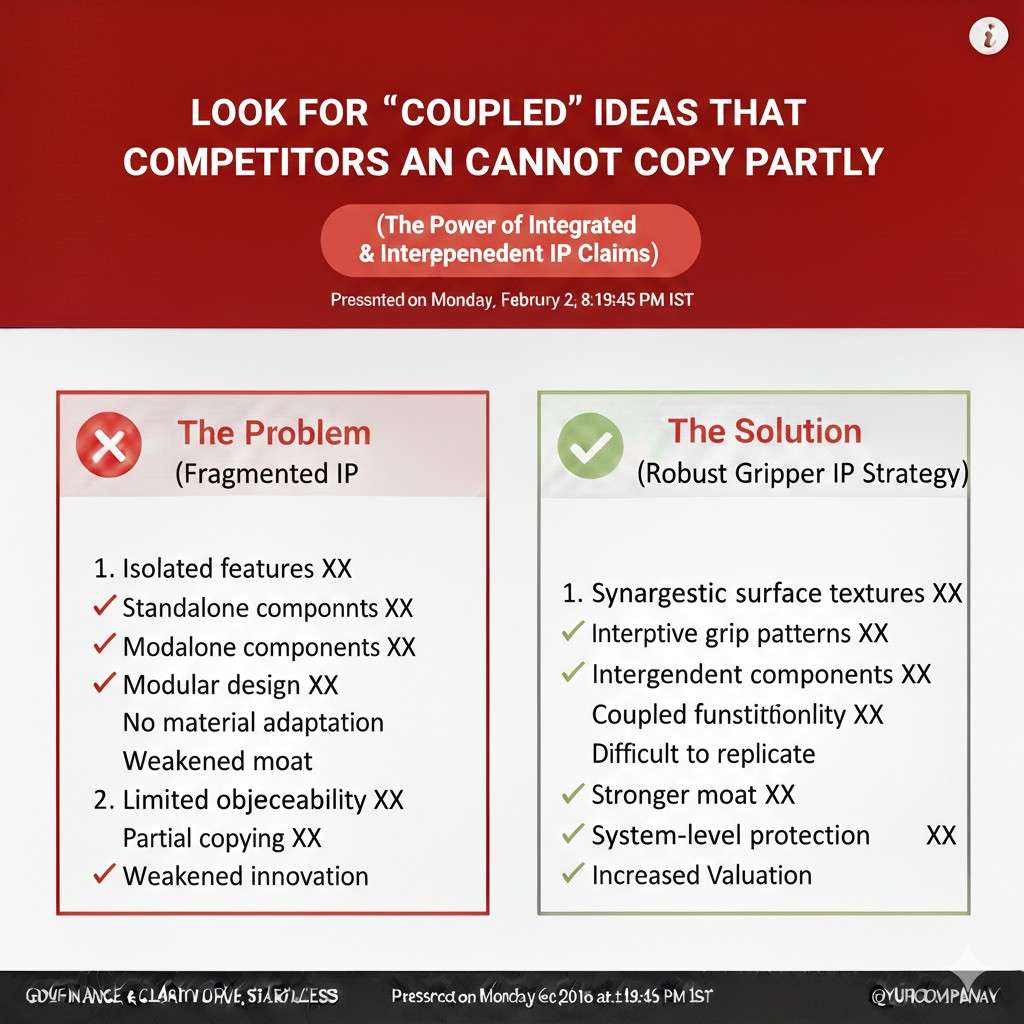
Some ideas are easy to copy in isolation. A ribbed pad can be copied. A suction cup can be copied. A hinge can be copied.
But when your best results come from a combination, you get leverage. The combination is what you patent.
For example, your fingertip compliance might be tuned to a force controller that reads motor current, and your grasp planner might choose contact points that make that loop stable. A competitor can copy one part, but not get the outcome.
That is the kind of invention that makes a patent valuable, because it forces others to take a long detour.
Capture the “edge cases” that your system handles
Robotics is not about the easy pick. It is about the messy pick.
If your gripper works on deformable items, or thin films, or reflective objects, or objects that change shape, those are valuable cases to document. The patent does not need to list every object. It needs to explain the structure and method that makes those cases possible.
A good patent can make your edge cases your protected territory. That is where competitors struggle, and where customers pay.
Don’t hide the software just because it feels abstract

Many teams assume software is harder to patent. The truth is more nuanced.
Software is patentable when it is tied to a real technical improvement, especially when it is tied to physical hardware. In manipulation, the line between hardware and software is thin. The software decides force, timing, and motion. The hardware makes those decisions real.
If your grasp stability comes from a sensor fusion method, or a slip detection method, or a planning method that reduces failure, do not ignore it. Just make sure you describe it as part of a technical system, not as a business rule.
Use prototypes to expose what is actually new
Your earliest prototypes often show your novelty better than your final product. Why? Because early designs are less polished, but they show what you tried, what you rejected, and what you invented to get past a barrier.
If you keep pictures, notes, test clips, and design versions, you have a strong base for patent drafting. It also helps you explain what existed before, and why your solution is different.
This is one reason it helps to work with patent attorneys who understand robotics. They can pull invention stories out of messy prototyping in a way that becomes a clean filing.
If you want Tran.vc to help you do that, apply anytime here: https://www.tran.vc/apply-now-form/
What to document before you talk to a patent attorney
Make a simple “invention record” while it is fresh
The best time to write down your invention is right after you solve the problem. Waiting six months is risky, because you forget the small details that make the difference.
An invention record is not a legal essay. It is a set of notes that a patent attorney can use to write a strong application.
Write what the system is, what problem it solves, how it works, and what makes it different. Add sketches. Add photos. Add a short test result that shows improvement.
Describe the system at three levels
To make patent drafting easier, describe your gripper in three layers.
First, describe the overall system: what the gripper does, what objects it targets, and what environment it works in. Second, describe the key sub-systems: fingertips, actuation, sensing, control. Third, describe the details inside the key sub-systems.
This layered view helps you later when you want multiple claims that cover broad ideas and also narrow details. It also helps you avoid a common mistake: writing only about one tiny feature and missing the bigger invention.
Show the “before and after” in plain terms
Patents become stronger when they show a clear improvement. You do not need complex charts. You need plain comparisons.
For example, “the old design slipped on thin cardboard at 2N, the new design holds at 7N.” Or “the old design needed two tries per pick, the new design succeeds on the first try most of the time.”
Even if you cannot share exact numbers in public, you can keep them in your records and share them with your attorney under confidentiality.
List variations you might build next
A smart patent filing covers not only what you built, but also what you are likely to build next.
If you know you may change finger count, or switch from motor drive to tendon drive, or add a sensor type, write that down. If you may change materials or pad structures, note that too.
This matters because the patent can be written to cover those variations, even if you have not built them yet. That gives you room to evolve without stepping outside your own protection.
Capture diagrams that explain motion and force
For grippers, diagrams are everything. A drawing of the linkage path, or the force direction, or the sensor placement can communicate more than a page of text.
If you can, create a few clean sketches that show the key ideas. They do not need to be perfect. They need to be clear.
A patent attorney can turn these into formal drawings later, but your early sketches guide what matters.
If you want help turning your gripper notes into a clean filing plan, Tran.vc can support you with in-kind IP services as part of our investment model. Apply anytime here: https://www.tran.vc/apply-now-form/