
AI startups move fast. Your patent plan has to move fast too.
If you build in AI, you already know this pain: your model changes, your data changes, your product shifts, and your “real” invention becomes clear only after you ship and learn. But patents do not work like product sprints. A patent filing freezes a moment in time. That is why many AI founders file one solid first application, then keep expanding it as the tech matures.
This is where continuations become a quiet superpower.
A continuation is a way to keep the same “root” patent filing alive while you add new angles, new claim sets, and new business protection over time. In simple terms, it lets you say: “We are not done yet. Our AI system has more value than what we knew on day one, and we want coverage that matches that value.”
For startups, continuations can be the difference between:
- having a patent that looks nice on a slide, and
- having a patent family that actually scares competitors and gives investors confidence.
In this guide, I’ll show you how continuations work for AI patents, why they matter so much for early teams, and how to use them in a practical way without wasting money. I’ll keep the language simple, and I’ll focus on what you can do step by step as your product grows.
And if you want a team that does this with you—strategy, drafting, and filings—Tran.vc can help. Tran.vc invests up to $50,000 in in-kind patent and IP services so technical founders can build a real moat early, before a big seed round forces rushed decisions. You can apply anytime here: https://www.tran.vc/apply-now-form/
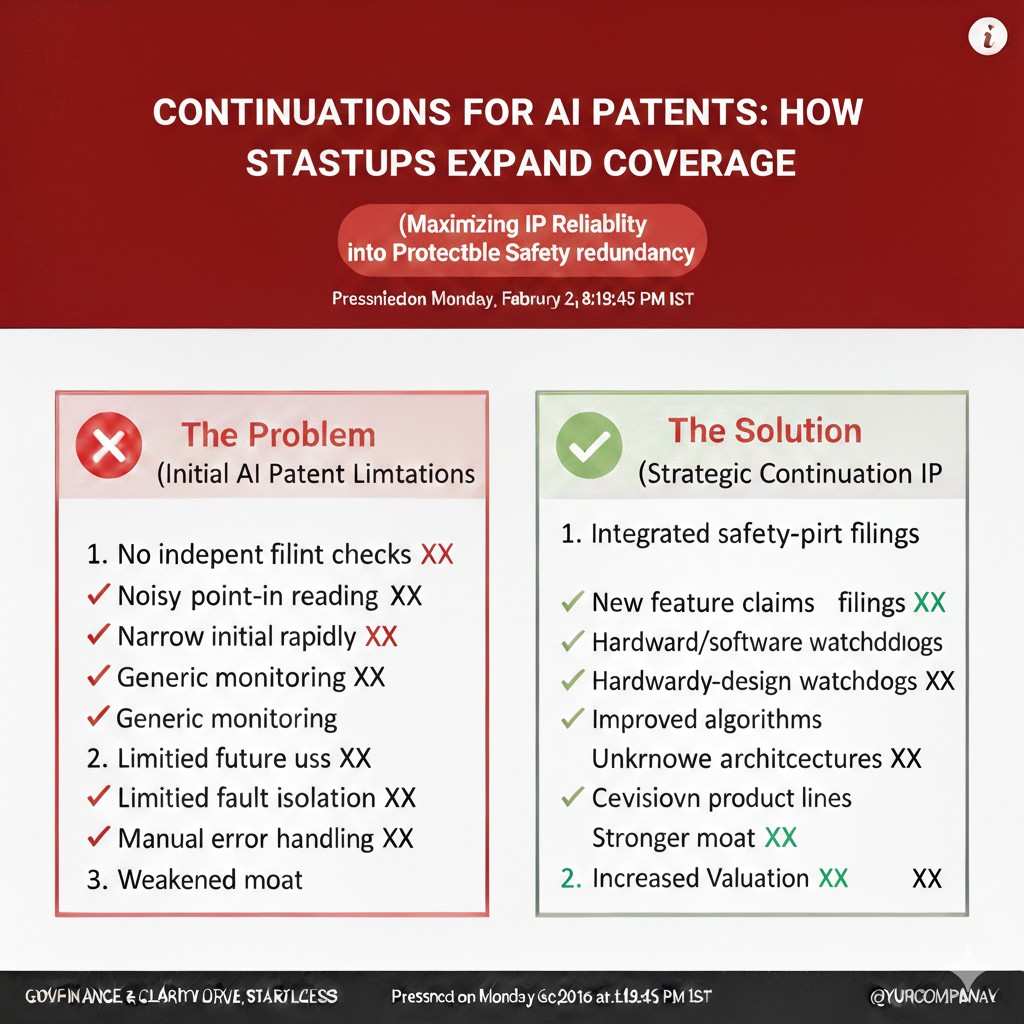
Continuations for AI Patents: How Startups Expand Coverage
A simple way to think about a continuation
A continuation is a new patent application that stays tied to the same first filing you already made. It uses the same written description and the same drawings. What changes is the focus of the claims, which is the part that decides what you truly “own” on paper.
Think of your first filing as the trunk of a tree. A continuation is another strong branch that grows from that same trunk. You are not starting over. You are building outward, using the same foundation, but aiming your protection at a new target.
For AI startups, this matters because what you need to protect often becomes clearer over time. The product gets sharper, the market talks back, and the best competitive edge may not be the first thing you wrote down. A continuation lets you adjust your aim while keeping the benefits of that first date.
Why startups use continuations more than they expect
Early teams usually file when they have just enough proof that the idea works. Then they learn faster than any legal process can move. A few months later, the team may have better model design, a stronger pipeline, a more clever training method, or a safer deployment loop.
If you only file once, your patent might cover the older version and miss the newer value. Continuations let you keep filing new claim sets that match how your system is really built and sold today.
This is also how startups create a “patent family” that looks serious to investors. One patent can help. But a family with planned continuations signals that the company is building long-term leverage, not just collecting paperwork.
The practical promise of a continuation
A continuation lets you keep the same disclosure while trying new claim angles. That means you can go after different parts of your system without rewriting the whole application. If your first filing is written well, you can later claim the workflow, the model behavior, the monitoring loop, the data handling, and even the way outputs are used in a real-world setting.
This is why the first filing is so important. A strong first filing gives you room to grow. A thin first filing boxes you in. When Tran.vc supports founders, this is a big part of the work: making sure the first filing is built for expansion, not just for filing.
If you want help building that kind of “expandable” filing, you can apply anytime here: https://www.tran.vc/apply-now-form/
The three related tools: continuation, continuation-in-part, and divisional
Why people mix these up
These three are often spoken about like they are the same thing. They are not. They all help you file more applications from a related base, but they serve different goals and come with different trade-offs.
For AI startups, the difference is not academic. It can change your risk level, your cost, your timeline, and your ability to enforce later. So it is worth slowing down and getting the distinctions clear.
Continuation: same description, new claim focus
A continuation uses the same written content as the parent application. You do not add new technical material. You do not change the story. You simply choose a different set of claims that are still supported by what you already disclosed.
This is ideal when your invention has many “claimable” pieces, and you want to protect them in separate waves. It is also useful when you want to keep negotiating with the patent office from different angles, without giving up the early filing date that can be so valuable.
In AI, this often happens when the first claim set aimed at one part of the system, but later you realize another part is what competitors will copy. A continuation lets you pivot the protection toward what actually matters now.
Continuation-in-part: new material added, mixed dates
A continuation-in-part, often called a “CIP,” is used when you have real new technical content that was not in the earlier filing. You add the new material and you can claim it. The trade-off is that the new material gets a later priority date.
That detail about dates is a big deal. In simple terms, the parts supported by the old filing keep the old date. The parts supported only by the new material get the new date. So you can end up with a patent that has a split timeline inside it.
For AI startups, this can be useful when your system changed in a meaningful way. Maybe you moved from a rules-based prefilter to a learned filter. Maybe you added a training loop that uses live feedback. Maybe you found a new method to reduce hallucinations that did not exist when you first filed.
A CIP can capture that improvement. But it should be used with care. If you rely too heavily on the later date, you may lose ground against what became public in between.
Divisional: forced split because the patent office says so
A divisional application usually happens when the patent office says your original application covers more than one invention. The examiner may require you to pick one invention to pursue in that application. The other inventions can be pursued in a divisional.
This is not you choosing a new strategy because you want to. It is often a reaction to a “restriction requirement.” In that sense, divisional filings are common when your first application is broad and covers multiple distinct parts.
For AI startups, this can happen when you describe a system that includes data prep, training, inference, deployment safety, and user interaction, and the examiner says those are too separate. A divisional gives you a path to protect the other parts without losing the early date.
Which one tends to fit AI startups best
Most early AI startups lean heavily on continuations because they want new claim coverage without changing the description. That is the cleanest tool for expansion when the first filing was written with depth.
CIPs are more situational. They can be powerful when the invention truly evolved, but they require careful planning because of the date issue. Divisionals are often unavoidable when your first filing is ambitious, and they can become a good thing if you manage them with intention.
A strong IP partner can help you plan this like a roadmap instead of a scramble. Tran.vc’s model is built around that kind of planning, because it is hard for founders to do this alone while shipping product. Apply anytime if you want help building a continuation-ready strategy: https://www.tran.vc/apply-now-form/
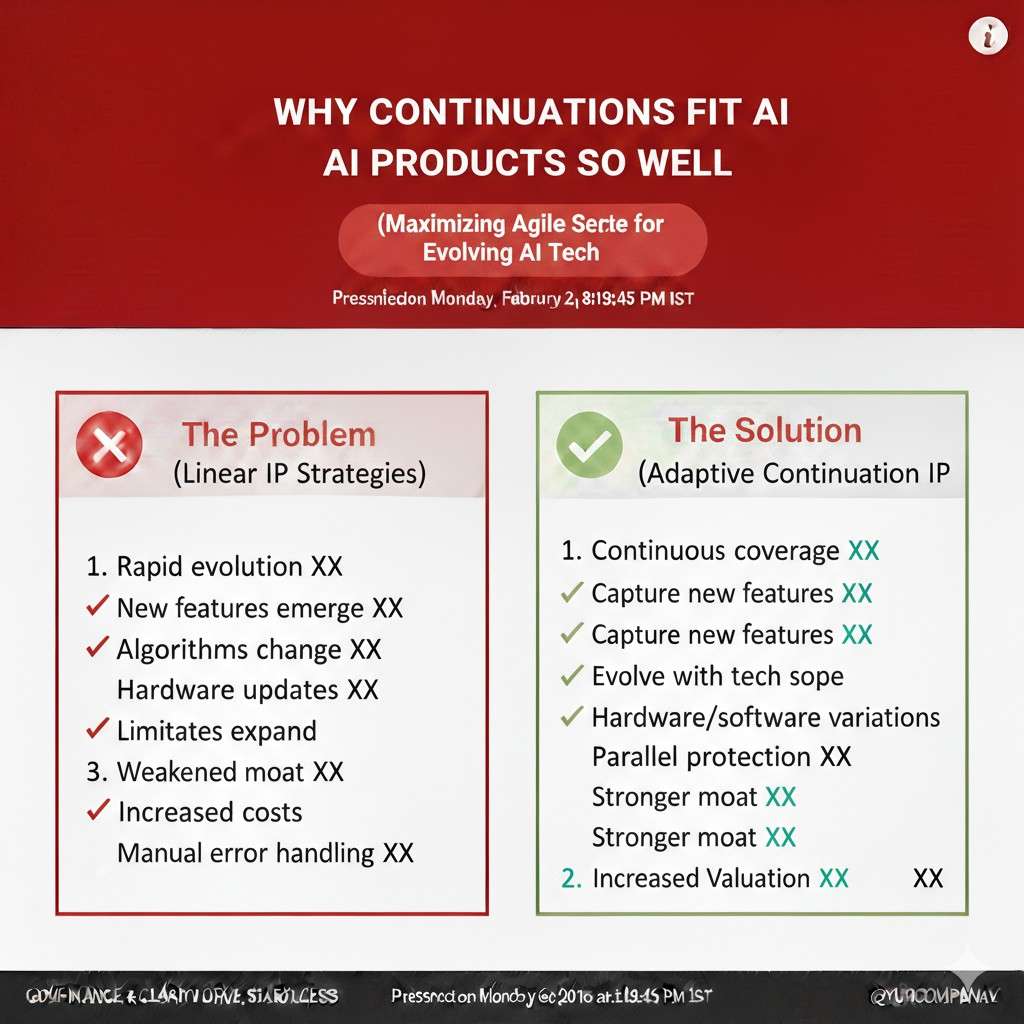
Why continuations fit AI products so well
AI inventions are often “systems,” not single features
Many AI products are not one discrete feature. They are a chain of steps that interact. Data comes in, it gets cleaned, it gets labeled or weak-labeled, it gets embedded, it flows through a model, outputs are scored, results are checked, and then actions happen.
Even if you sell one product, the “invention” may sit in multiple places inside that chain. A competitor might copy your training method but change the UI. Another might copy your monitoring loop but use a different model. Another might copy your data pipeline but market it differently.
Continuations let you protect the same disclosed system from multiple angles, which is often the only way to build real coverage in AI.
Your first idea is rarely the best claim target
In the beginning, founders describe what they think is special. Later, customers and competitors teach you what is actually special. This is normal. It is not a mistake. It is how learning works.
The patent problem is that the best claim target might not be the “headline” of your first pitch. It might be the small technical trick that makes the model stable. It might be the way you manage drift. It might be the way you combine user feedback with automatic checks. It might be the way you decide when not to answer.
A continuation gives you room to shift your claim focus toward what the market proves is valuable, while still anchored to the early filing.
Continuations help you play both offense and defense
A startup’s IP goals are often two-sided. You want to stop direct copying, which is defense. You also want leverage in partnerships, fundraising, and future enforcement, which is offense.
If you only have one claim set, you have one weapon. If that claim set ends up narrow, it may not match the way competitors build around you. With continuations, you can create several claim sets over time. Some can be broad and aimed at the core workflow. Others can be narrower and aimed at key implementation details.
This gives you flexibility. It lets you respond to what you see in the market, not just what you guessed early on.
Continuations can keep your application “alive” longer
There is also a timing benefit. Continuations can keep the patent family active while you learn. That means you can continue shaping protection as you refine product-market fit, rather than being locked into one final result too early.
For AI startups, where the space changes quickly, that extra time can matter. It can also matter for fundraising, because investors often respond well when there is a clear plan to expand coverage rather than a single filing with no follow-through.
If you want Tran.vc to help map a continuation plan that matches your product road map, you can apply anytime: https://www.tran.vc/apply-now-form/
What exactly changes in a continuation
The description stays the same
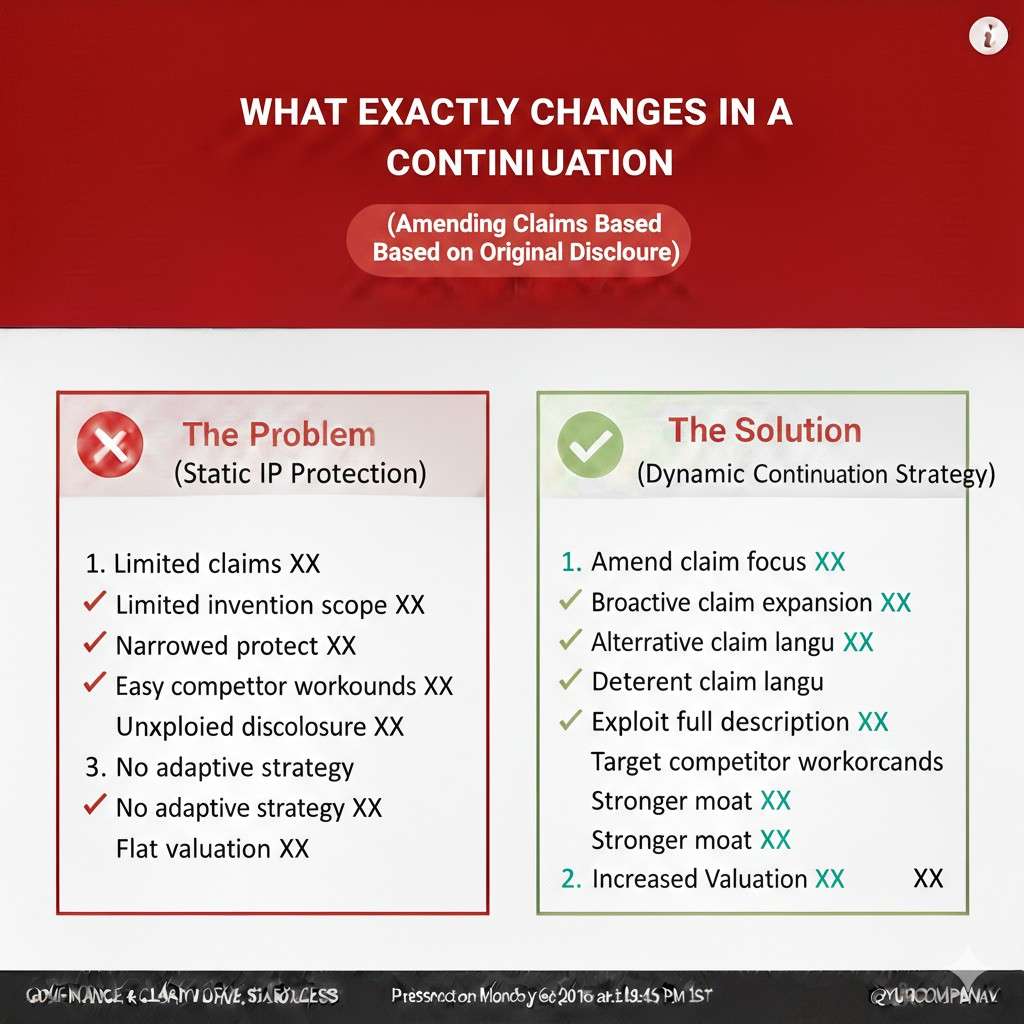
In a continuation, you do not add new technical content. The written description stays the same as the parent. The drawings stay the same. You are working with what you already disclosed.
This is why founders should care about the quality of the first filing. If the first filing clearly explains multiple variations, multiple flows, and multiple technical options, you have more room to claim later. If it only describes one narrow path, you may not have enough support to expand.
A smart first filing is not vague. It is detailed. It gives examples. It shows different ways the system can work. That detail is what makes future continuations possible.
The claims can be different, sometimes very different
Claims are the legal boundary. They are the part that gets examined, negotiated, and granted. In a continuation, you can present a new set of claims that point to a different aspect of the same disclosed invention.
For example, imagine your parent application claimed a method of generating outputs with a specific model structure. A continuation might instead claim the way you select training data, or the way you score outputs, or the way you route a query to one of several models.
All of these can be supported by the same description if the first filing was drafted with care. The continuation is your chance to surface that hidden value and turn it into a protected boundary.
The goal is coverage expansion, not just more paper
Some founders assume continuations are only for big companies with big budgets. In reality, smart startups use continuations to avoid waste. Rather than filing many separate new applications from scratch, they build a strong base and then expand off it with focused claim sets.
This can be more cost-effective when done well. It also helps create a coherent story for investors: one core invention, defended through a set of evolving claims that match the company’s growth.
Building the right base filing so continuations are actually possible
The hidden truth: continuations do not fix a weak first filing
Many founders hear “continuations let you expand later” and assume that means they can file something quick now and clean it up later. That is not how it works.
A continuation cannot add new technical material. It cannot introduce new steps, new model parts, new data logic, or new system flows that were not already in the first application.
So if your first filing is thin, your future continuations will also be thin. You will be stuck trying to stretch a small story into big coverage, and the patent office will push back because the support is not there.
This is why the first filing must be written like a strong technical document, not like a marketing pitch.
What “enough detail” looks like for AI systems
For AI, “enough detail” is not about revealing your secret sauce line by line in a way that hurts you. It is about describing the system so clearly that you can later claim different angles without changing the story.
A good base filing usually explains the full pipeline from input to output, and it does so in more than one way. It describes alternatives. It describes choices.
If you have an AI product that takes a user query and returns a result, the filing should not only describe the model. It should describe how the query is prepared, how context is formed, how the system chooses what information to use, how outputs are checked, and how the system handles uncertainty.
These are often the exact areas where a competitor copies you, because they are the parts that make the product safe and reliable.
The “variation mindset” that makes continuations easy
When you are drafting the first filing, you want to think in variations.
Not variations like “we might use Model A or Model B” only. That is too shallow. You want variations in steps and structure.
For example, if your system filters inputs, you may do it before retrieval, after retrieval, before the model runs, after the model runs, or at multiple points. If you have a scoring system, you may score by confidence, by risk, by policy rules, by user history, or by downstream impact.
Each of those is a possible future claim focus. Your first filing should mention them as real options, not as an afterthought.
A well-built base filing feels like a map. A continuation strategy is simply choosing which roads to fence off first, and which ones to fence off later.