
Pre-seed money feels big on day one. Then rent hits. Cloud bills show up. A key hire asks for a “market” salary. A pilot takes longer than planned. And suddenly the runway looks short.
This guide is for founders who want to make a small round last longer without moving slower. The goal is not to “be cheap.” The goal is to spend with purpose, protect what matters, and keep your options open.
If you are building in AI, robotics, or deep tech, you can apply anytime to Tran.vc to get up to $50,000 in-kind patent and IP services so you can build a moat early without burning cash. Apply here: https://www.tran.vc/apply-now-form/
How to Stretch a Pre-Seed Round Like a Pro
Why this matters more than ever
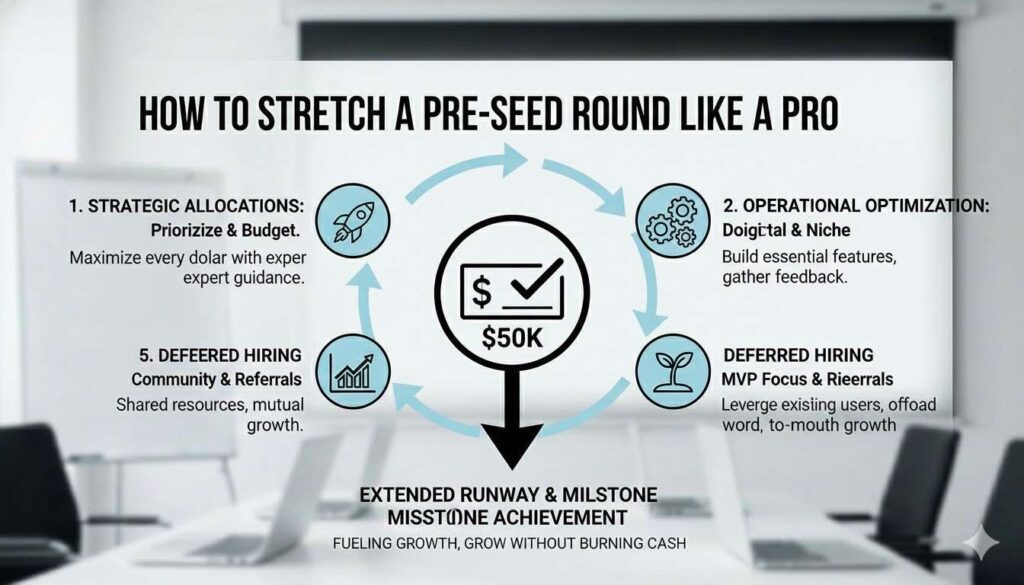
Pre-seed money is supposed to buy you time. In deep tech, time is expensive because the work is real. You are not just shipping screens. You are testing systems, collecting data, tuning models, running pilots, and proving the product can live in the real world.
If you spend like a bigger company before you have proof, you do not just lose money. You lose choices. When choices shrink, you start taking bad deals, rushing hires, and chasing any investor who will reply.
If you are building AI, robotics, or other technical products, you can apply anytime to Tran.vc and get up to $50,000 in-kind patent and IP services to build protection early without draining cash. Apply here: https://www.tran.vc/apply-now-form/
What “stretching” really means
Stretching a pre-seed round is not about saying “no” to everything. It is about saying “yes” only to spending that pushes you toward a clear milestone. When money is limited, the best teams do not move slower. They move cleaner.
Clean movement means you can explain every spend in one sentence: what it bought, what risk it removed, and what it unlocked next. If you cannot explain it, it is likely noise dressed up as work.
The goal you should measure
At pre-seed, your goal is simple: reach the next fundable proof point before you run out of runway. You are trying to arrive at a moment where a smart investor can see the path and believe it.
That path looks different for each startup. But it always includes a real product story, real learning from the field, and enough defensibility that you are not just “a feature” someone can copy.
Build a money system you can run every week
Stop treating finance like a monthly chore
Many founders look at their bank account only when it feels scary. That is too late. A pre-seed round needs a weekly habit, not a monthly review. When you do it weekly, the numbers stay small enough that you can fix mistakes fast.
This does not require a complex setup. You need one owner, one simple sheet or dashboard, and a short meeting that happens no matter what. If you skip it, spending becomes emotional. Emotional spending is how runway disappears.
Track spending by outcomes, not categories
Budget categories are fine for taxes. They are not great for decisions. “Software” does not tell you if you moved forward. “Contractors” does not tell you if you reduced risk. What matters is whether the spend helped you reach proof.
So you track by outcomes like “pilot readiness,” “model accuracy on customer data,” “hardware reliability,” or “safety testing.” When spending is tied to outcomes, you can see what is paying off and what is just comfort.
This also changes team behavior. People stop asking for tools “because we should.” They start asking for tools because the tool unlocks a specific step that matters right now.
Run the weekly money check the same way each time
A weekly check is simple. First, you look at what you spent and what you got from it. Next, you decide what you will spend on in the next seven days and what result you expect. Finally, you update runway based on what is now true, not what you hope is true.
The value is not the math. The value is the focus it forces. When you do this every week, the team naturally learns to spend on proof and avoid drift.
Choose what you will not do in this round
The hidden cost of “keeping options open”
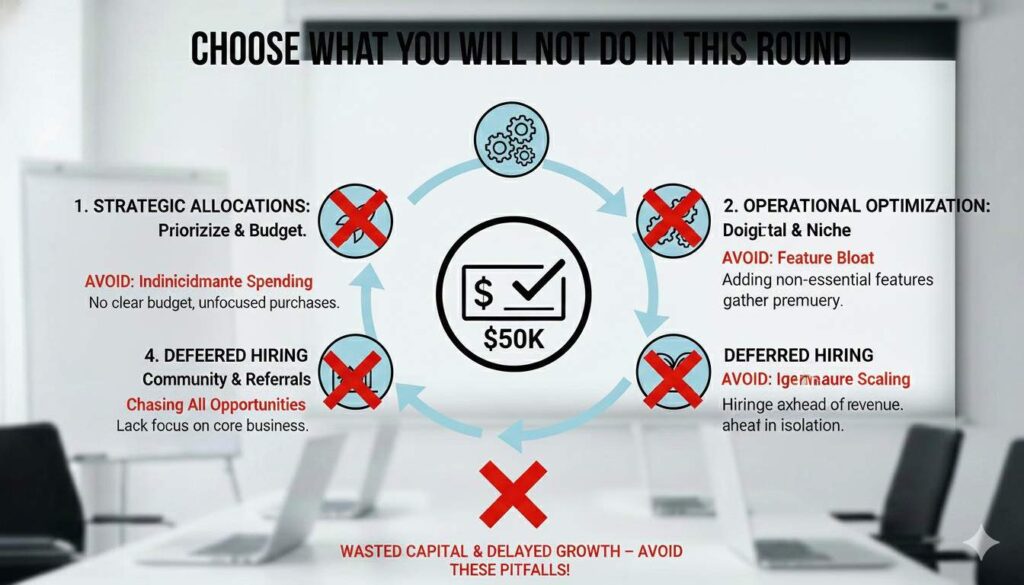
Founders often say they want to keep options open. In practice, that turns into building many half-products, chasing many markets, and doing many “almost pilots.” It feels flexible, but it is actually fragile because each path needs money to stay alive.
Real flexibility comes from depth, not breadth. When you get one path working, it gives you strength. Strength buys you time. Time gives you options.
Pick one risk that matters most right now
Every pre-seed startup has risks. The mistake is trying to remove all of them at once. You need to pick the one risk that, if removed, makes everything else easier.
For AI, that risk is often “Does the model work on real customer data in a real workflow?” For robotics, it can be “Does the system run reliably for long periods outside the lab?” For regulated products, it might be “Can we pass the key safety gate that blocks adoption?”
Once you pick the main risk, you stop spending on things that do not remove it. That one change can add months of runway without reducing speed.
Turn “not now” into a written rule
The easiest way to waste money is to let “nice-to-have” work sneak in. So you write down what you will not do until the next round. This is not a negative list. It is a protection plan.
When someone proposes a new project, you compare it to the written rule. If it does not support the main risk, it goes into a later bucket. This reduces debates and stops the team from doing work that feels good but does not move the company forward.
Build a milestone budget instead of a monthly budget
Make the milestone specific enough to test
A milestone is not “launch.” A milestone is something you can test and prove. It is a clear statement that reduces doubt in your story.
For example, “We can run the robot for 100 hours without failure,” or “We can reduce errors by 30% on customer data,” or “We can deliver the outcome in under two weeks with a repeatable workflow.” These are strong because they are measurable.
When the milestone is measurable, your spending becomes easier to judge. If the spend does not increase the chance you hit the metric, you likely skip it.
Break the milestone into proof steps
Milestones are big. Proof steps are small. A proof step might be building a test rig, shipping a controlled pilot, collecting a specific dataset, or validating one key integration.
Each proof step should end with something you can show. A chart, a demo, a test result, a signed pilot plan, or a working workflow. Showing beats telling. Showing builds trust. Trust is what funding runs on.
Assign money to proof steps, not tasks
Tasks can expand forever. Proof steps are anchored. That is why you assign money to proof steps.
When you do this, you start making smarter trade-offs. You might decide a cheaper sensor is fine for now because the proof step is about software reliability, not final performance. You might delay a polished enclosure because the proof step is about repeatable motion, not aesthetics.
This keeps the company honest and keeps cash pointed at the result.
Control burn rate without slowing product
Pay for direction before you pay for speed
Speed is expensive. Direction is cheaper. Many teams buy speed too early by hiring too much, signing long contracts, or building heavy systems.
Direction means you know what to build next, why it matters, and how you will measure success. Once direction is clear, spending on speed makes sense because you will not waste it.
When direction is not clear, spending on speed turns into faster confusion. That is how pre-seed rounds vanish.
Keep recurring costs as low as you can
One-time spends hurt once. Recurring spends hurt every month. Pre-seed teams should treat recurring bills like rent, because they behave the same way. They take runway before you even start work.
This is why long software contracts are dangerous early. This is also why big office leases are risky. You can always add comfort later. You cannot always recover lost runway.
A good rule is simple: if you cannot cancel it quickly, think twice. Flexibility is a form of financial safety.
Avoid paying “enterprise prices” for pre-seed needs
Many tools and services are built for big teams. They charge for features you will not use. They push you into processes you do not need.
At pre-seed, you want tools that are simple and reversible. You want systems that help you learn, not systems that force you to act like a large company. Acting big too early is one of the most common ways startups waste money.
Design a small team that can hit the next proof point
People are your biggest spend and your biggest risk
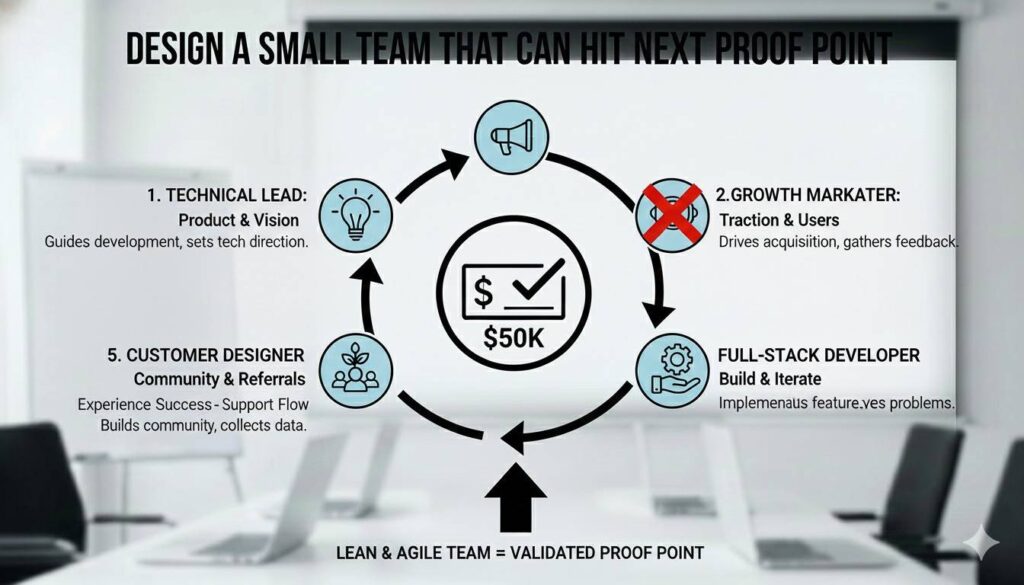
Hiring feels like progress. It also adds cost, meetings, and coordination. If you hire too early, founders spend more time managing than building and selling.
A small team can move extremely fast when the work is clear and ownership is sharp. The key is to hire only when a true bottleneck blocks the next milestone.
Hire to remove a bottleneck you can name
A good pre-seed hire removes a problem that founders cannot solve fast enough alone. It might be a missing skill, an integration that keeps slipping, or a technical gap that slows every sprint.
The test is not “Will this help someday?” The test is “Will this create measurable progress this month?” If the answer is unclear, you wait.
Waiting is not being cautious. Waiting is protecting runway so you can hire later from a stronger position.
Use flexible talent for narrow needs
Not every problem needs a full-time role. Many needs at pre-seed are narrow. A specialist can help you for a short window and then step out.
This approach keeps costs down and keeps the core team focused. It also reduces the chance you hire the wrong person out of urgency. Pre-seed hiring mistakes are expensive because they cost both money and time.
Treat vendors like deliverables, not like ongoing helpers
Every vendor should have a clear finish line
Vendors can help you move fast, but only when the work is scoped tightly. A vendor with an open-ended role can quietly become a recurring cost that never ends.
A healthy vendor relationship at pre-seed is based on a specific deliverable. You pay for an output you can use, not for “support.” You define what done looks like, and you stop when it is done.
This protects runway and keeps execution sharp.
Avoid long retainers unless the value is obvious
Retainers can make sense in rare cases. But many early teams agree to a retainer because it feels professional.
Professional is not the goal. Progress is the goal. If a retainer does not directly support the next milestone, it is likely a luxury.
When you keep vendor work project-based, you stay in control. Control is what you need when cash is limited.
Make it easy to switch if needed
If you cannot switch vendors, you have risk. If a vendor is holding key knowledge without documentation, you have risk. If a vendor controls access to your systems, you have risk.
At pre-seed, risk is expensive. So you keep ownership of accounts, documentation, and decisions. Vendors can help you build, but you should not let them become a dependency that drains you.
Build one real go-to-market path and stop splitting your energy
Choose the first customer type you can win
Most founders lose money by chasing many buyer types. The sales story changes, the product requirements change, and the team keeps rebuilding.
You want one buyer type with one painful problem you can solve better than alternatives. When you find that, you simplify everything.
You can write clearer messages. You can build a tighter demo. You can run pilots faster because you stop reinventing the pitch each time.
Founder-led sales is not optional at this stage
At pre-seed, the founder is the best salesperson because the founder knows the details, the trade-offs, and the why behind the product.
This does not mean being pushy. It means being present. You talk to users every week. You listen. You adjust. You learn what people actually pay for, not what they praise in meetings.
When founders sell early, they also avoid wasting money on marketing that is not ready. A clear message is earned through calls, not bought through ads.
Make each conversation produce a useful next step
Sales calls should not end in vague positivity. They should end with a next step that creates proof. A pilot plan. A data sample. A site visit. A test requirement. A timeline.
When you run sales like this, you stop collecting “interest” and start collecting evidence. Evidence is what stretches runway because it gives you leverage with both customers and investors.
Make IP part of runway, not a “later” problem
Why deep tech founders cannot delay protection
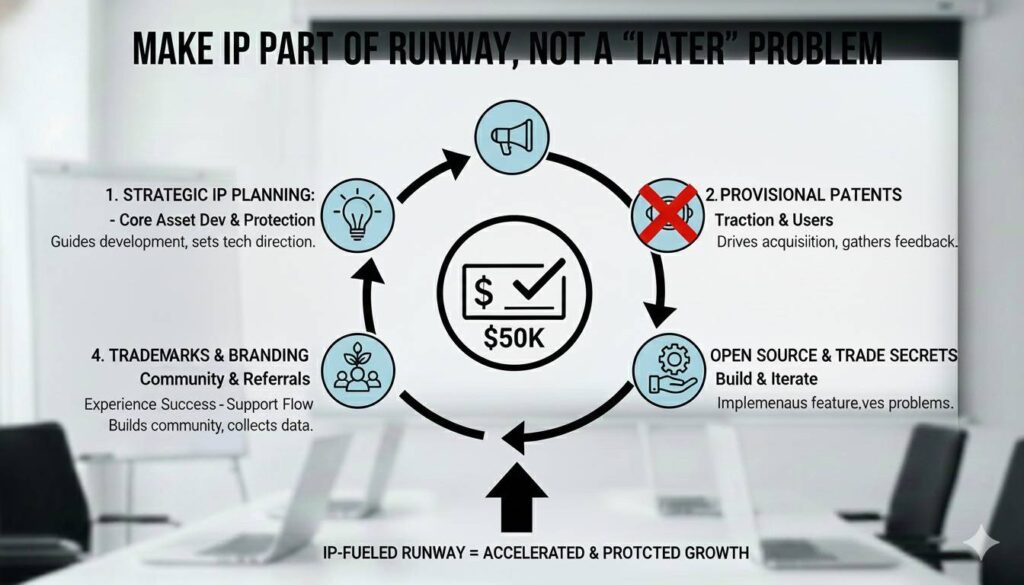
In AI and robotics, the core idea can spread fast once you show it. Demos get shared. Decks move around. Contractors come in. People leave.
If you wait too long, you may weaken what you can protect. You may also create confusion about ownership if assignments and agreements are not clean.
This is not meant to scare you. It is meant to keep you safe. Strong IP habits early protect your work and your future leverage.
IP is not just patents, it is a strategy
A patent filing is one part of a bigger plan. The bigger plan is deciding what you want to own, what you want to keep secret, and what you are willing to share.
A good plan matches your business model. It covers the core technical advantage. It avoids wasted filings that do not protect the real value.
When done well, IP becomes part of your fundraising story and part of your customer story. It signals seriousness and makes copying harder.
How Tran.vc helps you stretch runway with IP services
This is where Tran.vc fits. Tran.vc supports technical founders with up to $50,000 in-kind patent and IP services, so you can build defensibility without burning your cash on big early legal bills.
That means you can keep your round focused on product proof, pilots, and learning, while still building real protection around what makes you special.
If you want to explore this, you can apply anytime here: https://www.tran.vc/apply-now-form/
How to Stretch a Pre-Seed Round Like a Pro
Cut cloud spend without slowing the build
Cloud bills grow in a sneaky way. At first it is a few small charges and you ignore them. Then you add one more service, one more log stream, one more staging setup, one more GPU run, and suddenly your bill is a full-time hire.
The fix is not “use less cloud.” The fix is to treat cloud like a lab meter. You pay for tests that answer a question. You do not keep the meter running all night because it feels safe.
A practical habit is to review cloud cost every week, the same way you review cash. You look for the biggest line items and ask a simple question: what proof did this buy us? If you cannot point to proof, you pause that spend and redesign the workflow.
One of the fastest wins is turning off what you are not using. Idle machines, old test clusters, unused environments, and forgotten storage buckets are common. Teams often keep them “just in case,” but that “just in case” turns into months of waste. Set a rule: anything not used in seven days gets shut down or archived, unless it supports an active pilot.
Make GPU use intentional, not automatic
For AI teams, GPUs can be a runway killer. The trap is running experiments because you can, not because you must. Many runs are curiosity runs. Curiosity is good, but it has to be paced.
A better approach is to treat experiments as planned work with a clear goal. You decide what the run is meant to prove before you spend the compute. You also decide what result would make you stop. If you do not define a stop condition, your team will keep tuning because it feels productive.
Another important tactic is to keep your evaluation tight. If you can test ideas on a smaller dataset first, do it. If you can run part of the pipeline on CPU, do it. If you can cache features, do it. The point is not to be clever. The point is to reduce repeat costs while keeping learning speed high.
Control data storage and logging before it controls you
Logs and data storage feel harmless because each item is cheap. Then the pile grows. At pre-seed, you do not need perfect observability across every service. You need enough visibility to debug and to measure the key metric.
So you design logging around the few things that matter. You keep high-detail logs for short windows, then you compress or delete. You store raw data only when it is needed for training, audits, or a clear future use. Everything else should be summarized and cleaned.
This also helps your team focus. Too much data can make people chase shadows. In early stages, you want clean signals, not endless noise.
Spend on data like it is product development
Do not buy huge datasets before you know what you need
Early AI teams often buy data too soon. They think more data will fix the model. Sometimes it will. Often it will not, because the real problem is that the data does not match the real user workflow.
The smarter play is to get a thin slice of real data and use it to learn what “good” looks like. You want to see the edge cases, the messy inputs, the missing fields, the weird labels, and the human habits that break assumptions.
Once you know the shape of the problem, you can choose the right data plan. That plan might include collecting data, licensing data, generating synthetic data, or building labeling workflows. But you decide with clarity, not hope.
Build a small labeling system that produces reliable truth
Labeling can become a black hole. You can spend forever and still not trust the labels. The way out is to design a labeling process that produces consistent truth, even if it is small.
Start by writing a clear labeling guide that a smart person can follow without guessing. Then test it on a small batch and measure agreement between labelers. If labelers do not agree, your “ground truth” is not ground truth.
When you get agreement, you scale slowly. You keep spot checks. You keep a gold set of examples that never changes, so you can compare new labelers to a stable standard. This reduces rework and builds a dataset you can defend in front of customers and investors.
Use partnerships to get data without paying retail prices
Data is expensive when you buy it like a buyer. It is cheaper when you earn it like a partner. Many companies will share data if you solve a real pain and if the terms are clear.
This is where pilots matter. A pilot that creates value can unlock data access that money cannot buy. But you must be professional about it. You need clear agreements, clear boundaries, and clear ownership of what is created.
If you are building something that will be copied fast, this is another reason to handle IP early. Strong IP strategy can reduce fear on both sides because it clarifies what belongs to whom and how your core is protected.
Tran.vc helps founders do this without draining cash by providing up to $50,000 in-kind patent and IP services. If you are building AI, robotics, or deep tech, you can apply here anytime: https://www.tran.vc/apply-now-form/
Run pilots that create proof without draining you
Make the pilot a learning contract, not a vague promise
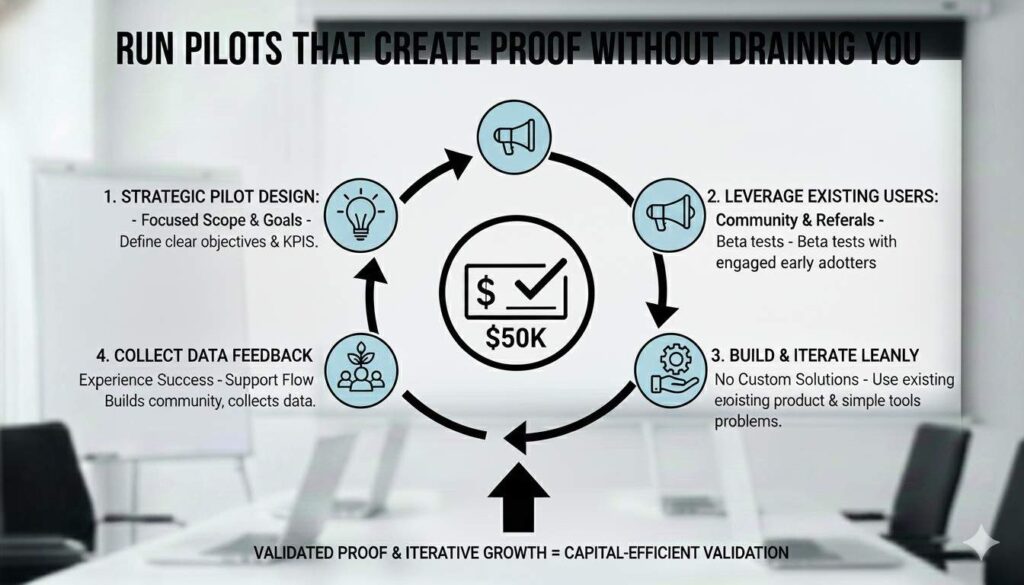
Pilots fail when they are “let’s try it and see.” That sounds friendly, but it causes drift. Drift costs money because it creates endless custom work with no clear finish.
A strong pilot has a narrow goal, a start date, an end date, and one metric that matters. It also has clear roles. You define what you will deliver, what the customer will provide, and what happens if something breaks.
When pilots are structured this way, they become cheap learning. They also become strong fundraising proof because you can explain exactly what happened and what you learned.
Reduce pilot scope until it feels almost too small
Founders often pitch pilots that are too broad because they want to impress the customer. But broad pilots invite complexity. Complexity eats runway.
A better pilot is a small “slice” that proves your product can produce a valuable outcome. It might be one workflow, one station, one site, one model task, or one integration.
When that small slice works, you can expand with confidence. Expansion is easier because you are not guessing. You are repeating something that already produced value.
Protect your roadmap from pilot-driven chaos
Customers will ask for many things during a pilot. Some requests are valid. Many are not. The danger is building everything they ask for just to keep them happy.
To avoid this, you keep a simple rule: you will consider changes only if they help hit the pilot metric. If the request does not move the metric, it goes into a future list.
This keeps your team from becoming a custom dev shop. It also signals strength. Serious customers respect focus when you explain it clearly.
Replace big marketing spend with a tight proof story
Your story should sound like a problem, not a product
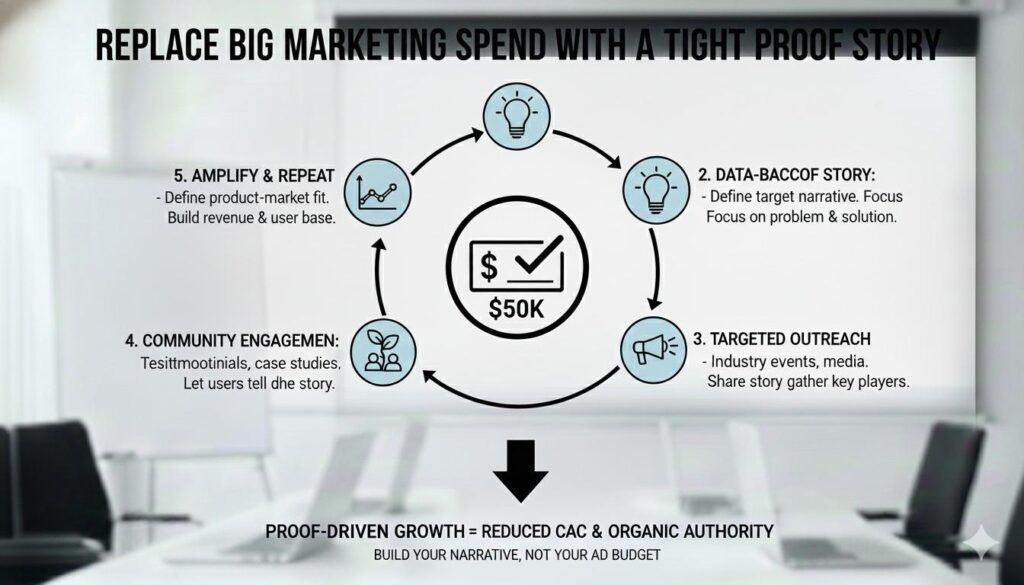
At pre-seed, marketing fails when it is about features. Buyers do not care about features. They care about pain, risk, cost, time, and outcomes.
So your story should start with the problem in plain language. Then you explain what changes when your product is used. Then you show proof. Proof can be a pilot result, a benchmark, a time saved, a failure rate reduced, or a clear before-and-after.
A strong story makes sales easier. It also makes hiring easier because talent wants to join a team that knows what it is doing.
Build a simple “proof pack” you can reuse everywhere
Instead of paying for broad awareness, you build a small set of assets that answer the buyer’s real questions. You want to reduce uncertainty fast.
A proof pack can include a short demo video, a one-page summary of the pilot goal and result, a short technical note that explains why your approach works, and a clear description of the deployment path.
When you have these assets, each customer call becomes easier. Each investor update becomes stronger. You stop rewriting your story from scratch each time.
Use direct outreach as your main channel early
Outbound is often seen as “sales work,” but at pre-seed it is also research. It is how you test messaging and find patterns.
You write a short message that speaks to a clear pain. You send it to a small, focused set of targets. You track replies. You refine. You repeat.
This approach costs almost nothing. It also creates a pipeline of relationships that can turn into pilots, partnerships, and investor intros.
Negotiate everything that touches runway
Vendors, landlords, and tools expect you to negotiate
Many founders accept the first price because they feel small. But most vendors have flexibility, especially for early teams. Discounts, startup programs, free tiers, and shorter terms are common if you ask.
Negotiation at pre-seed is not about being aggressive. It is about being clear. You explain your stage, your timeline, and what you can commit to. You ask for a structure that matches reality.
Even small reductions matter. Saving $500 a month is $6,000 a year. That can be a critical test run, a key part, or a trip to close a pilot.
Use “time” as your strongest negotiation tool
Your best leverage is not money. It is time. When you are not desperate, you can walk away. When you can walk away, you can get better terms.
This is one reason stretching runway matters so much. Runway is not just survival time. It is negotiating power.
Prefer pay-as-you-go structures at this stage
Pre-seed spending should be tied to learning. Pay-as-you-go fits learning because it lets you stop when the facts change.
Long commitments lock you into decisions made with weak information. Weak information is normal at pre-seed. That is why flexibility is so valuable.
Make fundraising easier by building leverage early
Investors fund momentum, not effort
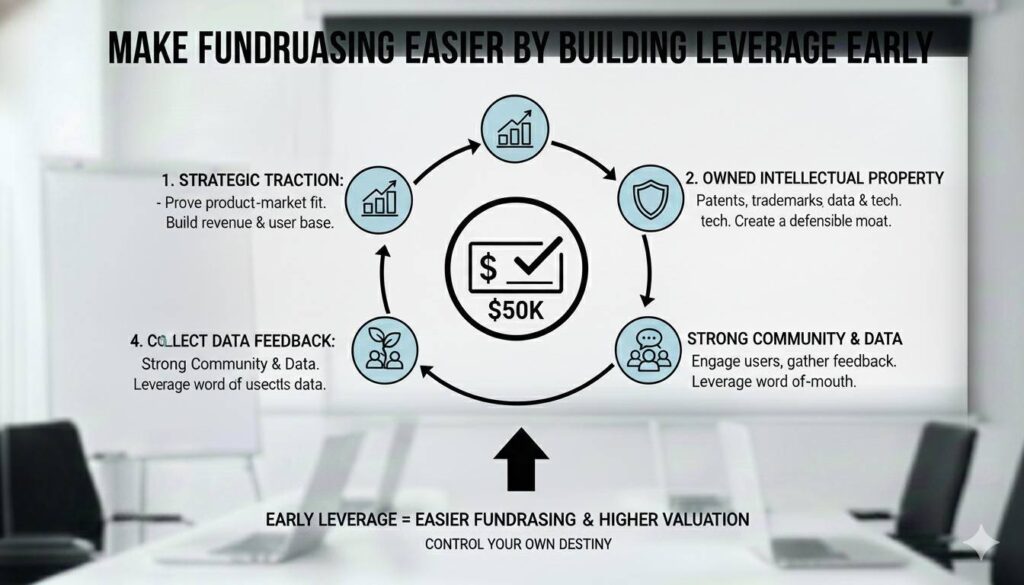
Many founders think investors fund “hard work.” They do not. Investors fund momentum. Momentum is proof plus pace.
Proof shows the product is real. Pace shows the team can execute. Together, they create belief that the next milestones will happen too.
When you stretch your round well, you can keep momentum long enough to raise on your terms. You do not have to rush into a bad valuation or give up too much control early.
Use IP as part of your leverage story
In deep tech, investors want to know what stops a bigger team from copying you. They want to see a moat that is real.
That is why IP strategy is not just a legal detail. It is a business tool. It shows you are building something defensible and that you are serious about ownership.
Tran.vc is built for this. Tran.vc supports technical founders with up to $50,000 in-kind patent and IP services, helping you protect what matters while you spend your cash on product proof and pilots. If this fits your stage, apply anytime here: https://www.tran.vc/apply-now-form/
Keep your investor updates short and proof-based
A good update is not long. It is clear. It says what you built, what changed, what you learned, and what you will prove next.
When investors see consistent proof, they lean in. When they lean in, fundraising gets easier. You spend less time chasing, and more time building.