
Small teams win in deep tech for one simple reason: they can move with focus while everyone else is still holding meetings.
In robotics, AI, and hard science products, time is expensive. Every week you spend “aligning” is a week you are not testing in the real world. Big teams often look strong from the outside. They have more people, more tools, more process. But deep tech is not a game of “more.” It is a game of “right.” Right problem. Right build. Right proof. Right protection.
When you are a small team, you feel the truth faster. You ship a rough test instead of a perfect slide. You talk to users instead of guessing. You fix the core issue instead of adding features. You learn in days what large teams learn in quarters.
There is also something most founders do not say out loud: deep tech is full of unknowns. A sensor behaves weird in heat. A robot slips on the surface you did not test. A model fails on edge cases no one warned you about. Unknowns punish big teams because they create false confidence. “We have a lot of smart people, so we must be fine.” But physics does not care. Neither does the market.
Small teams survive by staying close to the problem. The hardware bench is ten steps away. The logs are on one screen. The same person who writes the code sees the failure in the field. That tight loop is your superpower.
And there is a second reason small teams outperform: they can build a real moat earlier.
In deep tech, your edge is not only speed. It is your know-how, your unique method, your special design choices, your training pipeline, your system tricks, your control logic, your data setup, your safety routines. Most of that value lives in your head and in your code. If you do not turn it into assets, it leaks. Competitors copy. Big companies watch. A former contractor joins a rival. A partner “learns” too much.
That is why IP is not a late-stage task. It is a day-one task.
At Tran.vc, we work with small technical teams who want to build big outcomes without losing control early. We invest up to $50,000 in-kind in patent and IP services so you can protect what matters while you build. Not as paperwork. As strategy. As leverage. If you want to explore this, you can apply anytime here: https://www.tran.vc/apply-now-form/
This article will show you, in plain words, why small teams often beat large teams in deep tech, and how to use that advantage in a very practical way. We will talk about how small teams make better choices, run tighter tests, avoid waste, and turn technical work into defensible value that investors can respect.
Why Small Teams Outperform in Deep Tech
Deep tech is not normal software
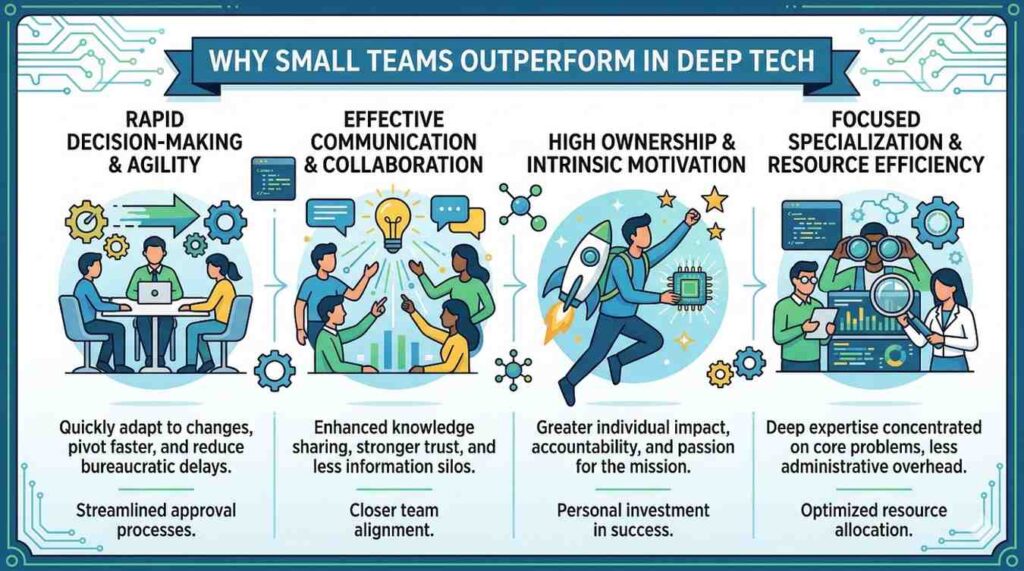
Deep tech is built on things that can break in the real world. A robot arm hits a limit. A camera fails in glare. A model works in the lab, then fails in a noisy factory. These are not small issues you can patch with a quick update. They are core issues that demand tight learning loops and sharp choices.
That is why deep tech teams cannot afford wasted motion. Every test run costs time, parts, and attention. Every redesign has a price. When the work has real friction, the team that learns fastest tends to win, even if it is small.
Bigger teams often move slower, not faster
A larger team usually brings more meetings, more handoffs, and more waiting. People need context. People need approvals. People need a shared plan before they act. Even with smart people, the pace can drop because the work is split into many small pieces that must reconnect later.
In deep tech, reconnecting later is dangerous. Small design choices stack up. A tiny change in firmware can affect control. A slight change in geometry can affect sensor readings. When many people touch one system, small mismatches can multiply.
Small teams have a tighter feedback loop
Small teams live closer to the work. The person writing the code often sees the robot fail. The person tuning the model sees the edge cases in the data. The person building the mechanical setup hears the vibration and knows something is off. This creates a fast loop between what you think and what is true.
That loop is your advantage. It keeps you honest. It helps you cut weak ideas early. It pushes you toward simple solutions that survive outside the lab.
Speed in deep tech is really “speed to truth”
Many teams confuse speed with “doing more.” In deep tech, speed is finding the truth faster than others. You do not need to build five features. You need to prove one key thing that removes doubt. That proof could be stable grasping, better battery life, safer motion, or higher accuracy under real conditions.
Small teams can aim at one truth at a time. They can avoid “nice to have” work that looks good but does not reduce risk. That ability to pick the right target, and hit it, is why small teams often outpace larger ones.
Small teams make clearer choices under pressure
Deep tech forces trade-offs. You cannot optimize everything at once. If you push for accuracy, you might lose speed. If you reduce weight, you might lose stiffness. If you improve safety margins, you might raise cost. Someone must choose, and the team must align fast.
In small teams, choices are more direct. The founders are closer to the problem. The decision maker is often the builder. This reduces the time between a new fact and a new plan, which is exactly what you want in a messy technical journey.
Small teams can protect the moat earlier
There is a second reason small teams win that is easy to miss. They can protect what they are learning while it is still fresh. Deep tech value often lives in methods, system design, training flows, data tricks, and edge-case handling. If you wait too long, you forget details or you ship without protection.
At Tran.vc, we see this pattern often. Teams build something real, then realize too late they never captured the invention as an asset. That is why we invest up to $50,000 in-kind in patent and IP services for robotics, AI, and other tech startups. The goal is to help you lock in the edge while you are building it.
If you are working on a defensible technical advantage and want to turn it into real leverage, you can apply anytime here: https://www.tran.vc/apply-now-form/
The Hidden Cost of Coordination
Coordination looks harmless until it eats your weeks

In the early days, almost every delay is a coordination delay. The work itself may be hard, but the calendar pain often comes from waiting. Waiting for a decision. Waiting for parts. Waiting for a review. Waiting for a teammate who is overloaded. Waiting for a meeting slot to open.
Small teams reduce waiting by design. They often share the same mental map. They can make a call in ten minutes and move. This matters because deep tech does not reward perfect plans. It rewards fast learning and clean proof.
Handoffs create blind spots in complex systems
When one person owns software and another owns hardware, it can work well. But it also creates gaps. The software person may not notice a mechanical tolerance issue. The hardware person may not realize a timing change in the code creates a control problem. These gaps are not about talent. They are about distance.
Small teams can collapse these gaps by working in “systems thinking” mode. The same few people can own the full loop from sensing to control to actuation to safety. Even if roles exist, the understanding is shared more deeply.
Meetings are not the enemy, but excess meetings are
In deep tech, some meetings save time because they prevent bad work. The issue is when meetings become the work. Large teams drift toward this because it feels safe. It feels organized. It gives a sense of progress, even when the product is not improving.
Small teams usually cannot afford that comfort. They feel the pain faster, so they protect build time. They prefer a quick test and a short debrief. That rhythm keeps energy high and facts fresh.
Clear ownership is easier when the team is small
Ownership is not a title. It is the power to decide and the duty to deliver. In large groups, ownership can blur because many people touch the same part of the system. Then problems become “everyone’s problem,” which often means nobody fixes them fast.
Small teams tend to have sharper ownership. When something breaks, everyone knows who will address it today. That clarity reduces stress and removes the slow drift that kills early momentum.
Why Small Teams Learn Faster
Deep tech punishes assumptions

Assumptions are cheap and tests are costly, so teams naturally build stories in their head. The danger is that stories become plans, and plans become months of work, and then reality says no. In deep tech, the “no” can come from physics, safety, cost, or user behavior.
Small teams do better because they can challenge assumptions early. They do not need broad agreement to run a small test. They can act, observe, and adjust without a long approval chain.
A small team can run tighter experiments
A tight experiment is one that answers one question clearly. Not ten questions. Not a vague “let’s see what happens.” One crisp question with a setup that produces a clear result. This is how deep tech risk falls fast.
Small teams are good at tight experiments because they are closer to the system. They know what to measure. They notice small changes. They can rerun the test the same day and compare results while the details are still in memory.
Fast learning comes from short cycles, not long sprints
Many teams run “sprints” like software teams do. That can help with structure, but deep tech often needs daily cycles, not two-week cycles. You test, you learn, you change one variable, you test again. You do this until the truth is stable.
Small teams can work this way because they are less dependent on schedules and ceremonies. They can keep a simple rhythm: build, test, review, adjust. When this rhythm becomes normal, progress feels steady instead of random.
Small teams can keep the product simple on purpose
In deep tech, complexity grows fast. You add sensors, add logic, add modes, add exceptions. Each addition can help one case but hurt overall reliability. Small teams tend to value simplicity because they feel the cost of complexity directly.
This is not about being minimal for style. It is about choosing designs that will survive scale. When you build fewer moving parts, you can make each part stronger. That is a key reason small teams often produce more robust systems early.
Turning Small-Team Speed Into a Real Moat
Speed alone is not enough if others can copy
A small team can move fast and still lose if a larger competitor copies the core method. Deep tech edges often look invisible at first, then suddenly they look obvious once you demonstrate results. When your demo is strong, it also becomes a signal for others to follow.
That is why protection matters. Not as a legal afterthought, but as a build decision. The question is simple: what part of what we are doing is truly new, and how do we capture it while we still remember every detail?
Patents can fit small teams when done the right way
Some founders avoid patents because they think it will slow them down. That can be true if the work is handled poorly. But when patent work is aligned with product work, it can actually sharpen focus. It forces you to describe the invention clearly, and it helps you separate the unique idea from the supporting parts.
At Tran.vc, the support is structured to match early-stage reality. You are building, testing, and iterating. Our job is to help you spot what is protectable, shape it into a strong strategy, and file in a way that fits your timeline.
If you are building in robotics, AI, or other deep tech, and you want to turn your technical edge into assets investors respect, you can apply anytime here: https://www.tran.vc/apply-now-form/
A small team can document invention as part of normal work
The best time to capture an invention is when you are solving the hard problem. Not six months later when memories fade. Small teams can build simple habits that make this easy. When you change a design because you found a new failure mode, that can be invention. When you create a training pipeline that fixes a core issue, that can be invention.
When you treat invention capture like normal engineering, not like a “legal event,” you stop losing valuable ideas. This is how small teams can build strong protection without slowing the build.
Investors notice when your learning becomes an asset
Many seed investors have seen deep tech teams with impressive demos but weak protection. They worry that a bigger player can replicate the core. When you can explain not only what works, but also what is novel and protected, the story changes.
You are no longer selling hope. You are showing a plan that turns R&D into leverage. That is one of the cleanest ways small teams can compete with large teams, even when they have less cash.
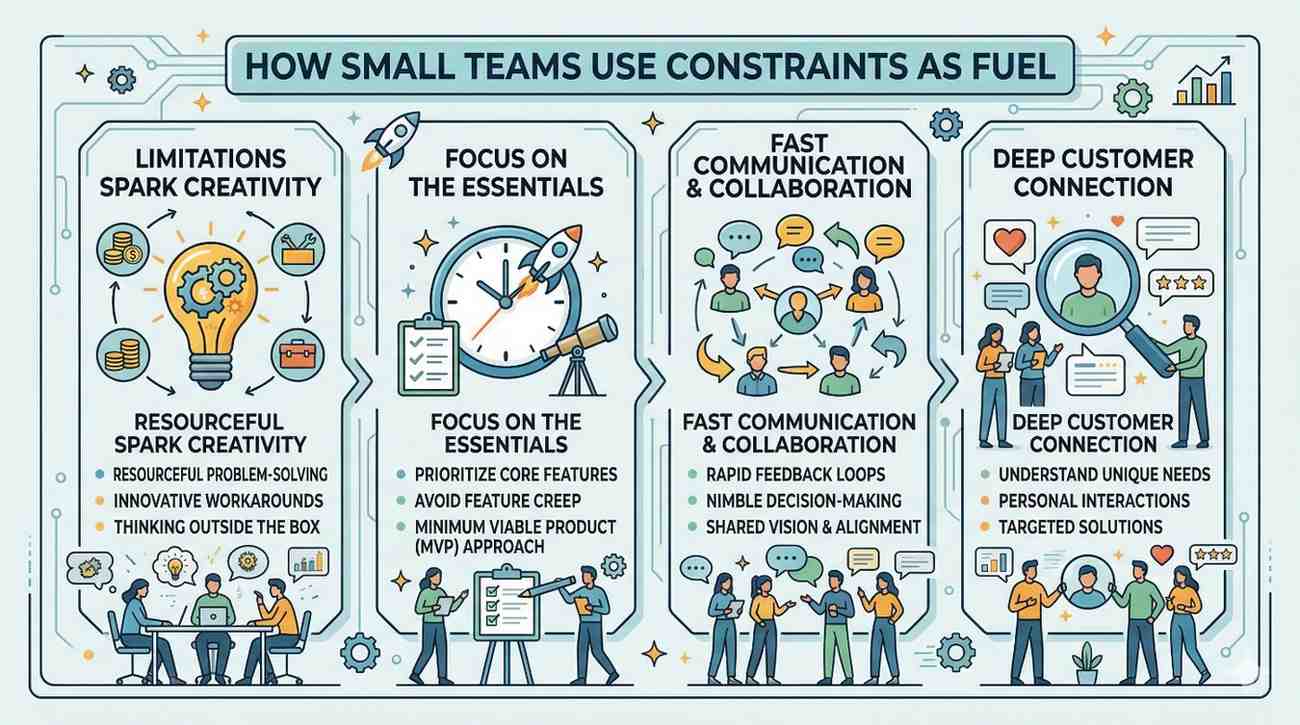
How Small Teams Use Constraints as Fuel
Constraints force you to build what matters
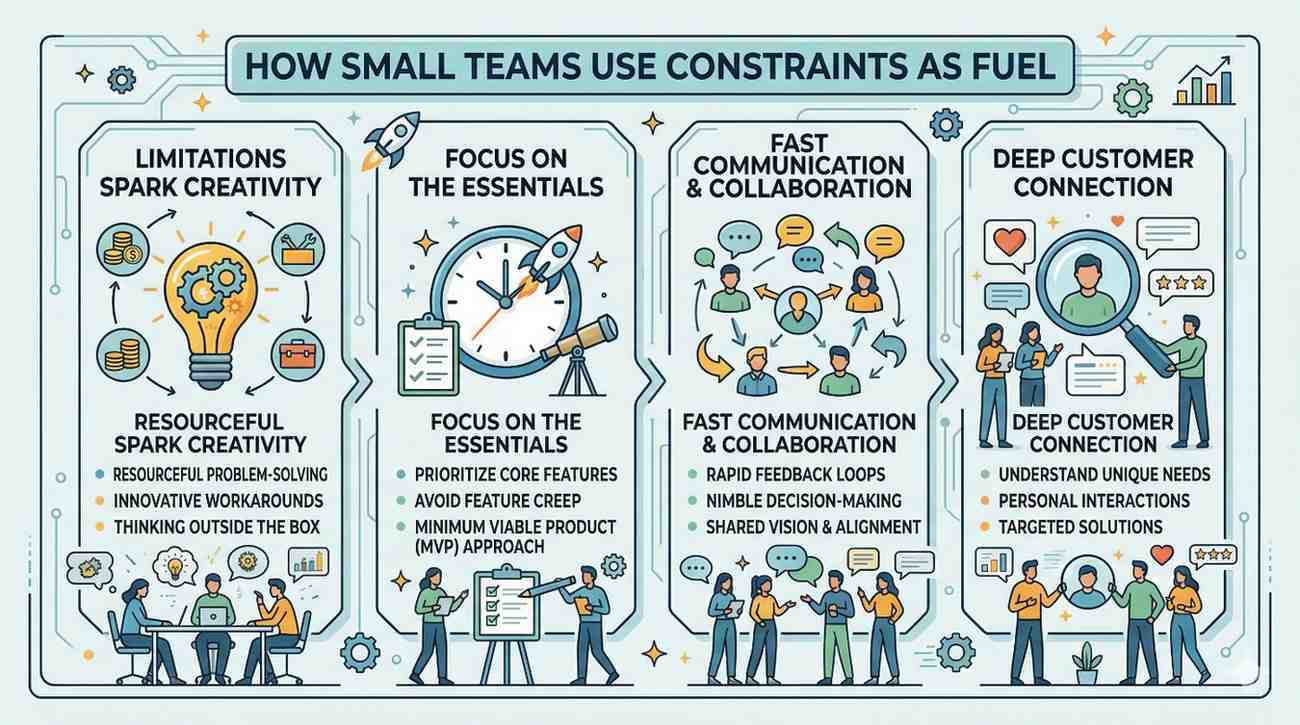
A small team rarely has spare time, spare cash, or spare people. At first, this feels like a weakness. But in deep tech, it often becomes an advantage because it forces discipline. You cannot hide behind busy work when there are only a few builders in the room.
When you have limited bandwidth, you start asking better questions. What must be true for this company to work? What proof would remove the most doubt? What failure would kill us if we do not address it now? These questions guide you toward the work that actually moves the company forward.
Limited resources reduce feature drift
Large teams can keep adding features because there are always more hands. That can be useful once the core system is stable. Early on, it can be a trap. Deep tech products often need reliability more than they need breadth.
Small teams tend to focus on the one or two functions that define value. A robotics company might focus on one task that must work in the real world, every day. An AI company might focus on one workflow where accuracy and trust matter more than fancy demos. This focus keeps your product story clean and your technical risk under control.
A small team can stay closer to the user
Deep tech founders sometimes assume the tech is the product. It is not. The product is the outcome for the user, delivered in a way that fits their world. The world has noise, messy habits, and constraints you did not predict.
Small teams are more likely to spend time with users because they are still searching for truth. They are not separated by layers of roles. They can watch, ask, and adjust fast. This direct view helps you build something that does not just work, but also fits.
Tight teams often make stronger trade-offs
Every deep tech system is a set of trade-offs. The trick is choosing trade-offs that match your target use case. If your robot must work in tight spaces, you may accept slower motion. If your model must be trusted in a regulated setting, you may accept a higher cost to reduce error.
Small teams can choose trade-offs faster because fewer people need to agree. More importantly, the people deciding are often the ones who will live with the decision in the build. That creates practical choices instead of theoretical ones.
The Small-Team Operating System
One shared map beats ten separate opinions
Small teams often outperform because they share context. Everyone knows the main goal for the month. Everyone knows the current failure mode that matters most. Everyone knows what “good” looks like in the next test.
This shared map reduces the need for long explanations. It also reduces accidental conflict, where two people work hard in different directions. When you keep the map simple and visible, you create alignment without heavy process.
Deep tech needs daily clarity, not weekly planning
In many startups, planning happens once a week. In deep tech, a new test result can change everything. You may learn that your sensor choice is wrong. You may learn that a data assumption is false. You may learn that a customer constraint is tighter than expected.
Small teams can adjust daily without feeling unstable. They can treat new facts as progress, not as disruption. A simple daily check-in about what was learned and what changes next is often enough to keep speed high.
Strong engineering notes are a hidden advantage
Small teams can move fast, but speed without memory turns into chaos. In deep tech, it is easy to repeat the same mistakes if you do not capture what you learned. A short habit of writing clear notes after tests can prevent months of confusion later.
The goal is not long documents. The goal is a clean record of what was tried, what happened, and what you believe now. When you keep notes simple and consistent, new hires ramp faster and old decisions stay understandable.
Design reviews should be small and sharp
Big design reviews often become performance. People prepare slides. People defend their work. People argue over details that do not change the outcome. In a small team, design reviews can be quick, direct, and useful.
A strong review focuses on risks, not opinions. What can fail in the field? What assumptions are untested? What is the cheapest experiment that will answer the big question? When reviews stay focused on risk, they accelerate progress instead of slowing it.
Building Trust With Real Proof
Deep tech buyers do not buy promises
Most deep tech customers have been burned before. They have seen demos that do not survive real use. They have heard claims that fall apart after two weeks. They may like innovation, but they cannot risk their operation on hope.
Small teams can win trust by doing fewer things, but proving them deeply. One stable workflow in a real environment often beats ten features in a controlled demo. Your goal is not to impress. Your goal is to remove doubt.
Reliability is a product feature
In robotics and applied AI, reliability is not just “nice.” It is the feature that makes adoption possible. If your system fails in ways that are hard to predict, the customer must babysit it. Then the product becomes a burden.
Small teams can take reliability seriously early because they feel every failure. They are close to the system, so they can see patterns. They can fix root causes instead of patching symptoms. Over time, this builds a product that earns trust through behavior, not marketing.
Field tests reveal the real moat
Your moat often shows up in messy situations. The competitor can match your lab demo. They struggle when the lighting changes, when the surface is wet, when the user behaves differently, or when the task has variation.
Small teams can build their moat by choosing field tests that stress the system. Not reckless tests, but honest tests. When you learn to survive variation, you create know-how that is hard to copy because it comes from repeated contact with reality.
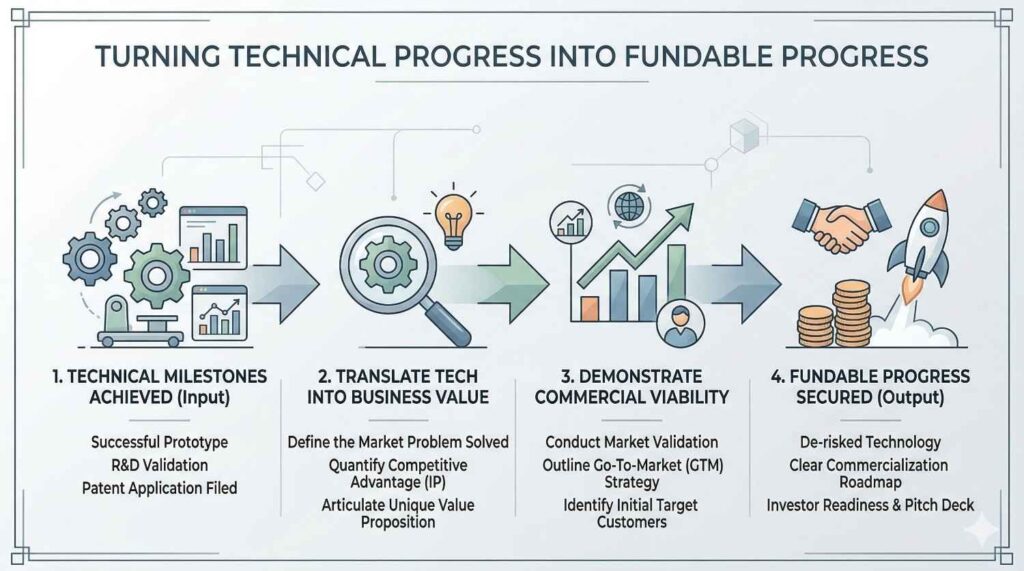
Turning Technical Progress Into Fundable Progress
Investors fund reduced risk, not effort

In the early stages, investors are not funding hard work. They are funding a path to a business with reduced risk. When you can show that key risks are shrinking, the conversation becomes easier.
Small teams are in a strong position because they can reduce risk in clean steps. They can pick one risk, run focused tests, and show proof. This creates a simple narrative: we found the hardest issue, we solved it, and now we are moving to the next.
The story must connect tech to value
Deep tech founders often talk about architecture, models, sensors, and specs. That matters, but the fundable story connects the tech to a clear outcome. How does this save time, save money, raise safety, or improve quality for the customer?
Small teams can keep this connection clear because they do not have extra layers. The builders can talk directly to the problem. When you can explain your system in plain words, investors assume customers can understand it too.
IP turns progress into leverage
This is where many small teams can gain an edge over bigger teams. When you capture your inventions as IP, you turn learning into an asset. You also create a stronger funding position because you can show defensibility, not just momentum.
Tran.vc supports this early. We invest up to $50,000 in-kind in patenting and IP services for robotics, AI, and other tech startups. The goal is to help you protect what is unique while you are still building, before the world copies it.
If you want to build with protection from day one, you can apply anytime here: https://www.tran.vc/apply-now-form/