
R&D is where real value gets made. It is also where startups run out of oxygen. The common story goes like this: you build something hard, it takes time, and you need money before the market can pay you back. So you try to raise a big VC round. You pitch. You wait. You change the deck. You pitch again. Months pass. Your team slows down. Your roadmap turns into a wish list.
There is another way.
You can fund R&D without betting your whole company on one large round. You can stack smaller, smarter sources of support. You can turn R&D from a cash sink into a plan that pays for itself in steps. And you can protect your best work while you do it, so you build leverage instead of stress.
That is what this guide is about.
If at any point you want hands-on help turning your inventions into real IP that investors respect, you can apply to Tran.vc here: https://www.tran.vc/apply-now-form/
The real problem is not “money.” It is “timing.”
Why R&D cash needs a different plan
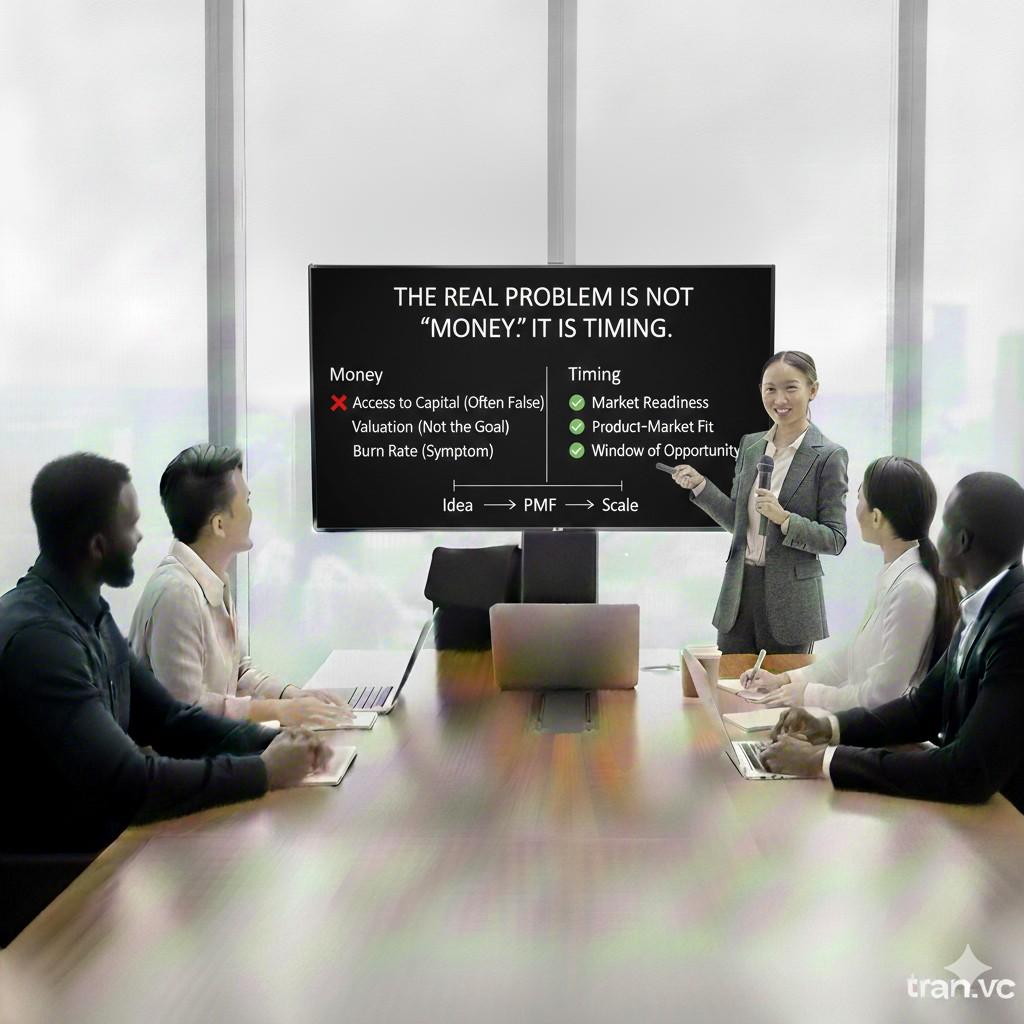
R&D does not move in straight lines. You try something, it fails, you learn, and you try again. That loop is normal in robotics, AI, and deep tech. The problem is that most funding expects smooth progress, quick shipping, and fast revenue. When your work takes longer, the money and the work fall out of sync.
That gap creates pressure. Teams start cutting corners. Founders start overpromising. Roadmaps become marketing, not truth. This is how great technical teams end up tired, broke, and stuck.
The goal is steady progress, not the biggest check
The best R&D plan is built to keep the team moving every week. It should help you hit proof points that reduce risk, one by one. And it should grow your leverage over time, so future funding becomes easier and cheaper. You want to raise because you choose to, not because you are forced to.
This is also where IP matters more than most founders think. A strong patent strategy can turn your work into an asset that is easy to explain and hard to copy. That makes partners more serious and investors more confident. Tran.vc helps founders do this early by investing up to $50,000 in in-kind IP and patent services. You can apply anytime at: https://www.tran.vc/apply-now-form/
Start by funding “proof,” not “the dream”
Proof points are how you buy time
Many founders try to fund the whole vision at once. That feels bold, but it drains cash fast and increases risk. A better approach is to fund the next proof point, then the next, then the next. Each proof point should remove one big doubt in the mind of a customer, partner, or investor.
In robotics, a proof point might be repeatable performance in a real setting, not a lab demo. In AI, it might be a strong result on real data with clear comparison to a baseline. In hardware, it might be a stable prototype that meets one hard spec more than once.
Build an “R&D funding map” you can actually follow
You only need three proof points to start. Write down what each one costs in people, time, and cash. Then write down what each one unlocks, like a pilot, a partner meeting, a grant milestone, or a seed check. This is your funding map.
When you have this map, you stop guessing. You can match the right funding source to the next proof point. You can also explain your plan in a way that feels calm and real, even if you are still early.
Use IP to lock in the value you create
As you hit each proof point, you should capture what is unique. That could be a method, a system design, a control approach, a training workflow, or a novel way you deploy in the real world. When you protect those parts, you turn progress into leverage.
This is exactly where Tran.vc fits. They help technical founders turn early R&D into IP-rich foundations, so you can raise with more power later. If you are building in AI, robotics, or deep tech, apply here: https://www.tran.vc/apply-now-form/
The best R&D funding is the kind that does not force you to lie
“Story pressure” is a hidden tax

When money expects quick revenue, founders often feel forced to stretch the truth. They say the product is almost ready when it is not. They say the customer is committed when it is only a friendly conversation. They say the tech is done when it still needs months of work.
That pressure can turn into bad decisions. You hire too fast. You promise features too early. You take deals that steal your roadmap. You burn trust with your team and your buyers because the timeline was never real.
R&D-friendly funding lets you speak plainly
The best funding fit allows you to say, “We are building, here is the proof point, here is the timeline, and here is what success looks like.” That is a strong position. It creates trust. It also makes the work easier because your team can focus on building, not pretending.
If you want to fund R&D without big VC rounds, you want sources that accept uncertainty, reward learning, and still push you toward proof.
1) Customer money, without selling the full product
Sell a narrow outcome, not a full platform
You do not need a complete product to get paid. You need a clear result that matters to the customer. Most buyers do not wake up wanting “a robot” or “an AI model.” They want fewer defects, faster throughput, safer work, less waste, fewer missed alerts, or better planning.
So you sell a small slice of value first. That could be a paid feasibility study, a paid pilot, or a paid design partnership. Each one funds R&D while also creating real proof for your next step.
Paid feasibility studies that lead somewhere real
A feasibility study works when it answers one hard question fast. You agree on the test, the data needed, the timeline, and the deliverables. The customer pays because they get a clear answer and a plan, not vague hope.
For example, you might run your system on their environment for a set period and deliver results, failure modes, and a pilot design. If it works, you have earned the right to move forward. If it does not, you still learned something valuable without burning your whole runway.
Paid pilots that do not trap your team
Paid pilots are powerful, but only when the scope stays tight. A pilot should prove one core part of the value in a real setting. It should not become a custom build that takes over your roadmap.
To avoid that trap, make sure your pilot produces reusable assets. You want code, tooling, test rigs, safety work, and deployment steps that become part of the product. If every pilot is totally different, you are building a services company by accident.
Protect your IP before the contract does damage
Customer contracts can quietly take your future. Many include terms that claim ownership of what you build, improvements, or even your methods. Some ask for exclusivity that blocks you from selling elsewhere. This can scare away investors later because it reduces your upside.
You can be fair and still protect yourself. Customers can get usage rights, limited licenses, or early pricing benefits. But your core platform, methods, and improvements should usually stay yours.
This is where early IP strategy helps you negotiate with confidence. Tran.vc supports founders by investing up to $50,000 in in-kind patenting and IP services, so your work stays defensible as you start winning customers. Apply here: https://www.tran.vc/apply-now-form/
2) Non-dilutive grants that match deep tech timelines
Why grants work well for real R&D
Grants are often slower than a customer sale, but they can be a strong fit for hard science and engineering. The biggest advantage is simple: many grants expect learning and experiments. They do not require you to show fast revenue before the work is ready.
If your roadmap includes testing, validation, or building a new technical capability, grants can pay for parts of that journey. They also build credibility. A grant win signals that an expert group reviewed your idea and believed it was worth funding.
Pick grants that reward measurable progress
Many founders waste months chasing the wrong grants. They apply to programs that sound exciting but do not match the stage of the company. A good grant is one where your next proof point fits the grant’s milestones.
If your next proof point is a working prototype in a real setting, look for grants that fund prototyping and field testing. If your next proof point is a new method, dataset, or validation study, look for programs that fund research and testing.
The goal is not to collect grants like trophies. The goal is to use a grant to remove one big risk, then use that proof to unlock the next form of funding.
Make the application easier by reusing what you already have
A strong grant application is not magic writing. It is clear thinking written in plain words. You describe the problem, the approach, the plan, and what success looks like. If you already built an R&D funding map, you can reuse most of it.
You can also reuse the same core story across many programs. The details change, but the spine stays the same. When you treat grant writing as a reusable asset, it stops feeling like a random side job.
Use grant work to strengthen your IP position
When you do grant-funded R&D, you may create key inventions. If you do not capture them, you lose a major chance to build a moat. Even worse, you may publish too early and harm your patent options in some places.
This is why IP planning should sit next to grant planning, not after it. Tran.vc helps founders shape what to file, when to file, and how to explain the work in a way that supports both patents and fundraising later. Apply anytime here: https://www.tran.vc/apply-now-form/
3) Strategic partners who pay for access, not ownership
Partnerships can fund build-out without a big round

In deep tech, large companies often want early access to new capability. They may not want to buy a startup yet. They may not even want a full product. But they do want a window into what is coming, and a way to shape it.
This creates a chance for you to fund R&D through a structured partnership. The partner pays for pilots, integration work, test time, or co-development. In return, they get early access and a clear path to deployment if results are strong.
The best partners bring more than money
Money matters, but it is not the only value. A good partner can bring data, test sites, expert feedback, and distribution paths you cannot build alone. Those can shorten the time between prototype and real use.
A weak partner brings long meetings and slow decisions. They say “this is important” but never commit to action. You want partners that can move with a startup pace, or at least can support a clear pilot without dragging it out.
Guardrails that keep you from getting boxed in
Partnership deals can become dangerous when they restrict your future. Common traps include broad exclusivity, rights to your improvements, and terms that let the partner delay while you stay stuck.
A healthier structure is one where the partner gets a limited license for a specific field or use case, tied to performance and time. If they want broader rights, they pay more, and they commit to timelines that protect you.
This is one place where having real patents and a clear IP plan changes the power dynamic. When your core work is protected, you can offer access without giving away the engine. Tran.vc is built around helping early founders do that work before the big negotiations start. Apply here: https://www.tran.vc/apply-now-form/
4) “Service-to-product” revenue that does not derail the roadmap
Use services as a bridge, not a destination
Many deep tech startups can generate cash by doing high-value services around their core technology. This might be integration work, custom modeling, prototype builds, or testing support. Used the right way, services can pay the bills while the product matures.
Used the wrong way, services can swallow the company. You end up with ten custom projects and no product. The difference is not luck. It is structure.
Define a service offer that produces product assets
A service offer should create reusable value. You want each engagement to generate code, tools, data, test methods, safety steps, and deployment workflows you can reuse.
When you design your service work like this, you are not “doing random work for money.” You are buying product progress with customer checks. This keeps the team motivated because every project moves the core forward.
Price for focus, not for being “nice”
Founders often underprice early services. They do it to win the deal. The result is predictable: the customer demands a lot, the team gets stretched, and the work becomes unprofitable.
A better approach is to price in a way that protects focus. High prices can be a filter. They also signal seriousness. If the customer cannot pay enough to make the work worthwhile, they are not the right early partner.
Build IP while you earn
Service work can create inventions. If you treat it as “just client work,” you may miss those inventions. If you treat it as “R&D in the wild,” you can capture key methods and file protection around what you learn.
This is part of “seed-strapping.” You grow using real work and smart automation, while you build a moat that makes future funding easier. If you want help building that moat early, Tran.vc is designed for that. Apply here: https://www.tran.vc/apply-now-form/
5) Milestone pricing and staged deals that pay as proof grows
Why staged deals fit R&D better than big promises

R&D is uncertain. Buyers know this. When you ask a customer to commit to a big annual contract before the proof exists, they often hesitate. But many will agree to a staged deal that pays as results appear.
This keeps risk low for them and keeps funding steady for you. It also forces clarity. Everyone agrees on what “good” looks like at each stage.
A simple structure that works in practice
A common structure is: paid evaluation, then paid pilot, then paid rollout. Each stage has a clear scope, a clear metric, and a clear decision point.
The most important part is the decision point. If the metric is hit, the next stage is unlocked. If it is not hit, you either revise the plan or stop. That prevents endless “maybe” projects that drain time.
Keep the metrics tied to business value
Technical metrics matter, but business metrics are what buyers fund. Instead of only tracking model accuracy or cycle time in a vacuum, tie your targets to outcomes like reduced waste, improved uptime, faster processing, lower manual work, or fewer errors.
When you do this, you make internal champions stronger. They can explain the value in terms their leaders understand. That makes it easier for them to keep paying as the project grows.
6) Lean hardware plans that cut burn without cutting ambition
Build what proves the point, not what looks impressive

In robotics and hardware-heavy systems, it is easy to overspend early. You buy expensive parts, build custom rigs, and chase a polished look before you have proof.
A lean plan does not mean low quality. It means you focus spending on what reduces risk fastest. You invest in the parts that validate performance and reliability. You delay the parts that only improve polish.
Use off-the-shelf components where they do not hurt defensibility
Your moat usually does not come from basic components anyone can buy. It comes from how you combine them, control them, and make them work in the real world.
So you can often use off-the-shelf hardware early, while you invest your time into the core system design and control logic. Later, once the proof is strong, you can decide where custom hardware truly matters.
Treat test setups as reusable infrastructure
A test setup should not be a one-time cost. It should become a tool you use again and again. Build it so it is easy to repeat tests, log results, and compare changes across versions.
This is not just good engineering. It is also fundraising support. When you can show repeatable test results, you reduce perceived risk and increase your leverage.
7) Founder-led financing that keeps control where it belongs
Why early founders often overestimate VC necessity
Many technical founders believe a large VC round is the only serious path forward. This belief usually comes from what they see in headlines, not from what actually works at the start. Big rounds are designed to scale proven systems, not to explore uncertain R&D.
When you raise too early, you lock yourself into expectations that do not match reality. You also give up control before you know what your company really is. Founder-led financing flips this order. You build first, then raise from strength.
Using small checks to extend real runway
Small checks from angels, operators, or early believers can be powerful when paired with a clear R&D plan. These checks often come with fewer strings and more patience. They can fund a specific proof point without forcing a full company story.
The key is to be clear about use of funds. You are not selling hype. You are inviting them to support a defined technical milestone that reduces risk and increases value.
Treat early investors as partners, not just money
The best early backers bring more than cash. They bring pattern recognition, customer access, and calm perspective. They understand that deep tech takes time and that learning is part of the process.
When you communicate openly and show steady progress, these investors often become repeat supporters. They help bridge gaps, introduce partners, and support you until the business is ready for larger capital.
8) IP as a funding tool, not a legal afterthought
Why IP changes how investors see R&D
In R&D-heavy companies, most of the value sits inside the work, not the revenue. Investors know this, but they need a way to understand and trust it. Strong IP gives them that handle.
When your inventions are clearly defined and protected, investors can see what is unique and why it matters. This reduces fear and increases confidence, even if revenue is still early.
File early to protect learning, not just success
Many founders wait to file patents until everything is “done.” By then, key ideas may already be exposed or hard to protect. Early filing lets you capture the core methods and systems while they are still forming.
This does not mean filing blindly. It means being intentional. You protect what is fundamental and flexible, not every small tweak. This keeps costs under control while still building a strong moat.
Use IP to support partnerships and deals
IP is not just for investors. It also helps in customer and partner talks. When you can say, “This part is protected, and here is how we license it,” negotiations become clearer and more balanced.
Tran.vc was built around this idea. They invest up to $50,000 in in-kind patenting and IP services so founders can build leverage early, before big rounds and big negotiations. If you want to explore this path, apply here: https://www.tran.vc/apply-now-form/
9) Connecting R&D funding to future seed investors
Seed investors want reduced risk, not finished products
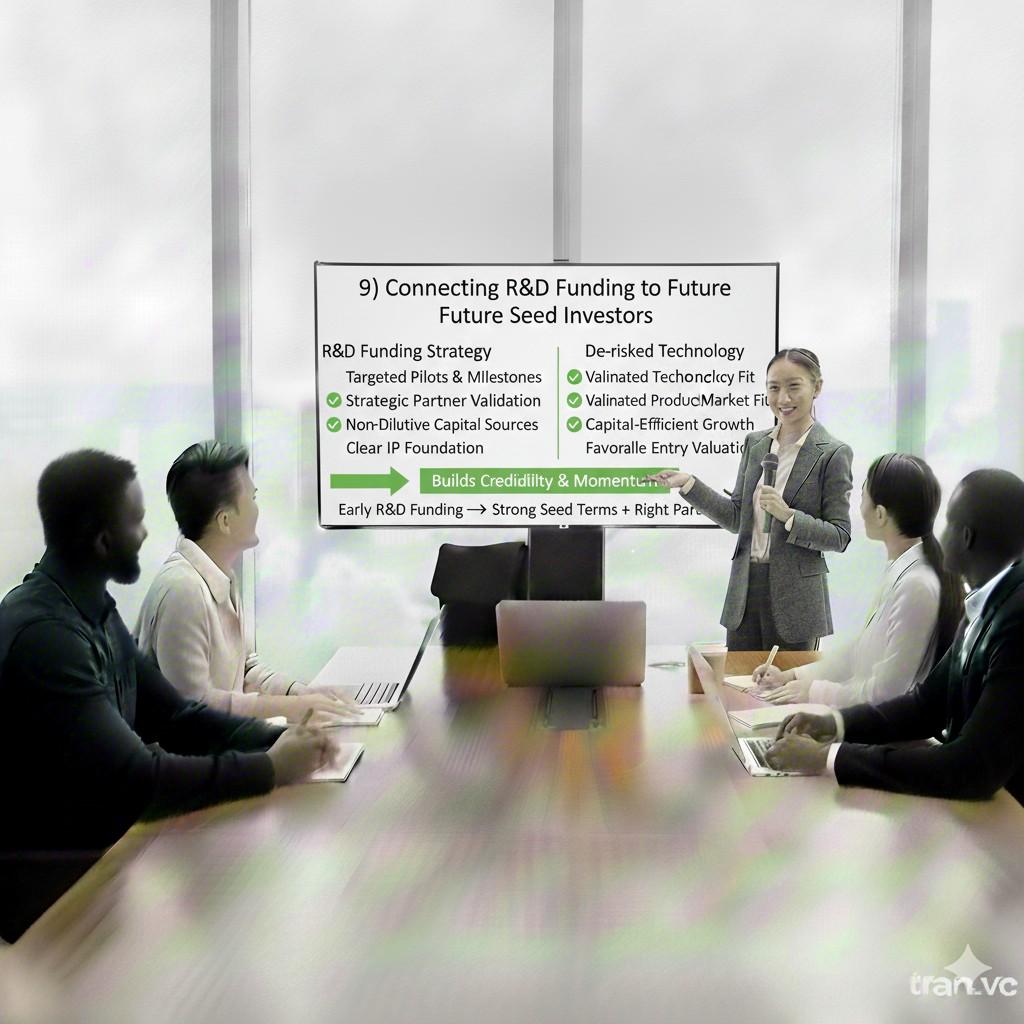
Good seed investors know that deep tech is still evolving at the seed stage. What they look for is reduced risk. They want to see that key unknowns have been tested and that the team can learn and adapt.
When you fund R&D through proof points, you create exactly what they want to see. Each funded milestone becomes a slide they can trust, because it is based on real work, not projections.
Tell a calm, honest story that shows momentum
When you finally talk to seed investors, your story should feel steady, not rushed. You explain the problem, the approach, the proof points you have hit, and the next ones ahead.
You also explain how you funded the work so far. This matters more than many founders realize. It shows discipline, creativity, and respect for capital. It tells investors you know how to survive and grow.
Raise with leverage, not urgency
When you have customers, partners, grants, and protected IP, you are not raising out of fear. You are raising to go faster. That shift changes the conversation completely.
Investors respond differently when they know you have options. Terms improve. Trust grows. And you keep more control over the company you are building.
10) A practical 90-day plan to fund your next R&D phase
Start with one clear technical goal
Pick the next proof point that matters most. Write it in plain words. Make sure everyone on the team agrees what success looks like and why it matters.
This focus will guide every funding decision. If a funding source does not help you reach this proof point, it is a distraction.
Match funding sources to the proof point
If the proof point is customer-facing, look for paid studies or pilots. If it is research-heavy, look for grants. If it is system integration, look for partners. If it is early validation, consider small founder-led checks.
You do not need all sources at once. You need the right one for the moment.
Protect what you build as you go
As work progresses, note what is new and valuable. Talk to an IP expert early, not after the fact. This ensures your learning turns into long-term advantage.
Tran.vc helps founders do exactly this, without forcing them into early VC rounds. They work side by side with technical teams to build IP-backed companies from day one. You can apply anytime at: https://www.tran.vc/apply-now-form/
Final thoughts: build with intention, fund with clarity

Funding R&D without big VC rounds is not about avoiding growth. It is about earning it. When you fund proof instead of promises, you build trust with customers, partners, and investors.
You also build something stronger: a company that knows why it exists, what makes it different, and how to move forward without panic.
If you are a technical founder building in AI, robotics, or deep tech, and you want help turning your R&D into protected, fundable assets, Tran.vc is designed for you. Apply here to start the conversation: https://www.tran.vc/apply-now-form/