
Most startups do not fail because the idea is bad. They fail because money runs out before the idea has a fair shot. If you are building AI, robotics, or other hard tech, that risk is even higher. Your work takes time. Your work costs more. And the world expects you to move fast anyway.
This is where “seed-strapped” startups win.
Seed-strapped does not mean “cheap.” It means “sharp.” You treat every dollar like a tool, not a trophy. You spend with purpose. You build leverage early. You protect what matters. You do not raise just to feel safe. You raise when the business is ready to turn funding into speed.
At Tran.vc, we see this pattern again and again. The teams that win are not always the teams with the biggest seed round. The teams that win are the ones that can stretch dollars without stretching themselves thin. The ones who build real assets early—especially IP—so investors take them seriously and competitors think twice.
In this article series, I’ll show you how seed-strapped startups win in the real world. Not with hype. With clear moves you can make this week.
And if you want help doing this with serious patent and IP support behind you, you can apply anytime here: https://www.tran.vc/apply-now-form/
The “one-week loop” that keeps you sane
Why weekly loops beat long roadmaps

A long roadmap can feel safe, but it often hides the truth. It lets you delay hard decisions because everything is “planned.” A weekly loop does the opposite. It forces you to choose what matters right now, ship something real, and learn from it fast.
When money is tight, speed is not about rushing. Speed is about reducing guesswork. A weekly loop creates a steady pace where you keep moving forward without burning out your team or your budget.
What a healthy weekly loop looks like
A strong weekly loop has one clear goal: lower one major risk. Not ten risks. One. That risk might be “Will a customer pay for this?” or “Can the model hit the needed accuracy?” or “Can the robot complete the task without failure?”
You pick one target, build the smallest test that can answer it, run the test, and write down what you learned. Then you decide the next move based on facts, not hope. This is how seed-strapped teams stay honest and efficient.
How to pick the right weekly goal
The best weekly goal is the one that unlocks the next door. If you are unsure what to build, talk to customers. If customers want it but doubt you can deliver, build a proof point. If the proof point works but adoption is hard, simplify the workflow.
Your weekly goal should feel slightly uncomfortable. That is a good sign. It means you are not just polishing; you are learning.
How to stop “busy work” from eating the week
Busy work hides in meetings, internal debates, and extra features. The fix is simple: start the week by deciding what you will not do. Put it in writing.
A seed-strapped startup wins by saying “no” early and often. Not forever, but for now. Every “no” protects your runway and keeps your team focused on the one thing that moves the business forward.
Spending rules that actually work
Spend to learn, not to look good
Many early costs exist only to create a feeling of progress. A nicer brand. A fancier site. A bigger booth. More “visibility.” Those things can matter later, but early on they often deliver weak results.
Seed-strapped teams spend on learning first. Learning costs can be small, but the value can be huge. One paid pilot, one dataset that unlocks a demo, or one field test that proves a robotics task can change your whole fundraising story.
Spend on assets that compound
Compounding assets keep paying you back. A reusable code base, a clean test rig, a stable data pipeline, a repeatable onboarding flow, or a strong IP plan are all assets that grow in value over time.
If you are building AI or robotics, compounding assets are what turn your startup from a project into a company. They make your work easier to repeat, easier to improve, and harder for others to copy.
Avoid costs that do not change outcomes
A simple test helps here: if you removed this expense, would your customer success rate drop? Would your ability to ship slow down? Would your ability to protect your edge weaken?
If the answer is no, it is not a priority. Seed-strapped startups survive by refusing costs that only make the company feel more “real.” They focus on costs that make the company more effective.
Build a “default yes” list and a “default no” list
A seed-strapped team should know what it funds without debate. For many deep tech teams, the “default yes” items are things like testing, tooling that speeds development, and customer-facing experiments.
The “default no” list often includes things like long marketing projects before product proof, expensive hires without clear output, and large commitments that lock the company into one path too early.
The hidden leak: building too much before selling
Why technical teams overbuild
In deep tech, founders often think they must finish the full system before they can sell. This comes from pride and also from fear. Pride says, “We should show a complete product.” Fear says, “If we show it early, people will see flaws.”
But the market does not reward completeness at the start. The market rewards confidence. Your job is to build enough to prove value and earn trust, not to build everything you imagine.
Sell a clear result, not a perfect product
Customers do not buy your architecture. They buy a result. For AI, a result might be fewer errors, faster decisions, lower cost, or higher accuracy in a narrow task. For robotics, it might be higher throughput, safer operations, or fewer failures in one repeatable job.
When you sell a result, you can start earlier. You can offer a paid pilot that tests one outcome with clear measures. That keeps your build focused and stops the team from drifting into endless feature work.
Use paid pilots to fund learning
A paid pilot is not just revenue. It is proof that your work has value. It also changes the relationship. When a customer pays, they pay attention. They show up. They share real constraints. They help you learn faster.
If you are seed-strapped, this is one of the best ways to stretch dollars. Instead of funding your learning alone, you share the cost with the customer while building a real case study for future sales and fundraising.
Keep pilots tight so they do not become traps
The risk with pilots is scope creep. A pilot can turn into a custom build that eats months and locks you into a narrow use case. The fix is to keep the pilot short, measurable, and focused on a single success metric.
A seed-strapped startup is polite but firm. You can say, “We will test this one outcome in this time window, with these inputs, and these limits.” That clarity protects your time and helps the customer understand what success really means.
Proof does not mean perfect product
Proof is a signal, not a finish line
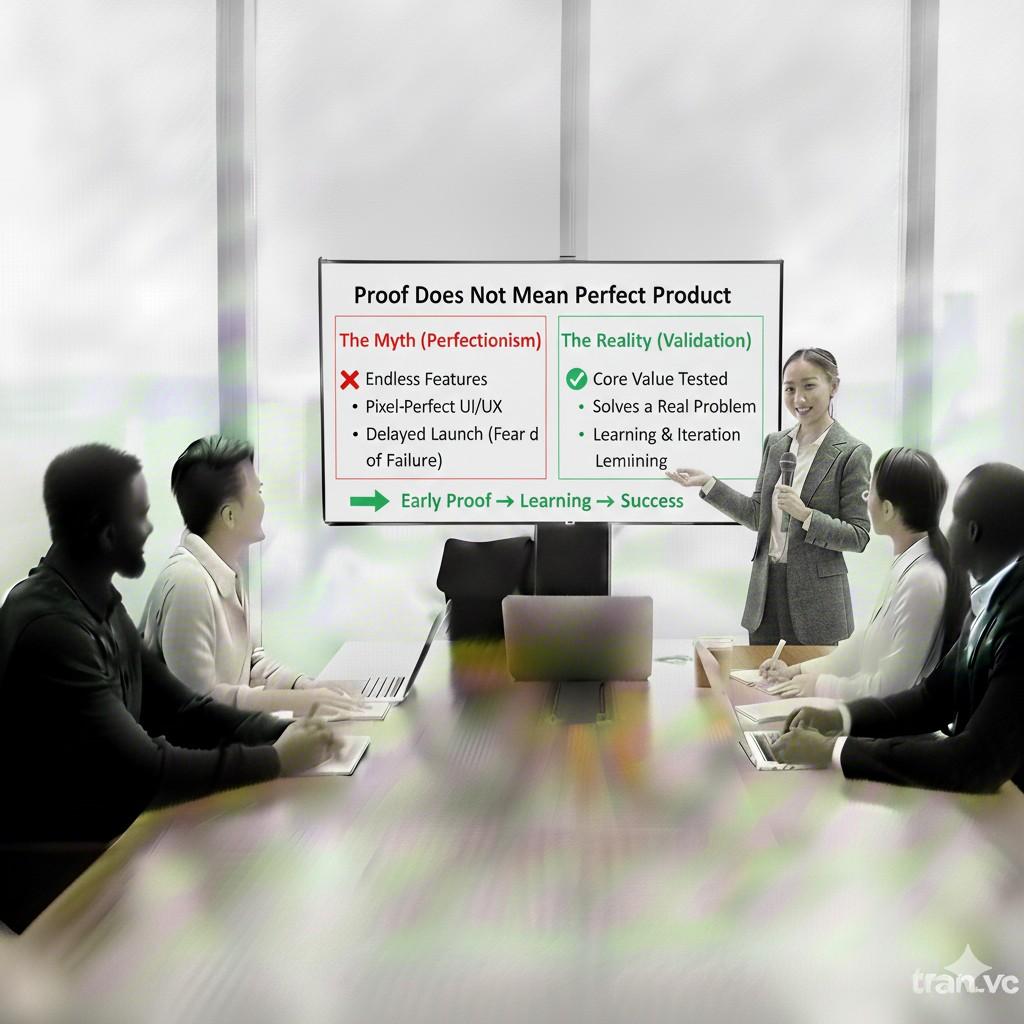
Proof is not about building the final system. It is about showing one strong signal that reduces doubt. That signal can be small, but it must be real. Investors and buyers both respond to proof because it lowers risk.
If you try to prove everything at once, you will move slowly and spend too much. If you prove the right thing first, you create momentum that makes the next step easier.
Proof for AI: narrow, reliable, repeatable
For AI startups, strong proof usually starts narrow. A model that performs well on one specific task can beat a broad model that is unclear. Reliability matters more than fancy features. If the output changes randomly or breaks often, trust drops fast.
A good early target is a workflow where the user can act on your output. When the result is clear and useful, it becomes easier to get usage, feedback, and eventually payment.
Proof for robotics: stable behavior in real conditions
For robotics, proof often comes from repeatability. One successful demo can be exciting, but repeatability is what builds confidence. A customer wants to know it will work again tomorrow, not just today.
This means your early proof should include more runs than you think. It should include failure tracking, safety checks, and simple metrics that show progress. Proof is not just “it moved.” Proof is “it completed the task under real limits.”
Proof that sells: make the outcome easy to understand
The best proof is easy to explain in one breath. “We cut this step from three hours to thirty minutes.” “We reduced errors by forty percent.” “We increased throughput by twenty percent without adding staff.”
When proof is simple, it spreads. It becomes your pitch. It becomes your demo. It becomes the reason people take the next meeting.
The seed-strapped product plan: build a “thin wedge”
A thin wedge is your first entry point
A thin wedge is the smallest product that can enter a real workflow and create value. It is not meant to do everything. It is meant to get adopted. Adoption is the door to growth.
Many startups fail because they build a big product that nobody uses. A thin wedge avoids that by forcing you to focus on what the user will actually try.
Thin wedge for AI: one output, one action
For AI, the wedge can be a single output that leads to a clear action. That could be a daily alert, a ranking list, or a simple score that tells the user what to do next.
It does not need a full dashboard at first. It does not need dozens of features. It needs trust, clarity, and a path to impact.
Thin wedge for robotics: one task with strong support
For robotics, the wedge is often one task done well, even if the system needs support. Maybe a human loads parts. Maybe the environment is controlled. That is fine early on.
Your wedge should prove the value chain, not the dream. Once the value is proven, you can widen the wedge step by step.
Design for adoption, not for elegance
Many technical founders build for elegance. Customers adopt based on ease. If setup is painful, adoption slows. If the output is confusing, adoption dies.
So design the wedge to be easy to start and hard to ignore. Make the output clear, make the next step obvious, and make the value measurable.
Why IP is a seed-strapped superpower
IP turns your work into an asset
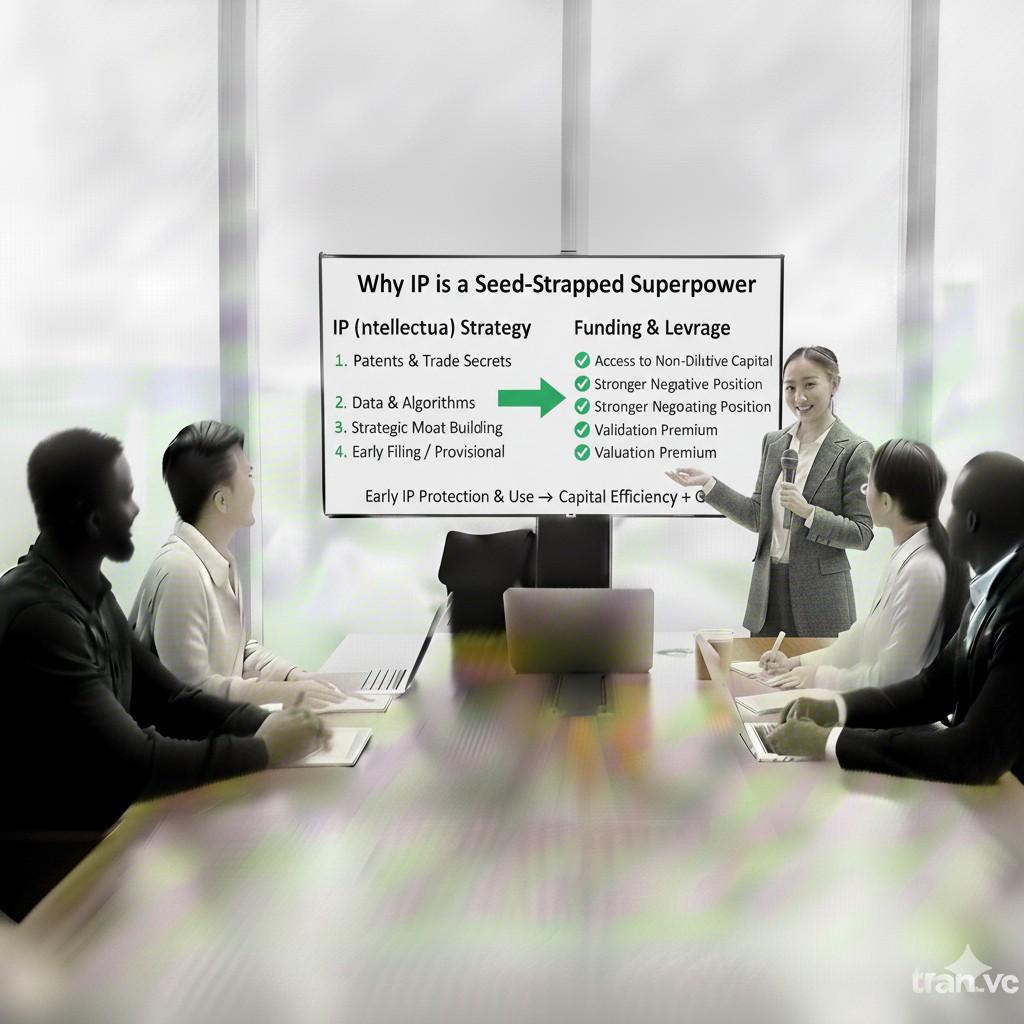
In deep tech, your code and methods are not just “work.” They can become assets that increase the value of your company. Strong IP helps you defend what you build and helps investors see that your advantage is not easy to copy.
Seed-strapped teams cannot outspend big players, so they must out-focus and out-protect. IP is one of the strongest tools for that.
IP also improves your strategy
When you take IP seriously early, it forces clarity. You start naming what is truly new in your system. You document it. You protect it. You build around it.
This changes your roadmap in a good way. It pushes you toward the parts that matter most. It also reduces future pain because you are less likely to lose key protection due to timing mistakes.
“Patents later” is often a costly delay
Many startups wait until they raise money to think about patents. By then, they may have already shown the invention publicly or shared details with partners. That can limit options and reduce strength.
A seed-strapped approach is not “file everything.” It is “file the right things early,” based on what is truly novel and valuable.
How Tran.vc helps founders protect the edge early
Tran.vc invests up to $50,000 in in-kind patenting and IP services for AI, robotics, and other tech startups. The goal is simple: help you build a defensible foundation without draining the cash you need for product and customers.
If you want to build an IP-backed moat early and raise with more leverage, you can apply anytime here: https://www.tran.vc/apply-now-form/
You cannot stretch dollars if you stretch the team
Burnout is expensive
Founders often try to save money by pushing the team to extremes. That creates hidden costs: mistakes, rework, missed details, broken trust, and slow progress. Burnout also makes people quit, and replacing talent is one of the most expensive things a startup can do.
Seed-strapped startups protect energy because energy is what turns time into progress.
Small teams need strong habits
A small team can move fast, but only if they share the same priorities. That means fewer meetings, clearer ownership, and honest updates on what is working and what is not.
Simple habits, done weekly, can protect months of runway. The goal is not heavy process. The goal is fewer surprises and faster learning.
Focus is the real “productivity tool”
Most productivity tools do not fix the core problem. The core problem is usually focus. When the team works on too many things, everything slows down.
Seed-strapped teams decide one key target, push it across the line, learn, and then pick the next target. This rhythm keeps the team motivated and keeps progress visible.
The real game: runway is not time, it is choices
Why “months of runway” can fool you

A startup can have twelve months of runway and still be in trouble. Another startup can have four months and be in control. The difference is not the calendar. The difference is the quality of decisions made each week.
Runway is really a record of choices. Every choice either buys learning, builds an asset, or burns cash without changing the outcome. If you treat runway like a timer, you will spend to feel safe. If you treat runway like a set of choices, you will spend to get proof.
The seed-strapped way to think about cash
Cash is not just fuel. Cash is focus. The moment you spend on the wrong thing, you are not only losing money, you are losing attention. The team starts talking about side projects, extra tools, and optional work. Your core work slows down.
Seed-strapped teams protect cash so they can protect focus. They do not starve the company. They aim to fund the next clear proof point, then the next one after that.
The simple question that keeps you honest
Before you spend, ask one question in plain words: “What will be true after we spend this?”
If the answer is vague, delay the spend. If the answer is clear, and the truth you will learn is important, spend with confidence. This is the simplest way to stop cash leaks before they become habits.
The difference between being “busy” and being “effective”
Why busy work feels good in deep tech

Deep tech work is hard. When it is hard, it feels safer to do tasks that look like progress. Teams build extra features, expand the code base, and create complex diagrams. Everyone stays busy, and the company feels alive.
But busy work often avoids the hardest question: “Will someone pay for this, and will it work in the real world?” If you do not face that question early, you will face it later when money is lower and time is tighter.
What effectiveness looks like week to week
Effectiveness is boring in a good way. It looks like one clear goal, a simple test, and a written result. It looks like a small demo that a customer can use, even if the product is not pretty. It looks like a pilot with one success metric, not a long list of hopes.
When a seed-strapped team is effective, the next step becomes easier. Sales becomes easier. Hiring becomes easier. Fundraising becomes easier. The work starts to stack on itself.
How to turn effort into results
Effort becomes results when you aim effort at the right risk. If you do not know the right risk, the best move is to speak with customers until the risk becomes clear.
A strong founder can say, “This week we will prove we can do X under Y condition, and we will know we succeeded if Z happens.” That clarity turns work into progress.
The “thin proof stack” that makes investors lean in
Why one proof point is not enough
A single demo can be exciting, but investors and customers both know demos can be staged. They look for a pattern of proof, not a one-time moment.
A seed-strapped startup does not try to prove everything. It builds a thin stack of proof points that connect. Each proof point supports the next one, like steps on a staircase.
What a thin proof stack looks like for AI
For AI, a thin proof stack often begins with a narrow use case, a clear dataset path, and a measurable lift over a baseline. Then it expands into reliability, workflow fit, and repeat usage.
The key is that each step answers a real doubt. “Can you get the data?” becomes “Yes, we integrated.” “Does it work?” becomes “Yes, here is the measured lift.” “Will it be used?” becomes “Yes, here are the weekly active users.”
What a thin proof stack looks like for robotics
For robotics, the stack often begins with repeatable behavior, then moves into uptime, safety, and the ability to operate in real conditions. Next comes the unit economics: what it costs to deploy and maintain, and what value it creates.
This stack is powerful because it matches how buyers think. They care about reliability first. Then they care about cost and rollout. If you show proof in that order, your story becomes easier to trust.
Raising without desperation: how seed-strapped teams keep leverage
Why leverage matters more than valuation early
Many founders chase valuation as if it is the final score. But early valuation can be a trap if you get it by giving up too much control or accepting terms that limit your options later.
Leverage is what matters. Leverage is the ability to say “no” and still be okay. When you have leverage, you can choose investors. You can choose terms. You can choose timing.
How to build leverage before you raise
Leverage comes from proof, not from confidence. When you can show customer pull, repeatable results, and a clear plan, you are not begging for funding. You are offering a chance to join a moving train.
For seed-strapped startups, the best leverage builders are tight pilots, paid work, strong retention signals, and clear technical milestones that demonstrate a defensible edge.
The quiet role of IP in leverage
IP is not only a legal tool. It is a negotiation tool. When your core method is protected, investors see that your value is not easy to copy. That reduces perceived risk. Reduced risk often improves terms.
This is why Tran.vc focuses so strongly on patent strategy and filings early. It helps founders raise with more confidence and more control. If this matches what you want, you can apply anytime here: https://www.tran.vc/apply-now-form/
Seed-strapped hiring: how to grow without breaking the budget
Why early hiring goes wrong
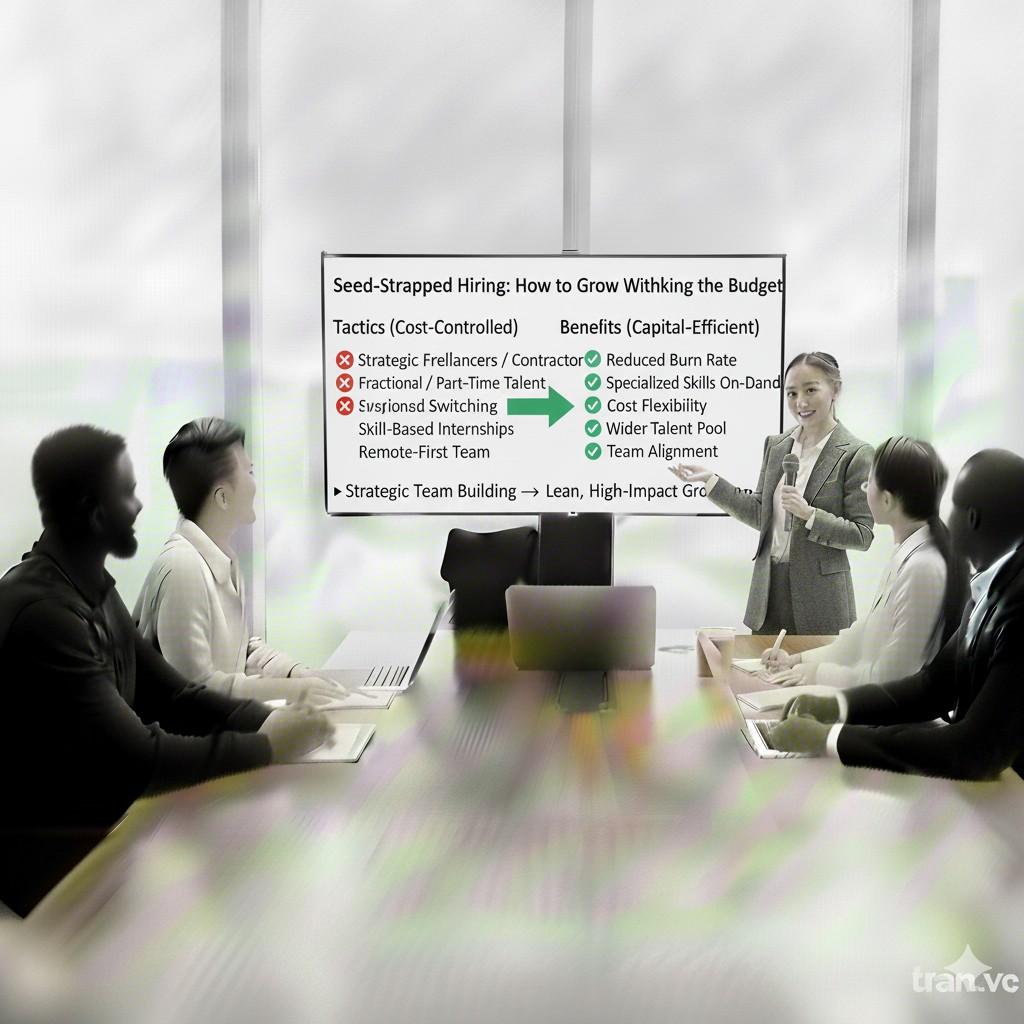
Most early hiring mistakes come from one problem: hiring for comfort. Founders hire to reduce anxiety, not to increase output. They add people before the work is clear, and then the team spends time coordinating instead of shipping.
A seed-strapped startup cannot afford that. Every hire must create a clear outcome that would not happen otherwise.
The best first hires create “shipping power”
In AI and robotics, the highest value early hires are the ones who can turn unclear problems into working outputs. They build quickly, test quickly, and document what they learn.
This is not about fancy titles. It is about ability. A seed-strapped team needs builders who can own a piece of the system end to end and push it into real usage.
How to “hire” without hiring
Many startups forget that there are ways to increase output without adding payroll. You can use contractors for clear tasks. You can partner with labs, vendors, or design houses for narrow needs. You can work with customers who can provide data, sites, or operational support.
This is not about avoiding hiring forever. It is about delaying full-time cost until you have proof that the role is truly needed.
A simple test before you add headcount
Before you hire, write down what will be different in sixty days if the person joins. If you cannot write it clearly, the role is not defined enough yet.
Seed-strapped hiring works best when the role is shaped by real work, not by an imagined future.
Customer conversations that actually change outcomes
Why most customer calls fail

Many founders treat customer calls like interviews. They ask, “Would you use this?” The customer says, “Sure.” Everyone feels good. Nothing changes.
A useful customer call is not about opinions. It is about facts. It is about how work is done today, what breaks, what costs money, and what happens when things go wrong.
The kind of questions that reveal the truth
The most useful questions are grounded in real events. Ask about the last time the problem happened. Ask what they did. Ask what it cost. Ask who got blamed. Ask what they tried before.
These questions feel simple, but they unlock details that shape your product. They also reveal whether the customer truly has urgency or is just curious.
Turning conversations into pilots
A seed-strapped startup should try to turn the best conversations into a next step that is small and real. That might be access to sample data, a site walkthrough, a shadow day, or a scoped pilot.
The goal is not to “sell” in the first call. The goal is to earn enough trust for a real test. Real tests create proof, and proof creates revenue and funding options.