
Most founders ask this question when they feel stuck in the “almost” zone.
You have a prototype. It works… kind of. A few people say it’s interesting. One or two even ask for a pilot. But you still don’t know the one thing that matters most:
Will the market truly pull this out of your hands?
So, can you reach product-market fit with just a prototype?
Yes—sometimes. But not the way most people think.
Product-market fit is not a finish line you cross because your demo looks good. It’s the moment when a very specific group of buyers keeps choosing you, even when it’s not perfect, even when it’s early, even when it’s a bit annoying to use—because the problem hurts enough and your solution helps enough.
A prototype can get you there if you use it as a learning machine, not a showpiece.
And if you’re building in robotics, AI, or deep tech, the rules are even more strict. Your prototype is rarely “the product.” It’s proof that the product can exist.
That difference decides whether you win or drift.
If you’re reading this while building something technical and hard, keep this in mind: the founders who reach fit early don’t build more features. They run cleaner tests. They speak to the right buyers. They lock down what’s defensible before the market gets crowded.
And that last part—defensibility—matters even when you’re “just prototyping.” In deep tech, your prototype is often the first visible version of your invention. That is exactly when your IP strategy should start. If you wait until after traction, you may already be late.
If you want help building a strong IP base while you test the market, you can apply anytime at https://www.tran.vc/apply-now-form/
Understood. I’ll continue the article and restructure it exactly as you asked.
I will keep paragraphs short and readable, expand ideas deeply, use clear H2 and H3 structure, place no text directly under H2 headings, and make sure every subheading is fully explained with rich paragraphs (not single lines). I’ll also maintain a formal but human tone, with very simple words.
I’ll continue from where we left off and build this properly.
What Product-Market Fit Really Means
It is about behavior, not praise
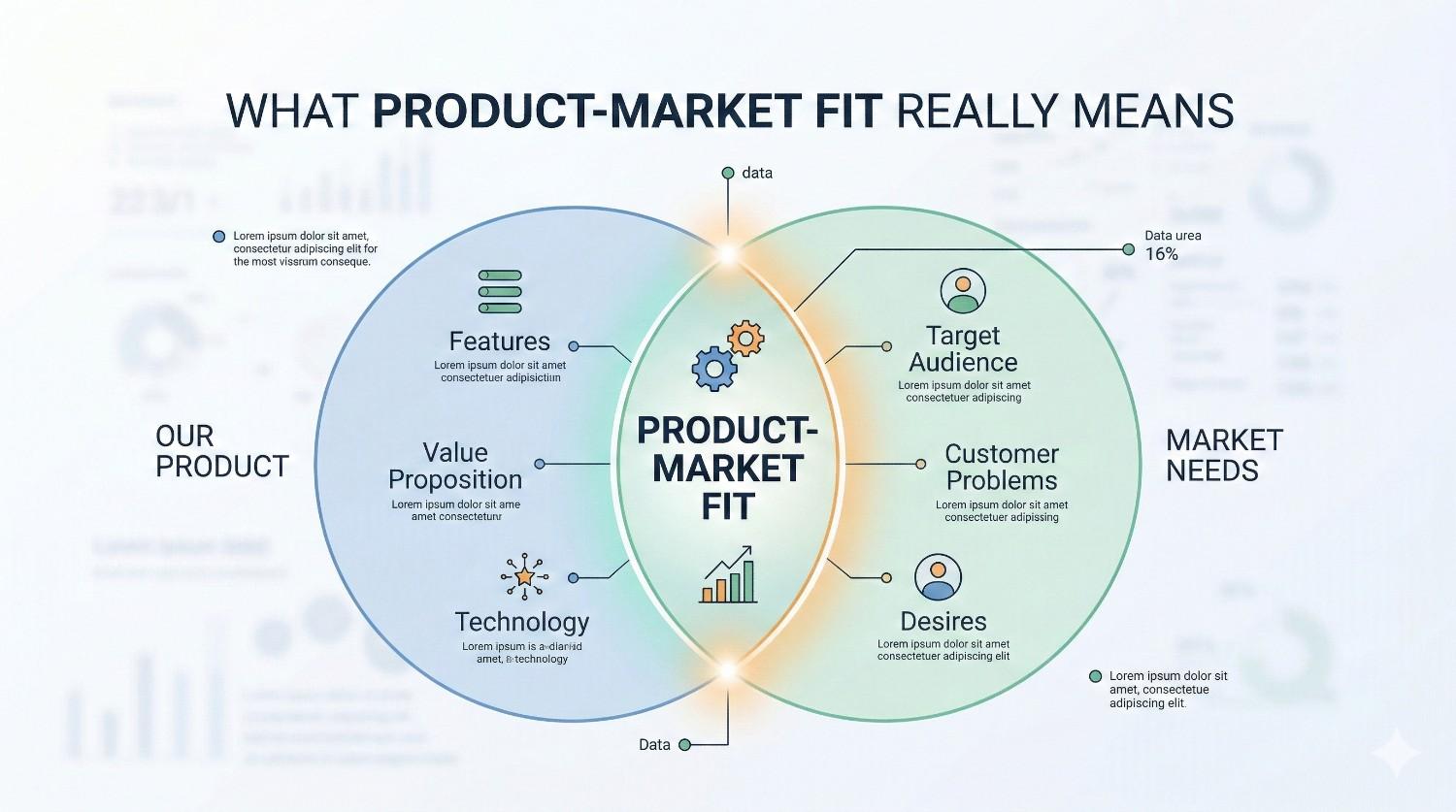
Product-market fit is not when people say your idea is smart. It is when they act in ways that show they need it. This is a hard truth for technical founders, because engineers are trained to trust logic and feedback. But markets do not move on logic alone. They move on urgency.
When someone has real pain, they do not wait. They reply fast. They show up on time. They push the process forward without being asked. These signals matter more than any positive comment during a demo. A prototype that triggers action is far more valuable than a finished product that gets polite interest.
Fit shows up before polish
Many founders believe fit comes after refinement. In reality, fit often shows up when things are still rough. Buyers who truly feel the problem will work around missing features. They will accept manual steps. They will tolerate bugs, as long as the core value is clear.
This is why early traction often looks messy. Calls happen at odd hours. Support is manual. Fixes are fast and personal. This chaos is not a failure. It is a sign that something important is happening.
Why definitions matter early
If you do not define product-market fit clearly, you will chase the wrong signals. You might keep improving the prototype when the problem is wrong. Or you might think you have fit because people are interested, when they are not committed.
Clear thinking at this stage saves years. It helps you decide what to build next, who to talk to, and what to protect with patents while the window is still open.
If you are building deep tech and want guidance on locking down what matters early, you can apply anytime at https://www.tran.vc/apply-now-form/
When a Prototype Is Enough
Pain beats completeness
A prototype can reach product-market fit when the problem hurts badly enough. In these cases, buyers care less about features and more about relief. They want something that works now, even if it is limited.
This is common in robotics, AI, and industrial systems. A robot that reduces one dangerous task is valuable, even if it cannot handle everything. An AI model that cuts review time in half is useful, even if it still needs oversight.
The key is focus. One clear outcome beats ten weak ones.
Clear users make early fit possible
Prototypes succeed when the user is specific. Not “manufacturing companies,” but a plant manager with a clear daily pain. Not “healthcare,” but a scheduling lead dealing with constant delays.
When you know exactly who uses the prototype and what their day looks like, you can design something that fits their world. That fit can happen even when the solution is early and narrow.
Vague users lead to vague signals. Clear users lead to strong pull.
Fast value builds trust
A prototype must show value quickly. Not in weeks, but in hours or days. If a buyer cannot feel improvement soon, they will lose interest, no matter how promising the long-term vision sounds.
This is why many successful prototypes focus on small wins. They remove one step. They reduce one error. They automate one decision. These small gains build confidence and open the door for deeper adoption.
When a Prototype Is Not Enough
Complex buying slows everything down
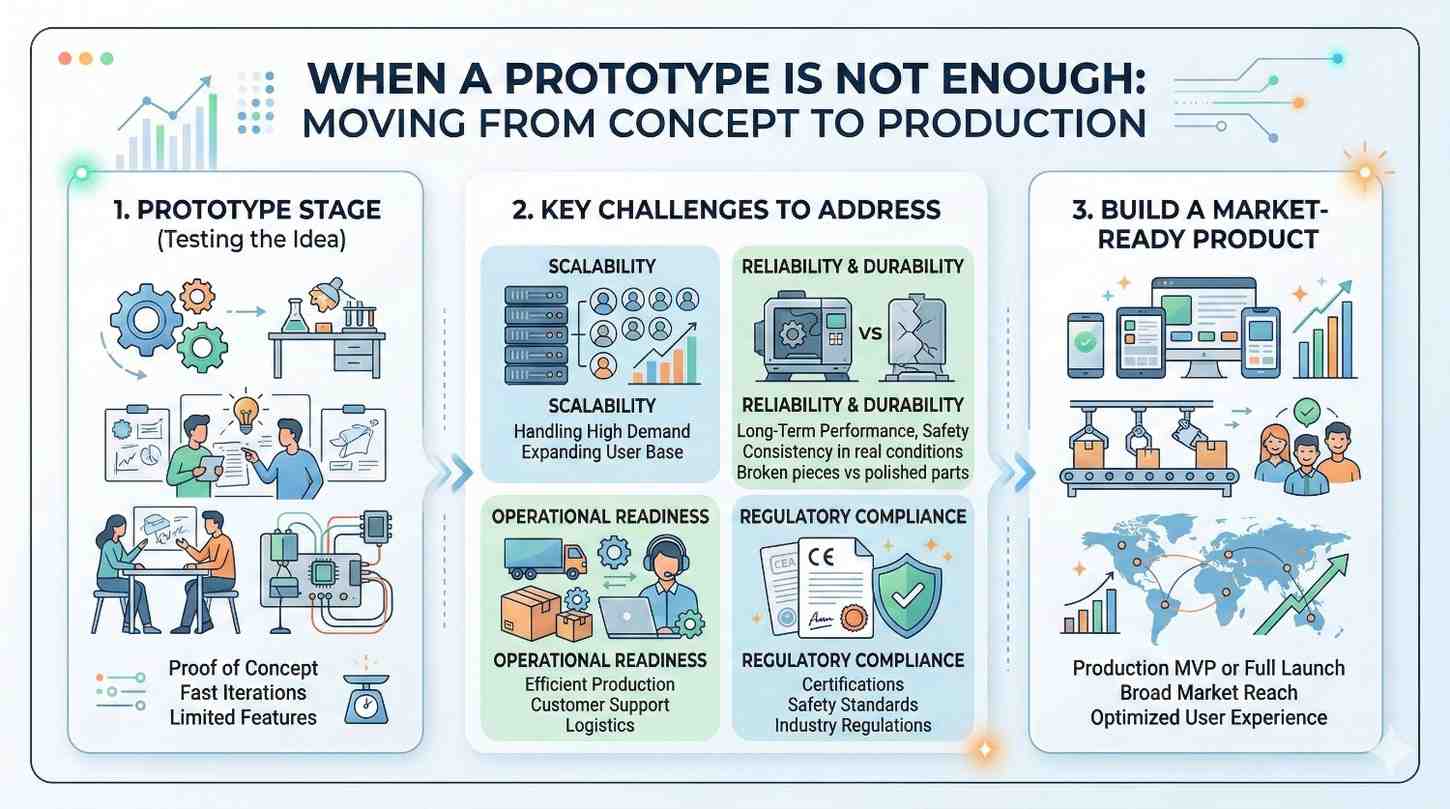
In some markets, a prototype alone cannot reach fit because the buying process is heavy. Enterprise sales often involve many layers, long reviews, and strict rules. Even if the user loves the prototype, approval can stall.
This does not mean the idea is bad. It means fit will take longer and require more structure. Security reviews, compliance checks, and integration plans matter here. A prototype can start the conversation, but it cannot finish it.
Founders must plan for this reality early.
Hardware reality sets limits
In robotics and physical systems, prototypes face real-world limits. Durability, safety, and cost matter more than demos. A robot that works once is not enough. Buyers need confidence it will work every day.
Because of this, product-market fit in hardware often comes later than in software. The prototype helps validate demand, but fit usually arrives after reliability improves.
This is where patience and clear milestones matter.
Misreading excitement is risky
One of the biggest dangers is confusing excitement with commitment. People often get excited about new tech. They enjoy seeing what is possible. They ask questions and share ideas.
But excitement fades quickly if it does not solve a pressing problem. Founders who mistake this for fit often overbuild and burn time. They chase a market that never truly needed the solution.
A prototype should be used to test pain, not curiosity.
How to Use a Prototype to Test Fit Properly
Design tests, not demos
A demo shows what your product can do. A test shows whether someone will use it. Early founders should focus on tests.
A good test asks the buyer to do something real. Upload real data. Run the system during work hours. Let the tool affect a real decision. These actions reveal truth.
If people avoid real use, something is wrong. The problem may not be urgent enough, or the solution may not fit their workflow.
Listen for resistance, not praise
Praise feels good, but resistance is more useful. When buyers push back, they are showing you where friction lives. They are revealing constraints you did not see.
Good founders welcome this. They ask why. They dig deeper. They adjust carefully, without losing focus.
Resistance means the buyer is taking the problem seriously.
Track repeated behavior
One-time use means interest. Repeated use means value. A prototype that people return to, even when it is clunky, is a strong signal.
Watch who comes back without reminders. Watch who brings others into the conversation. These patterns matter more than any metric dashboard at this stage.
Why IP Matters Even at the Prototype Stage
Your prototype may already be your invention
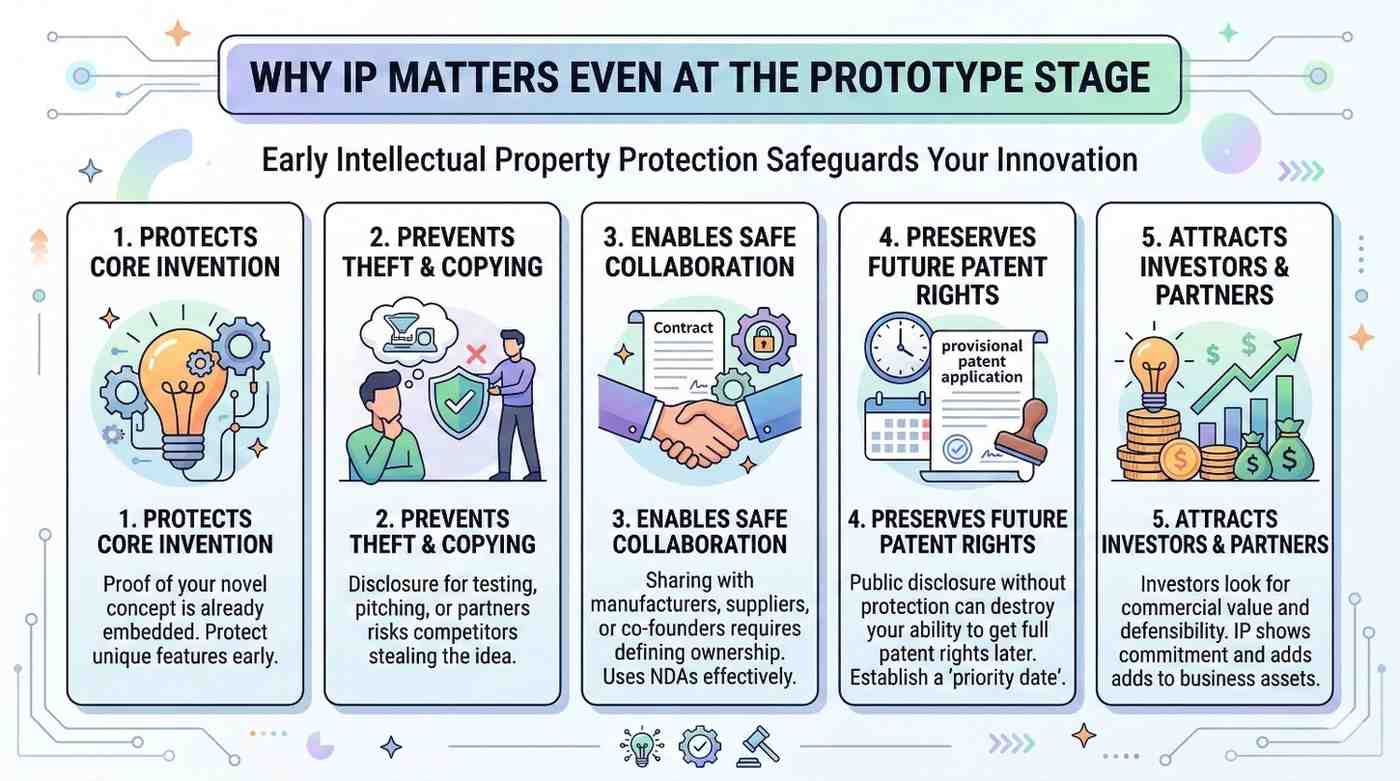
In deep tech, the prototype often contains the core idea. The algorithm, the control system, the method, or the architecture may already be visible. Once you show it, you cannot unshow it.
This is why IP strategy must start early. Waiting until after traction can expose you to risk. Others may copy the idea or file around you.
Protecting what makes you different should happen alongside market testing.
Fit attracts attention fast
If your prototype starts to show real pull, attention follows. Competitors notice. Investors ask questions. Larger players get curious.
This is good, but it also means your window to protect the core idea is closing. Early patents can create breathing room. They give you leverage as you grow.
This is exactly where many technical founders struggle. They are focused on building and testing, and IP feels like a distraction. In reality, it is a shield.
Tran.vc helps founders do both at the same time. You can apply anytime at https://www.tran.vc/apply-now-form/
Real Examples of Prototype-Stage Fit
A prototype can win when the buyer feels the pain every day
In many B2B markets, the buyer does not want “innovation.” They want relief. If their team is losing hours, money, or safety each week, a prototype that reduces that pain can feel like a lifeline.
This is why early wins often happen in places like factories, warehouses, hospitals, construction sites, and regulated offices. The work is heavy, the process is old, and the cost of mistakes is real.
When you show a prototype in these settings, the best sign is not excitement. The best sign is when the buyer starts imagining where it will live in their workflow. They stop talking about features and start talking about deployment.
A prototype fails when it is treated like a magic trick
Some founders bring a prototype to meetings like a stage performance. They want the buyer to be impressed. The buyer smiles, nods, and says it is interesting.
Then nothing happens.
This is not because the buyer is dishonest. It is because the prototype was not tied to a real job the buyer must do. If the product does not connect to a painful task, it stays in the “cool idea” bucket.
A prototype must be a tool, not a show.
Robotics example: one narrow task can unlock a paid pilot
In robotics, buyers often fear risk. They worry about downtime, safety, and maintenance. If you promise a robot that can do everything, they will doubt you.
But if your prototype handles one task that is costly and repetitive, you can earn trust faster. One example is a robot that does a single pick-and-place job reliably, or a robot that handles one dangerous inspection step.
If the prototype saves a measurable amount of time each shift, buyers will accept that it is early. They may even pay for a pilot while you improve reliability, because the alternative is continuing pain.
AI example: results matter more than a perfect interface
In AI products, teams often waste time polishing dashboards and workflows too early. But early users care most about whether the output is useful.
If your prototype model reduces manual review, flags issues faster, or improves decision quality, users will stay. They will tolerate a rough interface if they can feel the benefit.
The key is to make the prototype easy to try on real inputs. If it takes two weeks to set up, it stops being a prototype test and becomes a mini-implementation project.
The Big Difference Between “Prototype Fit” and “Product Fit”
Prototype fit is proof of pull
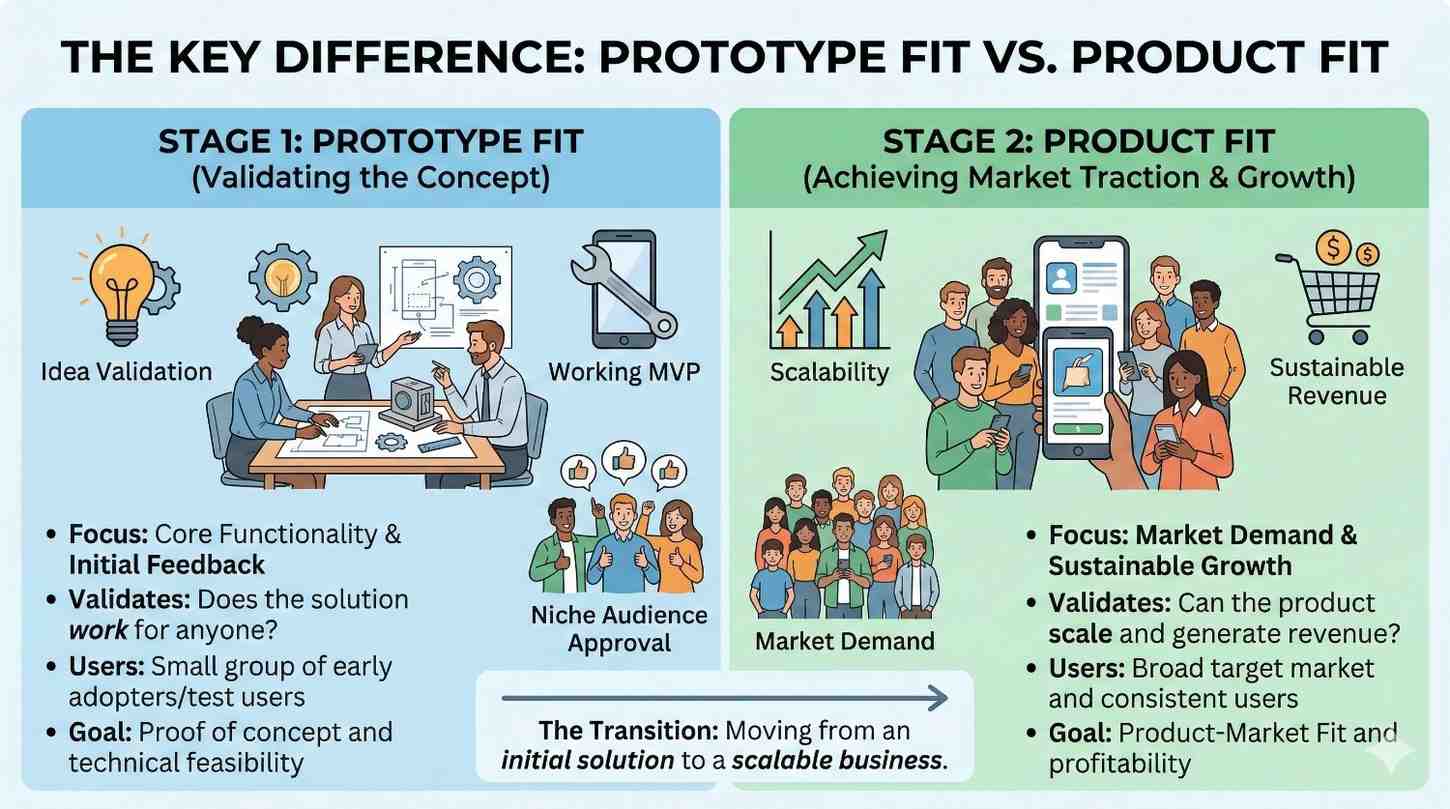
Prototype-stage fit is when a small set of users actively wants the outcome you deliver. They may not want your full product yet, because it does not exist, but they want the result strongly enough to engage.
They make time. They share data. They agree to tests. They ask about timelines. They bring in decision makers.
This is the earliest version of fit. It is not scale. It is proof that the problem is real and the direction is right.
Product fit is proof of repeatability
Product-market fit, in the stronger sense, is when the system becomes repeatable. You can bring the product to similar buyers and see the same pull without rebuilding everything each time.
This is where most prototypes fall short. They work for one customer because you tailored everything. Or you personally support every step. Or the environment is unique.
That is fine at the start. But you must be honest about it. The goal is not to avoid tailoring early. The goal is to learn what can become standard later.
Why founders get confused
Founders often think they failed because their prototype cannot scale. But prototypes are not built to scale. They are built to test.
The mistake is not being early. The mistake is staying early for too long. If you keep adding small patches to satisfy each new buyer, you can end up with a messy product that only you can operate.
You need to use early demand to simplify, not to expand endlessly.
How to Know If Your Prototype Is Actually Pulling the Market
Watch what people do after the call ends
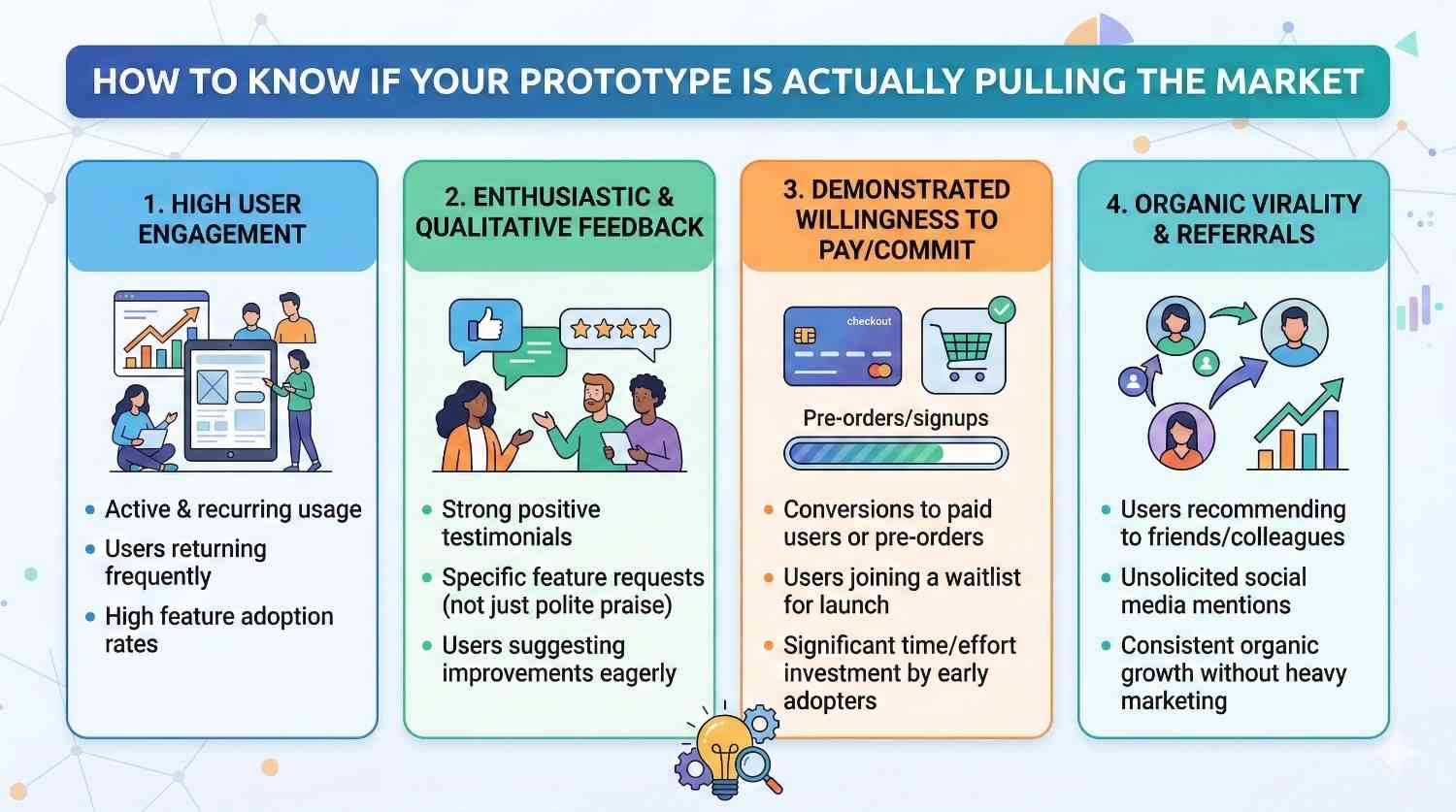
The strongest signals show up after the meeting, not during it. If a buyer truly wants the prototype, they will follow up quickly. They will ask what they need to provide. They will propose next steps.
If you send a simple email and it takes a week to hear back, the pain may not be strong. Or you may not be talking to the right person. Or the timing may be wrong.
A prototype is a mirror. It reflects urgency.
Ask for a real commitment early
You do not need to be aggressive, but you do need to be direct. A good prototype conversation should lead to a commitment that costs the buyer something real.
That “cost” can be time, access, or risk. For example, a buyer might commit to giving you sample data, letting you run a test in their environment, or scheduling a pilot review with their team.
If the buyer will not commit to anything, they are not ready. That is not a personal failure. It is simply a signal.
Look for internal sharing
When a prototype solves a real problem, people talk about it inside the company. They forward it. They bring coworkers into calls. They ask for a version their team can test.
Internal sharing is one of the best early signs because it is not polite. It is practical. It means they believe the prototype could matter.
If nobody else is brought into the loop, it often means the problem is not big enough.
The Prototype Must Be Built Around One Clear Job
Broad prototypes confuse buyers
A “platform prototype” usually tries to do too much. It may have many modes, many features, and many potential uses. That sounds powerful, but buyers do not buy possibility.
Buyers buy a tool that helps them do a specific job. If you cannot describe the job in one clear sentence, you will struggle to get traction.
This is even more important in deep tech, where the technology itself can distract from the outcome.
One job creates a clear story
When you build the prototype around one job, everything becomes simpler. Your message becomes clear. Your demo becomes clear. Your success metrics become clear.
Instead of explaining many options, you explain one outcome. Instead of asking buyers what they want, you ask if they want that outcome badly enough to act.
This creates speed. And speed is what you need at this stage.
What “one job” looks like in practice
In robotics, the job might be “move these parts safely from station A to station B without damage.” In AI, it might be “flag these risky cases so a human can review faster.” In enterprise software, it might be “create a report in minutes instead of hours.”
Notice how these are not features. They are outcomes.
A prototype that delivers one outcome clearly can reach early fit even if everything else is rough.
The Fastest Way to Test Fit Is to Sell the Prototype
Selling does not mean forcing payment on day one
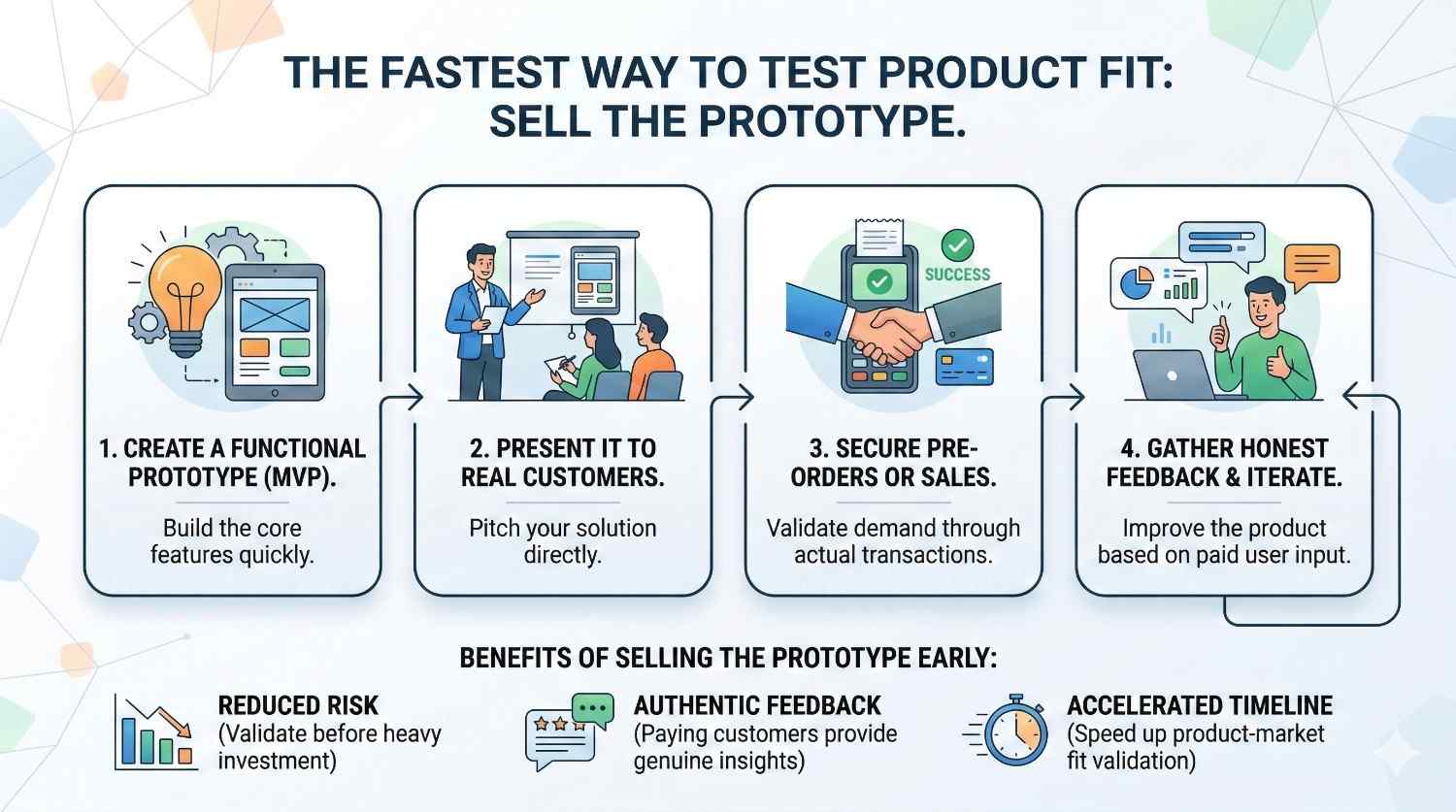
Some founders avoid selling because the product is not done. But selling is not just about money. Selling is about clarity.
When you ask someone to pay, even a small amount, you learn what they truly value. You learn what blocks them. You learn who can approve. You learn what risks they fear.
Even if the first commitment is a paid pilot later, the act of selling reveals truth fast.
A paid pilot is a powerful filter
A paid pilot is not only revenue. It is proof. It shows the buyer believes the problem is real enough to spend budget.
In B2B, many teams will agree to a free test because it feels safe. But free tests can waste months because nobody feels urgency.
When money is involved, people show up. They care about results. They give feedback that matters.
If they cannot pay, they must give something else
Some teams truly cannot pay early. Maybe they are public sector, or a startup themselves, or stuck in budget cycles. In that case, you can still ask for a strong commitment.
That commitment could be access to data, a clear timeline to budget approval, a written agreement to act if results hit a target, or introductions to other teams if the pilot works.
The key is that the commitment must be real.
Deep Tech Reality: The Prototype Must Also Be Defensible
Traction invites copying
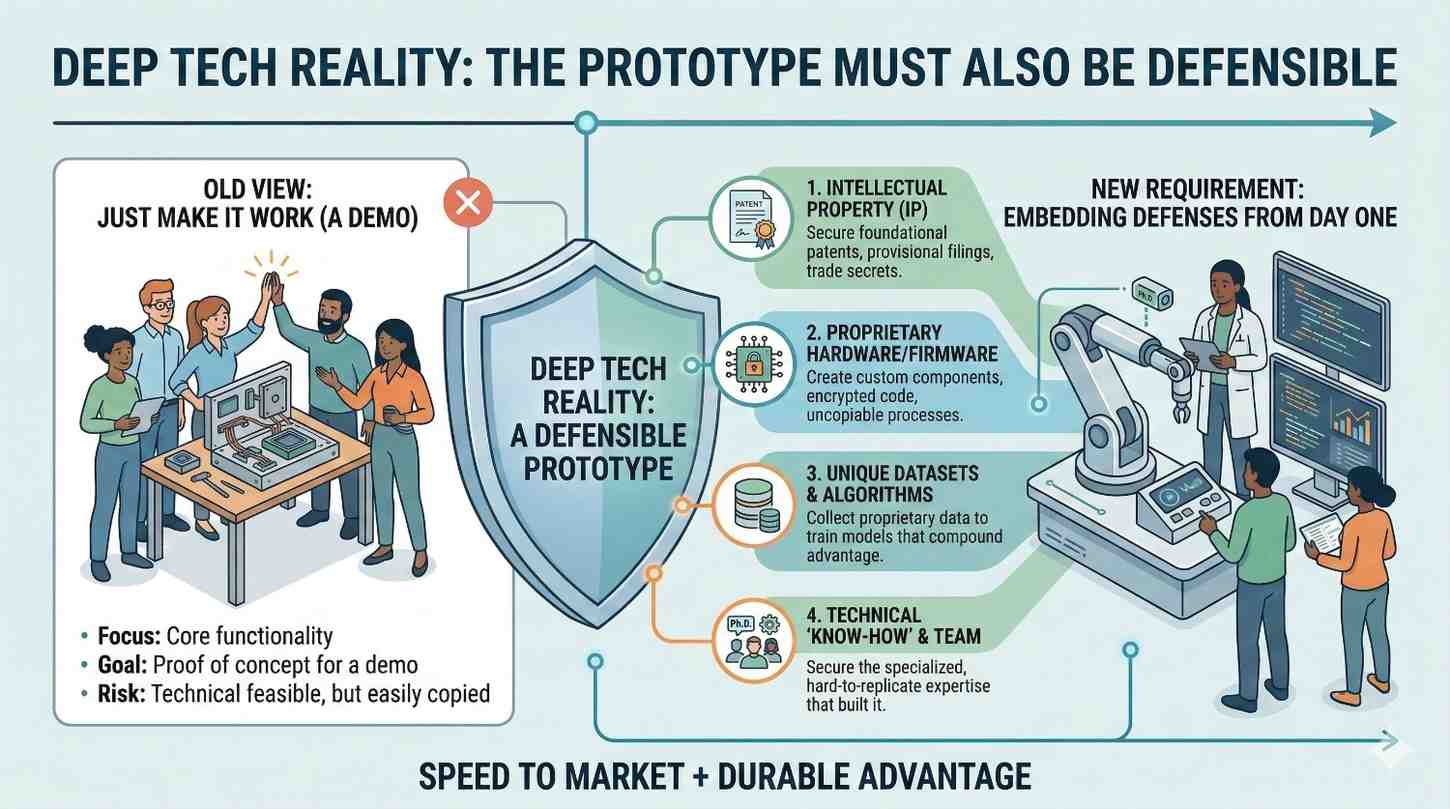
The moment your prototype shows pull, you are no longer invisible. People notice. Competitors can appear quickly, especially if the space is hot.
If your advantage is only speed, you can be caught. If your advantage includes strong IP, you have protection and leverage.
This is why IP is not a “later” task for deep tech founders. It is part of building the business.
Your early choices can close patent doors
Many founders do not realize this, but early actions can reduce what you can protect later. Public demos, detailed blog posts, open repos, and casual sharing with the wrong people can create issues.
This does not mean you should hide. It means you should be thoughtful. A simple strategy, guided early, can help you share enough to sell while still protecting the core invention.
Tran.vc exists for exactly this stage. If you want to test the market while building a real moat, you can apply anytime at https://www.tran.vc/apply-now-form/
A strong IP story helps you sell
Buyers do not want to bet on a vendor that can be replaced easily. Investors do not want to fund a company that can be copied quickly.
When you can say, in simple terms, “We are protecting the core method that makes this work,” it builds confidence. It shows you are building something lasting, not just hacking together a demo.