
Founder-market fit is not a badge you claim. It is something other people can see in the way you work, the choices you make, and the proof you can show. When you have it, investors feel calmer, customers trust you faster, and your team follows you with less doubt. When you do not have it, everything feels harder than it should.
If you are building in AI, robotics, or deep tech, founder-market fit matters even more. These markets punish guessing. They reward founders who know the real problem, understand the real limits, and can ship through messy, slow, high-stakes work. This is also why Tran.vc exists: to help technical founders turn hard-earned know-how into real, protected assets—so you can build leverage early, not later. If you want help proving your edge with strong IP and patent work from day one, you can apply anytime here: https://www.tran.vc/apply-now-form/
The simple meaning of founder-market fit
What it really means in plain words
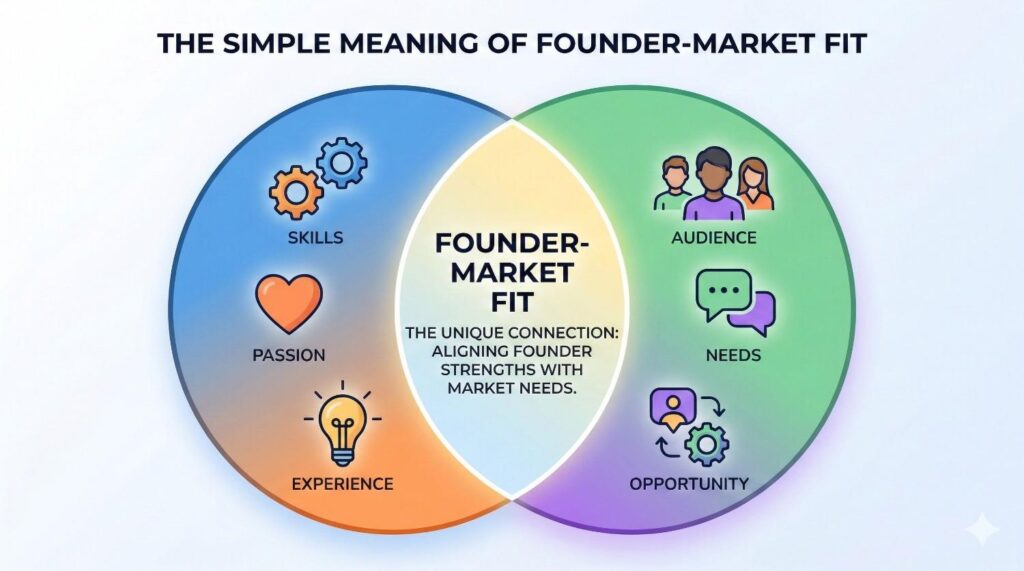
Founder-market fit means you are a natural match for the problem you are solving and the people who feel that problem every day. It is not about sounding smart or having a big resume line. It is about having the right mix of skill, focus, and lived closeness to the work so you can win when things get hard.
In deep tech, this fit shows up in how you think. You pick the right problem because you can spot what is real and what is noise. You choose trade-offs with care because you understand limits like cost, safety, speed, data quality, and timing. People can feel that you are not guessing, even when you are still early.
Fit is not a claim, it is a signal
Many founders try to “state” fit using strong words. They say they are the best person for the job. That does not land unless there is proof behind it. Fit is something others see by watching how you work, what you prioritize, and how you respond when a plan breaks.
A good signal of fit is calm clarity. You can explain the problem in a simple way without selling too hard. You can name the real blockers and you are not shocked by them. You also know what matters most in the first version, and you do not get pulled into side quests.
The three parts of fit
Founder-market fit is usually made of three parts that work together. The first part is domain closeness, meaning you know the space because you spent real time in it. The second part is build ability, meaning you can make the hard part real, not just talk about it. The third part is staying power, meaning you keep going when progress is slow and messy.
In AI and robotics, the “staying power” part matters a lot. These products often take longer to prove in the real world. A founder who can hold steady, keep learning, and keep shipping is the founder who earns trust fast.
Why “prove it” is the whole game
People are not judging your idea, they are judging your risk
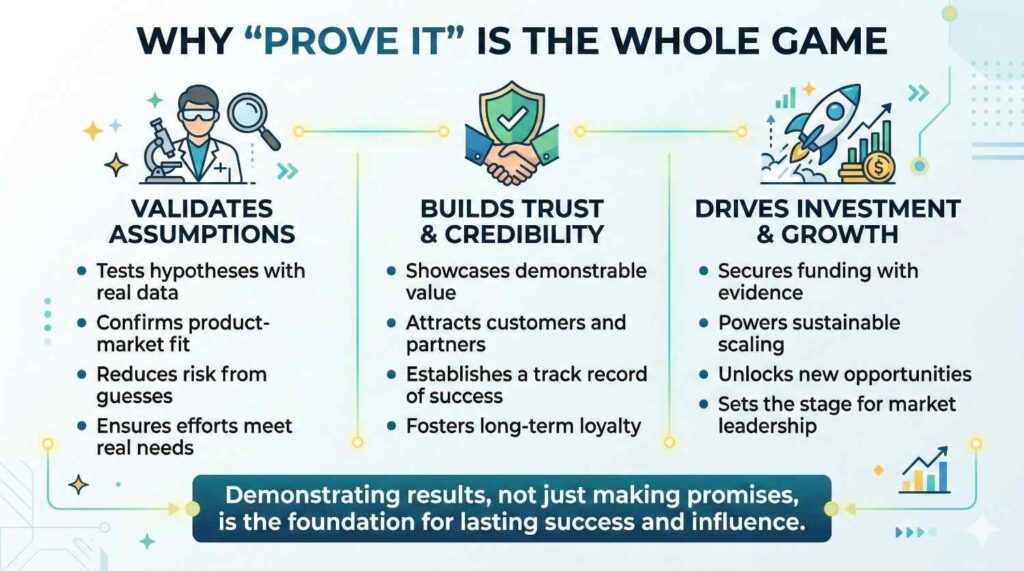
Investors, customers, and early hires all do the same thing at the start. They try to reduce uncertainty. They want to know if you will deliver, not just dream. Even if your idea is strong, they will hesitate if they feel the work will break you.
This is why proof matters more than excitement. Proof is what makes people relax. Proof makes your story feel stable. It also helps them imagine you leading through hard months without losing focus.
Proof is built with small, clear receipts
You do not need a giant customer list to prove founder-market fit. You need clear receipts that show you can move from insight to action. A working demo that solves one sharp problem can be a strong receipt. A pilot with real users, even if it is small, can be even stronger.
In deep tech, proof can also be test results that match real conditions. If your model works only on clean data, people will worry. If your robot works only on perfect floors, people will doubt. When you show results that reflect the messy world, your fit becomes easier to believe.
IP can be proof, not paperwork
Many founders treat patents like a later task. In deep tech, that is often a mistake. A patent plan forces you to clearly define what is new in your method, system, or process. It pushes you to name the “why us” in a way that is concrete.
That clarity is useful in fundraising and sales because it makes your advantage easier to explain. It also protects you when others try to copy. Tran.vc helps founders do this early by investing up to $50,000 in in-kind patenting and IP services, so your technical edge becomes a real asset from day one. If you want to build that kind of proof early, apply anytime at: https://www.tran.vc/apply-now-form/
The investor’s hidden checklist
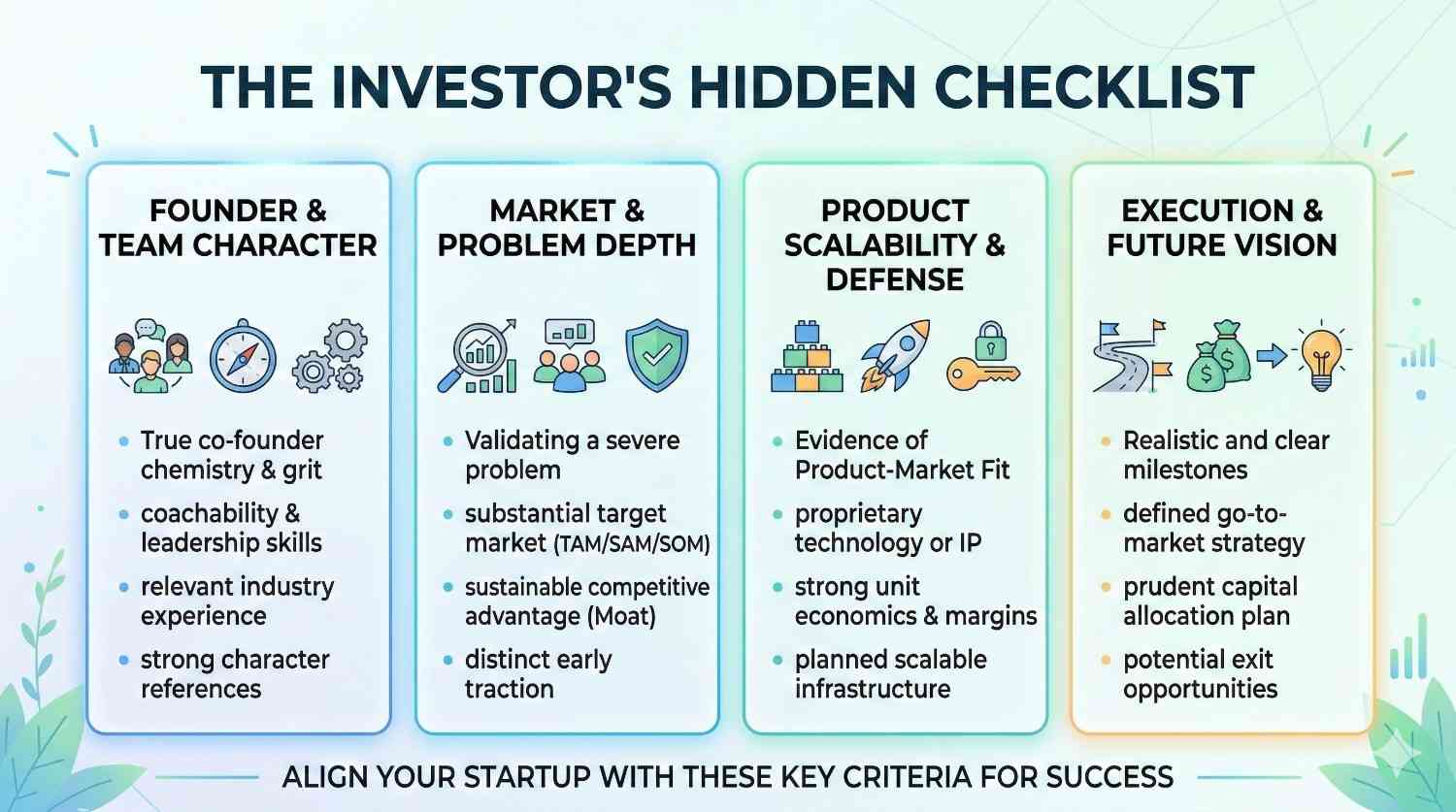
The “why you” test
Most investors may not say it directly, but they are always checking if you are the kind of founder who can carry this market. They look for more than confidence. They look for a personal connection to the work, plus the ability to build and lead.
When you pass the “why you” test, it feels like your background points straight to the problem. Even if you are not a perfect match on paper, you can show how your path gave you the insight and skill needed to win.
Earned insight vs. borrowed interest
Earned insight comes from lived experience. You built something similar, supported it in the real world, or worked close to the pain for years. Borrowed interest comes from reading about a trend or seeing a market map that looks big.
Borrowed interest is not bad, but it is weaker. If your insight is borrowed, you must replace it with deep field work fast. That means many customer talks, careful observation, real prototypes, and clear learning loops. You are trying to prove you can learn the market faster than others can copy you.
The “do you understand the real world” test
In AI and robotics, investors worry about the gap between a nice demo and real deployment. They want to know if you understand the real setting where your product must live. That includes safety issues, edge cases, downtime, training, integration, data drift, and the boring tasks that make products usable.
If you can speak about these issues in a calm, detailed way, you show fit. You sound like someone who has been near real operations, not just building in a vacuum.
The “can you protect the edge” test
Investors also think about how easy it will be for others to copy what you are doing. If your advantage is only speed, you may lose when a bigger team enters. If your advantage is a unique method, workflow, or system that can be protected, you become a safer bet.
This is where strong IP strategy matters. Patents can help you lock in key parts of your invention, especially if you are building core technology that others will want. Tran.vc works closely with technical founders to shape patent plans that match the real product and the real moat. If you want to do this the right way early, apply here: https://www.tran.vc/apply-now-form/
How to prove founder-market fit without sounding like you are selling
Use a “before and after” story, not a hype story
A hype story is full of big market words and bold claims. A proof story is simple and grounded. It starts with what you saw, what you tried, what failed, what you learned, and what you built next. This kind of story feels real because it includes friction.
When you tell your story this way, you are not begging for belief. You are showing your judgment. You are also showing that you learn fast and you do not hide from hard truths.
Show what you chose to ignore
One of the strongest signs of fit is what you do not chase. When you can explain why you did not build certain features, or why you avoided a flashy market, you show discipline. People trust founders who can say “no” with reasons.
This is especially powerful in AI, where it is easy to drift. If you can show that you picked a narrow use case, learned it deeply, and built a solution that works, you will look sharper than a team trying to do everything.
Speak in the language of the user
Founder-market fit becomes obvious when you sound like the customer. Not in a forced way, but in a natural way. You name their real goals, their real constraints, and what success looks like to them.
In robotics, that might mean you talk about uptime, maintenance, safety checks, change management, and the cost of failure. In enterprise AI, it might mean you talk about data access, security review, deployment, and internal ownership. When you speak this way, you do not need big claims. Your fit is heard in the details.
How to build founder-market fit when you do not start with it
Start by narrowing the problem, not widening it
Many founders believe they need a big vision to look serious. In reality, founder-market fit is easier to prove when your focus is narrow. A small, sharp problem lets you learn faster and show progress sooner. It also forces you to understand details that others skip.
When you narrow the problem, you stop talking in general terms. You begin to see real constraints, real failure modes, and real success measures. This depth creates fit over time. People start to trust you because your answers are specific and grounded, not vague.
Replace assumptions with daily contact
You cannot build fit from a desk alone. Fit grows when you spend time close to the people and systems you are building for. This does not always mean formal interviews. It can mean shadowing a workflow, watching a process break, or reviewing logs with an operator.
The key is frequency. One conversation a month is not enough. Regular contact keeps you honest. It also helps you build instinct. Over time, you start to predict problems before users say them out loud. That instinct is a strong signal of fit.
Build learning loops into the product itself
Founder-market fit grows faster when your product teaches you. Early versions should be built to reveal truth, not to impress. That means logging the right data, exposing edge cases, and showing you where your thinking was wrong.
In AI systems, this might mean tracking model drift or failure cases carefully. In robotics, it might mean logging environment conditions and hardware stress. When you use this learning openly in your story, people see that you are not guessing. You are adapting with purpose.
Turning technical skill into visible credibility
Skill alone is invisible until you show it
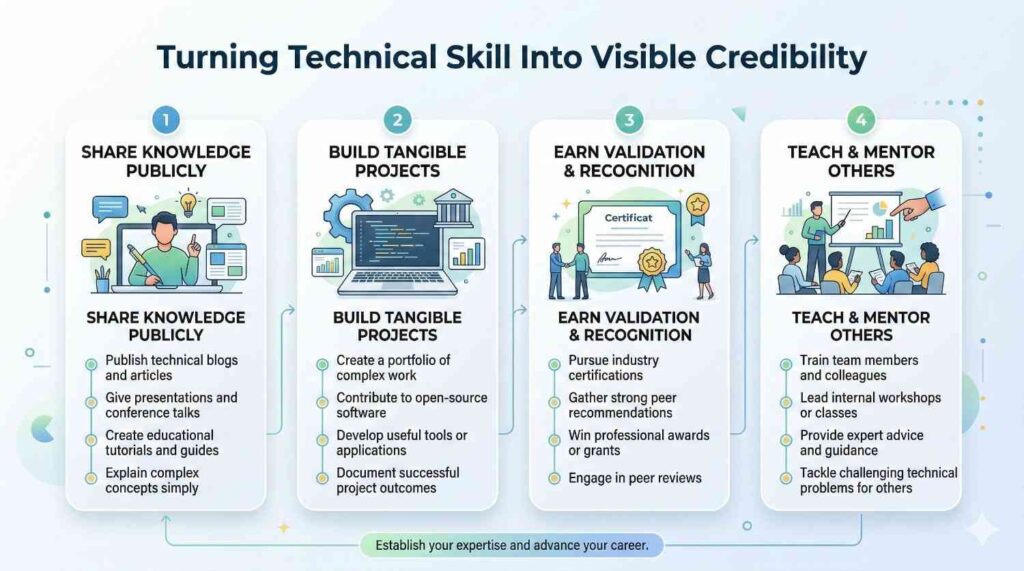
Many technical founders assume their ability will be obvious. It is not. You must translate your skill into visible outcomes. A clean demo that solves a real problem speaks louder than long explanations. Clear benchmarks also help others understand your level.
The goal is not to show everything you can do. It is to show the one thing that matters most for this problem. When people see that you can deliver the core value, they assume you can handle the rest.
Explain trade-offs without defensiveness
Strong founders do not pretend their system is perfect. They explain trade-offs clearly. They can say why they chose accuracy over speed, or cost over flexibility, or control over scale. This honesty builds trust.
When you explain trade-offs calmly, you show judgment. Judgment is more important than raw skill at the early stage. Investors and customers back founders who can make good calls under pressure.
Use IP to anchor your credibility
Patents and IP are not just legal tools. They are credibility tools when used well. A well-written patent shows that you understand your invention deeply and that you can explain it clearly. It also signals that you plan to build something lasting.
For deep tech founders, this is a powerful way to stand out early. Tran.vc helps founders turn their technical work into strong IP assets from the start, without forcing them to raise money too soon. If you want help shaping your credibility through smart IP strategy, you can apply here: https://www.tran.vc/apply-now-form/
Founder-market fit in fundraising conversations
Stop pitching the market, start pitching yourself in it
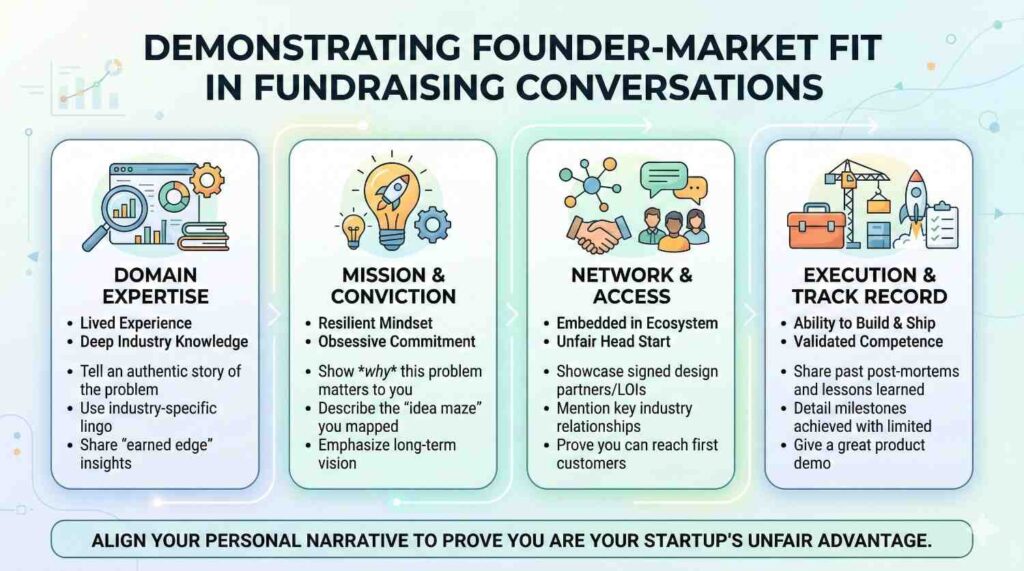
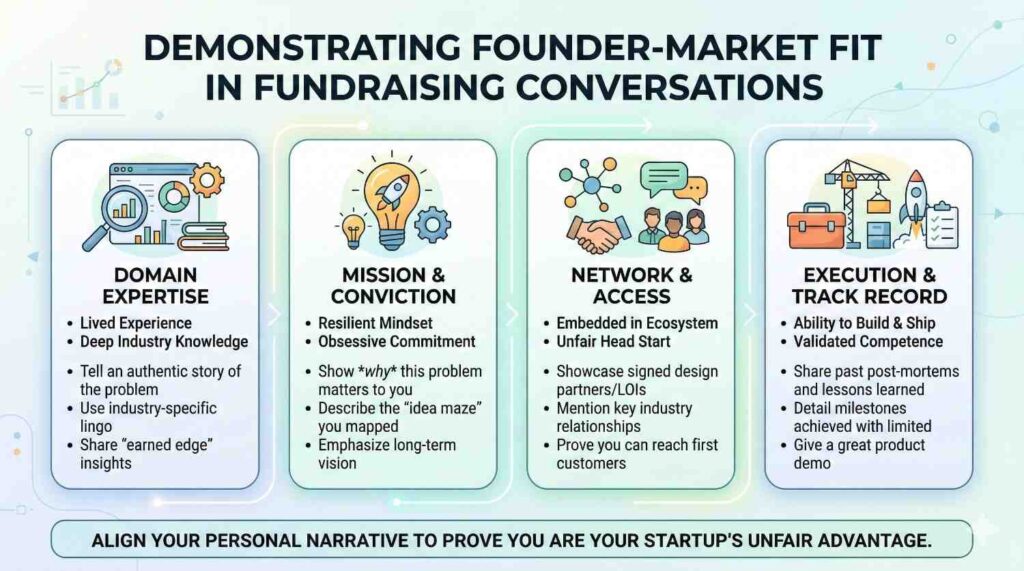
Most pitches spend too much time on market size and not enough on founder fit. Investors already know markets are big. What they want to know is why you will win inside that market.
When you speak, place yourself inside the story. Explain how your past work, choices, and learning connect directly to this problem. Do this naturally, without forcing it. Let it feel like a clear line, not a sales trick.
Answer doubts before they are spoken
Good founders learn to hear the unasked questions. If you are young, investors may doubt your experience. If you come from research, they may doubt your execution. If you come from industry, they may doubt your innovation.
You can address these doubts early by showing evidence. Share how you shipped fast, learned from failure, or led teams through change. This removes friction from the conversation and makes belief easier.
Show long-term commitment without drama
Founder-market fit also shows in how you talk about the future. You do not need to say you will work on this forever. You need to show that you understand the long road and that you are ready for it.
When you speak calmly about multi-year challenges, regulatory steps, or slow adoption, you show maturity. This steadiness is reassuring, especially in AI and robotics where timelines are rarely short.
Founder-market fit in customer trust
Customers trust familiarity, not polish
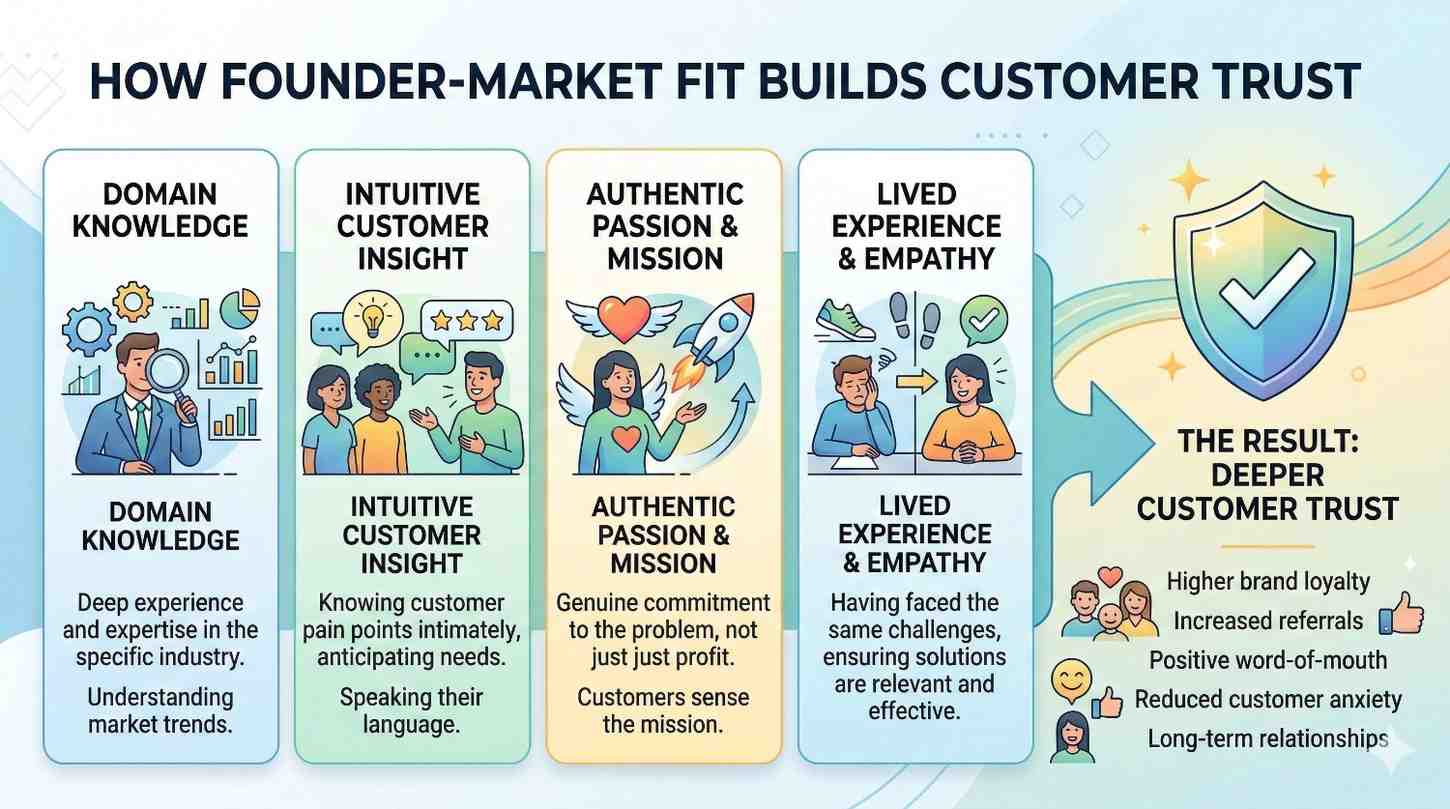
Customers want to feel understood. They do not care if your slides are perfect. They care if you understand their world. When you speak their language and respect their constraints, trust grows quickly.
This is where founder-market fit becomes a sales advantage. You are not pushing a product. You are solving a shared problem. That shift changes the tone of every conversation.
Early customers look for commitment
Early customers take risk by working with startups. They want to know you will not disappear when things break. Founder-market fit shows up when you stay close, respond fast, and take responsibility.
When customers see you personally involved, they believe in your commitment. This belief often matters more than features in the early days.
Fit compounds through referrals
When customers feel you truly get them, they talk. They introduce you to others like them. This kind of growth is slow but strong. It also creates a clear pattern around who your product is for.
That pattern helps you sharpen your focus and deepen your fit even more. Over time, your market starts to define you as much as you define it.
Using IP and patents to strengthen founder-market fit
IP clarifies what you actually do well
Many founders struggle to explain what is truly unique about their work. The process of building a patent forces clarity. You must define the core method, system, or process that makes your solution different.
This clarity improves your messaging, your roadmap, and your confidence. You stop hand-waving and start pointing to something concrete.
Patents signal seriousness early
In deep tech, patents send a clear signal that you are building real infrastructure, not a quick feature. They show that you are thinking about defense, scale, and long-term value.
This signal is especially useful before revenue. It helps investors and partners take you seriously even when the product is still early.
The right help matters
Bad IP work can waste time and money. Good IP work feels like strategy, not paperwork. Tran.vc was built to help founders do this the right way, with real patent attorneys and operators who understand early-stage pressure.
They invest up to $50,000 in in-kind patenting and IP services so founders can build defensible foundations without giving up control too early. If you want to turn your technical insight into lasting assets, apply anytime at: https://www.tran.vc/apply-now-form/
When founder-market fit becomes obvious
Others start telling your story for you
One clear sign of fit is when others explain your company well, even when you are not in the room. Investors summarize your edge accurately. Customers describe your value clearly. Team members repeat your priorities.
This happens when your fit is real and consistent. Your message stays stable because it comes from truth, not spin.
Decisions get easier, not harder
As fit grows, choices become clearer. You know which customers to serve, which features to build, and which opportunities to ignore. This focus saves time and energy.
You still face hard problems, but you face fewer confusing ones. That clarity is a hidden advantage.
You stop trying to prove yourself
At some point, you stop trying to convince people you belong. Your work does that for you. Conversations become calmer. Questions become deeper. People assume competence and focus on growth.
This is the quiet reward of founder-market fit. It does not shout. It steadies everything.