
Most founders wait too long to file patents. Not because they do not care. But because they are busy building, hiring, selling, and trying to stay alive. Then a funding round shows up, and suddenly everyone asks the same question:
“Where is the moat?”
This is where timing matters. Not “someday” timing. Not “when we have money” timing. Real timing. The kind that matches how investors think, how diligence works, and how fast competitors move.
In this guide, I will show you how to line up your IP filings with each funding step so you get the most leverage with the least waste. You will learn what to file, when to file, and how to avoid the two costly mistakes I see all the time:
One: filing too early, before the idea is clear, so you lock in weak claims.
Two: filing too late, after you have already shown the key parts in demos, decks, pilots, or public posts.
The goal is simple: when you raise, your IP story should already be in motion. Not a scramble. Not a “we will do it later.” A clean, calm plan that makes an investor feel safe.
Tran.vc exists for this exact problem. We invest up to $50,000 as in-kind patent and IP services so technical founders can build real protection early, without giving up control or chasing a big round too soon. If you want help turning your tech into defensible assets before your next raise, you can apply anytime here: https://www.tran.vc/apply-now-form/
Why timing matters more than “having patents”
The funding clock is not your product clock

Most teams build in loops. You ship, learn, and change the plan. Funding rounds are different. They follow a fixed rhythm: story, proof, diligence, and close.
If your IP work does not match that rhythm, you will feel stress at the worst time. You will rush filings, pay more, and still end up with weak coverage. Good timing turns IP into calm leverage, not a last-minute task.
Investors read IP as risk control
Many founders think patents are mainly about stopping copycats later. Investors often see them as a way to lower risk today.
A clean filing plan signals that your team knows what is core, what is optional, and what can be defended. It also signals that you understand how value is protected when the company is still young.
The real cost of bad timing
When you file too early, you often protect the wrong version of the invention. You spend money and time on claims that do not match what you will ship.
When you file too late, you risk losing rights in key markets, or you force investors to accept uncertainty. That uncertainty can show up as a lower price, more control terms, or slower diligence.
If you want a practical IP timing plan built around your next raise, you can apply anytime at https://www.tran.vc/apply-now-form/
The simple model: match IP moves to round milestones
Think in “proof points,” not in calendar dates
Founders ask, “Should I file before Seed?” A better question is, “What proof point will I show next?”
Your next proof point might be a customer pilot, a robotics demo, a model benchmark, or a manufacturing test. Each proof point often reveals something valuable. Your filing should happen before the proof point becomes public or widely shared.
Use three IP moments in every round cycle
In almost every round, there are three moments where IP work fits naturally: before the story goes wide, before diligence starts, and after the close when you can deepen coverage.
This keeps you from trying to do everything at once. It also lets you spend money when you have the most clarity, not when you are guessing.
Build a “core invention list” that stays stable
Your product will change. Your core inventions should not change as much. These are the pieces that make the system work in a way that is hard to copy.
In robotics, this might be control loops, safety logic, grasp planning, calibration, or sensing fusion. In AI, it might be training methods, data handling, model routing, inference speed tricks, or evaluation systems. You want this list early because it guides what you file first.
Tran.vc helps founders turn this core list into a real filing roadmap, without wasting effort. Apply anytime at https://www.tran.vc/apply-now-form/
Pre-Seed: when the idea is real but the company is still fragile
What “too early” looks like at Pre-Seed

At Pre-Seed, founders often file a patent on a concept slide. The problem is that a concept slide usually does not include the key engineering detail that makes claims strong.
A good patent needs a clear mechanism, not just a goal. “Reduce latency” is a goal. “A caching method that changes how tokens are stored and retrieved under specific conditions” is a mechanism. Pre-Seed is often the time when you are still discovering the mechanism.
What you should protect first at Pre-Seed
Pre-Seed protection works best when you focus on the smallest set of technical moves that make your approach different. You are not trying to patent the whole product. You are trying to lock in the heart.
This is the part you would hate to see in a competitor’s product a year from now. It is often a method, a pipeline, or a system design that is easy to explain to an engineer and hard to replicate without deep work.
How to use provisional filings without creating a mess
Provisional filings can be useful because they let you set an early date while you keep building. The mistake is treating provisionals like “rough notes.”
A strong provisional should read like a real document. It should describe the system, the steps, the variants, and the best mode you know today. That way, when you convert later, you are building on a strong base instead of rewriting under pressure.
The best Pre-Seed trigger for filing
A practical trigger is this: file when you are about to show the invention to people outside your tight circle, or when you are about to run a pilot where customers will see the inside of the system.
Demos, partner calls, and advisor intros seem harmless, but they spread fast. If you are about to share the “how,” not just the “what,” that is a strong sign you should file.
If you are at Pre-Seed and want to set a filing plan that fits your next investor conversations, apply anytime at https://www.tran.vc/apply-now-form/
Seed: when the story must become crisp and believable
What changes at Seed
At Seed, you are not just proving you can build. You are proving you can sell and repeat. Investors will ask how your tech stays special when you hire more people, ship faster, and face copycats.
This is where IP becomes part of the business story, not just a legal task. The timing matters because Seed rounds often move quickly once a lead is interested.
The Seed round “story window”
Before you start a wide outreach, you usually refine your deck, tighten your narrative, and prepare a demo. That is the story window.
Your best timing is to file right before that window opens wide. Then you can speak with more confidence. You can say, with truth, that your core inventions are already protected or in process.
What to file at Seed to support diligence
Seed investors do not need a giant portfolio. They need proof that the key ideas are being handled correctly. One solid filing on the main technical moat can do more than five weak ones.
If you have multiple inventions, prioritize the one that is hardest to detect from the outside. If a competitor could copy it by watching your product, protect it early. If it is mostly internal know-how that never shows, trade secret strategy may also matter.
How to talk about filings in a Seed deck without scaring people
Founders sometimes either hide IP or oversell it. Both backfire. A clean approach is simple: state what is filed, what is planned, and what the protection covers at a high level.
You do not need to give away details. You need to show that you have an intentional plan. Investors care less about fancy words and more about whether you can defend the thing that drives value.
The Seed trigger you should watch
A strong Seed trigger is when you move from one-off demos to repeatable deployments. The moment you standardize your pipeline, your hardware stack, or your model training loop, you are creating a blueprint others can follow.
That is often the moment to file. You are no longer guessing. You have a real system worth protecting.
Tran.vc can help you align Seed outreach with a filing plan so diligence feels smooth, not chaotic. Apply anytime at https://www.tran.vc/apply-now-form/
Seed Extension: when momentum is high and the temptation is to “wait”
Why Seed Extensions create IP drift

A Seed extension often happens because the company is making progress and wants more runway. The danger is that teams stop planning and start reacting.
In this phase, product changes can be rapid. If you do not keep your IP roadmap current, you can end up with a mismatch between what you built and what you protected.
The right way to add filings during a Seed Extension
This is often the best time to file on second-layer inventions. These are not the “core heart” claims. They are the supporting parts that make performance, safety, or cost better.
In robotics, this might be a new calibration method or fault detection method. In AI, this might be a method for reducing compute, improving eval, or handling edge cases safely.
The trigger to file during an extension
File when your system has stabilized enough that you can describe it clearly, but before you publish results widely.
Extensions sometimes include press, conference talks, and hiring pushes. Those create exposure. If you are about to become more visible, you want protection already in motion.
If you are in a Seed extension and want to keep your IP aligned with what you are building, apply anytime at https://www.tran.vc/apply-now-form/
How to Time Your IP Filings with Funding Rounds
Series A: when diligence gets serious and “defensibility” becomes a pricing factor
What Series A investors are really buying
At Series A, many investors assume your team can build. They now focus on whether your company can keep winning as the market wakes up.
They are buying a path to scale. That path includes tech, but it also includes protection. If a competitor can copy your key method in six months, your growth story looks fragile. That fragility shows up in valuation and in deal speed.
The Series A diligence lens on IP
Series A diligence usually goes deeper than Seed. People ask where your inventions came from, who built them, and who owns them.
They also ask if your filings match your real product. If the patents sound like an old version of the system, investors worry you are not managing the details. That worry can slow the round, even if your numbers are strong.
What “ready” looks like by the time Series A starts
You do not need a huge patent stack. You need an IP story that is complete and easy to follow.
That story should show three things: you have protected the core invention, you have a plan for the next layer, and you are not risking ownership problems. When those are in place, diligence feels clean.
What to file before you start Series A outreach
The best Series A filing set usually covers the engine and the edges. The engine is the main technical system that drives the unique outcome. The edges are the practical parts that make it deployable.
For robotics, that might mean the control approach plus the safety and calibration layer that makes it reliable in the field. For AI, that might mean the training or inference approach plus the system that makes it stable, fast, and safe in real use.
The key Series A trigger: “repeatable revenue meets repeatable tech”
A useful way to time filings is to watch for the moment when your business becomes repeatable and your tech becomes repeatable at the same time.
If you are selling a similar deployment again and again, and the engineering path looks the same each time, your system is now a template. Templates get copied. That is when you want your strongest filings already in process.
If you want Tran.vc to help you shape a Series A-ready IP plan while you stay focused on growth, you can apply anytime at https://www.tran.vc/apply-now-form/
How to plan your “diligence packet” so IP never becomes a scramble
Why a diligence packet lowers stress

Founders often fear IP questions because they think they need to reveal secrets. You do not. You need to show control and clarity.
A simple diligence packet helps you do that. It also saves time because your team is not rebuilding answers for every investor. You make one clean set of materials and reuse it.
What goes inside the IP part of the packet
You want to include proof of ownership and a clear map of what is filed. This is not about fancy charts. It is about being easy to understand.
The best packets make it simple to answer, “What do you have?” and “Why does it matter?” without giving away the entire playbook.
How to handle “we haven’t filed yet” without losing the round
Sometimes a founder is early and has not filed. That does not always kill a deal, but it raises questions.
If you are in this spot, do not hand-wave it. Explain your plan with dates and triggers. Show that you know what should be protected and why, and that you have already started the process. Investors forgive early stage gaps when they see fast, mature action.
How to prevent ownership issues before they appear
Ownership issues are often not about malice. They come from messy early days. A contractor writes code, a co-founder leaves, a university project blends into a startup, or a prior employer has unclear rights.
You want clean assignments and clean records before Series A diligence begins. If you wait, you may be forced to fix it under time pressure, and pressure causes mistakes.
Tran.vc works with real patent attorneys and startup operators to keep this clean from day one. Apply anytime at https://www.tran.vc/apply-now-form/
The “three-window” approach for every round, explained in plain terms
Window one: before you widen the circle

This is the moment right before you start showing the real system to more people. It often happens when your deck is done, your demo works, and you are starting to book many meetings.
File before this window if your meetings will include detailed architecture, performance tricks, or workflow steps that a sharp person could copy.
Window two: right before diligence gets deep
Once a lead investor is serious, they may pull in technical advisors, partners, or legal review. They will ask specific questions.
If you file right before this stage, you reduce the risk that you will need to either disclose too much or dodge questions. A filed application lets you speak with more comfort because the date is set.
Window three: after the close, when you can go broader
After a round closes, founders often hire, ship, and expand. This is also when you have more clarity about what the product really is.
This is a strong time to add supporting filings that protect real-world deployment details. You are no longer guessing. You are capturing what works.
How to avoid the most common timing mistakes that quietly hurt valuation
Mistake one: filing only when investors ask

When you file only because an investor asked, you are already behind. That means you will either rush or accept weak coverage.
It also signals that you did not plan. Even if the investor never says it out loud, that signal stays in the room.
Mistake two: waiting for “the final version”
There is no final version. Products evolve. Models change. Hardware revs. Data grows.
If you wait for perfect, you lose time and you risk public exposure. The goal is to file when the invention is clear enough to describe well, not when you believe nothing will change.
Mistake three: filing too many small things
Some teams file on every small feature. That can burn budget and distract the team.
A better approach is to focus on inventions that change how the system works, not just what the user sees. Protect the methods, the pipelines, and the system design choices that create the results.
Mistake four: treating IP as separate from product planning
IP should move with product milestones. If your product roadmap says, “We will launch pilots in March,” your IP roadmap should say, “We will file before pilots show the inside of the system.”
When the two roadmaps are separate, you miss triggers and scramble later.
If you want a roadmap where product milestones and IP actions stay linked, apply anytime at https://www.tran.vc/apply-now-form/
A practical way to build an IP calendar that matches your raise
Start from the date you want money in the bank
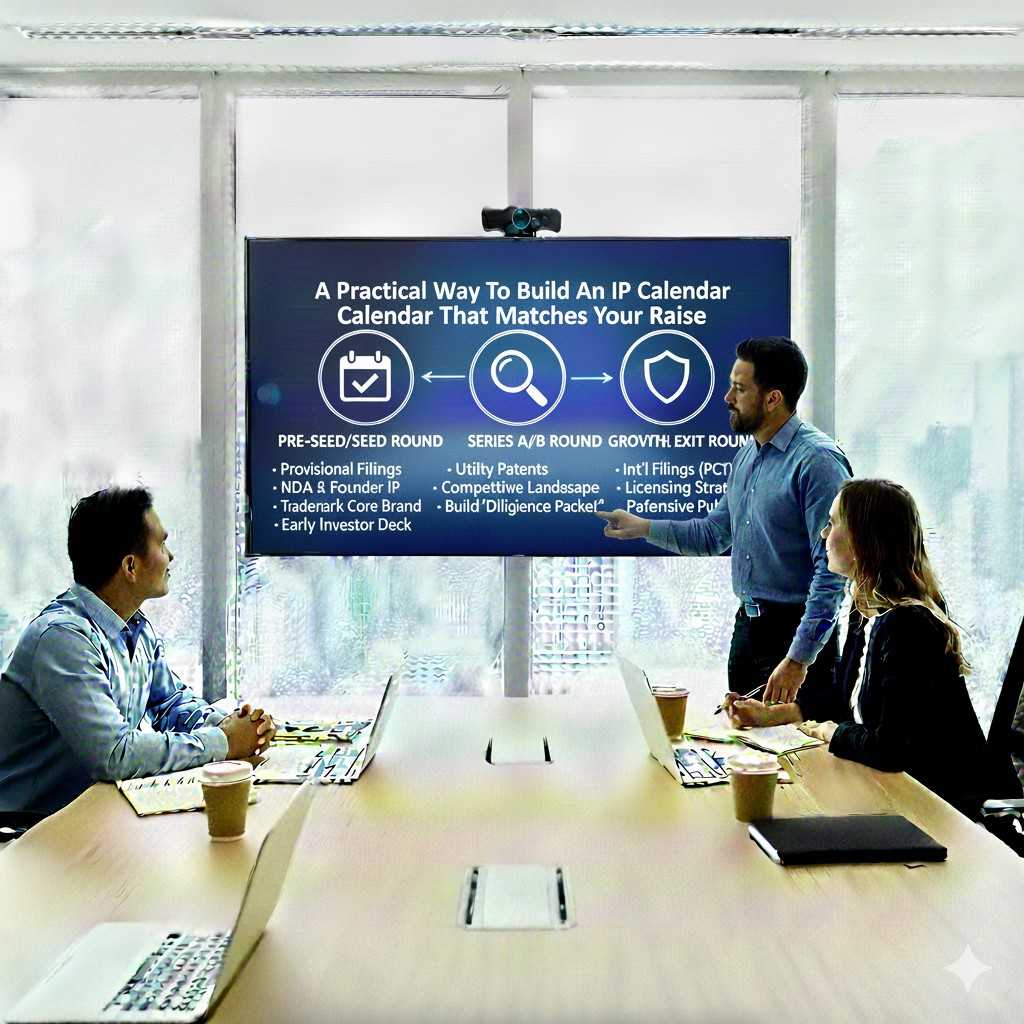
Work backward from the day you want the round closed. Not the day you want to start pitching.
Most founders underestimate how long it takes to get from first meeting to signed term sheet to close. If you plan IP work based on the close date, you are less likely to be surprised.
Tie filings to what will be shown, not what will be built
Founders think, “We will build feature X in six weeks.” That is not the key date.
The key date is when feature X will be shown to a customer, a partner, a new hire, or an investor in a way that reveals the method. Your filing should happen before the reveal.
Use “demo readiness” as a simple trigger
A demo is often the moment you stop experimenting and start presenting. Presenting creates exposure.
If your demo includes the special part of the system, that is a clean trigger to file. It does not matter if the demo is internal at first. Internal demos become external quickly.
Make room for iteration without rewriting everything
A smart filing plan expects change. You file a strong core early, then you add follow-on filings when the next layer becomes clear.
This prevents you from trying to predict the future in one document. It also prevents you from leaving value unprotected while you wait.