
Most deep tech startups begin the same way: a smart team, a real breakthrough, and a messy pile of notes, code, test data, and late-night fixes.
And then reality hits.
If you do not protect what you built, you do not really own it in the way investors care about. A competitor can copy the idea. A bigger team can publish first. A partner can walk away with the key insight. Or you can accidentally share the best part too early and lose the chance to patent it.
This article is about the milestones that matter most from “lab work” to “patent-ready asset.” Not in a theory way. In a real-world way that helps you move faster, stay safe, and build a moat around what makes you different.
Tran.vc helps founders do this early. We invest up to $50,000 in in-kind patent and IP services for AI, robotics, and other hard tech teams—so you can turn your work into defensible assets without giving up control too soon. If you want help with your patent roadmap and filings, you can apply anytime here: https://www.tran.vc/apply-now-form/
Milestone 1: The moment your “experiment” becomes an invention
What changes when lab work turns into IP

In the lab, it is easy to say, “We are still testing.” That feels safe, because it keeps pressure low. But patent work does not wait for a polished product. Many strong patents start when you find a new way to solve a hard problem, even if the rest of the system is still rough.
A simple signal is this: if another skilled engineer sees what you did and says, “That is a clean solution,” you may already have an invention. The value is often in the method, the system design, or the special setup that made the result possible.
The first clue is usually a “jump” in results
Most inventions show up as a jump, not a slow climb. One week the robot fails on a messy floor, and the next week it handles clutter. One month the model drifts, and then it suddenly stays stable for long runs. Those jumps matter because they often come from one key idea.
When you see a jump, do not rush past it. Pause and capture what changed in plain words. Write down what the system could not do before, what it can do now, and what exact choice created the change.
A quick habit that protects you without slowing you down
When a breakthrough test works, take 20 minutes the same day. Create a short “invention note” that explains the idea like you are teaching a new teammate. Add the messy details too, because the messy details are often where the invention is hiding.
If you want a team that helps you spot those invention moments early, Tran.vc does this with founders while they are building. You can apply anytime here: https://www.tran.vc/apply-now-form/
Milestone 2: Clean invention notes that a stranger could follow
Why patent work needs a different kind of note
Founders usually have notes, but patent notes must do a special job. They must be clear enough that a skilled person could rebuild the idea without you sitting next to them. That does not mean you share it publicly. It means you can explain it clearly to your patent team so they can write strong claims.
When notes are weak, filings become narrow. Narrow filings leave gaps. Gaps are where competitors slip through.
What strong invention notes actually contain
Strong notes start with the problem in simple words. Then they explain what common approaches do and why those approaches fall short. After that, they explain your solution as steps or blocks, so the shape of the idea is obvious.
The most important part is this: you must include what is required and what is optional. If you only describe the one version you tested last Friday, you may protect only that one version. If you describe the idea and its variations, you protect the space around it.
How to find variations without getting stuck in theory
A fast way to find variations is to think like a copycat. Imagine a competitor trying to copy your result while avoiding your exact design. What would they swap to look “different” on paper? Would they change the sensor, replace a module, alter the training setup, or move compute from edge to cloud?
Each swap idea is a clue for a variation you should describe in your notes. This is how you build coverage that lasts even as your product evolves.
Tran.vc helps teams turn raw lab wins into clean invention disclosures that lead to strong filings. If you want that support, apply anytime: https://www.tran.vc/apply-now-form/
Milestone 3: You stop “showing” the invention before you protect it
The disclosure trap founders fall into

Founders want to share demos, pitch partners, recruit talent, and post progress. All of that is normal. The risk is that the most exciting part of your work is often the exact part that should not be revealed before filing.
In many countries, public disclosure before filing can block patent rights. Even where rules are more forgiving, waiting can still reduce your options and weaken global coverage.
A safer way to communicate progress
You do not have to go silent. You can talk about outcomes while being careful with mechanisms. Outcomes are what the system achieves. Mechanisms are how the system achieves it.
For example, you can say you improved stability, reduced power use, or raised success rates in hard settings. But you should be cautious about sharing the exact method, the full system diagram, or the detailed steps that make it work.
NDAs help, but they do not replace filings
NDAs are useful for some partner talks, but they are not a shield. Some investors will not sign. Some partners will delay. Even with a signed NDA, enforcing it is slow and costly.
A filing gives you a stronger position. It lets you speak more freely, recruit with confidence, and negotiate from a place of strength.
If you want to build an IP plan that fits your fundraising path and your launch timing, Tran.vc can guide that early. Apply anytime: https://www.tran.vc/apply-now-form/
Milestone 4: You confirm what is truly new, not just “better”
“Better” is not always patentable
Many teams assume a patent is only for something that is “better.” But patents care about what is new and not obvious. A small change can be patentable if it creates a new result in a way others would not expect.
At the same time, not every improvement is worth filing. Some improvements are routine tuning that a skilled person would try. The goal is to find the parts of your work that are both new and defensible.
The difference between a strong core and a weak edge
A strong core is the part of your system that others cannot easily copy without stepping on your idea. A weak edge is a surface change that can be replaced with a simple alternative.
A good milestone here is when you can point to your core in simple words. You can say, “This is the key method,” or “This is the key system behavior,” and you can explain why competitors would struggle to reach the same result without it.
A practical way to test novelty without wasting weeks
You do not need a full research project to start. You can do a quick check by searching for the closest public work, then asking, “Do they teach the same method or only a similar goal?” Often you will find papers that describe the goal but not your exact path.
This is also where an experienced patent team adds speed. They know how to frame your invention against what exists, so you do not undersell it.
Tran.vc supports founders through this step with real patent experts who have seen early-stage patterns before. Apply anytime: https://www.tran.vc/apply-now-form/
Milestone 5: You choose what to patent and what to keep as a trade secret
Not everything should be patented

A patent is a bargain: you disclose the idea, and in return you get rights for a limited time. That trade can be great for deep tech, but it is not always the best move for every detail.
Some parts of a system are better kept as trade secrets. This is common for data pipelines, special datasets, internal tuning rules, or operational tricks that are hard to reverse engineer.
The simple rule that helps teams decide
If a competitor can learn it by taking your product apart, consider patenting it. If a competitor cannot easily learn it from the outside, and it would be hard to prove they copied it, trade secret may be safer.
This choice is not about ego. It is about building a moat that fits how your tech will be used in the real world.
Why this milestone matters to investors
Investors do not expect you to patent everything. They expect you to know what matters and why. When you can explain your choices with calm logic, you look prepared and you look serious.
Tran.vc helps founders make these calls early, before rushed fundraising forces rushed IP decisions. You can apply anytime here: https://www.tran.vc/apply-now-form/
Milestone 6: You file early enough to create leverage, not panic
Filing is a strategy move, not a finish line
Many founders think of filing as something you do at the end, once everything is perfect. In reality, early filings are often what give you room to breathe. They let you keep building while knowing the core idea is protected.
An early filing does not lock you in. It creates a timestamp. That timestamp is powerful because it marks when your invention officially exists in the eyes of the law.
Why waiting often creates more risk than safety
When teams wait too long, filing becomes rushed. Rushed filings miss variations. They focus only on the current build. They leave gaps that competitors can use later.
Worse, waiting often overlaps with fundraising. That is when pressure is highest and time is shortest. IP decisions made under pressure are rarely the best ones.
How early filings help fundraising conversations
When you can say, “We have filed on our core method,” the tone of the room changes. You do not need to overshare. You do not need to dance around details. You can focus on vision and execution.
This is not about impressing investors with paperwork. It is about showing that you understand how to protect value early.
Tran.vc structures IP work so filings support your fundraising timeline instead of colliding with it. If you want that alignment, apply anytime: https://www.tran.vc/apply-now-form/
Milestone 7: You design claims for how the product will evolve
Products change, patents should still fit

What you ship in year one is rarely what you sell in year three. Models get faster. Hardware gets smaller. Use cases expand. If your patent only fits version one, its value fades quickly.
This milestone is about lifting your view. You step back and ask how the idea might live in different forms over time.
Thinking in systems instead of parts
Strong claims often describe systems and flows, not just parts. They focus on how components interact, not only what those components are.
For example, the invention may not be the sensor itself, but how sensor data is handled, filtered, and acted on in a specific context. That interaction is harder to design around and more likely to stay relevant.
Why this matters more in AI and robotics
In AI and robotics, surface details change fast. Architectures shift. Frameworks evolve. But core ideas about how data is used, how decisions are made, or how machines adapt can last for years.
Designing claims with that in mind helps your IP age well instead of becoming a historical note.
Tran.vc works with founders to future-proof claims so IP grows with the company. Apply anytime: https://www.tran.vc/apply-now-form/
Milestone 8: You align IP with your go-to-market path
IP should support how you plan to win
A startup selling enterprise robotics has different IP needs than one licensing models or selling developer tools. The same invention can be framed in different ways depending on how value flows.
This milestone is about making sure your IP matches your business path, not just your tech stack.
Blocking competitors where it hurts them
Good IP blocks competitors at their choke points. That might be deployment, training, integration, safety, or cost reduction. The goal is not to block everything. It is to block the parts that matter most to your customers.
When IP lines up with go-to-market, it becomes a business weapon, not a shelf asset.
Why this clarity shows maturity
When founders can explain how their patents support sales, partnerships, or licensing, they sound grounded. Investors hear that you are not filing for vanity. You are filing with intent.
Tran.vc helps founders connect IP strategy directly to revenue strategy early on. You can apply anytime here: https://www.tran.vc/apply-now-form/
Milestone 9: You build an IP habit, not a one-time event
IP is ongoing, not a checkbox

Many teams file once and move on. Strong teams build a habit. They keep capturing ideas as the product grows. They review new breakthroughs regularly. They treat IP as part of engineering, not a legal chore.
This habit keeps you ahead. It also reduces stress, because nothing piles up.
Small reviews prevent big misses
A short monthly or quarterly review is often enough. You look back at what changed. You ask if any new ideas crossed the “invention line.” You decide whether to capture or wait.
This rhythm keeps your IP map clean and current.
Why this matters as the team grows
As more engineers join, ideas spread across the team. If only founders think about IP, things get missed. When invention capture becomes normal, everyone helps protect value.
Tran.vc encourages this habit from the start, so IP grows with your team. Apply anytime: https://www.tran.vc/apply-now-form/
Milestone 10: You can explain your IP story in plain words
Investors do not want legal lectures
Most investors are not patent experts. They want a clear story. What is protected? Why it matters. How long it can matter.
If you can explain this without jargon, you sound confident and prepared.
A simple structure that works
You explain the problem you solved, the core idea you protect, and how that protection blocks copying. You do not list claim numbers. You do not dive into legal language. You keep it human.
This story becomes part of your pitch, your data room, and your long-term narrative.
Why clarity builds trust
Clear IP stories signal focus. They show that you are not guessing. They show that you understand how value is built and defended over time.
Tran.vc helps founders shape this story so it supports fundraising and growth. You can apply anytime here: https://www.tran.vc/apply-now-form/
Milestone 11: You use patents to slow others down, not just protect yourself
Patents are about time, not ego
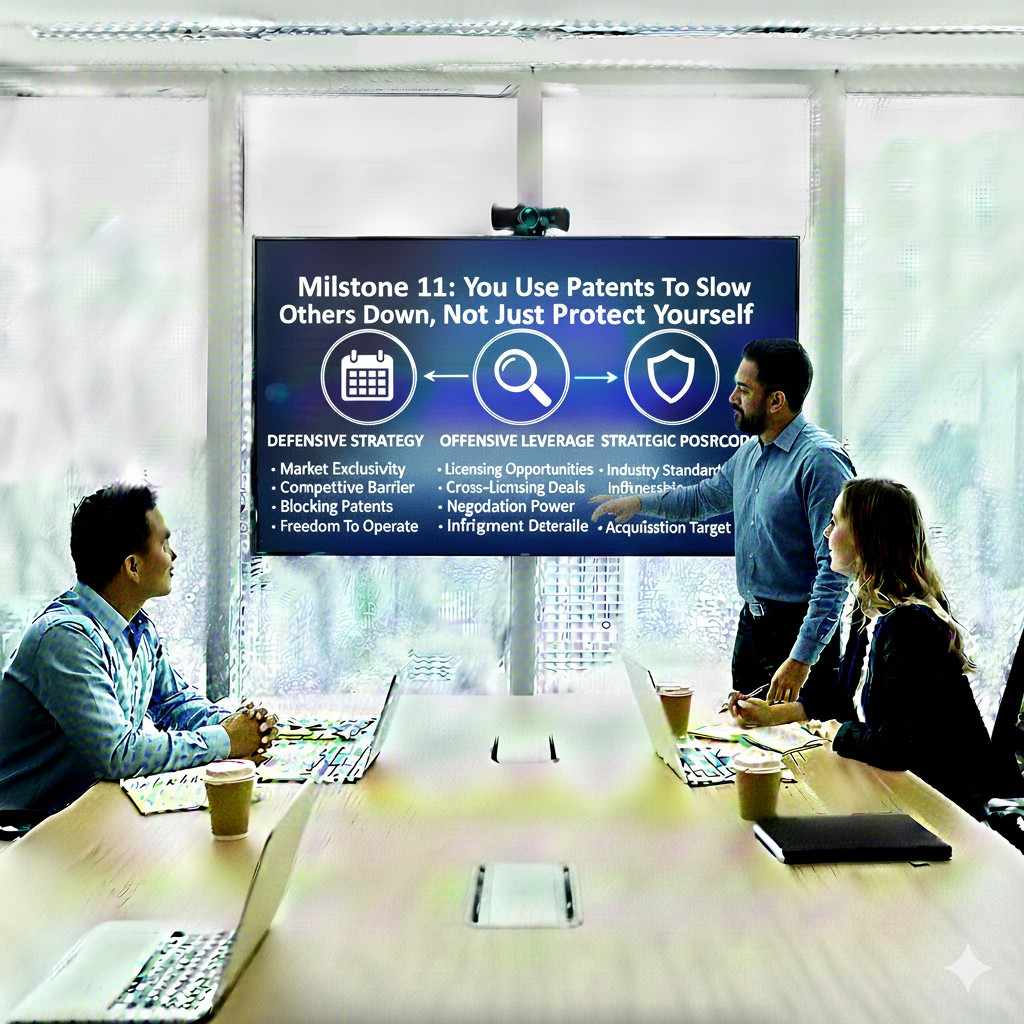
Many founders think patents are about winning arguments in court. In reality, for early-stage companies, patents are about time. They slow competitors down. They force others to think twice before copying or shipping something too close to your idea.
Time is what lets you learn faster, sell earlier, and build trust with customers.
How real protection shows up in the market
Strong patents often change behavior quietly. Competitors redesign their systems. Partners treat you with more respect. Acquirers take you more seriously. You may never see a lawsuit, and that is usually a good sign.
The goal is not to fight. The goal is to make copying expensive and risky.
Why early teams benefit the most from this leverage
Large companies can afford long battles. Startups cannot. That is why early protection matters. It shifts the game from speed alone to speed with safety.
Tran.vc focuses on building this kind of leverage early, before the stakes get high. Apply anytime: https://www.tran.vc/apply-now-form/
Milestone 12: You understand how IP supports partnerships and exits
IP shapes how others work with you
When you talk to partners, your IP position affects the deal. Strong IP can mean better terms, clearer boundaries, and more respect. Weak or unclear IP can lead to hesitation and delays.
This milestone is about knowing what your IP allows you to say “yes” to, and what it helps you say “no” to.
Acquirers look for clean ownership
If acquisition is a possible path, clean IP matters early. Buyers want to know that what they are buying truly belongs to you. They look for filings that match the product and team.
When IP work is done early and well, due diligence is smoother and faster.
Why this reduces founder stress later
Cleaning up IP late is painful. It is slow, costly, and full of risk. Doing the work early turns future conversations into confirmation, not correction.
Tran.vc helps founders build IP that stands up in partnerships and exits. You can apply anytime here: https://www.tran.vc/apply-now-form/
Milestone 13: You treat IP as a core asset, not a side task
The mindset shift that changes everything

The biggest milestone is mental. You stop seeing IP as paperwork and start seeing it as part of the product. It sits next to code quality, system safety, and customer trust.
This shift changes how decisions are made. Teams slow down just enough to capture value without losing momentum.
Why this mindset attracts better investors
Investors who understand deep tech look for founders who think this way. It signals maturity and long-term thinking. It shows you are building something meant to last.
This does not mean you move slower. It means you move with intention.
How Tran.vc fits into this approach
Tran.vc was built by operators and engineers who have been through this cycle themselves. The focus is not on flooding you with filings. It is on building the right protection at the right time.
They invest up to $50,000 in in-kind patent and IP services, so you can build defensibility before raising large rounds and giving up control.
Closing: From lab work to lasting value
Every deep tech company starts in the lab. What separates lasting companies from forgotten ones is how well they turn early insight into protected value.
The milestones in this article are not about slowing you down. They are about helping you move forward without leaving your best ideas exposed. When IP is handled early and thoughtfully, it becomes quiet support under everything you build.
If you are working on AI, robotics, or other hard tech, and you want help turning your inventions into real assets, Tran.vc is built for that stage.
You can apply anytime here:
https://www.tran.vc/apply-now-form/