
Most founders think about IP only when investors ask, “Do you have patents?” That is late. A better way is to build IP at the same time you build the tech, step by step, like you build your product.
One simple way to do that is to map your IP outputs to TRL, or Tech Readiness Levels. TRL is a common scale used in deep tech to describe how “real” a technology is, from early idea to proven system.
At Tran.vc, we help robotics, AI, and deep tech teams turn every TRL step into real IP assets—so you raise with leverage, not hope. You can apply anytime here: https://www.tran.vc/apply-now-form/
TRL is not just for engineers. It is also an IP roadmap.
TRL helps you answer a hard question: “What do we know is true right now?”
That same question is the heart of good IP. Patents are not prizes for being first. They are tools that protect what you proved, what you built, and what you learned in a way others cannot copy.
When you map IP outputs to TRL, you stop doing random patent work. You stop filing too early with weak claims. You stop waiting so long that your best ideas leak into papers, demos, GitHub, customer decks, or hiring.
Instead, you create a clear path:
- At early TRL, your output is mostly insights, models, and design choices.
- In the middle TRL, your output becomes test results, prototypes, and working methods.
- At later TRL, your output becomes full systems, manufacturing choices, and performance proof.
Each stage creates different IP. And each stage needs a different IP move.
This is what founders miss: IP is not one thing. It is a stack. It includes patents, trade secrets, data rights, code controls, invention records, and how you talk about the work in public.
So let’s map it.
Mapping IP Outputs to TRL (Tech Readiness Levels)
Why this article exists
Technical founders often treat IP like paperwork that happens “after the product works.” That timing is risky. When you wait, your best ideas leak into demos, customer calls, hiring talks, conference slides, or code reviews that spread beyond your team.
The smarter move is to build IP in step with your technology. This is where TRL, or Tech Readiness Levels, becomes a clean guide. TRL shows what stage your tech is in, from early concept to proven system. When you map IP outputs to TRL, you stop guessing what to protect and when to protect it.
Tran.vc supports this approach by investing up to $50,000 in in-kind patent and IP services for robotics, AI, and other deep tech startups. If you want to build an IP-backed foundation early, you can apply anytime at https://www.tran.vc/apply-now-form/
What “IP outputs” really means
Most people hear “IP” and think “patent.” In real founder life, IP outputs are broader than that. They include inventions worth patenting, yes, but also trade secrets, invention records, ownership controls, and the way your team describes the work in public.
An “IP output” is any artifact that strengthens your right to win. It can be a written invention disclosure, a patent filing, a protected process, a data pipeline that stays private, or a clear internal record that shows who invented what and when.
Why TRL is the best frame for deep tech founders
Deep tech does not move in one jump. It moves in steps. TRL makes those steps visible. That visibility helps you make better IP choices because each TRL stage creates different technical truth, and patents are built on technical truth.
When your TRL increases, your IP can become broader, stronger, and easier to defend. This is why TRL is not only an engineering status update. It is also an IP roadmap that keeps your moat growing as your product grows.
TRL 1–2: From idea to basic proof
What is “real” at TRL 1–2
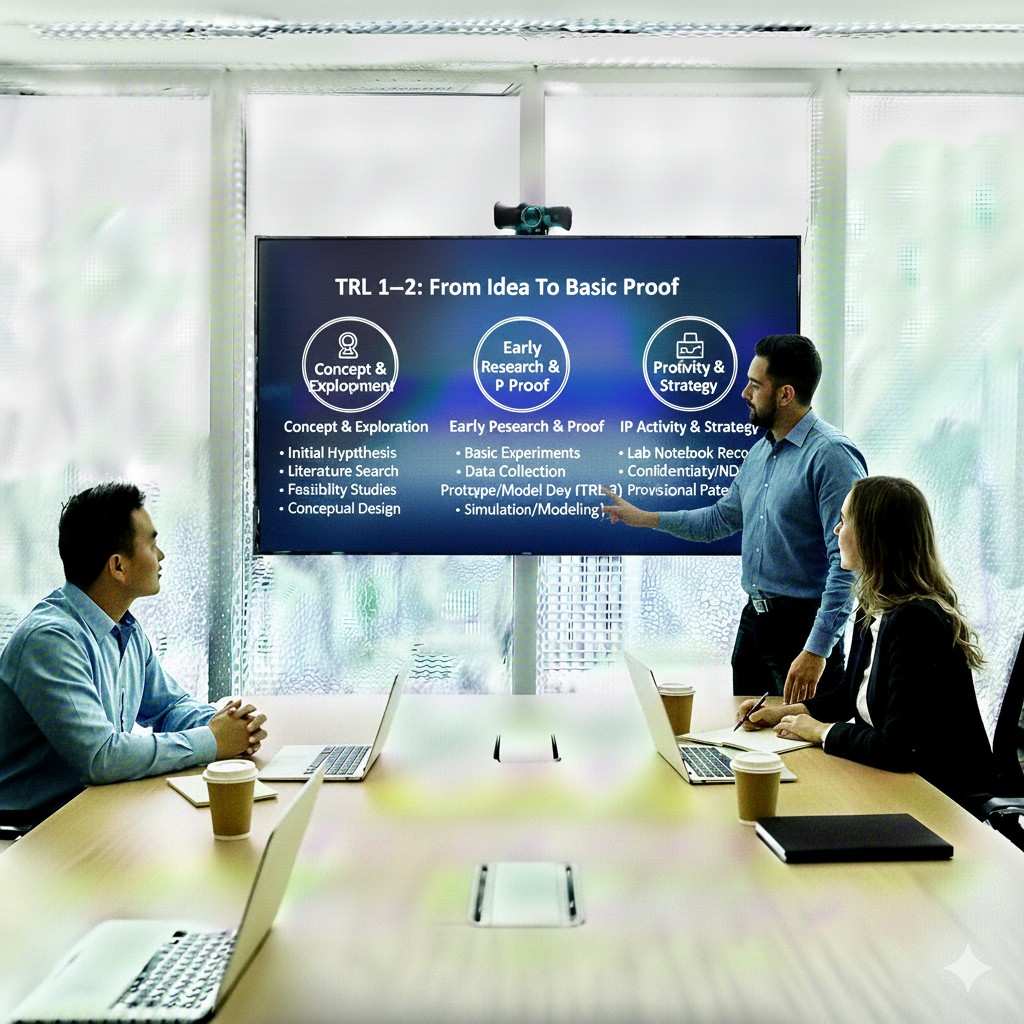
At TRL 1, you have a problem worth solving and a technical idea that might solve it. At TRL 2, you have shaped that idea into a clearer concept that can be explained, tested, and challenged.
Many founders assume they cannot do IP work here because they do not have a prototype. In practice, this stage can produce some of the most important IP, because this is when you make the core design choices that decide how the system will work.
The IP output is the insight, not the device
Early on, your strongest protectable value is often the “reason it works.” That reason might be a control strategy, a training method, a system structure, or a specific way of handling messy real-world inputs.
In robotics, this might be a new approach to motion planning in tight spaces, a safer fallback method, or a sensor fusion trick that stays stable under vibration. In AI, this might be a training method that cuts cost, a pipeline that reduces errors, or a model behavior rule that improves reliability.
How to capture IP without slowing down your build
At TRL 1–2, your goal is not to file everything. Your goal is to capture the best inventions while they are fresh and before they leak. You do that by logging key ideas in a simple, repeatable way.
When your team discovers a new method or a clean technical reason for performance, write it down with a date and the names of the inventors. Include what problem it solves, how it works, and why it is different from the usual way. This becomes the raw material for strong filings later.
The biggest risk at TRL 1–2: talking too soon
Founders are told to “share and get feedback.” That is good advice for product. It can be bad advice for IP if you share the wrong details before you file. Public disclosure can limit patent options in many places and can also make it easier for competitors to copy your approach.
This is why you need a simple disclosure habit. Before you publish a post, show a demo, present at a meetup, or send a detailed deck to outsiders, run a quick IP check. If you want Tran.vc to help you set this up, apply anytime at https://www.tran.vc/apply-now-form/
TRL 3: Proof of concept
What changes at TRL 3
TRL 3 is where you move from “we believe” to “we can show.” You might have a lab demo, a simulation that matches measured results, or a small prototype that proves the core idea under controlled conditions.
This stage matters because patents get stronger when you can explain the invention with real steps, real parameters, and real evidence. Even a small proof can unlock claims that are much harder to challenge later.
Turning engineering work into patent-ready invention language
Engineers often describe the work in build terms. Patent work describes the same thing in method terms. The meaning stays the same, but the structure becomes clearer and more defensible.
For example, an engineer might say, “We used a second control loop so the robot stays stable when the payload changes.” In invention terms, that becomes a method where an outer loop estimates payload variation and adjusts inner loop behavior to keep stability. This translation is where many valuable patents are born.
Building an IP map instead of filing random patents
At TRL 3, a common mistake is filing one patent because “we should have something.” That can lead to a narrow filing that does not protect the real moat.
A better approach is to map the invention family. You identify the core invention, then the key variations, then the likely copy paths. This does not mean you file everything today. It means you know what you would file if a competitor starts circling or if a major disclosure is coming.
When a provisional filing makes sense
A provisional filing can be a smart move at TRL 3 when three things are true: the invention is clear, the business value is real, and you are likely to disclose soon. The goal is to lock an early date and buy time to refine the claims as the tech matures.
The warning is that a weak provisional can create false confidence. If the write-up is vague, you may not get the protection you think you are getting. This is why founder teams benefit from real patent support early. Tran.vc invests in this work so you can file with intention. Apply anytime at https://www.tran.vc/apply-now-form/
TRL 4: Lab validation
What “validation” means in IP terms
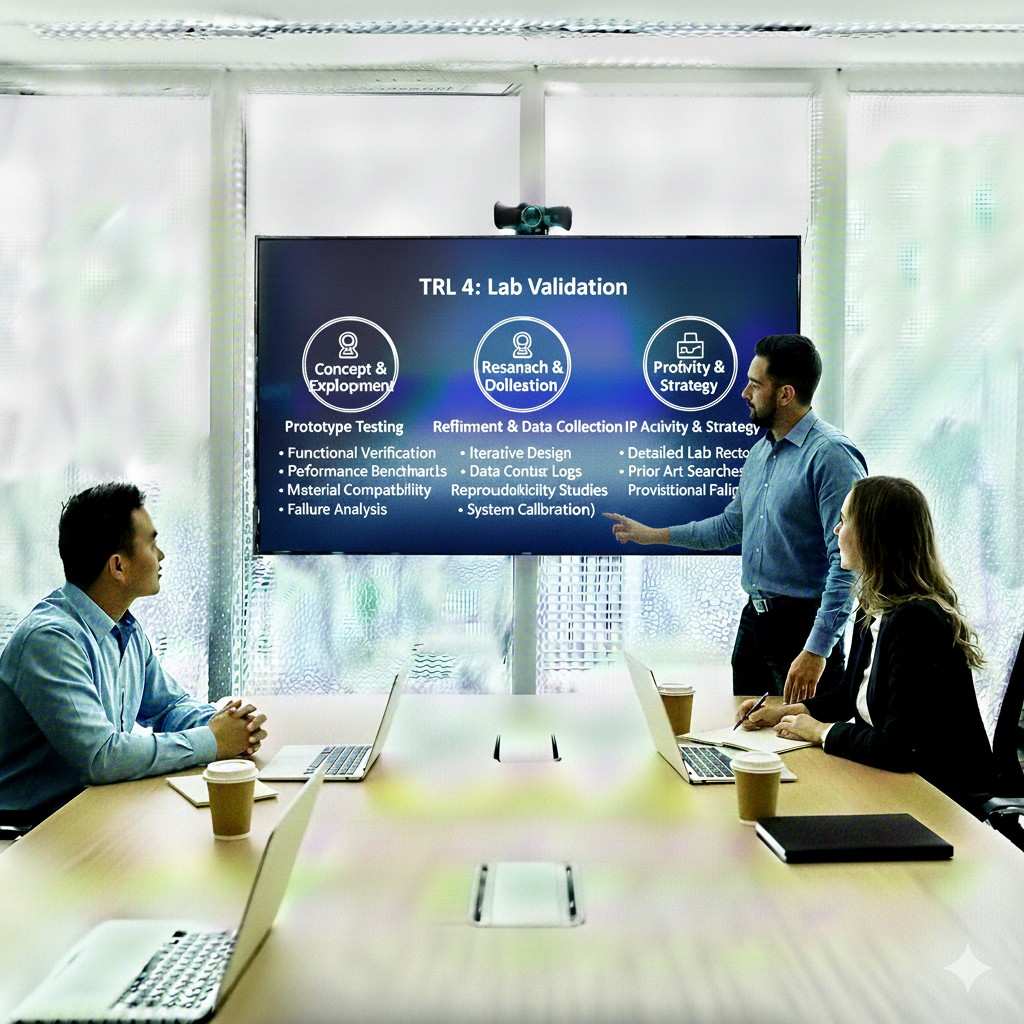
At TRL 4, you are no longer proving only one clever idea. You are proving a subsystem or component can run in a repeatable way in a lab environment. This creates a new type of IP output: performance relationships that can be described clearly and supported by test data.
Patents become stronger when you can show how inputs, steps, and settings link to measurable results. This is where your test logs and experiment write-ups stop being internal notes and start becoming claim power.
The IP output is repeatability and robustness
Competitors can often copy a broad concept. What they struggle to copy is a system that works reliably. Reliability comes from handling edge cases, failures, drift, noise, and variation in materials or environments.
If your lab results show stability under changing loads, reduced error under poor lighting, better outcomes under noisy data, or safer behavior under failures, those details can support stronger claims. They also give investors more confidence because they show the tech is not fragile.
The best founder habit at TRL 4: protect what you measure
At this stage, founders should treat testing as an IP activity, not only a technical activity. When you run a new test that proves something important, capture what you tested, what you learned, and what changed in the design as a result.
This is also the stage where trade secrets become more valuable. Some parts of your system may be better kept private, especially if they are hard to reverse engineer and give you an ongoing advantage. The right plan usually mixes patents and secrets, and it changes as TRL moves up.
TRL 5: Validation in a relevant environment
What “relevant environment” changes for IP
At TRL 5, your technology leaves the comfort of the lab and starts facing conditions that look more like the real world. This might mean a pilot setup, a controlled field test, or a customer-like environment with real constraints.
From an IP point of view, this is a major shift. The invention is no longer just about internal logic. It is now about how the system behaves when the world pushes back. That behavior is often where the most valuable IP lives.
The IP output becomes system behavior under stress
When your system works outside the lab, it has to deal with noise, timing issues, physical wear, data gaps, user error, and unexpected interactions. Each solution you add to handle these issues can become a protectable invention.
For robotics, this might involve recovery behaviors, safety fallbacks, or ways to adapt to uneven surfaces or changing payloads. For AI, it might involve handling data drift, unstable inputs, or real-time constraints that were not visible in earlier tests.
Why founders should update IP strategy at TRL 5
Many teams think their IP work is “done” once they file early patents. TRL 5 is where that thinking breaks down. The system you are validating now is richer and more complex than what you described at TRL 3.
This is the right time to review earlier filings and invention notes. Some ideas that seemed minor before may now be central to performance. Others may no longer matter. Updating your IP map keeps it aligned with the real product, not an old version of it.
TRL 6: Prototype demonstration
What makes TRL 6 different from TRL 5
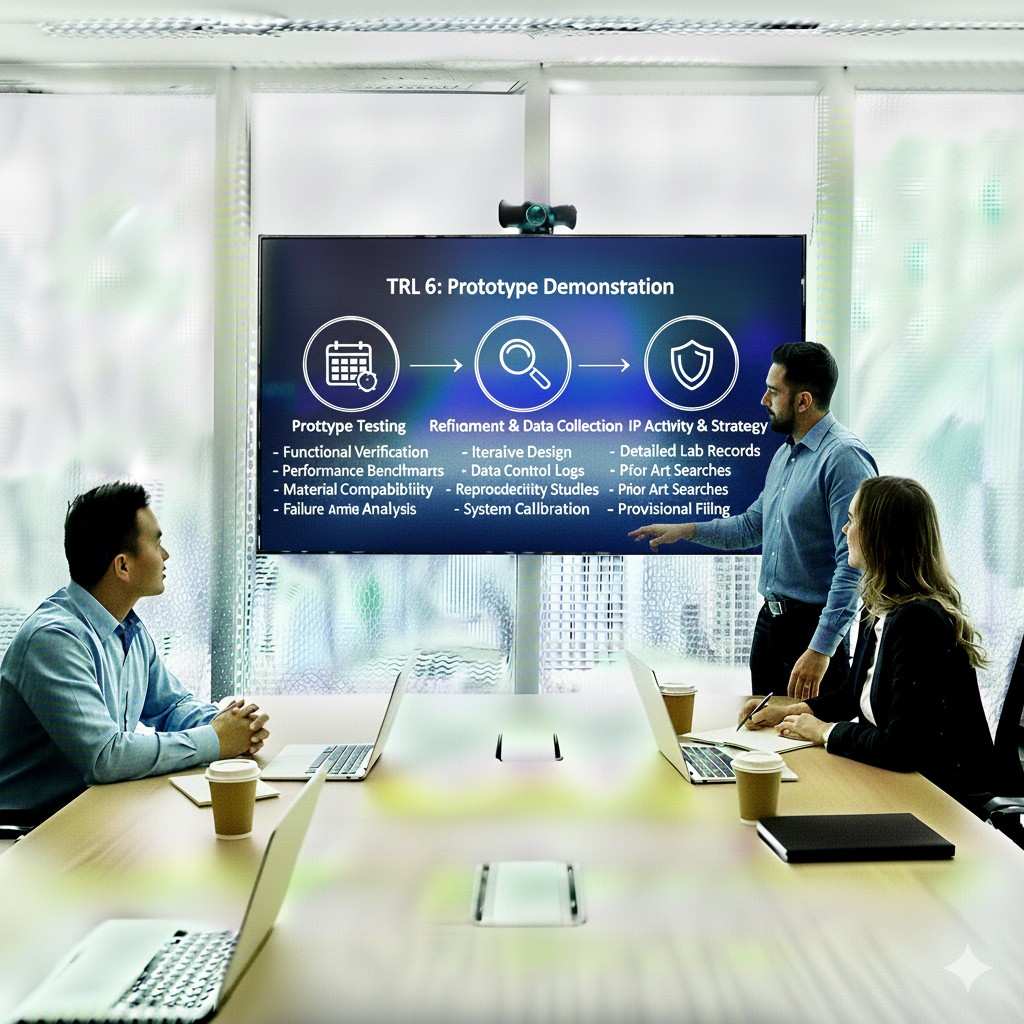
TRL 6 usually means you have a working prototype that demonstrates the full system, not just a component or subsystem. It may still be early, but it shows how everything fits together and delivers value in a realistic setting.
This is a powerful stage for IP because the system architecture is now clear. Architecture-level inventions are often broader and harder for competitors to design around.
Architecture-level IP and why it matters
Architecture-level IP protects how parts interact, not just what each part does. This includes data flow, control flow, timing relationships, and how decisions move through the system.
For example, the order in which an AI model processes signals, checks constraints, and triggers actions can be just as valuable as the model itself. In robotics, the way sensing, planning, and actuation are coordinated often defines performance and safety.
Aligning IP with investor storytelling
At TRL 6, founders often start serious investor conversations. Investors will ask how hard the system is to copy. Architecture-level patents and well-defined trade secrets make that answer much stronger.
Instead of saying, “We have a prototype,” you can say, “We have protected the system design that makes this prototype work.” That shift changes how investors see risk and long-term value.
TRL 7: System prototype in operational environment
When IP meets customers and partners
TRL 7 often involves pilots with real users, partners, or customers. The system is not just technically sound; it is operationally meaningful. This stage introduces new IP risks and opportunities.
The risk is exposure. More people see how the system works. The opportunity is clarity. Real use reveals what truly matters and what does not.
Operational insights as IP outputs
When customers use your system, they stress it in ways no lab test can. The fixes, optimizations, and safeguards you add here are often deeply practical and highly valuable.
These changes may not look “academic,” but they are exactly the kinds of inventions competitors want to copy. Protecting them, either through patents or secrets, helps lock in your operational advantage.
Managing disclosure without slowing growth
At TRL 7, you cannot hide everything. Sales, pilots, and partnerships require sharing. The goal is not secrecy at all costs. The goal is controlled sharing.
This means being clear about what is already protected, what must stay internal, and what can be shared safely. Teams that plan this early move faster with less fear. Tran.vc helps founders build these guardrails so growth and protection move together. You can apply anytime at https://www.tran.vc/apply-now-form/
TRL 8: Qualified system
What “qualified” means for IP strength
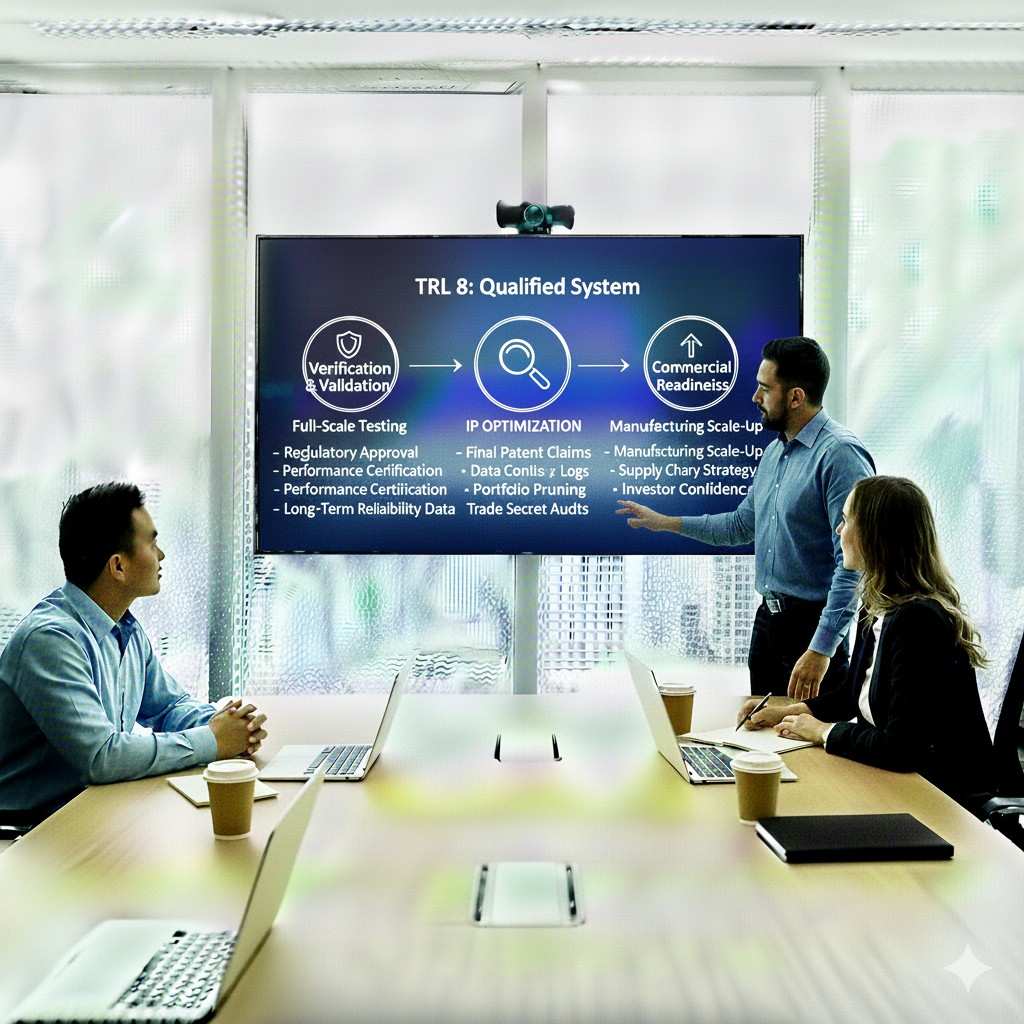
At TRL 8, your system is complete and qualified for its intended use. Performance is proven, reliability is understood, and the design is mostly stable.
From an IP perspective, this is where earlier work pays off. You are no longer scrambling to protect ideas. You are reinforcing and extending a moat that already exists.
Incremental improvements still matter
Even though the system is mature, incremental improvements can still be valuable IP. Manufacturing steps, calibration methods, deployment workflows, and update processes often become critical at this stage.
These may not sound exciting, but they are often the difference between a demo company and a scalable one. Protecting them makes it harder for fast followers to catch up.
TRL 9: Proven system
IP as a long-term business asset
TRL 9 means your system works in real-world conditions over time. At this point, IP is no longer just defensive. It becomes an active business asset.
Strong IP can support licensing, partnerships, strategic deals, and acquisitions. It also gives you leverage in negotiations because it proves long-term control over your technology.
Why early mapping makes TRL 9 stronger
Founders who mapped IP to TRL early arrive at TRL 9 with a clean, believable story. Their patents align with the product. Their secrets are intentional. Their disclosures were managed, not accidental.
This alignment is rare, and it stands out to investors and acquirers. It shows discipline, foresight, and real technical leadership.
Closing thoughts: Build IP the way you build tech
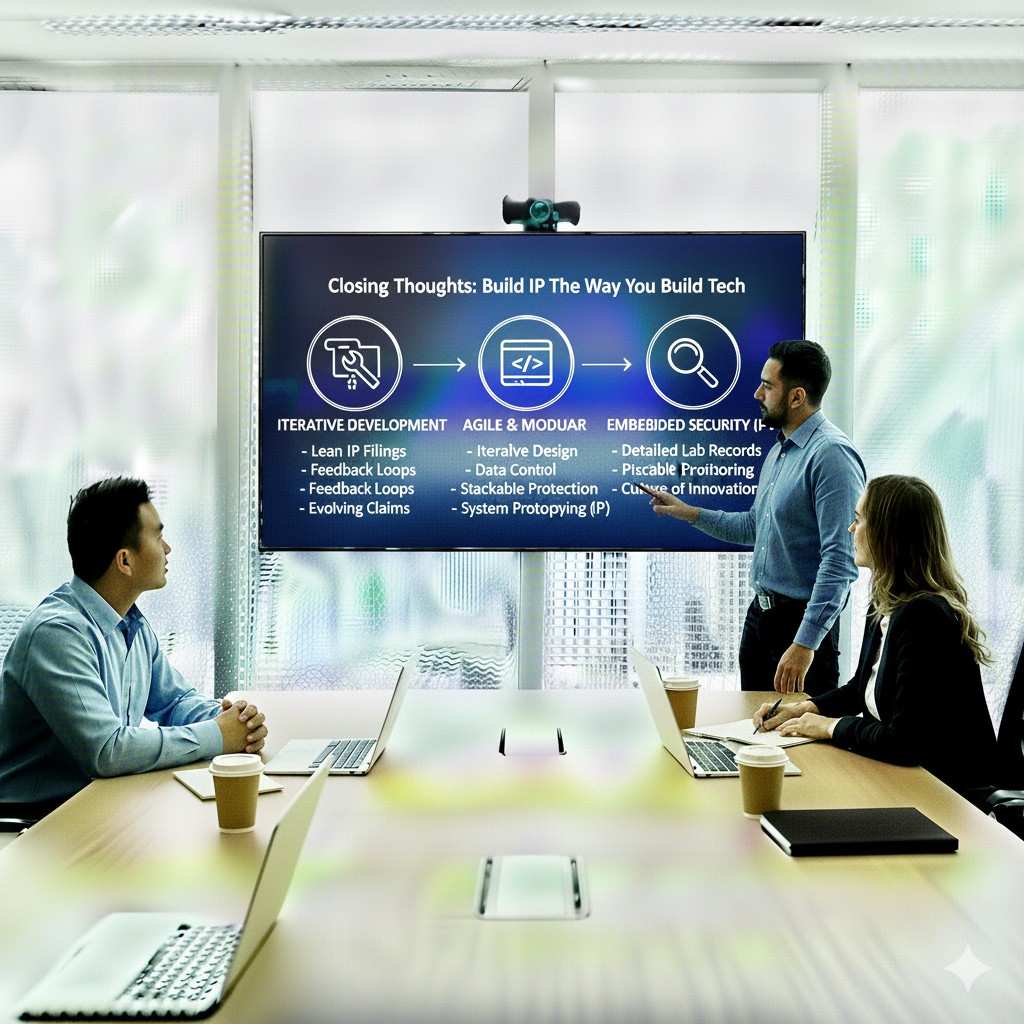
Mapping IP outputs to TRL is not about more paperwork. It is about timing, focus, and intent. Each TRL stage creates different truth. Good IP captures that truth at the right moment.
Tran.vc was built to support technical founders through this exact journey. We invest up to $50,000 in in-kind patent and IP services so you can build defensible companies without giving up control early or chasing money too soon.
If you are building in robotics, AI, or deep tech and want your IP to grow with your technology, you can apply anytime at https://www.tran.vc/apply-now-form/
A Practical Method to Map IP Outputs to TRL in Your Startup
Start with one sentence: what must be true at this TRL
Before you think about patents, write one sentence that describes what “working” means at your current TRL. Keep it plain. Something like, “Our robot can pick objects with a 90% success rate in a cluttered bin,” or “Our model flags defects with less than 2% false alarms on a live line.”
That single sentence becomes your anchor. It tells you what you are really building right now. It also tells you what you should protect, because the strongest IP often protects the reason you can make that sentence true.
Turn your TRL goal into an IP question
Once you have the TRL sentence, ask a second question in simple words: “What is the hard part that makes this possible?”
The answer is often not the feature. It is the hidden method behind the feature. It might be a timing trick, a training rule, a sensor layout, a control loop, a data filter, a calibration flow, or a way to handle failures.
When you capture that hard part clearly, you are no longer doing “random IP.” You are building a moat around the exact thing that creates performance.
Create a repeatable “invention capture” loop
Most teams fail at IP because they treat it like a one-time event. The better approach is a loop that runs along with engineering.
Each time you hit a TRL milestone, you pause and capture the inventions that made the milestone possible. That capture does not need to be long. It needs to be accurate, dated, and tied to evidence like logs, charts, test notes, or prototype behavior.
This is where Tran.vc helps many founders. We bring a real IP process into your weekly rhythm so your inventions do not get lost. If you want that support, you can apply anytime at https://www.tran.vc/apply-now-form/
What IP Outputs Look Like at Each TRL Milestone in Real Work
TRL 1–2 outputs that founders can actually produce
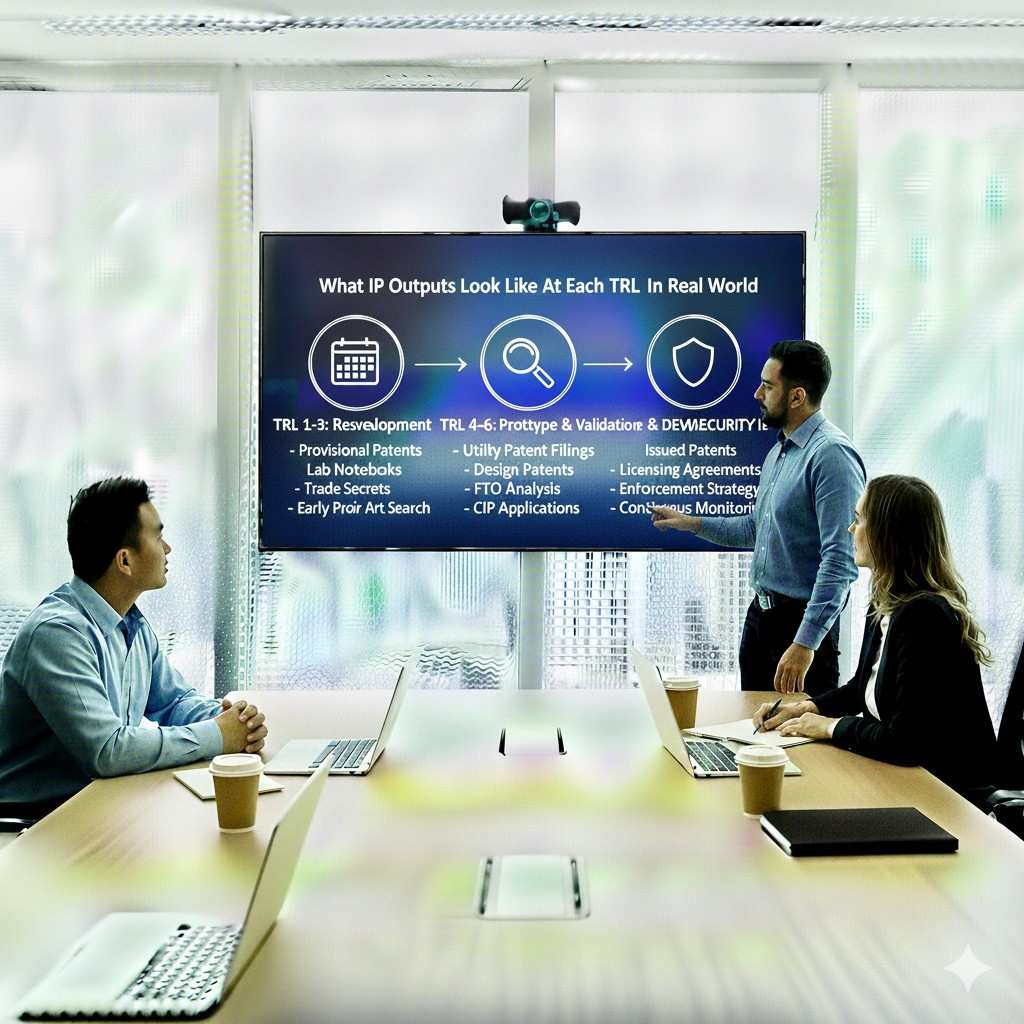
At TRL 1–2, you can produce invention notes even without a prototype. A good note is not a pitch. It is a technical explanation that another engineer could understand.
The strongest early notes usually explain why the usual approach fails and why your approach might succeed. This difference matters because patents reward novelty, but novelty is easier to show when you can describe the gap in current methods.
TRL 3–4 outputs that make patent writing easier
At TRL 3–4, your outputs become test-backed. This is where you should capture parameter ranges, edge case handling, and step-by-step methods.
If you only write “we improved accuracy,” you are leaving value on the table. If you write “we improved accuracy by adding this step before inference and tuning this threshold based on this signal,” you create a path to stronger claims.
TRL 5–7 outputs that protect the “real world” moat
At TRL 5–7, your outputs are mostly about operating in messy conditions. This is where your system becomes hard to copy, because the world is not clean and your solution is not just theory anymore.
Founders should pay attention to operational inventions here. Things like safe recovery, drift handling, automatic calibration, deployment workflows, and monitoring logic may look like “ops,” but they are often the core of reliability. Reliability is value, and value should be protected.
TRL 8–9 outputs that turn IP into leverage
At TRL 8–9, your outputs can support licensing, partnerships, and serious acquisition talks. The main job is to make sure your IP portfolio matches the shipped product, not an old prototype.
This is also when you tighten your trade secret program. Mature companies often win not only because of patents, but because key know-how stays private and controlled. A clear secret plan makes your advantage last.
Two Short Examples: Robotics and AI
Example 1: Robotics picking system moving from TRL 3 to TRL 6
Imagine a picking robot that works in the lab but fails with shiny items, odd shapes, and fast belt speeds. At TRL 3, the invention might be a grasp scoring method that uses vision plus a geometric rule to avoid slip.
At TRL 4, the invention may shift to repeatability. You might discover a calibration method that corrects small camera shifts without full re-calibration. That is a practical invention and often patentable if it is not standard.
At TRL 5–6, the value may come from recovery behavior. When a grasp fails, the robot might do a quick re-scan, change approach angle, and re-try within a safe timing window. That sequence can become a method claim, and it is exactly what competitors want when they try to copy performance.
Example 2: AI inspection model moving from TRL 2 to TRL 7
Consider a defect detection model for a factory line. At TRL 2, the invention might be a training rule that reduces false alarms without sacrificing recall. You may also invent a labeling method that makes noisy human labels usable.
At TRL 3–4, you may discover a data pipeline that normalizes lighting changes and camera differences. This is not “just data cleaning.” If it is a structured method with steps and measurable effects, it can support strong IP.
At TRL 5–7, the problem becomes drift. The line changes, materials change, and the model starts missing defects. If you build an on-line drift monitor with a safe fallback and a re-training trigger that avoids downtime, you now have a real-world moat. That moat should be protected, because it is what makes the product dependable.
If you are building something like this and want an IP plan that grows with your TRL, Tran.vc can help. Apply anytime at https://www.tran.vc/apply-now-form/
The Most Common Mistakes When Teams Try to Do This
Filing too early with weak support
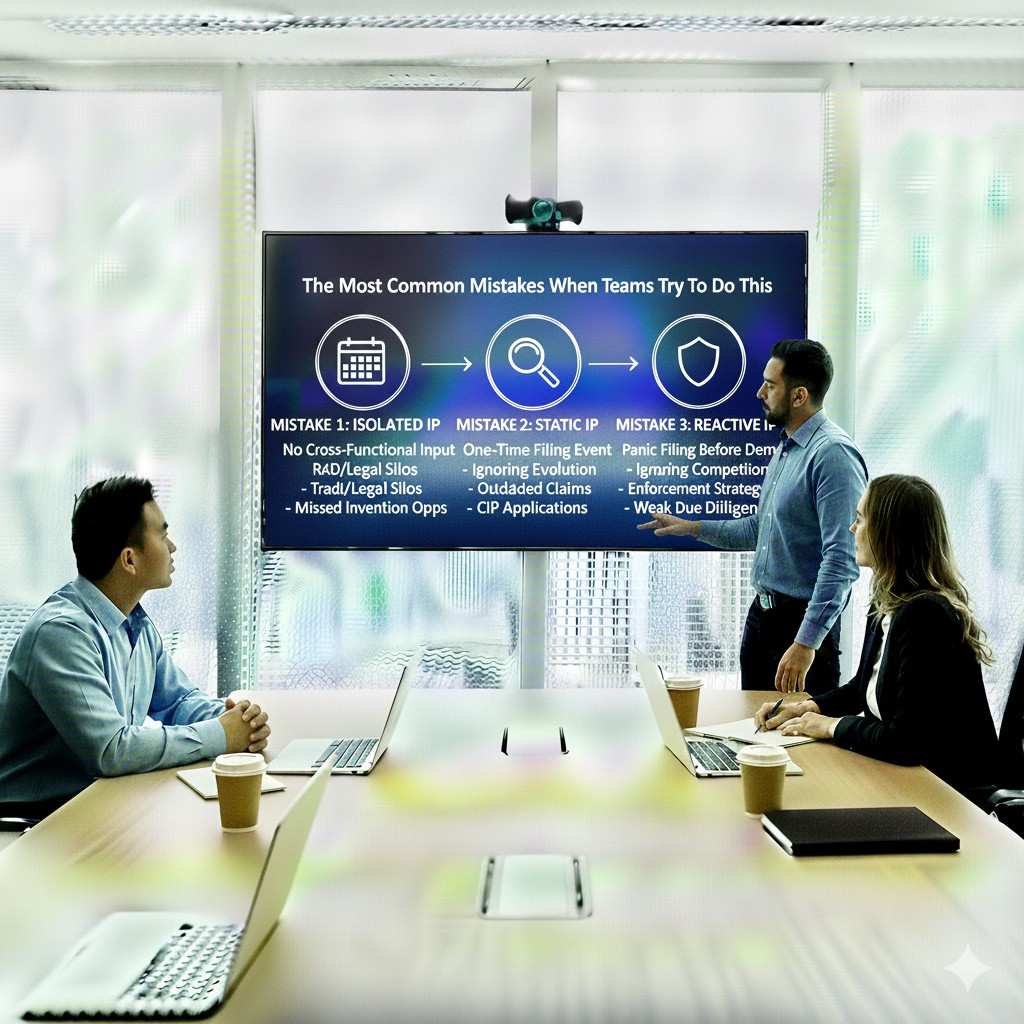
A rushed early filing can be too thin. If the filing lacks details, later protection may not cover what you actually built. This creates a bad situation where you “have a patent” but it does not protect the product.
The fix is not to delay forever. The fix is to file when you can explain the invention clearly and support it with enough detail that the claims can grow later.
Waiting too long until the best ideas are already out
The other failure mode is the opposite. Teams wait until demos, pilots, or press force them to talk. By then, the key methods may already be visible to outsiders or shared in a deck that spreads.
A simple rule helps: if you are about to show the “how,” not just the “what,” run an IP check. You do not need fear. You need timing.
Protecting the wrong layer
Many teams protect a surface feature when the moat is deeper. For example, they file on a UI flow when the real value is the control logic, calibration method, or data pipeline behind it.
Mapping IP to TRL helps avoid this, because it keeps the focus on the technical reason your TRL milestone is true. That reason is usually the moat layer worth protecting.