
Most founders wait too long to think about patents that belong to other people. Then a customer asks a hard question. Or an investor does. Or a big company sends a notice that ruins a launch week.
That is what an FTO is for.
FTO means Freedom to Operate. It is a focused way to check if what you plan to build, sell, ship, or deploy could step on someone else’s active patent rights in the places you want to do business.
It is not about whether your idea is “new.” It is not about whether you can get a patent. It is about a simpler and more urgent question:
Can we sell this without getting blocked?
If you are building AI, robotics, sensors, edge devices, or any deep tech that touches real-world systems, an FTO can save you from surprises that cost real money and real time. It can also give you leverage. The founders who do it at the right moment tend to move faster, close deals with more confidence, and raise with fewer “what if” doubts hanging over the round.
If you want Tran.vc to help you build an IP plan that includes the right FTO work at the right time, you can apply anytime here: https://www.tran.vc/apply-now-form/
What an FTO really is (in plain words)
An FTO is a legal risk check. You pick a product plan and a target market. Then you look for patents that are still active that might cover what your product does.
Two details matter here:
First, patents are country-by-country. A patent in the US does not automatically block you in India or Germany. So the same product can be low risk in one place and high risk in another.
Second, FTO is about claims, not marketing words. Patents have a section called “claims.” That is the part that defines what the patent owner can stop others from doing. The rest of the document gives background and examples, but the claims are the fence.
When people say, “We did a patent search,” they often mean a quick scan of titles and abstracts. That can be useful early on, but it is not the same as an FTO. A real FTO looks at claims and compares them to your product in a careful way.
FTO (Freedom to Operate): When and Why to Do It
Why this topic matters now
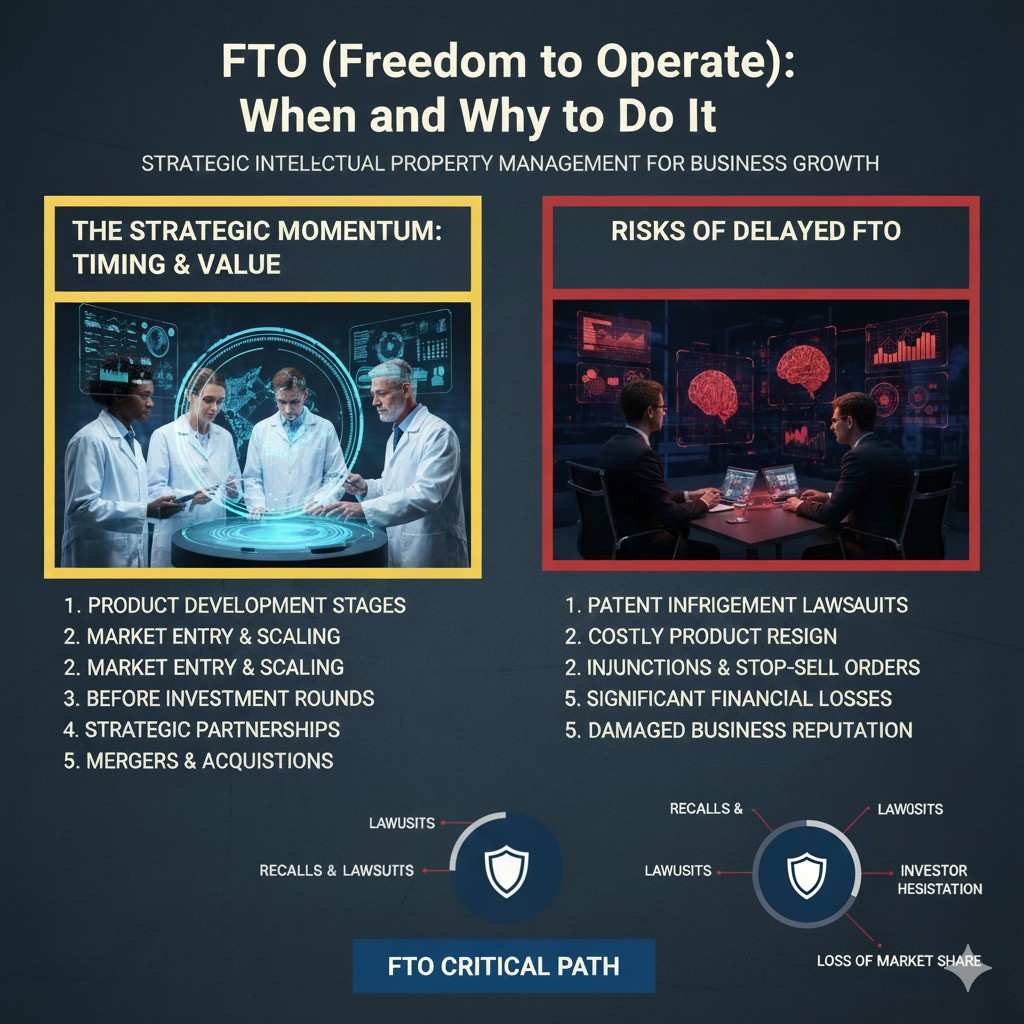
Most founders wait too long to think about patents that belong to other people. Then a customer asks a hard question, an investor digs in, or a big company sends a notice that freezes your launch. That is when a simple “we think we are fine” stops working.
Freedom to Operate, or FTO, exists to prevent that kind of surprise. It helps you spot risk early, while you still have choices. It also helps you speak with calm and clarity when someone important asks, “Can you really sell this?”
The plain meaning of FTO
FTO is a structured check to see if your product might step on active patents owned by others, in the places you want to do business. It is not about whether your idea is new in a general sense. It is about whether someone else already holds enforceable rights that could block you from making, using, or selling what you built.
In simple words, FTO answers one question: can we operate without getting stopped? The goal is to reduce unknowns before you sign contracts, ship units, or scale distribution.
Apply to Tran.vc if you want help doing this right
Tran.vc supports deep tech founders with up to $50,000 in in-kind patent and IP services. If you want an IP plan that includes the right FTO work at the right time, you can apply anytime at https://www.tran.vc/apply-now-form/
What an FTO really checks
It focuses on patent claims, not marketing words
A patent is not enforced by its title or the story it tells. It is enforced by its “claims,” which act like the legal fence around the invention. A real FTO compares what your product does to those claims, using the language the patent system actually cares about.
That is why quick keyword searching is not enough. You can read a patent summary and feel safe, yet the claims may still cover your key steps. A solid FTO goes claim-by-claim and ties the analysis back to your product features.
It is tied to a product version and a target market
FTO is not a one-time stamp that lasts forever. It is connected to what you plan to ship right now, and where you plan to ship it. When your product changes, or when you enter a new country, the risk picture can change too.
This is especially true for AI and robotics teams, because small shifts in implementation can matter. A different sensor setup, a different training pipeline, or a different control loop can move you closer to or farther from a claim.
It ends with decisions, not just a report
The best FTO work leads to practical choices. Sometimes it confirms you are in a safe zone and explains why. Sometimes it shows a risky area and gives you options, like redesigning a step, avoiding a specific feature, or planning a licensing path.
The value is not only in “finding patents.” The value is in shaping your product and go-to-market plan while you still have room to move.
A common myth that causes trouble
Having your own patent does not mean you are safe
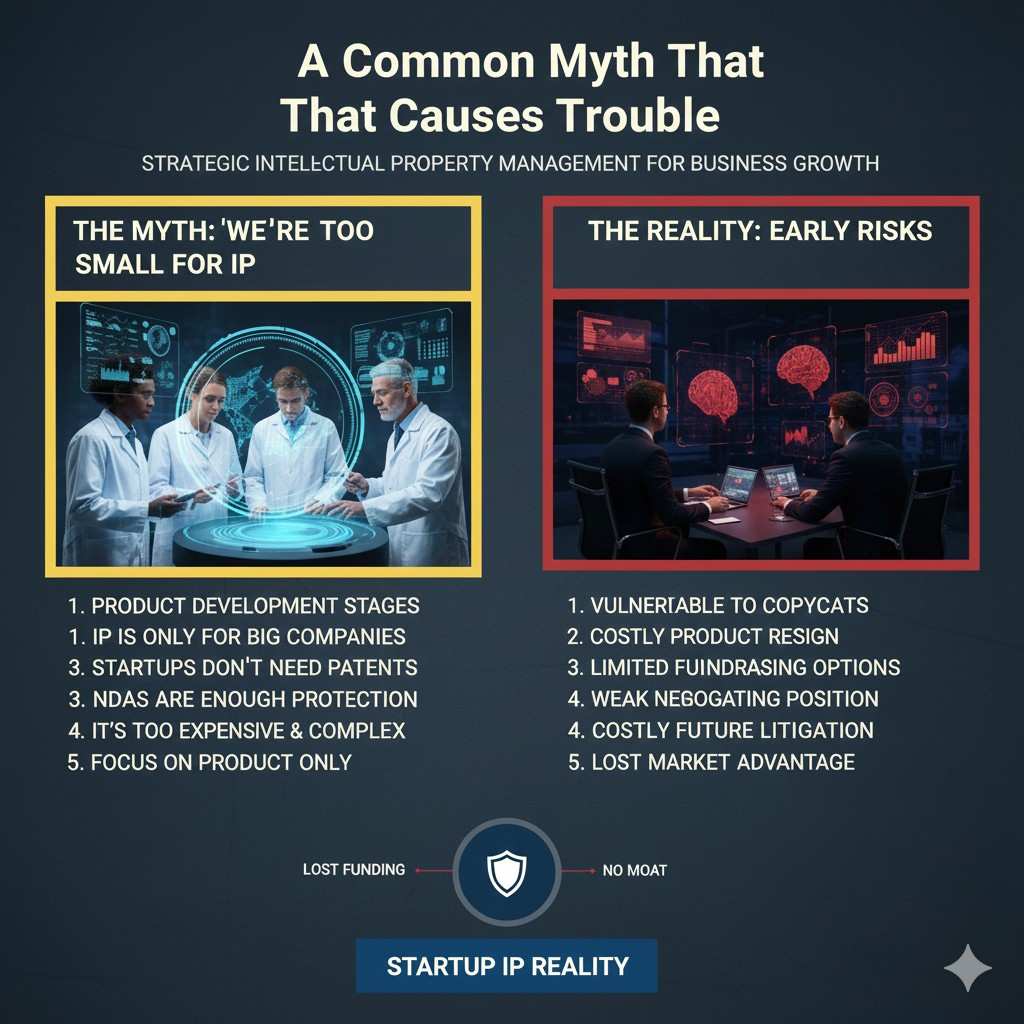
Many founders think, “If we patent our work, we can sell it.” That is not how patents work. Your patent can help you stop others from copying you, but it does not automatically give you permission to use every other patented idea that touches your product.
You can own a patent and still infringe someone else’s patent. The easiest way to understand this is to imagine many locked gates in one area. Owning one gate does not unlock the others. FTO is how you check which gates might block your path.
Why this matters for fundraising and deals
Investors often care about this more than founders expect. They do not need perfection, but they do want to see that you take risk seriously and that you can explain your plan. Customers, especially enterprise buyers, also care because they do not want their own business dragged into disputes.
If you can speak clearly about your FTO approach, you look like a team that can scale. That kind of confidence can speed up deals and reduce friction during diligence.
Why FTO is extra important in AI and robotics
AI products often sit on patented building blocks
Even when your model is new, your product may depend on many known components that others have patented. In robotics and applied AI, patents often cover the “how” of real-world execution, like sensing, motion, safety systems, calibration, or edge deployment.
That is why teams can be surprised. They focus on the novelty of the model, but the risk lives in the full system. An FTO helps you see risk across the whole chain, not just the part you feel proud of.
Robotics makes design changes expensive
Robotics teams face a second challenge: hardware lock-in. Once you commit to a board design, a mechanical assembly, or a manufacturing run, changes cost time and money. If you learn late that a core mechanism is risky, you may have to rebuild parts of the stack under pressure.
Doing FTO work before big lock-in moments protects your schedule and your cash. It also protects morale, because redesign under threat is one of the most draining experiences a team can face.
A strong FTO story can become a sales asset
Some buyers will ask directly about freedom to operate. Others will not ask, but their legal team will still look for red flags when the contract reaches final steps. When you can explain your approach in a calm, simple way, you reduce fear and shorten cycles.
This is not about sounding fancy. It is about showing that you have done careful work and that you have a plan if risk appears.
When to do an FTO
The right timing is “before a promise you cannot take back”

An FTO is most valuable when you are about to commit to something that will be hard to undo. That can be a customer contract, a public launch, a production run, a partnership, or a major integration. In those moments, you need fewer unknowns and more control.
If you are still throwing away prototypes every week, a full formal FTO can be too early. But that does not mean you ignore patents. Early on, you can do lighter checks to avoid obvious traps while you explore.
Before your first serious enterprise sale
Enterprise buyers often want stronger promises in the contract. They may ask you to warrant that you are not infringing and to cover them if trouble happens. Early startups should be very careful with broad promises like that, because they can create huge liability.
An FTO helps you negotiate smarter. You can narrow the language, define what you can truly stand behind, and avoid signing something that could explode later.
Before a hardware or manufacturing lock-in
If you are about to order custom parts, commit to molds, or lock a design for production, you want the risk picture to be as clear as possible. Small design choices can avoid big patent issues, but only if you catch them before the point of no return.
This is a moment where founders often regret waiting. A focused FTO at this stage can prevent costly redesign and delays.
When your product starts to look like a known category
Early products can be unusual, but over time many startups settle into a category. A warehouse robot starts to resemble other warehouse robots. A vision system starts to follow patterns that are common in the market. The more your product resembles what others already sell, the more likely it overlaps with existing patents.
When you feel your product taking a stable shape, it is a good time to do deeper FTO work. You will get a clearer answer because the design is no longer changing daily.
Before entering a new country or region
Patents are local. A risk that does not exist in one place may exist in another. If you plan to expand into the US, Europe, Japan, or other key markets, you should check those jurisdictions, not just your home base.
A practical approach is to stage expansion. Some startups launch first where risk is lower and the path is clearer, then enter higher-risk markets later with stronger preparation and better leverage.
What an FTO does not do
It does not guarantee you will never face conflict
Even a strong FTO cannot stop someone from making a claim. What it can do is reduce surprises and show that you acted responsibly. That record can matter in negotiations, in investor discussions, and in how your team responds under pressure.
Think of it as risk management, not risk elimination. The goal is to make smart choices early so problems do not show up late.
It does not cover every future version of your product
FTO work is tied to the product as described at the time. If you add new features, change technical steps, or move into new markets, you may need an update. This is normal and expected, especially for fast-moving teams.
The good news is that updates are often easier than starting from scratch, because you already know the landscape and you already have a method.
It does not replace your own IP strategy
FTO helps you avoid being blocked by others. Your own patents help you build leverage, value, and a moat. The strongest companies use both. They reduce risk on one side, and they build defensible assets on the other.
Tran.vc is built for that combined approach. If you want hands-on help building an IP foundation that supports fundraising and growth, apply anytime at https://www.tran.vc/apply-now-form/
How to think about risk in an FTO
Risk is not yes or no
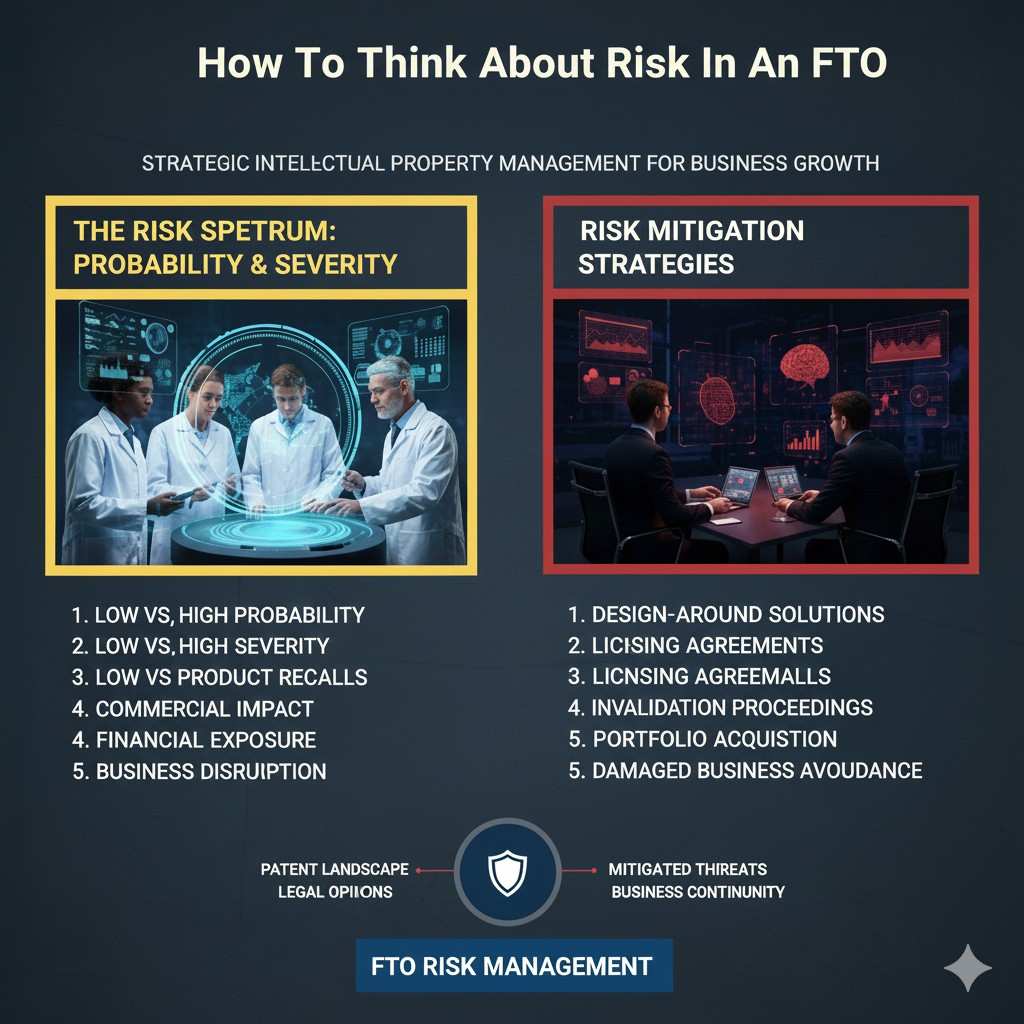
Founders often want a simple answer. They ask, “Are we safe or not?” Real FTO work does not work that way. Risk lives on a range. Some areas are clearly low risk. Some are clearly dangerous. Many sit in the middle, where smart choices can reduce exposure.
A good FTO explains where you sit on that range and why. It gives context instead of fear. That context is what lets founders make calm, informed decisions instead of reacting under pressure.
Legal risk and business risk are connected
Not all patent risk matters in the same way. Some patents are owned by companies that never enforce. Others are owned by players who actively defend their space. Some cover small features. Others touch the heart of the product.
An FTO should help you see not just legal overlap, but also business reality. Who owns the patent? How important is the claimed feature to them? How visible is your product? These questions help you decide what to fix now and what to monitor.
Design choices can change risk fast
One of the most useful outcomes of FTO work is discovering that small design changes can avoid big problems. A different data flow, a different order of steps, or a different hardware interface can move you out of a risky claim.
This is why timing matters. When teams do FTO early enough, they can design around issues with minimal cost. When they do it late, even small changes can be painful.
How an FTO is actually done
It starts with a clear product description
You cannot analyze risk if you do not know what you are analyzing. A proper FTO begins with a clear, honest description of the product. This includes how it works, not how it is marketed.
For AI and robotics teams, this often means describing data inputs, processing steps, decision logic, and outputs. The more precise the description, the more useful the FTO will be.
Relevant patents are identified and filtered
Next comes searching. This is not about finding every patent ever written. It is about finding patents that are active, relevant, and potentially close to your product. Older patents that have expired do not matter for risk, though they can still teach you about the field.
Good filtering saves time and money. It focuses attention on patents that could realistically matter, instead of drowning the team in paper.
Claims are compared to your product
This is the core of the work. Each relevant claim is compared to your product step by step. The question is whether all parts of a claim are present in what you do. If even one required part is missing, that claim may not cover you.
This comparison must be careful and grounded in facts. It is where experience matters most, because small details can change conclusions.
Findings are documented in plain language
The final output should not be a wall of legal text. It should be a clear explanation of where risk exists, where it does not, and why. Founders should be able to read it and understand the logic without a law degree.
This document becomes useful beyond legal planning. It can support investor discussions, partner talks, and internal decisions.
How FTO fits into an early-stage startup
Early exploration versus committed direction
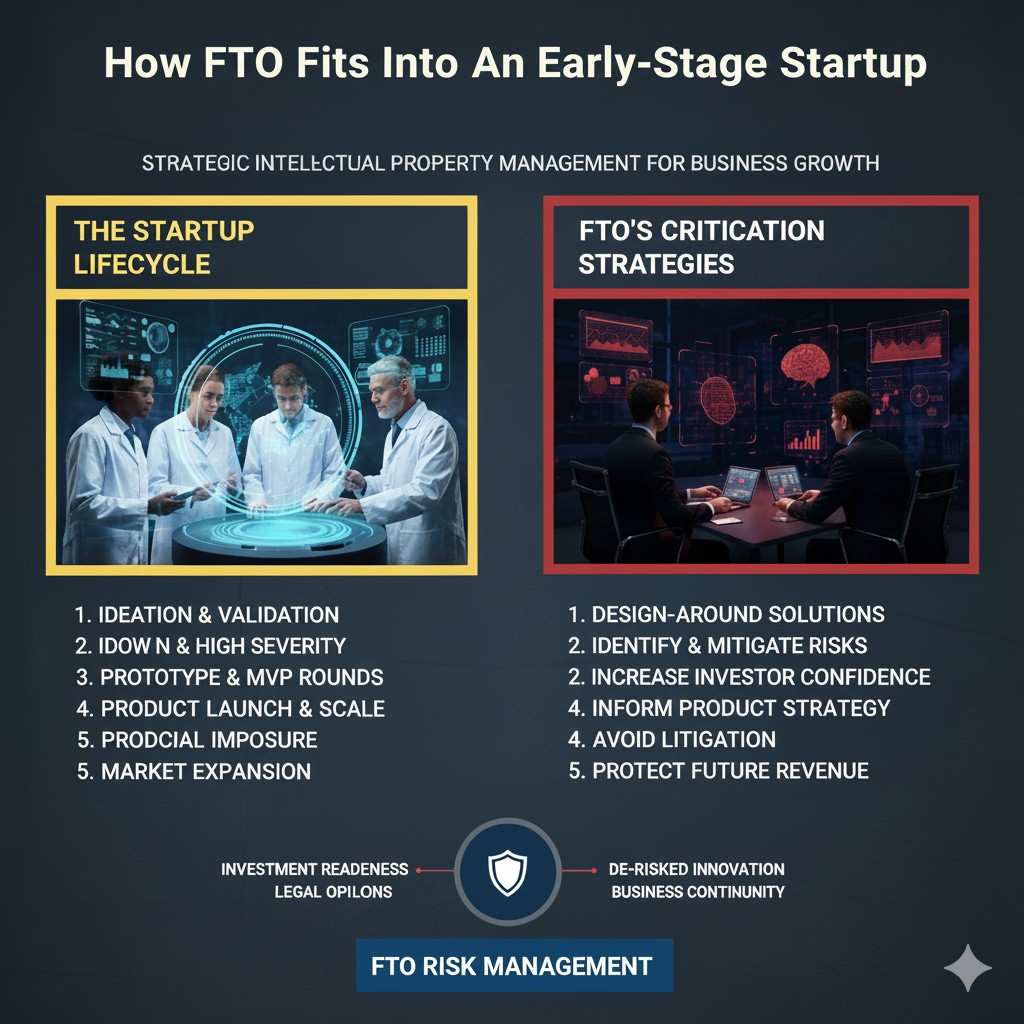
In the very early days, teams explore many paths. At that stage, heavy FTO work can slow learning. What matters then is awareness, not perfection. Quick checks can help avoid obvious danger zones while you test ideas.
As the product direction becomes clearer, deeper analysis becomes worth the effort. The key is matching the depth of FTO work to the level of commitment you are about to make.
Using FTO to guide roadmap decisions
An FTO can influence what you build first. If two features offer similar value, but one carries higher patent risk, it may make sense to ship the safer one first. This kind of choice can buy you time and momentum.
Over time, this approach leads to a roadmap that is shaped not just by customer needs, but also by risk management. That balance is what helps companies grow without constant fire drills.
FTO as part of fundraising preparation
Investors do not expect zero risk. They do expect founders to understand their risk. When you can explain what you checked, what you found, and how you plan to handle it, you earn trust.
This is especially true for deep tech investors who have seen deals fall apart late due to IP surprises. A thoughtful FTO story can make diligence smoother and faster.
Common mistakes founders make
Waiting until someone forces the issue
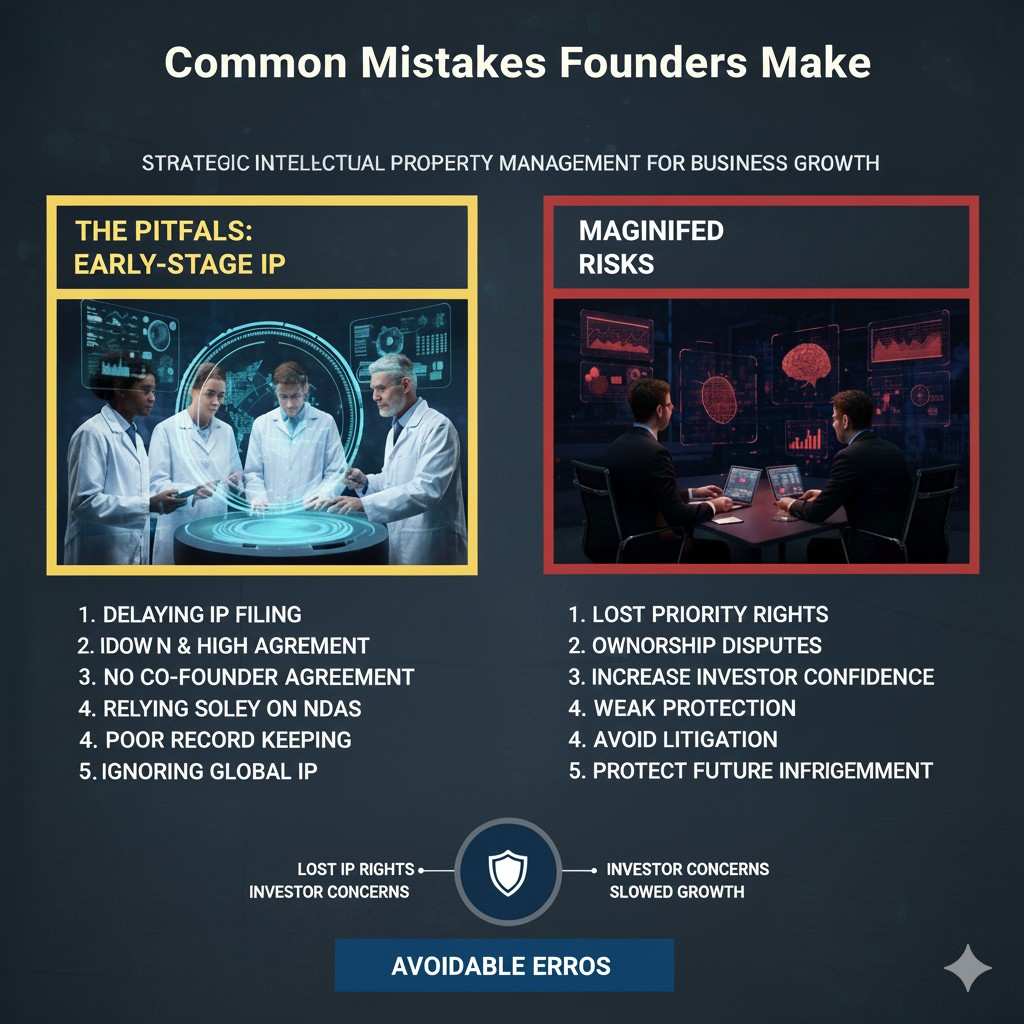
The most common mistake is waiting until a customer, partner, or investor demands answers. By then, the timeline is tight and choices are limited. FTO work done under pressure is often more expensive and less flexible.
Doing it earlier, on your own terms, gives you control over the outcome.
Treating FTO as a checkbox
Another mistake is treating FTO as a document you buy once and forget. Real products evolve. Markets change. A useful FTO approach evolves with them.
The goal is not to collect papers. The goal is to make better decisions over time.
Ignoring FTO because “we are small”
Some founders believe they are too small to matter. That can be true early on, but success changes visibility fast. The moment your product starts to work, attention follows. That is not the time to discover hidden risk.
Thinking ahead is part of building something durable.
How Tran.vc approaches FTO with founders
FTO as part of a broader IP plan
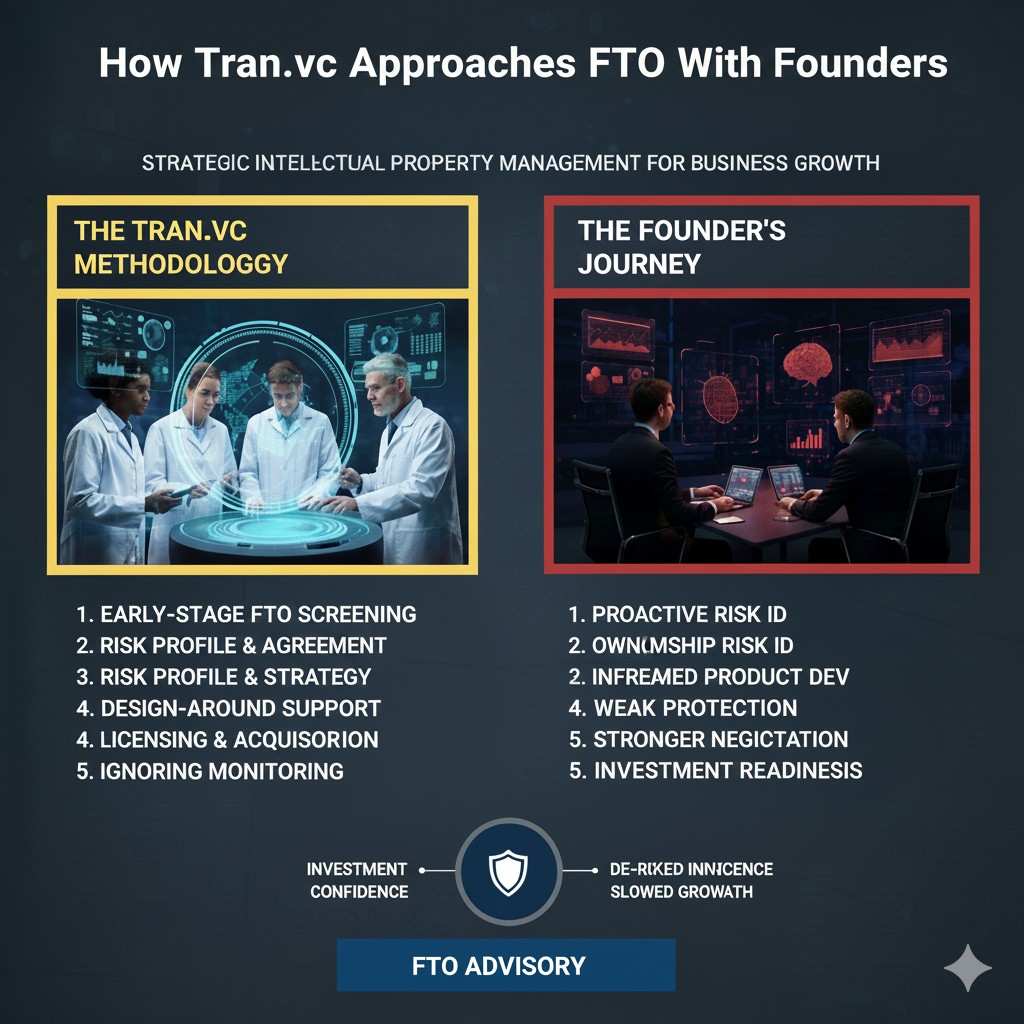
Tran.vc does not look at FTO in isolation. It is combined with invention capture, filing strategy, and long-term moat building. This way, risk reduction and value creation happen together, not in separate silos.
Founders get help understanding what truly matters for their specific technology, not generic advice.
Focus on leverage, not fear
The goal is never to scare founders. The goal is to give them leverage. When you understand the landscape, you can negotiate better, design smarter, and raise with more confidence.
That is why Tran.vc invests time and expertise, not just money. The work is meant to strengthen the company from the inside.
Apply anytime to start the conversation
If you are building in AI, robotics, or deep tech and want to turn your technical work into protected, fundable assets, Tran.vc can help. They invest up to $50,000 in in-kind patent and IP services to support early teams.
You can apply anytime at https://www.tran.vc/apply-now-form/