
Most startups try to grow fast first, and “protect later.” They ship a demo, chase users, and hope the market stays calm long enough to raise the next round.
But the startups that get acquired sooner often do one thing early that changes the whole game: they treat intellectual property like a product. Not paperwork. Not a “later” task. A real asset they build from day one.
When a buyer looks at a young robotics or AI company, they are not only buying a team and a roadmap. They are buying safety. They are buying advantage. They are buying the right to win.
That is why an IP-first startup can feel “done” sooner in the eyes of an acquirer. Even if the revenue is still small. Even if the product is still early.
An IP-first startup makes the buyer’s job easier. It reduces risk. It speeds up due diligence. It gives the buyer a clear story they can defend to their board. It gives them something they can’t just hire and copy.
And here’s the part many founders miss: strong IP does not only protect you from others. It also makes you easier to buy.
Tran.vc exists for this exact moment. We invest up to $50,000 in in-kind patent and IP services to help deep tech founders turn real engineering into real assets early—without giving up control too soon. If you’re building in AI, robotics, or other hard tech, you can apply anytime here: https://www.tran.vc/apply-now-form/
In this article, I’ll show you—plainly and step by step—why IP-first startups get acquired sooner, what buyers look for, and what you can do this month to make your company more “buyable,” even if you’re still early.
Why IP-First Startups Get Acquired Sooner
The real reason acquirers move faster on IP-first companies
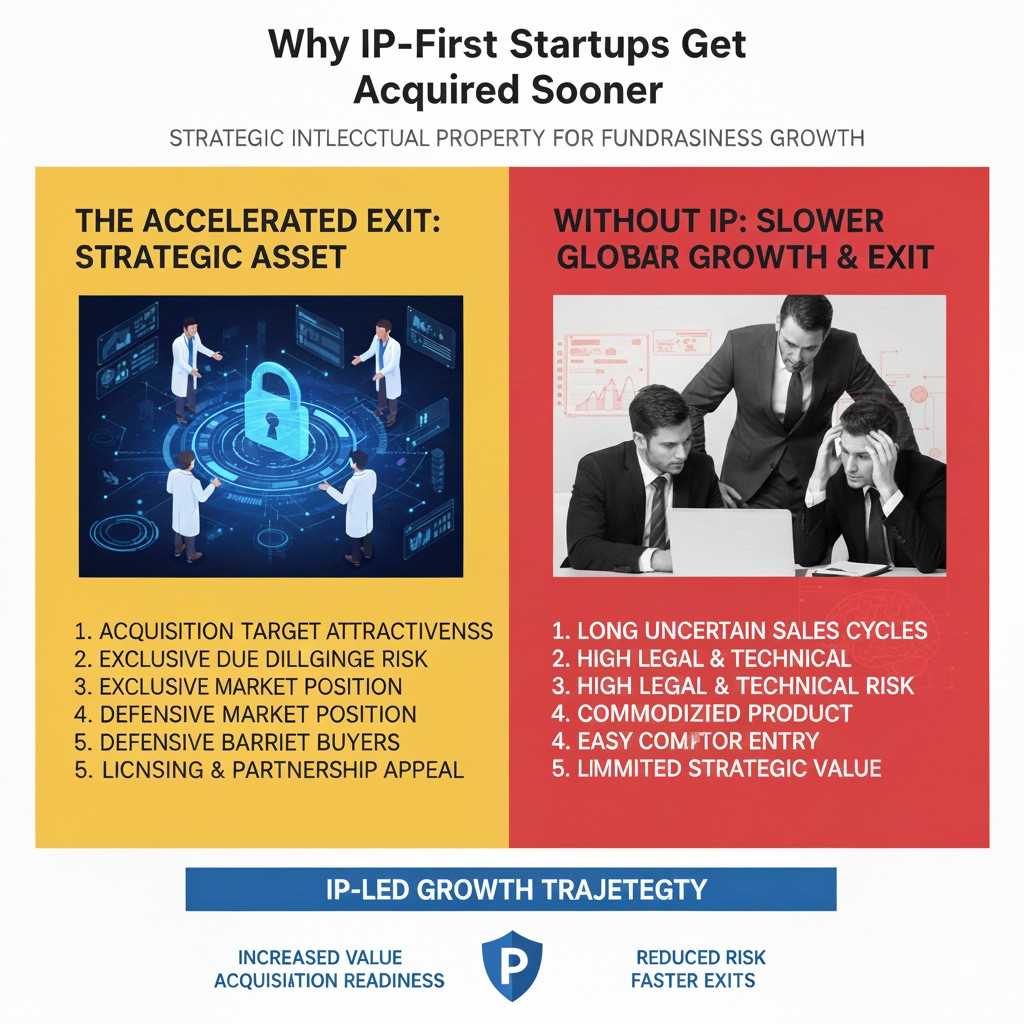
Buyers do not wake up excited to buy “potential.” They buy what they can explain, defend, and scale inside a bigger company.
When your startup is IP-first, you are not only showing a product idea. You are showing an owned advantage. That changes the tone of every call.
Instead of “Tell us why this could work,” the buyer starts asking, “How soon can we lock this in?”
That shift speeds everything up because the buyer can now justify urgency. They are not just buying your team. They are buying the right to own a lane.
If you are building AI, robotics, or deep tech, and you want to grow without giving up control early, Tran.vc can help you build that owned advantage from day one. Apply anytime at https://www.tran.vc/apply-now-form/
What “acquired sooner” really means in deep tech
In deep tech, “sooner” does not always mean you sell in 12 months. It means you become a serious target earlier than your peers.
A serious target is a company that makes sense on paper. It has clean ownership, a clear story, and a defensible edge.
IP-first startups often reach that point faster because they are building proof of ownership alongside proof of product.
That makes due diligence smoother, negotiation cleaner, and internal approvals easier for the buyer.
The buyer’s fear that IP solves
Acquirers are not only buying upside. They are buying risk and trying to reduce it.
They worry your tech cannot be defended. They worry a competitor can copy it quickly. They worry your own team built on top of someone else’s work.
They also worry your startup will become a legal mess after they buy it. That risk can kill a deal.
IP, done early and done right, removes many of these fears before they grow teeth.
How acquirers actually decide if your startup is a “must-buy”
They start with a simple question: “Can we build this ourselves?”
This is the first filter, even if they never say it out loud.
If they believe they can build the same thing in six months with their own team, your leverage drops. Your price drops. Their urgency drops.
Your job is to make that answer hard. Not by being flashy, but by showing that key parts are owned, protected, and not easy to recreate.
A strong patent plan, clear invention records, and clean assignments tell the buyer, “You can’t just rebuild this.”
They look for uniqueness, not just performance
Founders often sell accuracy, speed, and benchmarks.
Buyers care about those things, but they care more about what is unique. They ask what is different in the approach, not only the result.
In robotics, that might be how you sense the world, how you plan motion, how you control force, or how you handle safety.
In AI, it might be how you train, how you compress, how you evaluate, how you prevent drift, or how you make models reliable in the wild.
If you can name the unique pieces, and show they are protected, you move from “cool demo” to “strategic asset.”
They want a story they can defend to their board
A deal is not only decided by the person talking to you.
It is reviewed by people in finance, legal, product, and often the CEO. Many of them do not want to take risks that could blow up later.
When your IP is strong, the story becomes simple: “We bought an owned capability that blocks competitors and accelerates our roadmap.”
That is easier to approve than: “We bought a team with a promising product, and we hope nobody else can copy it.”
If you want that board-ready story, Tran.vc helps you shape it early through patent strategy and filings as in-kind services. Apply anytime at https://www.tran.vc/apply-now-form/
Why IP changes deal speed during due diligence
Due diligence is a trust test, not a paperwork test
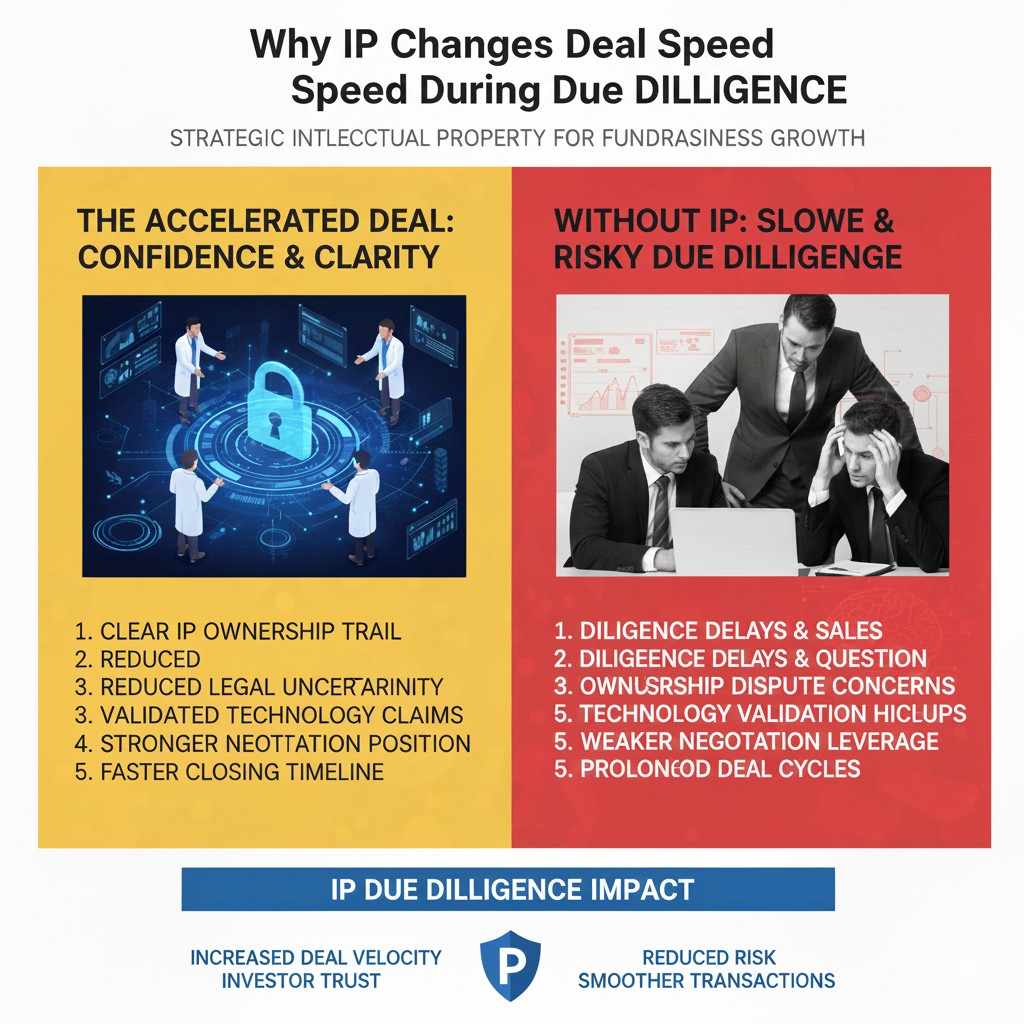
Most founders think diligence is about documents.
It is, but the deeper truth is that diligence is about trust. The buyer is asking, “Are there surprises here?”
Surprises slow deals. Surprises create discounts. Surprises kill deals.
An IP-first startup removes surprises because the ownership story is already clean, and the invention story is already written down.
Clean ownership removes the fastest deal killer
Here is a common problem in early startups.
A founder built part of the tech at a prior job. A contractor wrote key code without assigning rights. A research partner thinks they own part of the method.
Even if you are confident you “can explain it,” buyers do not like uncertainty. Their legal team will push back, and the timeline will stretch.
If it stretches long enough, the buyer loses interest or finds another target.
IP-first startups usually handle assignments, invention records, and boundaries early. That makes the buyer’s legal review calmer and faster.
Patents act like a map of what matters
A good patent plan is not just a filing. It is a map of your core ideas.
When a buyer reads it, they quickly see what you claim as your edge.
That clarity speeds diligence because the buyer can focus on the right questions instead of guessing.
It also helps them match your tech to their product lines and decide where the value sits.
Why IP-first startups feel “safer” to buy
Buyers pay more for low regret
A buyer is always thinking about regret.
If they buy you and it goes wrong, they will be blamed. If they do not buy you and a competitor does, they will also be blamed.
IP reduces regret risk because it gives the buyer something solid. Even if the product changes, the owned ideas still have value.
That is why IP-first startups often feel like a safer bet. Safety leads to faster decisions.
IP makes integration easier, not harder
Some founders fear patents will slow them down.
In practice, a simple IP system can speed up internal alignment. It forces the team to define what is core, what is optional, and what is truly new.
That same clarity helps during acquisition integration.
The buyer can see which parts to keep, which parts to merge, and which parts to build around.
When integration feels clear, buyers move with more confidence and fewer delays.
How IP-first thinking changes your fundraising and your acquisition path
Acquisitions often start as “partnership” talks
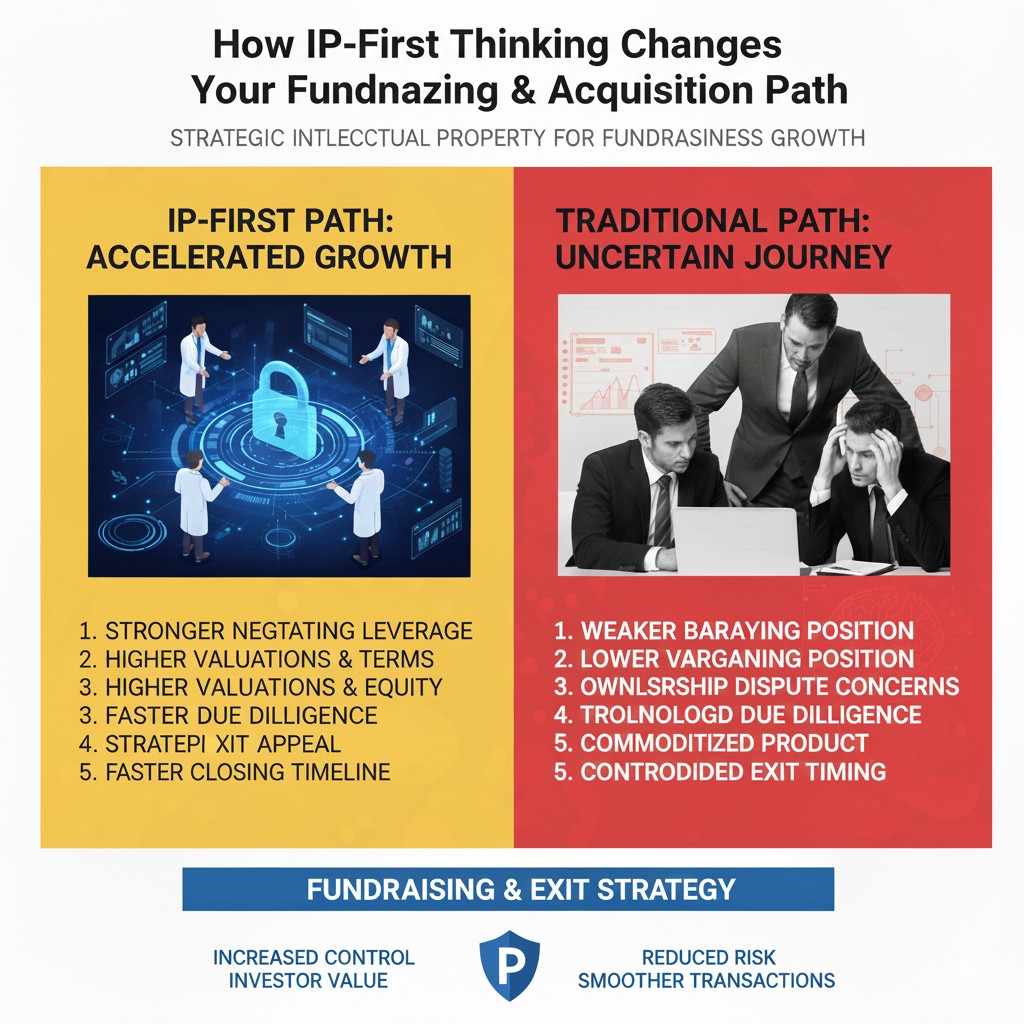
Many acquisitions begin quietly.
A company wants to partner, license, co-sell, or “explore a collaboration.” They want to get close enough to understand your tech.
If your IP is weak, those talks can be dangerous. You might teach them how to build the thing you are pitching.
If your IP is strong, those talks become safer and more valuable. You can share enough to create interest without giving away your secret sauce.
This is one of the hidden reasons IP-first startups get acquired sooner. They can engage early without fear.
IP creates leverage even when revenue is small
Revenue helps, but deep tech often takes time.
IP is one of the few ways an early startup can show durable value before the revenue curve hits.
When a buyer sees protected core methods, they can justify a deal based on strategic position, not only current sales.
That helps founders who are still early, still testing the market, or still building.
If you want to build this kind of leverage without giving up control early, Tran.vc is built for that. Apply anytime at https://www.tran.vc/apply-now-form/
The practical shift: from “building features” to “building assets”
Think of IP like you think of product quality
Many founders treat patents like legal chores.
IP-first teams treat patents like product quality. You invest early so that later you move faster and with fewer problems.
You do not need hundreds of patents. You need the right coverage around the right ideas.
That starts with learning how to spot inventions in everyday engineering work.
Most inventions are hiding in plain sight
In robotics and AI, inventions are often not one big breakthrough.
They show up as small, smart decisions: a way to reduce compute, a way to make sensing robust, a way to handle edge cases, a way to make training stable.
Founders overlook them because they feel “normal” to the team.
But to the market, and to a buyer, those decisions can be the difference between a copyable product and a defensible company.
What “defensible” really means in AI and robotics
Defensible is not the same as “hard”
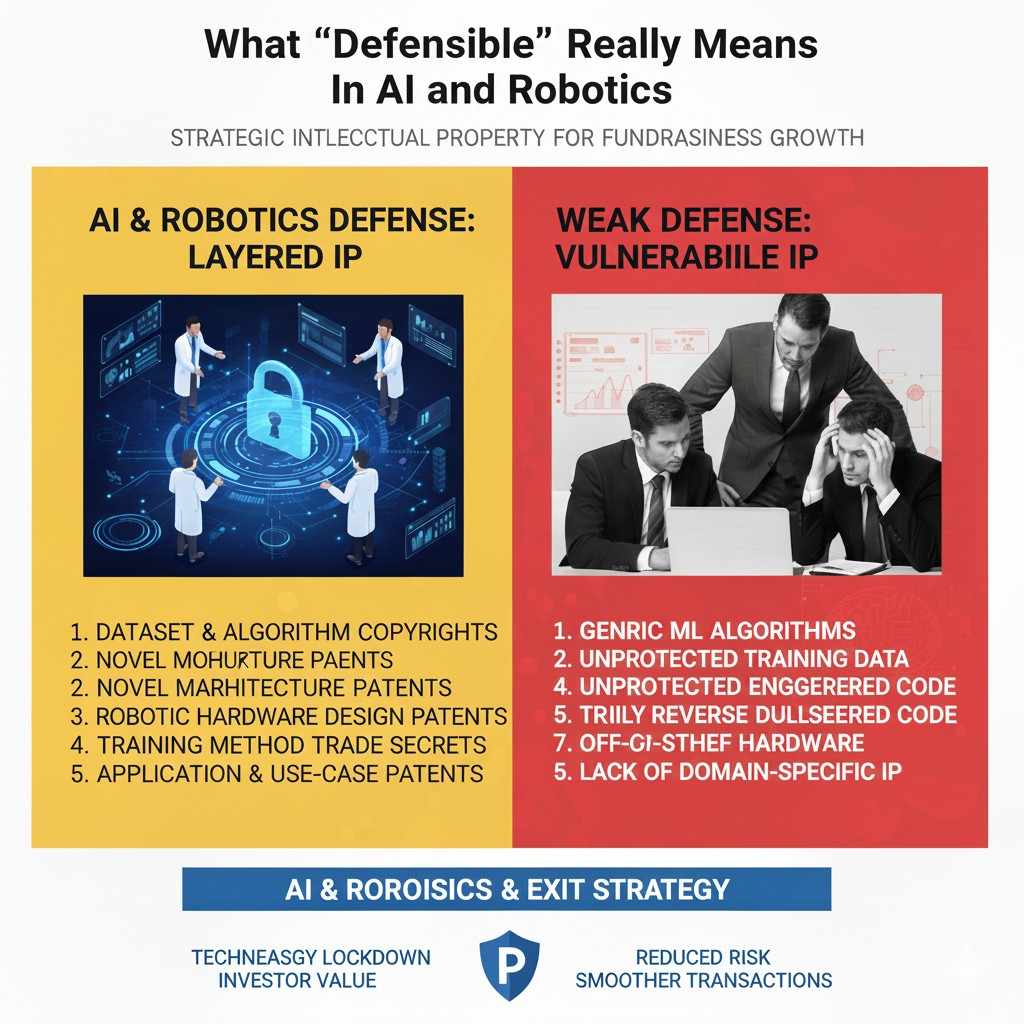
A lot of founders think defensible means the tech is complex.
Complexity helps, but it is not the main point. A buyer does not care if your system is hard to understand.
They care if your advantage is hard to copy without stepping on your rights.
That is why “defensible” is about ownership and boundaries.
It is the difference between “We built a strong system” and “We built a strong system, and we own the key method behind it.”
When a buyer sees clear boundaries, they can picture a future where competitors cannot simply clone your work and race you to the bottom.
If you want help turning your core methods into clear, owned boundaries early, Tran.vc supports founders with up to $50,000 in in-kind patent and IP services. You can apply anytime at https://www.tran.vc/apply-now-form/
Defensible in AI: what buyers want to see
In AI, buyers know a lot can be copied if the only story is “We trained a model.”
They have teams, GPUs, and access to data. They can hire strong people.
So they look for defensibility in places that are harder to reproduce quickly.
They pay attention to how you collect or create data, how you label it, how you keep quality high, and how you reduce noise.
They also pay attention to the system around the model. Things like evaluation, safety checks, monitoring, and the way the model is used inside a workflow.
Often the “owned edge” is not one model. It is the pipeline, the feedback loop, the way the system learns over time, and the way it stays reliable.
A good IP plan can cover these system parts, not just the model itself.
Defensible in robotics: what buyers want to see
Robotics buyers often have a different fear.
They worry your robot works in the lab, but not in the real world. They worry about safety. They worry about cost.
So defensibility can show up in sensing, control, hardware design, calibration, and methods that make deployment stable.
It can also show up in manufacturing choices and test methods that reduce failures.
A robot is a system, and defensibility is often in how the parts work together.
When you protect that “how,” you protect the part that takes years to learn.
Where founders accidentally leave defensibility on the table
Many early teams build something special, but they describe it in a vague way.
They say, “We use AI for this,” or “We have a proprietary algorithm,” or “Our robot is more robust.”
A buyer hears that and thinks, “Okay, but what exactly is new, and what exactly do you own?”
If you cannot answer that in plain words, you will feel risky.
IP-first teams learn to name the invention clearly.
Not with fancy language. With clear cause and effect.
“We do X in a specific way, which solves Y, and gives Z result.”
That clarity is useful for patents, but it is also useful for sales, partnerships, and acquisition talks.
How to find patentable ideas inside your current work
Stop waiting for a “big invention moment”
Most founders think inventions come as a single lightning bolt.
In real startups, inventions happen in small steps.
A workaround you created because a sensor was noisy.
A trick you used to cut inference time in half.
A method that makes your robot handle slippery objects.
A process that catches bad data before training.
These are real inventions when they are specific and repeatable.
Buyers value them because they are the hard-won lessons that others do not have yet.
The easiest way to spot an invention
Look at your engineering notes and ask a simple question.
“What did we change that made the system finally work?”
That change is often the invention.
It might be a sequence of steps.
It might be a new structure.
It might be the way you combine two known things into one new workflow.
It might be the way you measure a problem so you can fix it.
If the improvement is meaningful and not obvious, you may have something worth protecting.
Turn “we built it” into “we can claim it”
An invention has to be described in a way that can be repeated.
This is where founders get stuck. They know the work, but they struggle to explain it cleanly.
A simple approach is to write it like a recipe.
Start point: what the system receives.
Steps: what the system does, in order.
End point: what the system outputs and why it is better.
That “recipe” style often becomes the core of a strong patent draft.
It also becomes the core of a strong buyer story.
Tran.vc helps teams do this without slowing down product work. The focus is to capture what you already built, then protect it in a way investors and acquirers understand. Apply anytime at https://www.tran.vc/apply-now-form/
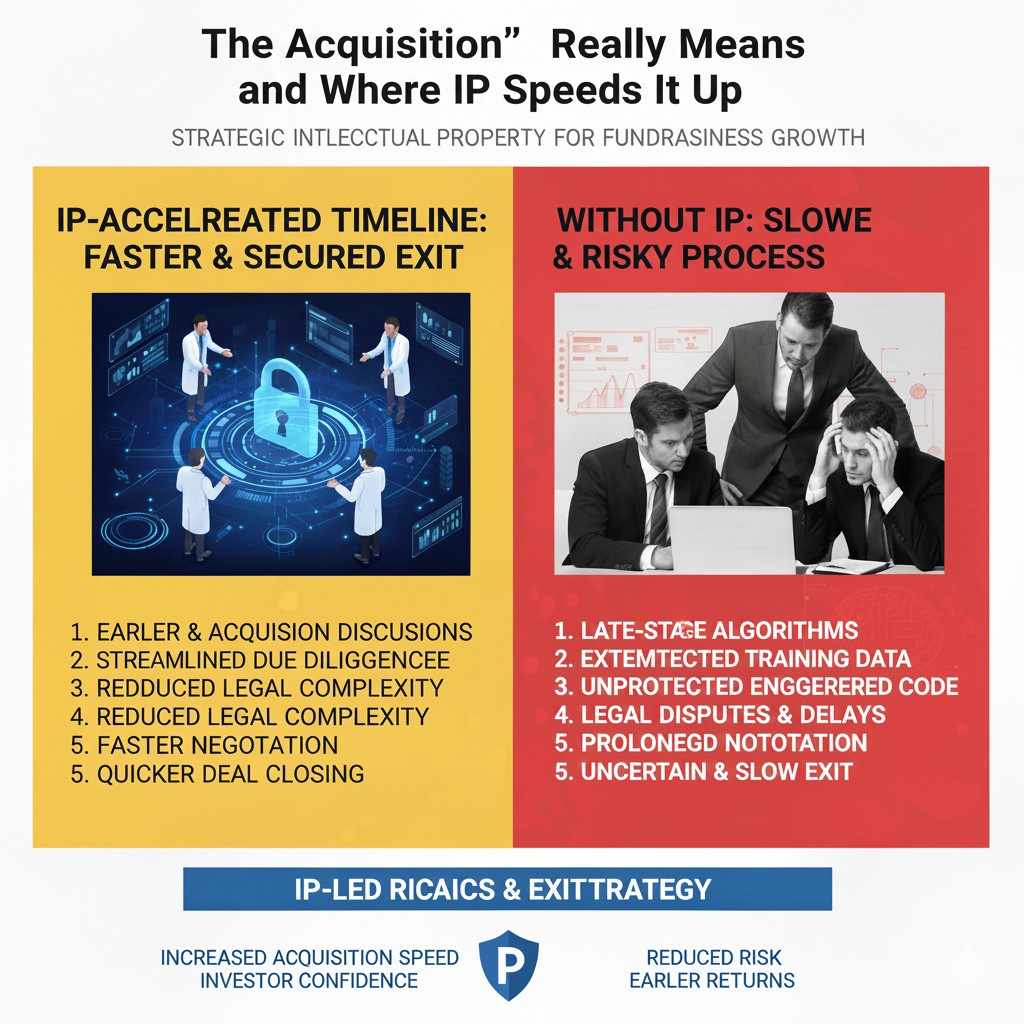
The acquisition timeline and where IP speeds it up
Step one: internal interest and the “why now” moment
Inside the buyer’s company, someone becomes your champion.
They see your product, your team, or your tech and they want it.
But they still need a reason to act now.
IP often becomes that reason.
If your filings show you are claiming a space, the buyer sees that waiting could be costly.
They may fear a competitor will buy you first.
They may fear you will become too expensive later.
They may fear you will block them in a key market.
That creates urgency, and urgency creates speed.
Step two: the legal team asks, “What are we really buying?”
This is where many deals slow down.
Legal teams will ask about ownership, prior employers, contractors, open source use, and whether your rights are clean.
They also ask if you have protected the parts you say are unique.
An IP-first startup usually has organized answers.
Not because they love paperwork, but because they built the habit early.
They can show assignments, invention records, and a clear patent plan.
When legal teams feel calm, timelines shrink.
Step three: negotiation gets simpler when the value is clear
Negotiation is not only about price.
It is about what the buyer believes they are getting.
If your value is only your roadmap, the buyer can push you down.
They can say, “We can hire people and build this.”
But if your value includes protected methods, the buyer has less room to argue.
They may still negotiate, but the conversation changes.
It becomes more about the right structure and less about whether you are worth it.
That is another reason IP-first startups close deals sooner.
What acquirers want to see in your IP, in plain terms
They want coverage around the core, not random filings

Buyers can spot “patent noise.”
Some startups file broad ideas that do not match the product.
Others file many small patents that do not connect.
That can look like confusion.
A buyer wants to see that you protected what truly matters.
The best signal is a simple set of filings that map to your core system.
Not too many. Not too few. Just focused.
They want evidence that the IP was built thoughtfully
A patent is not only a document. It reflects thinking.
If your filings show a deep understanding of the problem, and a clear technical approach, buyers trust your team more.
They assume you can keep inventing after the acquisition.
That matters because buyers often want more than one win.
They want the first win plus the next five.
They want to avoid future disputes
Even if a buyer likes your product, they will hesitate if they see future fights.
If your work touches a crowded space, they want comfort that you are not walking into a minefield.
Strong IP strategy helps here, too.
It helps you carve out a lane and avoid claims that could trigger conflict later.
This is one area where expert guidance matters a lot, especially for AI and robotics where the lines can be messy.
Tran.vc’s model is built around this kind of early guidance. If you want a clear plan that supports fundraising and acquisition readiness, apply anytime at https://www.tran.vc/apply-now-form/
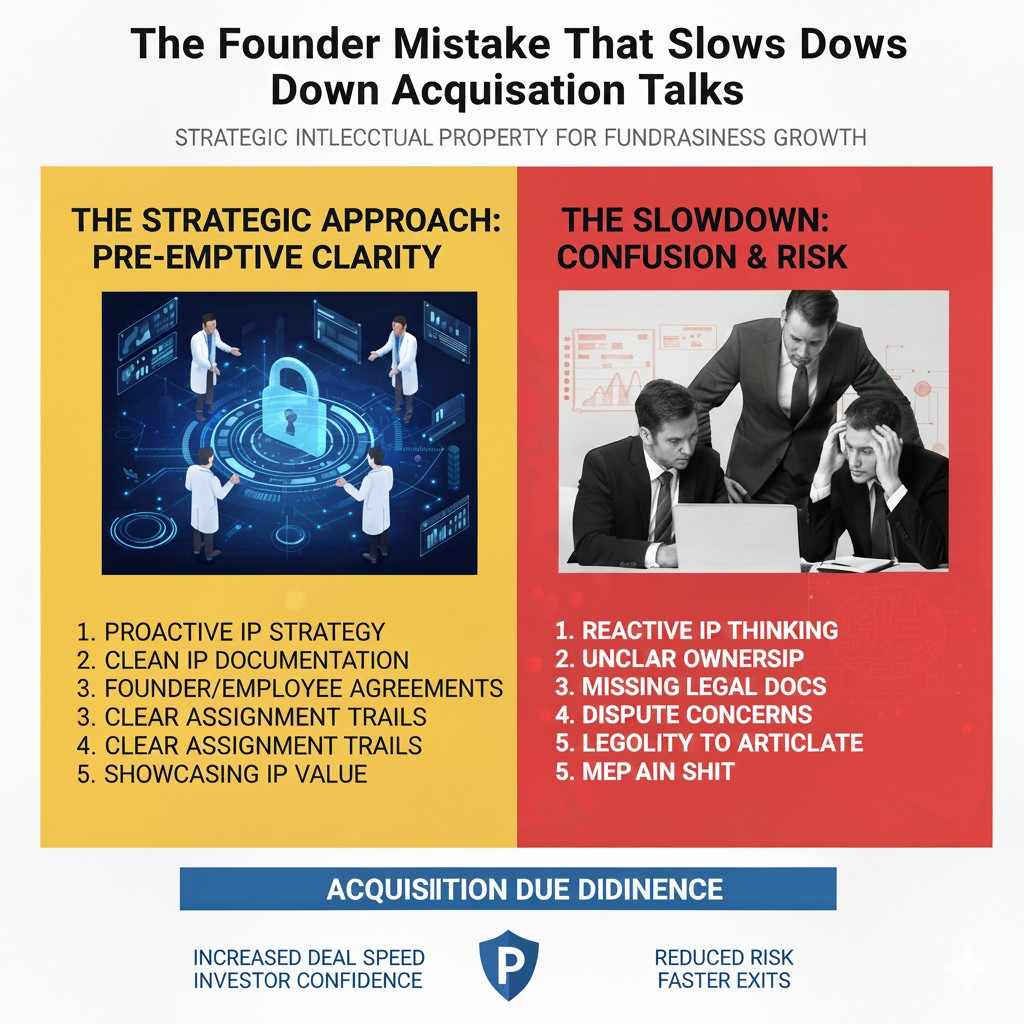
The founder mistake that slows down acquisition talks
Oversharing before you are protected
A founder gets excited.
A big company wants a call. They want a deeper demo. They want to bring “more technical people.”
It feels like progress, and it can be.
But if you share the core method before you have protection, you can lose your leverage.
Even if the other side is honest, information spreads inside large companies.
A curious engineer can go build a version and say, “We don’t need to buy them.”
IP-first startups do not hide everything.
They share smartly.
They keep the core method protected, and they reveal value in layers.
This is not paranoia. It is deal strategy.
Using IP to control the pace of disclosure
When you have filings and a clear strategy, you can show more with less fear.
That lets you move faster in discussions because you are not constantly worrying about what you can say.
You can focus on fit, timelines, and value.
That is a quiet but powerful advantage.