
Most founders treat IP like paperwork. Something you “do later” after the product works, the traction shows up, or the money comes in.
That is a mistake.
Done right, IP is not paperwork. It is a steering wheel. It helps you decide what to build, what to stop building, what to protect, what to sell, and what story your company can tell—without sounding like hype.
In this guide, I’ll show you how to use IP to keep your R&D and your business goals pulling in the same direction, every week, not “someday.” And if you want experienced hands helping you do this without wasting months, you can apply anytime at https://www.tran.vc/apply-now-form/
IP is a bridge between “what we can build” and “what the market will pay for”
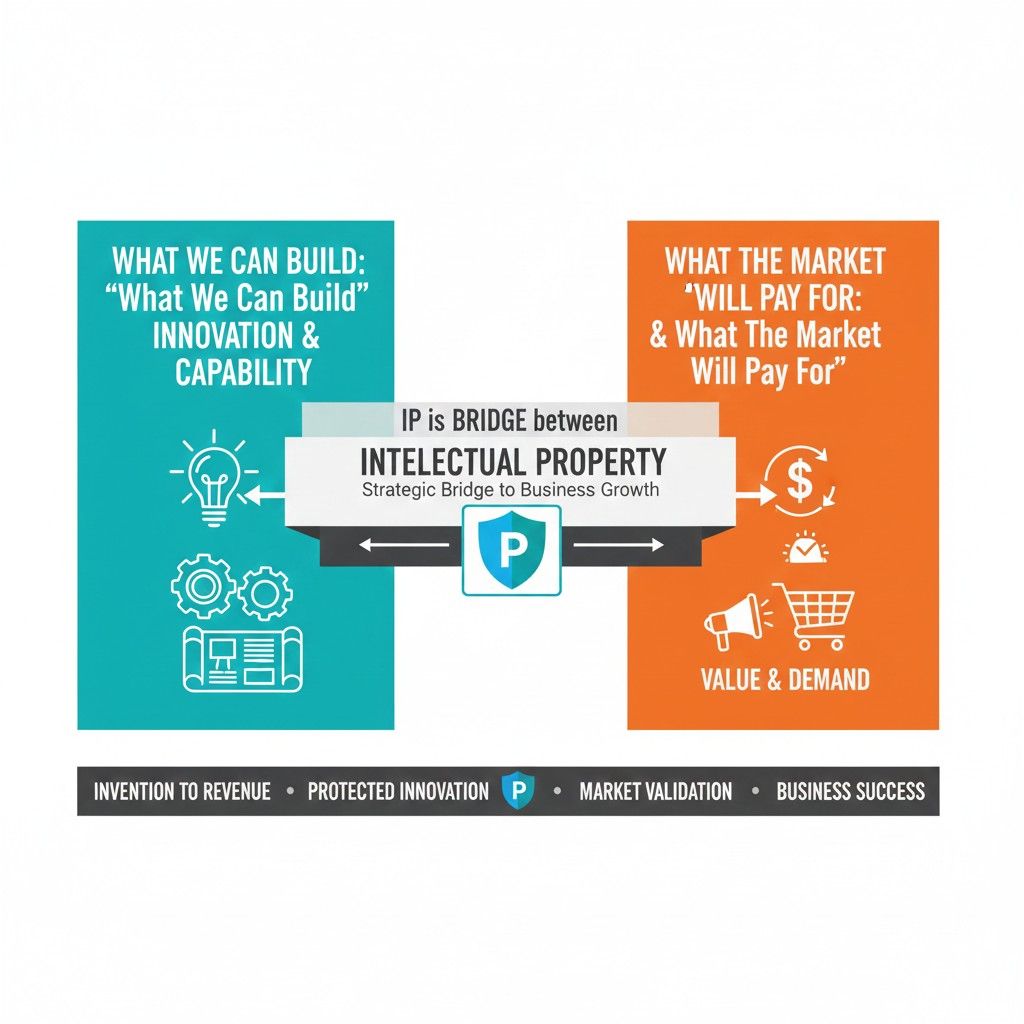
R&D teams are good at solving hard problems. Business teams are good at picking customers and pricing and channels. The trouble starts when these two sides run on different tracks.
R&D says: “We can build a better model.”
Business says: “We need a product that sells this quarter.”
Both may be right. But “right” does not mean “aligned.”
IP can align them because it forces clear answers to three simple questions:
What is truly new here?
Why does it matter to customers?
How do we stop others from copying it once it works?
When you write those answers down, you create a shared map. R&D sees what is worth pushing forward. Business sees what is worth betting the company on. And both sides can point to the same set of “core claims” about the invention, not vague slides.
Here’s the key mindset shift: patents are not just protection. They are also planning.
A good patent plan makes you decide what your company is, at a technical level, in a way that customers and investors can understand. It is like putting a frame around your best ideas, then telling your team: “This is the part that must win.”
If you are building in AI, robotics, or deep tech, this matters even more. Your work is expensive and time-heavy. If you spend six months making something impressive that nobody can defend or sell, you lose time you can’t get back.
Tran.vc exists for this exact problem. We invest up to $50,000 in in-kind patent and IP services, so you can build a real moat early—without burning cash on the wrong filings. If you want to see if it fits your startup, apply anytime at https://www.tran.vc/apply-now-form/
Start with business goals, but translate them into “protectable technical wins”
Many teams start IP the wrong way. They start with what they built and ask, “Can we patent this?”
A better way is to start with what the business needs and ask, “What technical wins must be true for us to win this market—and can we protect them?”
Let’s make that concrete.
A business goal might sound like:
- “We want to sell to Tier-1 manufacturers.”
- “We want to own warehouse picking.”
- “We want to be the safest autonomy stack in our category.”
- “We want to cut inference cost by 60% for enterprises.”
Those are business goals. But patents do not protect goals. They protect methods and systems.
So the translation step is where alignment happens. You take a business goal and turn it into a set of technical outcomes that matter in the real world.
Example: “safest autonomy stack” is not patentable by itself. But the specific way you detect edge cases, handle sensor failure, verify actions before motion, or fuse signals under uncertainty might be.
Example: “cut inference cost by 60%” is not patentable as a promise. But the specific architecture, compression method, caching approach, scheduling logic, or training pipeline that delivers that cost cut might be.
This translation forces both sides to get specific. Business can’t hide behind big claims. R&D can’t hide behind “cool demos.” You meet in the middle: measurable value and the technical route to deliver it.
Here’s a simple way to run this inside your company without adding heavy process:
When the business team says, “We need X,” ask R&D, “What must be technically true for X to happen?”
When R&D says, “We built Y,” ask the business team, “What customer pain does Y remove—and what would they pay to remove it?”
Then ask one more question that ties it all together:
“If a smart competitor saw this in a year, what would they copy first?”
Whatever the answer is, that is often your first IP target. Because competitors copy value, not effort.
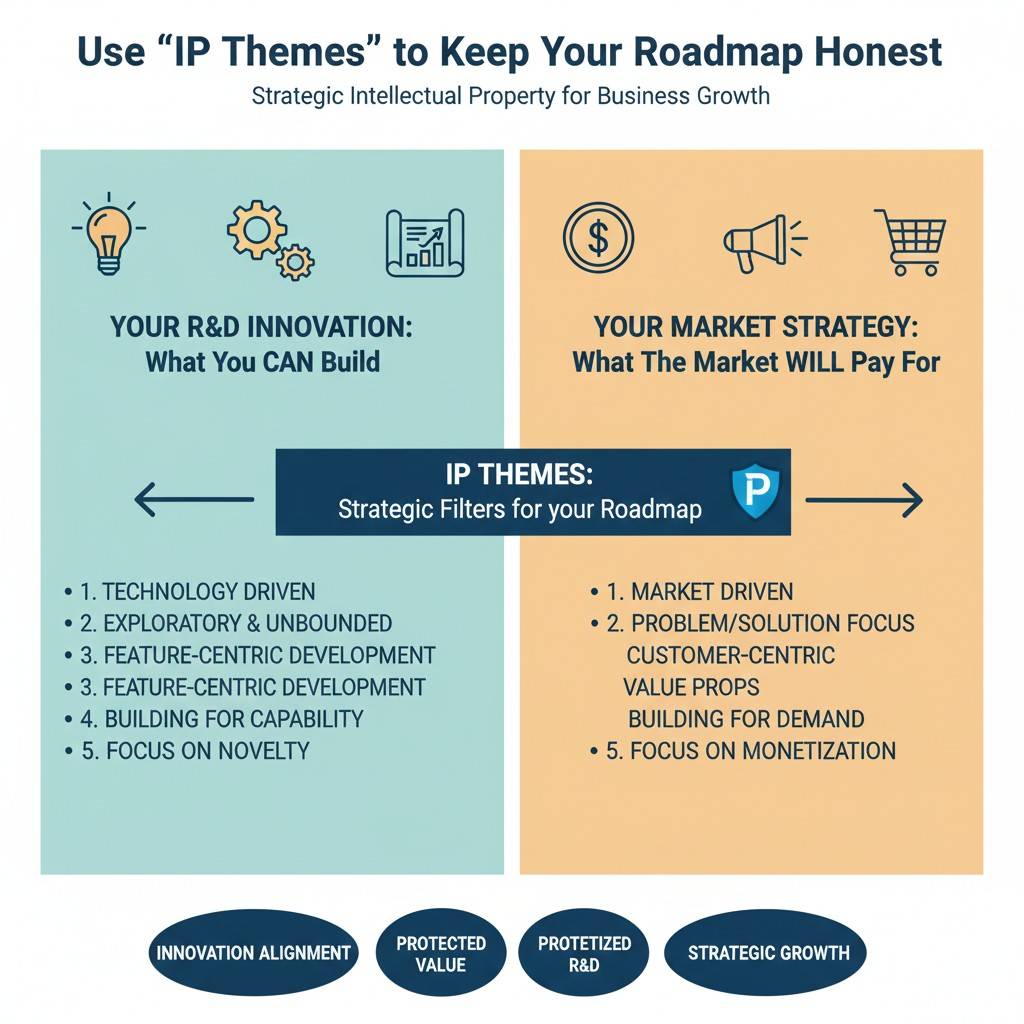
Use “IP themes” to keep your roadmap honest
One of the fastest ways startups drift is when roadmaps become a pile of requests.
A customer asks for Feature A.
An advisor suggests Feature B.
A teammate wants to explore Feature C.
A competitor launches Feature D.
Now your roadmap is a messy wish list.
IP themes are a clean fix.
An IP theme is simply a sentence that states what you are trying to own.
Not “we are building robotics.”
Not “we are building AI.”
But something like:
“We own safe grasp planning for unknown objects in clutter.”
Or:
“We own real-time learning under tight compute on edge devices.”
Or:
“We own detection and recovery from sensor drift in harsh environments.”
Notice what happens. An IP theme is narrow enough to guide R&D choices, but meaningful enough to support sales and fundraising.
Once you have two or three IP themes, you can use them like a filter:
If a roadmap item strengthens an IP theme, it gets priority.
If it does not, it must justify itself with real revenue or a clear strategic reason.
This is not about saying “no” to customers. It is about saying “yes” with a spine.
It also keeps your patents from becoming random.
A common early-stage mistake is filing patents that look impressive but don’t connect to how the company will win. That happens when filings are driven by what is easiest to describe, not what is most valuable to defend.
When your IP is tied to themes, you stop filing “fun inventions” and start filing “business-critical inventions.”
And that is exactly what investors want to see: not a patent count, but a patent story.
Tran.vc helps founders do this with a real strategy, not generic templates. You get guidance from people who have actually built and protected technology before. If you want to explore it, apply anytime at https://www.tran.vc/apply-now-form/
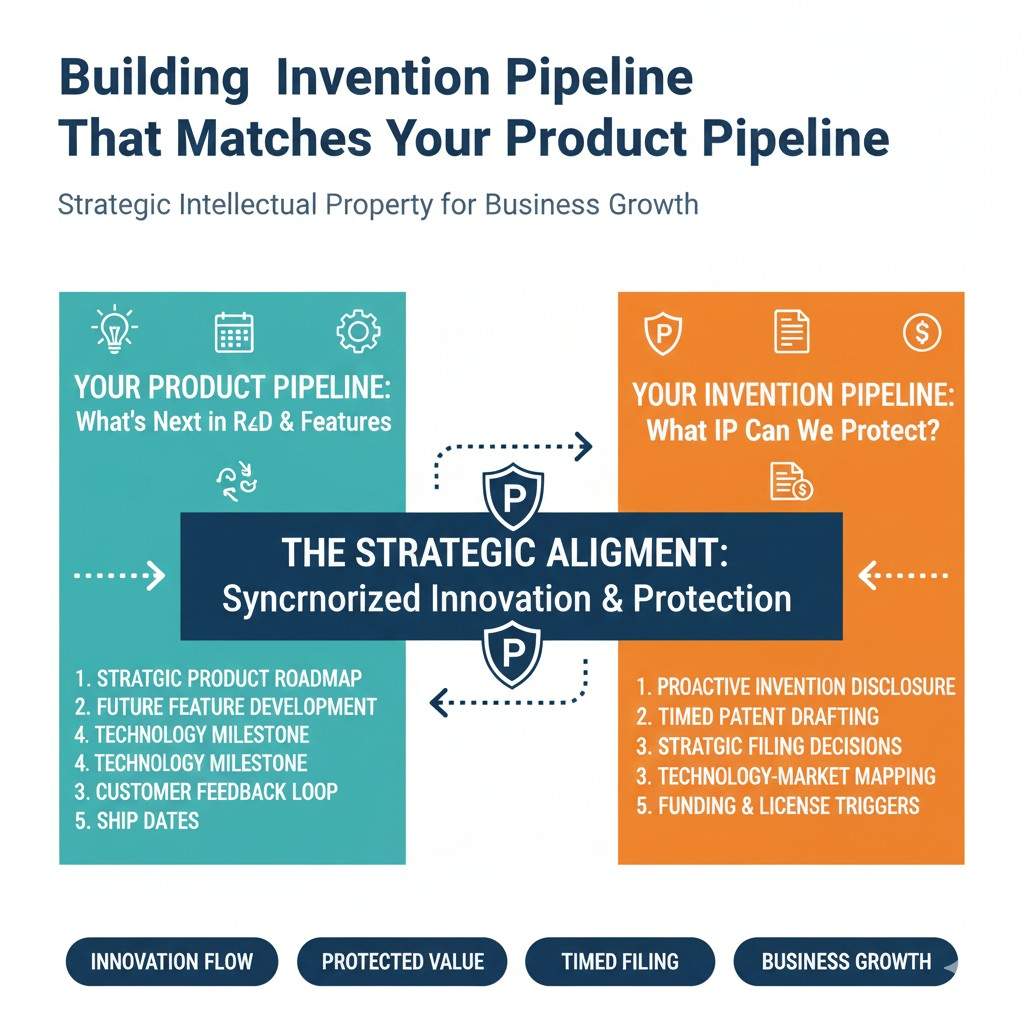
Build an “invention pipeline” that mirrors your product pipeline
Alignment fails when IP is handled as a one-time event. You file once, then forget it.
Instead, treat inventions like a pipeline—just like product work.
In product, you do discovery, scoping, building, testing, shipping.
For IP, you can do something similar:
You spot candidates, shape them, document them, decide what matters, and file at the right time.
The goal is not to add meetings. The goal is to capture value that already exists in your work, before it disappears into Slack threads and half-remembered decisions.
Here’s a very practical way this looks in real life:
Your team finishes a sprint and says, “We improved the system.”
Most teams stop there.
Aligned teams ask, “What changed? Why did it work? What tradeoffs did we solve? What did we try that failed?”
Those answers often contain patent-ready material, because real invention is usually found in the constraints and the fixes.
In AI and robotics, invention is often in the “how,” not the “what.”
Not “we detect objects,” but “we detect objects under motion blur, with low light, on edge hardware, while meeting timing limits.”
Those constraints are gold. They also happen to be the parts customers care about.
So you want a habit: after major technical wins, capture the details while they are fresh.
You do not need long docs. You need the right details:
What problem existed before?
What solution paths were tried?
What finally worked?
What is different about your approach?
What are the key steps that make it work?
What data inputs matter?
What outputs improve?
Where does it fail—and how do you handle that?
When you capture that consistently, your IP work becomes smoother, faster, and cheaper. You avoid the painful scramble of trying to reconstruct invention months later.
This also aligns R&D with business goals because it makes progress visible in a form that the business side can use:
- for pitches,
- for customer trust,
- for partnerships,
- and for staying ahead of copycats.
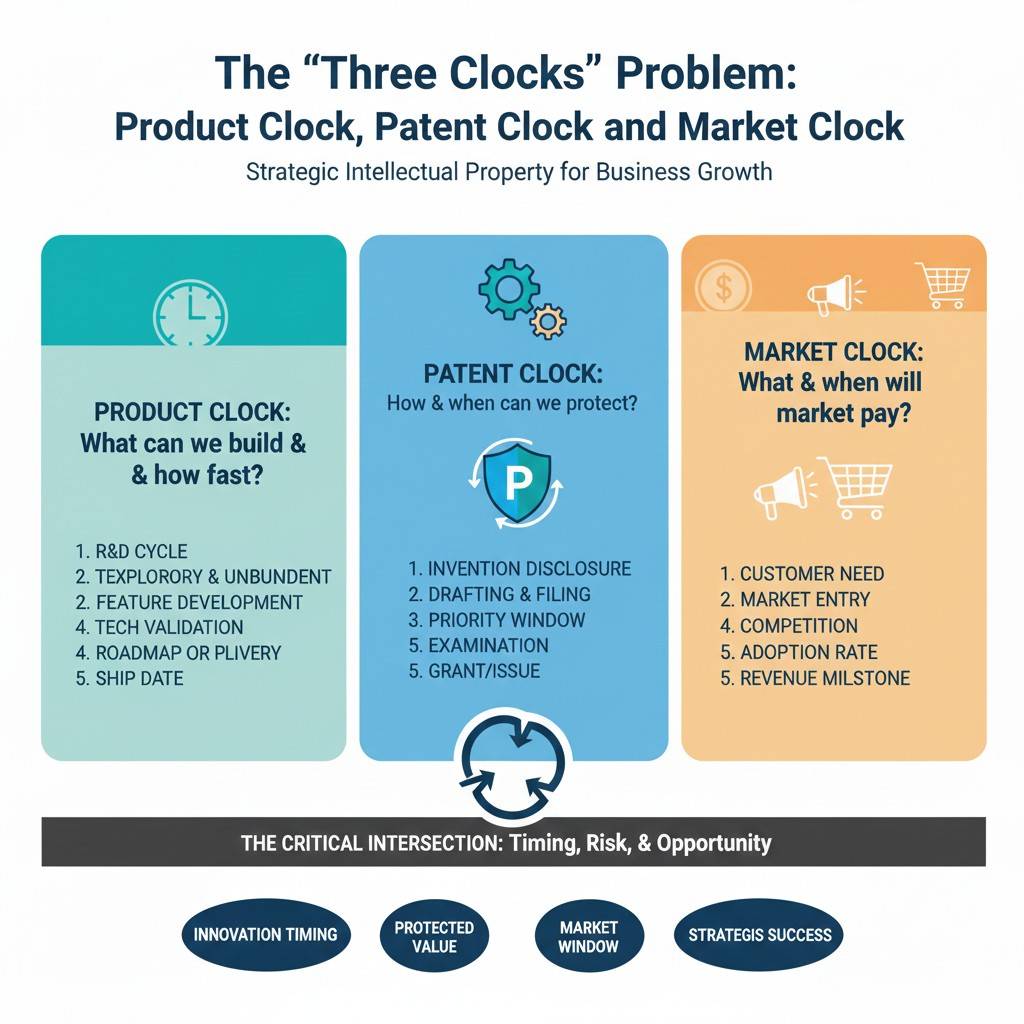
The “three clocks” problem: product clock, patent clock, and market clock
A big reason teams struggle with IP alignment is timing.
Product teams move fast. Markets move fast. Patents move slow.
So founders either file too early (before they know what matters) or too late (after they’ve shown it publicly or after competitors have similar ideas).
The solution is not “always file early.” The solution is “file with intent.”
You want to understand three clocks:
The product clock: when the feature becomes real and stable.
The market clock: when customers start caring and competitors start watching.
The patent clock: what you can protect now, and what you should wait to protect later.
This is why provisional filings can be useful when used wisely. They can lock in a date while you keep building. But they must be written well enough to support future claims. A weak provisional is not a shield. It is a false comfort.
The practical takeaway is this:
When you are about to reveal something that would be easy to copy and important to your sales story, you should treat that as an IP moment.
A demo day.
A conference talk.
A customer pilot where you share details.
A public repo update.
A blog post explaining your method.
These are business events, but they also change your protection risk. That’s alignment in real time: business activity triggers IP readiness.
If you want help building this timing sense—without slowing your product—Tran.vc’s whole model is built around it. Apply anytime at https://www.tran.vc/apply-now-form/
Using IP themes to guide the roadmap
Why themes prevent drift between teams
When R&D and business goals are not tied together, the roadmap slowly turns into a bag of requests. A customer wants one thing, a partner wants another, and the team keeps adding “just one more” feature. The product starts to look busy, but it is no longer sharp. IP themes stop that drift because they force a clear choice: what are we trying to own?
An IP theme is a simple statement of the technical value you plan to defend. It is not a broad promise like “we do AI for robotics.” It is a narrow point of control like “we own safe grasp planning for unknown objects in clutter.” A theme gives your team a steady target that does not change every time the market gets loud.
How to write themes that both R&D and business can use
A useful theme must be technical enough for engineers to build around, and clear enough for sales and investors to repeat without twisting words. If the theme cannot be explained in plain speech, it is too fuzzy. If it cannot be tied to a real method or system, it will not become strong IP.
A good theme often includes a hard condition that customers care about, like speed, safety, cost, or reliability. It also hints at a setting where most tools fail, like low light, messy shelves, noisy sensors, or strict compute limits. This helps the team stay honest about what is truly hard and truly valuable.
Turning themes into weekly decisions
Themes only work if you use them as a filter, not as a poster on a wall. Every time a new roadmap item appears, you ask a direct question: does this work strengthen one of our themes? If it does, it earns attention. If it does not, it must earn its place through real revenue impact or a critical customer need that keeps the business alive.
This creates a calm way to say “not now” without ego. It also protects engineers from endless context switching. Over time, the company becomes known for a few things it does better than anyone else, which is the root of a strong moat.
Keeping patents from becoming random paperwork
Many startups file patents because they think they should, not because the filings match the business. That leads to patents that look fine on paper but do not defend the path to revenue. Themes prevent that because they give you a structure for what to protect first.
If you have two or three themes, your filing plan becomes cleaner. You stop chasing every clever idea and start capturing the ideas that sit at the center of your product and your pricing power. This is the kind of IP story that investors actually respect, because it connects to how the company will win.
If you want a team that helps you shape these themes and turn them into a filing plan, you can apply anytime at https://www.tran.vc/apply-now-form/
Building an invention pipeline that matches your product pipeline
Why IP fails when it is treated as a one-time event
Most teams approach patents like a fire drill. They wait until a big moment is close, then rush to write something down. The problem is that invention details fade fast. People forget what failed, what finally worked, and why the final approach mattered. That missing detail is often what makes a patent strong.
When you treat IP as a steady pipeline, you remove the panic. You also avoid wasting money on weak filings. The goal is not more paperwork. The goal is to capture the best parts of your work while they are still clear.
Where real invention often hides in AI and robotics
In deep tech, invention is rarely the headline. It is usually the method that makes the headline possible. Many teams say, “we improved accuracy,” but the real value is in how they did it under tight limits. It might be in how the system handles sensor dropouts, how it detects bad inputs, or how it stays stable when the environment changes.
Customers do not pay for “accuracy” in isolation. They pay for results under real conditions. That is why the best IP often lives inside constraints. If you can explain how you solve the hard edge cases in a repeatable way, you are close to patent-ready material.
A simple way to capture invention without slowing the team
You do not need long documents to start. You need a habit. After a meaningful technical win, capture the story while it is fresh. The story should include the problem, what was tried, what failed, and what finally worked. It should also include what makes your approach different, and which steps are essential versus optional.
This kind of capture can be done in a short internal write-up, but it must be specific. General statements like “we used a better model” do not help. Clear statements like “we changed how we fuse signals when one sensor is unreliable” create real material that an IP team can shape into claims later.
How this pipeline aligns R&D with business goals
When invention capture becomes normal, the business side gains visibility into what is being built and why it matters. You are no longer relying on demos alone. You have a written record of technical value that can be used for enterprise trust, partnerships, and investor discussions.
This is alignment in practice. R&D sees which wins are central to the product. Business sees which wins can be turned into defensible value. Both sides get a shared language for progress.
Tran.vc supports founders with this exact process, and invests up to $50,000 in in-kind patenting and IP services to make it real early. Apply anytime at https://www.tran.vc/apply-now-form/
Timing: product clock, market clock, and patent clock
Why timing errors are costly and common
Filing too early can lock you into a narrow story before you truly know what matters. Filing too late can mean you have already shown the best parts to the world, which can weaken your position. This is why founders often feel stuck: move fast for product and market, but do not lose protection.
The answer is not to over-file or under-file. The answer is to file with intent and timing that matches your business moments.
The product clock and what “stable enough” really means
The product clock is about when something becomes real, repeatable, and likely to stay in the product. If a method is still changing every week, it may be too early to lock it into a full filing. But if a core approach is working and the team is building around it, that is a signal that the invention has shape.
In practice, “stable enough” does not mean perfect. It means the key steps are unlikely to disappear. It means the team has learned what the method depends on, and what outcomes it drives. That is usually enough to capture value, especially if a public reveal is coming.
The market clock: when competitors begin to copy
Markets copy what proves value. Once customers start paying attention, competitors will too. The market clock speeds up when you enter pilots, publish case studies, speak at events, or share technical details during enterprise sales cycles.
This is a place where founders often get surprised. They think secrecy protects them, but sales requires sharing. If your sales process includes technical deep dives, you should assume your ideas are being observed. Good IP planning respects this reality instead of pretending it is not happening.
The patent clock and how to avoid false comfort
The patent clock is about what you can protect now, and what can be strengthened later. Provisional filings can help lock in an early date, but only if they are written with enough detail to support future claims. A thin provisional that skips the key steps is not a shield. It is just a receipt that you filed something.
A smart approach often uses staged protection. You capture the core method early when a reveal is near, then you add follow-on filings as the product becomes clearer. This keeps you protected without freezing innovation.
If you want help building a timing plan that matches your product and sales reality, you can apply anytime at https://www.tran.vc/apply-now-form/
Using IP to turn a roadmap into a claim map
What a claim map is and why it creates alignment
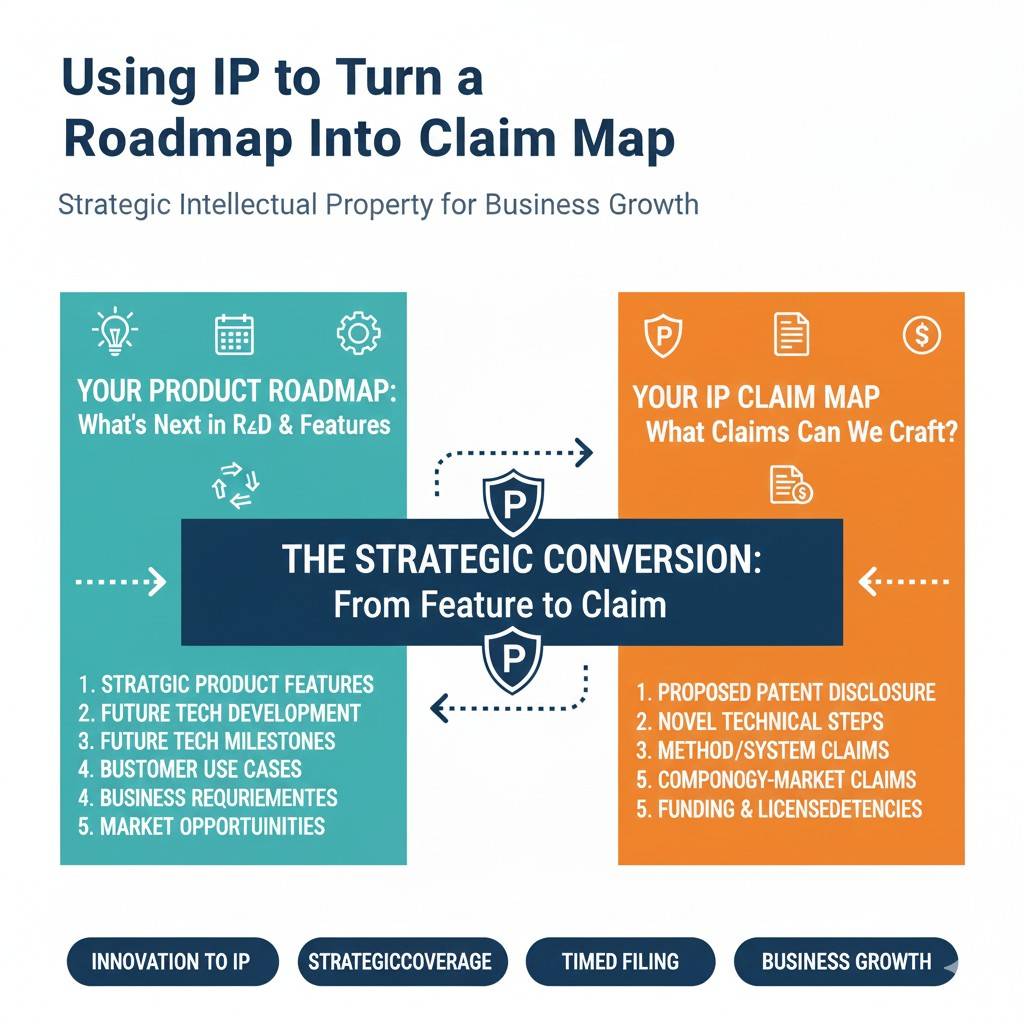
A roadmap tells you what you plan to build. A claim map tells you what you plan to own. When these two match, your company moves with focus. When they do not, you may still ship features, but you are not building a defendable advantage.
A claim map is not a legal document. It is a practical tool that connects core product capabilities to protectable ideas. It helps engineers see which parts of the system are “must-win.” It helps the business side see which capabilities can support pricing, enterprise trust, and long-term leverage.
How to convert product capabilities into protectable pieces
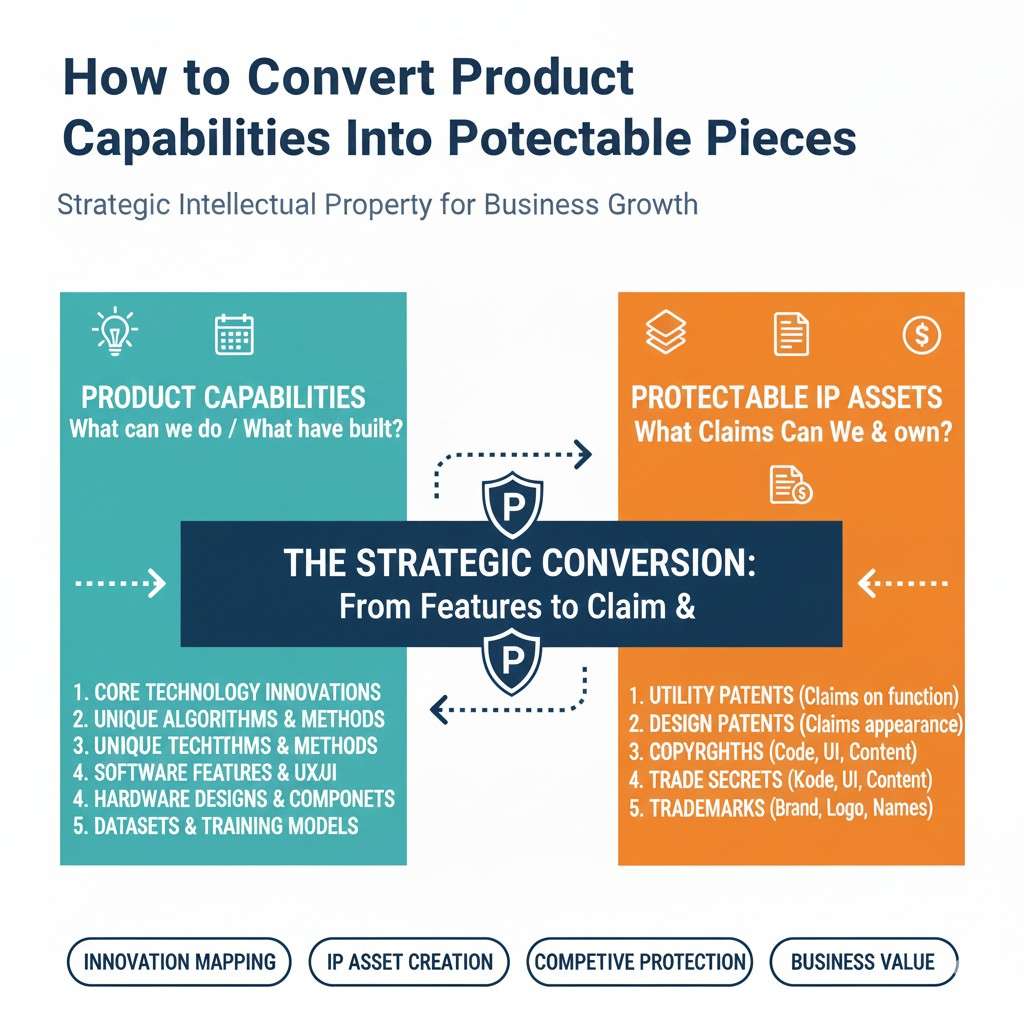
Start with one major capability your product needs to deliver. For example, “robot picks unknown items from clutter” or “model runs on edge with low power.” Then break that capability into the steps that make it work. Look for points where you solved a hard tradeoff, like speed versus safety, accuracy versus compute, or robustness versus cost.
Those tradeoff solutions are often the protectable parts. They show that you did not just follow a standard recipe. You made choices that created a unique method. When you document those choices, you create the raw material for patents that match the roadmap.
How the claim map changes R&D choices in a good way
Once engineers can see what the company wants to own, they stop spending time on side quests that do not support the goal. They still explore, but exploration becomes purposeful. It also reduces rework, because the team is less likely to build something that later gets cut for being off-strategy.
This is not about controlling engineers. It is about giving them a clear target so their work builds toward a defendable product. Many teams find this motivating, because it connects daily tasks to a bigger story of why the company deserves to exist.
How the claim map supports sales and fundraising
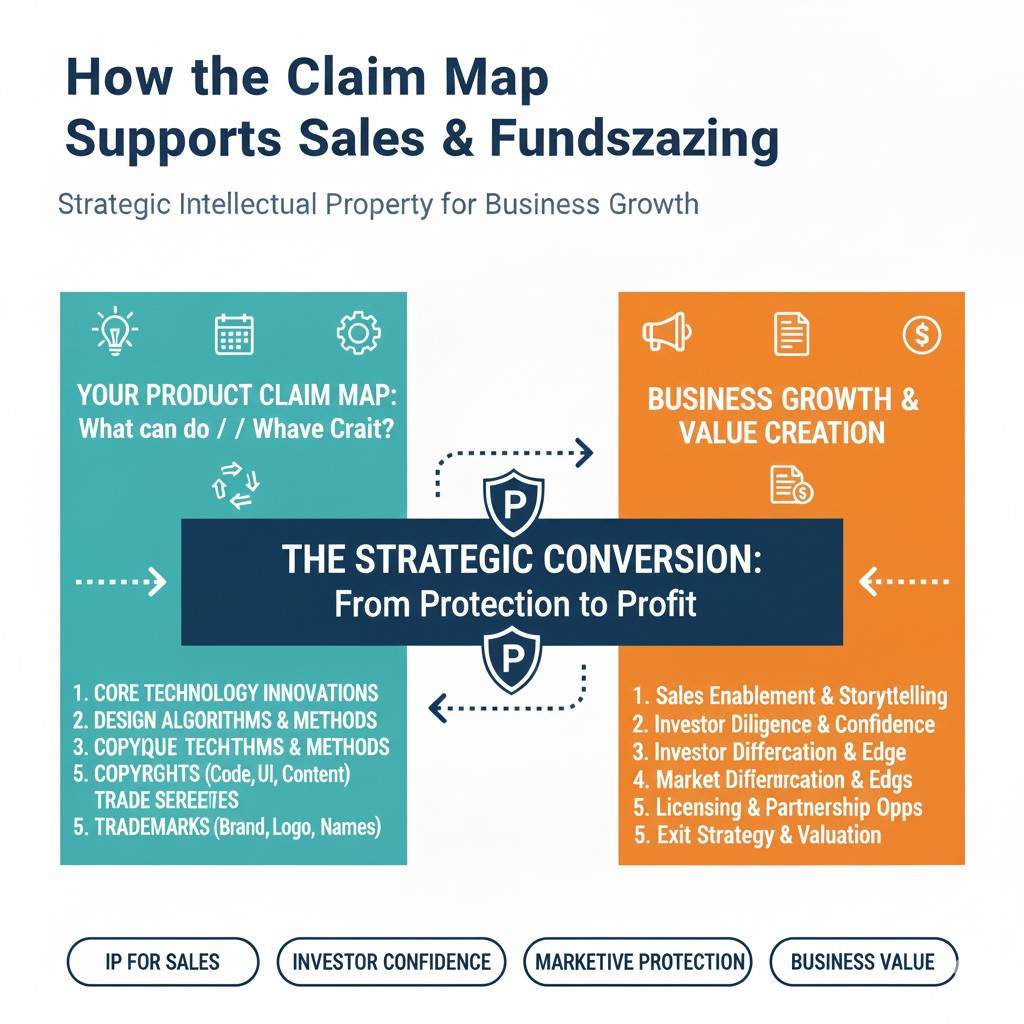
A claim map gives the business side a clearer story than generic “we are better” statements. Instead of saying “our system is unique,” you can explain the core methods that make it unique, in plain language, without exposing every detail.
Investors also respond well to this. They want to know what is hard to copy, and why your company will not be crushed by a larger player once the market is proven. When your roadmap and claim map match, the answer becomes easier to show.
If you want Tran.vc to help you build this kind of IP-backed product story early, apply anytime at https://www.tran.vc/apply-now-form/