
If you are building real tech—AI models, robotics systems, sensors, chips, or anything hard to copy—your patent timing can either protect you or quietly hurt you.
One rule matters more than most founders realize: the Paris Convention priority rule. People call it the 12-month rule. It sounds simple, but it can decide whether your international patent plan stays strong—or collapses.
In plain terms, this rule lets you file in one country first, then file in other countries later, while still keeping the earlier date as your “effective” filing date. That earlier date is called your priority date. Investors care about it. Competitors can lose sleep over it. And founders who miss it often find out too late.
This article will walk you through it like a human would. No legal fog. No fancy words. Just the real-world playbook—what the 12 months are, what you can do inside them, what mistakes to avoid, and how to use the rule to buy time without losing rights.
And if you want a team that helps you set this up the right way from day one, Tran.vc invests up to $50,000 in in-kind patent and IP services so you can build a real moat early—without rushing into a seed round too soon. You can apply anytime here: https://www.tran.vc/apply-now-form/
Paris Convention Priority: The 12-Month Rule Explained
What “Paris Convention Priority” really means
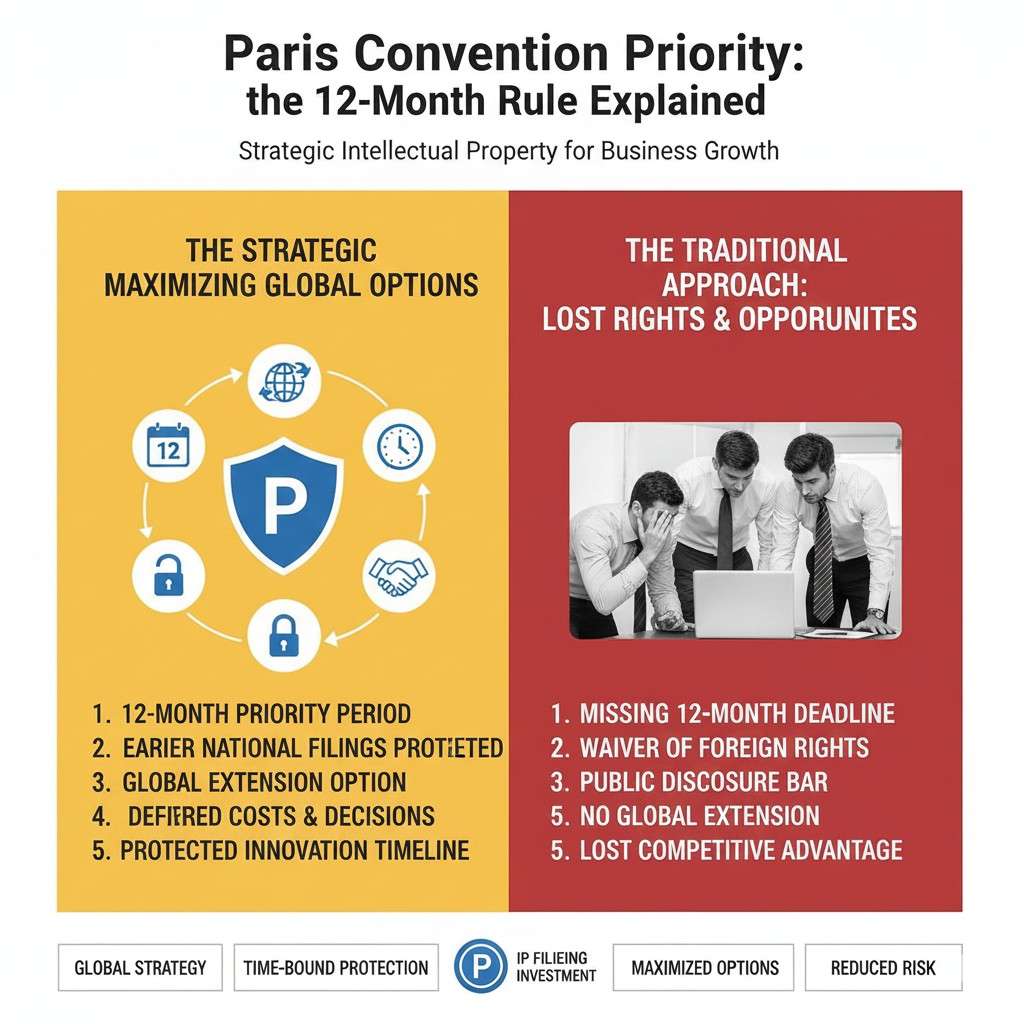
The Paris Convention is an agreement between many countries. It helps inventors and companies protect the same invention in more than one place, without having to file everywhere on the same day.
The main benefit is the word “priority.” Priority is your earlier filing date that counts as your key date later. When you file in other countries within the allowed window, you can often claim that first date as if you filed there on day one.
This matters because patents are a race against time. Your own product launch, your demo day, a customer pilot, or a competitor’s filing can all change what is possible. Priority helps you hold your place in line while you expand globally.
If you are building AI or robotics, this is not a small detail. Many deep tech products have global buyers from the start. The priority system is one of the cleanest ways to keep your options open without spending everything upfront.
Tran.vc helps founders set this up early, so the first filing is not random. It is designed to support the next filings and the story investors will inspect later. If you want help building an IP plan that fits your roadmap, you can apply anytime at https://www.tran.vc/apply-now-form/.
The 12-month rule in plain language
The 12-month rule means this: once you file your first patent application in a Paris Convention country, you usually have up to 12 months to file in other member countries and claim priority back to that first filing.
That 12 months is your window to decide where you actually need protection. It is time to learn which markets matter, which partners are real, and which regions are simply nice to have.
But the rule is strict. If you miss the deadline, you do not just lose a discount or a bonus. In many cases, you lose the right to treat your later filings as if they were filed earlier. That can change whether your invention is still considered new.
Founders often assume there is flexibility here. There is not much. The safer approach is to treat month 12 like a wall, not a suggestion.
When Tran.vc supports a startup, a big part of the work is building the calendar and decision points early. That way, you are not making global filing choices in a panic near the deadline.
Priority date vs filing date: why both exist

People get confused because they hear two dates. One is your “filing date” in each country. The other is your “priority date,” which comes from your first filing.
Your filing date is the day you submit an application in a specific office. If you file in the US on January 10, that is the US filing date. If you file in Japan on October 5, that is the Japan filing date.
Your priority date is the anchor. If your Japan filing properly claims priority to that US filing, then for many legal tests, the invention is treated as if it was filed on January 10 in Japan too.
This is powerful for one simple reason. Patent systems care a lot about what existed before your key date. If you have an earlier priority date, more things that happen later cannot be used against you.
This is why investors ask about it, even if they do not use the legal terms. They want to know if you own the timeline, or if your timeline owns you.
What the priority claim actually does for you
A priority claim is not just paperwork. It is the bridge between filings. It tells the second country’s patent office, “This is the same invention we filed earlier, and we are filing here within the allowed window.”
If it is done correctly, it can protect you from problems that come up during those 12 months. For example, if you publish a paper or show your system to a large customer after the first filing, that later public event is less likely to damage your foreign rights, because your key date is earlier.
It also helps with competition. If someone sees your product and tries to file something similar later, your earlier priority date can be an important shield.
That said, priority is not magic. It does not fix weak writing. It does not cover new ideas you invented after the first filing. And it does not protect things that were not described well enough in that first application.
This is why the quality of the first filing matters so much. Tran.vc focuses heavily on that first filing because it becomes the base layer for everything that follows.
Why the 12-month window exists at all

The window exists because global patent filing is expensive and complex. Without a window, inventors would need to file in many countries immediately, which would block many startups from protecting anything outside their home region.
The 12 months are meant to give you breathing room. You can test the market, learn from early users, and make smarter choices about where protection will actually help.
For founders, the window is also a strategy period. You can prepare better documents, build stronger claims, and decide which inventions are worth expanding. You can also look at what competitors are doing and adjust your approach.
The best founders treat this window like a focused sprint. Not a relaxed delay. You should use the time, but you should not sleep through it.
The big misunderstanding: “I can change everything later”
A common mistake is thinking the first filing is just a placeholder and the real work can happen later. Some teams file quickly, with thin detail, planning to “fix it” before going global.
But priority depends on what is actually in that first filing. If your later filings include key details that were missing, those new details may not get the early date. They might be treated as later inventions.
That can create a hidden weakness. You might think you have one clean priority date, but in reality, different parts of your application may have different effective dates.
If you are building fast-moving AI or robotics, this happens easily. The model changes. The system gets a new sensor. The training method shifts. Your edge often evolves month to month.
This is why you need an IP plan that matches how your tech will change. If you build it right, you can file the first case with solid detail, then add improvements through follow-on filings without breaking your story.
A practical founder view: what to do in month 0
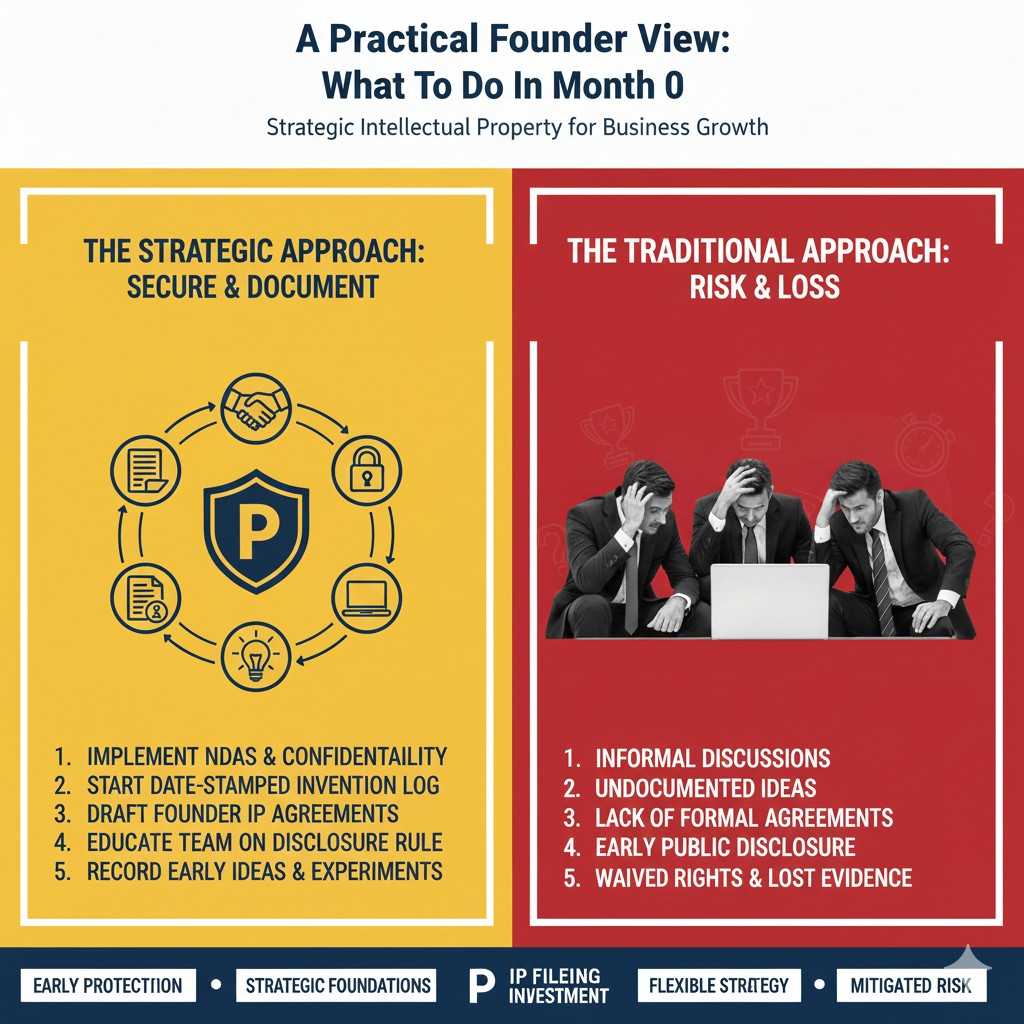
Month 0 is the day you file the first application. If you do it right, you do not just file. You also set up a simple structure for decisions.
You should have a clear written record of what is in the filing, what is not in the filing, and what you expect to build next. This helps you avoid assuming something is covered when it is not.
You should also mark the 12-month deadline on a shared calendar, not just in one person’s head. Many founders miss this because they were busy building and fundraising, and the deadline quietly arrived.
You also want a short list of target regions to explore during the year. Not a final decision, just a starting map. It keeps you from wasting months and then making rushed choices later.
If this feels like a lot, this is exactly the kind of early structure Tran.vc builds with startups. You can apply anytime at https://www.tran.vc/apply-now-form/.
What counts as a “first filing” for Paris priority
Your first filing is the earliest patent application that describes the invention and is filed in a Paris Convention country. In practice, this is often a provisional application in the US, or a regular filing in another country.
What matters is that it is a real filing that can support later claims. It needs to describe the invention in enough detail that it is understandable and usable, not just a vague idea.
If the first filing is too thin, the priority benefit becomes fragile. You may still claim priority, but it may not hold up for the parts that matter most.
In deep tech, “enough detail” usually means more than marketing talk. It means steps, system blocks, data flows, training or control logic, edge cases, and how the parts fit together.
This is why founders should avoid treating the first filing like a rushed form. It is the foundation. If the foundation is weak, the building is shaky.
The difference between patent families and one-off filings
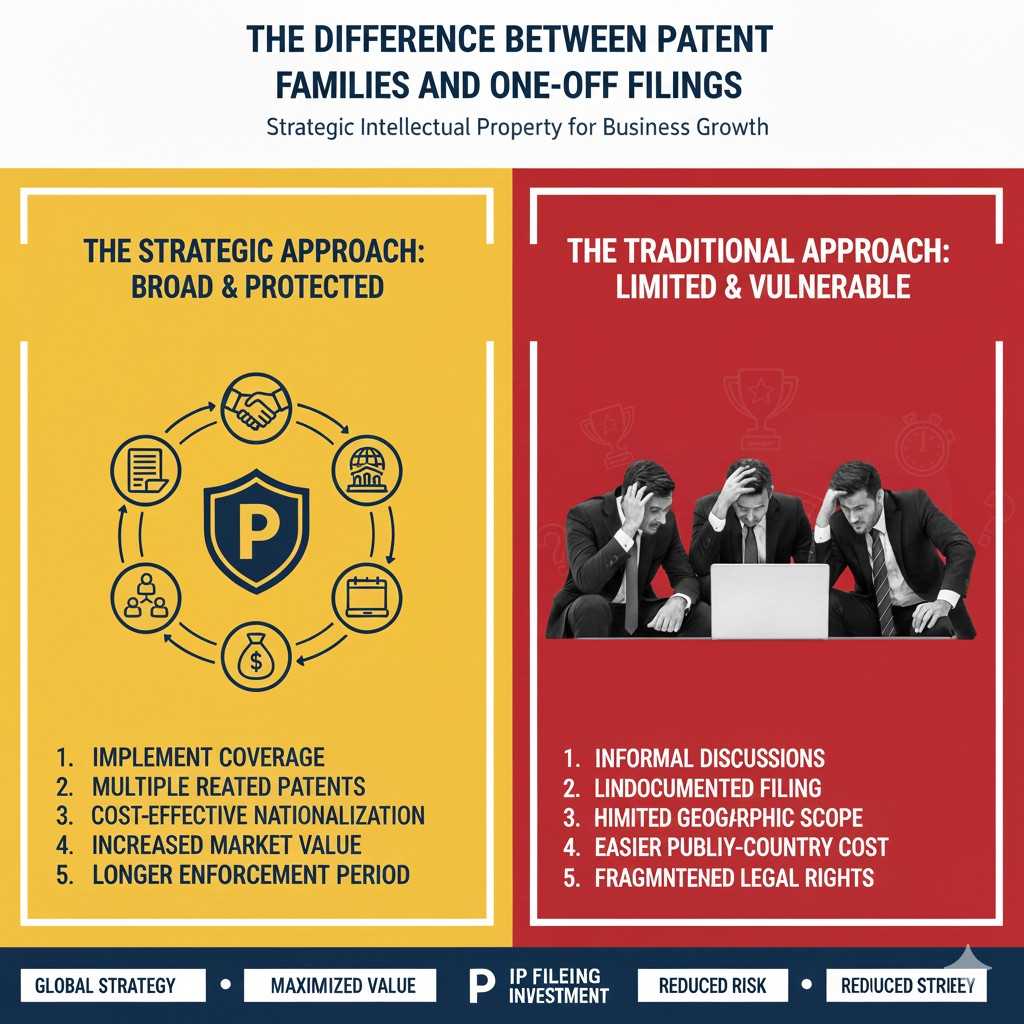
When you use the Paris Convention well, you often create what people call a “patent family.” That is a set of related filings in different countries, all tied to the same invention and the same early date.
A patent family makes your IP look organized. It also makes it easier to manage, because the story is consistent across regions. This can matter in fundraising because it shows you are serious about protection.
One-off filings are different. A company might file a patent in one place and never expand. That can still help, but it does not give you the global flexibility that a growing startup often needs.
If your product might be used in the US, Europe, Japan, Korea, or other key regions, a family approach is usually more aligned with long-term value.
For robotics and AI, the “where” question is not only about customers. It is also about manufacturing, suppliers, and partners. A thoughtful plan considers all of that.
A short note on “countries” vs “systems”
Founders often speak in terms of countries, but some patent paths are regional systems. Europe, for example, has a route that can cover many countries through a central process before it becomes national rights.
There is also the PCT route, which is not exactly a country filing but a process that can extend the timeline and keep options open. It is often used together with Paris priority planning.
Do not worry if these terms feel heavy right now. The point is simple. The 12-month rule is one of the first gates. After that, you can choose paths that match your budget and your markets.
The best time to understand these paths is before month 12. Not at month 11, when everything feels urgent.
Where this gets risky for AI and robotics founders

AI and robotics startups move fast. Your system today may be different in three months. Your data pipeline may change. Your control loop may be rewritten. Your model may jump from one approach to another.
This speed creates a special risk. If your first filing does not capture the core of what makes you different, your later global filings may not protect your real advantage.
Another risk is public exposure. Deep tech teams often show demos early to win pilots or talent. They post videos. They write blogs. They share papers. Each of these can create problems if you have not filed first.
The 12-month rule helps, but it only helps if the first filing was done before the public share, and only for what was clearly included in that filing.
This is why a clean process is valuable. File before you share, and make sure what you file matches what you are actually building.
How Tran.vc supports this stage
Tran.vc is designed for this exact moment. Not when you already have a big legal budget. Not after you have already leaked the key idea. Right at the stage where you need to protect your edge while you are still moving fast.
Tran.vc invests up to $50,000 in in-kind patent and IP services so you can build a real foundation early. That includes strategy, strong drafting, and guidance that fits how technical teams actually work.
If you want to build your moat before you raise your seed, you can apply anytime at https://www.tran.vc/apply-now-form/.
Paris Convention Priority: The 12-Month Rule Explained
The goal for the next 12 months: buy time without losing ground
Once your first filing is in, your job is not to “wait.” Your job is to use the year in a smart way. The 12-month window is like renting time. You get space to learn, but the clock still runs.
A good plan treats these months as a bridge between two big decisions. The first decision is what you protect in the first filing. The second decision is where and how you expand protection before the deadline.
If you do nothing during the year, you often end up filing wide at the last minute out of fear. That is expensive and messy. Or you file nowhere, and you later regret it when a market opens up.
The simplest way to stay in control is to set a clear rhythm early. Check your IP plan each month, match it to product changes, and keep a running list of “new” ideas that deserve their own filings.
If you want a team that builds this structure with you, Tran.vc does it as part of its in-kind patent and IP support. You can apply anytime at https://www.tran.vc/apply-now-form/.
The three questions that decide your foreign filing plan
When founders ask “Where should we file?” they often expect a short answer. In practice, good decisions come from three basic questions you revisit through the year.
The first question is where your revenue is likely to be. If your first real customers will be in the US and Europe, those regions often matter more than places you might never sell into.
The second question is where your competitors build and sell. Even if you do not plan to sell in a region today, it can still matter if a competitor operates there and could block you or copy you.
The third question is where your product will be made. Manufacturing matters because copying often happens close to production. For robotics, this can be a major driver, because suppliers and contract manufacturers can sit in different places than end customers.
These questions are simple, but they force clarity. You do not need a huge list of countries. You need a short plan that matches the reality of your business.
What “claiming priority” looks like in real paperwork
In practical terms, claiming priority means that when you file the later application, you include the details of the earlier filing. This usually includes the earlier application number, the filing date, and the country or office where it was filed.
Patent offices also have timing rules for submitting certified copies or priority documents. The details depend on the route you use. That is why it is risky to treat priority as a casual checkbox.
The good news is that when you have proper support, this becomes routine. The danger is when a team does it alone and misses a small formal step that later becomes a big headache.
Think of it like getting on a plane. Having a ticket is not enough if you forget your passport. Priority is similar. The right intent needs the right documents, on the right schedule.
Tran.vc’s approach is to remove this stress for technical founders so you can focus on building. If you want to see how this works, apply anytime at https://www.tran.vc/apply-now-form/.
“Same invention” is the key phrase most founders overlook
Paris priority is not a free pass for anything you invent later. The later filings have to be for the same invention that was disclosed in the first filing, at least for the parts that claim the earlier date.
If you add new material in the later filing, that new material may not get the earlier priority date. It may get the later filing date instead. That difference can matter if something happened in the middle, like a paper, a demo, or a competitor’s filing.
This is why founders should be careful with the phrase “We already filed.” The better question is, “Did we file the specific thing we are now trying to protect?”
For AI startups, this often shows up when the team changes the training approach, adds a unique data labeling step, or introduces a new model architecture. For robotics startups, it shows up when the team adds a special calibration routine, safety method, or mechanical linkage that becomes the real edge.
A strong IP plan expects evolution. It does not assume your best idea will stay frozen for 12 months.
How to handle improvements during the 12-month window
Most strong startups improve quickly. That is good for business, but it creates a patent timing problem if you do not track changes carefully.
A smart pattern is to treat your first filing as the “base” invention, then file follow-on applications for meaningful improvements as they emerge. This can be done in a few ways depending on your strategy and budget, but the main point is the same.
You do not want to cram a year of innovation into one last-minute foreign filing. You want your filings to reflect how the tech actually matured, with clear support for each key step.
This also makes fundraising easier. Instead of one thin filing and a lot of hope, you can show a growing set of filings that mirror your real progress. That is a stronger signal of execution.
Tran.vc often guides founders through this exact process. The goal is not “more patents.” The goal is the right coverage for the real advantage you are creating.
Why investors care about the 12-month rule even if they don’t say it
Many investors will not ask, “Did you claim Paris priority properly?” They will ask questions that circle the same issue.
They might ask when you filed, what is covered, and whether you have an international plan. They might ask if anything was published before filing. They might ask if a competitor could copy you abroad.
When you answer well, you show discipline. When you answer poorly, you create doubt. Not because patents are everything, but because timing mistakes suggest the company may be careless with important details.
For deep tech, IP is often part of the risk story. If your edge can be copied, the moat looks weak. If your edge is protected with a clear timeline, it is easier to believe you can hold your position.
This is one reason Tran.vc invests in IP services early. It helps founders walk into investor conversations with a clean, confident story.
The most common founder mistake: treating month 11 as the planning stage
A lot of teams know they have 12 months, so they relax. Then month 9 shows up, and suddenly the team is busy with hiring, sales, and product.
By month 11, they are scrambling. They start asking which countries matter. They try to pick between routes they do not fully understand. They rush decisions that should have been made with calm thinking.
The hard truth is that international filings are not only a legal choice. They are a business choice. If you rush business choices, you often waste money or miss protection where it matters.
The practical fix is simple. Start planning in month 2 or month 3, not month 11. You do not need final answers early, but you need early thinking.
If you want a founder-friendly structure for this, Tran.vc can help. You can apply anytime at https://www.tran.vc/apply-now-form/.
The “public disclosure” trap and how priority interacts with it
Public disclosure means sharing your invention in a way that makes it available to the public. That can be a conference talk, a paper, a blog post, a video, a public GitHub repo, or even a detailed product page.
In many countries, a public disclosure before filing can block patent rights. Some places have limited grace periods, but you should not plan your company around grace periods. They vary and they can be risky.
Paris priority helps with disclosures that happen after your first filing, because your key date can still be that first filing date for many later filings.
But it does not protect you if you disclosed before you filed the first time. So the safest rule is still the same: file before you share.
For AI founders, disclosure often happens through papers or open repos. For robotics founders, it often happens through demo videos and investor decks that get passed around. It is not always “public” on purpose, but it can become public fast.
A strong habit is to treat anything outside a tight NDA circle as potentially public. File first, then talk.
The difference between an NDA and a patent filing
Founders sometimes assume an NDA is enough. NDAs are useful, but they do not replace filing.
An NDA is a contract. It can reduce the risk of someone misusing what you share, but it does not stop independent invention, and it does not protect you from a third party who did not sign it.
A patent filing is different. It is a public legal stake. It sets a date and a claim that you are the inventor of something specific.
If you are relying only on NDAs while you pitch widely, you are taking a bigger risk than you may think. The safer pattern is simple: file first, then share, even under NDA.
This does not mean you need to file too early. It means when you are about to show the secret sauce, you should protect it.
Tran.vc is built for founders who want to move fast without making these timing mistakes. Apply anytime at https://www.tran.vc/apply-now-form/.
How to choose between direct country filings and the PCT route
Founders often hear two options after the first filing. One option is to file directly in the countries you care about within 12 months. The other is to file a PCT application within 12 months, which can keep options open longer before you enter specific countries later.
The right choice depends on budget, speed, and your need for flexibility. If you already know the key markets and want faster examination in some places, direct filings can make sense.
If you are still learning where the business will land, the PCT path can give breathing room. It can delay some of the biggest costs while keeping doors open.
What matters is not the label. What matters is aligning the path with your business timeline and cash plan. This is why you should talk about it early, not near the deadline.
Tran.vc helps founders map this to fundraising plans, so you do not overpay early or under-protect later.
Why Europe is often a special case for deep tech
Europe often comes up early because it is a large market with strong engineering adoption in many sectors. It also has a system that can cover multiple countries through a central process, at least at the earlier stage.
For robotics and industrial AI, Europe can matter because of manufacturing, automation, medical devices, and mobility. A surprising number of strategic buyers and partners operate there.
But Europe is not always the first choice for every company. If your product is only used in one region, or your buyers are almost all in the US, your first expansion choices might differ.
The point is not “always file in Europe.” The point is “make a decision based on real signals,” not on fear or vague advice.
This is why Tran.vc focuses on practical planning. The goal is to file where protection supports growth, not where it simply sounds impressive.
Turning the 12-month rule into a tactical advantage
Founders who use the 12 months well do two things at the same time. They keep their priority date safe, and they gather real information before spending big money.
They use the time to validate markets, track competitors, and tighten the invention story. They also use the time to build more inventions, so the portfolio grows as the company grows.
This creates leverage. When you file abroad, you do it with a clearer plan. When you raise money, you show that your IP work matches your execution. When a competitor tries to copy, you have a stronger position.
This is the quiet advantage many strong deep tech teams build early. It is not flashy, but it can change outcomes.