
Most founders think patents are only for the thing you can touch: the robot arm, the circuit board, the app screen.
But in real life, the “secret sauce” is often the way you make the thing.
It’s the order of steps on the factory line. The exact heat range. The timing between stages. The way your model gets cleaned, labeled, and retrained. The tooling choice that cuts defects in half. The method that turns a messy input into a stable output.
That is manufacturing and process know-how. And it is one of the easiest places for competitors to copy you—because once your product is in the wild, people can reverse engineer what it does. They can hire your ex-supplier. They can open it up, measure it, and recreate the end result.
What they cannot easily copy is how you consistently make it work at scale.
That is where manufacturing and process patents come in. They protect your “how.” Not just your “what.”
In this series, I’ll show you how process patents work, when they matter most, what can (and cannot) be patented, and how to protect the same know-how across many countries without wasting years or budget. I’ll also share practical moves you can take this month—especially if you are in robotics, AI, sensors, medical devices, advanced materials, or anything that needs real production to win.
If you want Tran.vc to help you protect your manufacturing and process edge (often before you even raise a seed round), you can apply anytime here: https://www.tran.vc/apply-now-form/
Manufacturing and Process Patents: Protecting Know-How Globally
Why this matters more than most founders think
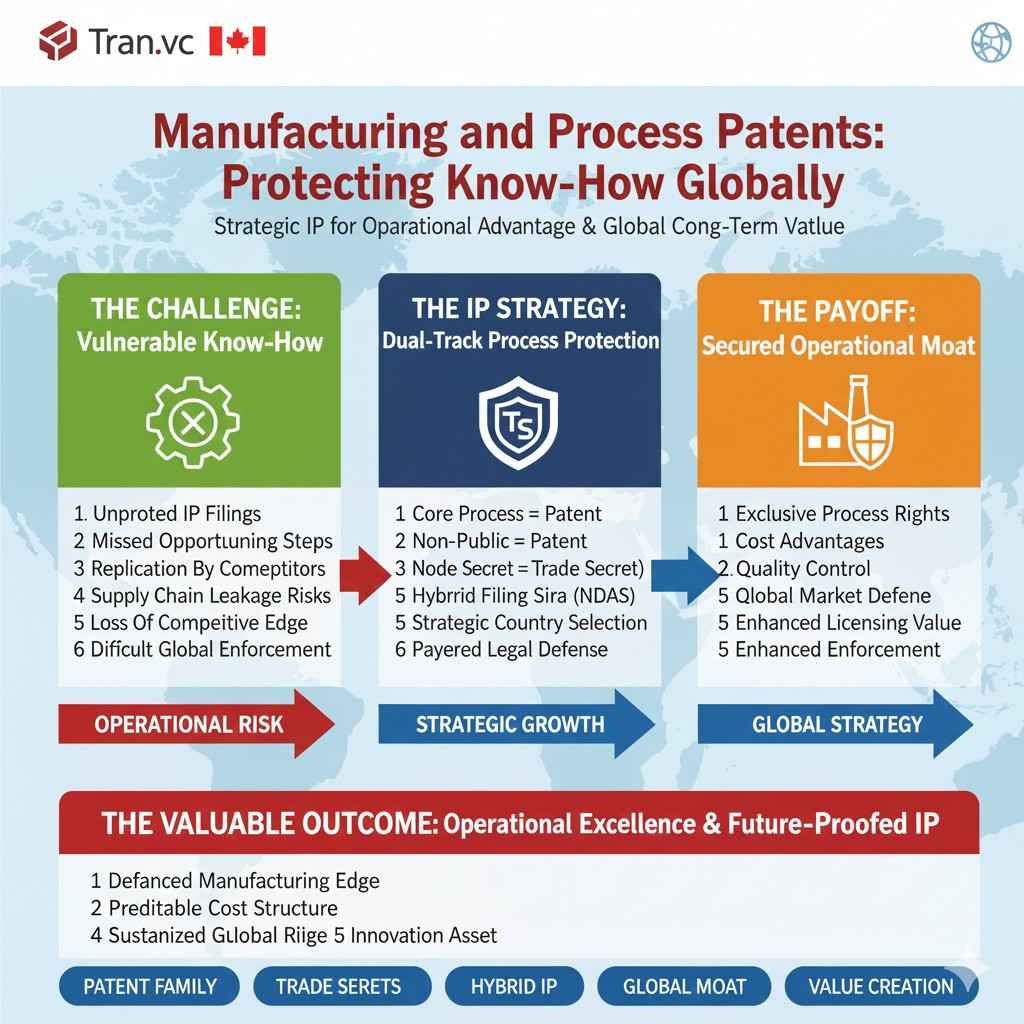
A lot of technical teams assume patents are mainly for a new product shape, a new device part, or a new software feature. That is the common story. But when you look closely at what makes a startup hard to copy, it is often the way the product is made, tuned, trained, or shipped at scale.
This is especially true in robotics, AI, and advanced hardware. Your first demo can look impressive, but the real win is repeatable performance. The step-by-step method that makes your robot reliable in dusty factories. The process that keeps your model stable after thousands of edge cases. The manufacturing flow that turns fragile prototypes into dependable units.
Competitors can buy your product and test it. They can watch your videos and read your papers. They can even hire people who worked around your space. What they cannot easily see is the exact sequence of steps, settings, and checks that make your results consistent.
That “how” is know-how. And it is worth protecting early, before it spreads through contractors, pilots, suppliers, and partners.
If you want Tran.vc to help turn your manufacturing or process advantage into IP that investors respect, you can apply anytime here: https://www.tran.vc/apply-now-form/
What this article will help you do
This article is meant to be practical. It will not be a textbook. It will help you spot process inventions hiding inside your engineering work, and then protect them in a way that holds up when you sell globally.
You will also learn a clear way to separate what should be patented from what should stay as a trade secret. Both are useful. The mistake is choosing one blindly, or choosing too late.
By the end, you should be able to look at your build and ask, “What part of this is the hard-to-copy method?” Then you can decide how to protect it in the countries that matter for your market, your supply chain, and your future buyers.
Understanding the difference: product patents vs process patents
Product patents protect “what it is”
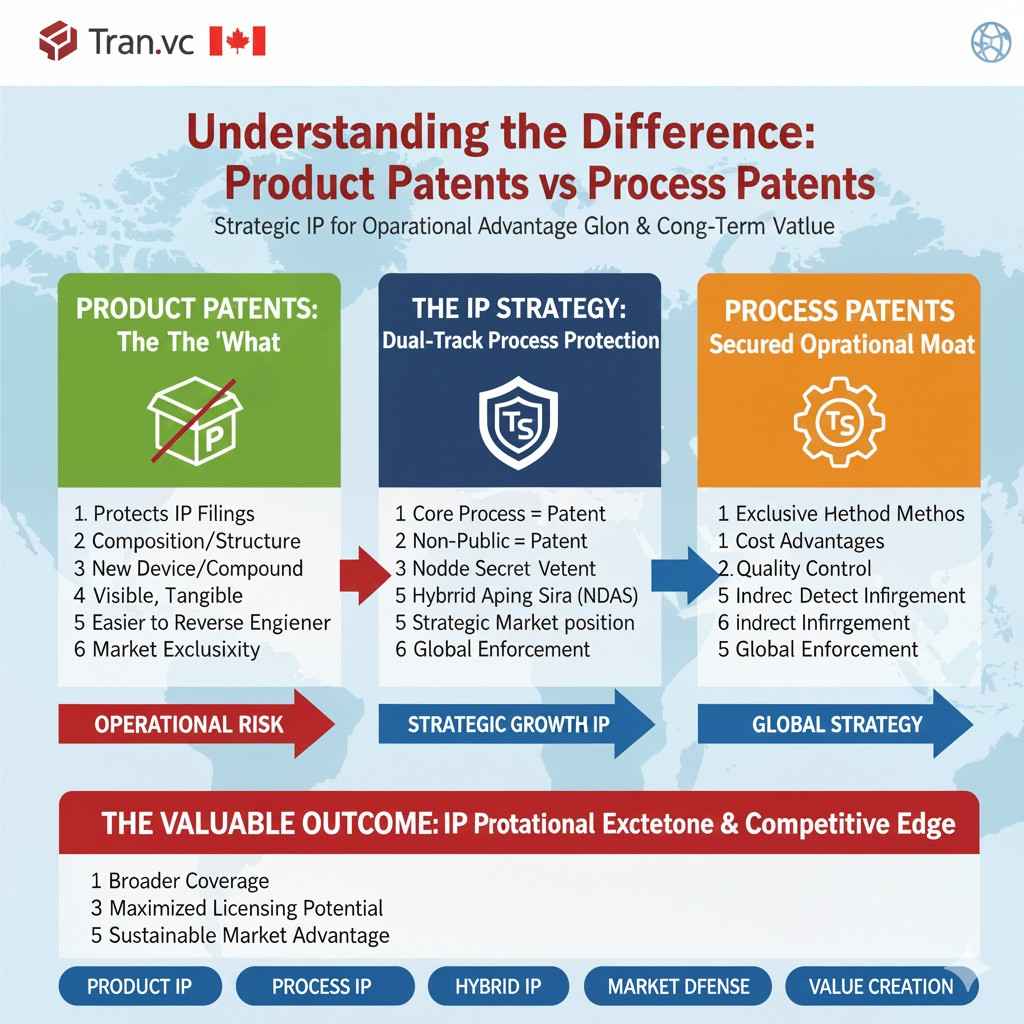
A product patent is focused on the thing itself. It protects a device, a system, a material, or a software-based structure that can be described as a product. The claim language is usually centered on parts, modules, components, or elements that exist in the final item.
In robotics, a product patent might cover a gripper structure, a sensing layout, a motor control unit, or a safety system that is built into the robot. In AI, it might cover a system arrangement, such as a platform architecture that uses specific modules together to get a result.
Product patents feel intuitive because you can point to the thing and say, “That is ours.” If a competitor makes a similar thing, you compare the competitor’s product to the claim language and see if it matches.
But product patents have a weakness in fast-moving markets. A competitor can sometimes avoid the patent by changing the visible structure while keeping the performance. They move a component, rename a module, or swap a part, and they argue they are outside your claim.
This is where process patents can become your second wall of defense.
Process patents protect “how it is done”
A process patent is focused on steps. It protects a method of making something, using something, or operating something. The invention is not the final object. The invention is the sequence that gets you to the result.
In manufacturing, that could be a method to reduce defects, speed up assembly, improve yield, or make a product work longer in harsh conditions. In AI and robotics, “process” often includes data handling steps, calibration steps, training workflows, cleaning pipelines, or deployment routines that lead to better performance.
A process patent is powerful because two products can look similar, but the way they are produced can be very different. If your method is what makes the product cheap enough, strong enough, or accurate enough, then protecting that method can be the real moat.
The method can also be the reason a large buyer trusts you. Buyers do not only buy your output. They buy your ability to deliver that output reliably, again and again.
Manufacturing patents and process patents are related, but not identical
People often use “manufacturing patents” and “process patents” as if they mean the same thing. They are related, but it helps to separate them.
A manufacturing patent usually refers to a method of making a physical thing. It might involve tooling steps, chemical steps, heat steps, assembly steps, or inspection steps. The focus is on production, and the value is in cost, speed, yield, strength, or reliability.
A process patent is broader. It can include manufacturing, but it can also include methods of using a system or running a workflow. For example, a method for calibrating a robot to a new environment can be a process invention. A method for updating a deployed model safely can be a process invention. A method for running a sensor fusion pipeline in a specific order for stability can be a process invention.
So manufacturing is often one type of process. But process is not always manufacturing. This matters because founders sometimes overlook process inventions in AI and robotics simply because they do not happen on a factory floor.
If you want help mapping your “hidden process inventions” in both hardware and AI workflows, you can apply anytime at Tran.vc: https://www.tran.vc/apply-now-form/
Why you often need both types together
If you only file product patents, you protect what your product looks like and how it is structured. That can be important, but it may not cover how you achieve your performance. That is the part that makes you win contracts and renewals.
If you only file process patents, you protect your method, but sometimes it is hard to prove a competitor is using that method, especially if it happens inside a factory you cannot see.
When you pair them, you get a stronger net. The product claims can catch copycats in the market. The process claims can catch copycats in the supply chain or in production.
This combination can also make diligence easier when you raise money. Investors like to see that you did not only protect the demo. You protected the path to scale.
What counts as a “process invention” in real startup work
The best process inventions are usually born from pain
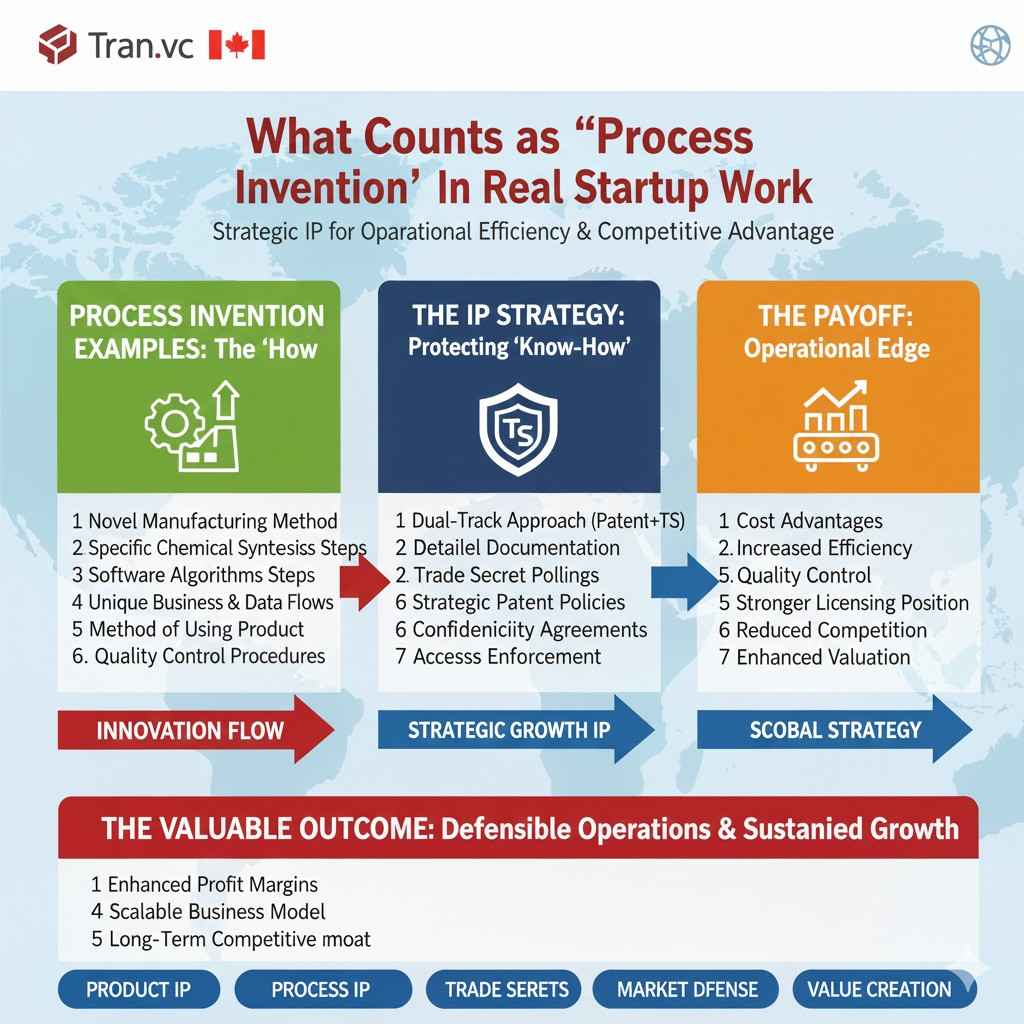
In most startups, the process invention is not a “big idea” that arrives in a meeting. It is something you discover while fighting a real problem.
Maybe your robot worked in the lab but failed in heat. So you created a step-by-step thermal conditioning method that made the system stable. Maybe your yields were terrible, so you designed a test sequence that found defects early and removed bad units before they created scrap. Maybe your model kept drifting, so you built a retraining loop with strict gates that prevented performance collapse.
These are not small details. These are often the reason you survive.
The trouble is, teams treat these as internal tricks and move on. They document them in a wiki, or keep them in someone’s head, and they never label them as inventions.
One practical habit that helps is to treat every repeated fix as a candidate invention. If the fix has steps, has measurable impact, and is not obvious, it may be protectable.
Examples in robotics and hardware manufacturing
In robotics, manufacturing inventions often sit in assembly and calibration. A robot may need a specific alignment procedure to avoid long-term drift. A sensor might need a special bonding method to survive vibration. A cable routing method might reduce failure. A set of torque steps may prevent micro-cracks that show up months later.
You can also have process inventions in how you test. A test process that detects failure earlier can save huge money. A burn-in sequence, a vibration profile, or a diagnostic routine can be an invention if it is designed in a novel way and achieves a clear improvement.
Even packaging can be process IP. If you found a way to ship delicate systems without damage using a defined sequence of supports, materials, and loading steps, that method may have value.
Examples in AI and data pipelines
Some founders assume process patents do not fit AI because “it is just code.” That is not accurate. Many AI inventions are process inventions because they are methods of handling data and producing results.
If you have a special sequence for collecting training data, cleaning it, labeling it, balancing it, and then training with specific gates, that is a method. If your deployment pipeline includes steps that prevent unsafe outputs, or detects drift in a specific way, that is a method.
Edge AI and robotics AI often have strong process IP because the work is tied to sensors, timing, and real-world conditions. Methods for sensor fusion, calibration, model compression, on-device updates, or domain adaptation can be described as process steps that lead to better stability or performance.
The key is to describe the method as a sequence that produces a technical result, not as a business rule or a generic idea.
The “non-obvious” test in plain words
A process is not patentable just because it is useful. It usually needs to be new and not obvious to a skilled person in that field. In plain words, it should not be the first thing any good engineer would try.
This does not mean it needs to be magical. Many process inventions are simple, but they are not common. They combine known steps in a specific order, with specific conditions, and that combination creates a surprising jump in results.
That surprise is the heart of many process patents. If you can show that your method improves yield, reduces failure, increases accuracy, reduces compute, or makes production stable, you are not just telling a story. You are describing a technical improvement.
Tran.vc helps founders find that improvement, frame it clearly, and file it in a way that supports global growth. If you want that help, apply anytime here: https://www.tran.vc/apply-now-form
How process patents are enforced in the real world
The common fear founders have about enforcement
Many founders hesitate to file process patents because they worry they will be impossible to enforce. The fear is simple and understandable. If the invention happens inside a factory or inside a software pipeline, how can you prove a competitor is using the same steps?
This fear is real, but it is incomplete. Process patents are enforced every year across many industries. The key is understanding how proof works in practice, not in theory.
Enforcement is not about catching someone in the act with a camera. It is about showing that the result they achieve strongly suggests the use of your method, especially when there are only a few known ways to reach that result.
When process patents are drafted carefully, they are written in a way that links steps to measurable outcomes. That connection is what makes enforcement possible.
Indirect proof is often enough
In many cases, you do not need direct access to a competitor’s factory or code. Courts often allow indirect evidence. This can include product characteristics, performance data, failure rates, cost structures, or supply chain behavior that strongly point to a specific method.
For example, if your patented process reduces defects in a very specific way, and a competitor suddenly shows the same defect pattern and cost improvement after struggling for years, that shift can be evidence. The same logic applies in AI when a system shows a unique stability or efficiency that matches your method.
Discovery is another tool. In a legal dispute, courts can require a company to disclose internal documents, supplier communications, or technical records. This is where process patents often show their strength, because internal steps tend to be documented somewhere.
The lesson is not that enforcement is easy. The lesson is that it is possible when the invention is real, specific, and tied to outcomes.
Why process claims must be written with enforcement in mind
A weak process patent describes steps in a vague way. A strong one describes steps with clear order, conditions, and purpose. It connects the steps to a technical effect that can be observed or measured.
This is why process patents should not be rushed. If the steps are too generic, enforcement becomes hard. If they are too narrow, competitors can step around them.
The best process claims strike a balance. They are specific enough to show a real invention, but flexible enough to cover variations that achieve the same result.
This is where working with experienced patent strategists matters. Tran.vc focuses heavily on this balance, because a process patent that looks good on paper but cannot be enforced is just decoration.
If you want help designing enforceable process claims from the start, you can apply anytime here: https://www.tran.vc/apply-now-form/
Global protection for process patents works differently
Why “where it happens” matters more than “where it sells”
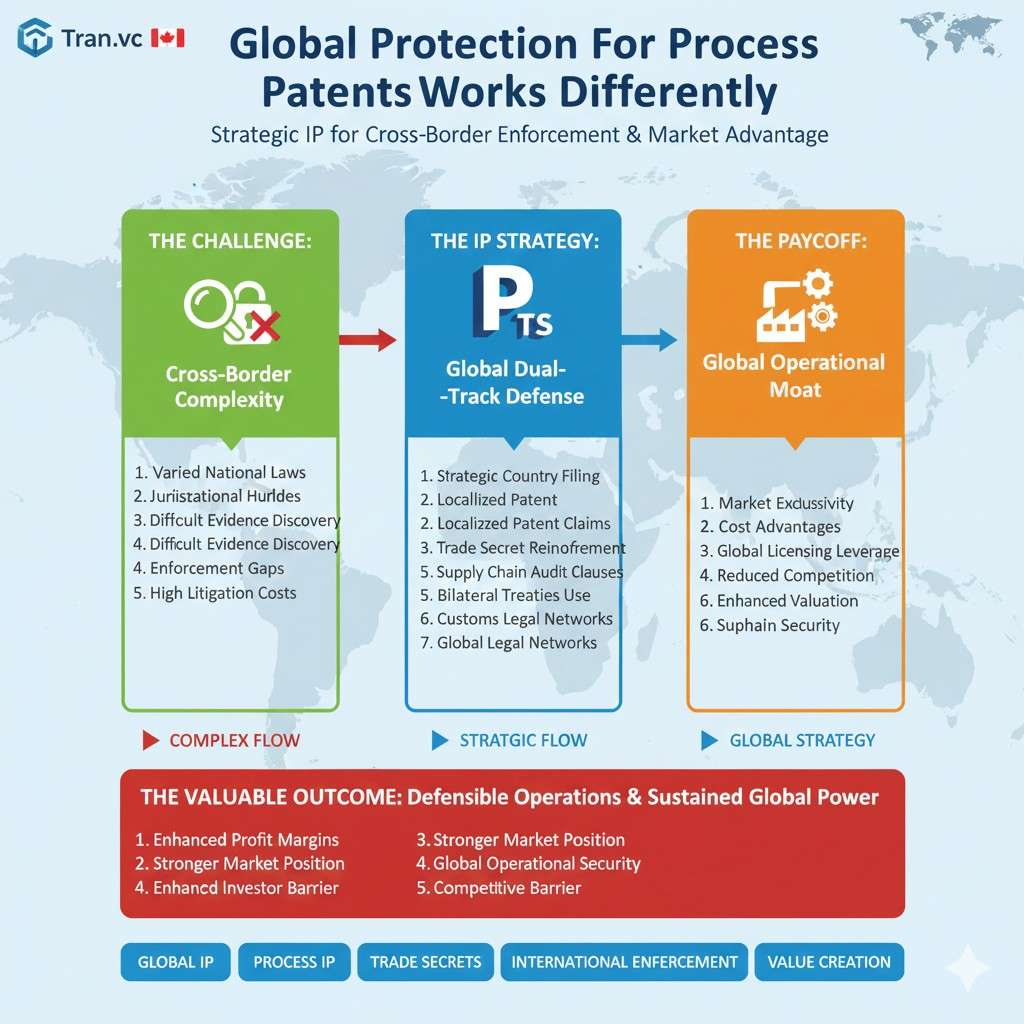
One of the biggest differences between product patents and process patents is geography. A product patent is usually enforced where the product is made, sold, or imported. A process patent is enforced where the process is used.
This sounds subtle, but it has big implications.
If your manufacturing process happens in one country, that country becomes very important for protection. If your AI process runs on servers in a specific region, that region matters. If your calibration or testing process is done in-house before shipping, that location matters.
Founders often file patents only in their home country or main market. That can leave a gap if the real value-creating process happens somewhere else.
A good global strategy maps where each key step actually occurs.
The special case of imported products
Some countries, including the United States, offer special protection for process patents when the product made by the patented process is imported. In simple terms, even if the process happens abroad, importing the result into the country can still be infringement.
This rule is powerful, but it is not universal. Different countries treat this differently. Some focus strictly on where the process is performed. Others allow broader enforcement.
This is why global process patent strategy is not about filing everywhere. It is about filing in the right places based on your supply chain and sales plan.
For a startup, that usually means thinking two to three steps ahead, not ten years ahead. Where will you manufacture first? Where will you likely scale? Where will large customers expect delivery?
Manufacturing-heavy countries and process protection
Countries with strong manufacturing bases often take process patents seriously. This includes places where electronics, robotics, materials, or medical devices are made at scale.
Protecting your process in these regions can prevent suppliers or partners from reusing your method with other customers. It can also strengthen your position in negotiations, because the IP risk becomes clear.
This is especially important when working with contract manufacturers. A process patent can act as a guardrail. It signals that the method is not just “how we do things,” but protected know-how.
AI and cloud-based processes across borders
AI introduces another layer of complexity. If your process runs on cloud infrastructure, it may touch multiple countries. Data may be processed in one region, models updated in another, and outputs delivered elsewhere.
In these cases, the strategy often focuses on the core inventive steps. Where is the key transformation happening? Where does the method achieve its technical effect?
The goal is not perfect coverage. The goal is meaningful leverage. Even partial coverage can be enough to deter copying or strengthen your position in a partnership or acquisition.
Tran.vc helps founders think through this early, before systems become too distributed to map cleanly. If that would help you, apply anytime at https://www.tran.vc/apply-now-form/
Process patents versus trade secrets: a real decision, not a slogan
Why this choice is not “either-or”
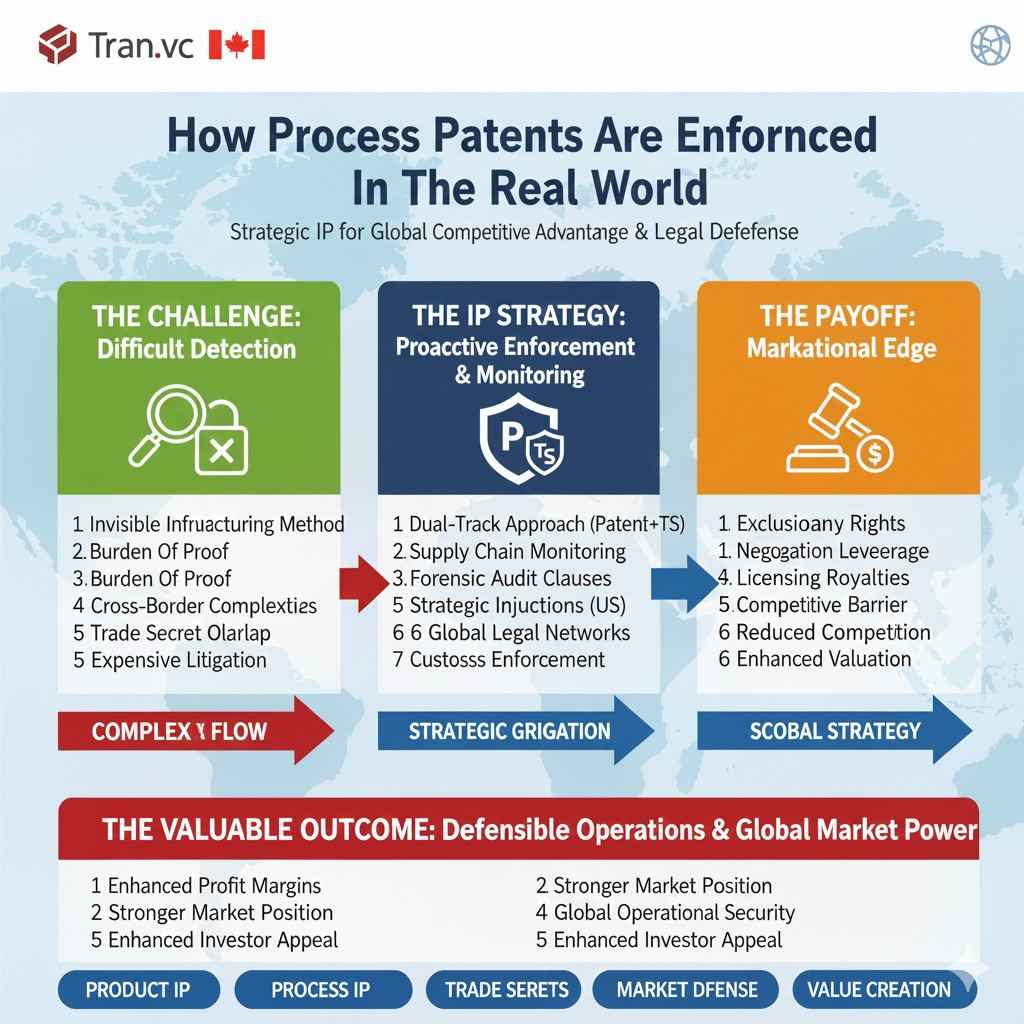
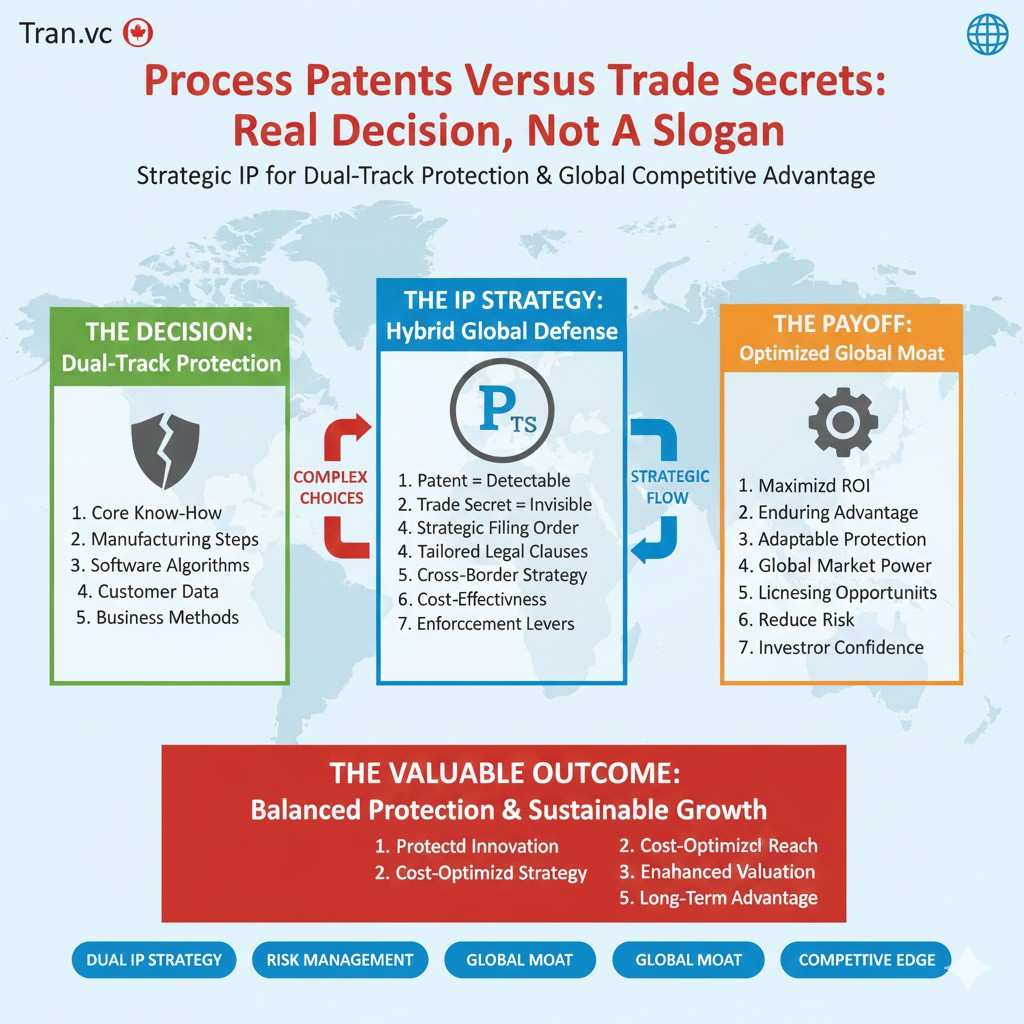
Founders are often told to choose between patents and trade secrets. In practice, strong companies use both.
A process patent is public. In exchange for disclosure, you get a time-limited monopoly. A trade secret stays private, but once it leaks, protection can vanish.
The decision depends on how visible the process is, how easy it is to reverse engineer, and how long it will matter.
The mistake is to default to trade secrets without thinking. Many “secrets” leak faster than founders expect, especially as teams grow and partners multiply.
When process patents make more sense
If a process is used across many products, suppliers, or regions, it becomes harder to keep it secret. If it delivers a clear technical advantage that others would want, it is also more likely to be copied.
In these cases, a patent can be safer. It gives you a clear right, even if someone learns the method independently or through a former employee.
Process patents are also useful when the method is hard to detect from the outside, but easy to describe in steps. That combination often leads to strong, enforceable claims.
When trade secrets still matter
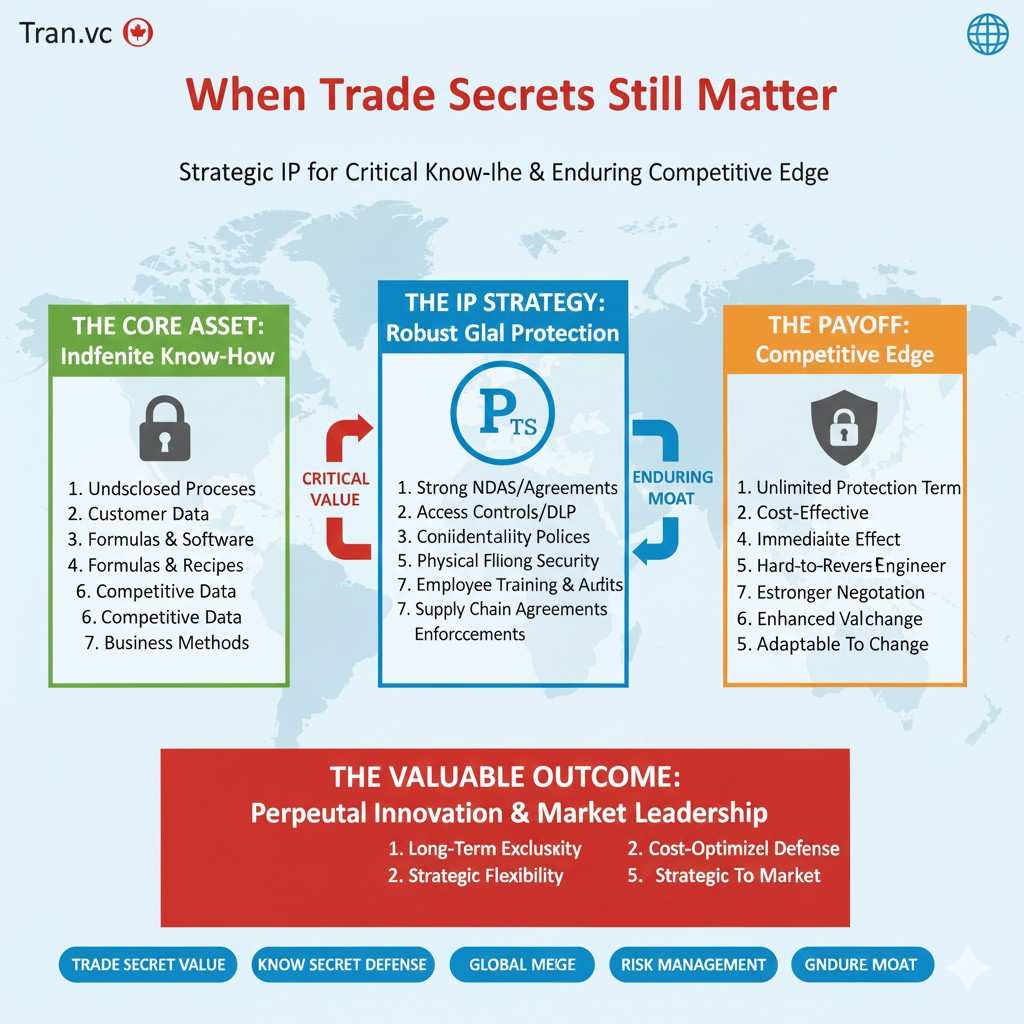
Some process details are better kept secret. These might include tuning parameters, thresholds, or small optimizations that are easy to change and hard to describe as a standalone invention.
Trade secrets also make sense for short-lived advantages. If a method will be obsolete in two years, the patent timeline may not match the value.
The strongest strategy often patents the core method and keeps the fine details secret. This creates layers. Even if a competitor reads your patent, they still lack the full picture.