
A spec is not a school essay. It is not a product page. It is not a “nice to have” doc you throw together after the code works.
A patent spec is a survival document.
It must survive hard questions from patent examiners in the U.S., Europe, China, India, and more. It must survive later edits. It must survive a future investor’s IP review. It must survive the day a competitor copies your idea and your lawyer has to point to one clean paragraph you wrote years ago and say, “Right here. We disclosed it.”
That is what “global prosecution” feels like. It is long. It is picky. It is full of rules that do not care how smart your team is.
This article will show you how to draft a spec that holds up across countries—so you do not lose rights because you were rushed, vague, or too narrow.
If you are building in AI, robotics, sensors, autonomy, edge systems, compilers, or any deep tech: this matters early. A strong spec can turn your work into a real asset that investors respect and competitors fear.
And if you want Tran.vc to help you build that moat with up to $50,000 in in-kind patent and IP services, you can apply anytime here: https://www.tran.vc/apply-now-form/
What “survives global prosecution” really means
When people say “global,” they often mean “file the same thing everywhere.”
That is not enough.
Different patent offices care about different things:
Some care a lot about how clearly you explain the invention so a skilled person can make it. Some care a lot about whether your claims are too broad. Some are strict about support: if your claim says X, the spec must clearly teach X, not hint at it.
A spec that survives is one that does three things at once:
It explains the invention clearly, in a way that could be built.
It includes enough backup options so you can change claims later without adding new matter.
It avoids traps that cause rejections in key regions.
You do not need to memorize every rule. You need a drafting approach that is “safe by design.”
That is what we will build.
Think of the spec as a “claim support bank”
Your claims will change during prosecution. That is normal. You might start with broad claims, then narrow. You might pivot to a different angle if the examiner finds close prior art. You might split into multiple filings. You might need to focus on one part: data flow, control logic, training method, sensor fusion, hardware layout, safety checks, or latency reduction.
If your spec is thin, you have no room.
If your spec is rich, you can move.
A good spec is a bank of support. Every time you describe a feature, you are making a deposit. Later, when you need to amend a claim, you make a withdrawal. If the deposit is not there, the claim change may be blocked, especially outside the U.S.
So the question is not “Can I describe the invention?”
The question is “Can I describe it in enough ways that I can still protect it after the world pushes back?”
That is the mindset.
Start with the invention story, not the product story
A common founder mistake is writing like this:
“We built a platform that does X. It has a dashboard. It has users. It helps companies.”
That is business language. It does not help your patent.
A spec must answer a different set of questions:
What is the technical problem?
Why do current systems fail?
What is your technical solution?
What are the key parts of your system?
How do those parts interact?
What are the main variations?
What are the limits and edge cases?
What is the smallest version that still works?
What is the most complete version?
This is not marketing. It is clarity.
Here is a simple way to begin your invention story:
First, name a real technical pain, without trashing anyone.
Then, describe what makes it hard.
Then, show the core idea that makes it easier.
For example, in robotics:
The problem might be unstable control when sensor latency changes.
What makes it hard is timing jitter and mixed-rate sensors.
Your solution might be a control loop that uses time-aligned state estimates with a confidence score that changes how the controller weights inputs.
That is an invention story.
Notice how the story points to mechanisms, not features.
This is important globally. Examiners in many regions want to see “a technical effect” tied to “technical means.” If you describe your work as a technical mechanism that produces a technical result, you are already drafting in a global-friendly way.
Write your “core” in one clean paragraph
Before you write 30 pages, write one paragraph you can defend.
Not a slogan. Not a pitch line. A plain description of the mechanism.
Example structure:
“In some examples, a system receives input data from A and B, aligns the data using time stamps, computes an intermediate representation R, selects an action using policy P constrained by safety rules S, and outputs a control signal. The system updates parameters of P using feedback F under conditions C to improve stability and reduce oscillation.”
That paragraph is not perfect. But it forces you to name the moving parts.
Why this matters:
When you draft later sections, you will reuse these nouns. That keeps the spec consistent. Consistency is survival. In prosecution, small wording drift becomes confusion. Confusion becomes rejection or narrow claims.
So pick your key nouns early and stick to them.
If you call it a “state vector” on page 3, do not call it a “state tuple” on page 12 unless you explain the relationship.
Decide your invention’s “center” and “edges”
Most deep tech inventions have a center and edges.
The center is the thing you must protect no matter what. If you lose it, the patent is useless.
The edges are variations that still matter, but they are negotiable. They exist to give you room to amend claims later.
Founders often do the opposite. They put the edge in the center.
Example:
Center: “Using uncertainty-aware fusion to weight sensors in real time to keep control stable.”
Edge: “Using LiDAR + IMU + camera.”
If you draft the invention as “a LiDAR system,” you might be trapped later.
If a competitor uses radar instead, you may not cover them.
So in your spec, you should describe inputs as “one or more sensors” and then later give examples: camera, LiDAR, radar, ultrasonic, wheel encoders, GPS, UWB, and so on.
The center should be the method and logic, not one brand of hardware.
This is not about being vague. It is about being abstract at the right layer.
Abstract does not mean unclear.
Abstract means “general but specific.”
The global drafting rule most teams learn too late
In many places, you cannot add new matter later. If it is not in the spec on day one, you may never be able to claim it.
This hits startups when they try to fix a spec after they learn more.
You can edit for clarity later, but you cannot add new technical content and still keep the same filing date.
So you must draft with future knowledge in mind.
How do you do that when you do not know the future?
You do it by describing:
Multiple ways to perform each key step.
Multiple forms of each key component.
Multiple data types and formats.
Multiple training or tuning options.
Multiple deployment settings.
Multiple failure modes and how you handle them.
You do not need huge lists. You can do it in smooth prose.
For example:
“The input may include images, point clouds, inertial readings, audio, or other sensor signals. In some cases the input is sampled at a fixed rate; in other cases it arrives with variable delay. The system may resample, interpolate, or buffer the input to align it to a common timeline.”
That one paragraph gives you future room. It also reads like a real engineering description, not a legal trick.
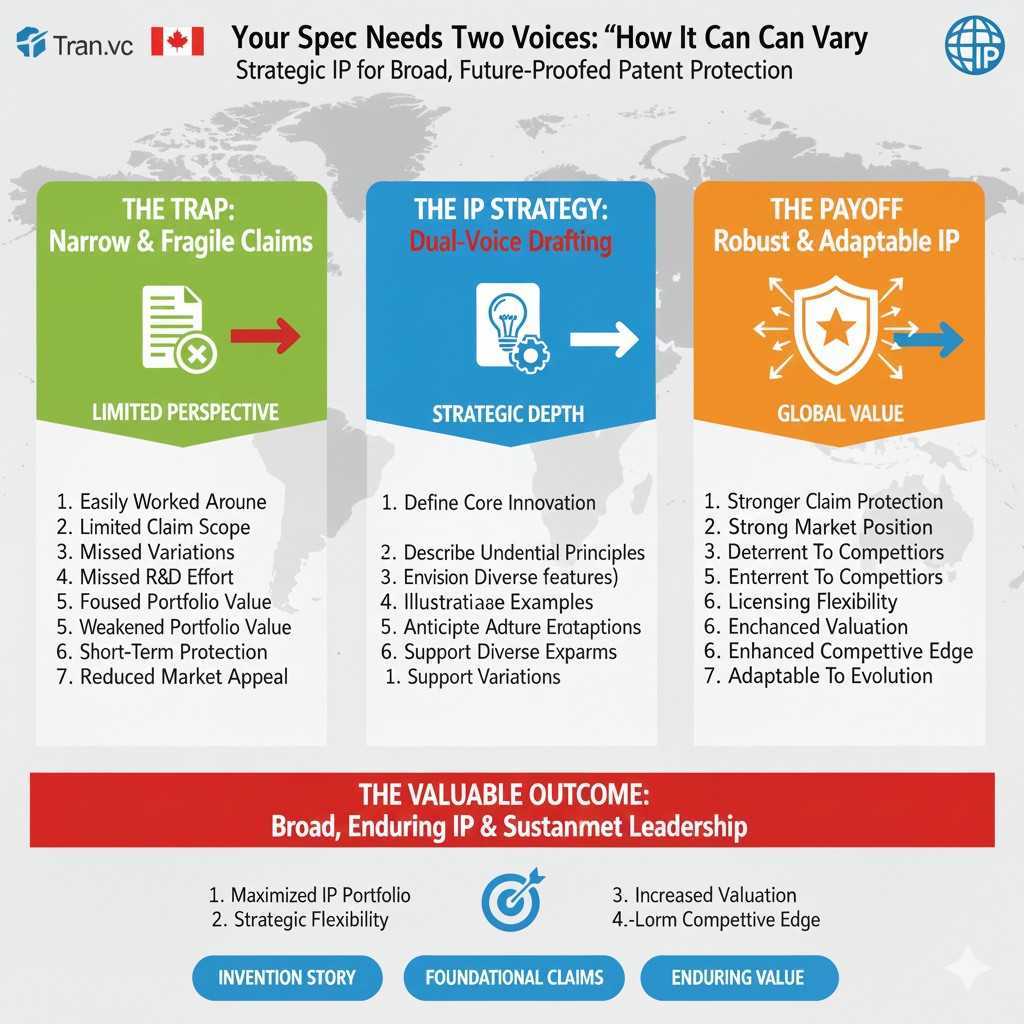
Your spec needs two voices: “how it works” and “how it can vary”
Many specs fail globally because they only have one voice.
They either:
Explain one implementation in deep detail, but give no variations. That feels narrow.
Or:
Write broad, fuzzy language, but do not teach a real implementation. That feels unsupported.
You need both voices.
Voice one: concrete teaching. A skilled person could build it.
Voice two: controlled flexibility. Clear options you can claim later.
A good pattern is:
Describe one main embodiment with clear steps and data flow.
Then, for each step, add a “variation paragraph.”
You can do this without bullet lists.
Example:
“After generating the state estimate, the system selects a candidate action. In some cases, the system uses a learned policy model. In other cases, it uses a rule-based controller, a model predictive controller, or a hybrid approach that blends learned outputs with constraint solving. The selection may be performed on-device, on an edge server, or across both, depending on latency and compute limits.”
Now you have coverage.
Draft the spec like you expect prior art to be found
Another common mistake is writing as if you will be the only person who ever thought of this.
Examiners will find similar ideas. Sometimes very similar.
Your spec should be written so that if a close reference appears, you can still point to:
A key difference in your mechanism.
A specific technical benefit tied to that difference.
A set of fallback features that can narrow claims while still catching competitors.
This means you should write your spec to highlight what is special.
But do it calmly.
Avoid statements like “no one has ever done this.” Those are risky and often wrong.
Instead, write:
“Conventional systems typically do X, which can cause Y under condition Z. The approaches described here can reduce Y by doing W.”
That is a safe, technical framing.
It also helps in regions that want to see “technical effect.”
Use figures as logic maps, not decoration
A spec that survives globally almost always has strong figures.
Not pretty figures. Useful figures.
Your figures should do three jobs:
Show the system components and connections.
Show the method steps in a clear sequence.
Show at least one key internal representation, like a state vector, embedding, safety envelope, cost function, or confidence score.
A figure is not “extra.” It is a support tool.
During prosecution, you will point to figure labels and say, “This is where we disclosed the element.”
So label well. Be consistent.
If you call a module “Fusion Engine 120” in one figure, do not call it “Fusion Module 220” in another unless you mean a different thing.
Also, avoid stuffing everything into one mega diagram. A clean set is better: one system view, one method flow, one key internal detail.
The “minimum viable disclosure” is not your goal
Founders often want to file fast, so they aim for a minimal spec.
The problem is: minimal specs do not survive.
They might get filed, but they break during prosecution, especially outside the U.S.
A survivable spec includes:
Enough detail that the invention is enabled.
Enough variations that you can amend claims.
Enough definition of terms that your words are not used against you.
Enough examples to show real-world use.
Again, you can keep it readable. This is not about length for length’s sake. It is about having the right content.
Tran.vc exists because many technical founders do not have time to learn all this the hard way. If you want hands-on help building an IP foundation while you build the product, apply here: https://www.tran.vc/apply-now-form/
The word choices that quietly cause global pain
Small words can create big traps.
Here are a few patterns to watch, explained in plain language.
“The invention is…”
Be careful with this phrase. If you say, “The invention is X,” you may accidentally narrow yourself. Some examiners and courts can treat it like you defined the invention as only X.
Safer: “In some examples,” “In some implementations,” “In one embodiment.”
You are not being sneaky. You are being accurate. Your invention likely has many forms.
“Must,” “always,” “requires”
Absolute words can also narrow you. If you say your system “must” use a specific step, you may later be forced into that step.
Safer: “may,” “can,” “in some cases.”
But do not overdo it. You still need clear teaching.
“Best,” “optimal,” “perfect”
These words invite arguments. Examiners may ask you to prove it. Competitors may use it against you.
Safer: “can improve,” “can reduce,” “can increase.”
And tie it to measurable outcomes when you can: latency, stability, energy use, error rate, memory, throughput, thermal load.
Define your terms like an engineer, not a lawyer
Global prosecution often becomes a fight about meaning.
What is a “node”? What is a “token”? What is a “constraint”? What is “real time”? What is “safe”?
If you do not define your key terms, the examiner may define them for you.
So define them in plain language.
Example:
“As used here, ‘real time’ refers to producing an output within a time limit that is set by the controlled system, such as within a control cycle, within a sensor frame interval, or within a latency budget.”
Now you have flexibility. Real time can mean different budgets in different products.
Same with “model.” In AI, “model” could mean a neural net, a tree, a linear regressor, a probabilistic model, or a mix. Say that.
Definitions are not fluff. They are guardrails.
Write claims in your head while drafting the spec
You are not writing claims yet, but you should think like someone who will.
As you draft each section, ask:
Could this be a claim element later?
Could I point to support for it?
Could I combine it with another element?
Does the spec show a reason for it?
This pushes you to include “connective tissue.”
For example, if you mention a “safety rule,” do not just name it. Explain how it is applied:
Is it a hard constraint that blocks actions?
Is it a cost term that penalizes risky actions?
Is it a separate monitor that overrides outputs?
Different claim strategies may need each one.
So write them.
The “fallback ladder” that keeps you alive in prosecution
You want your spec to support a ladder of narrowing options.
If the broad claim is rejected, you step down to the next rung.
If that is rejected, you step down again.
A ladder can be built around:
Inputs (more specific sensor set)
Timing (buffering, resampling, synchronization)
Representation (specific state vector structure)
Computation (specific model type or architecture)
Constraints (specific safety monitor form)
Deployment (edge vs cloud split)
Training (online fine-tuning vs offline)
Trigger conditions (when updates occur)
You do not need a list in the spec. You need to naturally describe these layers.
For example:
“The system may compute a confidence score for each sensor stream based on one or more of signal-to-noise ratio, recent error residuals, dropout rate, or calibration drift. The confidence score may be used to weight sensor contributions in a fusion stage, to adjust controller gains, or to select among multiple policy outputs.”
That single paragraph supports many rungs.
It also reads like a genuine design.
Make sure your spec covers both method and system
Some regions and some enforcement scenarios prefer method claims. Others prefer system claims. You typically want both.
Your spec should clearly describe:
A method: steps carried out.
A system: components configured to perform steps.
A non-transitory computer-readable medium: code stored on memory that causes steps. (This is common in software patents.)
You do not need to write claims now, but your spec should have sections that map to these forms.
Do not assume “we have a method description” is enough. If you only describe steps and never describe modules, you may limit yourself.
Likewise, if you only describe a block diagram and never describe steps, you may limit yourself.
So include both voices.
Build a spec skeleton that works in many countries
Think in sections, not pages
A spec that survives is not “long.” It is organized. When you use a clean skeleton, you stop forgetting key details. You also make it easier for an examiner, a judge, or an investor to follow your logic without guessing what you meant.
Most global trouble starts when a spec jumps around. One paragraph talks about training. The next talks about hardware. Then it goes back to user screens. That looks like a product doc, not an invention disclosure.
A strong skeleton keeps the story in order: problem, solution, system, method, options, and examples. When you do that, your later claims have a solid home.
Keep each section focused on one job
Every section should have a clear purpose. If a section is trying to do three jobs, it will do none of them well.
For example, your “Summary” section should explain the core idea in plain technical terms. It should not contain deep math, long definitions, or edge-case behavior. Save those for later.
Your “Detailed Description” should teach how to build it. That is where you earn credibility. It is where you show the moving parts and how they work together.
Write for an examiner who is smart but busy
Patent examiners read fast. They often scan for structure: headings, figures, clear terms, and repeatable language.
If you write in a clean order, the examiner finds what they need. That reduces misunderstandings. Misunderstandings are where most rejections begin, especially in software-heavy inventions.
This is also why paragraph shape matters. Short, clear paragraphs help the reader keep context. If a paragraph runs too long, the reader forgets the first half by the time they reach the end.
Nail the core: problem, technical gap, and technical effect
Describe the problem like a lab note, not a complaint
Your opening technical problem statement should sound calm and factual.
Instead of saying, “Existing systems are bad,” explain the failure mode. For robotics, that might be oscillation, drift, unstable trajectories, or missed safety checks. For AI, it might be hallucination, data leakage, model collapse, or latency under load.
When you name the failure mode, you make the rest of the spec feel necessary. It becomes easier to argue that your solution is not just an idea, but a fix to a real technical issue.
Show the “why it’s hard” without getting lost
The “why it’s hard” part is where you earn attention.
Here you explain what makes the problem stubborn. Maybe sensors arrive at mixed rates. Maybe compute is limited. Maybe the environment changes quickly. Maybe the model must adapt without breaking safety limits.
Keep it grounded. You are not trying to impress. You are trying to explain constraints that force a new approach.
Tie your solution to a measurable technical effect
Global prosecution often rewards specs that show technical effect clearly.
A technical effect is a real, measurable outcome like lower latency, higher stability, reduced error, reduced power use, fewer false positives, fewer missed detections, smoother motion, or better convergence.
You do not need numbers yet. You need cause and effect in plain words. The examiner should be able to say, “They do X, which leads to Y.”
Draft the Summary so it stays broad but supported
Use a “one invention, many forms” summary style
Your summary should describe the invention in a way that stays true even if details change later.
A good summary names the key components and how they interact. It does not lock you into one sensor type, one model type, or one deployment location.
This protects you when competitors copy the idea but swap parts. It also protects you during prosecution when you need to amend claims without twisting the story.
Include both system and method language early
Even though claims come later, your summary can already support multiple claim types.
You can describe a system that includes modules and data flow. You can also describe a method that includes steps. When your summary includes both, it becomes harder for an examiner to box you into one claim style.
This matters because different offices and different examiners lean toward different ways of reading inventions. A flexible summary keeps you safe.
Avoid words that silently narrow you
The summary is where founders often accidentally trap themselves.
If you say “the invention is” or “must,” you may set a boundary you did not mean to set. It is safer to describe examples, implementations, and options, while still teaching the invention clearly.
The goal is not to be vague. The goal is to avoid accidental promises you cannot keep.
Make the drawings do the heavy lifting
Start with three figures that almost always help
Most survivable specs can be anchored by three figures.
One figure shows the system blocks and connections. One shows the method steps in order. One shows a deep dive into the key internal part that makes your approach special.
This set helps across the U.S., Europe, and Asia because it gives multiple ways to “see” the invention. When you later amend claims, you can point to figure labels for support.
Label like you expect litigation someday
A label is not just a label. It is a handle you will grab later.
When you label a module, keep that name consistent in the text. If you label “Fusion Engine 120,” then the text should refer to “Fusion Engine 120” when discussing that module.
This reduces ambiguity. Ambiguity gives examiners room to misread you. It also gives competitors room to argue your disclosure was unclear.
Make at least one figure show data flow
In AI and robotics, data flow is often the invention.
If your invention changes how data is aligned, filtered, fused, embedded, compressed, or checked, show that with arrows and clear intermediate objects. Those intermediate objects are often where your novelty lives.
When you show data flow, you also make it easier to claim internal representations later, which is a strong way to catch copycats.
Write the Detailed Description like a build guide
Start with one full “main embodiment”
A common mistake is trying to describe ten versions at once.
Instead, pick one strong main embodiment and explain it end to end. The reader should see inputs, processing, outputs, and feedback loops.
This is where you prove the invention is real. You want a skilled engineer to read it and say, “Yes, I can implement this.”
Global offices often care deeply about this. If your main embodiment is thin, later variations may not save you.
Use repeatable nouns and stable terminology
Pick your key nouns early and reuse them.
If you say “policy model,” keep saying “policy model.” Do not swap to “decision network” later unless you explain it is the same thing.
The reason is simple. Examiners compare wording closely. In prosecution, you will quote your own spec to support your amended claims. Consistent terms make that easy.
Add variation paragraphs after each key step
After you explain one step clearly, add a short variation paragraph for that step.
For example, after describing time alignment, add how alignment can be done with buffering, interpolation, resampling, or learned correction. After describing control selection, add how it can be MPC, a learned policy, or a hybrid.
This creates a support bank. It also avoids the “one narrow implementation” trap that breaks patents outside the U.S.
Design “fallback paths” inside the spec, on purpose
Build a ladder of narrowing options without looking messy
A strong spec quietly includes multiple layers of specificity.
At the top layer, you describe the invention at the right abstraction level. Under that, you describe optional features. Under that, you describe more specific examples.
This is how you survive prior art. If the broad claim falls, you still have supported, meaningful narrower claims. You are not forced into a tiny corner that nobody infringes.
Use technical constraints as natural fallback features
Constraints are your friend because they are concrete and defensible.
Latency budgets, safety boundaries, memory limits, energy limits, and stability requirements are real engineering facts. When your spec explains how the system respects constraints, you create claim options that are hard to dismiss as “abstract.”
This also helps in regions that want a clear technical character. You are not just “processing data.” You are controlling a system under constraints.
Document edge cases like an engineer would
Many inventions shine when conditions get messy.
Sensors drop frames. Networks spike. Temperature changes. Lighting shifts. User behavior changes. Training data drifts. Actuators wear out.
If your invention handles these cases better than standard systems, say so. Then explain how.
These paragraphs often become your best ammunition later, because they show why your mechanism exists.
Cover AI inventions in a way that survives strict scrutiny
Describe the model, but also describe what is around the model
A patent that says “use a neural network” is not very useful.
A survivable AI spec explains the full pipeline: inputs, preprocessing, representation, model, postprocessing, safety checks, and deployment boundaries.
Often, the novelty is not the model type. It is how the model is used, constrained, updated, or combined with rules and signals.
So you should describe both the model and its operating environment, in a way that can be claimed later.
Write training and inference as separate but connected stories
Training and inference are different worlds.
Training is about data, labels, objectives, loss functions, augmentation, and updates. Inference is about latency, memory, accuracy under shift, and reliability.
Your spec should treat them as two related stories. Explain how the trained model is used at runtime. Then explain how updates can happen, if they happen at all.
This matters globally because you may later want to claim a training method, an inference method, or both. If you only describe one, you cut off options.
Be careful with “results-only” language
If you say, “The model predicts X,” that is not enough.
Explain how the prediction is used and why that is technical. For example, a prediction might be turned into a control signal with bounds. It might be filtered by uncertainty. It might be verified by a monitor. It might be fused with sensor-based estimates.
Those surrounding steps are often what make the invention patentable and enforceable.
Cover robotics inventions with strong mechanical and control disclosure
Show the full loop: sense, decide, act, verify
Robotics is about loops.
A survivable robotics spec often describes the full loop: sensing, state estimation, decision, actuation, and verification. Then it explains where your invention changes the loop.
If you skip parts of the loop, your invention can look like an isolated software trick. If you show the loop, it looks like a technical control solution that improves real-world behavior.
Explain timing and synchronization in plain words
Timing issues are common in robotics and autonomy.
If your invention handles mixed-rate inputs, jitter, drift, or delay, explain it clearly. Use simple language. Talk about buffering, timestamps, resampling, and alignment.
These concepts are understandable to examiners. They are also concrete. Concrete details help you survive.
Include safety as an implementation, not a promise
Many specs say “safe” but do not explain how safety is enforced.
If your system uses constraints, monitors, fault detection, fallback modes, or redundancy, explain the mechanism. Describe what happens when a check fails.
This turns “safe” into something you can claim and defend.
Avoid common global traps before they cost you rights
Do not rely on “we can add it later” thinking
Outside the U.S., you often cannot add missing technical content later.
So if you expect you might want to claim a certain variation, include it now. If you expect you might want to claim a certain hardware setup, include it now. If you expect you might want to claim a certain training style, include it now.
You do not need to write a textbook. You do need enough disclosure to support the claim later.
Keep your spec free from product-only details
Screens, dashboards, and user roles are usually not where the patent value is.
If you include UI content, connect it to a technical function. For example, a UI can configure a safety boundary, set a latency budget, choose among policy modes, or trigger calibration.
If a paragraph does not support a technical claim later, it is taking space without adding protection.
Do not hide the best part
Sometimes founders try to be “safe” by not disclosing too much.
That can backfire. A patent is a trade: you disclose, and you get rights. If you do not disclose the key mechanism, you may not get meaningful rights.
Your best protection comes from clear disclosure plus smart claim strategy, not from vague hints.
Tran.vc helps teams strike that balance, so you can protect what matters without slowing product speed. If you want that support, apply here: https://www.tran.vc/apply-now-form/