
Most startups do not fail because the tech is weak. They fail because the team cannot turn that tech into an asset that investors can trust and competitors cannot copy.
That is what an invention disclosure process helps you do.
An invention disclosure is a simple, written record of a new idea. It explains what you built, why it is new, how it works, and what problem it solves. It is not a patent. It is not a pitch deck. It is the missing bridge between “we built something cool” and “we can protect it and use it to raise with leverage.”
If you are building in AI, robotics, sensors, edge computing, biotech tools, or any deep tech area, this process is not “extra work.” It is how you stop losing value every time you ship code, show a demo, or talk to a customer.
Tran.vc helps technical founders do this early, without slowing down. We invest up to $50,000 in in-kind IP and patent work so you can build a real moat while you build the product. If you want help setting up your invention disclosure process and turning your inventions into a clean patent plan, you can apply anytime here: https://www.tran.vc/apply-now-form/
Invention Disclosure Process for Startups
Why this process matters more than most founders think
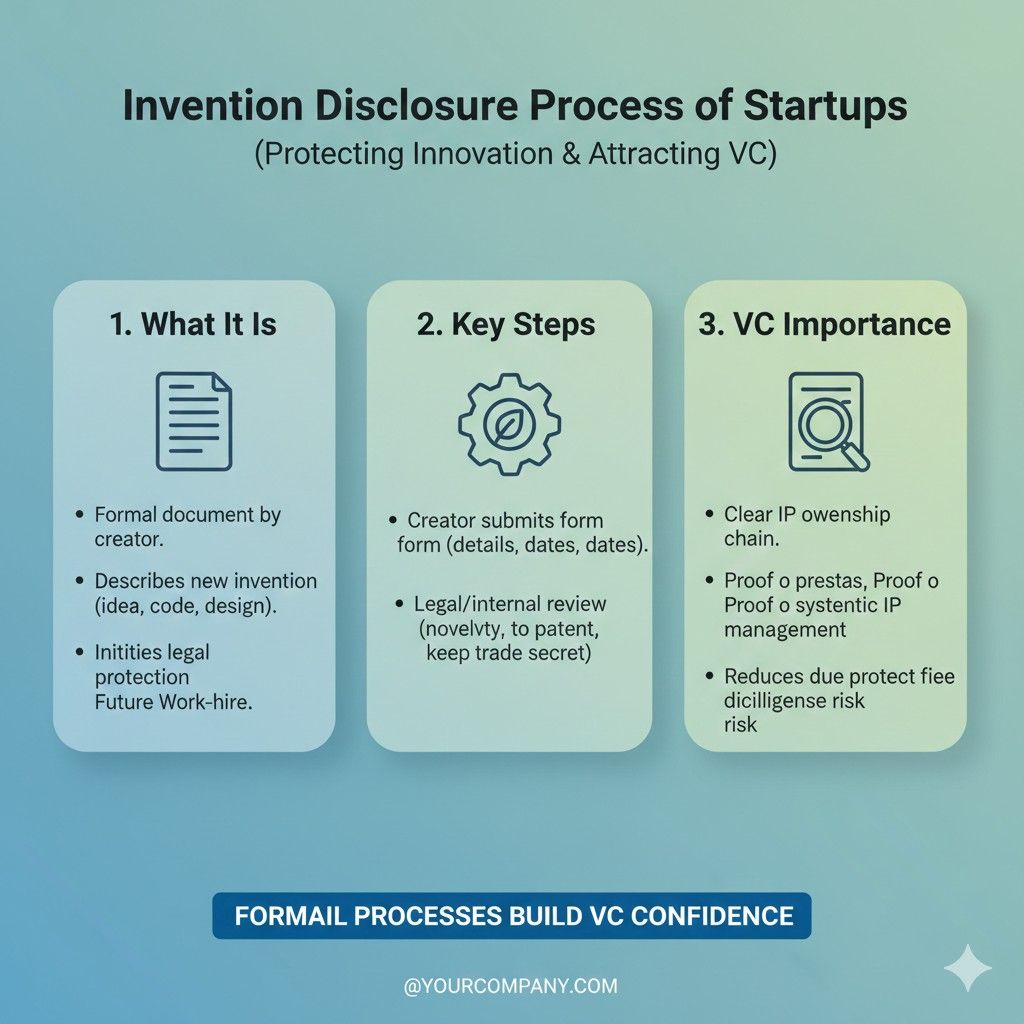
A startup is a race, but it is not only a race to build. It is also a race to claim what you build. If you wait too long, your best ideas can slip away in small, quiet ways. A teammate leaves with key details in their head. A contractor writes part of the system and later claims they “invented” it. A public demo becomes the first clear record of your method. A competitor sees it, copies the core, and ships faster.
An invention disclosure process is the habit that stops those leaks. It turns invention from a vague feeling into a clear record. It gives your company proof of what was made, when it was made, and how it works. That proof helps your patent team move with speed and accuracy, and it also helps you speak to investors with calm confidence.
At Tran.vc, we often see strong teams with real technical edge, but their ideas live in scattered notes, Git commits, and Slack threads. That is normal. Startups move fast. Yet that same speed makes it easy to lose the story of the invention. A disclosure process keeps that story intact, without slowing your build.
If you want help setting up this process and turning it into a patent plan, you can apply anytime at: https://www.tran.vc/apply-now-form/
What an invention disclosure is, in plain words
An invention disclosure is a short internal document that explains a new technical idea in a way a patent attorney can use. It describes the problem, the new method, and the key steps that make it work. It also includes the names of the people who helped invent it, and what proof exists that the team built it.
Think of it like a “handoff note” from the builders to the legal team. The builders know what is special, but they do not always know which parts matter most for patent strategy. The disclosure gives the attorney the raw material to shape claims that are strong and clear.
It also helps your company decide what to protect first. Not every idea needs a patent. Some ideas are better kept as trade secrets. Some are too common. Some are useful, but not core. A disclosure is the input that makes those choices easier and less emotional.
What this process is not
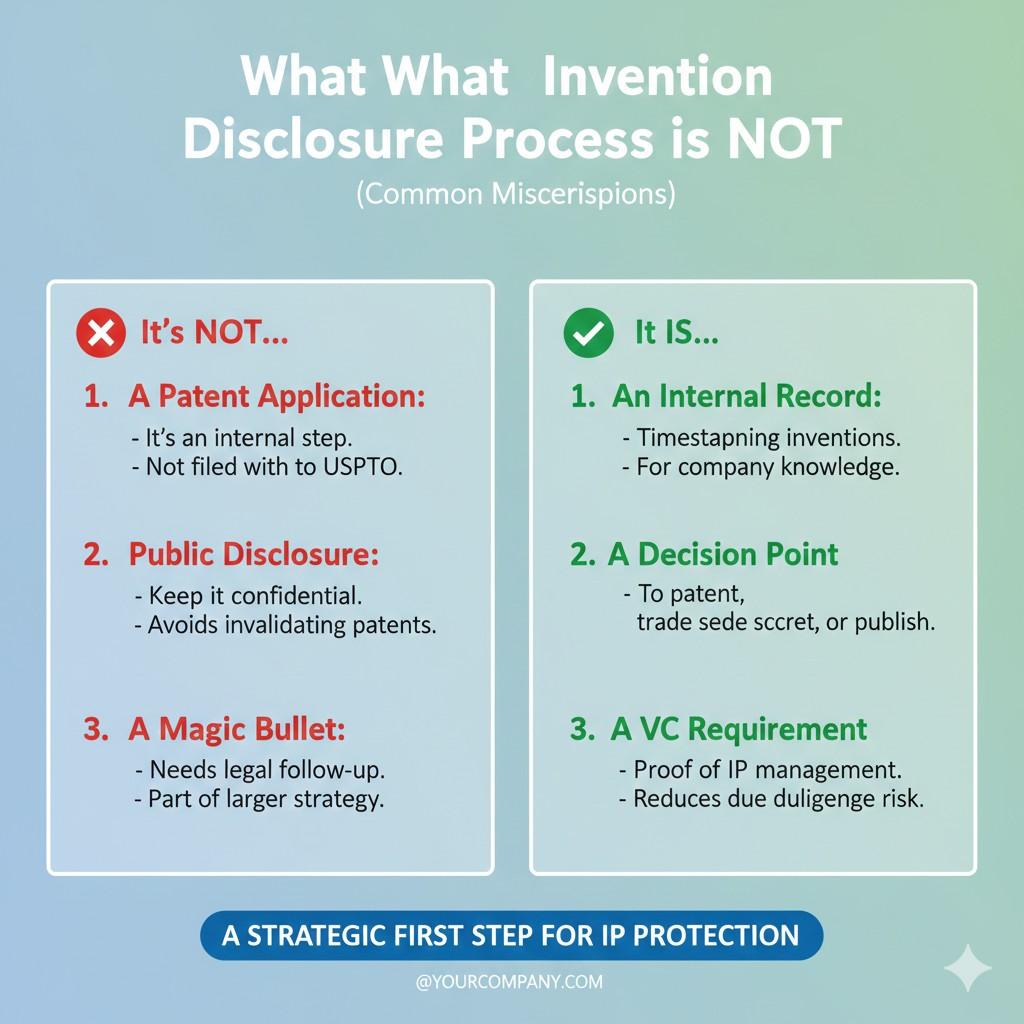
It is not a patent application. You do not need perfect language. You do not need to cite papers. You do not need to be “legal.” You only need to be clear and honest about what you built and why it is different.
It is also not meant to be a heavy approval system. Many founders fear that adding process will slow the team. That happens when the process is designed like a big company. A startup version should feel light, fast, and helpful. The best sign you built it right is that engineers do not hate it.
It is not a replacement for good invention meetings with counsel, either. The disclosure does not need to cover every detail of every edge case. It needs to capture the heart of the invention so a skilled attorney can ask the right follow-up questions.
The hidden cost of skipping it
When teams skip disclosures, patent work becomes reactive. A founder calls an attorney in a rush because a demo is coming up, or a big partner wants to see the system. The attorney then has to pull the invention out of the team through scattered calls. Details get missed. Timing gets tight. The result is often a weaker filing that fails to capture the real edge.
There is also an internal cost. Without disclosures, the team forgets which ideas were truly new at the time. Months later, everything feels obvious. That “obvious now” feeling is dangerous, because it makes founders under-report their own inventions. A disclosure written at the moment of creation is the best defense against that memory problem.
Finally, the biggest cost is leverage. IP is not only about lawsuits. It is about negotiation power. If you can show a clear pipeline of inventions, you look more durable. If you can explain your core methods in a structured way, investors listen longer and ask better questions.
If you want Tran.vc to help you build that pipeline early, apply anytime here: https://www.tran.vc/apply-now-form/
The startup version of the invention disclosure process
The goal is speed with accuracy
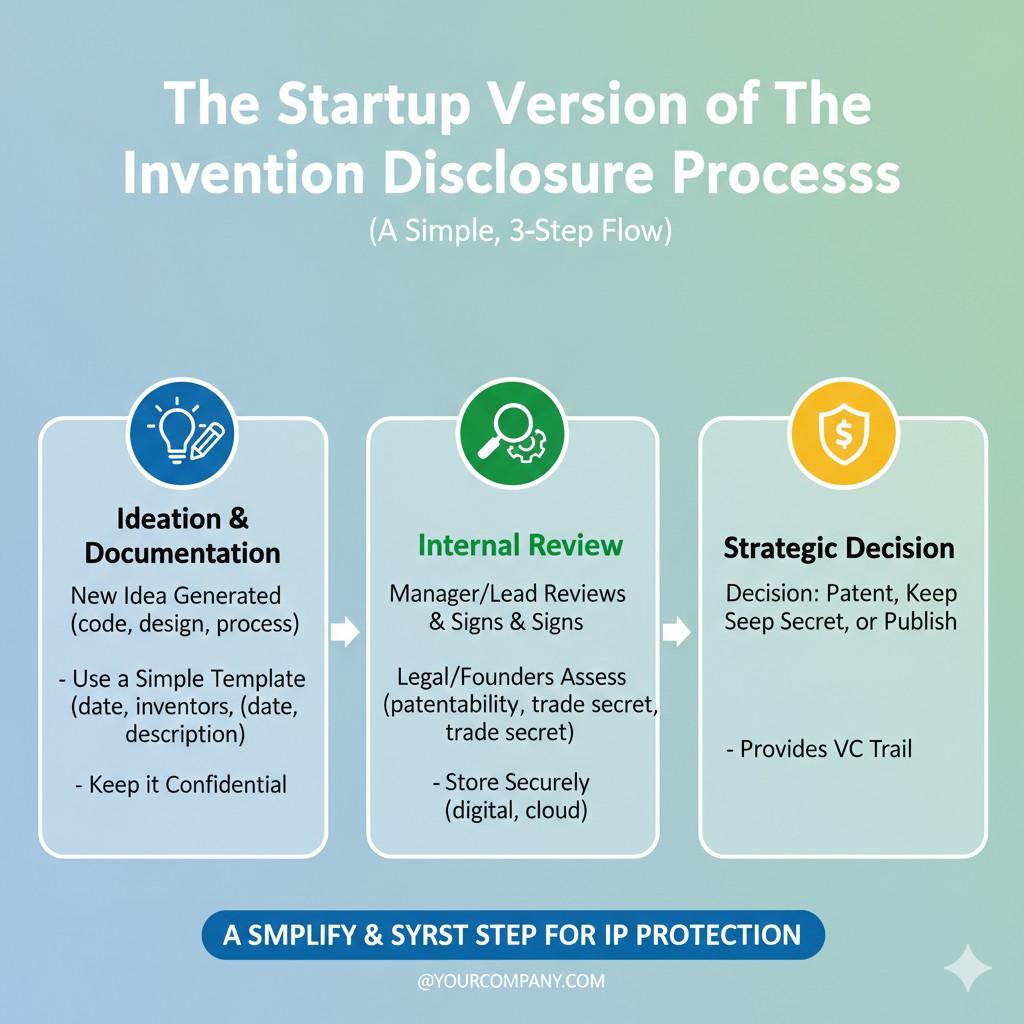
In a startup, the process must respect reality. People are building, shipping, fixing, and selling at the same time. So the goal is not to create perfect documents. The goal is to capture key inventions quickly, while they are fresh.
A good startup process feels like this: someone builds a new method, they spend a short block of time writing a clear disclosure, and the company has a repeatable path to decide what happens next. That next step might be a patent filing, or it might be to store the disclosure as a trade secret record. Either way, the invention is not lost.
This is important because patent quality depends on early clarity. The earlier you capture the details, the easier it is to describe the invention in a way that stands up later. That includes the variations, the alternatives, and the “we tried this first but it failed” story. Those details often become valuable in claim drafting.
Who should own the process inside the company
Many teams assume the CEO should own IP. In truth, the CEO should sponsor it, not run it. The best owner is usually a single person who is close to the technical work, but also organized. This might be the CTO, a staff engineer, or an operations lead who can handle follow-ups.
The owner’s job is not to judge inventions like a gatekeeper. Their job is to make sure disclosures get written, collected, and reviewed. They keep the rhythm. They help remove friction. They also make sure the company does not miss an invention because everyone was busy.
In a very early team, the owner might simply be the founder who cares most about IP. That is fine. What matters is that the role is clear. If no one owns it, it becomes “everyone’s job,” which becomes no one’s job.
When a disclosure should be created
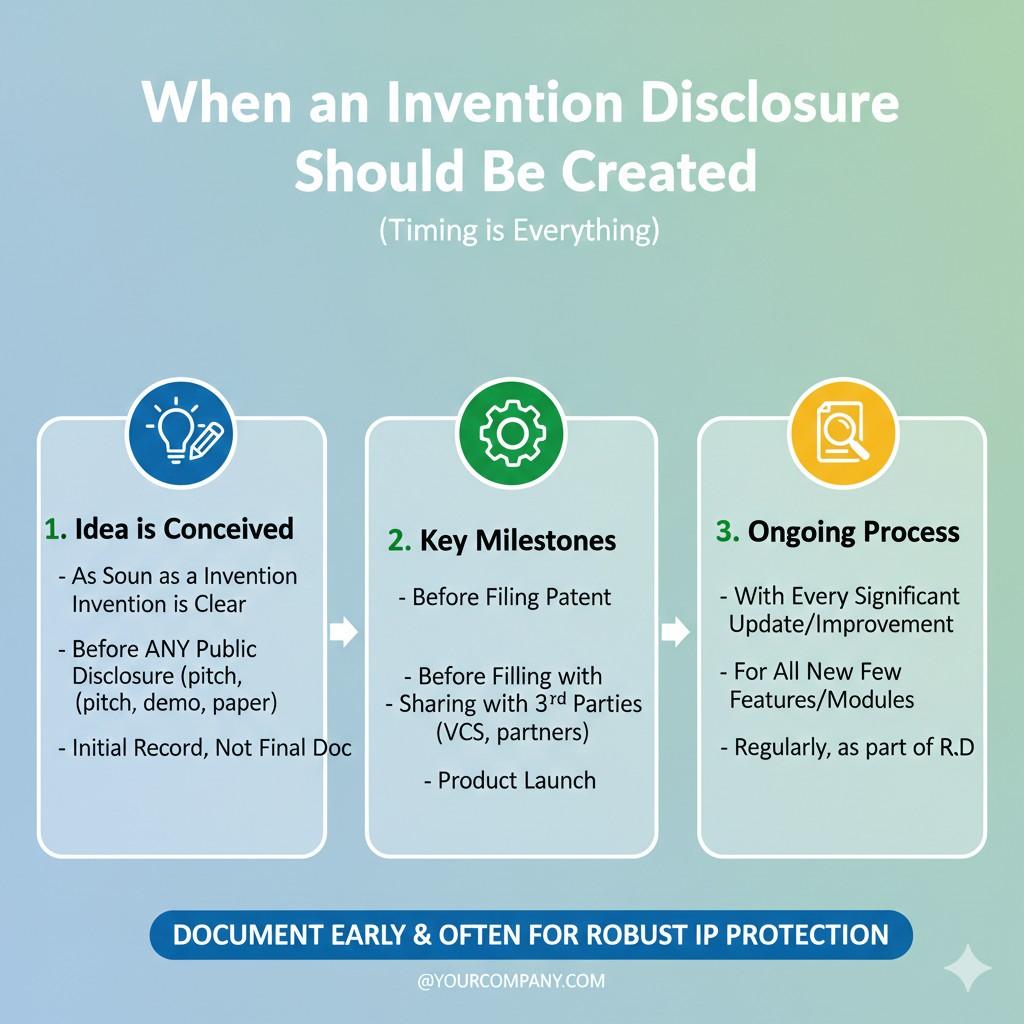
The best time to write a disclosure is right after the first working proof of the idea. Not after the product is perfect. Not after the paper is published. Not after the customer demo. Right after you can say, “This method works, and it is different.”
That moment happens more often than founders think. It can happen when you create a new training pipeline that cuts data needs in half. It can happen when you build a control loop that makes a robot stable in messy conditions. It can happen when you design a sensor fusion method that works on cheap hardware.
A simple rule helps: if the team would feel annoyed if a competitor copied this exact method, then it is worth a disclosure. You do not need to decide on patents yet. You only need to capture it.
How long it should take
A disclosure should not take days. If it does, people will avoid it. In early-stage teams, a strong target is under an hour of focused writing for a first draft. For big inventions, maybe longer, but those should be rare.
The key is structure. If you have a clean template and clear prompts, the writer is not staring at a blank page. They are simply answering questions in simple words. They do not need to polish. They just need to capture the steps, the parts, and the reason it matters.
Tran.vc often helps teams set up this template so it matches how patent attorneys think. That removes rework. It also makes your disclosures easier to turn into filings when the timing is right.
If you want that setup, apply anytime here: https://www.tran.vc/apply-now-form/
What makes an invention “real” enough to disclose
The difference between an idea and an invention
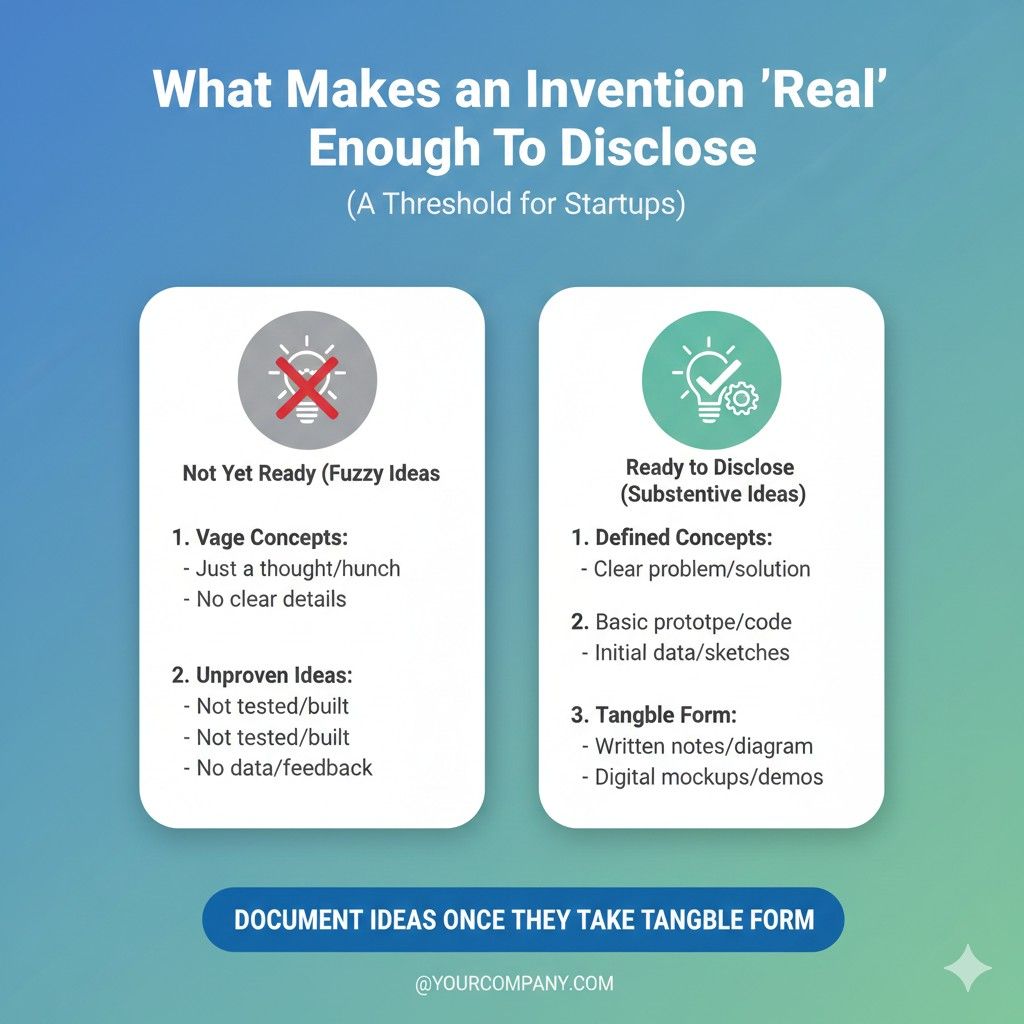
Startups create ideas all day. Most are not inventions. An invention is a specific solution, not a wish. It has a clear method. It has steps or parts that interact. It produces a result you can explain and repeat.
For example, “We will use AI to detect defects” is not an invention. It is a direction. But “We use a two-stage model that first normalizes lighting with a physics-based transform and then runs a lightweight classifier on edge hardware, and we also generate labels using this self-check loop” might be an invention. It is not about how fancy the words are. It is about whether the method is clear.
This matters because disclosures work best when they capture the method. Patent attorneys do not need your marketing story. They need the system story. What goes in, what happens, what comes out, and what makes it different from known approaches.
What “new” means in the startup world
Founders worry that nothing is new because they read papers and see many similar ideas online. The truth is that novelty often lives in the details. Two systems can share the same headline, but differ deeply in how they handle real-world constraints.
In robotics, the “new” part might be how you handle drift, or latency, or cheap sensors. In AI, it might be how you curate data, how you train with limited labels, how you compress a model, or how you do inference safely. In systems work, it might be how you schedule tasks, manage memory, or reduce power draw.
Disclosures are not only for “moonshot” inventions. They are for the practical methods that give your startup an edge in the field. Those are often the inventions investors care about most, because they show execution skill.
The value of writing it down even if you do not file
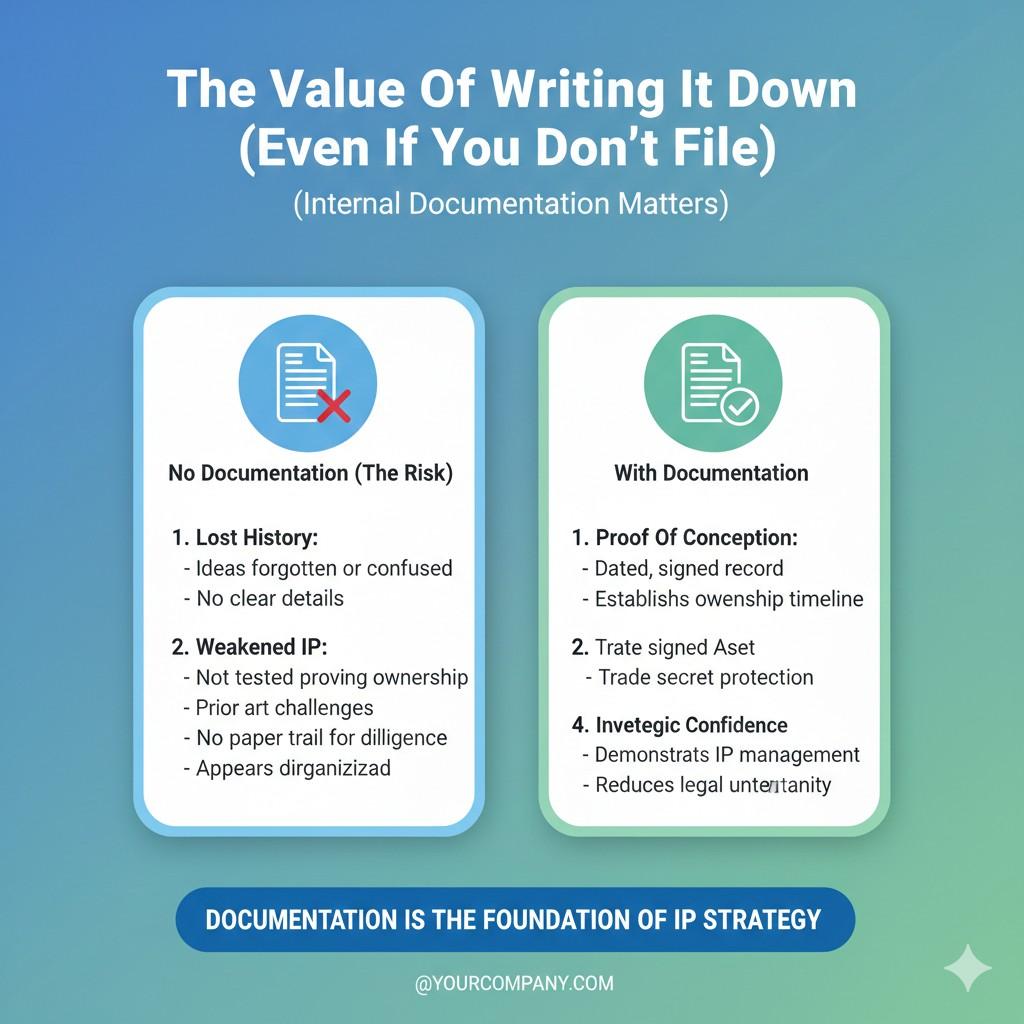
Some founders only want to write a disclosure if they plan to file a patent right away. That is a mistake. The act of writing it down is valuable even if you never file.
First, it creates an internal record of trade secrets. Second, it helps future hires understand why the system is built the way it is. Third, it helps you defend ownership if there is a dispute about who invented what. Fourth, it lets you build a pipeline of possible filings so you can choose the best ones when cash and timing align.
This is one reason Tran.vc invests in IP services instead of only cash. The work compounds. Each disclosure becomes a building block that can turn into a filing, a negotiation point, or a trust signal in due diligence.
If you want to build that pipeline with support, apply anytime: https://www.tran.vc/apply-now-form/
The core parts of a strong invention disclosure
Start with the problem in a way a stranger can grasp
A disclosure should begin with a problem statement that is concrete. Not “robust perception is hard.” Instead, “Our robot fails when lighting changes, because the camera feed causes false edges, and the model then misreads depth.” This kind of clarity helps the attorney understand what the invention is trying to fix.
A good problem statement is not long. It is focused. It also helps later, because patents often need to explain the problem and why prior solutions did not work well. When you capture that early, you save time.
Keep the language simple. Write as if the reader is smart but not living inside your codebase. The best disclosures read like a careful explanation, not like a research paper.
Describe the prior approach you replaced
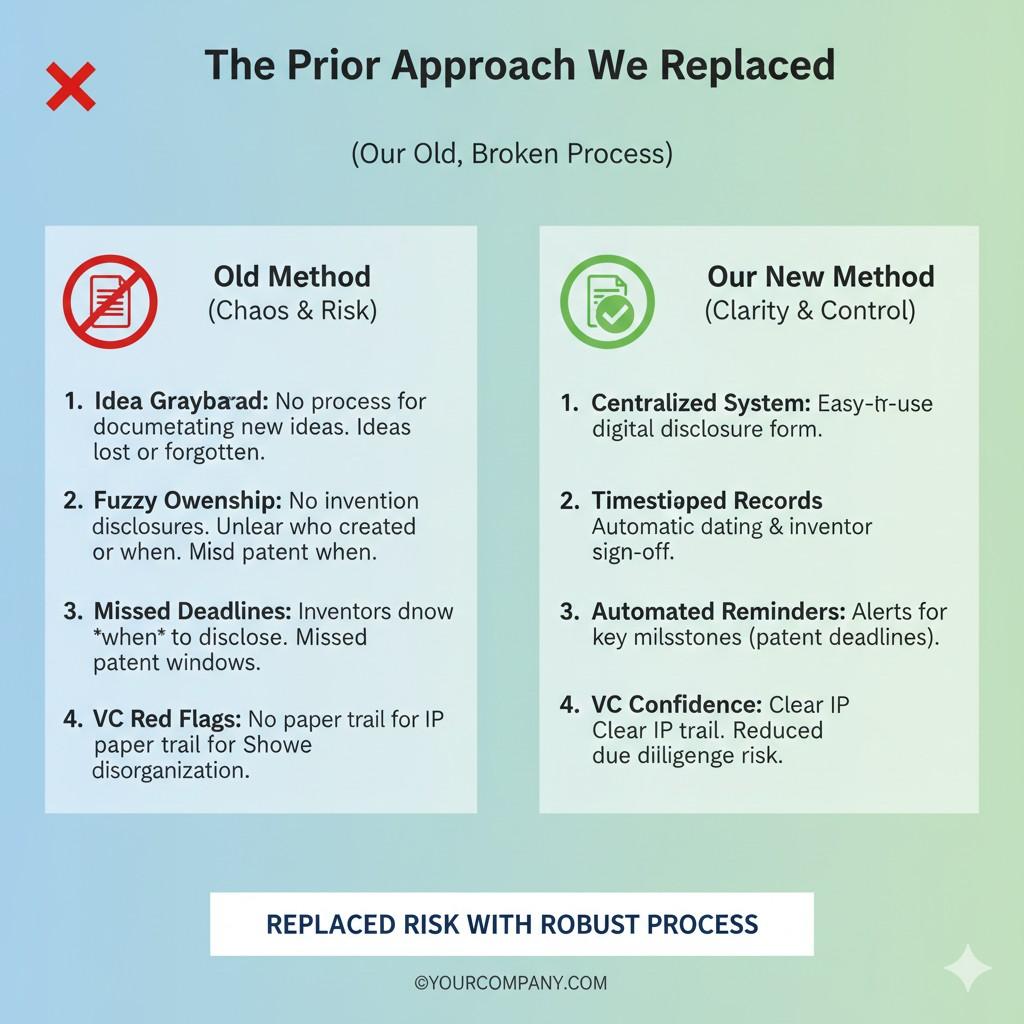
This part is often skipped, yet it is one of the most useful. Explain what you used to do, or what most people do, and why it fails in your case. This shows the gap between the old way and your new way.
It also helps you avoid weak claims. If you do not describe the prior approach, an attorney may assume the invention is broader than it is. Later, prior art can show up that forces you to narrow quickly. A strong disclosure makes the “before and after” clear from the start.
This does not need citations. It can be based on your experience. For example, “We tried a standard Kalman filter with this sensor setup, but drift grew over time due to this noise pattern.” That is useful.
Explain your solution as steps, not slogans
Now you describe the invention. The best way is usually a step-by-step explanation of what the system does. Avoid vague language like “we intelligently optimize.” Instead, write the exact flow.
If it is an AI method, describe data inputs, preprocessing, training steps, model structure at a high level, inference steps, and the output. If it is robotics, describe sensing, estimation, planning, control, and safety checks. If it is a platform, describe components, interfaces, and how the system behaves under load.
The goal is that someone could rebuild the method from your description, even if they are not on your team. That level of clarity is what gives a patent attorney the ability to draft strong claims and many variations.
Include variations and alternatives
Most founders describe only the “one best way” they built it. But patents get stronger when you include alternatives. If your method uses a camera, could it also work with LiDAR? If it uses a transformer, could it also use a smaller model? If it uses a certain threshold, what range works?
These variations matter because they widen your protection. They also help if you later change the product. Startups pivot. If your disclosure includes multiple versions, your patent plan can flex with you.
You do not need to test every variation. You can include reasonable options you believe would work. Just be clear about what is tested and what is a likely alternative.
Capture proof and timing without drama
You should include simple proof that the invention exists. This can be a link to a repo, a screenshot, a diagram, a test result, or a short clip. You should also note the date you first built it and the names of the inventors.
This is not about turning your disclosure into a legal battle. It is about good records. Clean records save pain later. They also help your attorneys ask the right questions about who contributed what.
In many cases, teams find inventorship confusing. A disclosure helps because it forces the team to discuss contributions while the work is fresh. That reduces conflict later.
If you want Tran.vc’s help building a disclosure template that captures these parts the right way, apply here: https://www.tran.vc/apply-now-form/
How to run invention disclosures without slowing the team
Make it a habit tied to real build moments
The best process is attached to moments that already happen. For example, after a sprint ends, or after a milestone demo, or after a key performance jump. You do not want a random “IP meeting” that feels separate from product work.
When the habit is tied to a real build moment, the disclosure feels like part of shipping. It becomes a short reflection: what did we invent this cycle that is worth saving? This also helps the company stay honest. If nothing new happened, then no disclosure is needed.
If the team is early and small, even a simple monthly rhythm can work, as long as the owner keeps it gentle and consistent.
Keep the writing lightweight and protected
Engineers hate busywork. The trick is to make the writing short and safe. Short means the template is clear and the time box is real. Safe means the disclosure is internal and stored in a secure place with limited access.
This safety matters because teams often avoid writing details out of fear that it will leak. Make it clear: disclosures are confidential. They are not shared outside the company unless under a proper agreement and as part of a planned filing strategy.
When the team trusts the system, they write better disclosures. Better disclosures lead to stronger patents. Stronger patents lead to more leverage when fundraising and partnering.
Review quickly, then decide a next step
A disclosure without a next step becomes dead weight. The review does not need to be slow. It should be a quick pass: is this core, is it new, and does it support our business?
After review, the company should tag the disclosure with a clear status. Some disclosures become “file soon.” Some become “watch and collect more data.” Some become “trade secret.” Some become “not core.” The point is clarity.
This is where experienced IP support matters. Many founders do not know what is worth filing. Tran.vc can help you make these calls early and avoid wasting money on weak filings. We also help you avoid missing the big inventions that deserve protection.
Apply anytime if you want that support: https://www.tran.vc/apply-now-form/