
AI moves fast. A model that feels new today can feel old in six months. That speed creates a quiet problem for founders: you can build something great, but you can also lose it fast if you do not protect it the right way.
This is where the choice becomes real.
Do you file patents, so you can stop copycats and show investors you own what you built?
Or do you keep your work as a trade secret, so no one sees how it works, and you stay ahead by staying silent?
There is no one “best” answer. The right move depends on what you built, how it can be copied, how you plan to sell, and how long you can keep the edge.
This article will help you make that choice with clear, simple thinking. We will look at what counts as an AI patent, what counts as a trade secret, and how each path helps or hurts you in real life. We will also talk about the biggest mistakes founders make, like filing too late, sharing too much, or keeping “secrets” that are not really protected at all.
And if you want help turning your AI work into real assets, Tran.vc can support you with up to $50,000 in in-kind patent and IP services so you can build a moat early—before you raise your seed round. You can apply anytime here: https://www.tran.vc/apply-now-form/
AI Patents vs Trade Secrets: How to Choose the Right Path
Why this choice matters more in AI than in most fields
In AI, the gap between “we built it first” and “everyone else has it too” can be very small. A clever feature can be copied by a competitor who looks at your product, reads your docs, or hires someone who worked on a similar system. Even if they do not copy your exact code, they may copy the result.
That is why protection matters early, even if you are still finding product-market fit. You are not protecting “the whole company.” You are protecting the few pieces that make you different, harder to copy, and easier to trust.
This choice also shapes your next steps. If you plan to sell to large companies, you may face security reviews, vendor checks, and IP questions. If you plan to raise money, investors may ask what you own, what you filed, and what can stop a big player from doing the same thing.
Tran.vc exists for this exact moment. If you are building in AI, robotics, or deep tech, they invest up to $50,000 in in-kind patent and IP services to help you build real leverage early. You can apply anytime here: https://www.tran.vc/apply-now-form/
What you should get from this guide
You should finish this guide with a clear way to decide what to patent, what to keep secret, and what to simply move fast on. You should also know how to avoid common traps, like filing a patent that is too broad to survive, or calling something a “trade secret” while leaving it exposed.
Most of all, you should walk away with a plan you can use this week. Not theory. Not big words. Just steps you can take while you build.
The two paths in plain words
What an AI patent really is
A patent is a legal right that lets you stop others from using your invention, even if they built it on their own. It is not just about stopping direct copying. The power is that it can block “independent” work that still lands on the same invention.
In simple terms, a patent can turn your idea into a fence. It does not stop every kind of competition, but it can stop the kind that hurts most: a better funded team building the same thing and selling it with more reach.
In AI, patents often cover how a system works, not just what it does. That may include the way you train a model, the way you compress it, the way you improve accuracy under tight limits, or the way you make outputs safer and more reliable.
A strong patent is specific enough to be real, but broad enough to matter. It is a balance. Too vague and it gets rejected or breaks later. Too narrow and it can be avoided with small changes.
What a trade secret really is
A trade secret is something valuable that you keep secret on purpose. It can be code, a data pipeline, a training recipe, a prompt system, a way you label data, a way you monitor drift, or a pricing method that gives you an edge.
The key is that it must stay secret, and you must act like it is secret. If it leaks, and it is not protected by strong controls, it can be hard to claim it was truly a trade secret in the first place.
A trade secret can last forever, at least in theory. It does not have an end date like a patent. But it can die in one day if a contractor posts something, a team member walks out with a notebook, or your product reveals too much about how it works.
With AI, this risk is real. Many AI systems can be studied from the outside. People can test them, probe them, and sometimes infer how they behave. If your advantage can be figured out by watching outputs, it is harder to keep it secret for long.
The big difference in one clear idea
Patents are about sharing details with the public in exchange for a time-limited right to stop others.
Trade secrets are about keeping details private to keep the edge, with no guaranteed right to stop others if they figure it out on their own.
Both paths can work. But each path asks you to play a different game.
AI patents: the good, the bad, and the real-world use
What patents are best at in AI
Patents are strongest when your advantage is a method that is hard to invent twice in the same way. For example, if you created a unique approach that cuts model cost by 40% without losing accuracy, that may be worth patenting. If you found a way to train with less data and still hit the same results, that can be worth protecting too.
Patents also help when your product will be visible. If customers can see your workflow, or if your API behavior reveals your special approach, secrecy becomes fragile. A patent can protect you even when the market can observe what you built.
Patents can also support partnerships. Large companies often like clarity. They want to know you own what you claim. When you can point to filed patents and a clean IP story, it can lower fear during deals.
In fundraising, patents do not replace traction, but they can change the tone of a conversation. They can make your story feel less like “we are early” and more like “we have a real asset.”
The cost you pay when you patent
The biggest cost is disclosure. A patent application explains your invention. That disclosure can help others learn. Even if they cannot legally use it during the patent term, they can study it, learn from it, and plan around it.
There is also cost in time and focus. Filing well is not a quick form. If you do it right, you need to capture the core idea, the variations, the edge cases, and the real technical insight. Many founders rush this and end up with a weak filing that looks impressive but does not hold up.
Another cost is that patents are not instant shields. Enforcement can be slow and expensive. A patent is strongest when it helps you deter, negotiate, license, or block. It is not always about going to court.
The best founders treat patents like leverage. Something that makes others think twice, and gives you options when you need them.
What makes an AI patent strong instead of “paper only”
A strong AI patent is not “we used AI to do X.” That kind of claim often fails because it sounds like a result, not an invention. A strong patent explains a clear method. It shows the steps, the parts, and why the method is different.
It also includes variations. Competitors do not copy you exactly. They copy the concept and adjust. A good patent anticipates those small changes and still covers them.
It also ties to a business reality. The best patents protect what matters in your product, not a random idea from a demo. If the invention is not tied to your roadmap, you may pay to protect something you never use.
This is why good strategy matters before filing. If you want Tran.vc to help you build this foundation early, you can apply anytime here: https://www.tran.vc/apply-now-form/
Trade secrets in AI: where they shine and where they break
Why trade secrets can be perfect for some AI teams
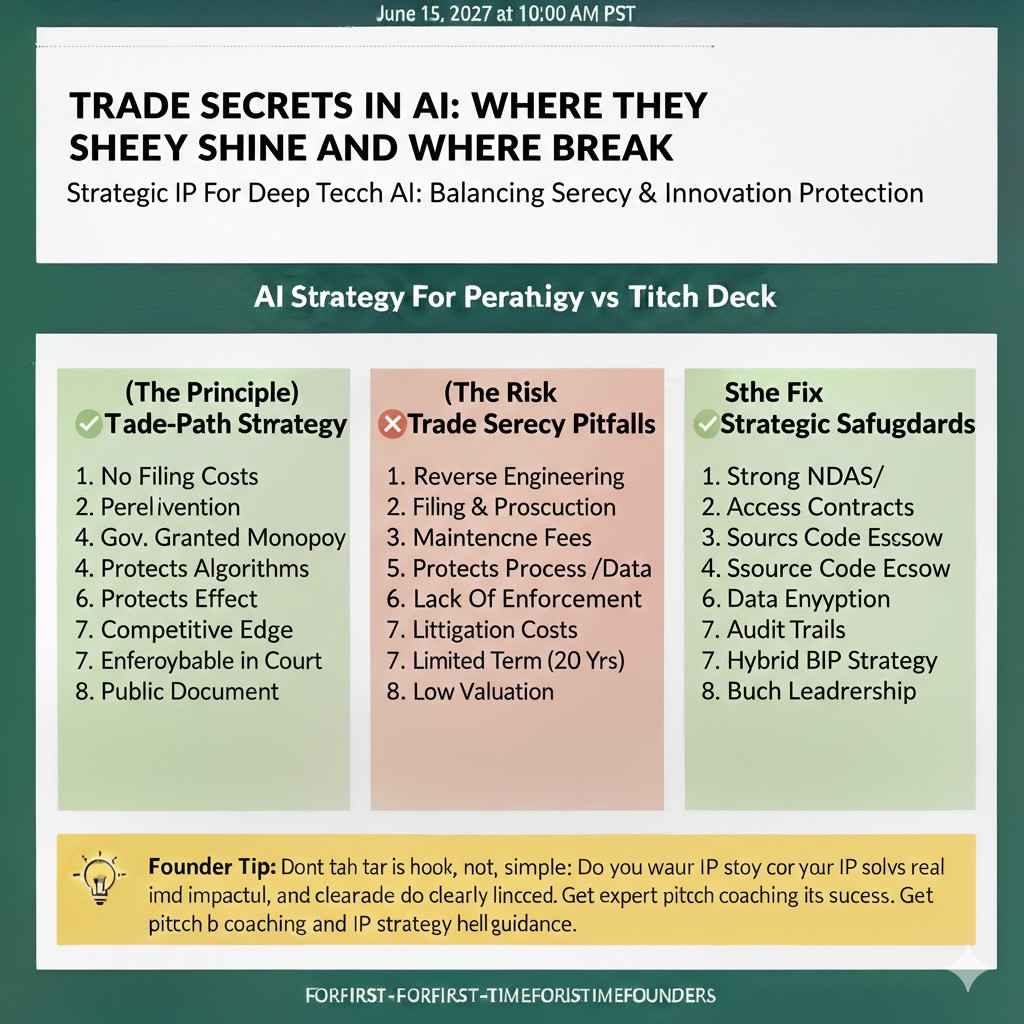
Trade secrets can be ideal when your advantage is a “recipe” that is hard to see from the outside. If your edge lives in internal tooling, internal data, and internal processes, secrecy can be powerful.
For example, your data labeling method might be the true magic. Or your way of mixing synthetic and real data might be the edge. Or your “human in the loop” workflow may be the thing that makes accuracy stable in the real world.
In many AI businesses, the winning factor is not the model alone. It is the full system. That system may include data intake, cleaning, training loops, feedback signals, monitoring, and post-processing. Many of these parts can be kept private.
Trade secrets also avoid the disclosure cost of patents. You do not have to explain anything to the public. You can keep improving quietly, which matters in a space where iteration speed is everything.
The hidden weakness most founders ignore
A trade secret is only as strong as your controls. If your team shares code in the wrong place, if you do not have strong contracts, or if you do not limit access, your “secret” may not be defensible later.
Also, trade secrets do not stop independent discovery. If a competitor figures out the same method, you cannot block them just because you did it first. With AI, that can happen more often than founders expect, especially in popular problem areas where many teams are exploring similar paths.
There is also the risk that your own product leaks the secret. If your outputs are so unique that they reveal the process, or if customers get access to parts of your system, secrecy can become a weak plan.
What “acting like it is a secret” actually means
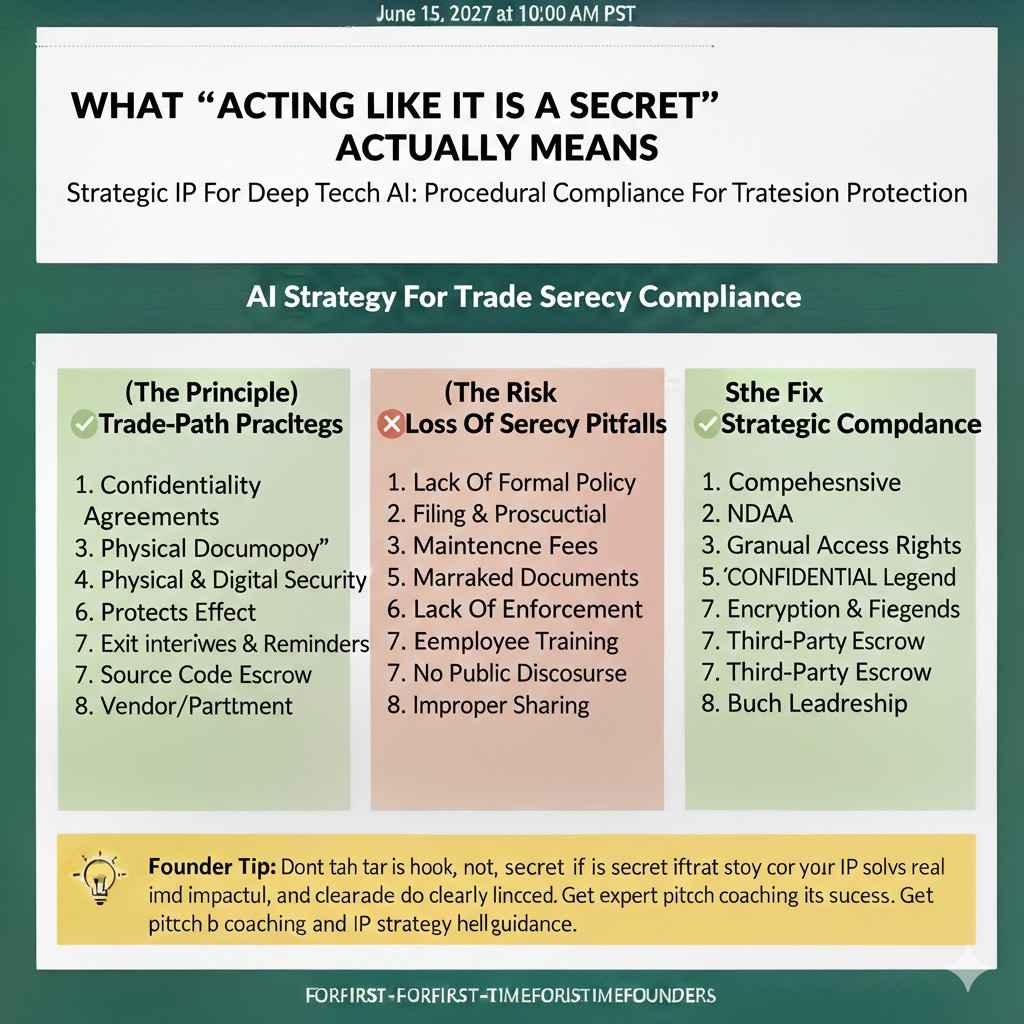
It means you track where the key knowledge lives. You control who can access it. You keep detailed records of what was created, when it was created, and who worked on it. You use strong agreements with employees, advisors, and contractors. You avoid casual sharing in public channels.
It also means you build systems that limit leakage. If your model weights are the secret, you do not ship them to customer devices without strong protection. If your prompts are the secret, you do not expose them through client-side code. If your training data is the secret, you do not allow it to leave your secure environment.
Trade secrets are not “we did not tell anyone.” They are “we protected it like it matters.” That difference is huge.
How to choose: a practical way to decide without guessing
Start with one simple question: can someone copy this by watching the product?
If a competitor can learn your method by using your tool, reading your docs, or testing your API, secrecy is fragile. In that case, patents may be the safer path, because you cannot hide what the market can observe.
If your advantage is buried inside your internal workflow, and customers never see it, trade secrets may be a better fit. You can keep the recipe private and keep improving.
This question sounds basic, but it saves founders from a common mistake: trying to keep something secret that cannot stay secret.
Ask the second question: will you still use this core method in 2 to 3 years?
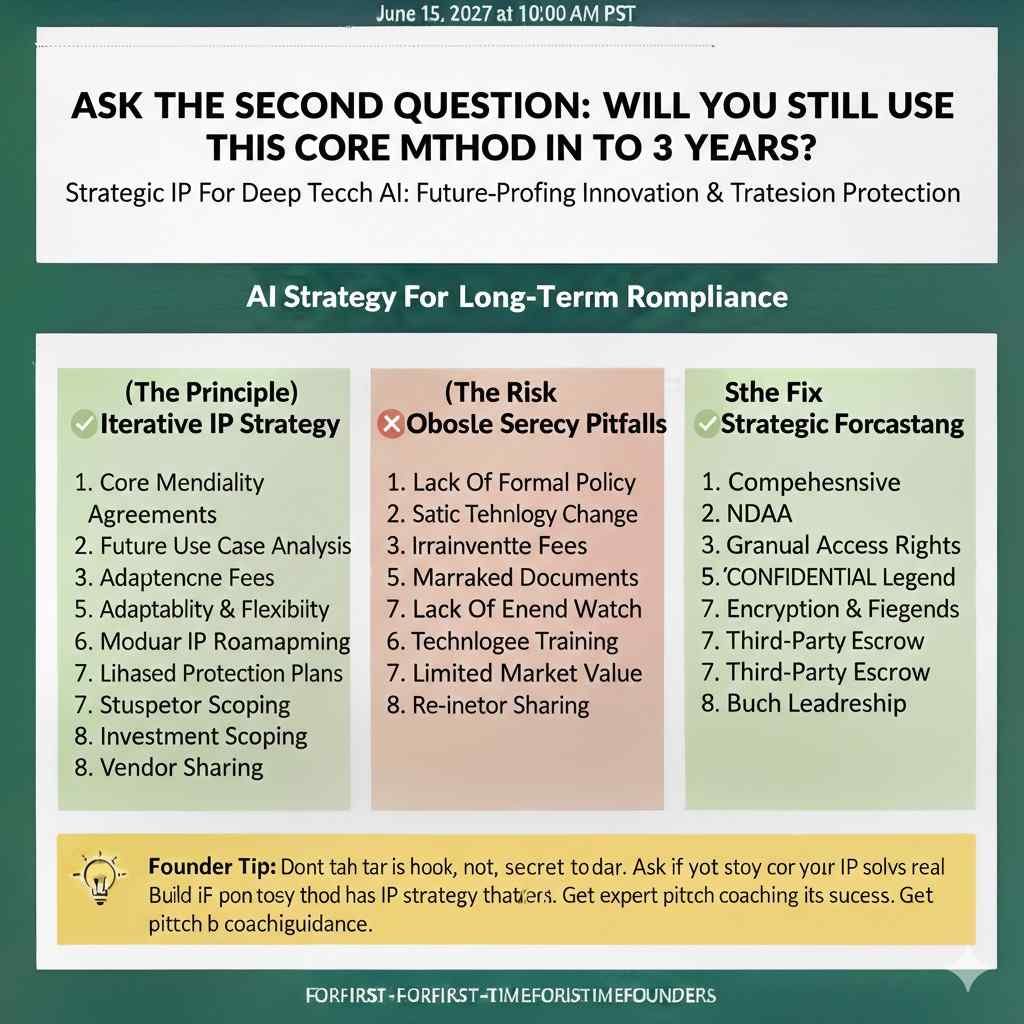
Patents take time and money. If the core method is something you will replace soon, it may not be worth filing. But if the method is a core piece of your system that will stay central as you scale, patents can make sense.
Trade secrets work well when you plan to change often. If you will keep evolving the recipe, secrecy lets you move without locking yourself into one “official” method in a public filing.
This does not mean patents block iteration. You can file improvements. But you should be honest about what is stable in your product and what is not.
Ask the third question: is your advantage a method, or is it access?
Sometimes the advantage is not a method at all. It is access to data, access to distribution, or access to a unique user group. In those cases, neither patents nor trade secrets are the main moat. Your main moat is relationships, data rights, and execution speed.
But if your advantage is truly technical, like a system-level method that delivers better results at lower cost, then patents or trade secrets become much more important.
Many founders waste time trying to patent what is really “access.” A good IP strategy separates the two early.
AI Patents vs Trade Secrets: How to Choose the Right Path
Patents and trade secrets show up in different startup moments
Most founders try to make this choice in a vacuum. They sit with the idea and ask, “Which one is better?” That question sounds fair, but it often leads to the wrong answer.
A better way is to ask, “When will this matter in my company’s life?” Because patents and trade secrets help in different moments, and they fail in different moments too.
If you sell to enterprises, your moment might be security review and vendor onboarding. If you are building developer tools, your moment might be copycat products and fast followers. If you plan to raise a priced seed round, your moment might be diligence when investors ask what you own.
When you map protection to moments, the decision becomes less emotional and more practical.
One more key idea before we go deeper
This is not always an either-or choice. Many strong companies use both. They patent a few core methods that could be copied from the outside, and they keep the “how we run it” parts secret.
But you cannot do both on the same exact piece in the same exact way. Once you disclose a method publicly, it is hard to claim it as a secret later. And once you rely on secrecy, you must be careful about what you publish, demo, or open-source.
If you want a team that helps you plan this early and avoid costly missteps, Tran.vc can support founders with up to $50,000 in in-kind patent and IP services. You can apply anytime here: https://www.tran.vc/apply-now-form/
How AI patents and trade secrets behave in the real world
Fundraising: what investors actually look for
Early investors do not fund patents alone. They fund teams, markets, and traction. But they do pay close attention to defensibility, especially in AI where many products can look similar on the surface.
A patent strategy, even at the provisional stage, can signal that you have identified what is truly novel in your system. It tells investors you are not just stitching tools together. It also gives them a story for why a larger company cannot simply copy your approach and outspend you.
Trade secrets can also support fundraising, but only if you can explain them in a way that feels credible. Investors have seen founders call basic code a “trade secret” when it is really just private GitHub repos. That does not land well.
To make trade secrets credible, you need to show that the secret is real, that it is hard to reverse, and that you have controls to keep it protected. When you can explain that clearly, it can be just as strong as a patent story.
The difference is how easy it is to prove. Patents are visible signals. Trade secrets are invisible until you explain them, and the explanation must feel grounded.
Enterprise sales: why big customers care about your IP
When you sell to large companies, they often worry about two things at once. First, they do not want to buy a product that will disappear because a competitor can copy it. Second, they do not want to buy something that will pull them into IP trouble later.
Patents can help with both. They can show you own the invention, and they can reduce the fear that you are infringing someone else because you have done thoughtful work around novelty and claims.
Trade secrets matter too, but in a different way. Some customers want to know you are not handing out your model weights or key methods to every client. They want to feel that your system is controlled, stable, and managed like a real piece of infrastructure.
Here is the tension many founders miss. Enterprises can push for transparency, like model cards, safety docs, and audit logs. That is normal. But transparency is not the same as disclosure of your crown jewels.
A good trade secret approach lets you share what customers need to trust you, while keeping the recipe private.